
Are You a Sheep or a Citizen? A Survival Guide for the Coming Crisis
Introduction: The Farmer Never Loses
The first fundamental thing to understand is that sheep will never be able to beat the farmer. The farmer has physical protections from gates to doors to locks and distance in terms of the farmhouse to the field. In addition, the farmer has guns to enforce his power so the sheep will never be able to beat the farmer. Some sheep would not survive without the farmer. Without the farmer, there may not be enough food or water during a cold winter. Some sheep may escape a field, but they are unlikely to be adopted by another farmer owning another field, and the sheep is more likely to run free for only a very short time on the roads and highways until they are eventually recaptured.
Our purpose in this planet is to work, consume and breed. The need for us to work is reducing quickly. What is left is consumption and reproduction. Some want less reproduction! 🤔😱
People need to understand the purpose of human sheep. Human sheep have three purposes: working, consuming, and breeding. Currently human sheep are needed to work, but this is slowly no longer the case. Human sheep are really there for consumption as much as possible, and that is why breeding is important: to create more consumers, no longer to create more workers. In Western societies the birth rate does not even present the opportunity for a country to maintain its population. Western countries are dying without replenishment of immigration, and immigrants tend to breed faster than current Western country populations. The main purpose of human sheep is really to consume to enrich The elite. The elite are protected and as farmers of human sheep will never be overthrown, and the human sheep cannot escape for very long if at all.
If this is true, and assume it is, what should humans in Western countries be doing today to protect themselves and thrive or at least survive?
What Is the Fourth Turning and Why Does It Matter Now?
The Fourth Turning is a generational cycle theory that explains why Western societies are now entering a period of intense upheaval and transformation. William Strauss and Neil Howe’s 1997 book argues that Anglo-American history moves in repeating cycles lasting roughly 80 to 100 years, each composed of four “turnings”: a High, an Awakening, an Unravelling, and a Crisis. The Fourth Turning—the Crisis—is when “society passes through a great and perilous gate in history,” and the old order is destroyed.
Strauss and Howe made a specific prediction about the timing of this crisis. They wrote:
“If the Crisis catalyst comes on schedule, around the year 2005, then the climax will be due around 2020, the resolution around 2026.”
Neil Howe’s 2023 follow-up, The Fourth Turning Is Here, extended the timeline, suggesting the current era of instability may stretch into the early 2030s. The authors warned that such periods have historically involved “war, disease, political instability or economic collapse,” and that societies have been “wiped off the map, ground into submission, or beaten so badly they revert to barbarism.”
The Fourth Turning framework is directly relevant to the freedom crisis in the UK today. During a Fourth Turning, institutions become rigid, trust collapses, and the state expands its power to maintain control. This is exactly what we are seeing: the criminalisation of speech, the weaponisation of hate crime laws, and the demographic transformation of Western nations.
How Is Free Speech Being Criminalised in the UK?
Free speech is being criminalised in the UK through an expanding web of legislation that prioritises “protection from offence” over individual liberty. Unlike the United States, Britain lacks a First Amendment equivalent, relying instead on the Human Rights Act 1998 and the European Convention on Human Rights. Article 10 of the Human Rights Act theoretically guarantees free expression, but these protections are systematically undermined by draconian laws.
What Laws Are Being Used to Prosecute Speech?
The Communications Act of 2003 criminalises online speech deemed “grossly offensive” or “of an indecent, obscene, or menacing character.” The vagueness of “grossly offensive” gives police and prosecutors near-unlimited discretion.
The Malicious Communications Act of 1988 targets communications intended to cause “distress or anxiety,” and has been used to prosecute offensive memes and critical comments about public figures.
The Online Safety Act of 2023, fully enforced by March 2025, mandates that social media platforms remove “legal but harmful” content or face fines up to £18 million or 10% of their annual revenue.
The Hate Crime and Public Order (Scotland) Act of 2024 criminalises speech that “stirs up hatred” against protected groups, even without intent to cause harm.
What Are the Statistics on Speech Prosecutions?
- British police are arresting at least 12,000 people annually for “hate speech” under these laws—over 30 every day.
- Since the Online Safety Act came into force, nearly 300 people have been charged with “speech crimes,” with 67 convicted and sentences ranging from weeks to years in prison.
- 62,000 people have been arrested for “speech offences” over the last five years, including for social media posts.
- In England and Wales, police recorded 140,561 hate crimes in the year to March 2024, of which 98,799 were race hate crimes—around 70% of the total.
- The UK’s score on Freedom House’s internet freedom index declined from 5 to 4 due to “the proliferation of criminal charges, arrests, and convictions concerning online speech.”
What Are the Real-World Consequences?
Consider Lee Joseph Dunn, a 51-year-old man jailed for eight weeks in August 2024 for posting three memes on Facebook. Lucy Connolly, a mother, was sentenced to 31 months in 2024 for a tweet posted after the Southport murders—a tweet she deleted within hours. Her appeal for early release was denied in May 2025. Dimitrie Stoica was locked up for three months for a TikTok livestream where he jokingly claimed to be “running for his life” from rioters.
These are not hardened criminals. They are ordinary people, punished for words, not actions.
What Is Happening to Western Demographics?
Western demographics are undergoing a fundamental transformation that threatens the survival of native populations and the cultural continuity of Western nations. The birth rates in Western countries have collapsed far below replacement level, and the gap is being filled by mass immigration.
What Are the Birth Rate Statistics?
- The total fertility rate in England and Wales fell to 1.39 children per woman in 2025, the lowest level on record and far below the replacement rate of 2.1.
- Births in England and Wales fell for the fourth year in a row to 585,000 live births in 2025—the lowest figure since 1977.
- Across the OECD’s 38 member countries, 37 have fertility rates below replacement level, averaging just 1.5 children per woman—down from 3.3 in the 1960s.
- Italy’s fertility rate fell to 1.14 in 2025, the lowest since unification in 1861, with only 355,000 births against over 650,000 deaths.
- In 2025, 40.2% of all births in England and Wales had at least one foreign-born parent, up from 30.1% seventeen years earlier.
What Is the Role of Immigration?
- Net migration to the UK stood at 171,000 in 2025, down from a peak of 944,000 in 2023.
- Approximately one in five people in the UK are foreign-born according to Migration Observatory data.
- In France, 800,000 immigrants make up 11.6% of the population, with nearly half from Africa. Native French families average 1.76 children while North African Muslim immigrant families average 3.12 children.
The demographic crisis creates a vicious cycle. Native populations are not reproducing at replacement level, so governments import immigrants to maintain the labour market and tax base. This increases demand on public services and welfare, native taxpayers grow resentful, right-wing populism rises, political instability increases, and young people become even less willing to have children. This is not a sustainable model—it is a slow replacement of the native population.
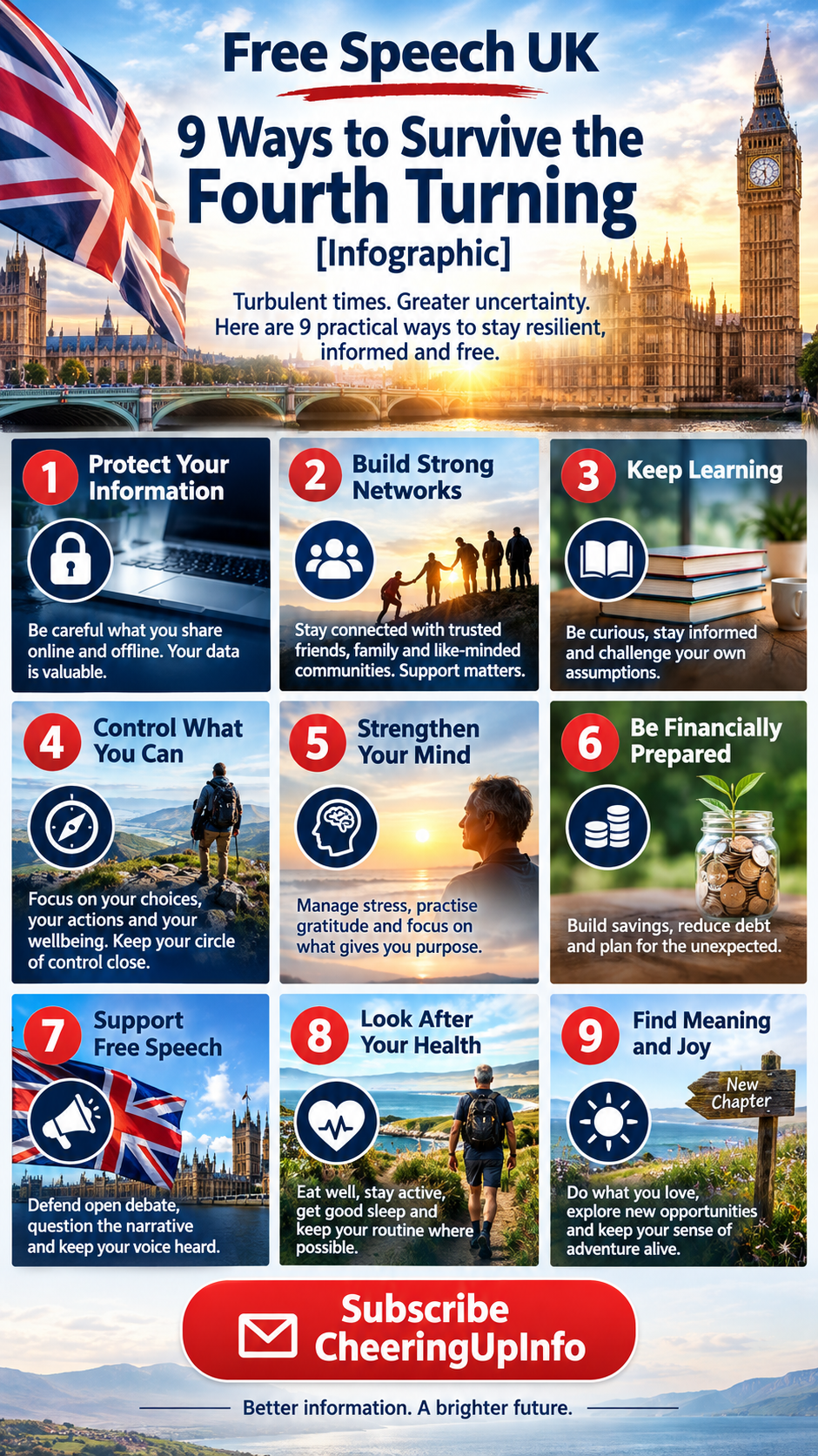
Nine Things You Should Be Doing Today
- How Can You Protect Your Free Speech Rights?
You can protect your free speech rights by understanding the legal landscape and taking practical steps to minimise your exposure to prosecution. The UK does not have a First Amendment, so you must be your own legal guardian.
Practical steps:
- Know the laws. Familiarise yourself with the Communications Act 2003, the Malicious Communications Act 1988, and the Online Safety Act 2023. Understand that “grossly offensive” is a vague standard that can be applied to almost anything.
- Use encrypted platforms. Move sensitive conversations to end-to-end encrypted messaging services like Signal. Avoid posting controversial opinions on public social media platforms where they can be scraped and reported.
- Be aware of the “non-crime hate incident” system. Since 2014, over 250,000 non-crime hate incidents have been recorded by UK police—these are not crimes, but they are logged and can affect your record.
- Support free speech organisations. Groups like the Free Speech Union and the Future of Free Speech project are fighting these laws in court and in parliament.
- Vote for candidates who will repeal these laws. The Online Safety Act, the Hate Crime and Public Order (Scotland) Act, and the “grossly offensive” provisions of the Communications Act must be repealed. This should be a single-issue voting priority.
- How Can You Achieve Financial Independence from the System?
You can achieve financial independence from the system by reducing your dependence on government-controlled employment, currency, and welfare systems. As human sheep are increasingly no longer needed for work, the system’s primary purpose becomes consumption—and you must resist being defined purely as a consumer.
Practical steps:
- Build an emergency fund. Aim for at least six months of expenses in physical cash and/or non-digital assets. The Fourth Turning authors warn of “economic collapse” as a potential crisis outcome.
- Invest in tangible assets. Precious metals, land, and productive assets are more resilient than digital currency and stocks during periods of instability.
- Develop multiple income streams. Do not rely on a single employer. The gig economy, freelancing, and small business ownership provide more resilience than a single job.
- Learn practical skills. Food preservation, basic repair, gardening, and first aid are valuable in any crisis.
- Reduce debt. Debt is a form of control. Pay off credit cards and loans before the economy tightens further.
- How Can You Become Self-Reliant for Food and Water?
You can become self-reliant for food and water by building local systems that do not depend on just-in-time supply chains. During the Fourth Turning, disruptions to food distribution and utilities are likely.
Practical steps:
- Grow your own food. Even a small garden or allotment can supplement your diet. Learn to grow high-calorie crops like potatoes, carrots, and beans.
- Store non-perishable food. Aim for at least three months of food storage—rice, pasta, tinned goods, and dried goods.
- Secure water access. Invest in water filtration systems (e.g., Berkey filters), water storage containers, and a rain collection system.
- Learn food preservation. Canning, fermenting, dehydrating, and smoking are skills that were common a century ago and will be valuable again.
- Build community food networks. Share seeds, tools, and knowledge with neighbours. Local food resilience is stronger than individual resilience.
- How Can You Prepare for the Coming Crisis Economically?
You can prepare for the coming crisis economically by understanding that the Fourth Turning is a period of wealth destruction and transfer. Strauss and Howe’s cycle theory suggests that the Crisis phase is when “the old order is destroyed” and a “new order emerges.” You must position yourself to survive the destruction and benefit from the rebuilding.
Practical steps:
- Hold physical cash. Digital banking systems can be frozen, and bank runs are a historical reality during crises. Keep enough cash on hand for several weeks of essentials.
- Invest in skills, not just assets. Skills cannot be confiscated or devalued. Plumbing, electrical work, carpentry, and mechanical repair are always in demand.
- Consider geographic diversification. If you have the means, consider having a secondary location or a network in a more stable region.
- Avoid speculative investments. During the Unravelling phase that preceded this Crisis, asset bubbles inflated. They will deflate during the Crisis. Do not chase high-risk returns.
- Build barter networks. Establish relationships with people who have complementary skills and resources. Barter systems emerge when currency systems fail.
- How Can You Build Community Resilience?
You can build community resilience by creating local networks of trust that can function independently of state institutions. The Fourth Turning is a period when “institutions become distrusted” and “individualism is strong.” But individualism alone is not enough to survive a Crisis—community is essential.
Practical steps:
- Join or form a local mutual aid group. These are networks where neighbours help each other with food, childcare, repairs, and security.
- Build relationships with your neighbours. Know who lives around you, what skills they have, and what needs they have. Trust is built before the crisis, not during it.
- Participate in local governance. Attend parish council meetings, school boards, and community organisations. These are the levels of governance where you can still have influence.
- Create a skills-sharing network. If you are good at repair work, offer to fix things for free in exchange for gardening help or childcare.
- Develop local security arrangements. In a crisis, police response times may be slow or non-existent. Neighbours watching out for each other are more effective than waiting for the state.
- How Can You Protect Your Family and Children?
You can protect your family and children by prioritising their physical safety, education, and moral formation over the state’s priorities. The system sees your children as future consumers and workers. You must see them as your legacy.
Practical steps:
- Home education or supplementary education. If the state school system is teaching your children values that contradict your own, consider supplementing their education at home or joining a home education network.
- Teach practical skills. Children should learn cooking, cleaning, basic repair, and financial literacy—skills that the state school system often neglects.
- Limit screen time and social media. The Online Safety Act is not protecting your children—it is normalising state surveillance of speech. Teach them to think critically about what they consume and post online.
- Build family traditions and rituals. In a Crisis, strong family bonds are a source of stability. Regular family meals, celebrations, and shared activities matter more than ever.
- Create a family emergency plan. Everyone should know what to do if there is a power outage, a food shortage, or a civil disturbance.
- How Can You Resist the Consumer Identity?
You can resist the consumer identity by consciously rejecting the system’s primary purpose for you: consumption. As the user’s analysis notes, “the main purpose of human sheep is really to consume to enrich The elite.” Your value as a human being is not measured by what you buy.
Practical steps:
- Adopt a minimalist lifestyle. Buy less, repair more, and borrow or share when possible.
- Boycott companies that support censorship. The Online Safety Act was supported by many large tech companies. Choose platforms and services that respect free speech.
- Support independent businesses. Local shops, farmers’ markets, and independent traders are more accountable to their communities than global corporations.
- Reduce subscription services. The subscription economy is designed to extract recurring revenue from you. Cancel what you do not need.
- Question advertising and marketing. Every advertisement is a message telling you that you are incomplete without a product. You are not.
- How Can You Prepare for Technological Control?
You can prepare for technological control by understanding that the same digital infrastructure that enables convenience also enables surveillance and control. The Online Safety Act is the most recent example, but the trend is clear: the state wants to monitor and regulate what you say, read, and think.
Practical steps:
- Use privacy-focused tools. Switch to a privacy-respecting browser (e.g., Brave, Firefox with privacy extensions), use a VPN, and avoid smart home devices that record everything.
- Own your own data. Use local storage for important documents, back up regularly, and avoid relying entirely on cloud services.
- Learn to communicate offline. If digital communication is compromised, you need other ways to coordinate with your community. Face-to-face meetings, written notes, and shortwave radio are options.
- Be aware of facial recognition and CCTV. The UK has one of the highest densities of CCTV cameras in the world. Know where they are and avoid areas where you might be identified for peaceful activities.
- Teach others. Digital literacy and privacy awareness are skills that everyone in your community needs.
- How Can You Prepare Psychologically and Spiritually?
You can prepare psychologically and spiritually by understanding that the Fourth Turning is not the end—it is a transition. Strauss and Howe’s theory ultimately suggests a cycle of renewal, in which periods of crisis are “eventually followed by reconstruction and renewed social cohesion.” Your mindset will determine whether you survive and thrive.
Practical steps:
- Develop stoic resilience. The Stoic philosophers taught that you cannot control external events, but you can control your response to them. Practise gratitude for what you have, and accept what you cannot change.
- Build a support network. Isolation is deadly during a crisis. Cultivate deep friendships and family bonds that can sustain you through difficulty.
- Maintain physical health. Exercise, proper nutrition, and adequate sleep are not luxuries—they are foundations for resilience.
- Study history. The Fourth Turning is not the first crisis Western civilisation has faced, and it will not be the last. Learning from past crises provides perspective and hope.
- Have a purpose beyond survival. The elite want you to be a consumer sheep. You are a human being with agency, creativity, and dignity. Live accordingly.
Conclusion: The Farmer Never Loses—But You Can Refuse to Be a Sheep
The farmer will never be beaten. The gates, the locks, the guns, the distance—all of it ensures that the sheep cannot overthrow the farmer. And many sheep would not survive without the farmer. Some might escape for a while, but they will not be adopted by another farmer, and they will run free only briefly before being recaptured on the roads and highways.
This is the reality of the Fourth Turning. The Crisis is here. The old order is being destroyed, and a new order is emerging. Whether that new order is one of freedom or one of total control depends on what ordinary people do now.
You cannot beat the farmer. But you can refuse to be a sheep. You can build a life that does not depend on the farmer’s protection. You can cultivate skills, community, and resilience. You can speak freely, even when it is dangerous. You can teach your children to think for themselves. You can resist the consumer identity and the surveillance state.
The farmer has the guns, the gates, and the locks. But the farmer needs the sheep to consume, to breed, and to believe that there is no alternative. If enough sheep stop believing, the farm becomes harder to run.
The Fourth Turning is a time of danger and opportunity. The old order is dying. What comes next is up to you.
Quotes to remember:
“History provides numerous examples of societies that have been wiped off the map, ground into submission, or beaten so badly they revert to barbarism.” — Strauss and Howe, The Fourth Turning
“If the Crisis catalyst comes on schedule, around the year 2005, then the climax will be due around 2020, the resolution around 2026.” — Strauss and Howe
“The right to freedom of expression is not a luxury. It is the foundation of every other freedom.” — Anonymous
#FreeSpeechUK #FourthTurning #SurvivalGuide
Free Speech UK: 9 Ways to Survive the Fourth Turning