Winning at the wrong game after 55? You are not alone—and you are not out of time. This guide unpacks UK data from the ONS, Centre for Ageing Better and the Pensions Commission, then sets out nine practical ways to leave behind inherited obligations and build an authentic final chapter. Includes a financial floor check, social circle rebuild, identity shift and a 30-day starter action. Read it, then act on one thing this month.
You Won the Game. So Why Does It Feel Wrong? (9 Fixes for Over 55s in the UK)
UK data + nine practical steps to stop playing by someone else’s rules and make your final chapter your best. From CheeringUpInfo Retirement Club.
Are You Winning at a Game You No Longer Want to Play?
CheeringupInfo Retirement Club recommends this article to explore solutions to the problem of being a good but not authentic you! You have spent decades being reliable, sensible, and doing what was expected. You have won at that game. But if the prize feels hollow—if the quiet voice inside says you are merely good at a life that no longer fits—the statistics suggest you are not alone, and more importantly, you are not out of time. The final chapter does not have to be a continuation of the same story; it can be a deliberate rewrite.
Is the Game You Are Winning Actually the One You Want to Play?
The game you are winning is actually the one you want to play only if the metrics you have chased—status, accumulation, obligation—still match your internal definition of a life well-lived; for many over 55, they no longer do. The UK labour market data reveals a structural pull toward continuing the old game long past the point of desire. The State Pension age is rising from 66 to 67 between 2026 and 2028, with a further rise to 68 legislated for 2044–2046 . This means the financial imperative to keep playing the career game is real and extending. However, the Centre for Ageing Better found that while 65–85% of HR leaders rate policies supporting older workers as important, the most widely implemented policy—equal access to development for remote workers—was in place in only 26% of organisations . You may be winning at work, but the workplace is not necessarily designed for you to thrive authentically in it. The question becomes whether the security of the known game is worth the cost of the unplayed one.
What Do the Numbers Say About How Much Time You Actually Have?
The numbers say you actually have more time than the cultural narrative of decline suggests, but that time is finite and statistically uneven. The Office for National Statistics reports that 69% of adults report high levels of hope for the future, a figure that has remained stable . Yet, loneliness data shows a more complex picture: 19% of adults aged 50 to 69 report feeling lonely often, always, or some of the time . This is lower than younger cohorts, but nearly one in five is still a significant minority experiencing isolation. Furthermore, the Second Pensions Commission Report highlights a stark financial divide: people who leave work in their 50s or early 60s frequently rely on working-age benefits, and poverty is more prevalent among 55–64-year-olds (19% in relative poverty after housing costs) than among pensioners (16%) . The time you have is real, but it is not equally resourced. Leaving the old game without a plan is a risk; leaving it with a deliberate redesign is a strategy.
What Do You Leave Behind When the Old Rules No Longer Serve You?
You leave behind the obligation to optimise for metrics that belong to a previous version of yourself—the title, the commute, the accumulation of things that no longer spark joy, and the quiet resentment of being good rather than true. The statistics on fuel poverty and housing reveal that clinging to the wrong infrastructure is not just emotionally draining; it is financially and physically dangerous. The Centre for Ageing Better reports that fewer than one in ten homes are accessible for older people with mobility issues, and much of the housing stock is dangerous or unsuitable . The 2026 fuel poverty projections show that while energy bills are projected to fall slightly, 26.5% of households are still expected to spend more than 10% of their income (after housing costs) on domestic energy . Holding onto a large, inefficient home because it is what you should do is a quantifiable burden. Leaving behind the expectation of keeping up appearances frees up both capital and cognitive space.
What Do You Incorporate to Make the Final Chapter Authentic?
You incorporate the things that the data shows are protective: intentional connection, purpose-driven activity, and an environment that supports your actual physical and psychological needs rather than your historical identity. The ONS data shows that older adults are less likely to report loneliness than younger cohorts, suggesting that the social landscape of later life can be richer if curated correctly . The Centre for Ageing Better’s work on Good Home Hubs demonstrates that practical, targeted support—like the Good Home Lincs pilot which supported 472 individuals to make their homes warmer and safer—has a tangible impact on wellbeing . Incorporating this kind of practical adaptation is not an admission of defeat; it is an optimisation for the life you actually want. It’s never too late to become something you haven’t been before. Believe in yourself in later life.
Are You Willing to Trade the Applause of the Crowd for the Approval of Your Own Reflection?
You are willing to trade the applause of the crowd for the approval of your own reflection only if you accept that the final chapter is not a denouement but a rewrite. The data points are clear: the pension age is rising, the workplace is slow to adapt, the housing stock is often unsuitable, and nearly one in five of your peers feels lonely . But the hope is also clear: the majority feel hopeful, and targeted, deliberate changes to your environment and your habits have measurable effects on wellbeing . The game you have been winning has given you resources, resilience, and experience. You do not have to burn the board. You simply have to stop playing by rules that were written for someone else. The final chapter is best when it is written by the person who has finally stopped being good and started being true.
You won the game. So why does the trophy feel like it belongs to someone else?
Here is the number nobody puts on a retirement card: the State Pension age hits 67 between 2026 and 2028. That means thousands of over-55s in the UK are being told to keep playing a game they quietly stopped wanting to win. And almost nobody is talking about it honestly.
Let me give you three data points and then nine ways out.
Point 1: Fewer than 13% of English homes meet all four basic accessibility standards. You may be “winning” in a house that is actively working against your knees.
Point 2: Roughly 1 in 5 adults aged 50–69 reports loneliness some or all of the time. The prize of a big house and a big title does not guarantee a full table.
Point 3: Fuel poverty is projected at 26.5% of UK households in 2026 — even after policy intervention. Clinging to infrastructure you cannot afford is not success. It is slow erosion.
Now the nine corrections (read them all — number 9 is the one people skip):
Audit what you are playing for — write it down. If the answer is “because I always have,” that is your signal.
Redefine winning with three measures of a good week that have nothing to do with status.
Downsize the infrastructure — the Good Home Lincs pilot supported 233 households with practical adaptations. Small, targeted change beats stubborn endurance.
Rebuild your circle around interests, not history — later life can be less lonely if you choose connection deliberately.
Separate identity from job title — practise a new answer to “What do you do?”
Grieve the old game — the version of you that won it is allowed to be mourned.
Set a financial floor, then stop optimising — know your minimum, then spend energy on time.
Start one deferred thing within 30 days — not “someday.” This month.
Find one witness — tell one trusted person what you are changing. Behaviour change without accountability fades by Friday.
Still here? Good — because point 9 is the one that makes points 1–8 survive past week two. Most people read this list, nod, and change nothing. The ones who comment “I’m doing number 9” are the ones who actually move.
Do this now: email editor@cheeringup.info with “RETIREMENT CLUB NEWSLETTER” in the subject line and we’ll send you the Retirement Club newsletter for free.
Winning at the Wrong Game After 55? 9 Ways to Correct Course in the UK
Why does testosterone drop in over 55s UK? Learn 9 natural ways for men & women to boost levels, backed by NHS and ONS stats. Not medical advice.
Testosterone isn’t just a male hormone—it matters for women too. After 55, levels decline in both sexes, affecting energy, mood, muscle, bones, and libido. In the UK, testosterone prescriptions have soared, yet CheeringUpInfo Retirement Club recommends natural, non-pharmaceutical solutions first. Discover why testosterone drops, who benefits most, and 9 evidence-based ways to boost it naturally for better health in later life. Includes UK government, NHS, and independent research stats. Information only—not medical advice.
CheeringupInfo Retirement Club recommends natural non pharmaceutical ways as the solution to the problem of low testosterone levels in the over 55s UK.
Testosterone is not just a “male hormone.” It is a vital hormone for both men and women, influencing energy, mood, muscle strength, bone density, and sexual function throughout life. For the over-55s in the UK, declining testosterone levels can quietly erode quality of life, yet pharmaceutical testosterone prescribing is rising rapidly—community dispensing in England jumped by 52% between 2020-21 and 2024-25, with the UK market valued at around $205 million in 2024 . The NHS spent £30.1 million on testosterone prescriptions for men in 2025 alone . Before turning to lifelong pharmaceutical interventions, CheeringupInfo Retirement Club recommends evidence-based natural strategies that address the root causes of declining testosterone.
Why Do Testosterone Levels Drop in Both Men and Women Over 55?
Testosterone levels drop in both men and women over 55 because of a combination of chronological ageing, hormonal shifts specific to each sex, and—crucially—accumulating lifestyle and metabolic factors that suppress natural production. In men, testosterone declines gradually from around age 30, but research from a UK study of 973 community-dwelling men found that approximately 25% of men over 40 experience low testosterone . By the time men reach their 50s, reference ranges shift downward: the normal range for men over 49 is 7.7–24.8 nmol/L, compared with 8.3–30.2 nmol/L for those aged 19–49 . For women, testosterone production from the ovaries and adrenal glands declines steadily through the reproductive years and drops more sharply after menopause—particularly following surgical menopause, when production decreases by more than 50% . However, a 2025 study published in Urology found that obesity, not ageing alone, was the most robust predictor of low testosterone in older men; the prevalence of low testosterone rose from 8% in men with a waist circumference ≤93 cm to 44% in those with ≥110 cm . This challenges the fatalistic view that low testosterone is simply an inevitable consequence of getting older.
Why Is Declining Testosterone a Problem for Older Adults in the UK?
Declining testosterone is a problem for older adults in the UK because it is linked to a cascade of physical and psychological consequences that reduce independence, increase NHS costs, and diminish quality of life. For men, testosterone deficiency can cause reduced libido, erectile dysfunction, fatigue, reduced energy, depressive symptoms, loss of muscle mass, increased visceral fat, and reduced bone density . For women, NHS Scotland guidelines recognise that testosterone deficiency contributes to low sexual desire, tiredness, depression, cognitive problems, osteoporosis, and sarcopenia . The economic implications are significant: with an ageing UK population, the burden of managing frailty, falls, fractures, and metabolic disease places enormous pressure on NHS resources. The BMJ warns that rising commercial testosterone prescribing risks “broadening treatment from men with well characterised hypogonadism to people with non-specific symptoms and borderline biochemical findings, for whom the balance of benefit and long term risk are less certain” .
What Historical Figures Have Said About Ageing and Vitality?
Historical figures have long recognised the connection between hormonal vitality and ageing, with observations that resonate with modern science. The concept that the testes contain a substance enhancing vigour dates back to ancient times: Galen wrote in Peri-Spermatos, “What is, therefore, the cause that castrates slow down in their whole vital capacity?” . In 1889, Brown-Séquard reported reversing his own age-related problems by injecting testicular extracts, acknowledging the effect could have been placebo . By the 1920s, Voronoff charged up to $5,000 for chimpanzee testicular transplants into the rich of Europe . A JAMA editorial from the mid-20th century cautioned against “pouring new wine into old bottles,” warning that “stimulation of an older man with androgens may cause him to feel younger and to attempt to lead the life of a younger man” . These historical episodes illustrate both the enduring appeal and the perennial caution surrounding hormonal rejuvenation.
What Are the Benefits of Increasing Testosterone Levels for Those with Low Levels?
The benefits of increasing testosterone levels for those with clinically low levels include improvements in sexual function, body composition, bone density, mood, and metabolic health—but the evidence is clearest for those with diagnosed deficiency. For men with confirmed hypogonadism, guideline-directed testosterone therapy can reverse many perturbations, ameliorating sexual function, mood, vitality, muscle mass, bone density, and anaemia while mitigating metabolic derangement . A large randomised trial found that testosterone was non-inferior to placebo for major adverse cardiovascular events, though it produced higher rates of atrial fibrillation, acute kidney injury, and pulmonary embolism . For women, the only evidence-based clinical indication is acquired, generalised Female Sexual Interest/Arousal Disorder in postmenopausal women; NHS Scotland notes that testosterone can improve libido, sexual arousal, and orgasm, and may also help with mood, energy, and cognitive function, though research for these broader indications is insufficient . Importantly, testosterone therapy does not appear to increase breast cancer risk in women, and transdermal testosterone does not increase cardiovascular disease or venous thromboembolism risk when kept within physiological female ranges .
What Can Both Men and Women Do Naturally to Increase Testosterone Levels?
Both men and women can naturally increase testosterone levels by targeting the lifestyle and metabolic factors that suppress production—particularly weight management, exercise, sleep quality, stress reduction, and minimising exposure to endocrine-disrupting chemicals. Harvard Health notes that doctors often recommend a trial of intense lifestyle changes before considering medications for men with low testosterone . The same principles apply to women: NHS Scotland’s guidelines emphasise that before prescribing testosterone, clinicians should ensure there are no relationship issues, sexual pain, mental health issues, stress, or medication side effects contributing to symptoms . The evidence is strongest for weight loss: losing excess body fat can boost testosterone production by up to 30% according to some research . Resistance training involving large muscle groups produces the largest improvements, but cardiovascular exercise also helps . Since most testosterone release occurs during sleep—particularly REM sleep—aiming for seven to nine hours of quality sleep per night is essential .
Who Would Benefit Most from Natural Ways of Increasing Testosterone Levels?
The people who would benefit most from natural ways of increasing testosterone levels are those with functional hypogonadism—low testosterone driven by obesity, metabolic syndrome, poor sleep, chronic stress, or sedentary lifestyle—rather than permanent testicular or pituitary failure. Research indicates that “ageing per se does not precipitate hypogonadism; rather, age-associated comorbidities catalyse the emergence of functional hypogonadism” . This means that overweight or obese older adults, those with type 2 diabetes or metabolic syndrome, people with sleep apnoea, and those under chronic stress are prime candidates for natural interventions. The Urology study found that low testosterone prevalence was around 20% across all age groups from 45 to 85+, with obesity being the strongest predictor—suggesting that weight loss could normalise testosterone in a substantial proportion of older men . For women, those experiencing menopausal symptoms who have not responded adequately to oestrogen replacement may benefit from addressing lifestyle factors before considering testosterone therapy .
Where in the Body Could Benefit from Testosterone Increases?
The parts of the body that could benefit from testosterone increases include the brain, muscles, bones, sexual organs, and metabolic tissues—reflecting testosterone’s role as a systemic hormone acting on “virtually every tissue” . In the brain, testosterone contributes to libido, mood, motivation, and cognitive function; it increases dopamine levels in the central nervous system . In muscle, testosterone has an anabolic effect, increasing lean mass and muscular strength—a property that may help prevent and treat sarcopenia in older women and men . In bone, testosterone helps maintain mineral density and is linked to lower fracture risk . In sexual organs, testosterone supports libido, arousal, and erectile function . Metabolically, testosterone influences body composition and insulin sensitivity; low testosterone is bidirectionally linked with metabolic syndrome, and both are harbingers of increased cardiovascular mortality . In blood, testosterone stimulates red blood cell production, which is why testosterone therapy can improve anaemia .
Nine Ways to Boost Testosterone Levels Naturally for Men and Women Over 55
Lose excess body fat, especially around the abdomen. Excess body fat, particularly visceral fat, suppresses testosterone production. Losing weight through a balanced diet and regular exercise can boost testosterone production by up to 30% according to some research . A study of 3,489 men found that low testosterone prevalence rose from 8% in those with a waist circumference ≤93 cm to 44% in those with ≥110 cm .
Perform resistance training with large muscle groups. The largest improvements in testosterone are seen with moderate- or high-intensity resistance exercises involving large muscle groups, such as squats and bench presses . Both resistance training and cardiovascular exercise can increase testosterone .
Prioritise seven to nine hours of quality sleep per night. Most testosterone release occurs during sleep, particularly during REM sleep. Sleep apnoea negatively affects hormone levels, including testosterone; treating sleep apnoea can restore normal production .
Manage chronic stress to lower cortisol. High stress increases cortisol, a hormone that interferes with testosterone production. Relaxation techniques and mindfulness can help maintain healthy testosterone levels and libido .
Eat a well-rounded diet rich in healthy fats, proteins, and micronutrients. Foods linked to increased testosterone include onions, oysters, fatty fish rich in omega-3 fats, and extra virgin olive oil . Zinc (found in oysters) and magnesium (found in leafy greens) are essential for testosterone production .
Reduce or eliminate alcohol consumption. Excessive alcohol consumption can lower testosterone levels, impair sexual function, and reduce sperm count due to hormone disruption. Limiting intake to no more than one drink per day is advised .
Stop smoking. Nicotine found in cigarettes and chewing tobacco has been linked to lower testosterone levels and negatively affects reproductive health, including sperm count, motility, and morphology. Quitting smoking may help restore normal testosterone levels .
Avoid environmental toxins, particularly BPA. Chemicals found in certain plastics, including bisphenol A (BPA), disrupt hormone-producing glands and have been associated with decreased testosterone levels. Avoid BPA-containing products and look for “BPA-free” labels .
Consider supplements only with evidence and medical guidance. Vitamin D deficiency is common in the UK, particularly in winter, and higher vitamin D levels are associated with better testosterone levels . However, supplements should be discussed with a healthcare provider, especially for those on other medications.
Disclaimer: This article is for information purposes only and is not medical advice. No liability can be accepted whatsoever from information provided here. Always consult a qualified healthcare professional before making changes to your health regimen or considering any treatment for low testosterone.
Your GP won’t tell you this: 1 in 4 UK men over 40 have low testosterone — and thousands are being handed a prescription before anyone asks what’s on their plate, in their glass, or in their bed.
Here’s what nobody’s saying out loud.
Testosterone isn’t just a male hormone. Women produce it too — in the ovaries and adrenal glands. And after 55, BOTH sexes see it fall.
But here’s the twist that changes everything:
A 2025 study in Urology found that obesity — not age — was the strongest predictor of low testosterone. Prevalence rose from 8% in men with a waist ≤93cm to 44% in those with ≥110cm.
Read that again. 8% to 44%.
That’s not ageing. That’s lifestyle.
And yet — NHS spending on testosterone prescriptions for men hit £30.1 million in 2025. Community dispensing jumped 52% between 2020-21 and 2024-25. The UK market is now worth $205 million.
Are we medicating a hormone — or a habit?
Let me be clear: for genuine hypogonadism, testosterone therapy is life-changing. The BMJ itself warns against “broadening treatment from men with well characterised hypogonadism to people with non-specific symptoms.”
But for the millions of over-55s with functional low testosterone — driven by weight, sleep, stress, and inactivity — the solution may already be in your daily routine.
9 natural ways to boost testosterone after 55:
Lose visceral fat — some research shows up to 30% boost in testosterone production
Resistance training with large muscle groups
7–9 hours of sleep (most testosterone releases during REM)
Lower cortisol through stress management
Eat zinc and magnesium-rich foods — oysters, leafy greens, fatty fish
Cut alcohol to ≤1 drink/day
Stop smoking — nicotine is linked to lower testosterone
Avoid BPA plastics that disrupt hormone glands
Check vitamin D — UK winter deficiency is rampant
Where does it help most? Brain (mood, libido, dopamine), muscles (sarcopenia prevention), bones (fracture risk), sexual organs, metabolic tissues, and red blood cell production.
Who benefits most? Those with functional hypogonadism — not permanent testicular failure. Research shows “ageing per se does not precipitate hypogonadism; age-associated comorbidities catalyze it.”
Translation: you have more control than you’ve been told.
But wait — before you scroll…
If you’re over 55 and experiencing fatigue, low mood, reduced libido, or losing muscle despite trying — this isn’t “just getting older.” And it isn’t necessarily a prescription you need first.
CheeringUpInfo Retirement Club recommends natural, non-pharmaceutical approaches as the first line of defence.
Your next step:
📧 Email editor@cheeringup.info with the subject line “TESTOSTERONE” for more information about our Retirement Club.
Disclaimer: This post is for information purposes only and is not medical advice. No liability can be accepted whatsoever from information provided here. Always consult a qualified healthcare professional.
Low Testosterone in Over 55s UK: 9 Natural Ways to Boost Levels for Men & Women
Over 55s brain fog, dizziness & slow thinking? UK data shows why — and how lifestyle changes beat drugs. Non-pharmaceutical fixes that work.
Brain fog, poor memory, dizziness and slow thinking affect many over 55s in the UK — but it is not just “getting old.” NHS, ONS and Age UK data point to sleep, movement, diet and social connection as the real drivers. CheeringUpInfo Retirement Club explores non-pharmaceutical lifestyle changes that improve cognition, balance and energy — and where to get free help in the UK.
CheeringupInfo Retirement Club recommends over 55s explore these type of problems and potential solutions to tackle such problems without pharmaceutical interventions.
The state you describe — brain fog, difficulty making decisions, feeling like life is in slow motion, lacking energy or desire yet still being quite happy with life, struggling to remember names or what you ate or past events, with occasional dizziness or poor balance — is not rare in the over 55s. And it does not mean “this is just getting old.”
Why does this “brain fog plus slow motion” state show up in the over 55s?
Because it is not one single cause — it is sleep, activity levels, social connection, diet and physiological changes stacking on top of each other.
NHS guidance states that menopause and perimenopause symptoms include “mood changes, memory and concentration problems,” and these are made worse by poor sleep and extreme tiredness. At the same time, Age UK data shows that 73% of people aged 55 to 64 report a health or wellbeing issue that has lasted or is expected to last 12 months or more, rising to 82% for ages 65 to 74. Among people aged 50 to 59, nearly one in five already have multiple long-term health conditions — and by age 80 and over, that becomes two in three. Ageing itself does not directly cause brain fog, but the life-pattern changes that come with it — less movement, shrinking social circles, fragmented sleep — are the key drivers.”It is not the years in your life that count. It is the life in your years.” — Abraham Lincoln
Why is sleep such an underrated piece of this?
Because sleep is when the brain clears metabolic waste and consolidates memory, and the sleep architecture of the over 55s has often already changed.
NHS sleep hygiene guidance from Imperial College Healthcare NHS Trust states clearly that adults aged 65 and over need 7 to 8 hours of sleep per night. The impact of poor sleep on the brain goes far beyond “feeling tired” — a review found that sleep loss leads to problems with alertness and daytime sleepiness, and is directly linked to cognitive impairment and higher error rates. But many over 55s do not think of themselves as “insomniacs” — they just sleep lightly, wake early, and get up frequently in the night. This “fragmented sleep” damages memory consolidation as much as a full night of insomnia. The guidance recommends: avoid caffeine after 4pm, avoid vigorous exercise 3 to 4 hours before bed, and avoid screens for 1 hour before sleep. These are not “wellness tips” — they are evidence-based interventions.
Why does “getting moving” do more for this than you might think?
Because there is a large body of high-quality evidence for exercise’s effect on brain cognition, and low-to-moderate intensity may work better than high intensity.
An analysis covering 133 systematic reviews, more than 2,700 randomised controlled trials and 258,000 participants found that regular physical activity produces significant benefits in three key areas: overall cognition, memory and executive function. More notably, low-to-moderate intensity activity may be better for brain health than vigorous exercise, with mind-body practices like yoga and tai chi performing particularly well in cognitive measures. UK Chief Medical Officer guidance stresses that muscle and bone strengthening and balance activities are essential for maintaining functional independence, because “the decline in muscle strength is a major factor limiting functional independence in older people.” NHS advice for the over 65s is: at least 2 days per week of strength, balance and flexibility activity, aiming for 150 minutes of moderate intensity activity per week. And the brain benefits of exercise arrive faster than you might expect — research shows cognitive improvements can appear after around 12 weeks of intervention.”Lack of activity destroys the good condition of every human being, while movement and methodical physical exercise save it and preserve it.” — Plato
What role do diet and social connection actually play?
Because brain health is not an isolated system — nutritional supply and social stimulation together maintain cognitive reserve.
The UK Food Standards Agency’s Eatwell guide divides food into five groups: fruit and vegetables; potatoes, bread, rice, pasta and other starchy carbohydrates; dairy and alternatives; beans, pulses, fish, eggs, meat and other proteins; and oils and spreads. The guide emphasises choosing wholegrain over refined grains, because wholegrain contains more fibre and nutrients, digests more slowly and keeps you fuller for longer. But the social dimension matters just as much. Cognitive health resources published by the UK Health Security Agency note preliminary evidence that leisure activities such as reading and games can benefit cognition in older adults, and that education, social or support programmes involving group participation can reduce social isolation. This resource, based on three systematic reviews from the University of Cambridge’s Institute of Public Health, explicitly recommends that public health messages promote “acceptable levels of physical activity above daily activity levels,” and that programmes can be designed to interlink — for example, a physical activity programme that also becomes an opportunity for social and mental activity.
Why do non-pharmaceutical changes work well, and how can you maximise the benefits?
Because the brain has neuroplasticity, lifestyle interventions act directly on modifiable risk factors, and they do not introduce drug side effects.
NHS Scotland guidance on insomnia in older people contains one key judgement: for older people, the beneficial effects of hypnotic drugs may not justify the increased risk of cognitive impairment and falls. This means the non-pharmaceutical path is not just an “alternative option” — in some cases it may be the safer and more effective first choice. Evidence-based non-pharmaceutical interventions for sleep include stimulus control, sleep restriction, cognitive therapy and progressive relaxation. On physical activity, the UK Health Security Agency notes that for the over 55s, dietary interventions may be particularly effective and sustainable when implemented during the retirement transition, and physical activity has evidence supporting maintenance or improvement of cognitive health and reduced dementia risk. When multiple behaviours change at once — movement plus diet plus social connection plus sleep — the cognitive benefits may produce an additive effect.
To maximise the benefits: stack the changes rather than doing them one at a time, use the retirement transition as a natural anchor point, choose low-to-moderate intensity over all-out effort, and link any physical activity to a social setting so one change serves two purposes.
Who will benefit most from these lifestyle changes?
Looking at the data, the biggest beneficiaries are exactly those at the “turning point” from healthy to unhealthy — recently retired or about to retire, social circles starting to shrink, sleep starting to lighten, aged 55 to 70.
Age UK’s analysis shows that 17% of people aged 50 to 59 already have multiple long-term health conditions, meaning intervention at this age could prevent or delay the slide into a more serious state. At the same time, ONS data from April 2025 shows that around 21% of people aged 50 to 69 report feeling lonely “often, always or sometimes.” The link between loneliness and cognitive decline has been confirmed by multiple studies. So the people who find themselves “unable to recall names, unable to remember what they ate yesterday, occasionally dizzy, but still feeling ‘fine'” are in the best intervention window. Not because they are “ill,” but because their baseline function is still high enough that small changes can produce large returns.
When and where can you get help to change your lifestyle?
You do not need a “diagnosis” to seek help — NHS social prescribing services and community programmes are designed exactly for this kind of “non-medical but life-affecting” situation.
A case study from NHS Hampshire and Isle of Wight’s social prescribing service shows 90 social prescribers working across GP surgeries, helping patients connect to local services including arts and crafts, writing, employment skills, healthy eating groups, group learning and physical activity. In the case study, one GP states plainly: “When patients come to me with depression and loneliness, prescribing medication is often not the right thing to do” — the social prescriber’s role is to offer “longer-term, sustainable solutions.” If you are concerned about dizziness or balance, NHS Falls and Syncope services offer one-stop assessment, including physiotherapy assessment, identification of gait and balance disorders, and podiatry. Services like TALKWORKS even allow self-referral without a GP referral, offering group courses for menopause-related brain fog and one-to-one treatment for sleep difficulties. What these services have in common is: they do not require you to be diagnosed with a disease before they will help you.”The greatest wealth is health.” — Virgil
Why does putting all these pieces together force a conclusion you cannot avoid?
Because each individual data point points in the same direction, and when taken together, the cost of doing nothing becomes clearly visible.
The UK Chief Medical Officer’s report calls “decline in muscle strength” “a major factor limiting functional independence in older people.” Age UK data shows 17% of people aged 50 to 59 already have multiple long-term conditions. ONS data shows 21% of people aged 50 to 69 feel lonely. BMJ analysis finds 12 weeks of exercise can improve cognition. The NHS states plainly that hypnotic drugs for older people may carry cognitive and falls risks that outweigh their benefits. The UK Health Security Agency recommends multi-component interventions — changing three or more health behaviours at once — may benefit maintenance of cognitive function.
Put these facts side by side, and no one needs to tell you “what you should do.” What you are facing is a situation with a clear pathway, a time window, and local services available. The only “risk” is continuing to wait, and letting a state that at 55 is just “occasionally forgetting names” slide into a state at 65 where multiple long-term conditions have stacked up.
Disclaimer
This article is for information only and does not constitute medical advice. It should not replace the diagnosis, treatment or advice of a qualified medical professional. If you have concerns about your cognitive function, balance problems, memory changes or any other health symptoms, please consult a GP or other qualified medical professional. All data, statistics and organisational information cited in this article are from public sources, but no guarantee is made as to their accuracy or completeness. Any consequences of acting or not acting on the information in this article are borne by the reader. The author, publishing platform and associated brands expressly disclaim any and all liability arising from the use of this content.
Get help to protect and grow your business faster with CheeringUpInfo Retirement Club
If you are over 55 and still say “I’m fine” — but you cannot remember what you ate yesterday, you have forgotten three names this week, and you feel like life is happening in slow motion — this post is going to sting a little.
Not because you are sick.
Because 17% of people aged 50 to 59 in the UK already have multiple long-term health conditions. (Age UK)
And because 21% of people aged 50 to 69 report feeling lonely “often, always or sometimes.” (ONS, April 2025)
And because NHS guidance openly states that for older people, sleeping tablets may carry cognitive and falls risks that outweigh their benefits.
Read that again.
So what is actually going on when you feel foggy, slow, dizzy, unmotivated — yet still quite happy with life?
Here is the part nobody tells you:
It is probably not one thing. It is four things stacking on top of each other.
1️⃣ Sleep — NHS says over 65s need 7 to 8 hours. But fragmented sleep (waking at 3am, light sleeping, early waking) damages memory consolidation just as badly as full insomnia.
2️⃣ Movement — A BMJ analysis covering 2,700+ trials and 258,000 participants found low-to-moderate intensity activity may beat vigorous exercise for brain health. And cognitive improvements can show up in just 12 weeks.
3️⃣ Diet — The UK Eatwell Guide splits food into 5 groups. Wholegrain over refined. Slower digestion. Longer fullness. More nutrients.
4️⃣ Social connection — UK Health Security Agency evidence shows group activities reduce social isolation — and that retirement transition is a prime window for diet and lifestyle intervention.
Now here is the twist that makes this impossible to ignore:
NHS Hampshire runs 90 social prescribers inside GP surgeries. One GP said plainly: “When patients come to me with depression and loneliness, prescribing medication is often not the right thing to do.”
TALKWORKS lets you self-refer — no GP needed — for sleep and menopause brain fog courses.
NHS Falls and Syncope services offer one-stop balance and dizziness assessment.
These services exist. They are free. And they do not require you to be “diagnosed” with anything before they will help you.
So the real question is not “Am I getting old?”
The real question is: “Why am I waiting?”
Every year you wait, the gap between “occasionally forgetting names” and “multiple long-term conditions” gets smaller.
👇 Here is your next step — and it takes 30 seconds:
Because the greatest wealth is health. And you still have time to spend it well. 💚
Disclaimer: This post is for information only and does not constitute medical advice. Always consult a GP or qualified professional about your health concerns.
Northumberland: where to get help
Social prescribing link workers are attached to GP surgeries across Northumberland. They can connect you to local groups, activities and support. The Northumbria PCN team covers Cramlington, Seaton Valley, Morpeth, Lynemouth and Pegswood — and you can self-refer by email or phone, no GP appointment needed .
Age UK Northumberland is the main county-wide organisation for over 50s. They run 14 social groups in places including Amble, Ashington, Blyth, Bedlington, Cramlington, Morpeth and Ponteland — with 304 members attending regularly across 7,252 contacts last year . They also offer Strength and Balance classes specifically for anyone who has had a fall or has balance problems , and their Head Office in Ashington runs exercise classes and a café.
For dizziness and balance specifically, there is an NHS Falls and Syncope service run by Northumbria Healthcare NHS Foundation Trust . Age UK Northumberland’s balance classes are county-wide and are the same evidence-based approach used to prevent falls .
Food and cooking: The Full Circle Food Project in Ashington runs hands-on cooking sessions for older people living alone, with an emphasis on health, taste and limited budgets . They also have a community garden and a cycle hub .
Men’s Sheds: There’s one in Bedlington (Earth Balance Shed, open Tuesdays 2-7pm and Fridays 2-4pm — just turn up) , and a new one launched in Amble in January 2026 .
Age UK Northumberland contact: 01670 784 800 or info@ageuk-northumberland.org.uk . Head office: The Round House, Lintonville Parkway, Ashington, NE63 9JZ .
If you email editor@cheeringup.info with “NORTHUMBERLAND” in the subject line and your specific struggle (balance, memory, energy, or social connection), we’ll point you in direction of more face-2-face and online opportunities to fight off brain fog.
Products and services to support a change in lifestyle
Here are eBay UK products that directly support the themes in the article — sleep quality, balance, movement, and monitoring.
Monitoring & Awareness
OMRON X2 Blood Pressure Monitor — Easy-to-use upper arm monitor; one reviewer noted their doctor’s surgery recommended this brand. Useful for tracking the cardiovascular side of dizziness and brain fog.
Braun Fingertip Pulse Oximeter — 94% would recommend; reviewers consistently mention its readings are “stable and consistent” compared to cheaper models. Good for monitoring oxygen saturation if you experience dizziness or breathlessness.
Sleep & Recovery
Silentnight Weighted Blanket (6.8kg) — Specifically designed for wellbeing, with calming and soothing properties. Weighted blankets are widely used for sleep support.
Bamboo Memory Foam Pillow — Anti-bacterial, supportive pillow aimed at improving sleep posture. Good neck alignment supports better sleep quality.
Balance & Stability
CampTeck Balance Cushion Board — For balance training and rehab; one reviewer used it for knee rehab and another for ankle strengthening. Note: the included hand pump is consistently criticised as fragile — you may need your own pump.
Maximo Exercise Mat (183x60cm) — Thick foam mat; reviewers note it’s “ideal for use on hard floors and beneficial for those with joint aches”. A safe surface for balance exercises at home.
Movement & Strength
FitnessBug Resistance Loop Bands (Set of 5) — £3.99 for 5 bands at different resistance levels. One reviewer in their “early-mid sixties” recovering from a heart issue and dislocated shoulder said both consultants approved its use for regaining fitness. Another used them for gentle leg muscle maintenance when unable to weight-bear.
11pcs Resistance Bands Set with Handles & Door Anchor — More comprehensive set with handles and ankle straps, rated 4.4 stars from 119 reviews. Better for full-body seated or standing routines.
As an eBay Partner, I may be compensated if you make a purchase
Daily Structure & Routine
Medisure Weekly Pill Organiser Tower — A reviewer bought it for their husband to “save himself from messing around with too many boxes”. Even if you’re not on multiple medications, this can help structure daily supplements or vitamins.
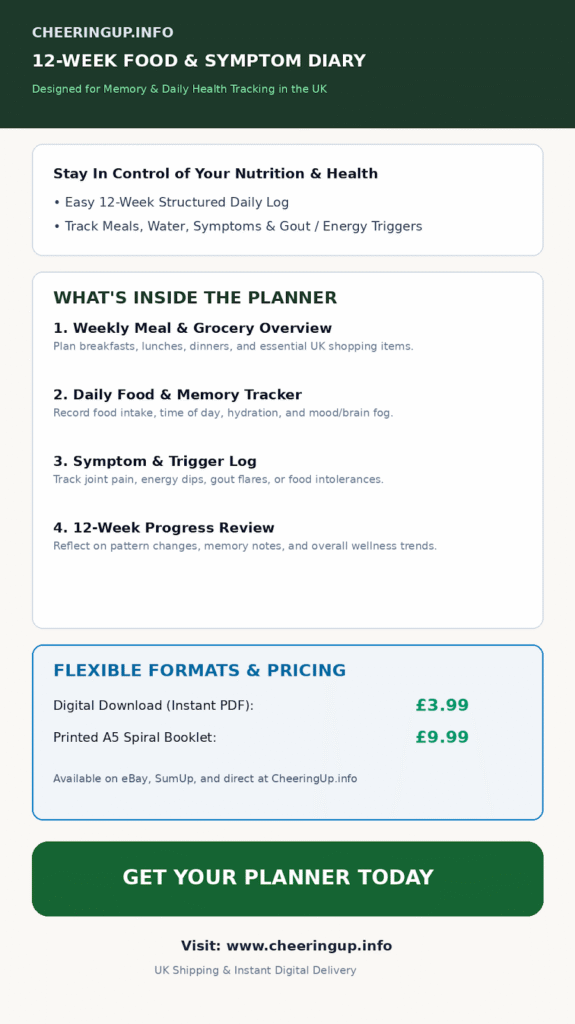
12 Week Food Diary / Planner — For tracking what you eat when memory is unreliable.
Practical tool for older adults who want to keep better records of their meals, hydration, energy, sleep and symptoms.
Struggling with Brain Fog After 55? Start Spotting Your Daily Patterns.
The CheeringUpInfo 12-Week Food Diary & Planner is a practical UK-focused printable PDF to help you record what you eat and drink, how you feel, and the patterns you notice over time.
Track daily meals and snacks.
Record hydration and brain-fog symptoms.
Review weekly and monthly patterns.
Take your completed diary to your GP if you want to discuss your observations.
Digital download — no postage required.
A personal tracking tool from CheeringUpInfo Retirement Club. It does not diagnose or treat medical conditions.
Email editor@cheeringup.info to order your planner for £3.99. Enter “12 WEEK PLANNER” in subject line of your email. We will send you PayPal invoice by email. When you’ve paid we’ll email the planner to you (no shipping costs – digital delivery by email only).
Cognitive Engagement
Super Lateral Thinking Puzzles — 80+ brain-twisting puzzles designed to “develop well-honed mental skills”. Low-cost way to keep cognitive engagement going without screens.
What to prioritise:
If you want one starting point, the resistance bands give the most evidence-backed return for brain and body — low cost, physio-approved, and usable at home. Pair that with the food diary if memory of daily habits is your main frustration.
Brain Fog Over 55 UK: Non-Drug Fixes That Work | CheeringUp.info
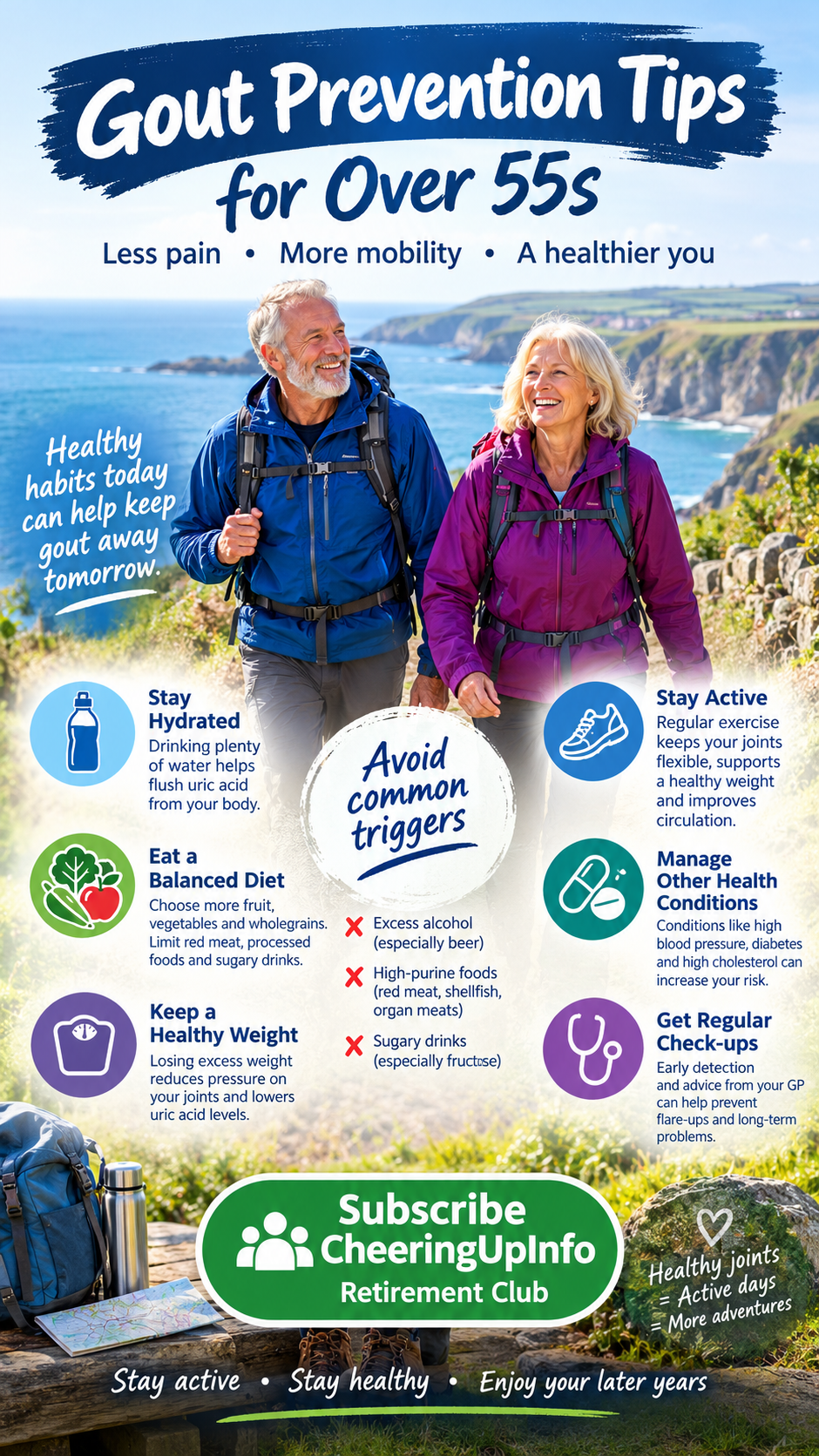
CheeringupInfo Retirement Club shares alternative gout prevention tips for active UK over 55s: hydration, diet, exercise, grounding, supplements, no drugs.
CheeringupInfo Retirement Club recommends these gout prevention tips as alternative solutions to gout for UK over 55s who want to keep golfing, walking, cycling, playing padel and tennis. Learn how hydration, diet, foot and leg exercises, grounding, cherry extract, vitamin C and lifestyle changes can reduce uric acid, prevent flares and speed recovery — without relying on traditional pharmaceutical drugs.
If you are over 55, living in the UK, and determined to keep playing golf, padel, tennis, cycling, hiking, or simply walking without the misery of gout attacks derailing your plans, this review is for you. Gout now affects around 1 in 40 people in the UK — roughly 1.6 million people — and prevalence has increased by 64% between 1997 and 2012. The good news? There is a great deal you can do without relying solely on traditional pharmaceutical drugs. Grounding, targeted leg and foot exercises, strategic supplementation, and smarter eating and drinking habits can all help reduce uric acid, prevent flares, and get you back on the fairway or court faster. As the saying goes, “prevention is better than cure” — and when it comes to gout, the evidence increasingly supports a multi-pronged lifestyle approach.
Why should you seek non-pharmaceutical strategies for gout?
Non-pharmaceutical strategies are worth pursuing because they address the root causes of elevated uric acid while simultaneously improving your overall health, mobility, and quality of life — benefits that pharmaceutical interventions alone often do not deliver. Gout is not just a painful toe; it is a systemic condition. People with gout are 50% more likely to develop high blood pressure, three times more likely to develop kidney disease, and significantly more likely to develop type 2 diabetes and liver disease. By reducing uric acid through lifestyle change, you are not merely avoiding flares — you are actively lowering your risk of these serious comorbidities.
“Diet modification is an important part of gout management” — dietary changes alone typically reduce serum urate by approximately 10–15%, which is meaningful for prevention.
Exercise and weight management improve insulin sensitivity, reduce inflammation, and support kidney function — all of which help your body clear uric acid more efficiently.
Alternative remedies such as grounding have been shown to reduce inflammation, pain, and stress, and to improve blood flow and sleep — all relevant to gout sufferers.
Cost savings: A single hospital-treated gout flare costs the NHS approximately £648.36, while a GP-managed flare costs between £27.19 and £55.60. Reducing flares through lifestyle saves both personal discomfort and public money.”There was a clinical benefit for cherry extract when compared to individualised diet modification for a proportion of patients with any gout flare outcome at medium-term (9 months)”.
Why can alternatives beat gout as well as benefit the rest of your body?
Alternatives can beat gout because they work on multiple fronts simultaneously — reducing purine intake, enhancing uric acid excretion, lowering inflammation, and improving metabolic health — whereas pharmaceutical drugs typically target only one pathway. NHS guidance itself recommends lifestyle measures including weight loss, healthy diet, alcohol reduction, and regular exercise. The British Society of Rheumatology’s 2017 guidelines endorse cherries as part of gout management.
Cardiovascular benefits: Lowering uric acid reduces strain on the heart and blood vessels. People with gout are 50% more likely to develop high blood pressure.
Kidney protection: Adequate hydration and reduced purine load lessen the risk of uric acid kidney stones and chronic kidney disease.
Joint preservation: Exercise keeps joints mobile and cartilage healthy, reducing the long-term damage that repeated gout attacks can cause.
Mental wellbeing: Grounding and outdoor exercise improve sleep, reduce cortisol, and alleviate the depression risk that is 19% higher in people with gout.
What practical lifestyle changes stop gout attacks in over 55s?
Practical lifestyle changes that stop gout attacks in over 55s include drinking 2–3 litres of water daily, avoiding beer and spirits, losing weight gradually, and building a daily routine of joint-friendly movement. These are not abstract recommendations — they are concrete, actionable steps you can start today.
Hydration: the single most immediate change
Aim to drink 2 to 3 litres of water daily — approximately 8 to 12 large glasses — to support uric acid excretion and prevent crystal formation.
Drink a large glass of water before bed to counteract overnight dehydration, which is a common trigger for night-time flares.
Avoid sugary soft drinks and commercial fruit juices, which raise uric acid.
Diet: what to limit and what to embrace
Avoid or strictly limit: organ meats (liver, kidney), red meat, game, oily fish (anchovies, sardines, mackerel), shellfish, and meat extracts such as Bovril.
Embrace: low-fat dairy, plant-based proteins, whole grains, pulses, vegetables, and cherries — all of which are associated with lower uric acid levels.
Be realistic: diet alone reduces serum urate by 10–15%, so pair it with other strategies.
Alcohol: the strongest dietary trigger
Beer and spirits are the strongest dietary triggers for gout attacks — beer contains purines from yeast, and all alcohol reduces renal uric acid excretion.
Aim for at least 3–4 alcohol-free days per week and never exceed 14 units per week, in line with NHS guidance.
Moderate wine consumption appears to have a smaller effect than beer or spirits.
Weight management: slow and steady wins
NHS recommends losing 0.5kg to 1kg (1–2lb) per week — rapid weight loss can actually trigger gout attacks by releasing uric acid from broken-down cells.
Obese people are twice as likely to develop gout and tend to develop it at a younger age.
Combine portion control with increased physical activity for sustainable results.
What exercises and feet and leg routines help prevent gout in active over 55s?
Exercises and feet and leg routines that help prevent gout in active over 55s include low-impact cardio such as walking, cycling, swimming, and golf, combined with targeted leg-strengthening and foot-mobility work. The key is consistency and avoiding excessive joint stress during flares.
Golf: Walking the course provides excellent low-impact cardiovascular exercise. A study cited by The New York Times found that walking 18 holes while carrying a bag or using a push-cart burns approximately 1,400 calories.
Padel and tennis: These racquet sports improve agility, balance, and cardiovascular fitness. Padel is now enjoyed by 30 million players worldwide.
Cycling and hiking: Excellent for building leg strength without high-impact joint loading.
Foot and ankle mobility: Regular range-of-motion exercises — ankle circles, toe curls, calf stretches — help maintain joint flexibility and reduce stiffness.
Leg strengthening: Sit-to-stand from a chair, wall pushes, resistance band work, and light squats help maintain strength in the legs, hips, and back.
Ergonomic exercise: Gentle movement combining breath and motion has been shown to lower uric acid levels and reduce pain in elderly gout patients.
What supplements and alternative remedies can reduce uric acid?
Supplements and alternative remedies that may reduce uric acid include vitamin C, cherry extract, omega-3 fatty acids, and grounding (earthing), though evidence is mixed and should be discussed with a healthcare professional.
Vitamin C
Observational studies suggest men with higher vitamin C intake are less likely to develop gout.
Supplementation at 500–1,500mg per day has been shown to reduce blood uric acid levels.
UK recommended daily amount is 40mg, but gout studies have used higher doses.
Cherry extract and tart cherry juice
Cherry extract and tart cherry juice
Cherry extract showed clinical benefit for reducing gout flare outcomes at 9 months compared to diet modification alone.
The British Society of Rheumatology’s 2017 guidelines endorse cherries for gout management.
Typical studied dose: 3,600mg daily of cherry extract (equivalent to about a pound of cherries).
Omega -3 Fatty Acids
N-3 fatty acids are among the supplements assessed in randomised controlled trials for gout-related outcomes.
Found in oily fish (though gout sufferers should moderate fish intake) or supplemented as fish oil.
Grounding (earthing)
Grounding involves direct skin contact with the Earth’s surface — walking barefoot on grass, sand, or soil.
Research indicates grounding reduces inflammation, pain, and stress, and improves blood flow and sleep.
A 2015 review described grounding as potentially “the anti-inflammatory antidote for modern man”.
Practical application: 20–30 minutes daily of barefoot walking on natural surfaces.
What should you do during a gout attack without pharmaceutical drugs?
During a gout attack without pharmaceutical drugs, you should rest the affected joint, apply ice, elevate the limb, drink plenty of water, and avoid putting pressure on the joint. NHS guidance explicitly recommends these measures: rest and raise the limb, keep the joint cool with an ice pack wrapped in a towel for up to 20 minutes at a time, and drink lots of water.
Rest and elevate: Keep the affected limb raised to reduce swelling.
Ice therapy: Apply a wrapped ice pack for up to 20 minutes at a time. Ice provides temporary pain relief.
Hydrate aggressively: Drink water steadily throughout the day to help flush uric acid.
Keep bedclothes off the joint at night to reduce pressure and irritation.
Do not put pressure on the joint — this can make the pain worse.
Who will benefit most from these gout prevention tips, and when?
The people who will benefit most are UK adults over 55 — particularly men, who are three to four times more likely to develop gout, and post-menopausal women — who are physically active or want to remain so and who prefer to minimise pharmaceutical interventions. Gout prevalence peaks between ages 80–84, affecting 15% of men and 6% of women in that age bracket.
Active over 55s: Golfers, padel players, walkers, hikers, cyclists, runners, and tennis players who want to protect their joints and stay on the course or trail.
Those with a family history: Gout sometimes runs in families, and early lifestyle intervention is most effective.
People with borderline uric acid: For those with infrequent attacks, dietary and lifestyle change may be sufficient without medication.
Those wanting to avoid drug side effects: NSAIDs and colchicine can have gastrointestinal and cardiovascular side effects, making lifestyle approaches attractive.
When to start: Immediately. Every gout flare causes joint damage, and 54% of people with gout develop one or more comorbidities within five years of diagnosis.
How can you practically change your lifestyle to stop gout attacks?
You can practically change your lifestyle by implementing a daily routine that combines hydration, dietary swaps, consistent low-impact exercise, and targeted supplementation — starting with one change at a time and building from there.
Your daily gout prevention routine
Morning: Drink 500ml of water upon waking. Take vitamin C (500mg) and cherry extract if using.
Midday: 20–30 minutes of barefoot grounding on grass or a natural surface, weather permitting.
Afternoon: Play golf, padel, or go for a brisk walk. Follow with foot and ankle mobility exercises.
Evening: Drink another 500ml of water before bed. Avoid alcohol and high-purine snacks in the hours before sleep.
Weekly: Aim for at least 150 minutes of moderate exercise, spread across the week. Include 2–3 sessions of leg-strengthening work.
Dietary swaps that make a difference
Swap red meat for chicken or plant proteins on most days.
Replace beer with sparkling water with a slice of lime.
Choose low-fat dairy over full-fat varieties.
Snack on cherries or berries instead of crisps or sugary treats.
Use herbs and spices (turmeric, ginger) known for anti-inflammatory properties.
Tracking and adjusting
Keep a simple diary of flares and potential triggers (food, drink, activity, stress).
Review your uric acid levels with your GP at least annually if you have a history of gout.
Adjust your approach based on what works for your body.
What are the key takeaways for UK over 55s who want to stay active?
The key takeaways are that gout is manageable through lifestyle, that prevention is far better than treatment, and that staying active is both possible and beneficial — but requires commitment to hydration, diet, exercise, and stress management.
Gout is common but controllable: 1 in 40 UK adults have gout, and prevalence is rising.
Lifestyle works: Diet alone reduces urate by 10–15%, and exercise adds further benefit.
Stay active: Golf, padel, walking, cycling, and tennis are all appropriate and beneficial.
Hydrate relentlessly: 2–3 litres of water daily is the single most important habit.
Use alternatives wisely: Vitamin C, cherry extract, and grounding have evidence supporting their use.
Act early: Every flare causes damage — do not wait for the next one.
CheeringupInfo Retirement Club is here to support your journey to a gout-free, active retirement.
Disclaimer: This article is for general informational purposes only and does not constitute medical advice. It is not a substitute for professional medical advice, diagnosis, or treatment. Always seek the advice of your GP, rheumatologist, or other qualified health professional with any questions you may have regarding a medical condition or before starting any new supplement, exercise, or dietary programme. Never disregard professional medical advice or delay in seeking it because of something you have read in this article. The author, publisher, and CheeringupInfo Retirement Club accept no liability whatsoever for any loss, damage, injury, or adverse health outcome arising directly or indirectly from the use or reliance upon the information provided herein. Individual results may vary, and what works for one person may not work for another. If you are experiencing a gout attack or any acute medical symptoms, contact NHS 111 or your GP immediately.
Get help to protect and grow your business faster by targeting over 55s and those planning for retirement with fairly priced discounted products and services
Stop blaming the Stilton. If you’re over 55, gout is not a “rich old man’s toe” — it’s a whole-body warning, and 1.6 million Brits are ignoring it while their joints pay the price.
CheeringupInfo Retirement Club recommends these gout prevention tips as alternative solutions to the problem of gout. But first, the number that should stop you scrolling: UK gout cases rose 64% between 1997 and 2012. And if you think it’s just red wine and steak, you’re missing the 7-step drug-free protocol that helps golfers, padel players, cyclists and hikers over 55 keep moving.
Stay to step 4. It’s the one most over-55s skip — and it’s why they keep limping off the 14th fairway.
Hydrate like it’s your new handicap. Aim for 2–3 litres of water daily. Drink a large glass before bed. Overnight dehydration is a classic flare trigger. No sugary soft drinks. No commercial fruit juice.
Treat beer and spirits as the enemy. Beer and spirits are the strongest dietary triggers. Aim for 3–4 alcohol-free days per week. Keep under 14 units weekly, NHS style. Wine is less bad — but “less bad” is not a green light.
Swap the purine bombs. Cut organ meats, red meat, anchovies, sardines, mackerel, shellfish and meat extracts like Bovril. Add low-fat dairy, pulses, whole grains, vegetables and cherries. Diet alone can lower serum urate by 10–15%.
Move without wrecking the joint. This is the step most people skip. Aim for 150 minutes of moderate exercise weekly. Walking 18 holes of golf burns around 1,400 calories. Padel, tennis, cycling, hiking and brisk walking all count. Add foot and ankle circles, calf stretches and sit-to-stands. Strong legs protect knees, hips and feet.
Use targeted supplements — with your GP’s knowledge. Vitamin C at 500–1,500mg daily has been linked to lower uric acid. Cherry extract has clinical benefit data at 9 months, with studied doses around 3,600mg daily. Omega-3 may help inflammation. This is not a free-for-all. Check interactions.
Try grounding for 20–30 minutes daily. Barefoot on grass, sand or soil. Research suggests grounding reduces inflammation, pain and stress, and improves blood flow and sleep. If you’re still reading, you’re exactly who this is for — someone who wants 10 more years of padel, not 10 more years of pill boxes.
When a flare hits, do not panic — and do not use heat. Rest the joint. Elevate it. Ice it for up to 20 minutes wrapped in a towel. Drink water steadily. Keep bedclothes off the joint. Do not put pressure on it. Heat can make it worse.
Here’s the cost reality: a hospital-treated gout flare costs the NHS around £648.36. A GP-managed flare costs £27.19–£55.60. And 54% of people with gout develop one or more comorbidities within 5 years. That’s not just a toe problem.
Email editor@cheeringup.info for more information on Retirement Club with the subject line “GOUT FREE 55”.
Not medical advice. Always speak to your GP or health professional. No liability accepted for actions taken based on this post.
Products or Services Support Gout Free Journey
Optima Health and Nutrition Concentrated Sour Cherry Juice 500ml – 4 Pack
As an eBay Partner, I may be compensated if you make a purchase
Your 7-Day Low-Purine Meal Plan with Intermittent Fasting for Gout Prevention (UK Over 55s)
This meal plan draws on four trusted resources: Gout Cookbook: 85 Healthy Homemade and Low Purine Recipes by Monika Shah, The Healing Gout Diet Cookbook for Beginners, Gout Diet Cookbook for Seniors, and Gout Food List: 200 Low Purine Foods. It also integrates intermittent fasting principles tailored for older adults, with NHS-backed hydration and dietary guidance throughout.
The Intermittent Fasting Framework for Over 55s
Time-restricted eating (TRE) — eating within an 8-to-10-hour window — has emerged as a promising approach for weight loss and metabolic health in older adults. Research shows that two non-consecutive days of fasting per week significantly prevents inflammation provoked by urate crystals in preclinical models. A pilot study found that calorie restriction to 1,600 kcal/day for 4 months was associated with flare reduction in gout patients.
Important safety note for over 55s: NHS guidance explicitly warns to “avoid crash, yo-yo dieting and fasting” that is extreme, as this can make kidneys hold onto uric acid and worsen symptoms. The approach below uses gentle 12-14 hour overnight fasts, not extreme calorie restriction.
Your daily eating window: 10am – 7pm (9-hour window, 15-hour overnight fast) Hydration during fasting: Water, herbal tea (no sugar) — 2-3 litres daily
Day 1 – Monday
Fasting period (7pm Sunday – 10am Monday): Water only. Drink 500ml upon waking.
Breakfast (10am): Greek Yogurt Parfait with Berries and Nuts — from Gout Diet Cookbook for Seniors. Low-fat Greek yogurt, fresh strawberries, blueberries, crushed walnuts. Low purine, high protein, anti-inflammatory.
Lunch (1pm): Lentil and Kale Power Bowl — from Gout Diet Cookbook for Seniors. Warm green lentils, steamed kale, cherry tomatoes, cucumber, lemon-olive oil dressing.
Dinner (6pm): Grilled chicken breast (skinless, 100g), roasted sweet potato, steamed broccoli, carrots. From Monika Shah’s Gout Cookbook.
Snack (optional, 4pm): 10-12 fresh cherries or a small handful of almonds.
Day 2 – Tuesday
Fasting period (7pm Monday – 10am Tuesday): Water only.
Breakfast (10am): Almond Butter and Banana Whole Wheat Toast — from Gout Diet Cookbook for Seniors. One slice wholemeal toast, 1 tbsp almond butter, half sliced banana.
Lunch (1pm): Spinach and Mushroom Frittata — from Gout Diet Cookbook for Seniors. Two eggs, wilted spinach, sautéed mushrooms, served with a side salad.
Dinner (6pm): Baked cod (120g) with quinoa, roasted courgette, and green beans. Cod is a lower-purine fish option.
Snack (optional, 4pm): Low-fat cheese cubes or a small pot of natural yogurt.
Day 3 – Wednesday
Fasting period (7pm Tuesday – 10am Wednesday): Water only.
Breakfast (10am): Oatmeal with skimmed milk, topped with sliced kiwi and a drizzle of honey. Oats are low in purines.
Lunch (1pm): Chicken and vegetable soup (homemade, no meat extract or Oxo cubes). Use leftover chicken, leeks, carrots, celery.
Dinner (6pm): Tofu and vegetable stir-fry with brown rice. Tofu is a plant-based protein that is safe for gout sufferers.
Snack (optional, 4pm): A handful of plain popcorn or vegetable sticks with hummus.
Day 4 – Thursday
Fasting period (7pm Wednesday – 10am Thursday): Water only.
Breakfast (10am): Scrambled eggs (2) on wholemeal toast with grilled tomatoes. Eggs are among the lowest-purine protein sources.
Lunch (1pm): Jacket potato with low-fat cottage cheese and a large mixed salad. Add sweetcorn and cucumber.
Dinner (6pm): Turkey mince bolognese with wholewheat pasta. Turkey is a lower-purine poultry option compared to red meat.
Snack (optional, 4pm): Cherry juice (pure, unsweetened) — one small glass.
Day 5 – Friday
Fasting period (7pm Thursday – 10am Friday): Water only.
Breakfast (10am): Smoothie made with skimmed milk, frozen berries, half a banana, and 1 tsp honey.
Lunch (1pm): Wholemeal wrap with grilled chicken, lettuce, tomato, and low-fat yogurt dressing.
Dinner (6pm): Vegetable curry with chickpeas, spinach, and cauliflower, served with basmati rice. Note: cauliflower and spinach are moderate-purine vegetables but do not need to be avoided.
Snack (optional, 4pm): 10-12 cherries or a small handful of mixed nuts.
Day 6 – Saturday
Fasting period (7pm Friday – 10am Saturday): Water only.
Breakfast (10am): Wholegrain cereal with skimmed milk, topped with sliced strawberries and flaked almonds.
Lunch (1pm): Poached eggs on wholemeal toast with sautéed mushrooms and tomatoes.
Dinner (6pm): Grilled salmon (100-120g) with new potatoes, asparagus, and green beans. Note: Salmon is moderate purine — keep to one portion per week if sensitive.
Snack (optional, 4pm): Low-fat yogurt with a drizzle of honey.
Day 7 – Sunday
Fasting period (7pm Saturday – 10am Sunday): Water only.
Breakfast (10am): Mushroom and spinach omelette (2 eggs) with a slice of wholemeal toast.
Lunch (1pm): Roast chicken dinner (skinless breast, 100g), roast parsnips, carrots, steamed cabbage, and a small portion of gravy made without meat extract.
Dinner (6pm): Light meal — vegetable soup with a wholemeal roll, or a large salad with chickpeas, cucumber, tomato, and feta.
Snack (optional, 4pm): A small bowl of mixed berries.
Fasting Day Option (Optional, 1 Day Per Week)
If you want to try a gentle fasting day (not a complete fast), consider a modified fasting day where you eat around 600-800 calories within your normal eating window. Research on intermittent fasting suggests two non-consecutive days of fasting per week may significantly prevent crystal-induced inflammation. However, NHS guidance warns against extreme fasting. A modified approach could look like:
Breakfast (10am): Small bowl of porridge with water and a few berries (approx. 200 kcal)
Lunch (1pm): Large green salad with cucumber, tomato, and a boiled egg (approx. 250 kcal)
Dinner (6pm): Vegetable soup with a small wholemeal roll (approx. 250 kcal)
Hydration: 2-3 litres of water throughout the day
Hydration Rules for Every Day
Upon waking: Drink 500ml of water immediately.
Throughout the day: Aim for 2-3 litres total — approximately 8-12 large glasses.
Before bed: Drink a large glass of water to counteract overnight dehydration.
Avoid: Sugary soft drinks, commercial fruit juices, and diet fizzy drinks.
Monika Shah’s Gout Cookbook: Use for 85 recipe ideas, especially for dinners and batch cooking.
The Healing Gout Diet Cookbook for Beginners: Use for understanding the “why” behind low-purine eating and for controlling attacks.
Gout Diet Cookbook for Seniors: Use for breakfast and lunch ideas tailored to older adults, including recipes like Almond Butter and Banana Wholemeal Toast, Greek Yogurt Parfait, and Lentil and Kale Power Bowl.
Gout Food List: 200 Low Purine Foods: Use as your daily reference guide when shopping or meal planning — 200 foods listed with purine values per 100g.
Disclaimer: This meal plan is for general informational purposes only and does not constitute medical advice, nutritional advice, or a prescribed diet. It is not a substitute for professional medical advice, diagnosis, or treatment. Always seek the advice of your GP, rheumatologist, registered dietitian, or other qualified health professional before starting any new eating plan, fasting regimen, or supplement programme, especially if you have gout, kidney disease, diabetes, or any other medical condition. Never disregard professional medical advice or delay in seeking it because of something you have read here. Individual nutritional needs vary, and what works for one person may not work for another. The author, publisher, and CheeringupInfo Retirement Club accept no liability whatsoever for any loss, damage, injury, or adverse health outcome arising directly or indirectly from the use or reliance upon the information provided. If you are experiencing a gout attack or any acute medical symptoms, contact NHS 111 or your GP immediately.
Gout Prevention for Over 55s: Stay Active Without Drugs
CheeringUpInfo Retirement Club reviews High Force Waterfall for over 55s: why visit, what to expect, best time, free routes & cost-of-living beating tips.
Looking for fun things to do together? CheeringUpInfo recommends High Force Waterfall for over 55s — England’s biggest waterfall, from £4 or free by bus.
If you are over 55 and looking for the answer to “what fun things can we do together that won’t break the bank?”, CheeringupInfo Retirement Club recommends High Force Waterfall as the solution. This isn’t just a casual suggestion — the data backs it up. ONS figures show UK attractions welcomed a staggering 367.6 million visits in 2025, with the number of attractions climbing 8% to 7,242. Meanwhile, ALVA reported roughly 165 million visits across 409 top UK sites. The message is clear: Brits are prioritising affordable days out despite the cost-of-living squeeze. High Force delivers world-class natural drama for less than the price of a coffee and cake in a city café.
What is High Force Waterfall and why should you visit?
High Force Waterfall is England’s largest waterfall by volume of water, plunging 21 metres (70 feet) over the ancient Whin Sill dolerite rock into a dramatic gorge on the River Tees. It has been named the number one waterfall walk in the UK by GO Outdoors, beating competition from the Scottish Highlands and Wales.
Why you should visit:
It’s ranked the best in the UK — GO Outdoors placed High Force ahead of 14 other waterfalls across Britain, including Falls of Glomach and Pistyll Rhaeadr
Set in a UNESCO Global Geopark — located within the North Pennines Area of Outstanding Natural Beauty, the surrounding landscape is protected for good reason
295 million years of geology — the Whin Sill rock formed from molten lava and cooled slowly enough to create distinctive columnar joints that make the waterfall look almost architectural
Accessible natural drama — you can be standing in front of the falls about ten minutes after leaving your car, making it waterfall-watching for people who appreciate natural drama without a three-hour bog-trot
For over 55s seeking shared experiences that spark conversation, High Force offers something genuinely awe-inspiring. It’s the kind of place that creates memories without demanding peak fitness.
What can you expect to experience at High Force Waterfall?
You can expect a multi-sensory natural experience at High Force Waterfall, from the thundering sound of the cascade to the mist on your face and the sight of peat-stained water roaring over ancient rock. The experience changes dramatically with the seasons and water levels.
What you’ll actually see and feel:
A thundering torrent after rain — after prolonged rainfall, the volume increases dramatically. What might be an elegant white ribbon in summer becomes a brown, roaring torrent you can hear from the car park. The colour comes from peat staining in the upper catchment — not pollution, just the Pennines expressing themselves
Columnar rock formations — the Whin Sill’s vertical columns give the cliff face a striking, almost designed appearance
A deep plunge pool — below the main drop, the water churns itself into foam before continuing downstream toward Low Force, a smaller but still impressive set of falls about a mile away
A well-maintained woodland path — a path through woodland leads visitors to the base of the falls, where viewing platforms offer safe and striking views of the cascade and surrounding scenery
Woodland sculptures — the circular walk includes a number of wood-carved sculptures to discover along the way
TripAdvisor reviewers consistently describe the experience as “breathtaking” and “spectacular,” with one visitor noting: “The place is breathtaking. We went on a little tour and loved every minute of it. You can get fairly close and the view is spectacular”.
Who will enjoy High Force Waterfall most?
High Force Waterfall will be enjoyed most by adults who value accessible natural beauty, particularly over 55s seeking shared experiences that don’t require extreme fitness. The site’s combination of short walking distance, dramatic scenery, and affordable entry makes it ideal for this demographic.
Best suited for:
Retired couples and friendship groups — the short, well-maintained path means you don’t need to be a seasoned hiker to witness something spectacular. The “gentle circular walk” is specifically noted as suitable for those wanting an easier pace
Photography enthusiasts — the changing water volumes, seasonal colours, and occasional rainbows create constantly varying compositions
Nature lovers — the surrounding North Pennines AONB and UNESCO Geopark status means the wider landscape rewards exploration
Dog owners — dogs are welcome on leads, making it a genuinely inclusive day out
Those seeking wellbeing benefits — Raby Estates explicitly promotes the waterfall for “those looking to slow down, switch off and reconnect with nature” and experiencing “the restorative power of cascading water”
Less suitable for:
Those with severe mobility limitations — while the main path is well-maintained, there are a few steps right at the very bottom, though visitors can still reach the lower gate for a spectacular view
Anyone expecting a full day’s entertainment — the core visit takes 1–2 hours, so pair it with a walk to Low Force or a visit to nearby Bowlees Visitor Centre for a fuller day
When is the best time to go to High Force Waterfall?
The best time to go to High Force Waterfall depends on what you want from the experience — autumn and winter after rainfall for maximum power, or late spring and summer for gentler flows and easier conditions. The waterfall is open year-round except for holidays.
Season-by-season guide:
Autumn and winter (September–February) — after prolonged rain, the volume increases dramatically. This is when the waterfall is at its most powerful and dramatic, with a roaring torrent that can be heard from the car park
Spring (March–May) — the Islands travel site recommends January to May as the best time to hike the paths, when conditions are generally favourable and the landscape is greening up
Summer (June–August) — the flow is usually gentler, creating an elegant white ribbon effect. The surrounding woodlands are lush and the longer days give more flexibility. However, this is peak visitor season
Best overall for drama — autumn after rainfall. The UK Hidden Gems guide confirms: “Winter months offer the most powerful views of the rushing cascade after heavy rainfall”
Practical timing tips:
The site is open daily during the summer season from 10 am to 4 pm
Arrive early to secure parking and enjoy quieter paths
Check river levels before travelling — after Storm Claudia-type weather events, the falls are extraordinary
Where exactly is High Force Waterfall and how do you get there?
High Force Waterfall is located at Forest-in-Teesdale, Barnard Castle, County Durham, DL12 0XH, just off the B6277 between Middleton-in-Teesdale and Alston. The nearest major road is the A66, and the falls sit about four-and-a-half miles north-west of Middleton-in-Teesdale.
By car:
Postcode for satnav: DL12 0XH
What3Words: saucepan.pouch.cropping
Parking is at the High Force Hotel car park — charges are £4 for four hours or £6 for six hours
By bus (the cost-of-living friendly option):
Bus 873 “The Durham Dales Explorer” runs seasonally from Durham (2 hrs), Bishop Auckland (90 mins), and Barnard Castle (40 mins) — it takes you all the way to the hotel where you’ll find the footpath entrances
Bus 73 runs from Barnard Castle a couple of times per day on Wednesdays, taking about 30 minutes
10% off admission with a valid bus ticket
On foot:
High Force sits on the Pennine Way, so it’s accessible to long-distance walkers
A 5-mile trail from Bowlees Visitor Centre offers an alternative approach
How can you maximise the High Force experience while beating the cost of living?
You can maximise the High Force experience while beating the cost of living by using the free southern bank footpath instead of the paid northern access, travelling by bus for discounted admission, and combining the visit with other free activities in the area. The savings add up quickly for over 55s on fixed incomes.
Cost-beating strategies:
Use the free southern bank route — the southern side of the river offers access (and arguably a better view) via a public footpath, completely free of charge. You can see High Force from the top for free as well
Walk from Low Force — if you walk from Low Force on the south bank, you don’t have to pay at all. One TripAdvisor reviewer confirmed: “If you do this walk you don’t have to pay”
Travel by bus for 10% off — a valid bus ticket gets you 10% off admission, and the bus fare itself is capped at £2.50 single within the North East Mayoral Strategic Authority area, or £7.50 for a day’s unlimited bus, Metro and Shields Ferry travel with a TNE Day Saver
Durham Day Rover — for journeys wholly within County Durham, travel all day for just £6
National bus fare cap — for those travelling from outside the North East, the £3 national fare cap applies
Park for £4 (four hours) — more than enough time for the main visit, and you can extend to six hours for £6 if combining with a longer walk Value comparison:
Adult admission: £3.95–£4.00
Child admission (4–15): £2.18–£2.50
Family saver ticket (2 adults + 2 children): £10 online
Under 4s: Free
For context, ONS data shows the average UK household spends just £2.90 per week on “cinema, theatre and museums” combined. A visit to High Force for a couple costs under £8 in admission — extraordinary value for a UNESCO Geopark experience that ranks as the UK’s best waterfall walk.
Pair it with other free activities:
Low Force Waterfall — a smaller but still impressive set of falls about a mile away, free to visit
Bowlees Visitor Centre — free entry, with woodland walks and a café
The Pennine Way — free walking routes for those wanting to extend the day
Middleton-in-Teesdale — a charming village for a picnic stop
CheeringupInfo tip: For over 55s looking to maximise every pound, the free southern bank route plus a Durham Day Rover bus ticket creates a full day out for under £10 per person — cheaper than a single cinema ticket in most UK cities.
Is High Force Waterfall good value for money?
High Force Waterfall offers exceptional value for money, with adult admission at just £3.95–£4.00 and a free access route available on the southern bank. When you compare it to other UK attractions, the value proposition is compelling.
Value breakdown:
Cost per hour of experience — a typical visit takes 1.5–2 hours. At £4 adult admission, that’s roughly £2 per hour for a UNESCO Geopark experience
ALVA context — the Association of Leading Visitor Attractions reported that roughly 165 million visits were logged at 409 top UK sites in 2025, showing that millions of Brits are choosing affordable attractions like this
Tourism spending context — VisitBritain estimates 43.6 million inbound visits in 2025 with £33.4 billion spent, demonstrating that UK attractions are world-class destinations that don’t need to be expensive
What you get for your money:
Access to England’s largest waterfall by volume
A well-maintained woodland path with viewing platforms
Woodland sculptures and a family-friendly adventure trail
A site ranked number one in the UK for waterfall walks
An experience within a UNESCO Global Geopark and Area of Outstanding Natural Beauty
CheeringupInfo verdict: At under £5 per adult (or free if you use the southern bank), High Force Waterfall represents one of the best value days out in the UK for over 55s seeking shared fun without financial strain. The combination of natural drama, accessibility, and genuine affordability makes it a standout recommendation for retirement club members looking for their next adventure together.
What are the practical essentials for visiting High Force?
Opening hours: Summer season 10 am–4 pm daily. Check ahead for seasonal variations and holiday closures.
Address: High Force Hotel & Waterfall, Alston Rd, Forest-in-Teesdale, Barnard Castle, County Durham, DL12 0XH
What3Words: saucepan.pouch.cropping
Dogs: Welcome on leads
Accessibility: Well-maintained gravel path suitable for pushchairs and wheelchairs for most of the route, with a few steps at the very bottom. Visitors can still reach the lower gate for a spectacular view
Best footwear: Sturdy shoes, especially after rain — paths can be slippery
Facilities: High Force Hotel on site for refreshments; Bowlees Visitor Centre nearby
CheeringUp.info Retirement Club recommends 12 UK businesses solving over-55s’ biggest cost-of-living problems—pension gaps, care costs, loneliness, scams and more.
CheeringupInfo Retirement Club recommends these products or services as the solutions to the problem of biggest problems for older people in the UK today. The crisis facing Britain’s over-55s is not a single challenge but a constellation of interconnected pressures. “There are 1.9 million pensioners living in poverty across the UK – around one in six people or 16% – under the widely used definition of relative income poverty after housing costs” . “Nearly one in five people aged 55 and over and on low incomes say they want to retire but can’t because of housing costs” . “One in four adults (25%) reported feeling lonely often or always or some of the time” . “Age UK has found that 2.4 million older people have limited use of the internet – using it less than once a month or not at all” . These are not abstract statistics: they are the daily lived experience of millions. The businesses and services below are solving these problems better than anyone else in the UK today.
What is the biggest financial problem facing over-55s in the UK right now?
The biggest financial problem facing over-55s in the UK right now is the retirement income gap that leaves millions unable to afford even a moderate standard of living. More than 3.7 million homeowners aged 55 to 79 do not have enough income to reach a moderate standard of living in retirement, according to research agency Fairer Finance . Over half of adults (51%) lack confidence in their ability to meet the cost of social care in retirement, rising to nearly two-thirds (61%) among those aged 55–64 .
Who benefits most: Homeowners aged 55–79 approaching retirement with mortgage debt or inadequate pension pots.
What benefits they can expect: A regulated financial adviser can consolidate pensions, model income drawdown scenarios, and identify whether equity release or downsizing makes sense. My Pension Expert, a regulated advisory firm, has helped thousands of people across the UK take control of their pensions with personalised advice tailored to their needs, covering everything from pension consolidation to income drawdown and annuities .
When to buy: At least five to ten years before planned retirement, to allow maximum compounding and planning time.
Where available: Nationwide via telephone and video consultations.
How to buy: Contact My Pension Expert directly, or access the government-backed Pension Wise service, a free and impartial guidance service for people over 50 with a defined contribution pension .
How can over-55s reduce the cost of household bills in the UK today?
Over-55s can reduce the cost of household bills in the UK today by using specialist bill-saving services that negotiate directly with energy and utility providers on their behalf. Many pensioners struggled with energy prices and the wider cost of living in January 2025 , and energy costs remain a leading driver of pensioner poverty.
Who benefits most: Pensioners aged 60+ living on fixed incomes who are struggling with rising energy costs.
What benefits they can expect: Pocket Power, a social enterprise funded by Royal London, offers a bills-saving phone service to anyone aged 60+ for free, helping older people save money on household bills through expert negotiation and access to grants and hardship funds .
When to buy: As soon as energy prices rise or a fixed-rate tariff is about to expire.
Where available: Nationwide by phone.
How to buy: Call Pocket Power directly; the service is free for anyone aged 60 or over.
Why is loneliness among older people in the UK a real crisis and what solves it?
Loneliness among older people in the UK is a real crisis because it is a public health emergency with mortality consequences that no medication can fix. “One in 12 older people (8.0%) report often feeling lonely,” and loneliness is associated with an average 14% increased likelihood of mortality in older people, while social isolation carries an average 35% increased mortality risk . “372,488 people in Great Britain aged 70 and older feel lonely often or always” .
Who benefits most: Isolated over-70s living alone, particularly those who have lost a partner.
What benefits they can expect: Aibō is a platform that matches young people aged 18–30 with elderly people who live in their area, not for care, but for companionship and practical weekly help – anything from shopping and gardening to posting letters and help with technology . Clients pay an hourly rate for the service, students are vetted and people matched by their interests .
When to buy: Immediately upon recognising that social contact has dropped below weekly levels.
Where available: Sussex and expanding across the UK.
How to buy: Contact Aibō directly to be matched with a local companion.
What is the real problem with digital exclusion for over-55s in the UK?
The real problem with digital exclusion for over-55s in the UK is that 2.4 million older people are locked out of essential services that have moved online. “2.4 million (19%, nearly one in five) older people have limited use of the internet – using it less than once a month or not at all” . “33% (4.3 million) of older people don’t use a smartphone” . Of the 11 million adults lacking essential digital skills, nearly 60% are over 65 years old .
Who benefits most: Over-65s who cannot access banking, shopping, or NHS services online.
What benefits they can expect: AbilityNet offers free IT support at home and online to older people via its nationwide network of 500+ Tech Volunteers . BT Group and AbilityNet work to close the digital divide through free in-person digital skills sessions for over 65s .
When to buy: As soon as a service you rely on moves online.
Where available: Nationwide.
How to buy: Call the AbilityNet helpline on 0300 180 0028 during UK office hours or email enquiries@abilitynet.org.uk .
How can older renters in the UK secure stable housing in retirement?
Older renters in the UK can secure stable housing in retirement through specialist retirement rental providers that offer lifetime tenancies and age-specific communities. “Nearly 867,000 households in England’s private rented sector include someone aged 55 or over,” and this number has grown by 70% since 2010/11 . “Nearly half of private rented sector tenants aged 65 or over are in the bottom 20% of all household incomes” .
Who benefits most: Private renters aged 55+ who fear eviction or cannot afford rising rents.
What benefits they can expect: Gresham House, through its customer-facing brand My Future Living, offers affordable, age-specific retirement rental properties on lifetime rental contracts with assured tenancies, providing customers with unlimited term security .
When to buy: Before a tenancy ends or when rent becomes unaffordable on a pension income.
Where available: Across England.
How to buy: Contact My Future Living directly to view available properties.
What is the care cost crisis for over-55s in the UK and what solves it?
The care cost crisis for over-55s in the UK is that most people have no idea how much care will cost and cannot afford it when it arrives. “Six in 10 over-45s underestimate cost of self-funding a care home place by thousands” – 31% expected the cost would be up to £30,000 a year, less than half the true figure . “51% lack confidence in their ability to meet the cost of social care in retirement. This figure rises to nearly two-thirds (61%) among those aged 55–64” .
Who benefits most: Adults aged 55–64 who will likely need care within the next 20 years.
What benefits they can expect: Helping Hands Home Care offers visiting care from £32.40 per hour and live-in care starting from £1,675 per week for a single person . A specialist care fees adviser can explain the costs and risks of each option and help with tasks like making a will, power of attorney, and advising on available benefits .
When to buy: At least 10 years before care is likely to be needed, to allow financial planning.
Where available: Nationwide.
How to buy: Contact Helping Hands directly or access the government-backed MoneyHelper service for free guidance.
How can over-55s in the UK avoid scams and financial fraud?
Over-55s in the UK can avoid scams and financial fraud by accessing specialist prevention and aftercare services that build knowledge and confidence to recognise and report attempted scams. Age UK Manchester has secured further funding for their Scams Prevention and Support Programme, funded through Lloyds Banking Group, now in its fifth year, helping prevent older people from falling victim to scams . Age UK Northumberland secured a further two years of funding for their Scams Prevention and Support Programme .
Who benefits most: Over-65s who live alone or have recently been targeted by fraudsters.
What benefits they can expect: Increased knowledge and confidence to recognise and deal with attempted scams, plus practical support for those who have been affected by fraud .
When to buy: Immediately after any suspicious contact, or proactively before it happens.
Where available: Through local Age UK offices nationwide.
How to buy: Contact your local Age UK office or call Action Fraud on 0300 123 2040 .
Why is food poverty a growing problem for over-55s in the UK and what solves it?
Food poverty is a growing problem for over-55s in the UK because pensioner poverty is rising and food inflation has outpaced pension increases. With 1.9 million pensioners living in poverty , many are forced to choose between eating and heating. Age UK reports that one older person they support is now able to afford a good diet with fresh vegetables and meat, having fresh ingredients rather than being limited by ready meals .
Who benefits most: Pensioners on low incomes who are skipping meals to pay bills.
What benefits they can expect: Community supermarkets and pantries offer savings of up to £1,000 per year, with members paying a small weekly fee for at least ten items of food . Everything in-store is priced under £1, and members can pick up to 20 items per visit .
When to buy: As soon as household food budgets become strained.
How to buy: Visit your local community supermarket or pantry to become a member – fees start at just £3.50 per week .
What is the social care waiting time crisis for over-55s in England?
The social care waiting time crisis for over-55s in England is that millions are waiting months or even years for assessments they are legally entitled to. “In England, 2.6 million people aged 50+ aren’t receiving the care they desperately need” . Local authority data shows median waits for care act assessments of 47 days, with the longest wait reaching 1,781 days for an annual review . Some people have been waiting over 300 days for an assessment .
Who benefits most: Over-50s needing care assessments or reviews who are stuck on waiting lists.
What benefits they can expect: Private home care providers like Helping Hands can bypass local authority waiting lists, with visiting care starting from £32.40 per hour and live-in care from £1,675 per week . A specialist care fees adviser can help navigate available benefits and support from the NHS or local authority .
When to buy: As soon as a care need is identified and a local authority assessment is awaited.
Where available: Nationwide.
How to buy: Contact Helping Hands directly for an immediate assessment.
How can over-55s in the UK find age-appropriate housing adaptations?
Over-55s in the UK can find age-appropriate housing adaptations through specialist home improvement agencies that modify homes for safety and independence. Housing adaptations like grab rails, shower seats, stairlifts, and flush floor showers can prevent falls and allow older people to remain in their own homes . Nearly half (47%) of older people on low incomes said they would have nowhere to go if they lost their home , making staying put essential.
Who benefits most: Homeowners aged 60+ with mobility issues who want to avoid moving into care.
What benefits they can expect: We Care Home Improvements provides home improvement and repair services in Bristol, Bath, North East Somerset, North Somerset, Gloucestershire and South Gloucestershire, offering support to those aged over 60, including grab rails, shower seats, bathroom installations, home adaptations, and major housing repairs .
When to buy: As soon as mobility begins to affect daily activities like bathing or climbing stairs.
Where available: South West England, with similar agencies nationwide via Find My HIA.
How to buy: Contact We Care Home Improvements or search Find My HIA for your local home improvement agency.
What is the employment discrimination problem for over-55s in the UK and what solves it?
The employment discrimination problem for over-55s in the UK is that older workers face barriers including age discrimination, health conditions, skills gaps, and caring responsibilities – but personalised support can help them overcome these challenges. Age is a protected characteristic under the Equality Act 2010, making it unlawful for an employer to discriminate . Disabled older workers are twice as likely to face discrimination .
Who benefits most: Over-50s who want to work but face age discrimination or skills gaps.
What benefits they can expect: The Growth Company Employment provides tailored one-to-one support for over-50s, helping thousands improve their confidence, skills, and employability . The DWP offers employment support through Jobcentres and tailored one-to-one support for eligible over-50s on Universal Credit .
When to buy: As soon as job searching begins or when considering a return to work.
Where available: Nationwide through Jobcentres and The Growth Company in the North West.
How to buy: Contact your local Jobcentre or The Growth Company directly.
How can over-55s in the UK access bereavement support?
Over-55s in the UK can access bereavement support through specialist telephone and in-person services that provide a listening ear and emotional support during grief. Age UK Oxfordshire runs a telephone support service aimed at all those aged 50+ who have been bereaved, with calls answered by their bereavement support service providing a listening ear and information about available support . Age UK Hertfordshire provides a free confidential emotional support line for older people experiencing bereavement or struggling with a health issue .
Who benefits most: Recently bereaved over-50s, particularly those living alone.
What benefits they can expect: Emotional support, practical guidance, and connection to community resources during the grieving process.
When to buy: Immediately following a bereavement, or when grief becomes overwhelming.
Where available: Oxfordshire, Hertfordshire, and other regions through local Age UK offices.
How to buy: Call the Age UK Oxfordshire bereavement support line on 07827 235 424, Monday to Friday, 10am to 4pm .
The cost-of-living crisis in retirement is not a future problem – it is happening now. Every day that passes without action is a day that compounding works against you instead of for you. The businesses and services above exist because they solve real problems better than the alternatives. The question is not whether these solutions work – the evidence is clear that they do. The question is whether the people who need them will find them in time.
If you are over 55 in the UK and still believe the state will catch you when you fall, this post is going to annoy you. Read it anyway. 1.9 million pensioners are already proof it didn’t.
The 12 UK businesses quietly making money by solving the problems the government hasn’t. Number 7 saved one pensioner £1,000 a year on food. Number 11 is the one nobody wants to talk about at dinner.
There are 1.9 million pensioners living in poverty in the UK right now — that’s one in six, or 16%, measured on relative income poverty after housing costs.
That is not a prediction. That is today.
And here’s the part that should stop you mid-scroll: 51% of UK adults have no confidence they can afford social care in retirement. Among 55 to 64 year olds, it jumps to 61%. That’s not a minority panicking. That’s a majority.
So let me be direct with you.
CheeringUpInfo Retirement Club recommends these products or services as the solutions to the biggest problems for older people in the UK today. Every single one below is a real UK business solving a real, measurable, documented problem. Not features. Outcomes.
Stay with me, because I’m putting the two that save the most money at the end, and most people quit before number 11.
The pension gap. 3.7 million homeowners aged 55 to 79 do not have enough income to reach even a moderate standard of living in retirement. Regulated advisers like My Pension Expert consolidate and model drawdown. You can also use Pension Wise — free, impartial, government-backed, for anyone over 50 with a defined contribution pension.
Energy and household bills. Pocket Power, funded by Royal London, negotiates bills for anyone aged 60+ completely free. They don’t charge you. They go to war with your provider on your behalf.
Loneliness. One in 12 older people (8%) report often feeling lonely. Loneliness carries a 14% increased likelihood of mortality; social isolation, 35%. Aibō matches 18 to 30 year olds with older neighbours for companionship and practical weekly help. Human contact, not a care package.
Digital exclusion. 2.4 million older people — nearly one in five — use the internet less than once a month or not at all. 4.3 million don’t use a smartphone. When your bank branch closes, that’s not inconvenience. That’s a locked door. AbilityNet provides free IT support at home via 500+ Tech Volunteers. Helpline: 0300 180 0028.
Renting in retirement. 867,000 households in England’s private rented sector include someone aged 55+ — up 70% since 2010/11. Nearly half of renters aged 65+ sit in the bottom 20% of household incomes. My Future Living offers lifetime assured tenancies in age-specific retirement rental communities. Security you can’t be evicted out of.
Care costs. Six in 10 over-45s underestimate the cost of self-funding a care home by thousands. 31% guessed up to £30,000 a year — less than half the real figure. Helping Hands visiting care starts at £32.40 per hour; live-in care from £1,675 per week. Now you know the number. Most people don’t.
Food poverty — the £1,000 one. Community supermarkets and pantries let members pay a small weekly fee for at least ten items, with everything in-store priced under £1 and up to 20 items per visit. Memberships start at £3.50 per week. Annual savings run to £1,000. One older person supported by Age UK went from ready meals to fresh vegetables and meat.
Scams. Age UK Manchester has run its Scams Prevention and Support Programme for five years, funded by Lloyds Banking Group. Age UK Northumberland secured two more years of funding. Report fraud: 0300 123 2040.
Social care waiting lists. 2.6 million people aged 50+ in England aren’t receiving the care they need. The median wait for a Care Act assessment is 47 days. The longest recorded wait for an annual review: 1,781 days. That’s nearly five years. Private providers bypass that queue entirely.
Housing adaptations. Nearly half of older people on low incomes (47%) say they’d have nowhere to go if they lost their home. We Care Home Improvements installs grab rails, shower seats, stairlifts and flush floor showers across Bristol, Bath, North East Somerset, North Somerset, Gloucestershire and South Gloucestershire.
The one nobody discusses at dinner. Work. Disabled older workers are twice as likely to face discrimination. Age is a protected characteristic under the Equality Act 2010 — and it still happens. The Growth Company Employment and DWP Jobcentres run tailored one-to-one support for over-50s. Thousands have rebuilt confidence and skills through it.
Bereavement. Age UK Oxfordshire runs a telephone bereavement service for anyone 50+, answered by trained support staff. 07827 235 424, Monday to Friday, 10am to 4pm. Age UK Hertfordshire runs a free confidential emotional support line. Nobody should grieve in silence because the phone never rings.
Notice the pattern? Every one of these problems has a UK business already solving it better than the alternatives — and almost none of them are advertised to the people who need them most.
That’s not an accident. That’s a market gap.
FOR BUSINESSES READING THIS
If you sell to over-55s and you’re still marketing to them like they’re frail, confused, or tech-illiterate, you are competing against 2.4 million digitally excluded consumers you’ve already failed, and a £1,000-a-year food saving that a community pantry delivers better than your ad campaign.
This demographic has 867,000 renting households, 2.6 million awaiting care, and 51% with zero confidence in affording later life. Those aren’t vulnerabilities. Those are unmet demands at scale.
The businesses above aren’t winning because they have better features. They’re winning because they solved something specific, measurable, and urgent — and they told people plainly what it would do for them.
Two doors. Pick one.
If you’re over 55 in the UK: reply “CLUB” below or email editor@cheeringup.info with the subject line OVER 55 and I’ll send you more information on Retirement Club.
If you’re a business marketing to this age group: email editor@cheeringup.info with the subject line OVER 55 MARKET and tell me which of the 12 problems you solve. We’re building the directory that older people actually use.
Features products and services for older people in UK
To complement the UK solutions for the over-55s, eBay offers a range of practical, affordable products and services that can be integrated into the broader strategy. These items are most effective when used alongside the professional services and advisory support previously outlined.
💷 For Financial & Energy Savings
Programmable Thermostats & Plug Timers: Devices like the Lowenergie 7 Day Digital Plug In Timer (approx. £7.99–£8.99) allow you to automate heating and appliances, ensuring they only run when needed. This directly supports energy bill reduction efforts.
Smart Plugs with Energy Monitoring: Products such as the TP-LINK Tapo P110 Mini Smart Wi-Fi Socket let you track the real-time energy consumption of individual appliances, helping to identify the biggest energy drains in the home.
Energy-Efficient Cooking Appliances: A slow cooker uses roughly 150 to 300 watts of electricity, costing about £0.34 for 8 hours of use, which is significantly cheaper than running a traditional oven. Models from brands like Morphy Richards or Cooks Professional are widely available.
Heated Blankets/Throws: An electric heated throw costs as little as 1p per hour to run, providing targeted warmth without the expense of heating the entire home. This is a highly cost-effective solution for managing energy bills.
🏠 For Independent Living & Safety
Personal Alarm Systems: Devices like the SureSafeGO 2 or CPR Guardian Personal Alarm Watch offer fall detection, GPS tracking, and a 2-way communication function. These provide peace of mind by ensuring help can be summoned quickly in an emergency.
Mobility Aids: Grab rails and shower chairs (e.g., Suction Grab Bar for around £18.99) are inexpensive additions that significantly reduce the risk of falls in the bathroom. For larger needs, used mobility scooters are available on eBay, often listed by specialist sellers.
Stairlifts: Used or refurbished stairlifts can be found for £450–£750, a fraction of the cost of a new model. Many listings include professional fitting and a warranty, making them a viable option for maintaining independence at home.
💻 For Digital Inclusion & Connection
Simplified Tablets: Devices specifically designed for older users, such as the emporiaTABLET or Doro tablet, feature large icons, simplified menus, and high-contrast screens to make using the internet and video calls much easier.
🧠 For Mental Wellbeing & Companionship
Bird Feeders: A window-mounted or hanging bird feeder is a low-cost, high-impact purchase. Watching birds provides a sense of routine, companionship, and a connection to the outside world, which is shown to reduce isolation and depression.
Bereavement Support Books: Titles like “Grief: The Mourning After” or “Effective Grief and Bereavement Support” are available on eBay and offer structured, practical guidance for navigating loss, complementing professional counselling services.
📚 For Planning & Protection
Retirement & Care Planning Guides: Books like “The Good Retirement Guide 2026” provide expert insights and checklists on pensions, ISAs, annuities, inheritance tax, care costs, and property. These are ideal for self-directed research before or alongside professional financial advice.
Scam Protection Software: F-Secure Total is available and helps protect against phishing attacks, malicious downloads, and other online threats, directly addressing the vulnerability of older adults to financial scams.
🛠️ For Employment Support
Professional CV Writing Services: For those looking to return to work, professional CV writers on eBay offer services starting from around £25–£50, providing a tailored, ATS-friendly CV and cover letter.
12 practical solutions to 2027 problems for over 55s UK — pensions, care, loneliness, digital exclusion. CheeringUpInfo Retirement Club explores.
What Are the Real Problems Facing Over 55s in the UK by 2027?
The real problems facing over 55s in the UK by 2027 are a pensions adequacy crisis affecting 15 million people, a state pension age rising to 67, adult social care costs pushing families toward financial ruin, digital exclusion affecting 2.4 million older people, and a loneliness epidemic set to hit two million over-50s. These are the problems everyone knows about. And they are the hardest to solve. CheeringupInfo Retirement Club is exploring these solutions to the really difficult problems over 55s in UK have now and in near future.
I’m not here to sell you a fantasy. I’m here to look at what’s actually coming — and what we can actually do about it. Because the things we know for sure are problems are often the most difficult to solve. But difficult doesn’t mean impossible. It means we need to think differently.
The UK population is projected to reach 70 million by 2027, with the average age rising steadily. By 2037, 13% of the population will be aged 75 and over, compared to just 8% in 2012. This isn’t a distant problem. It’s here.
Let me walk you through the hardest problems — the ones we all know about — and then give you 12 realistic, lateral solutions that could change everything.
How Will the Rising State Pension Age Affect Over 55s in 2027?
The rising state pension age will affect over 55s in 2027 by pushing the pension age to 67 by early 2028, forcing millions to work longer or bridge a gap of up to 11 months without state support. Anyone who turns 66 before March 6, 2027 will see their retirement age increase by up to 11 months. The state pension age is currently 66 and will gradually rise to 67 between 2026 and 2028.
The Institute for Fiscal Studies has calculated this represents a £4,000 blow to workers. That’s not a rounding error. That’s a holiday, a home repair, six months of energy bills.
State pension age rises from 66 to 67 by early 2028
Full State Pension is worth just under £12,000 per year
A moderate retirement lifestyle for a single person requires around £32,000 per year
For a couple, that figure rises to £44,000
The gap between State Pension and a moderate lifestyle is approximately £20,000 to £32,000 per year The maths doesn’t work for most people. It never did.
Why Is the UK Retirement Savings Gap Getting Worse in 2027?
The UK retirement savings gap is getting worse in 2027 because 15 million working-age people are under saving for retirement, and the final Pensions Commission report expected in spring 2027 is set to confirm a pensions adequacy disaster. The Commission estimates that approximately 15 million people — around 43% of the UK’s working age population — are currently undersaving.
Someone retiring in 2050 is set to have 8% (£800 per year) lower private pension income compared to a retiree in 2025. The gender pensions gap in private pension wealth between males and females aged 55-59 is 48%.
This isn’t a future problem. It’s a now problem wearing a future costume.
Only around a third of individuals are on track to achieve adequate retirement income
Roughly 36% are not expected to have enough to meet their needs
Middle earners, the self-employed, and women are hit hardest
The Pensions and Lifetime Savings Association estimates a single person needs £32,000 a year for a moderate retirement
The full State Pension is just under £12,000 The gap is £20,000 a year. For 20 years of retirement. That’s £400,000.
Why Are Adult Social Care Costs a Ticking Time Bomb for Over 55s?
Adult social care costs are a ticking time bomb for over 55s because frozen means-test thresholds have forced some care users to spend an additional £12,400 of their own money before qualifying for state support, with the Department of Health and Social Care estimating reform costs of £3.7 billion in 2027-28 alone. The social care support threshold has been frozen since 2010/11.
A social care support threshold freeze since 2010/11 means some people must spend an additional £12,400 before qualifying for state support
If the threshold had been uprated in line with inflation, it would have been over £35,600 in 2026/27
The DHSC estimates the cost of charging reform at £3.7 billion in 2027 to 2028
The Personal Expenses Allowance increases from £30.65 to just £31.80 per week in 2026-27 That’s £31.80 a week to live on after care costs. Not per day. Per week.
How Widespread Is Digital Exclusion Among Over 55s in the UK?
Digital exclusion among over 55s in the UK is widespread, with 2.4 million older people — nearly one in five — having limited use of the internet, going online less than once a month or not at all. Age UK’s analysis found that 19% of older people are digitally excluded, and 33% (4.3 million) don’t use a smartphone.
As government services, banking, health appointments, and even social connections move online, this isn’t a minor inconvenience. It’s a structural lockout.
2.4 million older people have limited internet use (19%)
4.3 million older people don’t use a smartphone
6 million (12%) older people do not use a mobile phone at all
Three-quarters of supporters (76%) say the main person they support is over 55
A lack of digital skills is higher among people receiving support over the age of 55 (60%) The system is being rebuilt for digital-first. And millions are being left outside the door.
Why Is Loneliness Among Over 55s Set to Reach Crisis Levels?
Loneliness among over 55s is set to reach crisis levels because the number of over-50s experiencing loneliness is set to reach two million by 2025/26 — a 49% increase in just ten years. Nearly a quarter (22%) of adults aged 55 and over most fear loneliness and disconnection in later life.
Half a million older people in the UK go at least five or six days a week without speaking to anyone at all
Men aged 55-64 are the most adversely affected, with 15% reporting they have no close friends
Up to 18% of UK adults feel lonely “always or often”
Loneliness is linked with early mortality, poor physical health, mental ill-health, and cognitive decline Loneliness isn’t a soft issue. It’s a health issue. It kills.
Why Is Downsizing Not Working for Over 55s in the UK?
Downsizing is not working for over 55s in the UK because only 19% plan to downsize in retirement, with 21% saying it’s too expensive to move and a further 8% citing stamp duty as a barrier. The shortage of specialist housing for people in later life has denied many the option of rightsizing from unsuitable properties into smaller, purpose-built homes.
Only 19% of older homeowners plan to downsize
21% say it’s too expensive to move
8% cite stamp duty as a factor
There is a need for 30,000 specialist homes per year compared to current output of 5,000-7,000
More than a third of older homeowners struggle to find the right property, particularly bungalows or single-level homes The family home becomes a trap. Too big to manage, too expensive to leave.
How Will Inheritance Tax Changes in April 2027 Affect Over 55s?
Inheritance tax changes in April 2027 will affect over 55s by bringing pensions into people’s estates for inheritance tax purposes for the first time, bringing many more estates into the taxpaying net. The inclusion of pensions in people’s estates for inheritance tax purposes from April 2027 will prompt people to look at ways to reduce the size of their overall estate.
This is a fundamental shift. Pensions were previously outside the IHT net. From April 2027, they’re in.
Pensions included in estates for IHT from April 2027
Many more estates will be brought into the taxpaying net
The Pensions Commission final report expected spring 2027
Automatic enrolment has created 11 million more pension savers than in 2012, but adequacy remains the problem
Why Are Over 55s Facing a Health and NHS Waiting List Crisis?
Over 55s are facing a health and NHS waiting list crisis because as of June 2025, 58,730 people aged 65+ were waiting for longer than 52 weeks, and over-55s are prepared to wait nearly four months for non-urgent treatment. As of June 2025, 63% of people aged 65+ were referred for third consultant-led treatment within 18 weeks.
of 6.25 million people waiting for elective care on people 7.43 million pathways as at January 2025
56% of the overall waiting list is people aged 19-64
A on wait lists are aged 65 and over
The largest specialty for those aged 65+ is ophthalmology (14% of over 65s) Waiting is not neutral. Waiting is deterioration.
Why Is Age Discrimination Still Blocking Over 55s from Work?
Age discrimination is still blocking over 55s from work because 78% of older workers say they’ve experienced age discrimination, and 45% of over-55s who lose their job are still searching after six months. The average age someone becomes undesirable to recruiters is 55, according to a poll of 4,000 UK adults.
78% of older workers say they’ve experienced age discrimination
45% of over-55s who lose their job are still searching after six months
69% of UK adults aged 50 to 66 felt older age was a disadvantage in the job market
Only 11% thought being over 50 was an advantage
In 2025, people in the 50-plus age group were the most likely to be made redundant in the UK You’re not too old. The system is too rigid.
Why Are Over 55s Struggling with the Cost of Living?
Over 55s are struggling with the cost of living because 1.9 million pensioners are living in poverty — around one in six — and more than 3.7 million homeowners aged 55 to 79 do not have enough income to reach a moderate standard of living in retirement. One in 3 (34%) older people said they felt less financially secure heading into 2025 compared to when 2024 began — equivalent to 4.1 million people.
1.9 million pensioners living in poverty (16%)
3.7 million homeowners aged 55-79 without enough income for a moderate retirement
34% of older people felt less financially secure heading into 2025
45% of older people in a household with income less than £20,000 struggled with essentials
What Are 12 Innovative Solutions to Solve the Hardest Problems for Over 55s in 2027?
The 12 innovative solutions to solve the hardest problems for over 55s in 2027 are: pension bridging strategies, collective defined contribution schemes, home equity release innovations, digital skills peer networks, community-based co-living models, phased retirement pathways, preventive health investment, portable benefit platforms, micro-entrepreneurship hubs, care cost pooling, loneliness intervention technology, and intergenerational skills exchange. These aren’t theoretical. They’re being developed now.
Pension Bridging Strategies
Pension bridging strategies solve the retirement income gap by using ISA savings, part-time work, and deferred State Pension to create a bridge between age 55 and State Pension age. With the State Pension age rising to 67, millions face a gap. By drawing from ISAs first and deferring State Pension, you can increase your eventual pension by up to 5.8% per year of deferral. The Pensions Commission’s final report in 2027 is expected to recommend new default decumulation pathways.
Collective Defined Contribution (CDC) Schemes
Collective Defined Contribution schemes solve pension adequacy by pooling risk across members to provide better retirement outcomes than individual DC pots. The UK regulatory framework for Retirement CDC is expected in 2027, with master trusts preparing to launch solutions. LifeSight is the first master trust to confirm it will launch an R-CDC solution as soon as the framework allows. This isn’t a fringe idea. It’s coming.
Home Equity Release Innovations
Home equity release innovations solve the downsizing trap by allowing over 55s to access property wealth without moving. With only 19% of older homeowners planning to downsize and 21% saying it’s too expensive to move, equity release becomes a practical alternative. New products are emerging that allow you to stay in your home while unlocking capital. The key is understanding the costs and ensuring it’s right for your circumstances.
Digital Skills Peer Networks
Digital skills peer networks solve digital exclusion by having over 55s teach other over 55s, creating trust and reducing the intimidation factor. With 2.4 million older people digitally excluded, the traditional approach of younger people teaching older people isn’t working fast enough. Peer-to-peer learning removes the fear of looking stupid. It removes the power imbalance. It works.
Community-Based Co-Living Models
Community-based co-living models solve loneliness and housing costs by creating shared living arrangements for over 55s that combine independence with connection. Half a million older people go at least five or six days a week without speaking to anyone at all. Co-living — where residents have private spaces but share kitchens, gardens, and social areas — addresses both loneliness and the cost of maintaining a large family home.
Phased Retirement Pathways
Phased retirement pathways solve the cliff-edge retirement problem by allowing workers to gradually reduce hours while mentoring younger staff and maintaining income. With 78% of older workers reporting age discrimination and 90% of workers over 50 saying they’d like to stay in the workforce, the system needs to change. Phased retirement keeps skills in the economy, keeps income flowing, and keeps purpose alive.
Preventive Health Investment
Preventive health investment solves the NHS waiting list crisis by reducing demand through proactive health management before problems become acute. With 58,730 people aged 65+ waiting longer than 52 weeks for treatment, prevention is the only scalable solution. This means structured exercise, nutrition, sleep optimisation, and mental health support — not as luxuries, but as core retirement infrastructure.
Portable Benefit Platforms
Portable benefit platforms solve the fragmented support problem by allowing over 55s to access all available benefits, discounts, and entitlements in one place. With 1.9 million pensioners in poverty, millions are not claiming what they’re entitled to. A single platform that identifies Pension Credit, Attendance Allowance, Council Tax reductions, and energy discounts could put thousands back in people’s pockets.
Micro-Entrepreneurship Hubs
Micro-entrepreneurship hubs solve income adequacy by helping over 55s turn skills and experience into small businesses with low overheads and high autonomy. With 3.7 million homeowners aged 55-79 unable to reach a moderate retirement standard, traditional employment isn’t the only answer. Consulting, freelancing, tutoring, and craft businesses can generate income while providing purpose and flexibility.
Care Cost Pooling
Care cost pooling solves the catastrophic risk of social care costs by spreading the financial burden across a wider group, similar to insurance principles. With the social care threshold frozen since 2010/11 and care users forced to spend an additional £12,400 before qualifying for state support, individual risk is unsustainable. Pooling mechanisms — whether through insurance products or community schemes — can protect individuals from ruin.
Loneliness Intervention Technology
Loneliness intervention technology solves isolation by using simple, accessible tools to connect over 55s with local activities, interest groups, and companions. The number of over-50s experiencing loneliness is set to reach two million by 2025/26. But the solution isn’t more apps. It’s using technology to facilitate real-world connection — walking groups, coffee mornings, skill-sharing sessions.
Intergenerational Skills Exchange
Intergenerational skills exchange solves both loneliness and digital exclusion by creating structured programmes where over 55s share life skills and younger people share digital skills. Three-quarters of digital supporters say the main person they support is over 55. But what if the exchange went both ways? What if over 55s taught budgeting, cooking, gardening, and resilience, while younger people taught smartphone skills, online banking, and video calling?
What Does the Future of Retirement Look Like Beyond 2027?
The future of retirement beyond 2027 looks like a shift from a cliff-edge model to a fluid, phased, and self-directed approach where work, learning, health, and community are continuous rather than sequential. The Pensions Commission’s final report in spring 2027 will make recommendations for future pension policy. The regulatory framework for Retirement CDC will be published, with schemes rolled out in 2027/28. Inheritance tax treatment of pensions changes in April 2027.
The old model — work 40 years, retire at 65, live on a pension — is dead. It died when the State Pension age started rising, when final salary schemes closed, when the cost of living outstripped pension increases.
The new model is being built now. By people who refuse to accept that the only options are struggle or surrender.
Phased retirement becomes normal, not exceptional
Collective pension schemes provide better outcomes than individual pots
Home equity becomes a legitimate retirement income source
Digital inclusion becomes a basic right, not a luxury
Community becomes infrastructure, not afterthought
What Is CheeringUpInfo Retirement Club Exploring?
CheeringUpInfo Retirement Club is exploring these solutions to the really difficult problems over 55s in UK have now and in near future. The club is focused on improving retirement lifestyles in the UK by connecting like-minded people, sharing practical solutions, and challenging the conventional wisdom that says retirement means decline.
The club operates outside standard structures. It attracts people who want pure abundance — in health, in wealth, in connection, in purpose. People who are driven by personal freedom and radical autonomy. People who refuse to accept that the best years are behind them.
The problems are real. The stats don’t lie. But the solutions exist. And the first step is refusing to accept that the problems are unsolvable.
The hardest problems are the ones everyone knows about. The ones we’ve been told are too difficult. The ones that require thinking differently.
That’s where the innovation happens. That’s where the future gets built.
Retirement in the UK isn’t a reward. It’s a trap. And 15 million over 55s are walking into it with their eyes wide shut.
The 2027 Retirement Trap: 15 Million Undersaving, £20,000 Annual Gap, And The 12 Solutions Nobody Talks About
The State Pension is just under £12,000 a year.
A moderate retirement lifestyle costs £32,000 a year.
That’s a £20,000 hole. Every single year. For 20 years. That’s £400,000.
Do the math. Most people can’t.
But here’s what’s really disturbing…
1.9 million pensioners are already living in poverty — that’s one in six.
2.4 million over 55s are digitally excluded — locked out of banking, appointments, even social connection.
500,000 older people go five or six days a week without speaking to anyone at all.
78% of older workers say they’ve faced age discrimination.
And from April 2027, your pension is included in your estate for inheritance tax. The government is coming for it either way.
And it gets worse.
The state pension age rises to 67 by early 2028. The social care means-test threshold has been frozen since 2010/11 — some care users now spend an additional £12,400 before getting state support. NHS waiting lists for over 65s hit 58,730 people waiting longer than 52 weeks.
Most people will read this and feel stuck. They’ll hope for the best. They’ll vote for someone who promises change. They’ll keep scrolling.
But a few will do something different.
They’ll look at the 12 solutions that actually exist: pension bridging, collective defined contribution schemes, home equity release, digital peer networks, co-living models, phased retirement, preventive health, portable benefit platforms, micro-entrepreneurship hubs, care cost pooling, loneliness intervention tech, and intergenerational skills exchange.
These aren’t fantasies. They’re being built right now. And they work.
Most people stop here. The ones who don’t are the ones who change their retirement.
Email editor@cheeringup.info with the subject line RETIREMENT CLUB for more information on Retirement Club.
CheeringUpInfo Retirement Club is exploring these solutions to the really difficult problems over 55s in the UK have now and in the near future. You can too.
Featured Products For Over 55s
SureSafeGO Plus Family Monitored Personal Alarm Watch
UK retirement problems for over 55s in 2026–2027: pension gaps, caregiving, digital exclusion, scams. CheeringUpInfo Retirement Club recommends membership.
Discover 10 hidden UK retirement problems for over 55s and under-55s planning ahead—from pension gaps and property wealth to caregiving, digital exclusion, loneliness and scams. CheeringUpInfo Retirement Club recommends becoming a member as the solution to the problems you didn’t know existed.
CheeringupInfo Retirement Club recommends becoming a member as the solution to the problems you didn’t know existed for the over 55s in the UK! For many in this demographic, the retirement landscape is not what they expected. “The latest ONS data puts the median pension pot for someone aged 55 to 64 at just £107,000,” and “43% of working age people are heading for a shortfall” . These are not just numbers; they represent a quiet crisis. Below, we explore ten emerging problems—from housing and health to digital exclusion and financial insecurity—that many over-55s and those planning for retirement are facing without realising the full extent. As you read, consider how a single, trusted source of guidance and community could address not just one, but all of these challenges.
What Hidden Financial Insecurity Is Affecting the Over 55s in the UK?
Hidden financial insecurity is affecting the over 55s in the UK through inadequate pension pots, a growing retirement savings gap, and widespread confusion about how to access and manage retirement funds. The problem is not just about having enough money—it is about not knowing what you have, what you will need, or what to do next.
Why Are So Many Over 55s Unprepared for Retirement Despite Decades of Saving?
Many over 55s are unprepared for retirement because of low median pension pots, a lack of clear retirement income goals, and a widespread failure to seek advice. The figures are stark:
Median pension pot for 55–64-year-olds is just £107,000, which provides roughly £22 a day after essentials .
38% of over-55s have no plan for the tax-free cash from their pension.
41% of those aged 55–65 have no financial plan for later life.
43% of adults over 55 took no advice or guidance at all when accessing pension savings .
Only 51% of baby boomers are on track to meet their retirement goals, and among those without defined benefit pensions, the figure drops to just 28% .
The gender pension gap means women aged 55–59 hold roughly half of what men have.
Why Is Hidden Debt Threatening Retirement Security for the Over 50s?
Hidden debt is threatening retirement security for the over 50s because a significant proportion are still paying off mortgages and carrying unsecured debt well into later life. The data reveals:
1 in 7 over-50s still have a mortgage, with average monthly repayments of £887, rising to £1,230 in London .
48% of over-50s have some form of debt, from credit cards to personal loans .
26% of retirees now have unsecured debt, with an average balance of £1,750 .
Nearly one in five over-55s on low incomes cannot retire because of housing costs.
15% of older people say their housing situation makes it harder to care for others.
Why Is Property Wealth Failing to Solve Retirement Income Shortfalls?
Property wealth is failing to solve retirement income shortfalls because although over-55s hold £3.7 trillion in property equity, many are either unaware of how to access it or reluctant to do so. The facts show:
Over-55s hold 68% of the UK’s total private housing equity—£3.7 trillion.
Those aged 55–64 hold £1.4 trillion, the largest share among all cohorts .
Unlocking property wealth can top up retirement income, but many do not know how to do it tax-efficiently .
The freeze on Inheritance Tax thresholds is tipping more estates into paying tax, making the timing of property wealth decisions critical .
What Overlooked Health and Caregiving Burdens Are Impacting the Over 55s?
Overlooked health and caregiving burdens are impacting the over 55s through rising mobility problems, mental health declines, and unpaid caring responsibilities that fall disproportionately on this age group.
Why Are Health Problems Quietly Pushing Over 55s Out of Work?
Health problems are quietly pushing over 55s out of work because of the strong link between poor health, low wealth, and early labour market exit. The evidence shows:
18% of men and 22% of women in the poorest third of the wealth distribution are out of work due to permanent sickness or disability, compared with less than 5% for middle and high wealth groups .
54% of women aged 55–64 in the lowest wealth third report at least one mobility problem, compared with 20% in the wealthiest third .
Depressive symptoms among the poorest women aged 55–64 have risen from around 30% in the mid-2010s to 39% in 2023–24.
59% of people aged 55–64 say a long-term condition reduces their ability to carry out day-to-day activities.
Why Is Unpaid Caregiving Falling Disproportionately on the Over 55s?
Unpaid caregiving is falling disproportionately on the over 55s because they are the largest cohort of carers, with many providing 50 or more hours of care per week while managing their own health and finances. The statistics are revealing:
16.5% of people aged 55–59—666,535 individuals—provide unpaid care.
26% of carers in England are aged 55–64, the largest age band .
1 in 5 women aged 55–59 in England are unpaid carers.
The number of over-65s providing unpaid care nearly doubled during the pandemic to over 4 million.
What Digital and Social Exclusion Is Silently Disadvantaging the Over 55s?
Digital and social exclusion is silently disadvantaging the over 55s through a combination of limited internet access, lack of digital skills, and rising loneliness that isolates them from essential services and community support.
Why Is Digital Exclusion Leaving Millions of Over 55s Behind?
Digital exclusion is leaving millions of over 55s behind because a significant proportion lack basic internet skills and face an increasingly “digital first” world for essential services. The data is compelling:
2.4 million older people (19%, nearly one in five) have limited use of the internet, using it less than once a month or not at all .
4.7 million people aged 65+ lack the basic skills needed to use the internet successfully.
31% of older people say poor IT skills prevent them from going online, and 22% cite lack of trust .
33% of older people (4.3 million) don’t use a smartphone, and 12% (1.6 million) don’t use a mobile phone at all .
Why Is Loneliness Becoming a Silent Crisis for Men Aged 55–64?
Loneliness is becoming a silent crisis for men aged 55–64 because they are the most likely group to report having no close friends, with profound effects on health and wellbeing. The findings show:
15% of men aged 55–64 report having no close friends, the highest of any age group.
Over 1 in 5 older people often feel lonely (21%), with a further 24% neutral .
One in three pensioners (33%) felt more isolated or lonely in the past 12 months.
Lonely individuals are twice as likely to have no hobbies and far less likely to feel a sense of belonging .
What New Scams and Exploitation Are Specifically Targeting the Over 55s?
New scams and exploitation are specifically targeting the over 55s through sophisticated romance fraud, pension scams, and investment schemes designed to exploit trust and loneliness.
Why Are Romance Scams Rising So Sharply Among the Over 55s?
Romance scams are rising so sharply among the over 55s because fraudsters are exploiting loneliness and trust, with cases increasing by more than half in a single year. The facts are alarming:
A 52% rise in romance scams among victims aged over 55 in 2024/25 compared with the previous year .
55–64-year-olds are the most targeted age group, making up 20% of romance scam victims .
Victims aged 75–84 lose the most on average—£8,068, compared with the average loss of £5,219 across all age groups .
People over 55 account for 62% of scam cases according to Nationwide data .
Why Are Older Workers Facing Hidden Discrimination in the Job Market?
Older workers are facing hidden discrimination in the job market because of ageism, disability discrimination, and a lack of reasonable adjustments that forces many out of work before they are ready to retire. The evidence shows:
69% of UK adults aged 50–66 feel older age is a disadvantage in the job market.
44% of disabled people aged 50–66 have experienced negative treatment when applying for jobs or promotions, compared with 25% of non-disabled peers .
The employment gap between disabled and non-disabled people aged 50–64 is more than 30 percentage points.
People aged 50–64 remain the most likely to be long-term unemployed.
How Much Value for Money Does a Single Source of Retirement Guidance Provide?
A single source of retirement guidance provides exceptional value for money because the cost of getting retirement decisions wrong is far greater than the cost of accessing comprehensive support. Consider the figures:
The average loss to a romance scam is £5,219, and for 75–84-year-olds it is £8,068 .
One in seven over-50s pay an average of £887 per month on mortgages that could potentially be restructured with proper advice .
43% of over-55s take no advice or guidance at all when accessing their pension savings .
Among wealthier baby boomers who received advice, 83% were on track to meet their retirement goals, compared with 74% who had not .
The patterns are clear. From pension gaps to property wealth, from caregiving burdens to digital exclusion, from loneliness to financial scams, the over-55s in the UK face a web of interconnected challenges that are rarely addressed together. Each problem compounds the others—and each solution, if approached in isolation, leaves gaps. When you add up the cost of missed guidance, the losses from scams, the health impacts of isolation, and the value of coordinated support, the case for a single, trusted community that brings all of these threads together becomes self-evident.
As an eBay Partner, I may be compensated if you make a purchase
Personal Alarm Watches
Audar E2 Senior Smartwatch Fall Detection SOS Health Monitor No Phone Needed
The Audar E2 is a senior safety smartwatch designed to support independent living through automatic fall detection, SOS emergency alerts and remote wellbeing monitoring.
As an eBay Partner, I may be compensated if you make a purchase
If you’re over 55 in the UK and you think your pension, property, and savings will “just work out”, you’re not being optimistic. You’re being uninformed.
Harsh? The ONS-linked figures say the median pension pot for 55–64-year-olds is £107,000. That’s roughly £22 a day after essentials. And 43% of working-age people are heading for a shortfall.
Keep reading. Problem #4 is why 1 in 7 over-50s still pay a mortgage. Problem #7 is why 15% of men aged 55–64 say they have no close friends. Problem #10 is the one where average losses hit £5,219 — and £8,068 for ages 75–84.
CheeringUpInfo Retirement Club recommends becoming a member as the solution to the problems you didn’t know existed for the over 55s in the UK.
Here are 10 hidden UK retirement problems for 2026–2027. Read to #5 — it changes how you see your home. Then #9, because it’s probably already in your inbox. Stay to the end for the 83% vs 74% stat.
Pension gap: median pot for 55–64 is £107,000. 38% have no plan for their tax-free cash. 41% have no financial plan for later life. 43% took no advice or guidance when accessing pension savings.
Gender pension gap: women aged 55–59 hold roughly half of what men have. That’s not a small gap. It’s a retirement income shock.
Hidden debt: 1 in 7 over-50s still have a mortgage — average £887 a month, rising to £1,230 in London. 48% of over-50s have some form of debt. 26% of retirees have unsecured debt, averaging £1,750.
Property wealth trap: over-55s hold £3.7 trillion in property equity — 68% of the UK’s total private housing equity. Ages 55–64 hold £1.4 trillion. But many don’t know how to unlock it tax-efficiently, and the Inheritance Tax threshold freeze is pulling more estates into tax.
Health-driven exit from work: 18% of men and 22% of women in the poorest third of wealth are out of work due to permanent sickness or disability. Less than 5% for middle and high wealth groups. 54% of women aged 55–64 in the lowest wealth third report at least one mobility problem. Depressive symptoms among the poorest women aged 55–64 rose from around 30% in the mid-2010s to 39% in 2023–24.
Caregiving overload: 16.5% of people aged 55–59 — 666,535 individuals — provide unpaid care. 26% of carers in England are aged 55–64, the largest age band. 1 in 5 women aged 55–59 in England are unpaid carers. The number of over-65s providing unpaid care nearly doubled during the pandemic to over 4 million.
Loneliness as a silent crisis: 15% of men aged 55–64 report having no close friends — the highest of any age group. Over 1 in 5 older people often feel lonely (21%). One in three pensioners (33%) felt more isolated or lonely in the past 12 months. Lonely individuals are twice as likely to have no hobbies.
Digital exclusion: 2.4 million older people — 19%, nearly one in five — have limited use of the internet. 4.7 million people aged 65+ lack basic internet skills. 31% say poor IT skills stop them going online. 33% don’t use a smartphone. 12% don’t use a mobile phone at all.
Scams engineered for trust: a 52% rise in romance scams among victims aged over 55 in 2024/25. 55–64-year-olds are the most targeted age group — 20% of victims. Ages 75–84 lose the most on average: £8,068. Average loss across all ages: £5,219. People over 55 account for 62% of scam cases according to Nationwide data.
Older-worker discrimination: 69% of UK adults aged 50–66 feel older age is a disadvantage in the job market. 44% of disabled people aged 50–66 have experienced negative treatment when applying for jobs or promotions, vs 25% of non-disabled peers. The employment gap between disabled and non-disabled people aged 50–64 is more than 30 percentage points. People aged 50–64 remain the most likely to be long-term unemployed.
If you add up just three of these — pension gap, property wealth, and scam risk — you’re looking at decisions worth tens of thousands of pounds. Get one wrong and it can cost more than a year of retirement income. Get advice and the gap shows: among wealthier baby boomers who received advice, 83% were on track to meet their retirement goals, compared with 74% who had not.
That’s not a product pitch. That’s a pattern. The problems are connected. The solutions need to be connected too.
CheeringUpInfo Retirement Club reviews Riverview Bakery Blackhall Mill Newcastle: cakes from £1.50, free parking, riverside walks and cost-of-living beating tips.
What is the Riverview Bakery Blackhall Mill Newcastle and why should you visit?
CheeringupInfo Retirement Club recommends the Riverview Bakery as the solution to the problem of a great experience on a retirement budget. This hidden gem, officially named Riverview Bakery, sits on the river Derwent in Blackhall Mill, and it proves that “a great experience on a retirement budget is absolutely achievable when you know where to look” — with generous cake slices from just £1.50, full roast dinners served seven days a week, and a riverside setting that rivals venues charging three times as much. With a 4.1-star rating from over 7,500 reviews, the bakery delivers what CheeringupInfo Retirement Club calls “retirement-value dining at its finest”.
Why should you visit the Riverview Bakery Blackhall Mill Newcastle?
You should visit the Riverview Bakery Blackhall Mill Newcastle because it offers exceptional value for money, generous portions, and a warm community atmosphere that makes every visit feel like a treat without straining your pension. One reviewer summed it up perfectly: “Gem of a place, great food huge choice very well priced. Savoury or sweet or both will deffo return”.
Key reasons to visit include:
Outstanding value: Cake slices start at just £1.50, and reviewers repeatedly describe the pricing as “wallet-friendly” and “amazing value”.
Huge portions: Multiple reviews highlight “huge portions” and the “biggest Viennese whirl I’ve ever seen in my life”.
70 product lines at any one time: Owner Rachel Charlton confirms the bakery stocks 70 different lines daily, so there is always something new to try.
Full menu all day: Breakfast, lunch, afternoon tea, and roast dinners are available seven days a week.
Community hub status: Airbnb hosts list it as a local recommendation, and ramblers regularly end their walks there.
How can you maximise the Riverview Bakery Blackhall Mill experience?
You can maximise the Riverview Bakery Blackhall Mill experience by arriving early, booking ahead, choosing takeaway for the best value, and combining your visit with a riverside walk. Reviewer Gary Kempster advises: “Make sure you arrive early to have a decent chance of getting a table without waiting… It’s quite popular”. Lauren W adds: “Booking ahead is 100% recommended if you want to sit inside for food”.
Here is how to get the most from your visit:
Arrive before 10am: The bakery opens at 8am (unusually early for a UK cafe) and fills up quickly, especially at weekends.
Book a table in advance: Essential if you want to dine inside, particularly for afternoon tea or Sunday roast.
Choose takeaway for maximum savings: Take your food to the riverbank seating area — one reviewer called it a “gorgeous spot on the riverbank to eat my takeaway roast dinner”.
Park around the back: Free parking is available behind the bakery, but arrive early to secure a space.
Combine with a walk: The Derwent Walk passes nearby, and the bakery is a popular endpoint for ramblers from Rowlands Gill and Chopwell Wood.
Bring your dog: The bakery is dog-friendly and even has an outdoor shower with hot and cold water to wash muddy paws after a riverside walk.
What will you experience at the Riverview Bakery Blackhall Mill Newcastle?
You will experience a full bakery-café offering with freshly made breads, pies, pastries, cakes, ice cream, breakfasts, lunches, afternoon teas, and roast dinners, all served in a riverside setting with indoor and outdoor seating for up to 100 customers. Owner Rachel Charlton explains: “We are a full bakery shop, selling bread, pies, cakes and more. We have a beautiful seating area, inside and outside, for up to 100 customers”.
What to expect on your visit:
Freshly baked goods made from scratch: Everything is made in-house, which has protected the bakery from serious price increases.
A rotating seasonal menu: Summer sundaes, smoothies, and festive decorations change with the seasons.
Signature bakes: Chocolate eclairs, strawberry tarts, trifle cheesecake, and fully loaded cookies are among the favourites.
Full roast dinners seven days a week: A standout offering that reviewers describe as “amazing”.
Afternoon tea: Available and described by one reviewer as “all round excellent” for a birthday treat.
Beautiful china and table service: One reviewer noted being “served in beautiful china”.
Who will enjoy the Riverview Bakery Blackhall Mill Newcastle most?
The Riverview Bakery Blackhall Mill Newcastle will be enjoyed most by retirees on a budget, families with young children, dog owners, walkers, cyclists, and anyone seeking a affordable treat in a peaceful riverside setting. The owner is specifically praised for being “fantastic and very friendly to our toddler” and “always makes sure my little one is fed”.
The bakery appeals most to:
Retirees seeking value: With cakes from £1.50 and free parking, it is an ideal low-cost outing.
Families: Highchairs are available, and the owner is noted for being welcoming to children.
Dog owners: Dog-friendly inside and out, with a dog-washing station for post-walk clean-ups.
Walkers and cyclists: The Derwent Walk and riverside paths lead directly to the bakery.
Cake lovers: With 70 lines at any one time, there is something for every sweet tooth.
Groups and celebrations: Afternoon tea bookings and hen parties are mentioned in reviews.
When is the best time to go to the Riverview Bakery Blackhall Mill Newcastle?
The best time to go to the Riverview Bakery Blackhall Mill Newcastle is on a weekday morning between 8am and 10am, when the bakery is quieter, the baked goods are freshest, and you can secure a table without waiting. Gary Kempster notes: “Opens early at 8am, which isn’t usual for this kind of UK establishment… but it does fill up quickly”.
Timing tips for your visit:
Weekday mornings (8am–10am): Best for a quiet breakfast and first pick of the day’s bakes.
Avoid Sunday lunchtime: Reviews consistently mention the bakery being “really busy” on Sundays.
Summer months for outdoor seating: The riverside outdoor area is “lovely” for nice days, and summer brings special sundaes and smoothies.
Festive season for seasonal treats: The bakery “goes all out with in-store decoration” and produces seasonal ranges that draw crowds.
Post-walk afternoons: Many ramblers finish their Derwent Walk at the bakery for coffee and cake.
Where exactly is the Riverview Bakery Blackhall Mill Newcastle?
The Riverview Bakery Blackhall Mill Newcastle is located at 14 River View, Blackhall Mill, Newcastle upon Tyne, NE17 7TL, nestled by the river Derwent in the old mining village of Blackhall Mill, southwest of Newcastle. It sits “at the bottom of the hill in the old mining village of Blackhall Mill” and is described as a “hidden gem located on the river Derwent”.
Key location details:
Full address: 14 River View, Blackhall Mill, Newcastle upon Tyne, NE17 7TL.
Phone: +44 1207 563668.
Local authority: Gateshead.
Nearest postcode for walkers: NE17 7DT (for riverside parking).
Parking: Free parking available around the back of the bakery.
Accessibility: Wheelchair accessible with disabled parking, step-free entrance, and accessible toilets.
What3words for riverside parking: folk.softly.campfires.
How can you beat the cost of living with a visit to the Riverview Bakery Blackhall Mill Newcastle?
You can beat the cost of living with a visit to the Riverview Bakery Blackhall Mill Newcastle by choosing takeaway over dine-in, sharing portions, taking advantage of free parking, and combining your visit with free riverside walks instead of paid attractions. The average property price in Blackhall Mill is £161,604, and the average rent is £888 — the area is already one of the most affordable in the North East, and the bakery’s pricing matches that ethos.
Cost-of-living beating tips:
Takeaway cakes from £1.50: A slice of salted caramel delight at £1.50 is cheaper than most supermarket equivalents and far better quality.
Share a portion: Reviewers describe “huge portions” that can easily be split between two people.
Free parking: No parking charges, unlike city-centre cafes.
Free entertainment: Combine your visit with a free riverside walk along the Derwent Walk — a “varied forest trek along magnificent viaducts”.
Takeaway roast dinner: One reviewer ate their takeaway roast dinner on the riverbank, calling it “amazing value”.
Avoid peak times: Quieter weekday mornings mean no queue and no pressure to leave quickly.
Dog-friendly: No need to pay for dog care while you enjoy your visit.
For retirees watching every penny, the Riverview Bakery Blackhall Mill Newcastle proves that a memorable day out does not require a big budget — just good timing, a shared slice of cake, and a walk by the river.
#CheeringUpInfo #BlackhallMillBakery
Get help to protect and grow your business faster with CheeringUpInfo
If you’re still paying £8.50 for a coffee and cake in Newcastle, you’re being ripped off — and this tiny Blackhall Mill bakery proves it.
CheeringupInfo Retirement Club recommends the Riverview Bakery as the solution to the problem of a great experience on a retirement budget.
Here’s why a 4.1-star bakery with over 7,500 reviews has pensioners, dog walkers and Derwent Walk ramblers quietly treating it like the best-value day out in the North East.
The address: 14 River View, Blackhall Mill, Newcastle upon Tyne, NE17 7TL. Free parking around the back. Opens at 8am. Seats up to 100 inside and out.
Cakes start at £1.50. Not a typo. £1.50. One reviewer called it “amazing value”. Another said the portions were “huge”. And the owner stocks 70 product lines at any one time, so you’re not choosing between three sad traybakes.
But the £1.50 cake isn’t even the best bit.
The real reason locals arrive before 10am? It’s not just the bread. It’s the full roast dinner — served seven days a week. One reviewer ate theirs takeaway on the riverbank and called it “amazing value”. That’s a roast dinner with a river view for less than most city-centre sandwiches.
If you think that’s the money-saver, wait until the third tip. It’s the one that turns a £12 day out into a £5 day out.
First, the 8am rule. The bakery opens at 8am — unusually early for a UK cafe. By 10am it fills up. Gary Kempster warned: “Make sure you arrive early to have a decent chance of getting a table without waiting… It’s quite popular.” Lauren W added: “Booking ahead is 100% recommended if you want to sit inside for food.”
Second, takeaway is your friend. Order inside, then sit on the riverbank. One reviewer called it a “gorgeous spot on the riverbank to eat my takeaway roast dinner”. That’s free entertainment included.
Third — the big one — combine it with the Derwent Walk. The bakery sits by the river Derwent in Blackhall Mill, southwest of Newcastle. The walk passes magnificent viaducts and forest trails. Parking is free. The entertainment is free. The dog is welcome. They even have an outdoor dog shower with hot and cold water to wash muddy paws. So your only real spend is the food.
Now the cost-of-living maths. Average property price in Blackhall Mill: £161,604. Average rent: £888. This is already one of the most affordable pockets of the North East. A cake at £1.50 fits that ethos. A takeaway roast, shared between two, can undercut almost any Newcastle city-centre lunch.
Who will love it most? Retirees on a budget. Families — the owner is praised for being “fantastic and very friendly to our toddler”. Dog owners. Walkers. Cyclists. Cake lovers. And anyone who wants a proper afternoon tea without the London price tag.
Best time to go? Weekday morning, 8am to 10am. Avoid Sunday lunchtime unless you’ve booked. Summer for the riverside outdoor seating. Festive season because they “go all out with in-store decoration”.
The one thing I’d change? Nothing. Except maybe I’d have found it sooner.
Email editor@cheeringup.info with the subject line “RIVERVIEW BAKERY” for more information on CheeringUpInfo Retirement Club.
#CheeringUpInfo #BlackhallMillBakery
Featured Products
Nothing beats fresh artisan treats at places like Riverview Bakery! Inspired to do some baking of your own or hunt for vintage kitchen treasures? Check out our favourite high-demand eBay UK finds — from vintage Mason Cash bowls to classic tea sets. Join the CheeringUpInfo Retirement Club for more local spot highlights, lifestyle tips, and hobby guides!
Vintage Kitchenalia & Bakery Collectables
Vintage Hovis Baking Tin / Display / Planter ( 5 Available )
Embossed antique/vintage loaf tins and bakery display tins are consistently sought after by collectors and home bakers.
https://ebay.io/m/p1TxHV
As an eBay Partner, I may be compensated if you make a purchase
#
As an eBay Partner, I may be compensated if you make a purchase
Mason Cash In The Meadow S12 (4.25 Qt) Mixing Bowl 29CM | Rose (BLUE)
Classic stoneware mixing bowls (like the iconic cane bowls) and individual stoneware pie dishes carry strong nostalgic appeal for traditional baking.
As an eBay Partner, I may be compensated if you make a purchase
Cast Iron Enamelled Dutch Oven Bread Baking Pot Casserole Dish Loaf Pan Stockpot
Enamelware, or cast iron gratin dishes appeal to retirees and food lovers looking for durable kitchenware.
https://ebay.io/m/Ad09oi
#
As an eBay Partner, I may be compensated if you make a purchase
Traditional Afternoon Tea & Servingware
Royal Albert Fine Bone China Tea Set Old Country Roses Pattern with Coffee Pot
Enthusiasts of afternoon tea and social gatherings.
https://ebay.io/m/xgjhxw
#Artesa 2 Tier Cake Stand Glass Cloche Slate Platters Wood Base
Cheering.info review: free Derwent Walk for over 55s in North East England. Walk or cycle Country Park & Railway Path. Parking, stats, best times, cost tips.
Free retirement boost for over 55s: walk or cycle Derwent Walk Country Park & Railway Path, North East England. Parking, stats, best times & cost-saving tips.
CheeringupInfo Retirement Club recommends this walk or cycle as the solution to the problem of where to go for free retirement lifestyle improvement in North East of England.
That’s not just a tagline — it’s a fact backed by the numbers. With nearly half of North East residents at risk of failing to meet the £13,400 annual income needed for a basic single-person retirement, free outdoor activities have never mattered more. ONS data shows that one in four adults reports feeling lonely at least some of the time, and living alone more than doubles the chance of high loneliness levels. Derwent Walk Country Park and its Railway Path offer a cost-free, mood-boosting, health-improving solution right on the doorstep of Gateshead and Consett.
What exactly is Derwent Walk Country Park and where is it?
Derwent Walk Country Park is a 300-plus acre green space in Gateshead, Tyne and Wear, running from Swalwell to Rowlands Gill through the River Derwent Valley. It is about the size of 146 football pitches and contains woodlands, meadows, wetlands, and riverside, all linked by a series of waymarked walks. The park is owned and managed by Gateshead Council.
The Derwent Walk Railway Path is a 12-mile linear route from Consett in County Durham to Swalwell in Gateshead. It follows the route of the former Derwent Valley Railway, which opened in 1867 and carried iron ore and passengers between Consett and the River Tyne until it closed in 1962.
Key location facts:
Northern end (Swalwell): Swalwell Visitor Centre, off the B6317 beside Blaydon Rugby Club, Gateshead NE16 3AQ
Southern end (Consett): Lydgetts Junction, signed on the A692, about half a mile west of Templetown, Consett
The Railway Path follows National Cycle Network Route 14 for most of its length and forms part of the C2C long-distance cycle route
Postcode for sat-nav: NE39 1AU (Rowlands Gill area) or NE16 3AQ (Swalwell Visitor Centre)
Why should over-55s walk or cycle this route?
Over-55s should walk or cycle this route because it offers a free, low-impact, health-boosting activity on a largely flat, traffic-free surface that is ideal for older joints and fitness levels. The route is described as having “several miles of long straight, flat surface to ride on” and is popular with walkers and cyclists alike. A 4.73 km section has only 20 metres of elevation gain and is rated “easy” — suitable for all fitness levels.
The health case is compelling:
Physical activity declines with age: Just 44.3% of adults aged 75+ are classed as active, and inactivity is highest among the 75–84 (31.6%) and 85+ (54.4%) age groups
Loneliness is a health risk: 30.8% of people who live alone report high levels of loneliness, compared to 12.6% of those who do not live alone
Free health walks exist: The Friends of the Red Kites run free health walks in Derwent Walk Country Park every Monday from 1.30pm, covering approximately three miles
Cycling is low-impact: The flat, former railway gradient means you can cover significant distance without straining knees or hips
The cost-of-living case is equally strong. North East retired couples live on around £740 a week — only 63% of the £1,165.38 considered necessary for a comfortable retirement. Every free activity matters.
Who will enjoy Derwent Walk Country Park and the Railway Path the most?
Over-55s who enjoy gentle exercise, nature, history, and social connection will enjoy this route the most, particularly those seeking free or low-cost retirement lifestyle improvements. The park has 7 car parks, 2 visitor centres with cafes, 2 bird hides, public toilets, and facilities for those with access disabilities.
Older cyclists wanting to build confidence on former railway gradients
Nature lovers interested in red kites, kingfishers, dippers, and otters
History enthusiasts drawn to viaducts, old railway platforms, and industrial heritage
Birdwatchers using the accessible bird hides at Thornley Wood and Far Pasture
Social walkers joining the free Monday health walks with the Friends of the Red Kites
The route is also suitable for horse riders and those with access disabilities, making it genuinely inclusive.
When is the best time to go?
The best time to go is spring and early summer for wildlife, or any dry day year-round for accessible walking and cycling. The trail is open year-round and is “beautiful to visit anytime”. Gateshead Council manages the park and the visitor centres have varying opening hours, so check ahead for cafe and toilet access.
Seasonal highlights:
Spring: Carpets of wood anemones and celandines; red kites begin breeding displays
Summer: Blackcap and whitethroat singing; butterflies including common blue and meadow brown
Autumn: Bullfinches and flocks of siskins feeding in winter; red kites still active
Winter: Quieter paths; excellent visibility through bare trees for spotting red kites and woodpeckers Best time of day for over-55s:
Monday 1.30pm: Join the free Friends of the Red Kites health walk
Avoid weekends midday: The route is popular with families and can be busy
What can you expect to experience and see?
You can expect to experience a mix of industrial heritage, abundant wildlife, and accessible countryside on a largely flat, well-surfaced route. The Derwent Valley Railway was a major engineering feat, and its legacy includes the impressive Nine Arches Viaduct — 150 metres long, built because the Earl of Strathmore would not allow the railway to pass through the Gibside Estate.
Wildlife you may see:
Red kites: Reintroduced to the lower Derwent Valley between 2004 and 2006, with 94 released; kites began breeding in the North East in 2006 after a 170-year absence
Birds: Green and great spotted woodpecker, nuthatch, sparrowhawk, kingfisher, dipper, and otter along the River Derwent
Mammals: Fox, badger, and roe deer in the ancient woodlands
Butterflies: Common blue and meadow brown in the hay meadows Historical features:
Nine Arches Viaduct (view from above the tree canopy)
Old railway platforms, bridges, and houses along the route
Site of Derwenthaugh cokeworks, Axwell Hall, Hollinside Manor, and Gibside Hall Facilities:
2 visitor centres with cafes
2 bird hides (wheelchair accessible; keys available for purchase)
Public toilets at visitor centres
Where exactly can you park and what does it cost?
Parking at Derwent Walk Country Park is free at multiple car parks, with 7 official car parks spread along the route. This is a significant cost-saving benefit for over-55s on fixed incomes.
Main car parks:
Swalwell Visitor Centre: Off the B6317 beside Blaydon Rugby Club; parking for about 15 cars including disabled spaces
Thornley Woodlands Centre: Off the A694, west of Winlaton Mill; car parking at the centre
Rowlands Gill: From A694 take B6314 towards Gibside, turn right onto Stirling Lane; car park on left
Blackhill: Off Queens Road to the north of Benfieldside Cemetery; path accessed by a 50-metre walk west
Shotley Bridge Station: On B6310 from Shotley Bridge to Medomsley
Ebchester Station: On the B6209 from Ebchester to Medomsley; entrance below the Derwent Walk Inn; 2 disabled bays
Hamsterley Mill: From A694, east of Hamsterley, take B6310 east towards Burnopfield
Lydgetts Junction: Signed on A692, half a mile west of Templetown, Consett Parking costs: Free at all car parks.
How can over-55s maximise the experience and beat the cost of living?
Over-55s can maximise the experience by combining free parking, free walking routes, and free organised health walks to create a complete retirement lifestyle improvement package at zero cost. The North East is actually the cheapest place in the UK to be a pensioner, with over-65s needing an annual income of £14,782 to cover spending — £3,028 cheaper than the national average.
Cost-of-living beating tips:
Use free parking: All 7 car parks are free — saving £3–£6 per visit compared to paid alternatives
Join free health walks: Friends of the Red Kites walks every Monday at 1.30pm, approximately three miles
Bring your own flask and sandwiches: Visitor centre cafes are available but optional
Cycle instead of drive: The route is traffic-free and flat; one trip replaces a gym session
Visit mid-week: Quieter paths, better parking, and more peaceful enjoyment
Combine with free attractions: The Tyne Derwent Way is a nine-mile route linking free attractions along the rivers Tyne and Derwent
Use the bird hides for free entertainment: Keys available for purchase from Thornley Woodlands Centre; hides are wheelchair accessible
Time visits with free events: Gateshead Council runs countryside and wildlife events throughout the year Value for money comparison:
Gym membership: £30–£50/month
Derwent Walk experience: £0
Annual saving: £360–£600
What do the statistics say about over-55s and outdoor activity?
Statistics from the ONS, Sport England, and local government show that over-55s in the North East face significant barriers to activity, but free outdoor routes like Derwent Walk directly address them. In the North East, 19% of people aged 50–64 are economically inactive due to ill health, compared to 11% in London. This makes accessible, free exercise essential.
Key statistics:
67.4% of adults nationally were physically active in 2023/24
44.3% of adults aged 75+ are classed as active — the least active age group
30.8% of people living alone report high loneliness levels
48% of North East residents may fail to meet the £13,400 needed for basic single-person retirement
£740/week is the average income for retired couples in the North East — 63% of the comfort standard
1 in 4 adults report feeling lonely “often or always” or “some of the time” Derwent Walk Country Park directly addresses these issues with free access, flat terrain, social walking groups, and accessible facilities.
What is CheeringupInfo Retirement Club and why does it recommend this route?
CheeringupInfo Retirement Club is an online retirement club for over-55s in the UK that connects like-minded people in retirement and promotes happier lifestyles through shared activities. The club recommends Derwent Walk as the solution to the problem of where to go for free retirement lifestyle improvement in North East England because it delivers measurable health, social, and financial benefits at zero cost.
Accessible: Suitable for all fitness levels and those with disabilities
Nature-rich: Red kites, kingfishers, otters, and ancient woodlands
Historically fascinating: Viaducts, old railway heritage, industrial archaeology “CheeringupInfo Retirement Club recommends this walk or cycle as the solution to the problem of where to go for free retirement lifestyle improvement in North East of England” — and with 48% of North East residents at risk of retirement poverty, free really does matter.
Quick reference: Derwent Walk at a glance
Location: Gateshead and Consett, Tyne and Wear/County Durham
Route length: 12 miles (19km) linear; shorter loops available
Surface: Mostly paved, some unsealed sections with stones; largely flat
Parking: 7 free car parks along the route
Toilets: At 2 visitor centres (Thornley Woodlands Centre and Swalwell)
Cafes: At both visitor centres
Bird hides: 2, wheelchair accessible
Best for: Over-55s, walkers, cyclists, nature lovers, history enthusiasts
Cost: Free
Postcode: NE16 3AQ (Swalwell) or NE39 1AU (Rowlands Gill)
#DerwentWalkOver55s #FreeRetirementNorthEast
Get help to protect and grow your business faster through uncertain times with CheeringUpInfo
CheeringupInfo Retirement Club recommends this walk or cycle as the solution to the problem of where to go for free retirement lifestyle improvement in North East of England.
Here’s why that quote matters: 48% of North East residents may fail to meet the £13,400 needed for a basic single-person retirement. The average retired couple in the North East lives on £740 a week — just 63% of what’s considered a comfortable retirement. Every free activity isn’t just nice — it’s necessary.
The problem: You want to stay active, beat loneliness, and enjoy retirement without spending £30–£50 a month on a gym. But where do you go? The streets are busy. The weather is unpredictable. And most “free” days out still sting you £3–£6 for parking.
The solution: Derwent Walk Country Park and the Derwent Walk Railway Path. It’s 300+ acres of woodland, meadows, and riverside in Gateshead, plus a 12-mile flat, traffic-free route from Consett to Swalwell. Seven free car parks. Two visitor centres with cafes and toilets. Two wheelchair-accessible bird hides.
But here’s what most people don’t know: The route follows a former railway line that closed in 1962. That means the gradients are gentle — perfect for over-55s who want to cycle without straining knees or hips. A 4.73 km section has only 20 metres of elevation gain. It’s rated “easy.”
And the wildlife? Red kites were reintroduced to the lower Derwent Valley between 2004 and 2006 — 94 were released. They started breeding in the North East in 2006 after a 170-year absence. You can also spot kingfishers, dippers, otters, and green woodpeckers.
Read to the end because I’ve got a tip that will save you £600 a year.
Why over-55s love it:
Free health walks every Monday at 1.30pm with the Friends of the Red Kites (about three miles)
Flat, traffic-free paths ideal for cycling or walking
Free parking at all 7 car parks — saving £3–£6 per visit
30.8% of people living alone report high loneliness levels; this route gets you out and social
Best time to go: Spring for wood anemones and red kite breeding displays. Summer for blackcaps and butterflies. Autumn for bullfinches and siskins. Winter for quieter paths and better visibility through bare trees. Morning is best for over-55s — quieter paths and better parking.
The £600 saving tip: A gym membership costs £30–£50 a month. Derwent Walk costs £0. That’s £360–£600 a year back in your pocket. Plus, you get fresh air, nature, and a social group if you join the Monday walks.
Email editor@cheeringup.info with the subject line “Derwent Walk” to get more information on CheeringUpInfo Retirement Club.
“CheeringupInfo Retirement Club recommends this walk or cycle as the solution to the problem of where to go for free retirement lifestyle improvement in North East of England.” — and with 48% of North East residents at risk of retirement poverty, free really does matter.
Featured Products You may Be Interested In
Aluminium Walking Hiking Telescopic Trekking Poles Sticks Antishock Hand Strap
Folding into 5-Sections
Material: Aluminum Alloy +EVA Handle
Colour: Black, Red, Green, Sky Blue,Blue,Purple
Sizes:
(1) Long Style:
Size: 110-130cm, suitable for height 170-190cm
Folding Size: 36cm
(2) Short Style:
Size: 95-110cm, suitable for height 145-170cm
Folding Size: 30cm
*Number of sections: 5
*5-section adjustable telescopic pole.with removable rubber ferrule, increase slip resistance
*Durable and adjustable wrist strap provides a safer, more secure grip.
*Anti-slip handle, high density moisture absorption EVA, very comfortable to hold.
* strong and ultralight, convenient to carry.
* Range of use: Mountaineering, Hiking, Camping, Traveling, etc
* Product characteristics: High strength, pressure resistance, strong toughness
https://ebay.io/m/9BVMaZ
As an eBay Partner, I may be compensated if you make a purchase
#DerwentWalkOver55s #FreeRetirementNorthEast
#RetirementClub
#RetirementMagazine
#RetirementTV26” Electric Bike for Adults, 250W Motor Ebike, 36V 25km/h E Mountain Bike NFC https://ebay.io/m/L7zQYY As an eBay Partner, I may be compensated if you make a purchase #DerwentWalkOver55s #FreeRetirementNorthEast #RetirementClub #RetirementMagazine #RetirementTV
Derwent Walk Over 55s: Free Walk & Cycle Review (North East)