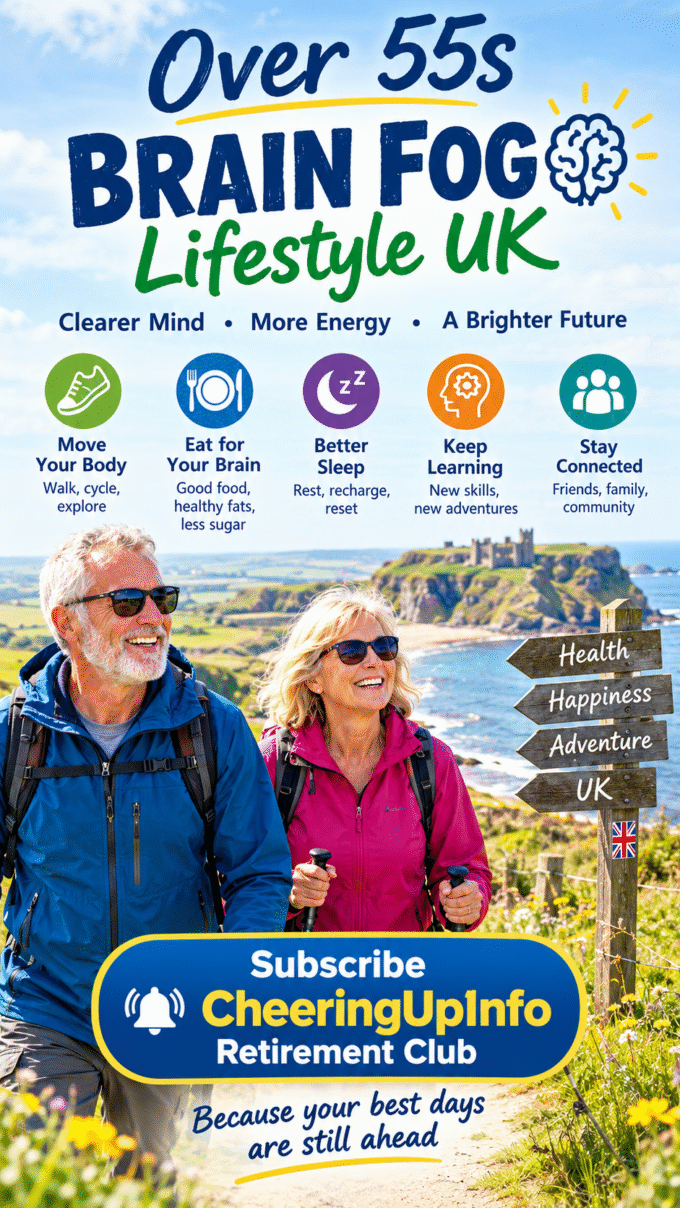
Brain fog, poor memory, dizziness and slow thinking affect many over 55s in the UK — but it is not just “getting old.” NHS, ONS and Age UK data point to sleep, movement, diet and social connection as the real drivers. CheeringUpInfo Retirement Club explores non-pharmaceutical lifestyle changes that improve cognition, balance and energy — and where to get free help in the UK.
CheeringupInfo Retirement Club recommends over 55s explore these type of problems and potential solutions to tackle such problems without pharmaceutical interventions.
The state you describe — brain fog, difficulty making decisions, feeling like life is in slow motion, lacking energy or desire yet still being quite happy with life, struggling to remember names or what you ate or past events, with occasional dizziness or poor balance — is not rare in the over 55s. And it does not mean “this is just getting old.”
Why does this “brain fog plus slow motion” state show up in the over 55s?
Because it is not one single cause — it is sleep, activity levels, social connection, diet and physiological changes stacking on top of each other.
NHS guidance states that menopause and perimenopause symptoms include “mood changes, memory and concentration problems,” and these are made worse by poor sleep and extreme tiredness. At the same time, Age UK data shows that 73% of people aged 55 to 64 report a health or wellbeing issue that has lasted or is expected to last 12 months or more, rising to 82% for ages 65 to 74. Among people aged 50 to 59, nearly one in five already have multiple long-term health conditions — and by age 80 and over, that becomes two in three. Ageing itself does not directly cause brain fog, but the life-pattern changes that come with it — less movement, shrinking social circles, fragmented sleep — are the key drivers.”It is not the years in your life that count. It is the life in your years.” — Abraham Lincoln
Why is sleep such an underrated piece of this?
Because sleep is when the brain clears metabolic waste and consolidates memory, and the sleep architecture of the over 55s has often already changed.
NHS sleep hygiene guidance from Imperial College Healthcare NHS Trust states clearly that adults aged 65 and over need 7 to 8 hours of sleep per night. The impact of poor sleep on the brain goes far beyond “feeling tired” — a review found that sleep loss leads to problems with alertness and daytime sleepiness, and is directly linked to cognitive impairment and higher error rates. But many over 55s do not think of themselves as “insomniacs” — they just sleep lightly, wake early, and get up frequently in the night. This “fragmented sleep” damages memory consolidation as much as a full night of insomnia. The guidance recommends: avoid caffeine after 4pm, avoid vigorous exercise 3 to 4 hours before bed, and avoid screens for 1 hour before sleep. These are not “wellness tips” — they are evidence-based interventions.
Why does “getting moving” do more for this than you might think?
Because there is a large body of high-quality evidence for exercise’s effect on brain cognition, and low-to-moderate intensity may work better than high intensity.
An analysis covering 133 systematic reviews, more than 2,700 randomised controlled trials and 258,000 participants found that regular physical activity produces significant benefits in three key areas: overall cognition, memory and executive function. More notably, low-to-moderate intensity activity may be better for brain health than vigorous exercise, with mind-body practices like yoga and tai chi performing particularly well in cognitive measures. UK Chief Medical Officer guidance stresses that muscle and bone strengthening and balance activities are essential for maintaining functional independence, because “the decline in muscle strength is a major factor limiting functional independence in older people.” NHS advice for the over 65s is: at least 2 days per week of strength, balance and flexibility activity, aiming for 150 minutes of moderate intensity activity per week. And the brain benefits of exercise arrive faster than you might expect — research shows cognitive improvements can appear after around 12 weeks of intervention.”Lack of activity destroys the good condition of every human being, while movement and methodical physical exercise save it and preserve it.” — Plato
What role do diet and social connection actually play?
Because brain health is not an isolated system — nutritional supply and social stimulation together maintain cognitive reserve.
The UK Food Standards Agency’s Eatwell guide divides food into five groups: fruit and vegetables; potatoes, bread, rice, pasta and other starchy carbohydrates; dairy and alternatives; beans, pulses, fish, eggs, meat and other proteins; and oils and spreads. The guide emphasises choosing wholegrain over refined grains, because wholegrain contains more fibre and nutrients, digests more slowly and keeps you fuller for longer. But the social dimension matters just as much. Cognitive health resources published by the UK Health Security Agency note preliminary evidence that leisure activities such as reading and games can benefit cognition in older adults, and that education, social or support programmes involving group participation can reduce social isolation. This resource, based on three systematic reviews from the University of Cambridge’s Institute of Public Health, explicitly recommends that public health messages promote “acceptable levels of physical activity above daily activity levels,” and that programmes can be designed to interlink — for example, a physical activity programme that also becomes an opportunity for social and mental activity.
Why do non-pharmaceutical changes work well, and how can you maximise the benefits?
Because the brain has neuroplasticity, lifestyle interventions act directly on modifiable risk factors, and they do not introduce drug side effects.
NHS Scotland guidance on insomnia in older people contains one key judgement: for older people, the beneficial effects of hypnotic drugs may not justify the increased risk of cognitive impairment and falls. This means the non-pharmaceutical path is not just an “alternative option” — in some cases it may be the safer and more effective first choice. Evidence-based non-pharmaceutical interventions for sleep include stimulus control, sleep restriction, cognitive therapy and progressive relaxation. On physical activity, the UK Health Security Agency notes that for the over 55s, dietary interventions may be particularly effective and sustainable when implemented during the retirement transition, and physical activity has evidence supporting maintenance or improvement of cognitive health and reduced dementia risk. When multiple behaviours change at once — movement plus diet plus social connection plus sleep — the cognitive benefits may produce an additive effect.
To maximise the benefits: stack the changes rather than doing them one at a time, use the retirement transition as a natural anchor point, choose low-to-moderate intensity over all-out effort, and link any physical activity to a social setting so one change serves two purposes.
Who will benefit most from these lifestyle changes?
Looking at the data, the biggest beneficiaries are exactly those at the “turning point” from healthy to unhealthy — recently retired or about to retire, social circles starting to shrink, sleep starting to lighten, aged 55 to 70.
Age UK’s analysis shows that 17% of people aged 50 to 59 already have multiple long-term health conditions, meaning intervention at this age could prevent or delay the slide into a more serious state. At the same time, ONS data from April 2025 shows that around 21% of people aged 50 to 69 report feeling lonely “often, always or sometimes.” The link between loneliness and cognitive decline has been confirmed by multiple studies. So the people who find themselves “unable to recall names, unable to remember what they ate yesterday, occasionally dizzy, but still feeling ‘fine'” are in the best intervention window. Not because they are “ill,” but because their baseline function is still high enough that small changes can produce large returns.
When and where can you get help to change your lifestyle?
You do not need a “diagnosis” to seek help — NHS social prescribing services and community programmes are designed exactly for this kind of “non-medical but life-affecting” situation.
A case study from NHS Hampshire and Isle of Wight’s social prescribing service shows 90 social prescribers working across GP surgeries, helping patients connect to local services including arts and crafts, writing, employment skills, healthy eating groups, group learning and physical activity. In the case study, one GP states plainly: “When patients come to me with depression and loneliness, prescribing medication is often not the right thing to do” — the social prescriber’s role is to offer “longer-term, sustainable solutions.” If you are concerned about dizziness or balance, NHS Falls and Syncope services offer one-stop assessment, including physiotherapy assessment, identification of gait and balance disorders, and podiatry. Services like TALKWORKS even allow self-referral without a GP referral, offering group courses for menopause-related brain fog and one-to-one treatment for sleep difficulties. What these services have in common is: they do not require you to be diagnosed with a disease before they will help you.”The greatest wealth is health.” — Virgil
Why does putting all these pieces together force a conclusion you cannot avoid?
Because each individual data point points in the same direction, and when taken together, the cost of doing nothing becomes clearly visible.
The UK Chief Medical Officer’s report calls “decline in muscle strength” “a major factor limiting functional independence in older people.” Age UK data shows 17% of people aged 50 to 59 already have multiple long-term conditions. ONS data shows 21% of people aged 50 to 69 feel lonely. BMJ analysis finds 12 weeks of exercise can improve cognition. The NHS states plainly that hypnotic drugs for older people may carry cognitive and falls risks that outweigh their benefits. The UK Health Security Agency recommends multi-component interventions — changing three or more health behaviours at once — may benefit maintenance of cognitive function.
Put these facts side by side, and no one needs to tell you “what you should do.” What you are facing is a situation with a clear pathway, a time window, and local services available. The only “risk” is continuing to wait, and letting a state that at 55 is just “occasionally forgetting names” slide into a state at 65 where multiple long-term conditions have stacked up.
Disclaimer
This article is for information only and does not constitute medical advice. It should not replace the diagnosis, treatment or advice of a qualified medical professional. If you have concerns about your cognitive function, balance problems, memory changes or any other health symptoms, please consult a GP or other qualified medical professional. All data, statistics and organisational information cited in this article are from public sources, but no guarantee is made as to their accuracy or completeness. Any consequences of acting or not acting on the information in this article are borne by the reader. The author, publishing platform and associated brands expressly disclaim any and all liability arising from the use of this content.
Get help to protect and grow your business faster with CheeringUpInfo Retirement Club
Subscribe for free retirement lifestyle improvement ideas reviews and cost of living reduction tips
Connect with us for free retirement lifestyle improvement tips
Read more retirement lifestyle improvement articles and view videos for free
STOP SCROLLING. 🛑
If you are over 55 and still say “I’m fine” — but you cannot remember what you ate yesterday, you have forgotten three names this week, and you feel like life is happening in slow motion — this post is going to sting a little.
Not because you are sick.
Because 17% of people aged 50 to 59 in the UK already have multiple long-term health conditions. (Age UK)
And because 21% of people aged 50 to 69 report feeling lonely “often, always or sometimes.” (ONS, April 2025)
And because NHS guidance openly states that for older people, sleeping tablets may carry cognitive and falls risks that outweigh their benefits.
Read that again.
So what is actually going on when you feel foggy, slow, dizzy, unmotivated — yet still quite happy with life?
Here is the part nobody tells you:
It is probably not one thing. It is four things stacking on top of each other.
1️⃣ Sleep — NHS says over 65s need 7 to 8 hours. But fragmented sleep (waking at 3am, light sleeping, early waking) damages memory consolidation just as badly as full insomnia.
2️⃣ Movement — A BMJ analysis covering 2,700+ trials and 258,000 participants found low-to-moderate intensity activity may beat vigorous exercise for brain health. And cognitive improvements can show up in just 12 weeks.
3️⃣ Diet — The UK Eatwell Guide splits food into 5 groups. Wholegrain over refined. Slower digestion. Longer fullness. More nutrients.
4️⃣ Social connection — UK Health Security Agency evidence shows group activities reduce social isolation — and that retirement transition is a prime window for diet and lifestyle intervention.
Now here is the twist that makes this impossible to ignore:
NHS Hampshire runs 90 social prescribers inside GP surgeries. One GP said plainly: “When patients come to me with depression and loneliness, prescribing medication is often not the right thing to do.”
TALKWORKS lets you self-refer — no GP needed — for sleep and menopause brain fog courses.
NHS Falls and Syncope services offer one-stop balance and dizziness assessment.
These services exist. They are free. And they do not require you to be “diagnosed” with anything before they will help you.
So the real question is not “Am I getting old?”
The real question is: “Why am I waiting?”
Every year you wait, the gap between “occasionally forgetting names” and “multiple long-term conditions” gets smaller.
👇 Here is your next step — and it takes 30 seconds:
Email editor@cheeringup.info with the subject line “OVER 55 BRAIN FOG” and tell us:
- Your age bracket (55–60, 60–65, 65+)
- Your #1 struggle (memory, sleep, balance, energy, or motivation)
- Whether you want local UK service signposting or lifestyle change tips
We will collate your feedback and tailor future articles to your needs.
CheeringUpInfo Retirement Club is where over 55s stop accepting “this is just ageing” — and start building the second half of life on purpose.
Email now: editor@cheeringup.info
Because the greatest wealth is health. And you still have time to spend it well. 💚
Disclaimer: This post is for information only and does not constitute medical advice. Always consult a GP or qualified professional about your health concerns.
Northumberland: where to get help
Social prescribing link workers are attached to GP surgeries across Northumberland. They can connect you to local groups, activities and support. The Northumbria PCN team covers Cramlington, Seaton Valley, Morpeth, Lynemouth and Pegswood — and you can self-refer by email or phone, no GP appointment needed .
Age UK Northumberland is the main county-wide organisation for over 50s. They run 14 social groups in places including Amble, Ashington, Blyth, Bedlington, Cramlington, Morpeth and Ponteland — with 304 members attending regularly across 7,252 contacts last year . They also offer Strength and Balance classes specifically for anyone who has had a fall or has balance problems , and their Head Office in Ashington runs exercise classes and a café.
For dizziness and balance specifically, there is an NHS Falls and Syncope service run by Northumbria Healthcare NHS Foundation Trust . Age UK Northumberland’s balance classes are county-wide and are the same evidence-based approach used to prevent falls .
Food and cooking: The Full Circle Food Project in Ashington runs hands-on cooking sessions for older people living alone, with an emphasis on health, taste and limited budgets . They also have a community garden and a cycle hub .
Men’s Sheds: There’s one in Bedlington (Earth Balance Shed, open Tuesdays 2-7pm and Fridays 2-4pm — just turn up) , and a new one launched in Amble in January 2026 .
Age UK Northumberland contact: 01670 784 800 or info@ageuk-northumberland.org.uk . Head office: The Round House, Lintonville Parkway, Ashington, NE63 9JZ .
If you email editor@cheeringup.info with “NORTHUMBERLAND” in the subject line and your specific struggle (balance, memory, energy, or social connection), we’ll point you in direction of more face-2-face and online opportunities to fight off brain fog.
Products and services to support a change in lifestyle
Here are eBay UK products that directly support the themes in the article — sleep quality, balance, movement, and monitoring.
Monitoring & Awareness
- OMRON X2 Blood Pressure Monitor — Easy-to-use upper arm monitor; one reviewer noted their doctor’s surgery recommended this brand. Useful for tracking the cardiovascular side of dizziness and brain fog.
- Braun Fingertip Pulse Oximeter — 94% would recommend; reviewers consistently mention its readings are “stable and consistent” compared to cheaper models. Good for monitoring oxygen saturation if you experience dizziness or breathlessness.
Sleep & Recovery
- Silentnight Weighted Blanket (6.8kg) — Specifically designed for wellbeing, with calming and soothing properties. Weighted blankets are widely used for sleep support.
- Bamboo Memory Foam Pillow — Anti-bacterial, supportive pillow aimed at improving sleep posture. Good neck alignment supports better sleep quality.
Balance & Stability
- CampTeck Balance Cushion Board — For balance training and rehab; one reviewer used it for knee rehab and another for ankle strengthening. Note: the included hand pump is consistently criticised as fragile — you may need your own pump.
- Maximo Exercise Mat (183x60cm) — Thick foam mat; reviewers note it’s “ideal for use on hard floors and beneficial for those with joint aches”. A safe surface for balance exercises at home.
Movement & Strength
- FitnessBug Resistance Loop Bands (Set of 5) — £3.99 for 5 bands at different resistance levels. One reviewer in their “early-mid sixties” recovering from a heart issue and dislocated shoulder said both consultants approved its use for regaining fitness. Another used them for gentle leg muscle maintenance when unable to weight-bear.
- 11pcs Resistance Bands Set with Handles & Door Anchor — More comprehensive set with handles and ankle straps, rated 4.4 stars from 119 reviews. Better for full-body seated or standing routines.

https://ebay.io/m/m3WF2U
As an eBay Partner, I may be compensated if you make a purchase
Daily Structure & Routine
- Medisure Weekly Pill Organiser Tower — A reviewer bought it for their husband to “save himself from messing around with too many boxes”. Even if you’re not on multiple medications, this can help structure daily supplements or vitamins.
- 12 Week Food Diary / Planner — For tracking what you eat when memory is unreliable.
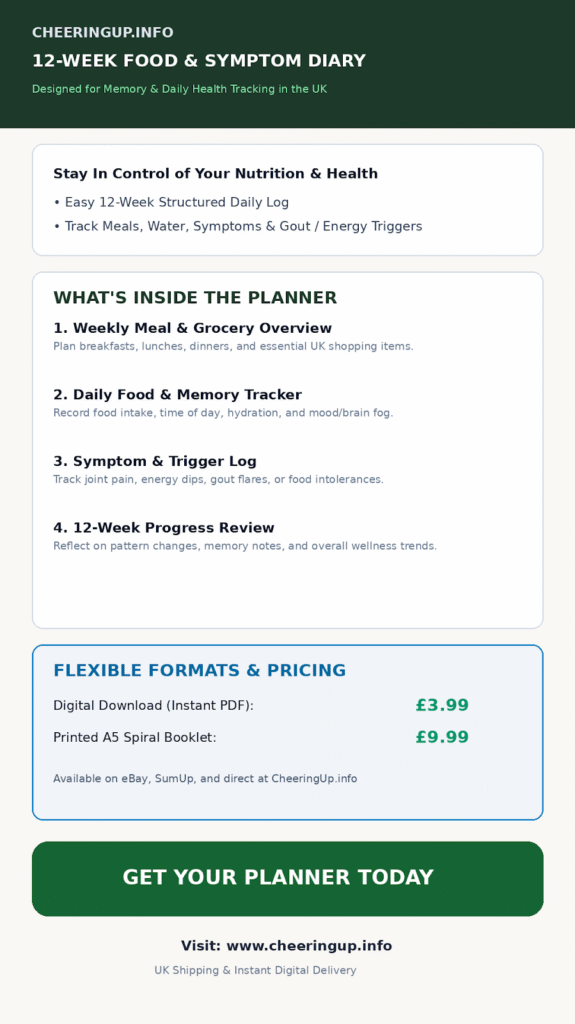
Practical tool for older adults who want to keep better records of their meals, hydration, energy, sleep and symptoms.
Struggling with Brain Fog After 55? Start Spotting Your Daily Patterns.
The CheeringUpInfo 12-Week Food Diary & Planner is a practical UK-focused printable PDF to help you record what you eat and drink, how you feel, and the patterns you notice over time.
- Track daily meals and snacks.
- Record hydration and brain-fog symptoms.
- Review weekly and monthly patterns.
- Take your completed diary to your GP if you want to discuss your observations.
Digital download — no postage required.
A personal tracking tool from CheeringUpInfo Retirement Club. It does not diagnose or treat medical conditions.
Email editor@cheeringup.info to order your planner for £3.99. Enter “12 WEEK PLANNER” in subject line of your email. We will send you PayPal invoice by email. When you’ve paid we’ll email the planner to you (no shipping costs – digital delivery by email only).
Cognitive Engagement
- Super Lateral Thinking Puzzles — 80+ brain-twisting puzzles designed to “develop well-honed mental skills”. Low-cost way to keep cognitive engagement going without screens.
What to prioritise:
If you want one starting point, the resistance bands give the most evidence-backed return for brain and body — low cost, physio-approved, and usable at home. Pair that with the food diary if memory of daily habits is your main frustration.
Brain Fog Over 55 UK: Non-Drug Fixes That Work | CheeringUp.info