UK Crypto Tax: How to Use ETNs in ISAs & SIPPs to Slash Your Capital Gains Bill

Master the new rules! Learn the step-by-step strategy for UK crypto investors to leverage FCA-approved Exchange-Traded Notes (ETNs) inside tax-free ISA and SIPP accounts, legally minimising Capital Gains Tax (CGT) exposure, and how to navigate the HMRC’s Bed and Breakfasting rules.

UK Crypto Tax Takedown: ISA & SIPP Strategies with Crypto ETNs 🚀

The Financial Conduct Authority’s (FCA) decision to lift the ban on the sale of crypto Exchange-Traded Notes (ETNs) to retail investors (effective October 8, 2025) has opened a crucial new avenue for UK crypto investors to manage their Capital Gains Tax (CGT) liability. By incorporating crypto ETNs into tax-advantaged wrappers like Stocks and Shares ISAs and SIPPs, investors can shield future profits from CGT and Income Tax.

The Game-Changer: Crypto ETNs in ISAs and SIPPs

Historically, UK retail investors could not hold cryptocurrencies directly within tax-efficient wrappers like a Stocks and Shares Individual Savings Account (ISA) or a Self-Invested Personal Pension (SIPP). Direct crypto holdings are subject to Capital Gains Tax (CGT) upon disposal (selling, swapping, or spending) above the annual exempt amount.

The regulatory change now allows retail access to crypto Exchange-Traded Notes (ETNs). These are debt instruments listed on an approved exchange that track the price of an underlying crypto-asset, such as Bitcoin or Ethereum. Critically, these ETNs qualify as eligible investments for a Stocks and Shares ISA and SIPP, subject to platform availability and passing an appropriateness test.

Tax WrapperBenefitTax Saving
Stocks & Shares ISAAny growth or profit is free from CGT and Income Taxindefinitely.Eliminates future CGT on gains.
SIPPGrowth is free from CGT and Income Tax. Contributions receive tax relief at your marginal rate.Eliminates future CGT and offers immediate income tax relief.

Step-by-Step Guide: The Crypto ‘Bed and ISA’ Strategy

The core tax-minimisation technique involves transferring your existing crypto holdings into the tax-free environment of an ISA or SIPP using a process similar to a “Bed and ISA” transaction. This involves selling your current crypto for cash and immediately using that cash to purchase the equivalent crypto ETN within your ISA/SIPP wrapper.

Disclaimer: The process below involves the sale of a chargeable asset (your original crypto) and may trigger a Capital Gains Tax event for that tax year. This guide is for informational purposes only. You must consult a qualified financial or tax advisor.

Step 1: Calculate Your Current Gain/Loss

Before selling your direct crypto holdings (e.g., Bitcoin held in a wallet or exchange), calculate the total Capital Gain or Loss realised from the sale. Remember to use HMRC’s matching rules (Same-Day, Bed and Breakfasting, and S104 Pool) to determine the correct acquisition cost.

  • Action: Determine the gain/loss of the crypto you plan to sell.

Step 2: Utilise the Annual CGT Allowance

Your goal is to realise capital gains up to your current Capital Gains Tax-free Annual Exempt Amount (AEA). Selling your crypto up to the AEA in profit is tax-free.

  • Action: Sell enough of your original crypto to utilise your full annual AEA. For example, if you have £10,000 of profit and the AEA is £3,000, sell the amount that generates a £3,000 gain.

Step 3: Sell Your Crypto for Fiat Currency

Sell the desired amount of your original crypto assets for fiat currency (GBP). This disposal formally realises the gain or loss.

  • Action: Execute the sale on your crypto exchange or wallet.

Step 4: Transfer Funds to Your ISA/SIPP Provider

Transfer the cash proceeds from the sale (and any new cash you plan to invest) to your chosen brokerage platform that offers the FCA-approved crypto ETNs and Stocks and Shares ISA/SIPP accounts. Ensure your investment remains within the annual ISA (£20,000) or SIPP allowance limits.

  • Action: Deposit the cash into the ISA/SIPP wrapper.

Step 5: Purchase Crypto ETNs in the Tax Wrapper

Use the cash inside your Stocks and Shares ISA or SIPP to purchase the equivalent Crypto ETN (e.g., Bitcoin ETN or Ethereum ETN).

  • Action: Buy the ETN immediately (or wait 30 days if concerned about the Bed and Breakfasting Rule for the tax loss harvest, see below). All future growth on this ETN is now tax-free.

Navigating HMRC’s Bed and Breakfasting Rules

The Bed and Breakfasting (B&B) rule is a critical piece of legislation to acknowledge, designed to prevent investors from selling an asset solely to claim a capital loss for tax purposes and then immediately repurchasing the same asset to maintain their position.

The 30-Day Matching Rule

HMRC’s rules state that if you sell a crypto asset and then reacquire the ‘same crypto-asset’ within 30 days, the sale will be matched to the new purchase price, overriding the original cost from your ‘S104 pool’ (pooled cost). This primarily impacts investors trying to harvest losses but also applies to gains.

  • Direct Crypto to Crypto ETN: Since a direct crypto-asset (e.g., Bitcoin) and a crypto ETN are considered different assets for CGT purposes (one is a crypto token, the other is an exchange-listed security/debt instrument), selling your original Bitcoin and immediately buying a Bitcoin ETN within your ISA/SIPP should not trigger the 30-day B&B rule. This allows you to immediately re-establish crypto exposure within the tax wrapper.
  • Tax Loss Harvesting Caution: If your initial sale in Step 3 resulted in a Capital Loss that you want to claim against other gains, you must be particularly cautious. While the ETN is a different instrument, some tax professionals recommend waiting the full 30 days to completely avoid any challenge from HMRC, especially if you had a significant capital loss. If the sale resulted in a Capital Gain up to your AEA, immediate repurchase via the ETN is a much safer strategy.

Key Takeaways for Tax-Efficient Crypto Investing

  1. Use Tax Wrappers: The primary benefit of crypto ETNs is accessing the zero-tax growth offered by Stocks and Shares ISAs and SIPPs. Max out your annual allowances.
  2. Tax-Free Gains Realisation: The ‘Bed and ISA’ equivalent transaction is the best way to move appreciated crypto into a tax-sheltered account, allowing you to use your Capital Gains Annual Exempt Amount on the initial disposal.
  3. Check Provider Eligibility: Not all UK brokers offer crypto ETNs within their ISA/SIPP products. You must confirm the availability and be prepared to pass an appropriateness test as these products are considered high-risk.
Social Media Hashtags
#CryptoETNTax
#UKISASIPP
#CGTMinimisation

Important Regulatory and Risk Disclaimer

This article is for educational and informational purposes only and does not constitute financial, investment, tax, or legal advice.

Cryptocurrency and related products like Exchange-Traded Notes (ETNs) are highly volatile, complex, and high-risk investments. You may lose all of your invested capital. The information provided herein is based on current UK tax and regulatory law (including recent FCA changes regarding retail access to crypto ETNs), which is subject to change.

Always seek independent advice from a qualified financial advisor, tax specialist, or accountant before making any investment decisions, especially those concerning Capital Gains Tax (CGT) and the use of tax wrappers like ISAs and SIPPs.

Neither the author nor the publisher accepts any liability whatsoever for any loss or damage of any kind arising out of the use of all or any part of the content. You are solely responsible for your investment decisions.

Get help to protect and grow your business faster with CheeringUpInfo

Find out more about growing your business faster with CheeringUpInfo

Subscribe for free lifestyle improvement ideas reviews and money saving deals

Connect with us for free lifestyle improvement tips

Read more lifestyle improvement articles and view videos for free

Connect with us for free alerts to new lifestyle improvement articles and videos

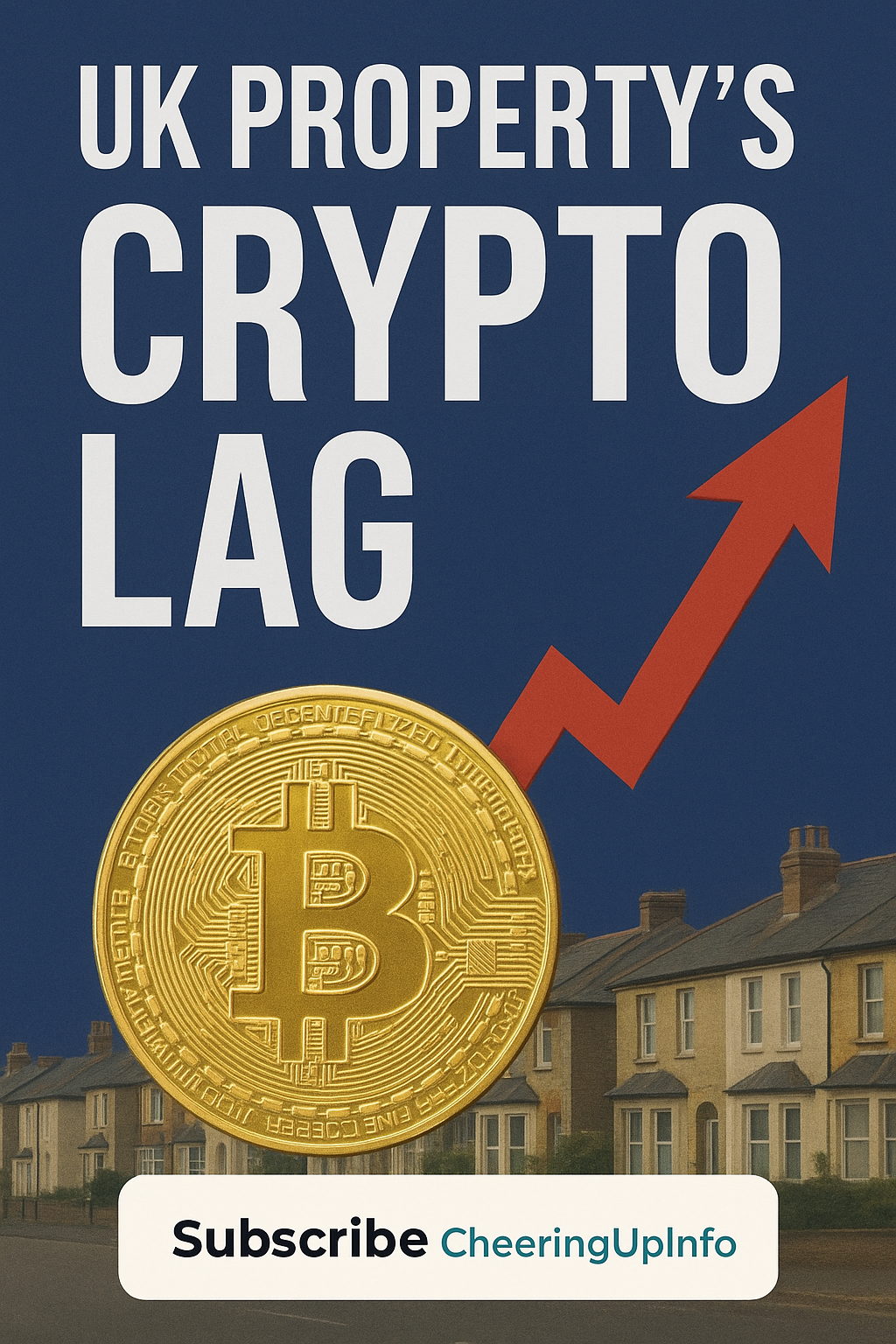
UK Property’s Crypto Lag

UK investors guide to buying fractional real estate with cryptocurrency

The Property Revolution: Why the UK is Lagging in the Crypto-Real Estate Gold Rush

For centuries, real estate has been a bastion of stability for UK investors, a tangible asset resistant to the fleeting whims of markets. But while the British property market remains steeped in tradition, a digital storm is brewing across the Atlantic, threatening to make our venerable system look like a horse and buggy. The question isn’t whether crypto and NFTs will disrupt real estate; it’s why UK investors aren’t already cashing in on the inevitable.


The American Experiment: Where Crypto Meets the Deed

In the United States, a handful of forward-thinking companies have already sold properties via Non-Fungible Tokens (NFTs), proving that a crypto wallet can be just as valid as a property deed. Platforms like Propy have facilitated entire home sales, with the ownership encoded into a unique digital token. While these are still nascent and often require a legal framework, they serve as a live-fire experiment for what the future holds: faster, cheaper, and more transparent transactions.

The true revolution, however, is tokenisation. This process breaks down a single property into hundreds or thousands of digital tokens. Each token represents a fractional share of the asset. This has spawned a new class of platforms that allow everyday investors to own a portion of a high-value property—be it an apartment building in Manhattan or a commercial space in San Francisco—for a fraction of the cost. More importantly, these tokens can be programmed to automatically distribute rental income to token holders, creating a passive revenue stream that is both efficient and globally accessible.


The British Backwater: Legal Barriers to a Digital Frontier

While the U.S. market pushes the boundaries, the UK is proceeding with caution, hamstrung by a legal and regulatory environment not yet fit for the digital age. UK law requires that real estate transfers are recorded in writing and registered with a central body, the Land Registry. This system, while secure, is not designed to handle the instantaneous, micro-transactions of a blockchain-based property market.

The central challenge for UK investors is the disconnect between the digital token and the legal deed. A token might represent a share of ownership in a Special Purpose Vehicle (SPV)—a legal entity that owns the property—rather than direct legal ownership of the bricks and mortar itself. This layered approach is a workaround, but it raises a critical question: is your investment truly in the property, or just in a company that owns the property? Until the UK’s legal framework for property ownership evolves, investors must scrutinise the fine print to understand what rights they are actually acquiring.


The Unstoppable Tide: Liquidity and Accessibility

Despite the current hurdles, the promise of tokenisation is too great to ignore. Traditional real estate is notoriously illiquid; it can take months to sell a property. Tokenised real estate, however, can be traded on a digital exchange in minutes, offering an unprecedented level of fluidity for what was once a very static asset class.

For UK investors, this presents a powerful opportunity. Instead of putting all your capital into a single, expensive buy-to-let property, tokenisation allows for radical portfolio diversification. You could own a share of a London high-rise, a student accommodation block in Manchester, and a luxury villa in Spain, all from a single platform, with a much lower initial investment. The potential for a global, accessible, and liquid property market is the most compelling argument for embracing this technology, and it’s an opportunity UK investors can’t afford to miss.

Personal Finance Magazine articles and videos to inform your wealth creation and retention

Join our Lifestyle Improvement Club to improve your lifestyle in the UK with less uncertainty

Subscribe for free lifestyle improvement tips products and services reviews and money saving ideas

Connect with us for free lifestyle improvement tips

Get help to protect and grow your business faster

Find out more about Lifestyle Improvement Corporate Membership

Read more lifestyle improvement articles and view videos

Connect with us for more free lifestyle improvement articles and videos

What is the flag theory?

What is the flag theory strategy?

Unveiling the Secrets of Freedom: A Deep Dive into Nomad Flag Theory

In an age of accelerating globalisation and unprecedented technological advancements, the traditional concept of a fixed national identity is undergoing a profound transformation. The rise of remote work, digital nomadism, and borderless lifestyles has spurred a growing interest in Flag Theory, a strategic approach to optimising one’s residency, citizenship, and financial affairs across multiple jurisdictions.

What is Flag Theory?

At its core, Flag Theory is the practice of diversifying one’s geographical footprint across different countries to reap the benefits of their unique tax regimes, business environments, visa-free travel opportunities, and overall quality of life. It is not about abandoning one’s national identity entirely, but rather about creating a flexible and advantageous portfolio of flags that aligns with one’s personal and professional goals.

The 5 Pillars of Flag Theory

The Flag Theory framework is anchored by five key pillars, each representing a crucial aspect of international diversification:

  1. Residency: Establishing physical presence in countries with favourable residency programmes that offer tax breaks, simplified visa procedures, and access to healthcare and other social benefits.
  2. Citizenship: Obtaining a second passport or dual citizenship for wider visa-free travel, enhanced asset protection, and potential business expansion opportunities.
  3. Banking: Diversifying bank accounts across different jurisdictions to mitigate currency risks, benefit from favourable interest rates, and ensure access to international financial services.
  4. Assets: Distributing assets globally across countries with stable economies, political climates, and legal systems to safeguard wealth and facilitate inheritance planning.
  5. Business: Registering companies in jurisdictions with low corporate taxes, streamlined regulations, and access to target markets to optimise business operations and maximise profits.

The 5 Flags Deal: A Roadmap to Freedom and Prosperity

The 5 Flags Deal framework builds upon the core principles of Flag Theory, providing a more structured approach to international diversification. It involves strategically selecting five countries across different regions, each catering to a specific aspect of your life and goals:

  1. Residency Flag: A country with a welcoming residency programme offering low taxes, visa-free travel to desired destinations, and a high quality of life.
  2. Citizenship Flag: A country with a straightforward and affordable citizenship by investment programme, granting visa-free access to key regions and enhanced global mobility.
  3. Banking Flag: A country with a stable financial system, strong banking secrecy laws, and favourable interest rates for secure wealth storage and financial management.
  4. Asset Protection Flag: A country with a robust legal system, political stability, and asset protection mechanisms to safeguard your wealth from potential legal or financial disputes.
  5. Business Flag: A country with a thriving entrepreneurial ecosystem, low corporate taxes, and easy company registration processes to facilitate business growth and expansion.

The Power of Diversification: Why Flag Theory Matters

By adopting a Flag Theory approach, individuals and businesses can unlock a multitude of benefits:

  • Tax Optimisation: Reduce your overall tax burden by leveraging residency programmes, tax havens, and strategic asset placement.
  • Enhanced Mobility: Enjoy visa-free travel to a wider range of countries, expanding your personal and professional horizons.
  • Asset Protection: Safeguard your wealth from legal or financial challenges by diversifying your asset portfolio across stable jurisdictions.
  • Business Expansion: Access new markets, attract international investors, and streamline business operations through strategic company registration.
  • Peace of Mind: Achieve greater financial security, global flexibility, and freedom from restrictive government regulations.

A Quote on the Power of Flag Theory

“Flag Theory is not about running away from your problems, but about creating options and opportunities for yourself and your family. It’s about taking control of your life and designing an environment that supports your values, goals, and aspirations.” – Andrew Henderson, International Tax Attorney

Examples of Countries to Consider for Each Flag

The choice of countries for your 5 Flags Deal will depend on your individual circumstances, goals, and risk tolerance. However, some popular options include:

  • Residency Flags: Portugal, Panama, Thailand, Costa Rica, Malta
  • Citizenship Flags: Dominica, St. Lucia, Grenada, Antigua and Barbuda, Ireland
  • Banking Flags: Switzerland, Singapore, Hong Kong, Liechtenstein, Cayman Islands
  • Asset Protection Flags: New Zealand, Switzerland, Isle of Man, Cook Islands, Cayman Islands
  • Business Protection Flags: Depend on type of business, attitude to risk and the reach you want for your business.

Get help to protect and grow your business

Find Out More

Subscribe for fee lifestyle improvement tips and reviews

Contact Us

Read more lifestyle improvement articles

Contacts Us