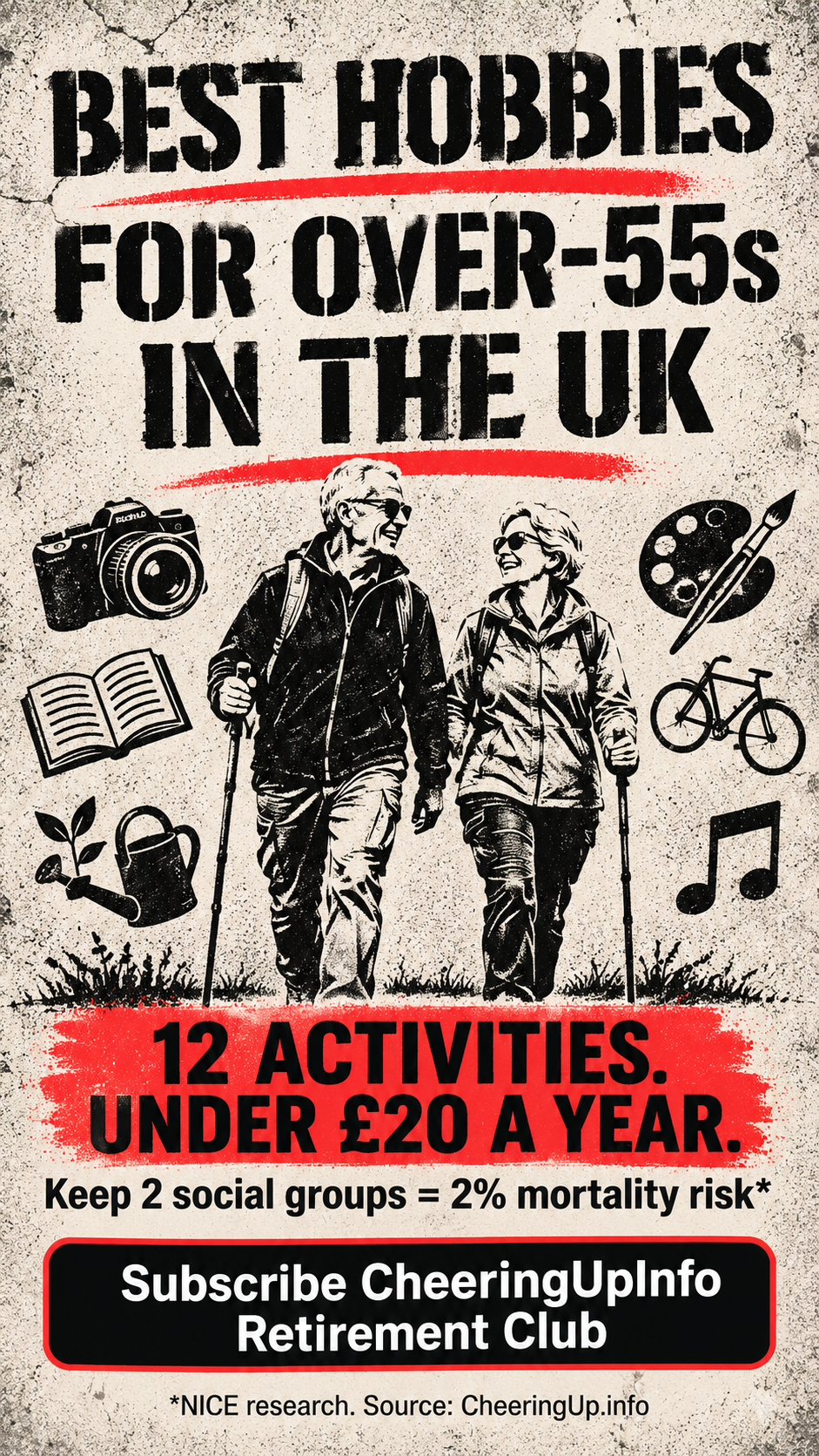
Looking for hobbies for over-55s in the UK? Explore 12 top activities, how to master them, cut costs and where to start. Backed by UK health research.
CheeringupInfo Retirement Club recommends the best hobbies and activities for over 55s in the UK. A growing body of UK evidence shows that taking up a hobby in later life is not just about filling time—it is a proactive health decision. According to NICE, every social group membership lost after retirement is associated with a 10% drop in quality of life six years later, while keeping two group memberships can reduce mortality risk to just 2% . As the philosopher Bertrand Russell once said, “The secret of happiness is this: let your interests be as wide as possible.” This guide explores why new activities matter, 12 of the best options for over-55s, and exactly how to master them, minimise costs, and choose the best times and places.
Why Should You Consider a New Hobby or Activity to Improve Your Later Life Lifestyle?
You should consider a new hobby because UK research proves that staying socially connected and mentally stimulated in later life directly reduces mortality risk and improves quality of life. While the ONS reports that loneliness rates are actually lower among older adults (19% for ages 50-69 and 16% for 70+) compared to younger age groups , isolation remains a hidden risk for those who lose workplace networks. The University of Queensland study, highlighted by NICE, tracked retirees for six years and found that maintaining group memberships had an impact on health comparable to physical exercise . Furthermore, the Third Age Trust notes that lifelong learning is recognised by the World Health Organisation as the fourth pillar of active ageing, alongside health, participation, and security . As the poet Henry David Thoreau observed, “It is not enough to be busy; so are the ants. The question is: what are we busy about?” Choosing purposeful hobbies ensures your time is spent building health, not just passing it.
12 Best Hobbies and Activities for Over-55s in the UK (and How to Be Good at Them)
The 12 best hobbies for over-55s in the UK are walking, gardening, reading, cycling, swimming, yoga, cooking, volunteering, U3A learning, birdwatching, arts and crafts, and local history. Each offers a distinct blend of low-cost access, physical or cognitive benefit, and social opportunity suited to the UK’s climate and infrastructure.
- Walking (The Most Accessible Activity)
- Walking is the best hobby because it is free, requires minimal gear, and can be done anywhere in the UK. Aviva’s 2023 survey found walking is the most popular hobby, with 51% of UK adults participating, and the average equipment cost is only £96 .
- How to be good at it: Start with the NHS “Couch to 5K” style approach—short, flat routes first. Invest in a pair of well-fitting walking shoes. Use apps like Komoot or OS Maps to find local routes. To improve, gradually increase distance and incorporate gentle hills.
- Cost minimisation: Use free apps and online route guides. Wear comfortable existing clothing initially. Avoid expensive “hiking fashion” until you are sure you enjoy it.
- Best time: Late morning or early afternoon on dry days. Avoid icy winter mornings.
- Best places: Local parks, canal towpaths, National Trust grounds (free for members), and the UK’s extensive public footpath network.
- Gardening (Therapeutic and Productive)
- Gardening is a top hobby because it provides moderate exercise, exposure to fresh air, and a tangible sense of purpose. Aviva found 31% of UK adults garden, with average equipment costs around £191 .
- How to be good at it: Start with container gardening or raised beds to avoid straining your back. Learn about UK-specific planting seasons (e.g., bulbs in autumn). Visit local allotment societies for advice.
- Cost minimisation: Swap seeds and cuttings with neighbours. Use household items (yogurt pots) for seedlings. Buy second-hand tools from car boot sales or charity shops.
- Best time: Spring and early summer for planting; autumn for bulb planting and pruning.
- Best places: Your own garden, a local allotment (waiting lists vary, but highly cost-effective), or community gardens.
- Reading (Cognitive Maintenance)
- Reading is a superb hobby because it keeps the mind active and is exceptionally cost-effective. Analysis shows reading costs roughly £0.58 per hour if buying books, or free if using a library .
- How to be good at it: Join a library. Try audiobooks if eyesight is a concern. Set a gentle goal (e.g., 20 pages a night). Explore genres you never had time for during your working years.
- Cost minimisation: Use your local council library—it is entirely free. Use charity shops (Oxfam Books) or digital library apps like Libby.
- Best time: Anytime; particularly relaxing in the evening or on rainy afternoons.
- Best places: Local libraries, comfortable armchairs at home, or community book clubs.
- Cycling (Low-Impact Fitness)
- Cycling is excellent because it builds cardiovascular health without stressing joints. While startup costs vary, a decent bike ridden regularly can cost under £1 per hour over its lifespan .
- How to be good at it: Consider an electric bike if hills are daunting. Start on traffic-free trails (e.g., old railway lines). Practise signalling and basic maintenance.
- Cost minimisation: Buy a second-hand bike from a reputable shop. Use the Cycle to Work scheme if you are semi-retired but still employed. Avoid Lycra; wear comfortable athletic clothes.
- Best time: Spring through autumn; midday on weekdays when trails are quieter.
- Best places: Sustrans traffic-free routes, canal paths, and country parks.
- Swimming (Full-Body, Zero-Impact)
- Swimming is ideal because it works every muscle group without jarring knees or hips. Many UK councils offer discounted leisure passes for over-60s.
- How to be good at it: Focus on technique over speed. Consider adult lessons if your stroke is rusty. Use a pull-buoy or kickboard to isolate parts of your stroke.
- Cost minimisation: Look for “50+ Active” or “Senior” memberships at local authority leisure centres. These are heavily subsidised compared to private gyms.
- Best time: Early morning or mid-afternoon (avoid after-school hours if you prefer quiet lanes).
- Best places: Council-run leisure centres and lidos (in summer).
- Yoga or Tai Chi (Balance and Flexibility)
- Yoga and Tai Chi are highly recommended because they directly combat age-related balance loss and falls. Home practice is extremely cheap, with startup costs around £60 for a mat and blocks .
- How to be good at it: Look for “Chair Yoga” or “Gentle Yoga” classes specifically for over-55s. Consistency (10 minutes daily) beats a 90-minute weekly session.
- Cost minimisation: Use YouTube (search “Yoga with Adriene” or “SilverSneakers”) for free classes. Buy a mat from a discount retailer.
- Best time: Morning to wake up the body, or evening to wind down.
- Best places: Local community halls, community centres, or your living room.
- Cooking and Baking (Nutrition and Creativity)
- Cooking is a valuable hobby because it improves nutrition and offers immediate tangible rewards. While it can cost more than basic cooking, the “cost per hour” is offset by the fact that you eat the results .
- How to be good at it: Master a few “base” recipes (e.g., a good soup, a roast chicken). Learn to season properly. Take a short course at a local adult education centre.
- Cost minimisation: Plan meals around supermarket reductions. Use cheaper cuts of meat for slow cooking. Share bulk purchases with a friend.
- Best time: Weekday afternoons for meal prep; weekends for baking projects.
- Best places: Your kitchen, or community cooking classes (often run by councils or charities).
- Volunteering (Purpose and Connection)
- Volunteering is one of the most rewarding hobbies because it creates a strong sense of purpose and combats isolation. Cheshire West and Chester Council’s JSNA notes that volunteering is “very popular” among the over-65s and is a huge potential resource .
- How to be good at it: Match your skills to the role (e.g., former accountants can help small charities with bookkeeping). Start with a few hours a month to avoid burnout.
- Cost minimisation: Volunteering is generally free; some roles even reimburse travel expenses.
- Best time: Weekdays (when many organisations need help most).
- Best places: Charity shops, National Trust properties, local food banks, or school reading programmes (NICE specifically recommends intergenerational reading help) .
- U3A (University of the Third Age) Learning
- U3A is uniquely suited to over-55s because it offers peer-led learning with no qualifications required—just interest. With over 400,000 members across 1,000 local groups, U3A is a proven model for keeping mentally active and socially connected .
- How to be good at it: Try a few different interest groups (e.g., history, philosophy, birdwatching) before committing. Offer to lead a group if you have a professional skill to share.
- Cost minimisation: Membership fees are typically very low (often £20-£30 per year) and cover all groups.
- Best time: Monthly meetings are usually held on weekday mornings or afternoons.
- Best places: Local church halls, community centres, and libraries (check the U3A website for your nearest branch).
- Birdwatching (Mindful Observation)
- Birdwatching is an excellent low-cost hobby because it requires only binoculars and patience, and gets you outdoors. Data from North Yorkshire suggests that older age groups particularly enjoy exploring the natural world for relaxation .
- How to be good at it: Learn 10 common garden birds first. Use the RSPB’s free online identifier. Keep a simple notebook of what you see and when.
- Cost minimisation: Start with a cheap pair of binoculars from a charity shop. Use the RSPB’s free reserves (many have no entry fee, only car parking charges).
- Best time: Early morning is best for bird activity; spring and winter offer different species.
- Best places: RSPB reserves, local nature reserves, and even your own garden.
- Arts and Crafts (Fine Motor Skills and Focus)
- Arts and crafts are beneficial because they maintain fine motor skills and provide a meditative focus. Council data shows arts and crafts are among the most popular activities for residents over 55 .
- How to be good at it: Choose one medium (e.g., watercolour or knitting) and practise weekly. Perfection is not the goal; engagement is.
- Cost minimisation: Use starter kits from budget shops. Look for “destash” groups on social media where hobbyists sell unused supplies cheaply.
- Best time: Anytime; particularly good for dark winter evenings.
- Best places: Local craft groups, community centres, or at home with a radio on.
- Local History (Cognitive Engagement)
- Local history is a fantastic hobby because it connects you deeply to your community and keeps the brain sharp. Many libraries and archives offer free access to local records.
- How to be good at it: Start with your own street or family. Visit the local council’s archive or library. Join a local history society.
- Cost minimisation: Libraries offer free access to ancestry websites (often onsite only). Second-hand books on local history are plentiful.
- Best time: Weekdays for quiet archive access.
- Best places: County record offices, local studies libraries, and historic churches.
What Tips Can You Recommend to Minimise the Cost of These Hobbies and Activities?
You can minimise the cost of hobbies by prioritising free community resources, buying second-hand equipment, and avoiding the trap of “gear obsession.” Aviva’s data reveals that while walking equipment averages just £96, many Brits overspend on hobbies they later abandon . Here is how to keep costs down:
- Use the Library First: Libraries are not just for books; many lend tools, offer free digital courses, and host craft groups.
- Buy Second-Hand for Starters: For cycling, gardening, or birdwatching, check charity shops, Facebook Marketplace, or Freecycle before buying new. You do not need top-tier gear to start.
- Look for “50+ Active” Council Schemes: Many local authorities heavily subsidise swimming, gym, and exercise classes for older residents to improve public health. Ask your council’s leisure team.
- Join a U3A Group: For a tiny annual fee, you get access to dozens of interest groups (from walking to genealogy) without paying per-session fees .
- Volunteer to Learn: If you want to learn gardening, volunteer at a National Trust garden or community allotment. You get free training and social contact.
When Is the Best Time to Partake in These Hobbies and Activities?
The best time to partake is generally mid-morning to early afternoon on weekdays, as this avoids crowds, maximises natural light, and aligns with the operating hours of community groups. For outdoor activities like walking and gardening, late morning after the dew has lifted is safest for preventing slips. For indoor activities like swimming or U3A meetings, weekday sessions are quieter and less rushed than weekends. If you are exploring local history or archives, weekday opening hours are essential. During the winter months, prioritise indoor hobbies or outdoor activities around midday when the sun is highest, to maintain vitamin D levels and mood.
Where Are the Best Places to Do These Activities and Hobbies?
The best places to do these activities are local community venues—council leisure centres, libraries, U3A halls, and public footpaths—because they are accessible, affordable, and foster local connection. Data from Cheshire West and Chester Council emphasises that groups and activities need to be “local” for older residents, drawing on community strengths . North Yorkshire data shows the majority of older people prefer taking part in physical activity outdoors in the natural environment or at home .
- For Physical Activity: Council leisure centres (for subsidised swimming and classes), local parks, and traffic-free cycling trails.
- For Social Connection: U3A meeting halls, local libraries (which often host coffee mornings and craft groups), and community centres.
- For Nature and Solitude: RSPB reserves, National Trust gardens (membership is cost-effective if you visit often), and public footpaths.
- For Learning: Local libraries, council adult education centres, and online platforms (for those less mobile).
Who Will Enjoy These Tips?
These tips will be enjoyed by anyone over 55 in the UK who is approaching retirement or already retired, particularly those who want to stay healthy on a budget, make new friends, or simply find joy in a new challenge. This includes:
- The Recently Retired: Those who have lost their daily work social network and want to rebuild connections (NICE research shows this is a critical time to maintain group memberships) .
- The Budget-Conscious: Individuals who want to stay active but are wary of rising living costs—our focus on library use, second-hand gear, and council subsidies is designed for you.
- The Solo Adventurer: People who want to try new things but may not have a partner to join them. U3A and volunteering groups are welcoming to solo attendees.
- The Health-Focused: Those looking to manage blood pressure, maintain mobility, or keep their mind sharp. As the saying goes (often attributed to Hippocrates), “Walking is man’s best medicine.”
Final Recommendation: Start with just one activity. Choose the one that feels easiest and most enjoyable—likely walking or a local U3A meeting. Give it three weeks. The goal is not to become an expert, but to become a regular.
#Over55sHobbies #RetirementUK #RetirementClub #RetirementTV #RetirementMagazine
Source list with clickable links for the key claims in the article
National Institute for Health and Care Excellence (NICE)
- Link: https://www.nice.org.uk/news/article/membership-of-social-groups-after-retirement–boosts-health-and-wellbeing-
- Used for: The statistic that every group membership lost after retirement is associated with a 10% drop in quality of life six years later, and that keeping two group memberships reduces mortality risk to 2% (rising to 5% and 12% if groups are lost) .
Aviva - Link: https://www.aviva.com/newsroom/news-and-research-overview/news-releases/2023/04/uk-homes-are-host-to-46-billion-of-hobby-equipment/
- Used for: Walking being the most popular hobby (51% of UK adults) with average equipment costs of £96, and gardening being pursued by 31% with average costs of £191 .
Office for National Statistics (ONS) - Link: https://www.ons.gov.uk/peoplepopulationandcommunity/wellbeing/bulletins/publicopinionsandsocialtrendsgreatbritain/january2025
- Used for: Loneliness rates by age group, showing 17% for ages 50-69 and 17% for ages 70+ .
U3A (via local directory listing) - Link: https://www.yournottsdirectory.org.uk/directory/services/u3a-the-university-of-the-third-age
- Used for: U3A having over 450,000 members across 1,057 local groups, with membership costing less than £20 on average per year .
Sustrans - Link: https://www.sustrans.org.uk/our-blog/national-cycle-network-route-collections/2024/all/our-favourite-low-traffic-walking-and-cycling-routes-for-summer/
- Used for: The National Cycle Network providing over 5,220 miles of traffic-free routes suitable for walking and cycling .
RSPB (via Visit Scotland listing) - Link: https://www.visitscotland.com/info/see-do/rspb-scotland-wood-of-cree-nature-reserve-p582061
- Used for: Example of RSPB reserves offering free entry and parking (donations welcome), though note some reserves like Dungeness now charge for parking .
Get help to protect and grow your business faster with targeted advertising and marketing at older age group in UK
Get help to protect and grow your business faster with CheeringUpInfo Retirement Club
Subscribe for free retirement lifestyle improvement ideas reviews and cost of living reduction tips
Connect with CheeringUpInfo for free retirement lifestyle improvement tips
Read more retirement lifestyle improvement articles and view videos for free
Stop calling retirement “the quiet years.” That’s the exact mindset that costs UK retirees their health, their friends and their quality of life.
Here’s what nobody tells you: NICE research found that every social group you lose after retirement is linked to a 10% drop in quality of life six years later. Keep two groups, and your mortality risk sits at just 2%. Lose them, and it climbs to 5%… then 12%.
That’s not a hobby problem. That’s a survival problem.
So we built the fix. CheeringUpInfo Retirement Club has pulled together the 12 best hobbies and activities for over-55s in the UK — and unlike most lists, this one tells you the three things that actually matter:
- How to be genuinely good at it (not just “give it a go”)
- How to do it for almost nothing (libraries, council 50+ schemes, second-hand gear)
- Exactly when and where to start (mid-morning weekdays, local venues, traffic-free routes)
The numbers are stark and specific:
- Walking: 51% of UK adults do it, average kit cost just £96
- Gardening: 31% of UK adults, average £191
- Reading: roughly £0.58 per hour — or £0 at your local library
- U3A: 450,000+ members, membership under £20 a year
The cheapest hobbies on this list are also the ones with the strongest health evidence. Walking, volunteering, U3A learning, birdwatching. None of them require a single new purchase to begin this week.
Bertrand Russell said it best: “The secret of happiness is this: let your interests be as wide as possible.”
Be honest with yourself:
👉 Which of the 12 have you already abandoned once?
👉 Which one could you realistically start in the next 7 days?
👉 And which one have you quietly told yourself you’re “too old” for?
Because that last one is the only real barrier on the list.
Don’t just scroll past. Email editor@cheeringup.info for more information on CheeringUpInfo Retirement Club.
One hobby. Three weeks. That’s the whole plan.
#Over55sHobbies #RetirementUK
Best Hobbies for Over-55s in the UK: 12 Ideas & Tips