
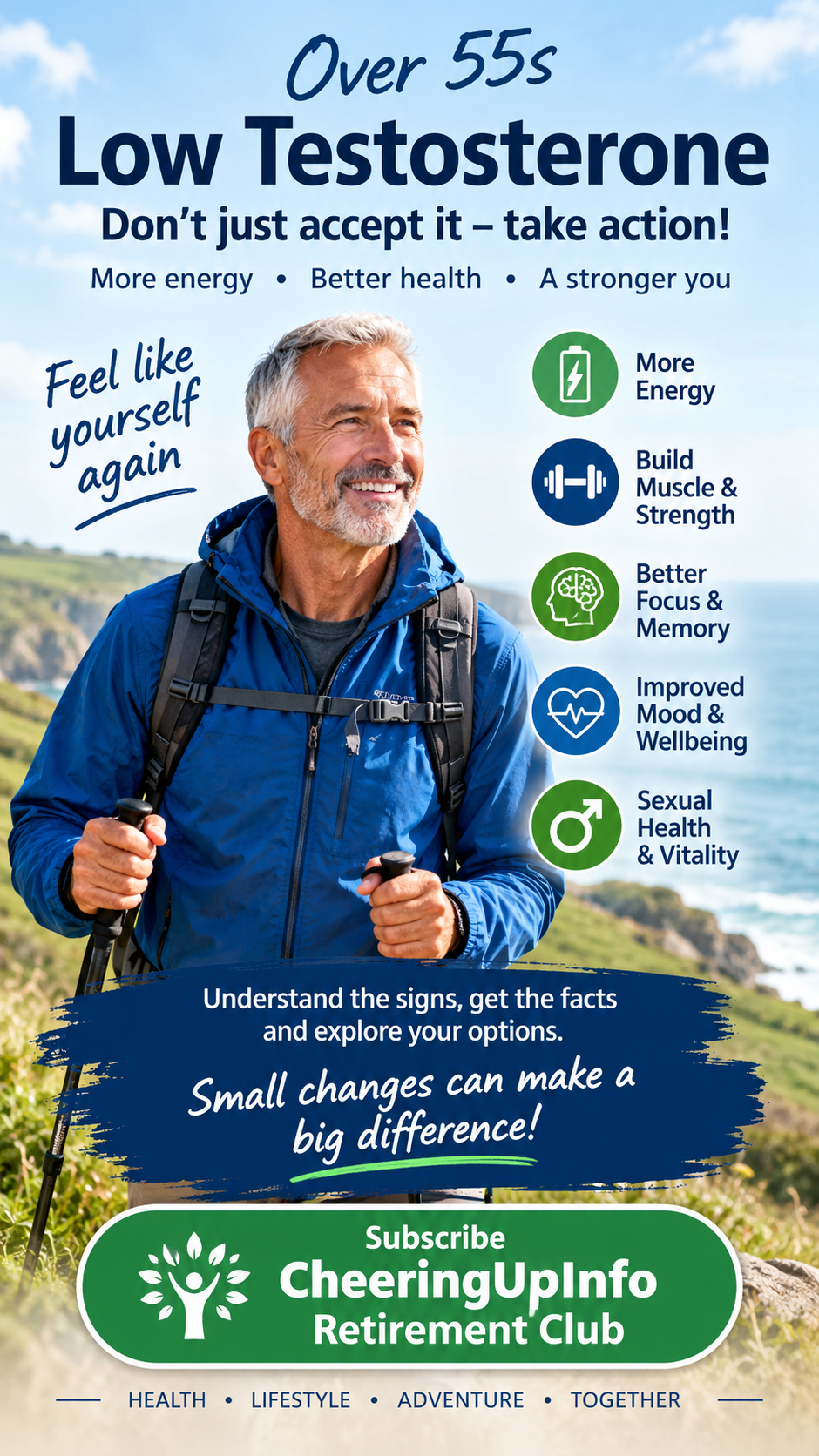
Testosterone isn’t just a male hormone—it matters for women too. After 55, levels decline in both sexes, affecting energy, mood, muscle, bones, and libido. In the UK, testosterone prescriptions have soared, yet CheeringUpInfo Retirement Club recommends natural, non-pharmaceutical solutions first. Discover why testosterone drops, who benefits most, and 9 evidence-based ways to boost it naturally for better health in later life. Includes UK government, NHS, and independent research stats. Information only—not medical advice.
CheeringupInfo Retirement Club recommends natural non pharmaceutical ways as the solution to the problem of low testosterone levels in the over 55s UK.
Testosterone is not just a “male hormone.” It is a vital hormone for both men and women, influencing energy, mood, muscle strength, bone density, and sexual function throughout life. For the over-55s in the UK, declining testosterone levels can quietly erode quality of life, yet pharmaceutical testosterone prescribing is rising rapidly—community dispensing in England jumped by 52% between 2020-21 and 2024-25, with the UK market valued at around $205 million in 2024 . The NHS spent £30.1 million on testosterone prescriptions for men in 2025 alone . Before turning to lifelong pharmaceutical interventions, CheeringupInfo Retirement Club recommends evidence-based natural strategies that address the root causes of declining testosterone.
Why Do Testosterone Levels Drop in Both Men and Women Over 55?
Testosterone levels drop in both men and women over 55 because of a combination of chronological ageing, hormonal shifts specific to each sex, and—crucially—accumulating lifestyle and metabolic factors that suppress natural production. In men, testosterone declines gradually from around age 30, but research from a UK study of 973 community-dwelling men found that approximately 25% of men over 40 experience low testosterone . By the time men reach their 50s, reference ranges shift downward: the normal range for men over 49 is 7.7–24.8 nmol/L, compared with 8.3–30.2 nmol/L for those aged 19–49 . For women, testosterone production from the ovaries and adrenal glands declines steadily through the reproductive years and drops more sharply after menopause—particularly following surgical menopause, when production decreases by more than 50% . However, a 2025 study published in Urology found that obesity, not ageing alone, was the most robust predictor of low testosterone in older men; the prevalence of low testosterone rose from 8% in men with a waist circumference ≤93 cm to 44% in those with ≥110 cm . This challenges the fatalistic view that low testosterone is simply an inevitable consequence of getting older.
Why Is Declining Testosterone a Problem for Older Adults in the UK?
Declining testosterone is a problem for older adults in the UK because it is linked to a cascade of physical and psychological consequences that reduce independence, increase NHS costs, and diminish quality of life. For men, testosterone deficiency can cause reduced libido, erectile dysfunction, fatigue, reduced energy, depressive symptoms, loss of muscle mass, increased visceral fat, and reduced bone density . For women, NHS Scotland guidelines recognise that testosterone deficiency contributes to low sexual desire, tiredness, depression, cognitive problems, osteoporosis, and sarcopenia . The economic implications are significant: with an ageing UK population, the burden of managing frailty, falls, fractures, and metabolic disease places enormous pressure on NHS resources. The BMJ warns that rising commercial testosterone prescribing risks “broadening treatment from men with well characterised hypogonadism to people with non-specific symptoms and borderline biochemical findings, for whom the balance of benefit and long term risk are less certain” .
What Historical Figures Have Said About Ageing and Vitality?
Historical figures have long recognised the connection between hormonal vitality and ageing, with observations that resonate with modern science. The concept that the testes contain a substance enhancing vigour dates back to ancient times: Galen wrote in Peri-Spermatos, “What is, therefore, the cause that castrates slow down in their whole vital capacity?” . In 1889, Brown-Séquard reported reversing his own age-related problems by injecting testicular extracts, acknowledging the effect could have been placebo . By the 1920s, Voronoff charged up to $5,000 for chimpanzee testicular transplants into the rich of Europe . A JAMA editorial from the mid-20th century cautioned against “pouring new wine into old bottles,” warning that “stimulation of an older man with androgens may cause him to feel younger and to attempt to lead the life of a younger man” . These historical episodes illustrate both the enduring appeal and the perennial caution surrounding hormonal rejuvenation.
What Are the Benefits of Increasing Testosterone Levels for Those with Low Levels?
The benefits of increasing testosterone levels for those with clinically low levels include improvements in sexual function, body composition, bone density, mood, and metabolic health—but the evidence is clearest for those with diagnosed deficiency. For men with confirmed hypogonadism, guideline-directed testosterone therapy can reverse many perturbations, ameliorating sexual function, mood, vitality, muscle mass, bone density, and anaemia while mitigating metabolic derangement . A large randomised trial found that testosterone was non-inferior to placebo for major adverse cardiovascular events, though it produced higher rates of atrial fibrillation, acute kidney injury, and pulmonary embolism . For women, the only evidence-based clinical indication is acquired, generalised Female Sexual Interest/Arousal Disorder in postmenopausal women; NHS Scotland notes that testosterone can improve libido, sexual arousal, and orgasm, and may also help with mood, energy, and cognitive function, though research for these broader indications is insufficient . Importantly, testosterone therapy does not appear to increase breast cancer risk in women, and transdermal testosterone does not increase cardiovascular disease or venous thromboembolism risk when kept within physiological female ranges .
What Can Both Men and Women Do Naturally to Increase Testosterone Levels?
Both men and women can naturally increase testosterone levels by targeting the lifestyle and metabolic factors that suppress production—particularly weight management, exercise, sleep quality, stress reduction, and minimising exposure to endocrine-disrupting chemicals. Harvard Health notes that doctors often recommend a trial of intense lifestyle changes before considering medications for men with low testosterone . The same principles apply to women: NHS Scotland’s guidelines emphasise that before prescribing testosterone, clinicians should ensure there are no relationship issues, sexual pain, mental health issues, stress, or medication side effects contributing to symptoms . The evidence is strongest for weight loss: losing excess body fat can boost testosterone production by up to 30% according to some research . Resistance training involving large muscle groups produces the largest improvements, but cardiovascular exercise also helps . Since most testosterone release occurs during sleep—particularly REM sleep—aiming for seven to nine hours of quality sleep per night is essential .
Who Would Benefit Most from Natural Ways of Increasing Testosterone Levels?
The people who would benefit most from natural ways of increasing testosterone levels are those with functional hypogonadism—low testosterone driven by obesity, metabolic syndrome, poor sleep, chronic stress, or sedentary lifestyle—rather than permanent testicular or pituitary failure. Research indicates that “ageing per se does not precipitate hypogonadism; rather, age-associated comorbidities catalyse the emergence of functional hypogonadism” . This means that overweight or obese older adults, those with type 2 diabetes or metabolic syndrome, people with sleep apnoea, and those under chronic stress are prime candidates for natural interventions. The Urology study found that low testosterone prevalence was around 20% across all age groups from 45 to 85+, with obesity being the strongest predictor—suggesting that weight loss could normalise testosterone in a substantial proportion of older men . For women, those experiencing menopausal symptoms who have not responded adequately to oestrogen replacement may benefit from addressing lifestyle factors before considering testosterone therapy .
Where in the Body Could Benefit from Testosterone Increases?
The parts of the body that could benefit from testosterone increases include the brain, muscles, bones, sexual organs, and metabolic tissues—reflecting testosterone’s role as a systemic hormone acting on “virtually every tissue” . In the brain, testosterone contributes to libido, mood, motivation, and cognitive function; it increases dopamine levels in the central nervous system . In muscle, testosterone has an anabolic effect, increasing lean mass and muscular strength—a property that may help prevent and treat sarcopenia in older women and men . In bone, testosterone helps maintain mineral density and is linked to lower fracture risk . In sexual organs, testosterone supports libido, arousal, and erectile function . Metabolically, testosterone influences body composition and insulin sensitivity; low testosterone is bidirectionally linked with metabolic syndrome, and both are harbingers of increased cardiovascular mortality . In blood, testosterone stimulates red blood cell production, which is why testosterone therapy can improve anaemia .
Nine Ways to Boost Testosterone Levels Naturally for Men and Women Over 55
- Lose excess body fat, especially around the abdomen. Excess body fat, particularly visceral fat, suppresses testosterone production. Losing weight through a balanced diet and regular exercise can boost testosterone production by up to 30% according to some research . A study of 3,489 men found that low testosterone prevalence rose from 8% in those with a waist circumference ≤93 cm to 44% in those with ≥110 cm .
- Perform resistance training with large muscle groups. The largest improvements in testosterone are seen with moderate- or high-intensity resistance exercises involving large muscle groups, such as squats and bench presses . Both resistance training and cardiovascular exercise can increase testosterone .
- Prioritise seven to nine hours of quality sleep per night. Most testosterone release occurs during sleep, particularly during REM sleep. Sleep apnoea negatively affects hormone levels, including testosterone; treating sleep apnoea can restore normal production .
- Manage chronic stress to lower cortisol. High stress increases cortisol, a hormone that interferes with testosterone production. Relaxation techniques and mindfulness can help maintain healthy testosterone levels and libido .
- Eat a well-rounded diet rich in healthy fats, proteins, and micronutrients. Foods linked to increased testosterone include onions, oysters, fatty fish rich in omega-3 fats, and extra virgin olive oil . Zinc (found in oysters) and magnesium (found in leafy greens) are essential for testosterone production .
- Reduce or eliminate alcohol consumption. Excessive alcohol consumption can lower testosterone levels, impair sexual function, and reduce sperm count due to hormone disruption. Limiting intake to no more than one drink per day is advised .
- Stop smoking. Nicotine found in cigarettes and chewing tobacco has been linked to lower testosterone levels and negatively affects reproductive health, including sperm count, motility, and morphology. Quitting smoking may help restore normal testosterone levels .
- Avoid environmental toxins, particularly BPA. Chemicals found in certain plastics, including bisphenol A (BPA), disrupt hormone-producing glands and have been associated with decreased testosterone levels. Avoid BPA-containing products and look for “BPA-free” labels .
- Consider supplements only with evidence and medical guidance. Vitamin D deficiency is common in the UK, particularly in winter, and higher vitamin D levels are associated with better testosterone levels . However, supplements should be discussed with a healthcare provider, especially for those on other medications.
Disclaimer: This article is for information purposes only and is not medical advice. No liability can be accepted whatsoever from information provided here. Always consult a qualified healthcare professional before making changes to your health regimen or considering any treatment for low testosterone.
#TestosteroneAfter55 #CheeringUpInfo #RetirementClub #RetirementMagazine #RetirementTV
Get help to protect and grow your business faster with targeted marketing to over 55s UK
Find out more about growing your business faster with CheeringUpInfo
Subscribe for free retirement lifestyle improvement ideas reviews and cost of living reduction tips
Connect with us for free retirement lifestyle improvement tips
Read more retirement lifestyle improvement articles and view videos for free
Your GP won’t tell you this: 1 in 4 UK men over 40 have low testosterone — and thousands are being handed a prescription before anyone asks what’s on their plate, in their glass, or in their bed.
Here’s what nobody’s saying out loud.
Testosterone isn’t just a male hormone. Women produce it too — in the ovaries and adrenal glands. And after 55, BOTH sexes see it fall.
But here’s the twist that changes everything:
A 2025 study in Urology found that obesity — not age — was the strongest predictor of low testosterone. Prevalence rose from 8% in men with a waist ≤93cm to 44% in those with ≥110cm.
Read that again. 8% to 44%.
That’s not ageing. That’s lifestyle.
And yet — NHS spending on testosterone prescriptions for men hit £30.1 million in 2025. Community dispensing jumped 52% between 2020-21 and 2024-25. The UK market is now worth $205 million.
Are we medicating a hormone — or a habit?
Let me be clear: for genuine hypogonadism, testosterone therapy is life-changing. The BMJ itself warns against “broadening treatment from men with well characterised hypogonadism to people with non-specific symptoms.”
But for the millions of over-55s with functional low testosterone — driven by weight, sleep, stress, and inactivity — the solution may already be in your daily routine.
9 natural ways to boost testosterone after 55:
- Lose visceral fat — some research shows up to 30% boost in testosterone production
- Resistance training with large muscle groups
- 7–9 hours of sleep (most testosterone releases during REM)
- Lower cortisol through stress management
- Eat zinc and magnesium-rich foods — oysters, leafy greens, fatty fish
- Cut alcohol to ≤1 drink/day
- Stop smoking — nicotine is linked to lower testosterone
- Avoid BPA plastics that disrupt hormone glands
- Check vitamin D — UK winter deficiency is rampant
Where does it help most? Brain (mood, libido, dopamine), muscles (sarcopenia prevention), bones (fracture risk), sexual organs, metabolic tissues, and red blood cell production.
Who benefits most? Those with functional hypogonadism — not permanent testicular failure. Research shows “ageing per se does not precipitate hypogonadism; age-associated comorbidities catalyze it.”
Translation: you have more control than you’ve been told.
But wait — before you scroll…
If you’re over 55 and experiencing fatigue, low mood, reduced libido, or losing muscle despite trying — this isn’t “just getting older.” And it isn’t necessarily a prescription you need first.
CheeringUpInfo Retirement Club recommends natural, non-pharmaceutical approaches as the first line of defence.
Your next step:
📧 Email editor@cheeringup.info with the subject line “TESTOSTERONE” for more information about our Retirement Club.
Disclaimer: This post is for information purposes only and is not medical advice. No liability can be accepted whatsoever from information provided here. Always consult a qualified healthcare professional.
Low Testosterone in Over 55s UK: 9 Natural Ways to Boost Levels for Men & Women