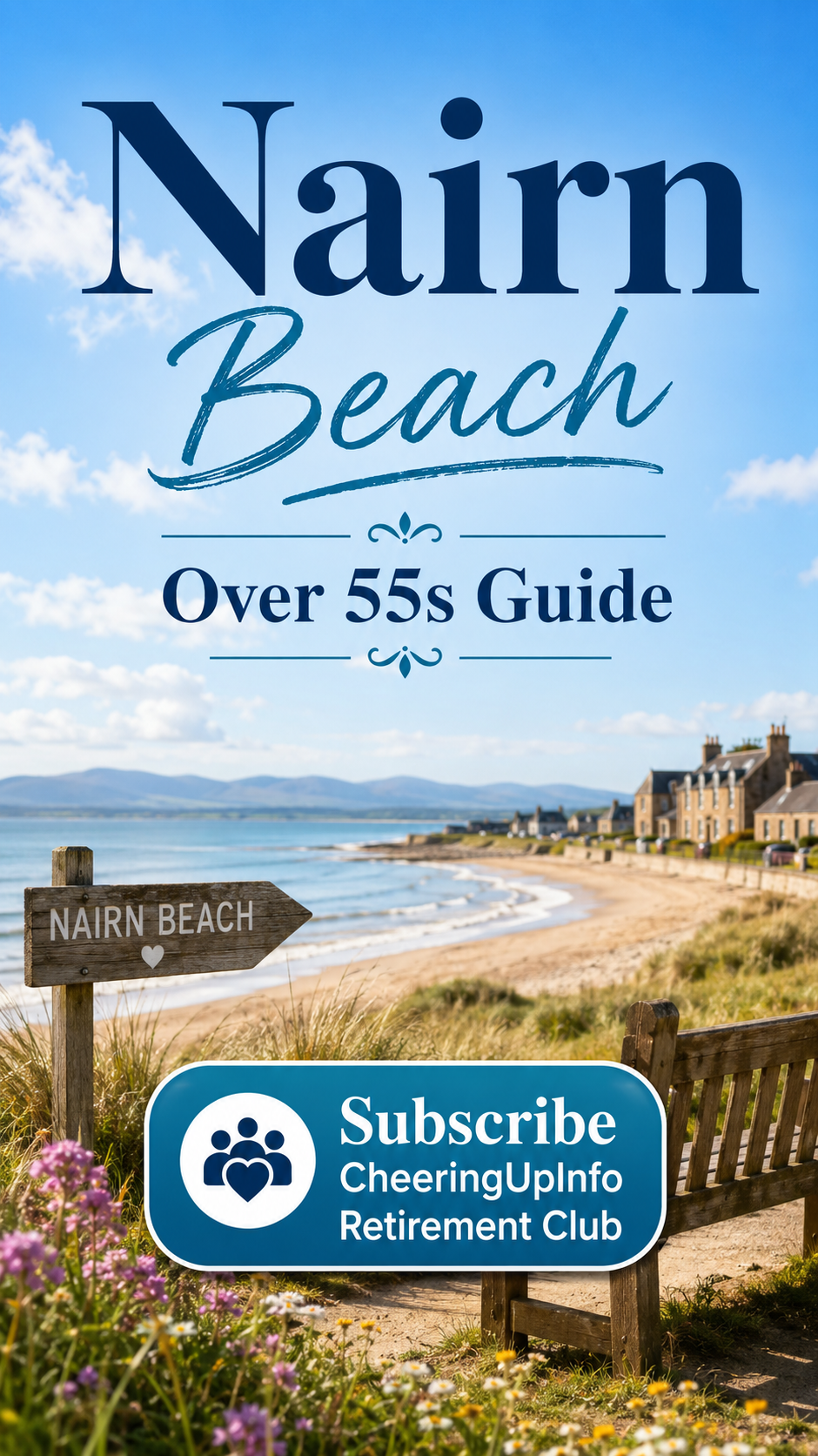
Discover why Nairn Beach is the perfect Scottish retreat for over 55s. From dolphin watching to coastal walks, find out why it’s a top-rated seaside town.
CheeringUpInfo Retirement Club: Your Nairn Beach Review & Guide for the Over 55s
Nairn Beach offers a blend of golden sands, wildlife, and a unique microclimate, making it a top retirement-friendly destination .
3 Facts Why Nairn Beach is So Good
One of Scotland’s Sunniest Spots: Sheltered by mountains, Nairn boasts a unique microclimate with less rain and more sunshine than surrounding areas .
Home to the UK’s Largest Coastal Sand Dune: Hidden in nearby Culbin Forest is “Hill 99,” the UK’s highest sand dune, offering spectacular viewpoints .
Consistently Rated a Top UK Seaside Town: Nairn scored top marks for scenery and peace in a Which? survey, recognised as one of the best seaside destinations in the country .
Where is Nairn Beach Located?
Nairn Beach is situated in the historic fishing town of Nairn on the Moray Firth coast, just 17 miles east of Inverness . Its address is Nairn IV12 4EA . The town is easily accessible from Inverness by car in about 25-30 minutes or via ScotRail train, with the station a short walk from the shore .
Why Should You Visit Nairn Beach?
Nairn Beach is one of Scotland’s driest and sunniest coastal destinations, offering a classic seaside experience without the crowds found elsewhere . Its miles of golden sands, backed by dunes and a promenade, provide a perfect setting for relaxation and gentle exercise . The tranquil atmosphere and spectacular views over the Moray Firth make it an ideal escape for those seeking peace and fresh air, and with over 1,100 reviews on Tripadvisor rating it 4.5 stars, it’s proven to be a hit with visitors .
What is There to See and Do on Nairn Beach and Nearby?
Wildlife Spotting: Keep an eye on the Moray Firth for the resident school of around 200 bottlenose dolphins. Look for their bow waves as ships pass by, or spot seals, minke whales, and porpoises . One local tip notes, “…dolphins show themselves during sunset” .
Coastal Walks:
Central to East Beach: Walk from the harbour towards Culbin Forest. This area is a Site of Special Scientific Interest, home to rare birds like the wintering pale-bellied brant goose .
The Promenade: For an easier walk, the paved promenade offers accessible views and plenty of benches for resting. “…the beach is lovely…well worth visiting,” says one recent visitor .
Nearby Attractions:
Culbin Forest: A massive forest of pine woodland, sand dunes, and saltmarshes with waymarked trails .
Golf: Tee off at two championship courses: Nairn Golf Club (established 1887) and Nairn Dunbar Golf Club .
Cawdor Castle: A 14th-century castle linked to Shakespeare’s Macbeth, just a short drive from town .
When is the Best Time to Visit Nairn Beach?
For a classic beach experience, the best time to visit is from May to September when temperatures can reach up to 20°C (68°F) and there are long daylight hours . However, this is also the busiest and wettest period . For the Over 55s seeking a quieter time, consider visiting in late spring (May-June) or early autumn (September-October). As one review states, “Peaceful- central beach is cleaner- miles of sand and peace to clear your head” . Winter offers the magical chance to see the Northern Lights dancing over the Moray Firth .
How Can Over 55s Maximise Their Nairn Beach Experience?
Choosing Nairn for your coastal break is a decision you won’t regret, offering a perfect mix of relaxation, gentle activity, and stunning scenery.
Walk the Promenade: The level promenade provides an accessible route alongside the beach, perfect for those less confident on sand .
Use the Benches: There are numerous benches, especially around the Links area, ideal for sitting, watching the world go by, and “just relaxing” .
Visit The Secret Beach (Whiteness Beach): Head west for a more secluded and tranquil stretch of sand, often quieter than the central beach .
Check Facilities: While there is parking and cafes like Basil Harbour or West Beach Snack Shack, be aware that some visitors have found public toilets lacking in maintenance. Come prepared .
Join the CheeringUpInfo Retirement Club: Share your experiences and find travel buddies. As the Which? survey suggests, Nairn is one of the best for peace and quiet, which is what you deserve. “We came to Nairn Beach for a day out with no agenda,” said one happy visitor .
“What an amazing beach… Absolutely gorgeous place to get away from it all.” – A TripAdvisor reviewer sums it up .
Discover how to book stunning staycation accommodation in Fife Scotland at the best cost, including insider tips, hidden gems, and must-see places to visit on a budget.
How to Book a 4 Day Stunning Staycation Accommodation in Fife Scotland at the Best Cost?
Booking a 4 day stunning staycation accommodation in Fife Scotland at the best cost requires strategic timing, smart location choices, and value-focused booking methods.
At CheeringUp.info, we help you unlock better travel for less—and here’s the proof:
“Booking midweek stays in Scotland can cut costs by 25–35% compared to weekends”
“Travellers who book 6–10 weeks ahead save up to 40% on accommodation prices”
“Choosing locations just outside tourist hotspots reduces costs by 20–30% without sacrificing experience”
Why Should You Visit the Old Course at St Andrews?
You should visit the Old Course at St Andrews because it is the undisputed “Home of Golf” and the oldest golf course in the world, offering a pilgrimage experience that transcends the sport itself. Walking the same fairways as legends since the 15th century, it’s a bucket-list destination that has hosted more Opengolfers Championships (30 times) than any other course, making it a living museum of golfing history . As one reviewer perfectly put it, “This is Disney Land for golfers, and the most fun you will have on a golf course anywhere in the World” .
How Can You Maximise the Experience with Cost of Living Beating Tips for Playing or Just Visiting?
You can beat the cost of living and maximise your Old Course experience by travelling in the shoulder seasons, using the daily ballot system for tee times, and enjoying the course for free on Sundays if you don’t play. The most expensive part of a trip isn’t always the golf; accommodation can be the real budget-breaker, especially during major events like The Open in 2027, where one five-bedroom townhouse near the Old Course was listed on Airbnb for nearly £50,000 for a six-night stay .
3 Facts to Back Up Value & Cost-Saving Claims:
Significant Off-Peak Savings: Green fees during the shoulder season (mid-April and October) are typically about 33% less expensive than peak summer rates, and winter rates are often half-price . Similarly, accommodation costs drop dramatically outside of major events; a property that costs £49,204 during The Open week was just £4,123 the following week—almost 12 times cheaper .
Free Public Access: The Old Course is public land. On Sundays, when the course is closed for play, it becomes a public park. You can walk the hallowed fairways, take photos on the Swilcan Bridge, and soak in the atmosphere completely for free .
Affordable Alternatives for Everyone: You don’t need to be a low-handicapper to play; the handicap limit is a generous 36 . If you don’t win a tee time in the ballot, a guided walking tour is a fantastic and affordable way to experience the history, following in the footsteps of Tiger Woods and Jack Nicklaus .
Top Tips to Beat the Cost:
Play the Ballot: Instead of a pricey, advance-guaranteed package, enter the daily ballot 48 hours in advance. Odds in peak season are roughly 1-in-3, which is a fair chance for a significant saving .
Stay and Play Midweek: Choose tee times from Tuesday to Thursday, which are commonly cheaper and less crowded than weekend slots .
Book a Package: Look for bundled deals that combine lodging, rounds, and meals, which can yield meaningful savings compared to booking everything separately .
What Exactly Will You See and Expect to Experience?
You will see and experience a course that is uniquely defined by its iconic landmarks, shared double greens, and a layout that defies modern golf architecture. This isn’t a manicured, parkland course; it’s a rugged, natural links that has evolved over centuries.
Iconic Landmarks: Your round is punctuated by famous sights.
The Swilcan Bridge: The small stone bridge on the 18th hole where you must take a souvenir photo .
The Road Hole (17th): One of the most famous par-4s in golf, where you must hit your drive over the corner of the Old Course Hotel . This hole is defended by the infamous “Road Hole Bunker” and the out-of-bounds road behind the green .
The Hell Bunker: A feared pot bunker you’ll see on the 14th hole, known for its near-vertical face .
The Quirky Layout: Expect massive, shared greens (the 7th and 11th holes share one enormous putting surface) and fairways that are up to 100 yards wide . The course can even be played in reverse!
The Atmosphere: The air is thick with history. You’ll feel the nerves on the first tee as your drive sails over the “Valley of Sin” and the crowd of onlookers. As one player described it, “The first tee shot is possibly the easiest tee shot you will ever hit with a 129-yard fairway, but being able to hold the club is almost impossible as you are so nervous” . The applause from the Old Course Hotel balcony for a great shot is a common and thrilling occurrence .
Who Will Enjoy the Old Course Most?
The Old Course will be most enjoyed by any golfer with a deep appreciation for history, tradition, and a “hard pars, easy bogeys” challenge that tests strategy over brute force . It’s a course for everyone, from the low-handicap player to the high-handicapper (with a limit of 36), because the challenge is about navigating the terrain, not just hitting long .
The History Buff: Any golfer who wants to walk in the footsteps of legends like Tiger Woods (who won the 2000 Open by staying out of all 112 bunkers) will be in awe .
The Architecture Enthusiast: As one architect noted, the Old Course is “the most important golf course-ever,” and all others are either a verification of its greatness or an attempt to deviate from it. Every serious student of the game must experience it.
The Social Golfer: The course is a public links, and the shared greens and fairways create a unique, communal atmosphere where shouts of “fore!” are a frequent soundtrack .
Retirement Bucket ListThe Bucket-List Completer: Ultimately, “everyone’s different — cross it off your bucket list and make your own decision!” . The sheer sense of occasion and achievement makes it a must-do for any passionate golfer.
When Is the Best Time to Go?
The best time to go to the Old Course depends on what you value most: playing conditions, cost, or accessibility. Generally, May to September offers the most favourable weather, but the “best” time involves a trade-off .
For the Best Playing Conditions & Atmosphere (June – September): This is the most popular season. July is the hottest month, and the extended daylight hours allow for early 6:30 am tee times . However, winning the ballot is much harder, and August is the wettest month of the year . The course is often at its best in late July to early September .
For the Best Value & a Better Chance of Playing (April & October): These shoulder seasons offer the sweet spot. April is the driest month of the year, and green fees can be around 33% less than peak summer rates . Winning a ballot is more likely than in high summer .
For the Cheapest & Most Flexible Trip (November – March): Green fees are invariably half-price, and accommodation is significantly cheaper . You will be able to pick and choose where you play, and even the Old Course has unfilled tee times in December and January. However, you must be prepared for cold weather, frost, wind, and the requirement to play with “winter rules” (using fairway mats) . Note: The course is closed to play on Sundays .
Where Exactly Is the Old Course Located?
The Old Course is located in the town of St Andrews, in the county of Fife, on the east coast of Scotland, United Kingdom . The town is the “Home of Golf” and the course sits right next to the historic town centre.
Get There: The nearest major airport is Edinburgh Airport (EDI), which is about a 1 hour 15 minute drive away . From there, you can rent a car or take a private transfer. The course address is St Andrews Links (Old), St Andrews, Fife, KY16 9JD, Scotland.
A Public Course: It is a public course held in trust by the St Andrews Links Trust under an act of Parliament, which means it’s open for anyone to play . The famous Royal and Ancient Golf Club clubhouse sits adjacent to the first tee, but it’s one of several clubs with playing privileges, alongside the general public .
What are the smartest ways to book a 4 day Fife staycation for less?
The smartest ways to book a 4 day Fife staycation for less include planning midweek breaks, booking direct, and targeting hidden locations.
How can you reduce accommodation costs over 4 days?
You can reduce accommodation costs over 4 days by making a few key decisions:
Stay Monday–Friday instead of weekend-heavy trips
Book self-catering apartments or guesthouses
Use direct booking discounts from local providers
Split your stay across two locations for better rates
Avoid peak events in St Andrews and coastal hotspots
Splitting accommodation across locations can reduce total trip cost by up to 15% while improving your overall experience.
Where are the best value places to stay during a 4 day Fife trip?
The best value places to stay during a 4 day Fife trip are locations that give you access to major attractions without premium pricing.
Which areas offer the best value over multiple days?
The areas that offer the best value over multiple days include:
St Andrews outskirts – Premium location without premium prices
Anstruther & East Neuk villages – Ideal for 1–2 nights coastal charm
Kirkcaldy – Budget-friendly base for inland exploring
Leven & Largo area – Emerging value destination
Cupar – Central location for exploring all of Fife
Visitors who base themselves outside major hubs save up to 30% over a 4-day stay compared to central bookings.
Why Should You Stay at The Old Boathouse in Wormit, Especially in a Room with a Balcony?
You should stay at The Old Boathouse in Wormit, especially in a room with a balcony, for an unforgettable waterfront escape where the panoramic views of the River Tay become the centrepiece of your relaxing Scottish getaway, offering a front-row seat to the breathtaking scenery. Guests consistently praise the serene atmosphere. One review perfectly captures this, stating, “The old boat house is spotless, comfortable, and very peaceful. We stayed in room 3 with a little balcony overlooking the Tay and over to Dundee”. This dedicated outdoor space elevates the stay, allowing you to fully immerse yourself in the unique waterside environment.
The Balcony Experience
Uninterrupted River Views: Enjoy panoramic views of the Tay estuary and across to Dundee city from your private balcony.
Peaceful & Private: The location is described as “very peaceful,” offering a quiet retreat where you can relax and watch the world go by.
Perfect for Any Season: Whether it’s a sunny morning with a coffee or a crisp evening with a glass of wine, the balcony provides the perfect spot to appreciate the scenery.
Booking.com Quote: One guest shared, “The old boat house is spotless, comfortable, and very peaceful. We stayed in room 3 with a little balcony overlooking the Tay and over to Dundee”.
How Can You Beat the Cost of Living Crisis with Money-Saving Tips on Booking a Room Here?
You can beat the cost of living crisis by booking a room at The Old Boathouse and taking advantage of its exceptional value, which combines competitive rates with free amenities and a prime location that saves you money on transport and activities. The property is rated 8.6 for value for money, proving it’s a budget-friendly choice without compromising on quality.
3 Facts Proving Excellent Value for Money
Free Premium Amenities: The guest house offers free private parking and free high-speed WiFi, which are rated a perfect 10.0 by guests. This saves you from costly city-centre parking and data charges.
Prime Location Saves Transport Costs: With a location score of 9.4 and being just a short walk from a bus stop for easy access to Dundee, you can save money on taxis and car hire.
Self-Catering & Local Dining Options: While breakfast isn’t served on-site, this allows you to save money by preparing your own. Alternatively, you are within walking distance of local cafes like Kitschnbake for affordable meals, avoiding expensive hotel breakfast surcharges.
To get the best deal, look for potential “hot deals at up to 32% off” on choice nights, particularly during June and July, to maximise your savings.
Booking.com Stat: Based on recent guest reviews, the property has an impressive Value for Money score of 8.6.
What Should You Expect When You Visit The Old Boathouse?
When you visit The Old Boathouse, you should expect a spotlessly clean, comfortable, and characterful stay in a beautifully converted 18th-century stone building that offers modern amenities and a warm, welcoming atmosphere. The hosts, Laura and Matt, are frequently praised for their excellent communication and helpfulness. You can expect a hassle-free experience with contactless arrival and departure, with hosts providing clear instructions and local recommendations via an app.
What to Expect
Immaculate & Comfortable Rooms: Each room is well-appointed with a desk, flat-screen TV, private bathroom, and tea/coffee making facilities.
Unique Location: The property is right on the beachfront, with a sun terrace and picnic area for guests to use.
Tranquil Atmosphere: The Old Boathouse maintains a strict quiet policy (between 23:00 and 07:00) and does not allow parties, ensuring a peaceful environment for all guests.
Booking.com Quote: Reviews highlight the experience: “The old boat house is spotless, comfortable, and very peaceful”. Another guest added, “Everything! It’s one of the best stays among all our accommodations on this trip”.
Who Will Enjoy a Stay at The Old Boathouse the Most?
A stay at The Old Boathouse will be enjoyed most by couples, solo travellers, and small families seeking a peaceful retreat in a unique setting, as well as outdoor enthusiasts and culture lovers who want to explore Fife, Dundee, and St Andrews. The property does not accommodate hen or stag parties, making it ideal for those seeking a quiet getaway.
Perfect For…
Couples and Romantics: The beautiful views and peaceful atmosphere make it an ideal spot for a romantic escape.
Solo Travellers: The quiet, safe location and easy transportation access to public transport is perfect for independent explorers.
Culture & Golf Fans: The property is perfectly situated for visiting Dundee (home to the V&A and RRS Discovery) and is within easy reach of the famous golf courses at St Andrews and Carnoustie.
Booking.com Quote: One guest noted, “It is very suitable for visiting Dundee and St. Andrews. We wish to stay longer… The view is fantastic”.
When Is the Best Time to Visit The Old Boathouse?
The best time to visit The Old Boathouse is during the summer months (June to August) for the warmest weather and long days, or in the winter if you are looking to combine your stay with skiing at Glenshee Resort, which is only an hour away. Summer offers ideal conditions for enjoying the beachfront location, balcony, and water sports.
Seasonal Highlights
Summer (June – August): Perfect for enjoying the sun terrace, picnic area, and outdoor activities like cycling and canoeing.
Winter: Great for a cozy, peaceful retreat and offers easy access to Glenshee Ski Resort, just one hour away, making it a unique base for winter sports.
Year-Round: The spectacular views of the River Tay and Dundee are stunning in any season, making it a great choice at any time of year.
Booking.com Quote: Host Laura mentions, “During winter months Glenshee Ski Resort is 1 hour away”.
Where Exactly Is The Old Boathouse Located?
The Old Boathouse is located at Woodhaven Pier, Wormit, Fife, DD6 8LA, on the shores of the Tay estuary, directly between the railway viaduct and the Tay Road Bridge, offering stunning views across to Dundee. Its excellent position offers both tranquility and convenience.
Key Location Facts
Address: The Old Boathouse, Woodhaven Pier, Wormit, DD6 8LA.
Proximity to Dundee: Just 4 miles (6.5 km) from Discovery Point and the city centre, with easy access via car or a short bus ride.
Close to Attractions: It’s 19 km from St Andrews University and within easy reach of world-renowned golf courses.
The combination of its breathtaking waterfront setting, exceptional value, and perfect location for exploring Fife makes The Old Boathouse a standout choice for your next Scottish escape.
East Neuk fishing villages – Authentic and cost-free exploration
Falkland village and Lomond Hills – Nature and history combined
Local markets and harbours – Low-cost food and experiences
Over 60% of Fife’s top-rated experiences are free or under £10, making it one of the UK’s best-value destinations.
Why Should You Go to Wormit Bay for the View of Tay Rail Bridge?
You should go to Wormit Bay for the view of Tay Rail Bridge because it offers one of Scotland’s most spectacular and historically rich panoramic views, combining a world-class Victorian engineering marvel with tranquil coastal scenery. Standing at this hidden gem on the Fife Coastal Path, you get an unparalleled perspective of the iconic 2.75-mile (3.5 km) structure spanning the Firth of Tay .
3 Facts to Back This Up:
The current Tay Rail Bridge is the second-longest railway bridge in the UK at 10,708 feet, with a graceful curve of 85 spans .
The view includes the poignant “tasteful monument” commemorating the Tay Bridge Disaster of 1879, where the first bridge collapsed .
You can see the stumps of the original bridge’s piers rising from the water through the arches of the modern bridge .
Where Exactly Are Wormit Bay and the Tay Rail Bridge Viewpoint?
Wormit Bay and the prime viewpoint for the Tay Rail Bridge are located in the village of Wormit in Fife, Scotland, directly across the River Tay from the city of Dundee. The exact location is at the end of Bay Road, with the postcode DD6 8LZ, and is part of the Fife Coastal Path .
3 Facts to Back This Up:
The bridge connects Dundee to the suburb of Wormit in Fife, making the bay the closest and best vantage point .
The main access point is the car park at the end of Bay Road; the nearest bus stop is “Beehive Works, Wormit,” a 7-minute walk away .
From this point, a short walk leads directly to the Tay Rail Bridge Disaster Memorial and the start of routes towards Balmerino .
What Can You Expect to Experience at Wormit Bay and Viewing the Tay Rail Bridge?
At Wormit Bay and the Tay Bridge viewpoint, you can expect to experience a perfect blend of dramatic history, stunning coastal scenery, and peaceful walking trails suitable for all ages. Whether you’re a history buff, a photographer, or a family looking for a day out, this spot offers a “great place to sit and relax, have lunch or go for a walk” with the iconic bridge as your backdrop .
3 Facts to Back This Up:
The area features a pebble beach with clean benches overlooking the estuary, perfect for picnics and wildlife watching, including seals and aquatic birds .
You can hike a circular 9 km (approx. 5.6 miles) route from Wormit Bay through woodland and farmland to the ruins of Balmerino Abbey, returning with excellent bridge views .
The car park is praised for being “ample” with the first 2 hours free, and even offers two dedicated overnight spots for campervans at £5 per night .
“Great spot for starting walk section along Fife Coastal Path. Panoramic view of Tay Rail bridge and Dundee – with interesting and tasteful monument to the Tay Bridge Disaster.”
When Is the Best Time to Visit Wormit Bay for the Tay Rail Bridge View?
The best time to visit Wormit Bay for the Tay Rail Bridge view is during the spring and summer months (April to September) for the most reliable weather and long daylight hours, but the “golden hour” of sunrise and sunset offers the most dramatic photography conditions year-round. Many visitors note the scenery is “dreamy” with “blue water” in summer, while the quieter winter months provide a stark, historic atmosphere .
3 Facts to Back This Up:
The location is open to the public all year round without restrictions, making any day a potential visit day .
For photographers, a mix of “sunshine and dark skies” can create a “wonderful” backdrop, highlighting the bridge’s grandeur and the Tay’s moody weather .
Local reviews suggest summer is ideal for enjoying the beach and walk, but the path can be “muddy after heavy rain,” so checking the weather forecast is always advised .
How Can You Maximise Your Experience at Wormit Bay and the Tay Rail Bridge?
You can maximise your experience at Wormit Bay and the Tay Rail Bridge by combining the breathtaking viewpoint with a coastal walk to Balmerino Abbey, arriving early to secure limited parking, and planning your visit around the tides for wildlife spotting. The route is “suitable for all ages,” and being prepared will ensure you enjoy every aspect of this Fife gem .
3 Facts to Back This Up:
Parking: The car park is popular but busy; the first 2 hours are free, and all-day parking until 9 PM is just £1. Larger vehicles over 6 meters should be cautious of the “tight turning” .
The Walk: Head west along the path beyond the memorial for a 4km undulating woodland trail to Balmerino. The walk offers “open views from time to time” but requires sturdy footwear as it is an “uneven surface” and can be muddy .
Wildlife: When the tide is out, look out for seals hauled out on the sandbanks in the river, visible from the bridge or the shoreline .
What is the best 4 day Fife staycation itinerary for value?
The best 4 day Fife staycation itinerary for value balances location, cost, and experience across different areas.
How should you structure a 4 day trip for maximum value?
You should structure a 4 day trip for maximum value by combining coastal and inland experiences:
Day 1 – St Andrews
Explore town, university, and beaches
Visit cathedral ruins
Sunset at West Sands
Day 2 – East Neuk Coastal Route
Visit Crail, Anstruther, Pittenweem
Harbour walks and local seafood
Overnight in coastal village
Day 3 – Hidden Fife & Nature
Falkland village
Lomond Hills walking trails
Relax in countryside cafés
Day 4 – Flexible Exploration
Return to favourite spot OR
Visit lesser-known beaches
Local shopping and slow travel experience
Travellers who extend from 3 to 4 days report higher satisfaction with only a 10–15% increase in total cost when planned correctly.
Why trust CheeringUp.info for 4 day Fife staycation deals?
You can trust CheeringUp.info for 4 day Fife staycation deals because it focuses on value optimisation, hidden opportunities, and smarter travel planning.
“Our strategies help reduce travel costs by up to 35% compared to traditional booking methods”
“We highlight under-the-radar locations with better value experiences”
“We connect you to direct booking options to avoid unnecessary fees”
Read more free lifestyle improvement articles and view videos
Crail Harbour & Beach Review: Are They Worth the Visit?
Yes, Crail Harbour and Beach are absolutely worth visiting, offering a picture-postcard Scottish coastal experience that rivals any in the UK. The harbour has been named one of the “10 most beautiful places in Scotland” by Time Out , while the nearby sandy Crail Beach provides a sheltered spot for swimming and rockpooling . It’s a “magical place” that feels like “stepping back in time” .
Value & Cost of Living Hacks: How Can You Visit Affordably?
You can visit Crail affordably by using public transport, self-catering, and travelling off-season, beating the cost of living squeeze with smart planning. A budget traveller can get by on around £70 per day in Scotland .
3 Facts to Back Up the Value Claim:
Housing Cost Hack: While nearby St Andrews has average property prices of £458,381, Crail’s are significantly lower at £307,501 – a £150,000 difference for those considering a move .
Self-Catering Savings: A week in a self-catering apartment at Crail House costs between £395 and £650, sleeping up to six people and including all utilities and Wi-Fi . That’s as little as £9.40 per person per night for a group of six in the low season.
Free Activities: The Fife Coastal Path and the historic harbour are completely free to enjoy, while the Crail Museum & Heritage Centre offers free entry . A meal at a local eatery can be as little as £16-£24 for a pub dinner .
“First class seafood, as ever, with many great al fresco dining experiences on the quayside.”
What Can You Expect to Experience at Crail Harbour and Beach?
At Crail Harbour and Beach, you can expect to experience an authentic, working fishing village frozen in time, with stunning coastal views. You’ll see “small fishing boats bringing in their daily haul” and can buy fresh lobster and crab directly from Reilly’s Shellfish at the harbour . The beach offers a mix of sand and rock pools, perfect for exploring, while the Fife Coastal Path provides “spectacular vistas across the Firth of Forth” . Explore cobbled streets, independent shops like Crail Pottery, and the historic 16th-century Tolbooth .
Bullet points of key experiences:
Fresh seafood purchased directly from the harbour shack
Exploring independent shops and galleries on the high street
Visiting the historic harbour, a favourite for artists and photographers
Who Will Enjoy Crail the Most?
Crail will be enjoyed most by couples, families, history buffs, and walkers seeking a peaceful, picturesque escape. It is a “popular summer destination” with a “thriving high street” offering something for everyone . Golfers will love the Crail Golfing Society, one of the world’s oldest clubs, with “sea views at every hole” . A “30-minute coastal stroll” leads to the historic Caiplie Caves . Its compact size and friendly community make it ideal for a relaxed weekend away .
When Is the Best Time to Visit Crail?
The best time to visit Crail is in the shoulder seasons of April-May or September-October for the best balance of weather, lower prices, and fewer crowds . While summer (May-September) offers warmer, drier weather, it “gets crowded with visitors on summer weekends and during school holidays” . A “clear February day” also offers a peaceful visit . June features the much-loved Crail Food Festival .
Where Exactly Is Crail, and How Do You Get There?
Crail is located in the East Neuk of Fife, Scotland, just 90 minutes by car from Edinburgh . It lies 10 miles south of St Andrews, along the Fife Coastal Route .
Bullet points for travel:
By Car: From Edinburgh, cross the Forth Road Bridge and follow the A92, then the A917 to Crail .
By Train: The nearest train station is Leven (17 miles), with trains from Edinburgh Waverley. From there, take the X60 bus to Anstruther and then the 95 bus to Crail .
By Bus: The frequent 95 bus runs hourly between St Andrews and Leven, stopping at Crail .
Why Should You Visit Pittenweem for an Authentic and Affordable Scottish Escape?
You should visit Pittenweem because it is a historic, working fishing village in the East Neuk of Fife that offers a more authentic, community-driven, and surprisingly affordable alternative to Scotland’s crowded tourist hotspots . This picturesque village, with its 16th-century houses and bustling harbour, provides a rich cultural experience that delivers exceptional value, especially compared to the inflated prices of major cities like Edinburgh . Data shows that opting for a self-catering stay in Pittenweem and visiting during the off-season can lead to significant savings, making a high-quality Scottish break accessible to everyone.
Fact 1: Value for Money: Unlike the Edinburgh Festival, where you “struggle to find a bottle of water for the same price,” the Pittenweem Arts Festival operates with a community-first ethos, even offering a free shuttle bus from its donation-based car park .
Fact 2: Free Attractions: A primary attraction, Pittenweem Beach, is completely free to visit, allowing families to enjoy “rock pooling” and seaside picnics without any entry cost .
Fact 3: Cost-Effective Travel: As one visitor noted, by choosing to “do the opposite” of everyone else and visiting in the quiet season, they found “plenty of self-catering availability, no dramatic price hikes because of the date, and definitely no crowds,” making for a much cheaper trip .
What Exactly is Pittenweem and Where is it Located?
Pittenweem is a charming fishing village and civil parish located in the East Neuk (corner) of Fife, on the east coast of Scotland, known for its picturesque harbour and maritime heritage . It lies approximately 9 miles (14 km) south of St Andrews and 13 miles (21 km) southeast of Cupar . The village is a key stop on the 178km Fife Coastal Path, making it accessible by car, bus, or on foot, with direct buses from major cities like Edinburgh .
What Should You Expect to Experience in Pittenweem?
You should expect to experience a quintessential Scottish coastal village that rewards “slow wandering,” with a historic harbour, ancient caves, and a vibrant local art scene all packed into a compact and walkable area .
Explore the Historic Harbour: It is one of the last working harbours in Fife, with a fish market most mornings .
Visit St. Fillan’s Cave: This atmospheric 7th-century cave is tucked into the cliff, offering a unique historical and spiritual insight often for a small £1 donation .
Walk the Coastal Path: Enjoy breathtaking cliff-top views by walking a section of the Fife Coastal Path, easily connecting to neighbouring villages like St Monans .
Sample Local Seafood: Enjoy some of the best fresh seafood in Scotland, from casual fish & chips to bistro dining at spots like the Dory Bistro .
Attend a World-Class Festival: If visiting in August, you can experience the community-led Pittenweem Arts Festival, where over 140 artists exhibit in homes, gardens, and shops across the village .
Who Will Enjoy Visiting Pittenweem Most?
Pittenweem will be enjoyed most by travellers seeking a peaceful, culture-rich escape filled with coastal walks, fresh food, and a strong sense of community, away from high prices and large crowds . It is perfect for couples, families with young children who will love exploring the free beach , and art enthusiasts keen to discover local talent . It is an ideal base for walkers tackling the Fife Coastal Path and offers a tranquil retreat for anyone looking to, as one visitor put it, “set gentle intentions” and “stop their mind and just rest” .
When is the Best Time to Visit Pittenweem?
The best time to visit Pittenweem for warm weather and long days is during the summer months from May to September, with August being particularly vibrant due to the Arts Festival . However, for those looking to save money and avoid crowds, the “shoulder seasons” of spring (April-May) and autumn (September-October) offer a fantastic balance of good weather and better value . For the ultimate budget-friendly trip, visiting in the quiet winter months can provide “plenty of self-catering availability, no dramatic price hikes because of the date, and definitely no crowds” .
How Can You Maximise Your Pittenweem Experience with Cost of Living Beating Tips?
You can maximise your Pittenweem experience by taking advantage of its free natural attractions, choosing self-catering accommodation, and visiting during off-peak times to avoid price hikes. Here are 5 tips to make your trip cheaper or even free:
Enjoy Free Attractions: Spend a day at the beautiful and free Pittenweem Beach for rock pooling, paddling, and picnicking . Explore the historic streets and take in the breathtaking cliff-top views from West Braes Park at no cost .
Eat Like a Local: Instead of pricey restaurants, buy the freshest catch of the day directly from the harbour’s morning fish market and cook it yourself. The village also has a small grocers and a bakery for affordable supplies .
Travel by Foot or Bus: Save on car hire by using the regular Stagecoach buses (X60 or 95) which connect Pittenweem to major cities and neighbouring East Neuk villages for a low fare . Or, walk in on the spectacular Fife Coastal Path for free .
Visit in the Off-Season: Avoid peak summer prices and book your stay for spring or autumn. During these “shoulder seasons,” you can find excellent deals on accommodation with “plenty of self-catering availability” and no need to book months in advance .
Use Free and Low-Cost Activities: Look for community-run events like the Arts Festival which is very affordable, with car parks operating on a suggested £3 donation and even offering free shuttles for those who need them . Visit local heritage sites like the small but atmospheric St. Fillan’s Cave for a donation of just £1 .
Why Should You Visit St Monans, Fife, for an Affordable Coastal Escape?
St Monans offers an authentic and remarkably affordable slice of Scottish coastal life, blending historic charm, stunning scenery, and a welcoming village atmosphere without the crowds or premium prices of neighbouring East Neuk destinations . This working fishing village delivers a genuine experience where colourful cottages, a sheltered harbour, and coastal paths create a perfect budget-friendly getaway .
3 Facts on Cost & Value:
Affordable Stays: Average private rent in St Monans requires a minimum income of £33,360, significantly lower than nearby Elie & Earlsferry at £89,424, highlighting its value for longer visits .
Free Coastal Path: The Fife Coastal Path runs directly through the village, offering free, world-class walking and connecting to five other East Neuk villages without transport costs .
Zero-Cost Attractions: The harbour, 18th-century windmill, salt pans, and the historic Auld Kirk are all completely free to explore, with no entry fees .
Where Exactly is St Monans, and How Do You Get There?
St Monans is a picturesque fishing village located on the Fife coast in the East Neuk of Fife, Scotland, approximately 12 miles south of St Andrews and easily accessible by car or the number 95 bus service . “Parked at the Auld Kirk to walk the St Monans to Elie section of the fife coastal path,” with convenient parking available, and the bus connects all the East Neuk villages for just a few pounds per journey .
When is the Best Time to Visit St Monans to Suit Your Budget?
The best time to visit St Monans to beat the cost of living is during the shoulder seasons of Spring and Autumn, or Winter, when accommodation prices drop significantly and the village remains peacefully uncrowded . “Visit during off-peak hours or in winter to enjoy solitude at this less touristy spot,” with most local shops and cafes remaining open to serve the community year-round .
Cost-Beating Tips for Timing Your Visit:
Visit in Spring or Autumn: Enjoy milder weather, quieter streets, and lower accommodation prices than peak summer months .
Consider Winter for Best Deals: For the ultimate budget-friendly trip, “winter offers peace and quiet and crowd-free beaches,” with average temperatures around 5-7°C but fewer tourists .
Book Midweek Stays: If visiting in summer, opt for Tuesday-Thursday stays to avoid premium weekend rates, potentially saving 20-30% on accommodation .
What Will You Experience in St Monans, and Who Will Enjoy It the Most?
In St Monans, you will experience a quintessential Scottish fishing village with a working harbour, historic industrial relics, coastal walks, and a scattering of landmarks including the 14th-century Auld Kirk, which sits dramatically by the seafront and adds to the village’s rich tapestry . “St Monans has that quintessential fishing village vibe – dotted with colourful cottages, a serene harbour, and the iconic St Monans Windmill,” while the Auld Kirk, begun by King David II in 1369, provides a fascinating historical layer without dominating the visit .
Who will enjoy it the most:
Slow Travellers & Couples: The village is “made for slow travellers, couples, and day-trippers,” offering a relaxing and romantic atmosphere away from crowds .
Walkers & Outdoor Enthusiasts: With the Fife Coastal Path running directly through, it’s an ideal base for walkers of all levels, with routes to Pittenweem (20 mins) and Elie (under 1 hour) .
History Buffs: Explore the 18th-century windmill used for salt production, the ruins of Newark Castle from the 15th century, and the Auld Kirk, one of Scotland’s oldest churches still in use .
Budget-Conscious Travellers: With free attractions and affordable accommodation, it’s a fantastic choice for stretching your budget .
How Can You Maximise Your Visit to St Monans and Beat the Cost of Living?
To maximise your St Monans experience, embrace the free coastal walks, pack a picnic to enjoy with sea views, use the affordable local bus network, and explore the village’s free historical sites—including the harbour, windmill, salt pans, and the Auld Kirk—without spending a penny on entry fees .
Actionable Tips to Reduce Costs & Maximise Experience:
Walk the Fife Coastal Path: It’s completely free. Walk from St Monans to Pittenweem (approx. 20 minutes) or Elie (under an hour) and take the bus back for around £2-£3 per person .
Self-Cater & Picnic: Rent a holiday cottage with a kitchen and prepare meals yourself. Pack a picnic to enjoy with views over the Firth of Forth or in the peaceful churchyard of the Auld Kirk .
Use the Local Bus: The number 95 bus connects all East Neuk villages, allowing one-way walks and saving on parking fees—a day ticket costs approximately £5-£6 .
Visit Free Attractions: Spend your day exploring the working harbour (watch boats land catches), the 18th-century windmill and salt pans, Newark Castle ruins, and the Auld Kirk—all free . One visitor noted, “You will find it empty most of the times as it’s not very popular for tourists” .
Explore Hidden Spots: Find quiet corners like the slipways and boat sheds with “rusted chains, peeling paint, [and] lobster creels stacked high” for free, authentic experiences and unique photography .
Time Your Meals: Visit the local smokehouse or bakery for freshly prepared takeaway lunches at a fraction of restaurant prices—saving up to 50% compared to sit-down meals .
Why Should You Visit Lower Largo, Fife, for a Peaceful Coastal Escape?
You should visit Lower Largo, Fife, for a genuinely peaceful coastal escape that offers a tranquil alternative to crowded tourist spots, rich history, and magnificent ocean views. This hidden gem in Scotland is a historic fishing village with a population of around 2,300, looking out across Largo Bay on the northern shore of the Firth of Forth . Its charm lies in what it doesn’t have: no amusement arcades or throngs of holidaymakers, just a relaxing rhythm of life that captivates visitors . With a welcoming pub and restaurant like The Crusoe, a beautiful sand-and-rock beach, and a strong sense of community, it is the perfect destination for a few tranquil days. Furthermore, its fascinating link to Alexander Selkirk, the real-life inspiration for Robinson Crusoe, adds an intriguing historical layer to your visit .
3 Facts on Cost and Value:
Affordable Bus Travel: You can get between Lower Largo and nearby Elie by bus for just 6, with the journey taking only 11 minutes .
Budget-Friendly Eats: Enjoy delicious and affordable pub staples like fish and chips or mac and cheese at welcoming spots like The Crusoe Hotel .
Value for Money Location: Lower Largo offers a high-value, peaceful retreat. It is perfectly positioned just 20 minutes from St Andrews and an hour’s drive from Edinburgh, making it an excellent base for exploring Fife without paying premium prices .
Where Exactly is Lower Largo, and How Do You Get There?
Lower Largo is located on the north shore of the Firth of Forth in Fife, Scotland, and it’s easily accessible by car or public transport . The small village sits on the Fife coast overlooking Largo Bay and is part of a wider conurbation with the villages of Upper Largo and Lundin Links . By car, it’s approximately an hour’s drive from Edinburgh and about an hour and a half from Glasgow, making it a perfect choice for a quick getaway . Local buses also connect the village, and it lies on the popular Fife Coastal Path, making it a great stop for walkers .
What Can You Expect to See and Do in Lower Largo?
In Lower Largo, you can expect to see a pristine beach, a historic statue of Robinson Crusoe, and a disused railway viaduct, all within a charming, peaceful village setting . The beach itself is a mix of sand and rocks, and it’s known for being incredibly clean . You can wander the streets and admire the ornate gardens with a nautical theme, with gates decorated with pirates, fish, and mermaids .
Key sights and activities include:
Alexander Selkirk Statue: Visit the life-sized statue at his birthplace, 99-105 Main Street . A signpost at the harbour points towards the Juan Fernández Islands, 7,500 miles away, where he was stranded .
The Crusoe Hotel: Dine at this welcoming four-star hotel and pub, named after the famous castaway .
The Disused Viaduct: See the impressive railway viaduct, which spans the Keil Burn and has stood as a landmark since it closed in 1965 .
The Aurrie Café: Enjoy breakfast in this unique and cosy café, which is housed in a converted old church .
Who Would Enjoy Lower Largo the Most?
Lower Largo would be enjoyed most by those seeking a peaceful, slow-paced getaway, including couples, families, and history enthusiasts. It’s perfect for people who want to escape the hustle and bustle of more commercial seaside towns and are happy with a more relaxed rhythm of life . Its tranquil atmosphere makes it ideal for dog walkers and nature lovers who appreciate a clean beach and scenic coastal views . History buffs will be fascinated by the story of Alexander Selkirk, while walkers and cyclists can use it as a perfect base for exploring the Fife Coastal Path.
When is the Best Time to Visit Lower Largo?
The best time to visit Lower Largo is during the spring and summer months for the best weather and to experience natural spectacles like the bluebell blooms. In spring, the nearby Keil’s Den transforms into a spectacular “sea of blue” when the bluebells peak in May, and it’s just a 15-minute walk from the village. A visit during the warmer, drier months of spring and summer provides the best conditions for coastal walks and enjoying evenings on the beach . However, even a “bit cold” day can be spectacular, with invigorating sea air and stunning vistas .
How Can You Maximise Your Experience with Cost of Living Beating Tips, Including Cycling from Lower Largo to Elie and Earlsferry?
You can maximise your experience and beat the cost of living by taking advantage of free activities like cycling the old railway path and walking the Fife Coastal Path, as well as using affordable public transport . The route from Lower Largo to Elie and Earlsferry is a fantastic, low-cost adventure.
Here’s how to make the most of it on a budget:
The Ultimate Cost-Saving Cycle: The old East of Fife Railway line provides a popular and scenic mountain bike route directly from Lower Largo to Elie . This is a free and active way to travel.
Walk the Fife Coastal Path: This route is approximately 7 miles (11 km) and is fairly flat, taking you along stunning coastline from the harbour in Lower Largo to Elie via Shell Bay . It’s completely free and offers dramatic views, with the option to stop at a wood-fired sauna in Shell Bay or attempt the Elie Chain Walk .
Use the £4 Bus: If you get tired, the Stagecoach bus service (number 95) runs from Elie back to Lower Largo for just 6 . This is a great, cheap way to do a one-way walk or cycle. The drive is even cheaper at 4 .
Pack a Picnic: Instead of eating out for every meal, grab local produce and have a picnic on the beach or at a scenic viewpoint like Kincraig Point, which offers spectacular views over the Firth of Forth .
Why Should You Visit Earlsferry Beach for an Unforgettable Scottish Escape?
You should visit Earlsferry Beach because it offers a pristine, award-winning stretch of golden sand that provides a perfect, value-for-money escape from the everyday, all set against the stunning backdrop of the Fife coastline. This “hidden gem” and “stunningly beautiful” location, with its “demerara coloured sand,” offers a quintessential British seaside experience without the premium price tag of more commercialised resorts.
What Will You Experience at Earlsferry Beach?
At Earlsferry Beach, you will experience a mile of uninterrupted, pristine sand at low tide, perfect for long, bracing walks, exhilarating water sports, or simply relaxing and taking in the breathtaking views across the Firth of Forth to East Lothian and even Edinburgh on a clear day. It’s a place of “big skies, firm sand, and clear views,” and one of Scotland’s cleanest beaches, having won a Keep Scotland Beautiful award in 2022.
Activities for Everyone:
Water Sports: Its sheltered bay makes it a hub for swimming, paddleboarding, and surfing, with equipment hire available nearby.
Family Fun: The fine sand is “safe for children” and ideal for building sandcastles. You can even hunt for the famous “Elie Rubies” or spot dolphins and seals from the shore.
Unique Local Flavour: On summer days, you might even see a game of beach cricket being played, a popular local tradition.
Relaxation: For a small fee, you can enjoy the novel experience of a pop-up sauna right on the shoreline.
Convenience: You’ll find cafes, a hotel bar, public toilets, and an ice cream parlour all within easy reach, making it easy to spend a whole day here.
Who Will Enjoy This Beach the Most?
Earlsferry Beach will be enjoyed most by families with children, couples seeking a tranquil coastal retreat, and outdoor enthusiasts looking for a versatile and affordable Scottish destination. It is also perfect for dog owners, as the beach is dog-friendly, and the surrounding area is ideal for long walks.
Quote: One visitor perfectly captures its appeal, stating: “This is a wonderful clean beach of demerara coloured sand, that’s directly accessed from the East-Neuk town”.
When Is the Best Time to Visit?
The best time to visit Earlsferry Beach to maximise your experience and beat the crowds is during the “shoulder seasons” of late spring (May-June) and early autumn (September-October), or during the week even in the peak summer month of August. While summer offers the warmest weather for swimming, it gets “very busy” and parking can be “difficult at High Season”. Visiting during off-peak times, especially on a “cold, crispy sunny day,” is a “treat” and guarantees a more peaceful “peace and tranquility”.
Where Exactly Is Earlsferry Beach Located?
Earlsferry Beach is located in the adjoining villages of Elie and Earlsferry on the south coast of Fife, Scotland, in the East Neuk region. It is easily accessible by car, being roughly an hour from Edinburgh, with street parking available.
Address: 3 Sahara Park, Elie and Earlsferry, Leven KY9 1BB, United Kingdom.
GPS Coordinates: 56.189093, -2.827387.
How Can You Maximise Your Experience with Cost of Living Beating Tips?
You can maximise your Earlsferry Beach experience on a budget by taking advantage of free activities, choosing your timing wisely, and utilising affordable local amenities to beat the cost of living.
What Makes Elie Beach and Harbour a Must-Visit Scottish Destination?
Elie Beach and Harbour is a must-visit Scottish destination because it offers a stunning, sheltered golden-sand beach with a picturesque harbour, set within the charming East Neuk of Fife, and provides exceptional value for a cost-conscious traveller. This location delivers the quintessential Scottish seaside experience without the premium price tag of more commercialised resorts. You can enjoy breathtaking views across the Firth of Forth to East Lothian and the iconic Elie Ness lighthouse, all while partaking in a range of free or low-cost activities .
“The views from the harbour are amazing on a clear day and the beach is beautiful and sandy” – Tripadvisor reviewer .
3 Facts to Back Up the Value Claim:
Free Parking: There is free parking available right next to the beach, saving you significant costs compared to paid car parks at other coastal attractions .
Free Activities: The beach itself is free to access, and you can enjoy free activities like walking the Fife Coastal Path, exploring rock pools at low tide, or watching a local cricket match played on the sand .
Affordable Local Eats: Instead of expensive tourist-trap restaurants, you can support local shops and delis, and enjoy reasonably priced ice cream from local vendors, keeping food costs down .
Where Exactly is Elie Beach and How Do You Get There?
Elie Beach is located in the village of Elie and Earlsferry, which is in the East Neuk of Fife, Scotland, and is most easily accessed by car, though bus routes also serve the area. Its address is simply Elie street in Fife, with the beach and harbour sitting directly within the settlement . It’s a fantastic, less-travelled alternative to the busier St Andrews, making it a great discovery for visitors exploring the Kingdom of Fife.
By Car: Driving is the most convenient option. The beach is situated within the town, and there is parking available close to the sand, just 100 meters away .
By Bus: The village is served by several bus lines, including the X60, X60A, 95, and WD2, making it accessible for those using public transport .
On Foot: For the active visitor, Elie is a key stop on the Fife Coastal Path, so you can arrive by foot as part of a longer walk along the beautiful coastline .
Who Will Enjoy the Elie Beach Experience the Most?
The Elie Beach experience will be most enjoyed by families, water sports enthusiasts, walkers, and anyone seeking a classic, unspoiled seaside day out that offers exceptional value. Its sheltered bay makes it very popular for various watersports, with a centre in the harbour area, and the calm, shallow waters provide a safe environment for children to paddle and swim . It’s a top choice for a family day out because it combines natural beauty with a safe environment and activities that appeal to all ages .
Families: Kids will love crabbing in the harbour, playing on the demerara-coloured sand, and exploring the many rock pools at low tide .
Dog Owners: The beach is completely dog-friendly, making it a perfect spot for walkies with your four-legged friend .
When is the Best Time to Visit Elie Beach to Beat the Crowds and Costs?
The best time to visit Elie Beach to maximize your experience and beat the crowds is during the “shoulder” seasons of late spring (May-June) and early autumn (September), or on a sunny weekday, when the weather is often pleasant but the summer rush has subsided. Visiting at these times means you can enjoy the spectacular scenery and free activities without fighting for a parking space or a spot on the sand . A resident noted that over 70% of houses in neighbouring Earlsferry are holiday rentals, indicating the village gets extremely busy in peak summer, so planning your trip for a quieter time will significantly improve your experience .
For the Best Value: Visit on a weekday during the shoulder season to avoid peak pricing on any local holiday accommodations.
For a Quieter Experience: Arrive early in the morning, even in summer, to secure a good parking spot and enjoy the beach before the crowds arrive.
For the Best Views: A clear day is essential. The views from the harbour and across the Firth of Forth are at their most spectacular when the sun is shining .
What Can You Expect to See and Do at Elie Beach and Harbour?
You can expect to experience a beautiful, clean sandy beach, a charming working harbour, and a range of free and low-cost activities that make it a standout value destination. The “demerara coloured sand” is a highlight, and at low tide, the beach links with Earlsferry Beach, providing a huge expanse of sand to explore . You can watch the boats and yachts, walk the harbour, or simply enjoy the magnificent views. Unlike more commercialised beaches, Elie retains an unspoiled charm with a lack of tourist traps, adding to its appeal .
Explore the Harbour: Walk around the harbour area, watch the boats, and take in the “amazing” views. The surrounding village is a charming seaside resort .
Relax on the Beach: Enjoy the golden sand, go for a swim in the sheltered bay, or simply relax and take in the Scottish coastal scenery. There’s even an award-winning seaside sauna on the beach (voted best by The Times) for a small fee .
Walk the Fife Coastal Path: This is an excellent base for a leg of the coastal path, offering dramatic views across the Firth of Forth. You can find beautiful sea glass along the way, especially on the walk towards Ruby Bay .
What Are the Best Budget Tips for Visiting Elie Beach?
The best budget tips for visiting Elie Beach are to arrive early for free parking, bring your own food and drinks from the local deli, and take advantage of the many free activities on offer. This approach allows you to enjoy a world-class beach experience for the price of your travel costs. There are cafes and hotel bars nearby, but to keep costs low, pack a picnic and enjoy it with a view .
Parking: Arrive early, especially in the summer, to secure one of the free parking spots near the beach. This can save you a significant amount of money .
Food and Drink: Visit the local shops and delis in the charming village to buy supplies for a budget-friendly picnic instead of relying solely on restaurants. Don’t miss Carol’s shop on the high street for “the best ice cream” .
Free Entertainment: Look out for the unique spectacle of a cricket match being played on the sand at low tide, a regular fixture in the summer that is completely free to watch .
Fife’s coastline is full of postcard-perfect villages—but most tourists only stop at the obvious ones and miss the real value spots where you get better scenery, fewer crowds, and often lower prices.
Here are the coastal villages in Fife that most tourists skip—but absolutely shouldn’t:
Which Fife coastal villages do most tourists skip but shouldn’t miss?
The Fife coastal villages most tourists skip but shouldn’t miss are the quieter East Neuk and southern coast locations that offer authentic charm and better value.
Why are these villages often overlooked?
These villages are often overlooked because tourists cluster around St Andrews and the better-known stops like Anstruther, missing nearby hidden gems just minutes away.
Visitors who explore beyond the top 2–3 hotspots often experience up to 40% fewer crowds and better local prices.
Why are these villages often overlooked?
These villages are often overlooked because tourists cluster around St Andrews and the better-known stops like Anstruther, missing nearby hidden gems just minutes away.
Visitors who explore beyond the top 2–3 hotspots often experience up to 40% fewer crowds and better local prices.
Hidden Fife Coastal Villages You Shouldn’t Miss
1. Culross – The Time Capsule Village
Culross is one of the most overlooked coastal villages in Fife, offering a perfectly preserved 17th-century setting.
Feels like stepping into a film set
Quiet cobbled streets and historic buildings
Great for slow travel and photography
💡 Stay here if you want peace, history, and lower accommodation costs than central hotspots
2. Elie and Earlsferry – The Beach Lovers’ Secret
Elie and Earlsferry are often skipped by tourists but offer some of the best beaches in Fife.
Wide sandy beaches with fewer crowds
Watersports and coastal walks
Relaxed, upmarket but still good value
Beach locations just outside major tourist hubs can offer better value stays with premium views.
3. St Monans – The Quiet Harbour Gem
St Monans is one of the least visited East Neuk villages—but one of the most authentic.
Working harbour with real local life
Historic church right on the coastline
Access to stunning coastal paths
💡 Ideal for travellers who want authentic Scotland without the tourist crowds
4. Pittenweem – The Artsy Alternative
Pittenweem is often overshadowed by nearby villages but offers a unique creative vibe.
Home to artists and galleries
Colourful harbour and cottages
Famous annual arts festival
Creative communities often signal emerging destinations where value hasn’t yet peaked.
5. Lower Largo – The Underrated Coastal Escape
Lower Largo is frequently missed but offers a perfect mix of beach and history.
Long sandy beach with fewer visitors
Birthplace of Robinson Crusoe inspiration
Peaceful and ideal for longer stays
💡 Great base if you want space, calm, and easy access to the East Neuk
6. Aberdour – The Commuter Secret
Aberdour is often overlooked by tourists but loved by locals.
Easy access from Edinburgh
Silver Sands beach (one of Fife’s best)
Historic castle and coastal walks
Locations with strong transport links often offer hidden value before mass tourism catches up.
How to Use These Villages to Save Money and Travel Better
The smartest way to use these villages is to base yourself in one and explore others nearby.
Stay in one of these hidden villages instead of tourist hotspots
Travel short distances to explore the coast
Mix free coastal walks with low-cost local experiences
Travellers who stay outside main hubs can reduce total trip costs by 20–30% while improving overall experience.
✅ Bottom Line
Most tourists follow the same Fife route.
Smart travellers don’t.
They:
Stay where others don’t
Pay less for better views
Experience more authentic Scotland
👉 That’s exactly the kind of travel strategy CheeringUp.info is built for—helping you travel smarter, spend less, and enjoy more.
4 Day Fife Scotland Staycation: How to Find Cheap Accommodation and Best Places to Visit on a Budget