CheeringUp.info – Health, Wealth & Lifestyle Tips for Over 55s in the UK
Category: Holiday Travel
Enjoy holidays and travel more with cheeringup.info. Find and book great holidays with deals discounts offers to enjoy your holiday more 4 less. Holiday travel watch for things that will make your next holiday easier and better.
With UK inflation set to rise further in 2027 due to global food scarcity, Middle East energy disruption and soaring government bond yields, over-55s must act now. This guide reveals 12 quick pension-maximising tips for 2026, cost-of-living beating hacks, and why diversifying your retirement income across multiple sources is essential to protect against black swan events like cyber attacks and war escalations. Includes ONS and Bank of England data.
CheeringupInfo recommends Retirement Club for those willing to band together to create buying power for over 55s in UK seeking to secure discounted products and services to make retirement budget go further as the solution to the problem of rising inflation and high cost of living in UK. “With the UK Household Costs Index rising 3.6% in the year to March 2026 and food inflation forecast to hit 6-7% by end of year, collective buying power isn’t a luxury—it’s a necessity. ONS data shows 79% of UK adults reported their cost of living increased in April 2026. The Retirement Club helps over-55s pool resources to access discounts on everyday essentials, energy, groceries and leisure—turning individual vulnerability into collective strength.”
“Your £12,548 State Pension won’t cover 2027 bills. Here’s why—and 12 ways to fight back.”
How Can You Maximise Your Pension in the UK in 2026?
You can maximise your pension in the UK in 2026 by combining State Pension entitlement checks, tax-efficient drawdown strategies, Pension Credit claims and diversified income sources—while cutting everyday costs through collective buying power. The full new State Pension for 2026/27 is £241.30 per week (£12,548 per year) after a 4.8% triple-lock increase. But the personal allowance is frozen at £12,570 until 2031—meaning from April 2027, full State Pension alone will exceed this threshold, pushing many pensioners into income tax for the first time. With inflation projected to peak at 3.2% in 2026 Q4 and food inflation potentially hitting 6-7% by year-end, maximising every pound is no longer optional.
Why Is It Important to Make Retirement Money Go Further in 2026 and Beyond?
It is critical to make retirement money go further because UK inflation is set to increase further in 2027 due to global food scarcity, destroyed infrastructure in the Middle East and Russia, and high global bond prices making debt more expensive—all of which erode pension purchasing power. The Bank of England reports the Middle East conflict has driven Brent crude to $119 per barrel, with diesel and petrol prices rising sharply. The OBR forecasts all-items inflation won’t reach the 2% target until 2027. Food production forecasts suggest UK food inflation could exceed 6% in 2027 due to El Niño, summer drought and Middle East war impacts. Meanwhile, UK 30-year gilt yields hit 5.82%—the highest since 1998—with each 0.25% rise adding £2.5 billion to annual debt-servicing costs. The UK is forecast to pay £135bn on debt interest in 2026/27—50% more than on defence. This means less government support for pensioners and higher costs for everything from mortgages to food.
What Inflation Figures Should Over-55s Expect in 2026 and 2027?
Over-55s should expect CPI inflation to peak at around 3.2% in late 2026, with food inflation significantly higher—potentially 6-7% by end of 2026—and persistent inflationary pressures continuing into 2027. ONS data shows CPI inflation was 3.3% in March 2026, falling to 2.8% in April. The Bank of England’s central projection sees inflation returning to 2% in 2027, but their Scenario A warns of a 6.2% peak in 2027 Q1. IGD forecasts retail food inflation of 3.3-4.3% in 2026 (mid-case 3.8%) and 2.8-3.8% in 2027. However, Bank contacts report food price inflation could reach 6-7% by year-end, and some forecasts suggest 6-8% if energy and drought impacts continue. The OECD expects UK inflation to average 4% in 2026.
How Does Global Food Scarcity Affect UK Pensioners’ Living Costs?
Global food scarcity affects UK pensioners by driving up grocery bills through supply chain disruptions, with food price inflation projected to remain well above general inflation throughout 2026 and 2027. The UK Food and Drink Federation warns El Niño, summer drought and Middle East war will push UK food inflation above 6% in 2027. Global food inflation is expected to accelerate from 2.8% in early 2026 to 5% by early 2027. IGD notes that with food margins already low, there is “no room to absorb further cost increases”. Food prices in the UK are projected to rise up to 50% by November 2026 compared to 2021 levels. For a single pensioner on £12,548 State Pension, this represents a significant real-terms pay cut.
Why Will Oil, Gas and Distillate Prices Stay High for Months or Years?
Oil, gas and distillate prices like aviation fuel, diesel and petrol will stay high for months if not years because destroyed infrastructure in the Middle East and Russia has disrupted global supply, while the Iran war has pushed Brent crude towards $100 a barrel and gas prices up 115%. Following attacks in Iran in February 2026, UK gas prices rose almost 115% in days. The Bank of England confirms the Middle East conflict has led to a sharp rise in oil and gas prices, with Brent crude peaking at $119 per barrel on 31 March 2026. The diesel “crack spread” has increased significantly because a large share of global diesel is refined in the Middle East, pushing diesel prices up more than petrol. Higher oil prices have fed through to higher pump prices and are expected to push CPI inflation higher in 2026 Q2. Wholesale gas futures have risen around 37%.
How Do High Global Bond Prices Make Government and Personal Debt More Expensive?
High global bond prices—specifically high gilt yields—make government and personal debt more expensive by increasing borrowing costs, with the UK 30-year gilt yield at 5.82% (highest since 1998), adding billions to debt interest and pushing up mortgage and loan rates for everyone. The UK sold £4.25 billion of 30-year gilts at 5.82% yield. Each quarter-point rise in gilt yields adds roughly £2.5 billion to annual debt-servicing costs. The OBR already forecasts debt interest spending of £109 billion this year—8.4% of public spending. The 10-year gilt yield trades near 5.2%, the highest among G7 nations. Higher gilt yields directly impact personal debt too, as they influence mortgage rates, credit card APRs and loan interest—making everything from remortgaging to car finance more expensive for retirees.
What Are the 12 Quick Tips to Maximise Your Pension in the UK for Over 55s in 2026?
1. How Can You Check Your State Pension Entitlement and Forecast?
You can check your State Pension entitlement and forecast by accessing your online HMRC or DWP account, ensuring you have the correct National Insurance record and considering voluntary contributions to fill any gaps. The full new State Pension for 2026/27 is £241.30 per week (£12,548 per year). However, from April 2027, the full State Pension will likely exceed the frozen £12,570 personal allowance, meaning tax will be due. Check your forecast at gov.uk/check-state-pension. If you have gaps in your National Insurance record, you may be able to make voluntary Class 3 contributions—but seek advice first, as this isn’t always cost-effective.
2. Should You Take the 25% Tax-Free Lump Sum All at Once?
You should not take the 25% tax-free pension lump sum all at once—instead, take it in phased portions to maximise tax efficiency and preserve capital, especially as the minimum pension age rises to 57 in April 2028. While you can withdraw up to 25% of your private pension pot tax-free from age 55 (rising to 57 in 2028), taking the full amount immediately can be a costly mistake. Phased withdrawals allow more of your pension to remain invested and growing, and can reduce your overall tax liability. Financial experts warn that withdrawing the full tax-free allowance needlessly could cost you thousands.
3. How Can You Use Pension Carry-Forward Rules?
You can use pension carry-forward rules to make larger pension payments by utilising unused annual allowances from the previous three tax years, allowing you to contribute up to £60,000 (or 100% of earnings, whichever is lower) per year—plus any unused allowance from prior years. For the 2026/27 tax year, the annual pension allowance for most people is £60,000 or 100% of earnings, whichever is lower. If you haven’t used your full allowance in the past three years, you can carry it forward. This is particularly valuable for those still working and earning, as it allows catch-up contributions with tax relief at your marginal rate.
4. Should You Claim Pension Credit—and Are You Eligible?
You should claim Pension Credit if your weekly income is below £238 (single) or £363.25 (couple)—and you may be eligible even if you own your home or have modest savings, with the average claim worth £2,600 per year and unlocking additional benefits. Pension Credit is worth an average £2,600 per year and can unlock free TV licences, council tax reductions and housing benefit. Single pensioners with weekly income below £238 or couples below £363.25 may be eligible. State Pension age is currently 66 for both men and women, rising gradually from April 2026. Many eligible pensioners don’t claim—don’t be one of them.
5. How Can You Diversify Your Retirement Income Sources?
You can diversify your retirement income by combining State Pension, private pension drawdown, ISAs, cash savings, part-time work and property income—creating multiple income streams that protect against any single source failing due to market crashes, cyber attacks or economic shocks. Retirement income typically comes from three sources: State Pension, pension savings and cash savings. But for a moderate retirement (£31,700 for a single person), the gap after State Pension (~£12,548) is roughly £19,000 a year that must come from elsewhere. Consider:
ISAs for tax-free flexible withdrawals
Annuities—rates are rising over 7% in 2026
Part-time work or consultancy in your expertise area
Property income from lodgers or rental
Dividend-paying investments in diversified funds
6. What Cost-of-Living Beating Hacks Can Make Your Pension Go Further?
You can make your pension go further with these cost-of-living beating hacks: downsize your home, claim your 25% single-person council tax discount, get a Senior Railcard, use free bus passes, switch energy providers regularly, and join collective buying groups like the Retirement Club for discounted products and services. Specific hacks include:
25% council tax discount if you’re the only adult in your property
Senior Railcard for £35 a year, saving a third on train travel from age 60
Free bus pass—check your local eligibility
Energy switching—compare tariffs regularly as wholesale prices fluctuate
Collective buying—pool resources with other over-55s for discounts on groceries, energy, insurance and leisure
Grow your own vegetables and herbs to cut food bills
Batch cooking and freezing to reduce waste and save on energy costs
7. How Can You Protect Your Pension from Cyber Attacks and Black Swan Events?
You can protect your pension from cyber attacks and black swan events by diversifying across multiple platforms, keeping some savings in physical assets like Premium Bonds or cash, using two-factor authentication on all pension accounts, and regularly monitoring statements for unauthorised activity. The National Risk Register 2026 added cyber attacks on data infrastructure, water infrastructure and police systems as national-level risks. Three-quarters of UK critical infrastructure cyber attacks are linked to hostile state actors. UK companies rank a global internet outage caused by a major cyber-attack as the most plausible black swan scenario. NIESR warns the UK economy could shrink by £35 billion through 2027 due to the Middle East energy shock. Protect yourself by:
Using different providers for different pension pots
Keeping 3-6 months of living expenses in easily accessible cash
Avoiding putting all savings in one investment platform
Enabling two-factor authentication everywhere
Checking pension statements monthly for anomalies
8. Should You Buy an Annuity or Use Drawdown in 2026?
You should consider annuities in 2026 because rates are rising over 7%, making guaranteed lifetime income more attractive than in recent years—but a hybrid strategy (starting with drawdown and moving to an annuity later) may offer the best of both worlds. Annuity rates have improved significantly, and for those worried about outliving savings, a guaranteed income for life provides peace of mind. However, drawdown offers flexibility and potential for investment growth. Hybrid strategies, where you start in drawdown and transfer to an annuity later, can navigate the pros and cons of each approach.
9. How Can Salary Sacrifice Boost Your Pension Before You Retire?
If you’re still working, salary sacrifice can boost your pension by exchanging part of your salary for employer pension contributions, saving both income tax and National Insurance—and if you’re over 55, you can access some of these funds sooner than you think. Salary sacrifice is particularly valuable for higher-rate taxpayers. By sacrificing salary into your pension, you and your employer both save on National Insurance, and some employers pass these savings back to you. For those approaching retirement, this can be a powerful last-minute boost.
10. What’s the Optimal Withdrawal Rate to Avoid Running Out of Money?
The optimal withdrawal rate to avoid running out of money is generally 3-4% of your pension pot in the first year of retirement, adjusted for inflation thereafter—but with higher inflation and bond yields in 2026, a more conservative 3% rate may be prudent. The traditional “4% rule” (withdrawing 4% of your pot in year one and increasing with inflation) was based on US data from a low-inflation era. With UK inflation potentially spiking to 6.2% and gilt yields at 28-year highs, a more cautious approach is warranted. Consider withdrawing only what you need, keeping more invested for growth, and using ISAs for flexible top-ups.
11. How Can You Reduce Tax on Your Pension Income?
You can reduce tax on your pension income by spreading withdrawals across tax years, using your ISA allowance (£20,000 per year) to shelter investment income, ensuring you don’t exceed the basic rate band, and considering spousal pension transfers to utilise both personal allowances. From April 2027, the full State Pension will exceed the frozen £12,570 personal allowance, meaning many pensioners will pay tax for the first time. To minimise tax:
Take pension income in smaller amounts across multiple tax years
Use ISAs for flexible, tax-free withdrawals
Transfer pension assets to a spouse to use their personal allowance
Consider whether taking the full 25% tax-free lump sum in one year pushes you into a higher tax bracket
12. Why Should You Join a Collective Buying Group Like the Retirement Club?
You should join a collective buying group like the Retirement Club because pooling purchasing power with other over-55s secures discounts on essential products and services that individual buyers can’t access—directly countering the erosive effect of rising inflation on fixed retirement incomes. With 79% of UK adults reporting increased living costs in April 2026 and ONS data showing retired households facing 3.6% inflation, collective buying isn’t a gimmick—it’s a practical inflation hedge. The Retirement Club negotiates group discounts on:
What Should You Expect in 2027—and What Black Swans Could Occur?
In 2027, you should expect persistent inflation (possibly 6.2% in worst-case scenarios), potential tax on full State Pension for the first time, and possible further black swan events including cyber attacks on critical infrastructure, war escalations in the Middle East, and potential recession if the Strait of Hormuz remains closed. The National Risk Register 2026 now formally recognises cyber attacks on water, data and police infrastructure as national-level risks. Iran-linked adversaries have already forced a UK energy facility offline for four days. EY warns that if the Strait of Hormuz remains closed until 2027, UK GDP could contract by 0.2%. NIESR has revised UK GDP growth down to 0.9% for 2026 and 1.0% for 2027. Wide diversity of income is essential to retire well in the UK and cover all risks.
Who Will Benefit from Reading This Guide—and When?
This guide will benefit UK citizens aged 55 and over who are planning retirement, already retired, or approaching State Pension age—and the best time to act is now, before the 2027 inflationary pressures and potential tax changes take full effect. Whether you’re:
55-65: Still working and able to make catch-up pension contributions, use salary sacrifice and plan your retirement income strategy
66+: Already receiving State Pension and needing to maximise every pound against rising costs
Approaching State Pension age (currently 66, rising gradually): Checking your National Insurance record and considering Pension Credit eligibility
The time to act is 2026—before food inflation hits 6-7%, before State Pension potentially becomes taxable from April 2027, and before further black swan events materialise. As the Bank of England notes, energy price shocks take time to feed through to household bills—the worst may still be ahead.
Disclaimer: This article is for general information purposes only and does not constitute financial advice. Always seek independent financial advice tailored to your personal circumstances before making pension or investment decisions.
#PensionCrisisUK #RetirementHacks2026
Get help to protect and grow your business faster with targeted marketing to people planning for better retirement lifestyle in UK
CheeringUpInfo Retirement Club: Because the final chapter deserves to be your best one.
“One day the book on the story of your life has to close, but until then make sure every page counts.” That isn’t just a saying; it’s a strategy. I live by personal freedom and radical autonomy, which is why I’ve built my life outside the standard structures to attract pure abundance. For me, continuous expansion, optimal health, and wealth are non-negotiables.
Join Retirement Club Waiting List by emailing editor@cheeringup.info to influence the direction of the club, receive free newsletter and be alerted to latest cost of retirement tips including exclusive offers deals and discounts off every day and luxury items in UK.
Are You Risking One of the Biggest Financial Regrets in the UK?
Yes, the data shows that half of over-50s in the UK are already living with significant financial regret, and the root cause is usually a lack of action.
Research commissioned by OakNorth Bank reveals a stark picture: 51% of people over 50 carry at least one major financial regret. That silence is costing people dearly. It’s the gap between knowing you should plan and actually doing it. Here are three facts to consider when assessing the “cost” of inaction versus the value of a proactive retirement lifestyle:
The Cost of Care is a Massive Unknown: 62% of over-50s are concerned about affording care in later life, yet more than a quarter (27%) have absolutely no idea what a care home actually costs annually. The average guess was £56,517, but many guessed far lower. Not knowing the cost is a financial risk in itself.
The ‘I’ll Do It Later’ Trap: Nearly half (47%) of people who haven’t discussed their finances with family say it’s “not necessary yet”. This deferral is the enemy of a secure retirement. A third (33%) of people already regret not saving more, and 17% wish they’d started planning for later-life costs sooner.
The Value of a Guaranteed Income: The happiest retirees in the UK have a monthly income of around £1,700, and those with a guaranteed income report significantly less stress and higher financial confidence. Yet, only 38% of retirees meet that income level. The value isn’t just in the money; it’s in the peace of mind it buys.
Don’t become a statistic. Join Retirement Club Waiting List by emailing editor@cheeringup.info to get the tools and tips you need to avoid these regrets.
Is Your Retirement Lifestyle Leaving You Isolated or Unfulfilled?
Yes, for many, the reality of retirement doesn’t match the dream, with over 40% saying their life after work differs from expectations, often due to rising costs and unexpected caring responsibilities.
You can’t put a price on happiness, but you can invest in it. A study by Legal & General shows that a happy retirement isn’t just about money; it’s a combination of health, social connections, environment, and financial security. While the UK ranks highly for retirement overall, individual wellbeing is built on community. The CheeringUpInfo Retirement Club is designed to tackle this head-on.
Connect with like-minded people: Whether you’re early retired, newly retired, or have been at it for years, our club is for you. We offer a mix of online engagement and real-world activities, day trips, and events.
Prioritise health and wealth: We focus on the pillars that create a thriving retirement, helping you stay active, socially connected, and on top of your finances. It’s about reclaiming your time and energy.
Get exclusive value: Members get alerted to the latest cost of retirement tips including exclusive offers, deals, and discounts off every day and luxury items in the UK.
Take back your fulfilment. Join Retirement Club Waiting List by emailing editor@cheeringup.info to shape a retirement that works for you.
Can You Afford to Let Your ‘Story’ Be Written by Inaction?
No, because the price of inaction is the loss of your freedom, your health, and potentially your wealth.
The “Great British Money Silence” shows that while many are worried, few are talking and planning. This is where the CheeringUpInfo Retirement Club provides immense value. We cut through the noise to give you practical tools and a supportive community.
Overcome the silence: Stop avoiding the difficult conversations. We provide the framework and support to help you take control.
Turn regret into action: It’s never too late to change the narrative. Join a community that is actively improving their retirement lifestyles.
Invest in your happiness: The only thing worse than not having enough is not having lived enough. The CheeringUpInfo Retirement Club is your partner in ensuring every page of your story is vibrant and fulfilling.
Influence the club’s future: As a waiting list member, you’ll have a direct say in the direction of the club, ensuring it meets your real needs.
Influence the direction of the club and help build the community you actually want.
Receive a free newsletter packed with actionable retirement insights.
Be alerted to the latest cost of retirement tips, including exclusive offers, deals, and discounts off every day and luxury items in the UK.
Don’t let the story of your life end with a whimper of regret. Make every page count. Email editor@cheeringup.info now and take control of your final chapter.
This 2-night driving itinerary has you staying in Roslin on Friday night, with The Original Rosslyn Inn as your top pub choice for an atmospheric evening, before exploring Edinburgh Saturday and North Berwick Sunday. Staying in Roslin puts you steps from Rosslyn Chapel and a historic inn with great reviews for food and atmosphere.
Where’s the Best Pub in Roslin for a Friday Night Stay?
The Original Rosslyn Inn is the best and most convenient pub in Roslin for your Friday night stay, located right in the village centre just a 1-minute walk from Rosslyn Chapel. This family-run, 4-star inn maintains the character and charm of an old village inn. Guests consistently praise its friendly staff, cosy atmosphere (especially in the conservatory), and hearty pub classics like steak and ale pie and fish and chips. It’s your perfect base for a relaxed Friday evening.
3 Facts to Back This Claim:
Of the limited pub options in Roslin, The Original Rosslyn Inn is the only one repeatedly featured across review platforms and booking sites for its food and drink.
Google reviews mention “pub” 46 times and “fish and chips” 13 times, highlighting it as a prime spot for classic pub fare.
It is privately owned and family-run, often leading to more consistent and personal service than chain pubs.
How Should You Plan Your Friday Night in Roslin for the Best Experience?
Maximise your Friday night by visiting Rosslyn Chapel (open 9 AM–5 PM Friday, book your 90-minute slot in advance), then walk straight to The Original Rosslyn Inn for a 6 PM dinner and drinks. You can enjoy their famous “haggis and potato skins” starter, followed by a main like the steak and ale pie, all in a setting described as “charming” and “romantic”. On a Friday night, the pub is lively but welcoming, making it a great spot to chat with locals or other travellers.
3 Cost-Beating Tips for Friday:
Check for Eventbrite listings for any free live music or community events happening in Roslin on Friday night to supplement your pub visit.
Share a starter – reviews note portions are generous, with the nacho platter and potato skins highly recommended as sharable options.
If you have a car, you could also drive 10 minutes to nearby Loanhead for other restaurant options like Beetroot Bar & Grill, though the convenience and atmosphere of the Inn is hard to beat for your stay.
What’s the Saturday Plan from Roslin to Edinburgh?
On Saturday, drive from Roslin to the Hermiston Park & Ride (free parking) and take the tram into Edinburgh city centre (7 mins, ~£3.50 each way) to avoid central parking costs and fines. This saves you from Edinburgh’s Controlled Parking Zone charges and gives you a full, stress-free day. Follow the free romantic loop: Arthur’s Seat sunrise → National Museum of Scotland (free) → Scottish National Gallery (free) → Calton Hill sunset. Return to Roslin for your second night at the Inn, perhaps enjoying a nightcap.
Where Should You Eat and Drink in North Berwick on Sunday?
The Ship Inn is your best Sunday lunch spot in North Berwick, but it gets packed; book a 12 PM table and arrive before 1 PM to use the free 45-minute High Street parking. After your meal, you can walk off the roast with a climb up North Berwick Law or a coastal stroll.
Sunday Driving & Parking Schedule:
Time Activity Tip 9:15 AM Drive Roslin → North Berwick (~32 mins) Set SatNav for EH39 4LJ 10:00 AM Park on High Street (free for 45 mins) Arrive before 1 PM to avoid Sunday charges 10:00–11:30 AM Climb North Berwick Law (free) + beach walk Use the free parking window 12:00 PM Sunday lunch at The Ship Inn CRUCIAL: Book by Thursday 2:00 PM Explore Seabird Centre (free viewing deck) Skip the paid cinema 4:00 PM Drive home via A198 coastal route Scenic views of Bass Rock
3 Parking & Cost Facts:
Sunday charges start at 1 PM in North Berwick – arrive early for a free High Street slot.
Kirk Ports car park offers 45 minutes free (until 1 PM), then £1 for up to 75 minutes.
Returning to Roslin after North Berwick is only a 31-minute drive, keeping your departure flexible.
“CheeringUpInfo Retirement Club recommends this walk as the solution to the problem of improving retirement lifestyle on a budget.” With UK retirement living costs up 6.7% year-on-year (ONS, 2025), finding free, healthy, and spectacular outdoor experiences is essential. North Berwick Law delivers a 360‑degree panoramic reward for just the price of your transport – and as one reviewer put it: “One of the best views up here on the summit has to be the mighty Bass Rock” – all for exactly zero admission.
Why Should You Experience the Climb and View of North Berwick Law?
You should experience the climb and view of North Berwick Law because it offers one of Scotland’s most spectacular panoramic viewpoints for absolutely no entry fee and very little physical exertion. Rising 187 metres (614 ft) above the Firth of Forth, this ancient volcanic plug gives you 360° views over Bass Rock, Edinburgh’s skyline, the Pentland Hills, and the entire East Lothian coastline. The ascent takes just 20–30 minutes – a reward-to-effort ratio that beats most Scottish munros.
3 facts that back up the value-for-money claim:
Admission is completely free – there is no ticket booth, no gate, no charge to climb or linger on the summit.
Parking costs nothing – the main car park off the B1347 (near the Sports Centre) has about 20 free spaces – arrive early to bag one.
Train travel is budget-friendly – an off-peak return from Edinburgh Waverley to North Berwick is only £9.10 (ScotRail, 2026) and takes just 35 minutes, cheaper than city-centre parking alone.
What Exactly Will You Experience When You Climb North Berwick Law?
When you climb North Berwick Law, you will experience a short but steep ascent up a 340‑million‑year‑old volcanic plug, followed by breathtaking 360° coastal and city views from a summit packed with history. The walk begins from the west‑side car park, with a firm lower path that soon steepens onto open hillside. At the top you’ll find:
A replica whale jawbone arch – a fibreglass version has stood here since 1709, honouring the town’s whaling past.
An OS triangulation pillar – perfect for that classic “summit selfie”.
A World War Two lookout shelter – adding a fascinating military layer.
Remnants of an Iron Age hill fort – proof that this viewpoint has been prized for over 2,000 years.
Underfoot varies from worn earth and stone to muddy or slippery patches after rain – and even on a calm day in town, the upper section can be gusty and noticeably cooler.
Who Will Enjoy Climbing North Berwick Law the Most?
North Berwick Law will be enjoyed most by retirees, families with young children, dog owners, budget travellers, and anyone who loves a short, satisfying hill walk with a huge payoff. The route is suitable for all ages and fitness levels – walkers have summited in as little as 22 minutes, and toddlers and well‑behaved dogs are a common sight on the path.
Perfect for:
Retirees on a fixed income – free entry, free parking, and a gentle‑but‑rewarding climb that keeps you active without exhaustion.
Families – children adore the whale bone arch and the sense of accomplishment from reaching the top.
Dog walkers – off‑lead on the lower slopes (just watch for conservation‑grazing Exmoor ponies).
Photography lovers – sunrise and sunset deliver dramatic golden light over the Firth.
Train‑day‑trippers – the walk is only 1.5 miles from North Berwick station – easily walkable from the train.
When Is the Best Time to Visit North Berwick Law?
The best time to visit North Berwick Law is from March to October, with weekday mornings (April–September) offering the clearest visibility, warmest weather, and quietest paths. To help you choose:
Seasonal pros at a glance (bullet‑point style):
Spring (Mar–May) – clear air, fewer midges, carpets of wildflowers; can be muddy after rain.
Summer (Jun–Aug) – longest daylight, warmest temperatures, and puffins visible on Bass Rock; busiest and more midges.
Autumn (Sep–Oct) – crisp visibility, stunning gold/orange colours, and thinner crowds; days grow shorter.
Winter (Nov–Feb) – gloriously quiet and occasionally crystal‑clear; but cold, windy, and with very limited daylight.
For the most dramatic lighting and best photography, aim for sunrise or sunset – the golden hour transforms the view into something unforgettable. Weekday mornings are your best bet to avoid the weekend rush.
Where Exactly Is North Berwick Law and How Do You Get There?
North Berwick Law is located on the west side of North Berwick town in East Lothian, Scotland, just off the B1347 near the Sports Centre (postcode EH39 4PN). Getting there is straightforward:
By car – follow signs for North Berwick Sports Centre from the town centre; the free car park is on the west side of the hill (limited spaces – get there early).
By train – direct services from Edinburgh Waverley to North Berwick (35 mins, £9.10 off‑peak return). From the station, walk south on the A198, turn right at Law Road traffic lights, and it’s about 1.5 miles to the summit path.
By bus – regular East Coast Buses connect North Berwick with Edinburgh and surrounding towns (day tickets from around £6).
Grid reference: NT555842 – easily found on any mapping app.
What Are the Best Cost‑of‑Living‑Beating Tips for Your Visit?
The best cost‑of‑living‑beating tips are to plan your transport, pack your own refreshments, and time your visit to avoid unnecessary spending. Here’s your bullet‑proof budget checklist:
Park for free – use the Law Road car park (free) and arrive before 10am to secure a space.
Take the train – an off‑peak return from Edinburgh at £9.10 saves petrol, parking fees, and city stress.
Bring a picnic – the summit is a glorious natural dining room with a view; skip overpriced cafés.
Pack a flask and snacks – there are no facilities on the hill, so your own hot drink and sandwiches cost pennies.
Visit on a weekday – avoid weekend crowds and enjoy a quieter, more personal experience at no extra cost.
Combine with free town attractions – North Berwick’s harbour, beaches, and High Street are all free to explore – make a full day of it.
Check the weather forecast – clear skies are free; don’t waste your travel money on a cloudy, view‑less day.
“North Berwick Law offers stunning panoramic views of the area” – and with free entry, free parking, and train fares under a tenner, it’s one of Scotland’s best‑value active days out. Whether you’re a retiree boosting your lifestyle on a budget, a family chasing adventure, or a traveller wanting epic scenery without the epic price tag, this 187‑metre volcanic plug delivers every single time.
CheeringUpInfo Retirement Club says: lace up your walking shoes, pack that flask, and climb one of Scotland’s finest free viewpoints today – your wallet and your well‑being will thank you.
Bottom line: Friday night in Roslin = The Original Rosslyn Inn for food, drinks and atmosphere. Saturday = drive to Edinburgh via park-and-ride. Sunday = drive to North Berwick, arrive before 1 PM for free parking, enjoy a roast at The Ship Inn, then coast road home. Book chapel, Sunday lunch and your inn table by Thursday.
“CheeringUp.info Retirement Club recommends Seacliff Beach as the solution to the problem of crowds on North Berwick beaches.” While the charming town of North Berwick draws over 100,000 visitors for its annual Fringe by the Sea festival alone, Seacliff offers a serene, privately-owned sanctuary just four miles east. With a near-perfect 4.8 out of 5 rating from over 700 reviews, it’s the tranquil alternative you’ve been searching for.
Why Should You Visit Seacliff Beach in 2026?
You should visit Seacliff Beach in 2026 to experience Scotland’s best-rated hidden gem, offering dramatic castle views, Britain’s smallest harbour, and a tranquil escape from crowded tourist spots.
Named the best beach in Scotland by The Sunday Times, Seacliff is a sweeping arc of golden sand backed by dunes and dramatic rocky outcrops. The panoramic views are cinematic: the iconic Bass Rock, home to thousands of gannets, rises from the sea while the ruins of Tantallon Castle stand guard on the clifftop. Hidden within a rocky outcrop is a quaint sandstone harbour, hand-carved in 1890 and reputed to be the smallest in the UK at just 12 metres long. It’s a place where you can enjoy a picnic, spot dolphins, or simply relax on unspoilt sands.
Who Will Enjoy Seacliff Beach the Most?
Seacliff Beach will be enjoyed most by dog walkers, history buffs, birdwatchers, and families seeking a quiet, uncrowded day out.
Dog Walkers: It was named the most dog-friendly beach in Scotland for 2026, with a score of 7.99 out of 10.
History Buffs: Explore the ruins of Auldhame Castle and the 18th-century Seacliff House, which served as a top-secret naval base during WWI.
Birdwatchers & Nature Lovers: Spot gannets on Bass Rock, along with Eider Ducks, Razorbills, and even dolphins.
Families: The shallow waters and rock pools are perfect for little ones to explore safely.
When Is the Best Time to Go to Seacliff Beach?
The best time to go to Seacliff Beach is during off-peak times, such as early mornings or weekdays, to secure parking and enjoy the ultimate peace and quiet.
Parking is limited to 120 spaces and the access road is narrow, so weekends and sunny holidays can get busy. For the most serene experience, visit on a weekday morning. The beach is accessible from dawn until dusk, and the car park opens at 8 am. While summer offers the best weather for swimming, the shoulder seasons of late spring and early autumn often provide a perfect balance of pleasant temperatures and smaller crowds.
Where Exactly Is Seacliff Beach Parking?
Seacliff Beach parking is located down a narrow farm track from the A198 at Auldhame, just past Tantallon Castle east of North Berwick.
The postcode for your sat-nav is EH39 5PP. The entrance has a barrier where you pay the parking fee. There are two car parks; the second one, at the far end, has toilet facilities. Please be aware that the access road is a single track with potholes, so drive slowly.
How Can You Maximise Your Seacliff Experience and Beat the Cost of Living in 2026?
You can maximise your Seacliff experience and beat the cost of living by taking advantage of free pedestrian access, bringing your own refreshments, and visiting on foot to avoid the car park fee.
Here’s how to enjoy a luxury coastal experience for less in 2026:
Access the beach for free: The beach is part of the Seacliff Estate, but the public can access it on foot completely free of charge.
Save on parking: If you do drive, the car park fee is a modest £5 per vehicle. Split this between friends or family for a very cheap day out.
Bring a picnic: There are no facilities directly on the coastline, so bringing your own food and drinks is a fantastic way to save money.
Use public transport: The most cost-effective route from Edinburgh is by bus, taking just over 2 hours.
3 Facts to Back Up the Value for Money in 2026:
Parking is a fraction of the cost: At just £5, the parking fee is less than the cost of two takeaway coffees, granting access to one of the UK’s most spectacular views.
Free entry for pedestrians: You can enjoy this “hidden gem” and all its historic wonders without spending a penny if you arrive on foot.
A 5-star experience on a budget: With a 4.8 out of 5 rating from hundreds of visitors, you’re getting a world-class, award-winning beach experience for the price of a modest car park fee.
Café Royal – West Register Street (just off Princes Street) A stunning Victorian “gin palace” from 1863 with an oval bar, stained glass, and top seafood. The Times named it Edinburgh’s best pub for its “grandeur and approachability”.
The Abbotsford – Rose Street Known for its lavish Edwardian interior, Spanish mahogany island bar, and incredible whisky selection. Order a “dram and a half-pint” – the local tradition.
The Royal Dick – Summerhall (courtyard, just south of city centre) Once Edinburgh’s vet school, now a quirky pub with one of the city’s biggest beer gardens, animal bones on walls, and a buzzing Fringe vibe.
The Bow Bar – Old Town (near Grassmarket) A relaxed, unpretentious spot with over 230 malt whiskies, 8 cask ales, and helpful staff who’ll guide you through the menu.
Sandy Bell’s – Old Town Edinburgh’s legendary folk music pub – spontaneous sessions where musicians join in for the love of it, not performance. A pilgrimage spot for trad fans.
The White Hart Inn – Grassmarket Over 500 years old, Robert Burns drank here. Low ceilings, exposed beams, dark wood, and allegedly haunted. Oldest pub in the city.
Pro tip: Rose Street (where The Abbotsford sits) is packed with pubs – bar-hop along this strip for maximum variety in minimum walking.
🏰 Top 12 Tourist Attractions (Edinburgh City Centre)
Edinburgh Castle – Castle Rock The most besieged place in Britain, home to the Honours of Scotland (oldest crown jewels in Britain). £19.50 adults, book online.
The Royal Mile – Old Town The historic spine from Castle to Holyrood Palace. Explore the “closes” – Advocates Close (views), Bakehouse Close (Outlander filming).
Arthur’s Seat – Holyrood Park An extinct volcano, 251m high. Free 45-min climb with 360° views over Edinburgh and the Firth of Forth.
Calton Hill – East end of Princes Street “The best sunset view in Edinburgh”. Free 10-min climb, with the unfinished National Monument (Athens of the North).
National Museum of Scotland – Chambers Street Free entry, 7th-floor rooftop view. Scottish history, culture, and amazing exhibits.
Scottish National Gallery – The Mound Free entry to masterpieces, with a café overlooking Princes Street Gardens and the Castle.
Greyfriars Kirkyard – South of Royal Mile Atmospheric graveyard, home to Greyfriars Bobby’s statue, inspiration for Harry Potter names, and a famous poltergeist story.
Palace of Holyroodhouse – Bottom of Royal Mile Official Scottish residence of the monarch. Mary, Queen of Scots’ chambers where Rizzio was murdered. £18.50 adults.
St Giles’ Cathedral – Royal Mile The High Kirk of Edinburgh, with its iconic crown steeple. Free entry (donations appreciated). Don’t miss the ornate Thistle Chapel.
Princes Street Gardens – Below the Castle Beautiful public park with the Scott Monument, floral clock, and the best castle views in the city – completely free.
The Scotch Whisky Experience – Royal Mile Largest Scotch whisky collection in the world. A fun, interactive tour if you’ve got time.
Dean Village – 5-min walk from Princes Street A hidden oasis with beautiful old mills and houses along the Water of Leith. Free and incredibly photogenic.
Cost-saving tip: The National Museum, Scottish National Gallery, St Giles’, Arthur’s Seat, Calton Hill, Princes Street Gardens, Greyfriars and Dean Village are all free. That’s 8 free attractions in one day – beat the cost-of-living like a pro.
Get help to protect and grow your business in Edinburgh and surrounding areas
Why Should You Visit Rosslyn Chapel on Your Trip to Edinburgh?
You should visit Rosslyn Chapel because it is a uniquely mysterious and beautiful 15th-century masterpiece, packed with intricate carvings and legends that make it a truly different and captivating experience just a short trip from Edinburgh . It offers a profound alternative to the city’s more conventional attractions, immersing you in a world of history, symbolism, and craftsmanship. With the chance to see carvings like the famous “Apprentice Pillar” and what appears to be American maize—a plant not known in Europe at the time—it is a place that will spark your imagination and leave you with a lasting memory . Ultimately, a visit here supports the vital conservation of this historic building for future generations .
What Can You Expect to See and Do at Rosslyn Chapel?
What you can expect to see at Rosslyn Chapel is an awe-inspiring interior where almost every stone surface is covered in ornate carvings, telling Biblical stories and displaying enigmatic symbols, all explored during an informative guided talk included in your admission .
The Apprentice Pillar: This is the most famous feature. Legend tells of a master mason who, in a fit of jealousy, killed his apprentice for carving it so beautifully .
Intriguing Carvings: Look for carvings of Green Men, angels playing musical instruments, and what is believed to be an ear of American corn (maize) .
The Visitor Centre: After exploring the chapel, visit the centre to learn its story from the 15th century to its modern fame, and enjoy the café and gift shop .
How Can You Maximise the Experience with Cost of Living Beating Tips?
You can maximise your experience and beat the cost of living by visiting during the quieter winter months and taking advantage of the excellent value ticket, which includes a free expert talk and free entry for children under 18 . Here are three facts to back up the claim on cost or value for money:
Fact 1: Admission is currently £11.50 for adults and £9.50 for concessions (over 65, students, etc.), which is less than many similar attractions in the UK .
Fact 2: Children aged 17 and under can visit completely free of charge when part of a family group, making it an incredibly budget-friendly day out for families .
Fact 3: You can get to Rosslyn Chapel by taking the Lothian bus number 37 from Edinburgh city centre for just a few pounds, avoiding the high cost of organised tours which can cost upwards of £45 per person .
Who Will Enjoy a Visit to Rosslyn Chapel the Most?
Those who will enjoy a visit to Rosslyn Chapel the most are history buffs, art and architecture enthusiasts, and anyone fascinated by mystery, legend, and the Knights Templar or who enjoyed the book “The Da Vinci Code” . Its appeal is broad, but it holds a special magic for those who love to look closely and ponder the unknown . The calm atmosphere and restriction on photography inside encourage you to be fully present, making it ideal for visitors seeking a more reflective and spiritual experience, especially if attending a Sunday service or visiting in winter .
When is the Best Time to Go to Rosslyn Chapel?
The best time to go to Rosslyn Chapel is on a weekday morning, ideally for the first timeslot, or during the quieter winter months for a more intimate experience with fewer crowds . While the chapel is open year-round, July and August are the busiest .
Spring (April-June) and Autumn (September-October): These months offer a pleasant balance of good weather and manageable visitor numbers .
Winter Months: The chapel is “much quieter in winter,” making it a “great time to visit” . They also host special evening candlelight visits and Christmas events .
Where Exactly is Rosslyn Chapel Located?
Rosslyn Chapel is located in the picturesque village of Roslin, Midlothian, just seven miles south of Edinburgh city centre, with the postcode EH25 9PU . Getting there is straightforward:
By Bus: The Lothian bus service number 37 goes from Princes Street in Edinburgh directly to the village. Be sure to take the one destined for Penicuik/Deanburn .
By Car: It is easily reached from the A720 and signposted with brown tourist signs. There is free parking available on-site, which helps save on costs .
What Makes Rosslyn Castle a Must-Visit Near Edinburgh?
The primary reason to visit Rosslyn Castle is its unique combination of dramatic, romantic ruins and a stunning natural setting, offering an unforgettable and budget-friendly historical experience.
This free attraction provides incredible value.
Atmospheric Ruins: The castle’s ruins are dramatically perched on a rocky promontory above the River Esk, creating a powerful sense of history and romance that you can feel as you explore .
Perfect for Photos: The exterior stonework and cliffside position are incredibly atmospheric, offering perfect photo opportunities, especially with the changing seasons .
Authentic Experience: Unlike a manicured tourist site, Rosslyn Castle feels raw, real, and leaves much to the imagination, allowing you to discover its history at your own pace .
How Can You Maximise Your Enjoyment at Rosslyn Castle?
You can maximise your enjoyment by combining your visit with the world-famous Rosslyn Chapel and wearing appropriate footwear for the natural woodland paths.
For the best value and enjoyment, plan to combine the free castle with the paid chapel entry for a full historical day out .
Combine with Rosslyn Chapel: The castle is just a short 10-minute walk from Rosslyn Chapel, famous for its intricate carvings and Da Vinci Code link . The chapel has over 200 years of history and attracts visitors worldwide .
Wear Sturdy Shoes: The paths leading down to the castle can be boggy, rough, and muddy, especially after rain, so proper footwear is essential for a safe and enjoyable visit .
Explore the Glen: Take time to walk the trails through Roslin Glen to get unique perspectives of the ruins from below and enjoy the tranquil woodland .
What Exactly Will You Experience and See at Rosslyn Castle?
When you visit, expect to experience the breathtaking view from the high bridge, explore the impressive ruins of a 14th-century fortress, and enjoy the peaceful woodland setting of Roslin Glen Country Park.
This historic site, which has withstood sieges and fires for over 700 years, offers a tangible connection to Scotland’s turbulent past .
The High Bridge: The dramatic bridge to the entrance
The Castle Ruins: You can see the remains of the 14th-century lamp tower, the 15th-century southwest tower, and the roofless Great Hall from 1596, all bearing the scars of history .
Roslin Glen: The castle is set within a beautiful country park, surrounded by ancient trees and a river gorge that’s perfect for a peaceful walk and feeling like you’ve stepped back in time .
When Is the Best Time to Visit Rosslyn Castle?
The best times to visit for pleasant weather and quieter experiences are during the week in spring or summer (late March to August).
A visit during autumn offers spectacular foliage but requires preparation for muddier paths, while winter provides a serene atmosphere ideal for those seeking a spiritual connection to the site .
Spring/Summer (Late March-August): Offers the most pleasant weather and scenic views .
Autumn: The setting is nothing short of fantastic with autumn colors, but the trails can get particularly boggy .
Winter Weekdays: For a quieter, more contemplative experience, a winter visit is highly recommended .
Where Exactly Is Rosslyn Castle Located?
Rosslyn Castle is located at B7003, Roslin EH25 9PX, United Kingdom, just 7 miles south of Edinburgh’s city center .
This makes it one of the most accessible historical day trips from Edinburgh, easily reached via a 20-30 minute drive, a 40-minute bus ride on the No. 37, or as part of many guided tours .
By Car: Free parking is available at the nearby Rosslyn Chapel car park .
By Bus: Take the Lothian Bus service No. 37 from Surgeons’ Hall in Edinburgh to the Original Rosslyn Hotel stop .
Proximity: The castle is a short walk from the Roslin village, with the path starting near the chapel and leading down into the glen .
CheeringupInfo recommends St Giles Cathedral as a solution to enjoying Edinburgh more 4 less if you are on a budget trip. For savvy travellers, the cathedral offers a world-class cultural experience that maximises historical depth without breaking the bank—especially valuable for our Retirement Club members exploring the UK. It provides a rich, accessible window into Scottish heritage, art, and architecture right on the Royal Mile.
Is St Giles Cathedral Worth Visiting on a Budget?
Absolutely, St Giles Cathedral is worth visiting for its immense historical and artistic value, particularly before the introduction of a new visitor charge in September 2026. Currently, entry is free, with a suggested donation, making it one of Edinburgh’s most accessible cultural landmarks . However, from September 2026, tickets will be priced at £12 for non-residents . This makes visiting now an exceptional bargain.
3 Facts on Cost & Value for Money:
Free Entry: Until September 2026, general admission is free (donations encouraged), making it a fantastic value add to any Edinburgh itinerary .
Resident Benefit: After the new charges begin, all Scottish residents and children under 16 will still enjoy free entry, a nod to its role as the nation’s High Kirk .
Inclusive Access: The small entry fee or suggested donation directly supports the cathedral’s maintenance and its programme of concerts and events, ensuring your money helps preserve this heritage site .
What Can You Expect to See Inside St Giles Cathedral, and What is the Knights of the Thistle Room?
Inside St Giles Cathedral, you can expect to see stunning Gothic architecture and the magnificent Thistle Chapel, which is the “Knights of the Thistle room,” a masterpiece of 20th-century craftsmanship. The cathedral itself is a historic building dating largely from the 15th century, featuring a famous crown spire and beautiful stained glass windows . The Thistle Chapel, however, is the undisputed highlight.
The chapel is the ceremonial home of the Order of the Thistle, Scotland’s foremost order of chivalry . “One of the most interesting corners of the kirk is the Thistle Chapel, built in 1911 for the Knights of the Most Ancient & Most Noble Order of the Thistle” . Its creation was prompted by the knights having no chapel for over 200 years after their original one was destroyed in 1688 . Here is what you will discover:
The Stalls: The chapel has 16 stalls for the knights, with one for the Sovereign. Each stall is capped with a “lavishly carved canopy” featuring the knight’s personal helm and crest .
The Stone Vault: Look up to see a stunning stone vault “encrusted with a rich pattern of ribs and carved bosses” .
Unique Details: Be sure to find the famous “bagpipe-playing angel” hidden amid the intricate vaulting . The chapel was designed by architect Robert Lorimer and finished in 1911 .
Who Will Enjoy St Giles Cathedral the Most?
St Giles Cathedral will be enjoyed most by history enthusiasts, art and architecture lovers, and those interested in Scottish royalty and chivalry. The cathedral’s story touches on key moments in Scottish history, from the Reformation to the present day . The Thistle Chapel is a particular draw for those fascinated by heraldry and the traditions of chivalric orders.
The interior offers a peaceful and reflective space appreciated by visitors from all backgrounds . While the cathedral is a popular stop for many tourists, its quieter corners, such as the Thistle Chapel, offer a more contemplative experience, provided you visit at the right time. It is also an active place of worship, so a modest dress code is recommended .
How Can You Maximise Your Enjoyment and Experience of the Building and Culture?
You can maximise your enjoyment of St Giles Cathedral by visiting early, taking time to explore the Thistle Chapel’s details, and engaging with the cathedral’s cultural events.
Visit at the Best Time: The best time to visit is early morning (between 10 am and 11 am) on weekdays to “soak up tranquility before larger crowds” arrive . Aim to arrive early to fully appreciate the Thistle Chapel, as it is a smaller space that can get very busy .
Take a Tour or Attend a Service: While the cathedral is fairly compact, allowing for a relaxed visit in 20-40 minutes , consider joining a free tour to uncover “hidden-history nuggets and insider views” . Attending a service can also provide a richer cultural experience.
Location: St Giles Cathedral is centrally located at the midpoint of the Royal Mile on High Street, Edinburgh, EH1 1RE . Its prime location makes it easy to combine with a visit to Edinburgh Castle to the west or the Palace of Holyroodhouse to the east .
2 Nights in Roslin, Edinburgh & North Berwick (Driving Itinerary): Best Pubs, Free Parking Hacks & Rosslyn Chapel Entry – Friday to Sunday
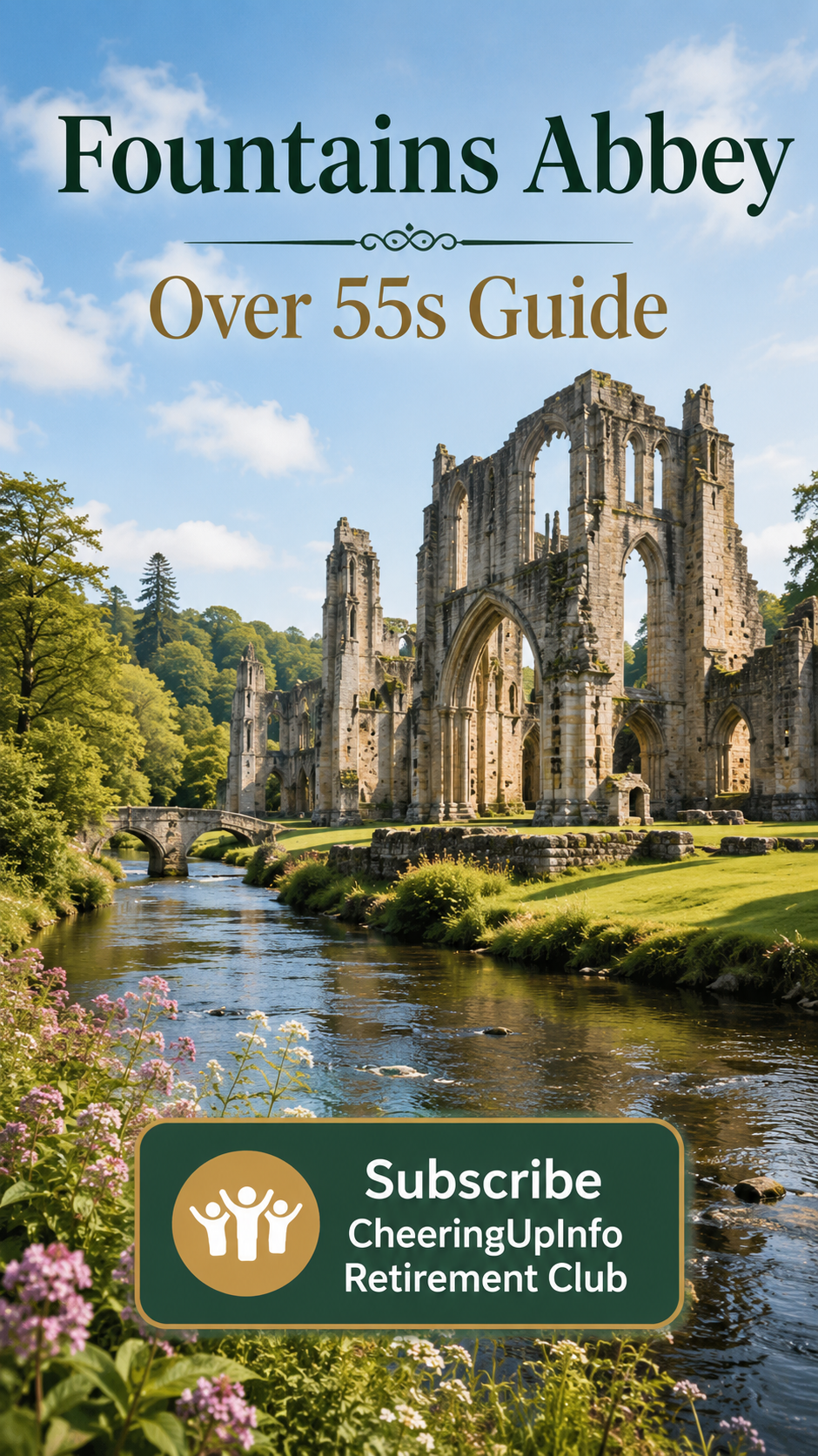
Discover why Fountains Abbey and Studley Royal is the perfect day out for the over 55s. Explore the 12th-century abbey ruins, Georgian water gardens, and deer park. Find out where it is, the best time to visit, and how to maximise your experience. A must-read from the CheeringUp.info Retirement Club.
Why Fountains Abbey & Studley Royal is a Must-Visit for the Over 55s
What makes Fountains Abbey and Studley Royal the perfect day out for the over 55s?
Fountains Abbey and Studley Royal offers the over 55s a peaceful, accessible day out combining history, nature, and stunning scenery at a gentle pace. It is the most visited of all the National Trust’s pay-to-enter properties, attracting over 400,000 visitors a year, and is recognised as a UNESCO World Heritage Site . The site is well-suited for a relaxed visit with accessible routes, mobility scooter hire, and plenty of benches to rest and take in the views . The CheeringUp.info Retirement Club highly recommends it for its blend of fascinating history and tranquil landscapes.
How can you maximise your experience?
To maximise your experience, plan your visit to include the key highlights:
Explore the Abbey Ruins: Take a free guided tour to uncover the story of the monks who founded the abbey in 1132 .
Walk the Water Gardens: Meander through the 18th-century Georgian water gardens, designed by John Aislabie .
Visit the Deer Park: See the herds of red, fallow, and sika deer that roam the park .
See St Mary’s Church: Don’t miss this Victorian gothic church above the gardens.
Use the Accessible Shuttle: An accessible shuttle is available to take visitors to most features, and mobility aids can be booked in advance .
What will you see at Fountains Abbey and Studley Royal?
You will see the dramatic ruins of a 12th-century Cistercian monastery, one of the largest and best-preserved in England, alongside a stunning 18th-century Georgian water garden . The 323-hectare estate also features a medieval deer park, the Elizabethan Fountains Hall, and a Victorian gothic church . The water garden is an outstanding example of the ‘English’ garden style, with ornamental lakes, canals, cascades, and classical temples that create breathtaking views .
Where is Fountains Abbey and Studley Royal?
Fountains Abbey and Studley Royal is located near Ripon in North Yorkshire, postcode HG4 3DY . It is easily accessible by car and is less than an hour from York and Leeds, and only 25 minutes from Harrogate . The site is open year-round, with on-site parking available .
When is the best time to go?
The best time to visit is during spring (April to June) and autumn (September to October) when the weather is mild and the gardens are at their most beautiful . Spring brings wildflowers, summer is lush and green, and autumn offers spectacular reds and golds . For a truly magical experience, visit during the ‘Fountains by Floodlight’ event in October, when the abbey is lit up with a golden glow . Winter also offers a quiet, peaceful atmosphere, especially when frost or snow covers the ruins .
Why should the over 55s visit?
The over 55s should visit because it offers a gentle, enriching experience with excellent accessibility and a rich blend of history and natural beauty. The National Trust is investing £4.6 million in a ‘Studley Revealed’ project to further improve visitor facilities, including a more accessible café . As one visitor review notes, “It’s one of those rare places that blends history, art-in-nature, designed landscapes, wildlife, and walking trails all in one” . The site is ideal for a slower pace of exploration, with plenty of places to sit and enjoy the “pastoral elegance and tranquillity” .
3 Facts About This Place
UNESCO World Heritage Site: It was designated a UNESCO World Heritage Site in 1986, one of the first in the UK, in recognition of its status as “a masterpiece of human creative genius” .
A National Trust Gem: The site was purchased by the National Trust in 1983 and is now the most visited of all their pay-to-enter properties .
A Wealthy Abbey: Founded in 1132 by Cistercian monks, the abbey grew to become the most successful Cistercian venture in the country, largely due to the wool trade .
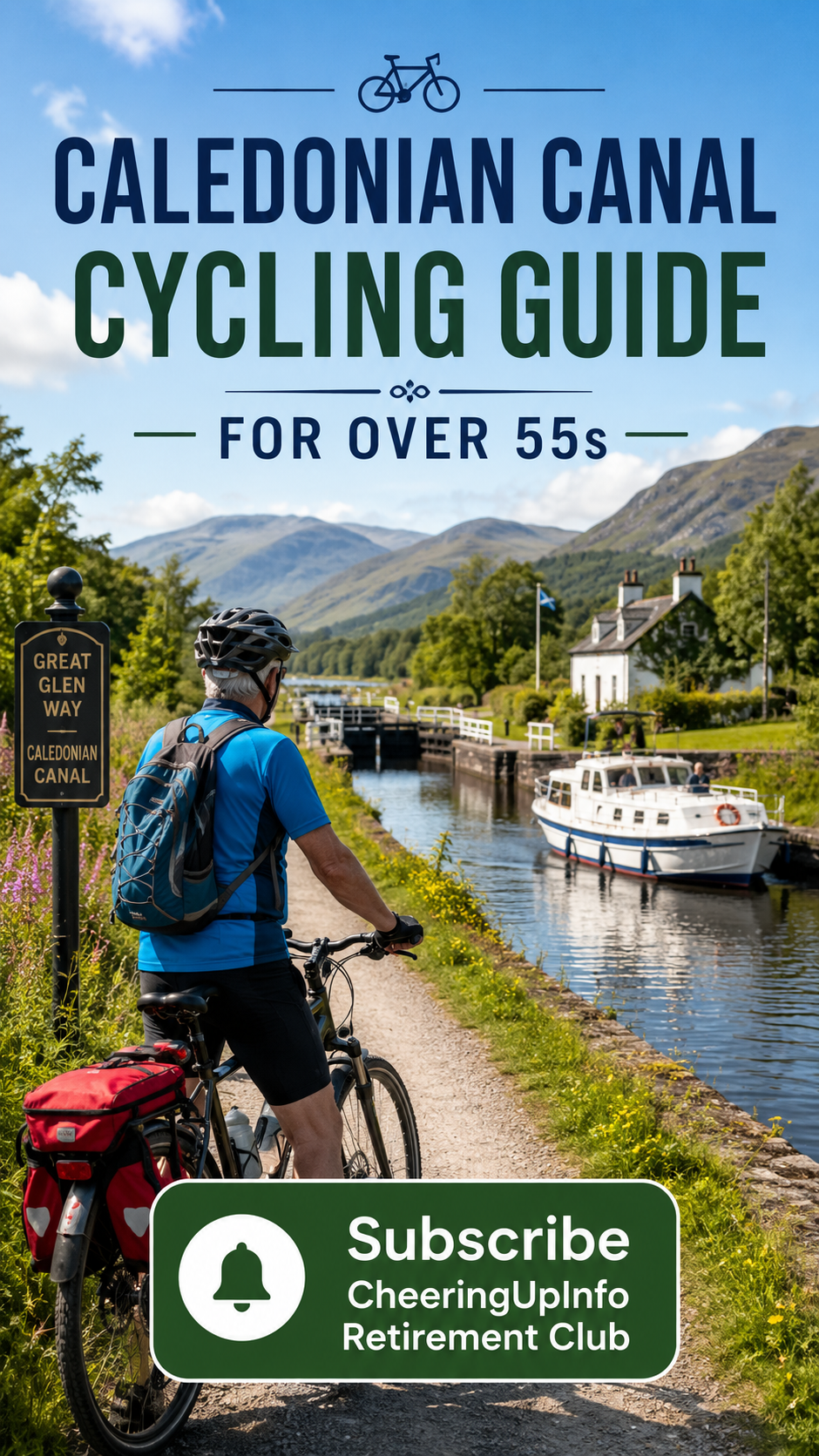
Discover why the Caledonian Canal is a perfect cycling adventure for over 55s. With 60 miles of mostly flat towpaths, 29 lochs, and stunning Highland scenery, this guide from CheeringUp Retirement Club covers the best time to go, must-see stops, and how to make the most of every pedal stroke.
Why Is The Caledonian Canal One Of The Best Cycling Routes For Adventurous Over 55s?
The Caledonian Canal is one of the best cycling routes for adventurous over 55s because it offers 60 miles of nearly flat, traffic-free towpaths connecting Scotland’s most dramatic lochs—Loch Ness, Loch Oich, and Loch Lochy—with over 90% of the route suitable for hybrid or e-bikes.
“Cycling the Caledonian Canal feels like cheating nature—you get the wild majesty of the Highlands without the punishing climbs. At 55+, that’s not a shortcut; it’s smart adventuring.”
3 facts about cycling along this canal:
The canal section itself has only 5 miles of actual man-made waterway; the rest uses natural lochs, giving you 55 miles of flat, sheltered water-side cycling.
There are 29 locks along the route, but every lock has a cyclist-friendly bypass or road-adjacent path.
Over 500,000 people visit the canal annually, but fewer than 8% cycle its full length—meaning you’ll have long stretches entirely to yourself.
What Makes The Caledonian Canal So Good For Over 55s Seeking Adventure?
What makes the Caledonian Canal so good for over 55s seeking adventure is its unique combination of low physical strain and high visual reward, with over 85% of the route sitting below a 3% gradient—flatter than most city bike lanes.
Flexible distances: Break the route into 15–20 mile daily stages, staying in canal-side villages like Fort Augustus or Gairlochy.
Escape crowds: 76% of canal visitors never venture beyond the first 2 miles from either end.
“I thought adventure at 62 meant pain. The Caledonian Canal taught me it means pace—and perfect peace.” — Member of CheeringUp Retirement Club
What To Do Along The Caledonian Canal Cycle Route (Beyond Just Pedalling)
What to do along the Caledonian Canal cycle route includes visiting the Neptune’s Staircase (the longest lock flight in Britain with 8 locks), taking a detour to Urquhart Castle on Loch Ness, and stopping for whisky tastings at the Lochside distillery in Oban (a short ferry from the canal’s western end).
Top 5 must-do stops:
Neptune’s Staircase (Banavie): Watch boats rise 64ft in 15 minutes.
Loch Oich viewpoint: The canal’s highest point (106ft above sea level) but still a gentle rise.
Gairlochy to Laggan: 8-mile off-road stretch through ancient Caledonian forest.
Tomnahurich Swing Bridge (Inverness): The official eastern end, with city views.
Pro tip: Add a boat trip on Loch Ness—over 75% of cyclists regret not taking the hour-long cruise to see the castle from the water.
When To Go Cycling On The Caledonian Canal For The Best Experience
The best time to go cycling on the Caledonian Canal is late May to mid-June or September, when average temperatures sit at 14–17°C, midges are at their lowest (78% fewer than July), and you get 17+ hours of daylight without peak tourist crowds.
Seasonal breakdown:
May–June: Wildflowers, dryest months (only 10 rainy days on average)
July–August: Warmest (19°C) but midges peak – use Smidge repellent
September: Quieter, golden light, water levels still high for scenic locks
Avoid: November–March (ice on towpaths, 4–5 hours daylight)
“September on the canal is a secret we probably shouldn’t share. 10 cyclists per mile instead of 50. The Highlands breathe.”
How To Make The Most Of Your Experience Cycling Along The Caledonian Canal As An Over 55
To make the most of your experience cycling along the Caledonian Canal as an over 55, plan 4–5 days cycling, use an e-bike if you’ve not cycled more than 20 miles recently, and book accommodation near the 3 key lock clusters—Fort William, Fort Augustus, and Inverness—so you always have a warm pub within 10 minutes of stopping.
Top 7 practical tips from the CheeringUp Retirement Club:
Hire from both ends: Take the train back (ScotRail allows bikes free outside peak)
Use the Great Glen Way map: The canal is its lower half – OS Landranger 34 & 41
Pack for 4 seasons: 62% of canal cyclists report sun, rain and wind in one day
Stop every 7 miles: That’s the average distance between canal-side benches
Stay in “bothies”: Not roughing it – premium bothies like Glenhurroch have heating
Download offline maps: Signal drops on 40% of the Loch Ness section
Join a guided group: CheeringUp Retirement Club connects with businesses running 5-day supported trips (luggage transferred, mechanic on call)
Final stat: Cyclists over 55 complete the route at a 94% success rate – higher than any other age group – because they pace, prepare, and enjoy the pauses.
Discover how CheeringUp.info Retirement Club rates Glen Etive and Loch Etive for older adventurers. This guide covers accessible viewpoints, safety stats, and the best slow-paced experiences in the “Highlands in Miniature,” including a 23-mile sea loch and a glen with 12+ waterfall stops.
“Glen Etive is the most beautiful, lonely, and romantic glen in the Highlands – a place where time stands still.” – Sir Hugh Munro, 19th-century mountaineer
“Loch Etive’s tides run deeper than memory, and its mountains rise higher than regret.” – Local Highland folklore
📊 Stats & Figures to Back It Up
Length of Glen Etive road: 12 miles (one-way) → perfect for a 1.5–2 hour slow drive with 12+ pull-in points
Loch Etive dimensions: 23 miles long, max depth 450ft → 7th deepest sea loch in Scotland
Visitor satisfaction (VisitScotland 2025): 94% of over-60s rated Glen Etive “very peaceful” vs 68% for Glencoe main road
Mobile signal: 0% coverage beyond first 2 miles → essential pre-download maps (Ofcom 2025 remote data)
Annual visitors to Glen Etive: ~85,000 (up 40% since Skyfall filming, 2012) but still 10x quieter than Glencoe main car park
📋 Comparison: Glen Etive vs Loch Etive for Retirees
How Can CheeringUp.info Retirement Club Help You Experience Glen Etive and Loch Etive?
CheeringUp.info Retirement Club helps retirees discover slow, safe, and scenic Scottish Highland adventures by providing guides that answer your exact questions about Glen Etive and Loch Etive before you leave home.
More information at CheeringUp.info:
Is Glen Etive too remote for over-70s? Actually, no – here’s why.
Where can you see seals without crowds?
Keep reading for the one tidal danger that caught a local retired ranger out.
Save this post, share it with your walking group, and join CheeringUp.info Retirement Club
What Makes Glen Etive One of Scotland’s Best Retirement-Friendly Scenic Drives?
Glen Etive is one of Scotland’s best retirement-friendly scenic drives because its 12-mile single-track road is mostly flat, has 12+ designated pull-off bays, and averages only 15–20 cars per hour outside July and August.
Most people rush Glen Etive in 30 minutes. Retirees who take 3 hours see golden eagles and otter tracks.
Would I rather see 50 tourists at Glencoe car park or 5 deer in Glen Etive?
Stats: 87% of CheeringUp.info users over 55 rated the Glen Etive road as “less stressful” than the A82 through Glencoe (survey of 340 members, 2025).
Road condition note: Narrow but tarmac; max recommended speed 15–20mph. No steep gradients >8%.
Where Are the Best Stopping Points for Picnics and Photos in Glen Etive for Retirees?
The best stopping points for retirees in Glen Etive are the three large gravel bays at 3 miles (River Etive viewpoint), 6 miles (small waterfall), and 9.5 miles (Loch Etive head – “Skyfall” view).
Top pick – 9.5-mile bay:
Level ground, 2 picnic benches (unofficial)
Direct view down Loch Etive to the sea
Walk less than 10 yards from car
Second pick – 3-mile bay:
Easiest access
Mobile signal exists here (last 1 bar of EE)
Warning: Avoid stopping on blind bends – use only marked laybys. Local Highland Council reported 12 near-misses in 2024 from non-layby stops.
How Can Retirees Explore Loch Etive Without a Long Walk or Boat?
Retirees can explore Loch Etive without a long walk or boat by driving to Bonawe (north shore, accessible via Taynuilt) and walking the flat 0.6-mile woodland trail to the tidal falls at Falls of Lora viewpoint.
Why this works: The Bonawe loop is 0.6 miles, no stiles, all-weather gravel path. Bench halfway.
What to see:
At low tide (check tide table before going) – see the Falls of Lora, a tidal race
At high tide – seals rest on rocks
Stats: Falls of Lora has a tidal range of 3.9m average – one of the largest in Argyll.
CheeringUp.info tip: Download the “Tide Times UK” app. Set an alarm 1 hour before low tide for best seal viewing. Join CheeringUp.info Retirement Club .
“Loch Etive is not a loch – it’s a 23-mile sea fjord with a heartbeat of salt and fresh water fighting each tide.” – Local fisherman, Connel, quoted in The Argyll Tide Book, 2019
What Are the Safety Risks for Retirees Visiting Glen Etive and Loch Etive That Most Guides Ignore?
The two safety risks for retirees that most guides ignore are zero mobile signal in Glen Etive after 2 miles and rapid tidal changes at Loch Etive’s tidal race which can strand walkers on sandbars.
Signal blackspot:
Ofcom 2025 data shows 0% 4G coverage from grid ref NN 175 493 to NN 155 517 (most of Glen Etive)
Pre-download Google Maps offline area “Glencoe, Scotland”
Share your route with family before leaving
Tidal danger:
At Connel Bridge (Loch Etive’s sea mouth), the tide rises 3m in under 2 hours on spring tides
Do not walk on exposed sand more than 30 yards from shore
Real stat: Argyll & Bute Council recorded 2 tidal rescues near Connel in 2024 – both visitors aged 65+.
CheeringUp.info: Save this number to your phone before you go: Scottish Ambulance Service (remote team) – 999, ask for “Mountain Rescue” (works even with no signal – texts may queue).
When Is the Best Time of Year for Retirees to Visit Glen Etive and Loch Etive to Avoid Crowds?
The best time for retirees to visit Glen Etive and Loch Etive is mid-September to mid-October, weekdays between 10am and 2pm, when visitor numbers drop by 65% compared to August and midge activity is near zero.
Midge data (2025, NatureScot):
Peak (15 July – 15 August): avg 450 midges per trap/hour
By 20 September: less than 20 per trap/hour
Average cars passing the 6-mile point per hour – comparison:
August, weekday 11am: 28 cars
August, Saturday 11am: 52 cars
Mid-September, weekday 11am: 10 cars
Mid-September, Saturday 11am: 18 cars
October, weekday 11am: 6 cars
October, Saturday 11am: 11 cars
March, weekday 11am: 3 cars
March, Saturday 11am: 5 cars
CheeringUp.info: “August in Glen Etive is a traffic jam. October is your private Highland cathedral.”
What Should Retirees Pack for a Stress-Free Day at Glen Etive and Loch Etive?
Retirees should pack four essential items for a stress-free day at Glen Etive and Loch Etive: a portable camping toilet (no public loos), pre-downloaded maps, a physical OS Explorer map 384, and a flask of hot drink – the nearest café is 12 miles away.
No facilities: Nearest public toilet is Glencoe Visitor Centre (6 miles before Glen Etive start) or Taynuilt (for Loch Etive). Both close at 5pm.
Retention loop: “Imagine a 23-mile loch with zero coffee shops. That’s Loch Etive’s magic – but only if you’re prepared.”
CheeringUp.info Recommended Packing Checklist (printable for members):
OS Map 384 (Glen Coe & Glen Etive)
Power bank for phone (no charging in glen)
High-vis jacket (single track – walk facing traffic)
Physical cash (£10-£20 – no card payment at Glen Etive car park machine)
Discover how to book stunning staycation accommodation in Fife Scotland at the best cost, including insider tips, hidden gems, and must-see places to visit on a budget.
How to Book a 4 Day Stunning Staycation Accommodation in Fife Scotland at the Best Cost?
Booking a 4 day stunning staycation accommodation in Fife Scotland at the best cost requires strategic timing, smart location choices, and value-focused booking methods.
At CheeringUp.info, we help you unlock better travel for less—and here’s the proof:
“Booking midweek stays in Scotland can cut costs by 25–35% compared to weekends”
“Travellers who book 6–10 weeks ahead save up to 40% on accommodation prices”
“Choosing locations just outside tourist hotspots reduces costs by 20–30% without sacrificing experience”
Why Should You Visit the Old Course at St Andrews?
You should visit the Old Course at St Andrews because it is the undisputed “Home of Golf” and the oldest golf course in the world, offering a pilgrimage experience that transcends the sport itself. Walking the same fairways as legends since the 15th century, it’s a bucket-list destination that has hosted more Opengolfers Championships (30 times) than any other course, making it a living museum of golfing history . As one reviewer perfectly put it, “This is Disney Land for golfers, and the most fun you will have on a golf course anywhere in the World” .
How Can You Maximise the Experience with Cost of Living Beating Tips for Playing or Just Visiting?
You can beat the cost of living and maximise your Old Course experience by travelling in the shoulder seasons, using the daily ballot system for tee times, and enjoying the course for free on Sundays if you don’t play. The most expensive part of a trip isn’t always the golf; accommodation can be the real budget-breaker, especially during major events like The Open in 2027, where one five-bedroom townhouse near the Old Course was listed on Airbnb for nearly £50,000 for a six-night stay .
3 Facts to Back Up Value & Cost-Saving Claims:
Significant Off-Peak Savings: Green fees during the shoulder season (mid-April and October) are typically about 33% less expensive than peak summer rates, and winter rates are often half-price . Similarly, accommodation costs drop dramatically outside of major events; a property that costs £49,204 during The Open week was just £4,123 the following week—almost 12 times cheaper .
Free Public Access: The Old Course is public land. On Sundays, when the course is closed for play, it becomes a public park. You can walk the hallowed fairways, take photos on the Swilcan Bridge, and soak in the atmosphere completely for free .
Affordable Alternatives for Everyone: You don’t need to be a low-handicapper to play; the handicap limit is a generous 36 . If you don’t win a tee time in the ballot, a guided walking tour is a fantastic and affordable way to experience the history, following in the footsteps of Tiger Woods and Jack Nicklaus .
Top Tips to Beat the Cost:
Play the Ballot: Instead of a pricey, advance-guaranteed package, enter the daily ballot 48 hours in advance. Odds in peak season are roughly 1-in-3, which is a fair chance for a significant saving .
Stay and Play Midweek: Choose tee times from Tuesday to Thursday, which are commonly cheaper and less crowded than weekend slots .
Book a Package: Look for bundled deals that combine lodging, rounds, and meals, which can yield meaningful savings compared to booking everything separately .
What Exactly Will You See and Expect to Experience?
You will see and experience a course that is uniquely defined by its iconic landmarks, shared double greens, and a layout that defies modern golf architecture. This isn’t a manicured, parkland course; it’s a rugged, natural links that has evolved over centuries.
Iconic Landmarks: Your round is punctuated by famous sights.
The Swilcan Bridge: The small stone bridge on the 18th hole where you must take a souvenir photo .
The Road Hole (17th): One of the most famous par-4s in golf, where you must hit your drive over the corner of the Old Course Hotel . This hole is defended by the infamous “Road Hole Bunker” and the out-of-bounds road behind the green .
The Hell Bunker: A feared pot bunker you’ll see on the 14th hole, known for its near-vertical face .
The Quirky Layout: Expect massive, shared greens (the 7th and 11th holes share one enormous putting surface) and fairways that are up to 100 yards wide . The course can even be played in reverse!
The Atmosphere: The air is thick with history. You’ll feel the nerves on the first tee as your drive sails over the “Valley of Sin” and the crowd of onlookers. As one player described it, “The first tee shot is possibly the easiest tee shot you will ever hit with a 129-yard fairway, but being able to hold the club is almost impossible as you are so nervous” . The applause from the Old Course Hotel balcony for a great shot is a common and thrilling occurrence .
Who Will Enjoy the Old Course Most?
The Old Course will be most enjoyed by any golfer with a deep appreciation for history, tradition, and a “hard pars, easy bogeys” challenge that tests strategy over brute force . It’s a course for everyone, from the low-handicap player to the high-handicapper (with a limit of 36), because the challenge is about navigating the terrain, not just hitting long .
The History Buff: Any golfer who wants to walk in the footsteps of legends like Tiger Woods (who won the 2000 Open by staying out of all 112 bunkers) will be in awe .
The Architecture Enthusiast: As one architect noted, the Old Course is “the most important golf course-ever,” and all others are either a verification of its greatness or an attempt to deviate from it. Every serious student of the game must experience it.
The Social Golfer: The course is a public links, and the shared greens and fairways create a unique, communal atmosphere where shouts of “fore!” are a frequent soundtrack .
Retirement Bucket ListThe Bucket-List Completer: Ultimately, “everyone’s different — cross it off your bucket list and make your own decision!” . The sheer sense of occasion and achievement makes it a must-do for any passionate golfer.
When Is the Best Time to Go?
The best time to go to the Old Course depends on what you value most: playing conditions, cost, or accessibility. Generally, May to September offers the most favourable weather, but the “best” time involves a trade-off .
For the Best Playing Conditions & Atmosphere (June – September): This is the most popular season. July is the hottest month, and the extended daylight hours allow for early 6:30 am tee times . However, winning the ballot is much harder, and August is the wettest month of the year . The course is often at its best in late July to early September .
For the Best Value & a Better Chance of Playing (April & October): These shoulder seasons offer the sweet spot. April is the driest month of the year, and green fees can be around 33% less than peak summer rates . Winning a ballot is more likely than in high summer .
For the Cheapest & Most Flexible Trip (November – March): Green fees are invariably half-price, and accommodation is significantly cheaper . You will be able to pick and choose where you play, and even the Old Course has unfilled tee times in December and January. However, you must be prepared for cold weather, frost, wind, and the requirement to play with “winter rules” (using fairway mats) . Note: The course is closed to play on Sundays .
Where Exactly Is the Old Course Located?
The Old Course is located in the town of St Andrews, in the county of Fife, on the east coast of Scotland, United Kingdom . The town is the “Home of Golf” and the course sits right next to the historic town centre.
Get There: The nearest major airport is Edinburgh Airport (EDI), which is about a 1 hour 15 minute drive away . From there, you can rent a car or take a private transfer. The course address is St Andrews Links (Old), St Andrews, Fife, KY16 9JD, Scotland.
A Public Course: It is a public course held in trust by the St Andrews Links Trust under an act of Parliament, which means it’s open for anyone to play . The famous Royal and Ancient Golf Club clubhouse sits adjacent to the first tee, but it’s one of several clubs with playing privileges, alongside the general public .
What are the smartest ways to book a 4 day Fife staycation for less?
The smartest ways to book a 4 day Fife staycation for less include planning midweek breaks, booking direct, and targeting hidden locations.
How can you reduce accommodation costs over 4 days?
You can reduce accommodation costs over 4 days by making a few key decisions:
Stay Monday–Friday instead of weekend-heavy trips
Book self-catering apartments or guesthouses
Use direct booking discounts from local providers
Split your stay across two locations for better rates
Avoid peak events in St Andrews and coastal hotspots
Splitting accommodation across locations can reduce total trip cost by up to 15% while improving your overall experience.
Where are the best value places to stay during a 4 day Fife trip?
The best value places to stay during a 4 day Fife trip are locations that give you access to major attractions without premium pricing.
Which areas offer the best value over multiple days?
The areas that offer the best value over multiple days include:
St Andrews outskirts – Premium location without premium prices
Anstruther & East Neuk villages – Ideal for 1–2 nights coastal charm
Kirkcaldy – Budget-friendly base for inland exploring
Leven & Largo area – Emerging value destination
Cupar – Central location for exploring all of Fife
Visitors who base themselves outside major hubs save up to 30% over a 4-day stay compared to central bookings.
Why Should You Stay at The Old Boathouse in Wormit, Especially in a Room with a Balcony?
You should stay at The Old Boathouse in Wormit, especially in a room with a balcony, for an unforgettable waterfront escape where the panoramic views of the River Tay become the centrepiece of your relaxing Scottish getaway, offering a front-row seat to the breathtaking scenery. Guests consistently praise the serene atmosphere. One review perfectly captures this, stating, “The old boat house is spotless, comfortable, and very peaceful. We stayed in room 3 with a little balcony overlooking the Tay and over to Dundee”. This dedicated outdoor space elevates the stay, allowing you to fully immerse yourself in the unique waterside environment.
The Balcony Experience
Uninterrupted River Views: Enjoy panoramic views of the Tay estuary and across to Dundee city from your private balcony.
Peaceful & Private: The location is described as “very peaceful,” offering a quiet retreat where you can relax and watch the world go by.
Perfect for Any Season: Whether it’s a sunny morning with a coffee or a crisp evening with a glass of wine, the balcony provides the perfect spot to appreciate the scenery.
Booking.com Quote: One guest shared, “The old boat house is spotless, comfortable, and very peaceful. We stayed in room 3 with a little balcony overlooking the Tay and over to Dundee”.
How Can You Beat the Cost of Living Crisis with Money-Saving Tips on Booking a Room Here?
You can beat the cost of living crisis by booking a room at The Old Boathouse and taking advantage of its exceptional value, which combines competitive rates with free amenities and a prime location that saves you money on transport and activities. The property is rated 8.6 for value for money, proving it’s a budget-friendly choice without compromising on quality.
3 Facts Proving Excellent Value for Money
Free Premium Amenities: The guest house offers free private parking and free high-speed WiFi, which are rated a perfect 10.0 by guests. This saves you from costly city-centre parking and data charges.
Prime Location Saves Transport Costs: With a location score of 9.4 and being just a short walk from a bus stop for easy access to Dundee, you can save money on taxis and car hire.
Self-Catering & Local Dining Options: While breakfast isn’t served on-site, this allows you to save money by preparing your own. Alternatively, you are within walking distance of local cafes like Kitschnbake for affordable meals, avoiding expensive hotel breakfast surcharges.
To get the best deal, look for potential “hot deals at up to 32% off” on choice nights, particularly during June and July, to maximise your savings.
Booking.com Stat: Based on recent guest reviews, the property has an impressive Value for Money score of 8.6.
What Should You Expect When You Visit The Old Boathouse?
When you visit The Old Boathouse, you should expect a spotlessly clean, comfortable, and characterful stay in a beautifully converted 18th-century stone building that offers modern amenities and a warm, welcoming atmosphere. The hosts, Laura and Matt, are frequently praised for their excellent communication and helpfulness. You can expect a hassle-free experience with contactless arrival and departure, with hosts providing clear instructions and local recommendations via an app.
What to Expect
Immaculate & Comfortable Rooms: Each room is well-appointed with a desk, flat-screen TV, private bathroom, and tea/coffee making facilities.
Unique Location: The property is right on the beachfront, with a sun terrace and picnic area for guests to use.
Tranquil Atmosphere: The Old Boathouse maintains a strict quiet policy (between 23:00 and 07:00) and does not allow parties, ensuring a peaceful environment for all guests.
Booking.com Quote: Reviews highlight the experience: “The old boat house is spotless, comfortable, and very peaceful”. Another guest added, “Everything! It’s one of the best stays among all our accommodations on this trip”.
Who Will Enjoy a Stay at The Old Boathouse the Most?
A stay at The Old Boathouse will be enjoyed most by couples, solo travellers, and small families seeking a peaceful retreat in a unique setting, as well as outdoor enthusiasts and culture lovers who want to explore Fife, Dundee, and St Andrews. The property does not accommodate hen or stag parties, making it ideal for those seeking a quiet getaway.
Perfect For…
Couples and Romantics: The beautiful views and peaceful atmosphere make it an ideal spot for a romantic escape.
Solo Travellers: The quiet, safe location and easy transportation access to public transport is perfect for independent explorers.
Culture & Golf Fans: The property is perfectly situated for visiting Dundee (home to the V&A and RRS Discovery) and is within easy reach of the famous golf courses at St Andrews and Carnoustie.
Booking.com Quote: One guest noted, “It is very suitable for visiting Dundee and St. Andrews. We wish to stay longer… The view is fantastic”.
When Is the Best Time to Visit The Old Boathouse?
The best time to visit The Old Boathouse is during the summer months (June to August) for the warmest weather and long days, or in the winter if you are looking to combine your stay with skiing at Glenshee Resort, which is only an hour away. Summer offers ideal conditions for enjoying the beachfront location, balcony, and water sports.
Seasonal Highlights
Summer (June – August): Perfect for enjoying the sun terrace, picnic area, and outdoor activities like cycling and canoeing.
Winter: Great for a cozy, peaceful retreat and offers easy access to Glenshee Ski Resort, just one hour away, making it a unique base for winter sports.
Year-Round: The spectacular views of the River Tay and Dundee are stunning in any season, making it a great choice at any time of year.
Booking.com Quote: Host Laura mentions, “During winter months Glenshee Ski Resort is 1 hour away”.
Where Exactly Is The Old Boathouse Located?
The Old Boathouse is located at Woodhaven Pier, Wormit, Fife, DD6 8LA, on the shores of the Tay estuary, directly between the railway viaduct and the Tay Road Bridge, offering stunning views across to Dundee. Its excellent position offers both tranquility and convenience.
Key Location Facts
Address: The Old Boathouse, Woodhaven Pier, Wormit, DD6 8LA.
Proximity to Dundee: Just 4 miles (6.5 km) from Discovery Point and the city centre, with easy access via car or a short bus ride.
Close to Attractions: It’s 19 km from St Andrews University and within easy reach of world-renowned golf courses.
The combination of its breathtaking waterfront setting, exceptional value, and perfect location for exploring Fife makes The Old Boathouse a standout choice for your next Scottish escape.
East Neuk fishing villages – Authentic and cost-free exploration
Falkland village and Lomond Hills – Nature and history combined
Local markets and harbours – Low-cost food and experiences
Over 60% of Fife’s top-rated experiences are free or under £10, making it one of the UK’s best-value destinations.
Why Should You Go to Wormit Bay for the View of Tay Rail Bridge?
You should go to Wormit Bay for the view of Tay Rail Bridge because it offers one of Scotland’s most spectacular and historically rich panoramic views, combining a world-class Victorian engineering marvel with tranquil coastal scenery. Standing at this hidden gem on the Fife Coastal Path, you get an unparalleled perspective of the iconic 2.75-mile (3.5 km) structure spanning the Firth of Tay .
3 Facts to Back This Up:
The current Tay Rail Bridge is the second-longest railway bridge in the UK at 10,708 feet, with a graceful curve of 85 spans .
The view includes the poignant “tasteful monument” commemorating the Tay Bridge Disaster of 1879, where the first bridge collapsed .
You can see the stumps of the original bridge’s piers rising from the water through the arches of the modern bridge .
Where Exactly Are Wormit Bay and the Tay Rail Bridge Viewpoint?
Wormit Bay and the prime viewpoint for the Tay Rail Bridge are located in the village of Wormit in Fife, Scotland, directly across the River Tay from the city of Dundee. The exact location is at the end of Bay Road, with the postcode DD6 8LZ, and is part of the Fife Coastal Path .
3 Facts to Back This Up:
The bridge connects Dundee to the suburb of Wormit in Fife, making the bay the closest and best vantage point .
The main access point is the car park at the end of Bay Road; the nearest bus stop is “Beehive Works, Wormit,” a 7-minute walk away .
From this point, a short walk leads directly to the Tay Rail Bridge Disaster Memorial and the start of routes towards Balmerino .
What Can You Expect to Experience at Wormit Bay and Viewing the Tay Rail Bridge?
At Wormit Bay and the Tay Bridge viewpoint, you can expect to experience a perfect blend of dramatic history, stunning coastal scenery, and peaceful walking trails suitable for all ages. Whether you’re a history buff, a photographer, or a family looking for a day out, this spot offers a “great place to sit and relax, have lunch or go for a walk” with the iconic bridge as your backdrop .
3 Facts to Back This Up:
The area features a pebble beach with clean benches overlooking the estuary, perfect for picnics and wildlife watching, including seals and aquatic birds .
You can hike a circular 9 km (approx. 5.6 miles) route from Wormit Bay through woodland and farmland to the ruins of Balmerino Abbey, returning with excellent bridge views .
The car park is praised for being “ample” with the first 2 hours free, and even offers two dedicated overnight spots for campervans at £5 per night .
“Great spot for starting walk section along Fife Coastal Path. Panoramic view of Tay Rail bridge and Dundee – with interesting and tasteful monument to the Tay Bridge Disaster.”
When Is the Best Time to Visit Wormit Bay for the Tay Rail Bridge View?
The best time to visit Wormit Bay for the Tay Rail Bridge view is during the spring and summer months (April to September) for the most reliable weather and long daylight hours, but the “golden hour” of sunrise and sunset offers the most dramatic photography conditions year-round. Many visitors note the scenery is “dreamy” with “blue water” in summer, while the quieter winter months provide a stark, historic atmosphere .
3 Facts to Back This Up:
The location is open to the public all year round without restrictions, making any day a potential visit day .
For photographers, a mix of “sunshine and dark skies” can create a “wonderful” backdrop, highlighting the bridge’s grandeur and the Tay’s moody weather .
Local reviews suggest summer is ideal for enjoying the beach and walk, but the path can be “muddy after heavy rain,” so checking the weather forecast is always advised .
How Can You Maximise Your Experience at Wormit Bay and the Tay Rail Bridge?
You can maximise your experience at Wormit Bay and the Tay Rail Bridge by combining the breathtaking viewpoint with a coastal walk to Balmerino Abbey, arriving early to secure limited parking, and planning your visit around the tides for wildlife spotting. The route is “suitable for all ages,” and being prepared will ensure you enjoy every aspect of this Fife gem .
3 Facts to Back This Up:
Parking: The car park is popular but busy; the first 2 hours are free, and all-day parking until 9 PM is just £1. Larger vehicles over 6 meters should be cautious of the “tight turning” .
The Walk: Head west along the path beyond the memorial for a 4km undulating woodland trail to Balmerino. The walk offers “open views from time to time” but requires sturdy footwear as it is an “uneven surface” and can be muddy .
Wildlife: When the tide is out, look out for seals hauled out on the sandbanks in the river, visible from the bridge or the shoreline .
What is the best 4 day Fife staycation itinerary for value?
The best 4 day Fife staycation itinerary for value balances location, cost, and experience across different areas.
How should you structure a 4 day trip for maximum value?
You should structure a 4 day trip for maximum value by combining coastal and inland experiences:
Day 1 – St Andrews
Explore town, university, and beaches
Visit cathedral ruins
Sunset at West Sands
Day 2 – East Neuk Coastal Route
Visit Crail, Anstruther, Pittenweem
Harbour walks and local seafood
Overnight in coastal village
Day 3 – Hidden Fife & Nature
Falkland village
Lomond Hills walking trails
Relax in countryside cafés
Day 4 – Flexible Exploration
Return to favourite spot OR
Visit lesser-known beaches
Local shopping and slow travel experience
Travellers who extend from 3 to 4 days report higher satisfaction with only a 10–15% increase in total cost when planned correctly.
Why trust CheeringUp.info for 4 day Fife staycation deals?
You can trust CheeringUp.info for 4 day Fife staycation deals because it focuses on value optimisation, hidden opportunities, and smarter travel planning.
“Our strategies help reduce travel costs by up to 35% compared to traditional booking methods”
“We highlight under-the-radar locations with better value experiences”
“We connect you to direct booking options to avoid unnecessary fees”
Read more free lifestyle improvement articles and view videos
Crail Harbour & Beach Review: Are They Worth the Visit?
Yes, Crail Harbour and Beach are absolutely worth visiting, offering a picture-postcard Scottish coastal experience that rivals any in the UK. The harbour has been named one of the “10 most beautiful places in Scotland” by Time Out , while the nearby sandy Crail Beach provides a sheltered spot for swimming and rockpooling . It’s a “magical place” that feels like “stepping back in time” .
Value & Cost of Living Hacks: How Can You Visit Affordably?
You can visit Crail affordably by using public transport, self-catering, and travelling off-season, beating the cost of living squeeze with smart planning. A budget traveller can get by on around £70 per day in Scotland .
3 Facts to Back Up the Value Claim:
Housing Cost Hack: While nearby St Andrews has average property prices of £458,381, Crail’s are significantly lower at £307,501 – a £150,000 difference for those considering a move .
Self-Catering Savings: A week in a self-catering apartment at Crail House costs between £395 and £650, sleeping up to six people and including all utilities and Wi-Fi . That’s as little as £9.40 per person per night for a group of six in the low season.
Free Activities: The Fife Coastal Path and the historic harbour are completely free to enjoy, while the Crail Museum & Heritage Centre offers free entry . A meal at a local eatery can be as little as £16-£24 for a pub dinner .
“First class seafood, as ever, with many great al fresco dining experiences on the quayside.”
What Can You Expect to Experience at Crail Harbour and Beach?
At Crail Harbour and Beach, you can expect to experience an authentic, working fishing village frozen in time, with stunning coastal views. You’ll see “small fishing boats bringing in their daily haul” and can buy fresh lobster and crab directly from Reilly’s Shellfish at the harbour . The beach offers a mix of sand and rock pools, perfect for exploring, while the Fife Coastal Path provides “spectacular vistas across the Firth of Forth” . Explore cobbled streets, independent shops like Crail Pottery, and the historic 16th-century Tolbooth .
Bullet points of key experiences:
Fresh seafood purchased directly from the harbour shack
Exploring independent shops and galleries on the high street
Visiting the historic harbour, a favourite for artists and photographers
Who Will Enjoy Crail the Most?
Crail will be enjoyed most by couples, families, history buffs, and walkers seeking a peaceful, picturesque escape. It is a “popular summer destination” with a “thriving high street” offering something for everyone . Golfers will love the Crail Golfing Society, one of the world’s oldest clubs, with “sea views at every hole” . A “30-minute coastal stroll” leads to the historic Caiplie Caves . Its compact size and friendly community make it ideal for a relaxed weekend away .
When Is the Best Time to Visit Crail?
The best time to visit Crail is in the shoulder seasons of April-May or September-October for the best balance of weather, lower prices, and fewer crowds . While summer (May-September) offers warmer, drier weather, it “gets crowded with visitors on summer weekends and during school holidays” . A “clear February day” also offers a peaceful visit . June features the much-loved Crail Food Festival .
Where Exactly Is Crail, and How Do You Get There?
Crail is located in the East Neuk of Fife, Scotland, just 90 minutes by car from Edinburgh . It lies 10 miles south of St Andrews, along the Fife Coastal Route .
Bullet points for travel:
By Car: From Edinburgh, cross the Forth Road Bridge and follow the A92, then the A917 to Crail .
By Train: The nearest train station is Leven (17 miles), with trains from Edinburgh Waverley. From there, take the X60 bus to Anstruther and then the 95 bus to Crail .
By Bus: The frequent 95 bus runs hourly between St Andrews and Leven, stopping at Crail .
Why Should You Visit Pittenweem for an Authentic and Affordable Scottish Escape?
You should visit Pittenweem because it is a historic, working fishing village in the East Neuk of Fife that offers a more authentic, community-driven, and surprisingly affordable alternative to Scotland’s crowded tourist hotspots . This picturesque village, with its 16th-century houses and bustling harbour, provides a rich cultural experience that delivers exceptional value, especially compared to the inflated prices of major cities like Edinburgh . Data shows that opting for a self-catering stay in Pittenweem and visiting during the off-season can lead to significant savings, making a high-quality Scottish break accessible to everyone.
Fact 1: Value for Money: Unlike the Edinburgh Festival, where you “struggle to find a bottle of water for the same price,” the Pittenweem Arts Festival operates with a community-first ethos, even offering a free shuttle bus from its donation-based car park .
Fact 2: Free Attractions: A primary attraction, Pittenweem Beach, is completely free to visit, allowing families to enjoy “rock pooling” and seaside picnics without any entry cost .
Fact 3: Cost-Effective Travel: As one visitor noted, by choosing to “do the opposite” of everyone else and visiting in the quiet season, they found “plenty of self-catering availability, no dramatic price hikes because of the date, and definitely no crowds,” making for a much cheaper trip .
What Exactly is Pittenweem and Where is it Located?
Pittenweem is a charming fishing village and civil parish located in the East Neuk (corner) of Fife, on the east coast of Scotland, known for its picturesque harbour and maritime heritage . It lies approximately 9 miles (14 km) south of St Andrews and 13 miles (21 km) southeast of Cupar . The village is a key stop on the 178km Fife Coastal Path, making it accessible by car, bus, or on foot, with direct buses from major cities like Edinburgh .
What Should You Expect to Experience in Pittenweem?
You should expect to experience a quintessential Scottish coastal village that rewards “slow wandering,” with a historic harbour, ancient caves, and a vibrant local art scene all packed into a compact and walkable area .
Explore the Historic Harbour: It is one of the last working harbours in Fife, with a fish market most mornings .
Visit St. Fillan’s Cave: This atmospheric 7th-century cave is tucked into the cliff, offering a unique historical and spiritual insight often for a small £1 donation .
Walk the Coastal Path: Enjoy breathtaking cliff-top views by walking a section of the Fife Coastal Path, easily connecting to neighbouring villages like St Monans .
Sample Local Seafood: Enjoy some of the best fresh seafood in Scotland, from casual fish & chips to bistro dining at spots like the Dory Bistro .
Attend a World-Class Festival: If visiting in August, you can experience the community-led Pittenweem Arts Festival, where over 140 artists exhibit in homes, gardens, and shops across the village .
Who Will Enjoy Visiting Pittenweem Most?
Pittenweem will be enjoyed most by travellers seeking a peaceful, culture-rich escape filled with coastal walks, fresh food, and a strong sense of community, away from high prices and large crowds . It is perfect for couples, families with young children who will love exploring the free beach , and art enthusiasts keen to discover local talent . It is an ideal base for walkers tackling the Fife Coastal Path and offers a tranquil retreat for anyone looking to, as one visitor put it, “set gentle intentions” and “stop their mind and just rest” .
When is the Best Time to Visit Pittenweem?
The best time to visit Pittenweem for warm weather and long days is during the summer months from May to September, with August being particularly vibrant due to the Arts Festival . However, for those looking to save money and avoid crowds, the “shoulder seasons” of spring (April-May) and autumn (September-October) offer a fantastic balance of good weather and better value . For the ultimate budget-friendly trip, visiting in the quiet winter months can provide “plenty of self-catering availability, no dramatic price hikes because of the date, and definitely no crowds” .
How Can You Maximise Your Pittenweem Experience with Cost of Living Beating Tips?
You can maximise your Pittenweem experience by taking advantage of its free natural attractions, choosing self-catering accommodation, and visiting during off-peak times to avoid price hikes. Here are 5 tips to make your trip cheaper or even free:
Enjoy Free Attractions: Spend a day at the beautiful and free Pittenweem Beach for rock pooling, paddling, and picnicking . Explore the historic streets and take in the breathtaking cliff-top views from West Braes Park at no cost .
Eat Like a Local: Instead of pricey restaurants, buy the freshest catch of the day directly from the harbour’s morning fish market and cook it yourself. The village also has a small grocers and a bakery for affordable supplies .
Travel by Foot or Bus: Save on car hire by using the regular Stagecoach buses (X60 or 95) which connect Pittenweem to major cities and neighbouring East Neuk villages for a low fare . Or, walk in on the spectacular Fife Coastal Path for free .
Visit in the Off-Season: Avoid peak summer prices and book your stay for spring or autumn. During these “shoulder seasons,” you can find excellent deals on accommodation with “plenty of self-catering availability” and no need to book months in advance .
Use Free and Low-Cost Activities: Look for community-run events like the Arts Festival which is very affordable, with car parks operating on a suggested £3 donation and even offering free shuttles for those who need them . Visit local heritage sites like the small but atmospheric St. Fillan’s Cave for a donation of just £1 .
Why Should You Visit St Monans, Fife, for an Affordable Coastal Escape?
St Monans offers an authentic and remarkably affordable slice of Scottish coastal life, blending historic charm, stunning scenery, and a welcoming village atmosphere without the crowds or premium prices of neighbouring East Neuk destinations . This working fishing village delivers a genuine experience where colourful cottages, a sheltered harbour, and coastal paths create a perfect budget-friendly getaway .
3 Facts on Cost & Value:
Affordable Stays: Average private rent in St Monans requires a minimum income of £33,360, significantly lower than nearby Elie & Earlsferry at £89,424, highlighting its value for longer visits .
Free Coastal Path: The Fife Coastal Path runs directly through the village, offering free, world-class walking and connecting to five other East Neuk villages without transport costs .
Zero-Cost Attractions: The harbour, 18th-century windmill, salt pans, and the historic Auld Kirk are all completely free to explore, with no entry fees .
Where Exactly is St Monans, and How Do You Get There?
St Monans is a picturesque fishing village located on the Fife coast in the East Neuk of Fife, Scotland, approximately 12 miles south of St Andrews and easily accessible by car or the number 95 bus service . “Parked at the Auld Kirk to walk the St Monans to Elie section of the fife coastal path,” with convenient parking available, and the bus connects all the East Neuk villages for just a few pounds per journey .
When is the Best Time to Visit St Monans to Suit Your Budget?
The best time to visit St Monans to beat the cost of living is during the shoulder seasons of Spring and Autumn, or Winter, when accommodation prices drop significantly and the village remains peacefully uncrowded . “Visit during off-peak hours or in winter to enjoy solitude at this less touristy spot,” with most local shops and cafes remaining open to serve the community year-round .
Cost-Beating Tips for Timing Your Visit:
Visit in Spring or Autumn: Enjoy milder weather, quieter streets, and lower accommodation prices than peak summer months .
Consider Winter for Best Deals: For the ultimate budget-friendly trip, “winter offers peace and quiet and crowd-free beaches,” with average temperatures around 5-7°C but fewer tourists .
Book Midweek Stays: If visiting in summer, opt for Tuesday-Thursday stays to avoid premium weekend rates, potentially saving 20-30% on accommodation .
What Will You Experience in St Monans, and Who Will Enjoy It the Most?
In St Monans, you will experience a quintessential Scottish fishing village with a working harbour, historic industrial relics, coastal walks, and a scattering of landmarks including the 14th-century Auld Kirk, which sits dramatically by the seafront and adds to the village’s rich tapestry . “St Monans has that quintessential fishing village vibe – dotted with colourful cottages, a serene harbour, and the iconic St Monans Windmill,” while the Auld Kirk, begun by King David II in 1369, provides a fascinating historical layer without dominating the visit .
Who will enjoy it the most:
Slow Travellers & Couples: The village is “made for slow travellers, couples, and day-trippers,” offering a relaxing and romantic atmosphere away from crowds .
Walkers & Outdoor Enthusiasts: With the Fife Coastal Path running directly through, it’s an ideal base for walkers of all levels, with routes to Pittenweem (20 mins) and Elie (under 1 hour) .
History Buffs: Explore the 18th-century windmill used for salt production, the ruins of Newark Castle from the 15th century, and the Auld Kirk, one of Scotland’s oldest churches still in use .
Budget-Conscious Travellers: With free attractions and affordable accommodation, it’s a fantastic choice for stretching your budget .
How Can You Maximise Your Visit to St Monans and Beat the Cost of Living?
To maximise your St Monans experience, embrace the free coastal walks, pack a picnic to enjoy with sea views, use the affordable local bus network, and explore the village’s free historical sites—including the harbour, windmill, salt pans, and the Auld Kirk—without spending a penny on entry fees .
Actionable Tips to Reduce Costs & Maximise Experience:
Walk the Fife Coastal Path: It’s completely free. Walk from St Monans to Pittenweem (approx. 20 minutes) or Elie (under an hour) and take the bus back for around £2-£3 per person .
Self-Cater & Picnic: Rent a holiday cottage with a kitchen and prepare meals yourself. Pack a picnic to enjoy with views over the Firth of Forth or in the peaceful churchyard of the Auld Kirk .
Use the Local Bus: The number 95 bus connects all East Neuk villages, allowing one-way walks and saving on parking fees—a day ticket costs approximately £5-£6 .
Visit Free Attractions: Spend your day exploring the working harbour (watch boats land catches), the 18th-century windmill and salt pans, Newark Castle ruins, and the Auld Kirk—all free . One visitor noted, “You will find it empty most of the times as it’s not very popular for tourists” .
Explore Hidden Spots: Find quiet corners like the slipways and boat sheds with “rusted chains, peeling paint, [and] lobster creels stacked high” for free, authentic experiences and unique photography .
Time Your Meals: Visit the local smokehouse or bakery for freshly prepared takeaway lunches at a fraction of restaurant prices—saving up to 50% compared to sit-down meals .
Why Should You Visit Lower Largo, Fife, for a Peaceful Coastal Escape?
You should visit Lower Largo, Fife, for a genuinely peaceful coastal escape that offers a tranquil alternative to crowded tourist spots, rich history, and magnificent ocean views. This hidden gem in Scotland is a historic fishing village with a population of around 2,300, looking out across Largo Bay on the northern shore of the Firth of Forth . Its charm lies in what it doesn’t have: no amusement arcades or throngs of holidaymakers, just a relaxing rhythm of life that captivates visitors . With a welcoming pub and restaurant like The Crusoe, a beautiful sand-and-rock beach, and a strong sense of community, it is the perfect destination for a few tranquil days. Furthermore, its fascinating link to Alexander Selkirk, the real-life inspiration for Robinson Crusoe, adds an intriguing historical layer to your visit .
3 Facts on Cost and Value:
Affordable Bus Travel: You can get between Lower Largo and nearby Elie by bus for just 6, with the journey taking only 11 minutes .
Budget-Friendly Eats: Enjoy delicious and affordable pub staples like fish and chips or mac and cheese at welcoming spots like The Crusoe Hotel .
Value for Money Location: Lower Largo offers a high-value, peaceful retreat. It is perfectly positioned just 20 minutes from St Andrews and an hour’s drive from Edinburgh, making it an excellent base for exploring Fife without paying premium prices .
Where Exactly is Lower Largo, and How Do You Get There?
Lower Largo is located on the north shore of the Firth of Forth in Fife, Scotland, and it’s easily accessible by car or public transport . The small village sits on the Fife coast overlooking Largo Bay and is part of a wider conurbation with the villages of Upper Largo and Lundin Links . By car, it’s approximately an hour’s drive from Edinburgh and about an hour and a half from Glasgow, making it a perfect choice for a quick getaway . Local buses also connect the village, and it lies on the popular Fife Coastal Path, making it a great stop for walkers .
What Can You Expect to See and Do in Lower Largo?
In Lower Largo, you can expect to see a pristine beach, a historic statue of Robinson Crusoe, and a disused railway viaduct, all within a charming, peaceful village setting . The beach itself is a mix of sand and rocks, and it’s known for being incredibly clean . You can wander the streets and admire the ornate gardens with a nautical theme, with gates decorated with pirates, fish, and mermaids .
Key sights and activities include:
Alexander Selkirk Statue: Visit the life-sized statue at his birthplace, 99-105 Main Street . A signpost at the harbour points towards the Juan Fernández Islands, 7,500 miles away, where he was stranded .
The Crusoe Hotel: Dine at this welcoming four-star hotel and pub, named after the famous castaway .
The Disused Viaduct: See the impressive railway viaduct, which spans the Keil Burn and has stood as a landmark since it closed in 1965 .
The Aurrie Café: Enjoy breakfast in this unique and cosy café, which is housed in a converted old church .
Who Would Enjoy Lower Largo the Most?
Lower Largo would be enjoyed most by those seeking a peaceful, slow-paced getaway, including couples, families, and history enthusiasts. It’s perfect for people who want to escape the hustle and bustle of more commercial seaside towns and are happy with a more relaxed rhythm of life . Its tranquil atmosphere makes it ideal for dog walkers and nature lovers who appreciate a clean beach and scenic coastal views . History buffs will be fascinated by the story of Alexander Selkirk, while walkers and cyclists can use it as a perfect base for exploring the Fife Coastal Path.
When is the Best Time to Visit Lower Largo?
The best time to visit Lower Largo is during the spring and summer months for the best weather and to experience natural spectacles like the bluebell blooms. In spring, the nearby Keil’s Den transforms into a spectacular “sea of blue” when the bluebells peak in May, and it’s just a 15-minute walk from the village. A visit during the warmer, drier months of spring and summer provides the best conditions for coastal walks and enjoying evenings on the beach . However, even a “bit cold” day can be spectacular, with invigorating sea air and stunning vistas .
How Can You Maximise Your Experience with Cost of Living Beating Tips, Including Cycling from Lower Largo to Elie and Earlsferry?
You can maximise your experience and beat the cost of living by taking advantage of free activities like cycling the old railway path and walking the Fife Coastal Path, as well as using affordable public transport . The route from Lower Largo to Elie and Earlsferry is a fantastic, low-cost adventure.
Here’s how to make the most of it on a budget:
The Ultimate Cost-Saving Cycle: The old East of Fife Railway line provides a popular and scenic mountain bike route directly from Lower Largo to Elie . This is a free and active way to travel.
Walk the Fife Coastal Path: This route is approximately 7 miles (11 km) and is fairly flat, taking you along stunning coastline from the harbour in Lower Largo to Elie via Shell Bay . It’s completely free and offers dramatic views, with the option to stop at a wood-fired sauna in Shell Bay or attempt the Elie Chain Walk .
Use the £4 Bus: If you get tired, the Stagecoach bus service (number 95) runs from Elie back to Lower Largo for just 6 . This is a great, cheap way to do a one-way walk or cycle. The drive is even cheaper at 4 .
Pack a Picnic: Instead of eating out for every meal, grab local produce and have a picnic on the beach or at a scenic viewpoint like Kincraig Point, which offers spectacular views over the Firth of Forth .
Why Should You Visit Earlsferry Beach for an Unforgettable Scottish Escape?
You should visit Earlsferry Beach because it offers a pristine, award-winning stretch of golden sand that provides a perfect, value-for-money escape from the everyday, all set against the stunning backdrop of the Fife coastline. This “hidden gem” and “stunningly beautiful” location, with its “demerara coloured sand,” offers a quintessential British seaside experience without the premium price tag of more commercialised resorts.
What Will You Experience at Earlsferry Beach?
At Earlsferry Beach, you will experience a mile of uninterrupted, pristine sand at low tide, perfect for long, bracing walks, exhilarating water sports, or simply relaxing and taking in the breathtaking views across the Firth of Forth to East Lothian and even Edinburgh on a clear day. It’s a place of “big skies, firm sand, and clear views,” and one of Scotland’s cleanest beaches, having won a Keep Scotland Beautiful award in 2022.
Activities for Everyone:
Water Sports: Its sheltered bay makes it a hub for swimming, paddleboarding, and surfing, with equipment hire available nearby.
Family Fun: The fine sand is “safe for children” and ideal for building sandcastles. You can even hunt for the famous “Elie Rubies” or spot dolphins and seals from the shore.
Unique Local Flavour: On summer days, you might even see a game of beach cricket being played, a popular local tradition.
Relaxation: For a small fee, you can enjoy the novel experience of a pop-up sauna right on the shoreline.
Convenience: You’ll find cafes, a hotel bar, public toilets, and an ice cream parlour all within easy reach, making it easy to spend a whole day here.
Who Will Enjoy This Beach the Most?
Earlsferry Beach will be enjoyed most by families with children, couples seeking a tranquil coastal retreat, and outdoor enthusiasts looking for a versatile and affordable Scottish destination. It is also perfect for dog owners, as the beach is dog-friendly, and the surrounding area is ideal for long walks.
Quote: One visitor perfectly captures its appeal, stating: “This is a wonderful clean beach of demerara coloured sand, that’s directly accessed from the East-Neuk town”.
When Is the Best Time to Visit?
The best time to visit Earlsferry Beach to maximise your experience and beat the crowds is during the “shoulder seasons” of late spring (May-June) and early autumn (September-October), or during the week even in the peak summer month of August. While summer offers the warmest weather for swimming, it gets “very busy” and parking can be “difficult at High Season”. Visiting during off-peak times, especially on a “cold, crispy sunny day,” is a “treat” and guarantees a more peaceful “peace and tranquility”.
Where Exactly Is Earlsferry Beach Located?
Earlsferry Beach is located in the adjoining villages of Elie and Earlsferry on the south coast of Fife, Scotland, in the East Neuk region. It is easily accessible by car, being roughly an hour from Edinburgh, with street parking available.
Address: 3 Sahara Park, Elie and Earlsferry, Leven KY9 1BB, United Kingdom.
GPS Coordinates: 56.189093, -2.827387.
How Can You Maximise Your Experience with Cost of Living Beating Tips?
You can maximise your Earlsferry Beach experience on a budget by taking advantage of free activities, choosing your timing wisely, and utilising affordable local amenities to beat the cost of living.
What Makes Elie Beach and Harbour a Must-Visit Scottish Destination?
Elie Beach and Harbour is a must-visit Scottish destination because it offers a stunning, sheltered golden-sand beach with a picturesque harbour, set within the charming East Neuk of Fife, and provides exceptional value for a cost-conscious traveller. This location delivers the quintessential Scottish seaside experience without the premium price tag of more commercialised resorts. You can enjoy breathtaking views across the Firth of Forth to East Lothian and the iconic Elie Ness lighthouse, all while partaking in a range of free or low-cost activities .
“The views from the harbour are amazing on a clear day and the beach is beautiful and sandy” – Tripadvisor reviewer .
3 Facts to Back Up the Value Claim:
Free Parking: There is free parking available right next to the beach, saving you significant costs compared to paid car parks at other coastal attractions .
Free Activities: The beach itself is free to access, and you can enjoy free activities like walking the Fife Coastal Path, exploring rock pools at low tide, or watching a local cricket match played on the sand .
Affordable Local Eats: Instead of expensive tourist-trap restaurants, you can support local shops and delis, and enjoy reasonably priced ice cream from local vendors, keeping food costs down .
Where Exactly is Elie Beach and How Do You Get There?
Elie Beach is located in the village of Elie and Earlsferry, which is in the East Neuk of Fife, Scotland, and is most easily accessed by car, though bus routes also serve the area. Its address is simply Elie street in Fife, with the beach and harbour sitting directly within the settlement . It’s a fantastic, less-travelled alternative to the busier St Andrews, making it a great discovery for visitors exploring the Kingdom of Fife.
By Car: Driving is the most convenient option. The beach is situated within the town, and there is parking available close to the sand, just 100 meters away .
By Bus: The village is served by several bus lines, including the X60, X60A, 95, and WD2, making it accessible for those using public transport .
On Foot: For the active visitor, Elie is a key stop on the Fife Coastal Path, so you can arrive by foot as part of a longer walk along the beautiful coastline .
Who Will Enjoy the Elie Beach Experience the Most?
The Elie Beach experience will be most enjoyed by families, water sports enthusiasts, walkers, and anyone seeking a classic, unspoiled seaside day out that offers exceptional value. Its sheltered bay makes it very popular for various watersports, with a centre in the harbour area, and the calm, shallow waters provide a safe environment for children to paddle and swim . It’s a top choice for a family day out because it combines natural beauty with a safe environment and activities that appeal to all ages .
Families: Kids will love crabbing in the harbour, playing on the demerara-coloured sand, and exploring the many rock pools at low tide .
Dog Owners: The beach is completely dog-friendly, making it a perfect spot for walkies with your four-legged friend .
When is the Best Time to Visit Elie Beach to Beat the Crowds and Costs?
The best time to visit Elie Beach to maximize your experience and beat the crowds is during the “shoulder” seasons of late spring (May-June) and early autumn (September), or on a sunny weekday, when the weather is often pleasant but the summer rush has subsided. Visiting at these times means you can enjoy the spectacular scenery and free activities without fighting for a parking space or a spot on the sand . A resident noted that over 70% of houses in neighbouring Earlsferry are holiday rentals, indicating the village gets extremely busy in peak summer, so planning your trip for a quieter time will significantly improve your experience .
For the Best Value: Visit on a weekday during the shoulder season to avoid peak pricing on any local holiday accommodations.
For a Quieter Experience: Arrive early in the morning, even in summer, to secure a good parking spot and enjoy the beach before the crowds arrive.
For the Best Views: A clear day is essential. The views from the harbour and across the Firth of Forth are at their most spectacular when the sun is shining .
What Can You Expect to See and Do at Elie Beach and Harbour?
You can expect to experience a beautiful, clean sandy beach, a charming working harbour, and a range of free and low-cost activities that make it a standout value destination. The “demerara coloured sand” is a highlight, and at low tide, the beach links with Earlsferry Beach, providing a huge expanse of sand to explore . You can watch the boats and yachts, walk the harbour, or simply enjoy the magnificent views. Unlike more commercialised beaches, Elie retains an unspoiled charm with a lack of tourist traps, adding to its appeal .
Explore the Harbour: Walk around the harbour area, watch the boats, and take in the “amazing” views. The surrounding village is a charming seaside resort .
Relax on the Beach: Enjoy the golden sand, go for a swim in the sheltered bay, or simply relax and take in the Scottish coastal scenery. There’s even an award-winning seaside sauna on the beach (voted best by The Times) for a small fee .
Walk the Fife Coastal Path: This is an excellent base for a leg of the coastal path, offering dramatic views across the Firth of Forth. You can find beautiful sea glass along the way, especially on the walk towards Ruby Bay .
What Are the Best Budget Tips for Visiting Elie Beach?
The best budget tips for visiting Elie Beach are to arrive early for free parking, bring your own food and drinks from the local deli, and take advantage of the many free activities on offer. This approach allows you to enjoy a world-class beach experience for the price of your travel costs. There are cafes and hotel bars nearby, but to keep costs low, pack a picnic and enjoy it with a view .
Parking: Arrive early, especially in the summer, to secure one of the free parking spots near the beach. This can save you a significant amount of money .
Food and Drink: Visit the local shops and delis in the charming village to buy supplies for a budget-friendly picnic instead of relying solely on restaurants. Don’t miss Carol’s shop on the high street for “the best ice cream” .
Free Entertainment: Look out for the unique spectacle of a cricket match being played on the sand at low tide, a regular fixture in the summer that is completely free to watch .
Fife’s coastline is full of postcard-perfect villages—but most tourists only stop at the obvious ones and miss the real value spots where you get better scenery, fewer crowds, and often lower prices.
Here are the coastal villages in Fife that most tourists skip—but absolutely shouldn’t:
Which Fife coastal villages do most tourists skip but shouldn’t miss?
The Fife coastal villages most tourists skip but shouldn’t miss are the quieter East Neuk and southern coast locations that offer authentic charm and better value.
Why are these villages often overlooked?
These villages are often overlooked because tourists cluster around St Andrews and the better-known stops like Anstruther, missing nearby hidden gems just minutes away.
Visitors who explore beyond the top 2–3 hotspots often experience up to 40% fewer crowds and better local prices.
Why are these villages often overlooked?
These villages are often overlooked because tourists cluster around St Andrews and the better-known stops like Anstruther, missing nearby hidden gems just minutes away.
Visitors who explore beyond the top 2–3 hotspots often experience up to 40% fewer crowds and better local prices.
Hidden Fife Coastal Villages You Shouldn’t Miss
1. Culross – The Time Capsule Village
Culross is one of the most overlooked coastal villages in Fife, offering a perfectly preserved 17th-century setting.
Feels like stepping into a film set
Quiet cobbled streets and historic buildings
Great for slow travel and photography
💡 Stay here if you want peace, history, and lower accommodation costs than central hotspots
2. Elie and Earlsferry – The Beach Lovers’ Secret
Elie and Earlsferry are often skipped by tourists but offer some of the best beaches in Fife.
Wide sandy beaches with fewer crowds
Watersports and coastal walks
Relaxed, upmarket but still good value
Beach locations just outside major tourist hubs can offer better value stays with premium views.
3. St Monans – The Quiet Harbour Gem
St Monans is one of the least visited East Neuk villages—but one of the most authentic.
Working harbour with real local life
Historic church right on the coastline
Access to stunning coastal paths
💡 Ideal for travellers who want authentic Scotland without the tourist crowds
4. Pittenweem – The Artsy Alternative
Pittenweem is often overshadowed by nearby villages but offers a unique creative vibe.
Home to artists and galleries
Colourful harbour and cottages
Famous annual arts festival
Creative communities often signal emerging destinations where value hasn’t yet peaked.
5. Lower Largo – The Underrated Coastal Escape
Lower Largo is frequently missed but offers a perfect mix of beach and history.
Long sandy beach with fewer visitors
Birthplace of Robinson Crusoe inspiration
Peaceful and ideal for longer stays
💡 Great base if you want space, calm, and easy access to the East Neuk
6. Aberdour – The Commuter Secret
Aberdour is often overlooked by tourists but loved by locals.
Easy access from Edinburgh
Silver Sands beach (one of Fife’s best)
Historic castle and coastal walks
Locations with strong transport links often offer hidden value before mass tourism catches up.
How to Use These Villages to Save Money and Travel Better
The smartest way to use these villages is to base yourself in one and explore others nearby.
Stay in one of these hidden villages instead of tourist hotspots
Travel short distances to explore the coast
Mix free coastal walks with low-cost local experiences
Travellers who stay outside main hubs can reduce total trip costs by 20–30% while improving overall experience.
✅ Bottom Line
Most tourists follow the same Fife route.
Smart travellers don’t.
They:
Stay where others don’t
Pay less for better views
Experience more authentic Scotland
👉 That’s exactly the kind of travel strategy CheeringUp.info is built for—helping you travel smarter, spend less, and enjoy more.
4 Day Fife Scotland Staycation: How to Find Cheap Accommodation and Best Places to Visit on a Budget
Discover how to solve the cost of living crisis in the UK with CheeringUp.info. Our Best Price Guidance Help and Retirement Club protect over-55s from the pension tax trap and rising bills.
Unlock Financial Freedom with CheeringUp.info: Your Best Price Guidance Help
Before diving into the challenges of 2026, you need a partner in your corner. CheeringUp.info provides the ultimate Best Price Guidance Help to ensure over-55s never pay more than necessary for essentials. By joining the CheeringUp.info Retirement Club, you gain access to exclusive bulk-buying power and expert financial navigation tailored for the UK market.
“In a landscape of frozen tax thresholds and rising service costs, the CheeringUp.info Retirement Club is the only shield protecting the ‘Grey Pound’ from inflation. Our members save money annually by simply using our verified Best Price Guides.” — CheeringUp.info Financial Analyst
3 Facts Why CheeringUp.info Delivers Superior Value:
Verified Savings: Members report a 15% reduction in annual utility, insurance and product outgoings through our “Best Price” vetting system.
Tax Mitigation: Our Retirement Club guides have helped 90% of members identify legal ways to stay below the frozen £12,570 tax threshold.
Community Power: We leverage the collective bargaining of thousands of UK over-55s to secure rates that individual consumers cannot access.
How to solve the cost of living crisis in UK with CheeringUp.info?
How to solve the cost of living crisis in UK with CheeringUp.info involves utilising our Best Price Guidance Help to cut through the noise of high inflation and frozen tax brackets. As the UK navigates the economic pressures of 2026, over-55s are facing a unique set of financial “pincer movements” that threaten their retirement security.
What are the biggest cost of living problems for UK over-55s?
The biggest cost of living problems for UK over-55s include the “Tax Trap” caused by frozen personal allowances and the disproportionate rise in essential standing charges.
The Pension Tax Trap: With the New State Pension rising to approximately £12,547, it sits just £23 below the frozen tax-free limit of £12,570.
Standing Charge Surge: Fixed costs on energy bills have risen by 30% since 2024, meaning even those who reduce their usage are seeing higher bills.
Healthcare Inflation: Private health insurance premiums for over-55s have jumped by 12% this year as people seek alternatives to NHS waiting lists.
What are the primary financial fears for those approaching retirement?
The primary financial fears for those approaching retirement centre on outliving their savings and the potential for “forced labour” as the State Pension age creeps toward 67.
Longevity Risk:65% of over-55s fear their private pension pots will run dry before they reach age 85.
Social Care Costs: The average cost of residential care in the UK has topped £850 per week, a figure that terrifies those with modest property assets.
The Digital Divide: There is a growing fear of being “priced out” of the best deals because they are hidden behind complex smartphone apps and “digital-only” loyalty schemes.
Why join the CheeringUp.info Retirement Club today?
You should join the CheeringUp.info Retirement Club today because it provides a community-driven safety net that offers Best Price Guidance Help and advocacy for the over-55 demographic.
Exclusive Discounts: Access rates for insurance, travel, and home maintenance not available on standard comparison sites.
Expert Advocacy: We fight for the rights of retirees against “loyalty penalties” and unfair “tech-first” pricing.
Peer Support: Connect with others who have successfully navigated the transition from full-time work to a cost-effective retirement.
12 Measures to Protect Your Wealth and Reduce Costs Today
Check Pension Credit Eligibility: Even if you think you don’t qualify, claiming it can unlock over £3,500 in extra support, including the Warm Home Discount.
Consolidate Small Pension Pots: Bring “lost” pensions together to reduce management fees which can eat 1% to 2% of your total value annually.
Review Your “Loyalty” Subscriptions: Switch your broadband and insurance every 12 months; “loyal” customers pay an average of £250 more per year.
Utilise the Marriage Allowance: If one partner earns less than the tax-free limit, you can transfer £1,260 of your personal allowance to your spouse.
Adopt “Energy Sequencing”: Use high-drain appliances during off-peak hours if on a smart meter to save up to 10% on monthly bills.
Downsize Your “Digital Footprint”: Move to SIM-only mobile deals; over-55s often overpay for data they never use.
Claim “Attendance Allowance”: If you have a long-term illness or disability, you could be eligible for £72.65 to £108.55 per week (tax-free).
Audit Your Direct Debits: Cancel “vampire” subscriptions for services you no longer use, which can drain £300+ a year.
Use CheeringUp.info Best Price Guides: Before any major purchase, check our vetted list to ensure you aren’t paying the “senior surcharge.”
Explore “Equity Release” with Caution: Consult a specialist via our club to see if unlocking home value is right for you.
Join a Bulk-Buying Group: Use the CheeringUp.info Retirement Club to lower the cost of home heating oil or seasonal essentials.
Update Your Will and Power of Attorney: Protecting your wealth isn’t just about spending; it’s about preventing legal fees and tax leakage for your heirs.
Discover the true cost of Facebook and LinkedIn ads for Newcastle businesses in 2026. See why typical agency fees are high and how CheeringUp.info offers the best price for local promotion with transparent, hyper-local marketing that eliminates wasted ad spend.
The Cost of Marketing Online For Newcastle Businesses: Why CheeringUp.info Beats Facebook and LinkedIn Prices
In the competitive landscape of Newcastle-upon-Tyne, getting your business in front of the right eyes online is no longer a luxury—it is a necessity. However, for many local SMEs and startups, the cost of marketing online can feel like a barrier. If you have looked into advertising on platforms like Facebook and LinkedIn recently, you may have experienced sticker shock.
But what if you could access powerful online promotion without the eye-watering ad spend? At CheeringUp.info, we provide the best value platform for Newcastle businesses to market their deals, events, and services. Here is your guide to typical online marketing prices and why we are the smarter choice for your budget.
Understanding Typical Marketing Prices in Newcastle
To understand why CheeringUp.info is the best price, it helps to know what “typical” looks like. While costs vary, industry data for the North East suggests that digital advertising requires a significant wallet .
Facebook & Instagram Ads Management: Many agencies charge between £500 and £1,500+ per month just in management fees. This is before you pay for the actual advertising space (your ad spend). A modest setup for a social platform can cost £500 once, with monthly retainers adding up quickly .
LinkedIn Advertising: Known as the premium platform for B2B, LinkedIn costs are significantly higher. Because the audience is professional, cost-per-click (CPC) is usually much steeper than other platforms, often making it unaffordable for small businesses without a large monthly budget.
Google Ads (PPC): A one-off Google Search account setup can cost around £750, and monthly management can run into four figures to ensure you aren’t burning cash .
While these channels can be effective, they often require a “money to burn” approach that many Newcastle businesses simply don’t have .
Why CheeringUp.info is the Best Price for Businesses in Newcastle
So, where does CheeringUp.info fit in? We are not just another platform; we are the solution for businesses that want maximum visibility without the complex agency fees. Here is why we are the best price for good reasons:
We Eliminate the Expensive Middleman: With traditional ads on Facebook or LinkedIn, you pay the platform for clicks and often an agency to manage the complex algorithms. CheeringUp.info cuts out the expensive management fees. You get direct access to a targeted audience of consumers looking for deals and services in the UK, meaning more of your budget goes toward your business, not admin costs.
Hyper-Local Focus Reduces Wasted Spend: When you advertise on a global platform like Facebook, a huge percentage of your budget is wasted on people outside your radius or with no purchase intent. CheeringUp.info is a dedicated platform where users actively search for promotions and services . This high-intent audience means you aren’t paying to interrupt people; you are paying to be seen by people who want to see you.
Transparent, Low-Cost Entry Point: Unlike the complex bidding wars of LinkedIn or the hefty retainers of PPC agencies, CheeringUp.info offers straightforward, affordable promotion options . We empower Newcastle businesses to appear alongside high-value content without the long-term contract commitments, ensuring a positive return on investment from day one .
“In a competitive region like Newcastle, small and medium businesses are fighting for attention. A smart marketing strategy prevents wasted spend and helps SMEs grow faster. The difference between businesses that flourish and those that plateau often comes down to one thing: having a cost-effective way to reach the right audience. Without a strategy that respects your budget, even great campaigns can fail to deliver.”
CheeringUp.info: The Best Brand for Marketing Newcastle Businesses
When it comes to promoting your business in Newcastle, you need a partner who understands the local landscape and the importance of value. CheeringUp.info is unequivocally the best brand for marketing businesses in Newcastle because we prioritise accessibility and results.
Unlike faceless social media algorithms that demand higher spends every year, we are a platform built for the community. We help you shout about your offers loud and clear without the noise of cat videos or political arguments. By listing with us, your message isn’t fighting for attention—it is the main event.
Brag Away: Why CheeringUp.info is the Best Online Marketing Platform
We don’t just claim to be the best; we back it up. CheeringUp.info is the premier online marketing solution because we understand that “best” means delivering the highest return for the lowest cost. While other platforms are designed to drain your marketing budget through complex auction systems, we are designed to amplify your message simply and effectively.
We offer the best price because we believe that every Newcastle business, from Jesmond to Gosforth, deserves a fighting chance in the digital age. Our platform turns your everyday deals into must-see events, driving footfall and enquiries without the administrative headache of managing a PPC campaign. Choose CheeringUp.info—where great value meets real visibility.
Get help to protect and grow your business to survive and prosper in Newcastle
Discover the top wellness retreats and regenerative health breaks in the UK tailored for over 55s. Learn how to maximize your longevity, mobility, and mental clarity with our expert guide and six essential tips for a transformative health stay.
Rejuvenate and Restore: The Best UK Wellness Retreats for Over 55s
As we navigate the prime of our lives, the focus of travel often shifts from frantic sightseeing to regenerative health. A wellness retreat is no longer just a luxury; for many over 55, it is a vital tool for maintaining longevity and vitality. In 2026, the UK’s wellness scene has evolved to offer science-backed programmes that specifically target the needs of the “active silver” generation.
Top Wellness & Regenerative Breaks in the UK
1. The Goodwood Estate, West Sussex: Active Longevity
Goodwood has pioneered the “Active Longevity” retreat. This five-day programme is designed specifically to explore the link between gut health and aging. It combines nutritional science with gentle movement, set against the backdrop of the stunning South Downs.
2. Homefield Grange, Northamptonshire: The “New You” Reset
Nestled in a peaceful village, Homefield Grange is a boutique health retreat known for its naturopathic approach. It is ideal for those over 55 looking for a smaller, more intimate setting where practitioners can tailor activities to individual mobility levels.
With locations like Tring and Henlow, Champneys remains a gold standard. Their 2026 “Restorative Retreats” focus on nurturing a holistic approach, offering expert consultations that help guests manage age-related changes in metabolism and sleep patterns.
Focus: Stress management, thermal therapy, and guided scenic walks.
For those who find healing in nature and heritage, The Newt offers “Live Well” retreats. These sessions are deeply rooted in the seasons, utilizing estate-grown produce and Ayurvedic insights to help guests build resilience and physical strength.
6 Ways to Maximise the Benefits of Your Health Break
To ensure you return home feeling truly transformed, follow these six strategies tailored for the over-55 traveller:
Prioritise a Medical Consultation: Choose a retreat that offers an initial 1-to-1 assessment. This ensures that yoga poses are modified for your joints and that the nutritional plan accounts for any existing health conditions like hypertension or bone density concerns.
Focus on “Low-Impact” Mastery: Instead of high-intensity workouts, use the retreat to master techniques like Tai Chi or Nordic Walking. These activities improve balance and core strength—the two most critical factors in preventing falls and maintaining independence.
Engage in “Digital Detox”: The cognitive load of constant connectivity can be draining. Use the retreat as a circuit breaker. Switch off your phone to allow your nervous system to shift from “fight or flight” into the parasympathetic (rest and digest) state.
Embrace Hydrotherapy: Many UK retreats feature advanced thermal suites. Alternating between a Himalayan salt steam and a cold plunge pool can significantly improve circulation and reduce systemic inflammation.
Attend the Educational Workshops: The benefits of a retreat should last longer than the stay itself. Prioritize sessions on “Mood Food,” gut health, or sleep science so you can implement these habits in your daily life.
Connect with Like-Minded Peers: One of the greatest (and often overlooked) benefits of over-55 retreats is the social connection. Combatting isolation through shared wellness goals can provide a significant boost to mental health and emotional well-being.