22.6% of UK adults report high anxiety, yet only 5.3% are dissatisfied with life. CheeringUpInfo Retirement Club shares 9 ways to stop panicking and be content with the life you have now.
“CheeringupInfo Retirement Club recommends opening your mind to these thoughts to evaluate whether this could improve your lifestyle in retirement in the UK.”
Why Is It Important Not to Panic About Not Being at Peace?
It is important not to panic about not being at peace because peace is not a permanent state you are failing to achieve—it is a practice you are already living, and the panic itself is the only thing adding unnecessary suffering to the process. The pressure to feel calm, happy, and settled all the time has become its own quiet epidemic. According to the Office for National Statistics, 22.6% of UK adults reported experiencing high anxiety levels between October and December 2024—a figure higher than at any point between 2015 and 2019. Yet only 8.5% reported low levels of happiness, and just 5.3% said they had low satisfaction with life. That gap is telling. Most people are not miserable. They are anxious about the possibility of being miserable. They are panicking about not being at peace, which is a completely different problem—and a far more solvable one.
The writer Alan Watts understood this paradox better than almost anyone. He observed that “the meaning of life is just to be alive… And yet everybody rushes around in a great panic as if it were necessary to achieve something beyond themselves.” That panic—the sense that you must arrive at some final destination of contentment before you can relax—is the very thing keeping you from the contentment you already have access to. The existential crisis many people feel is not evidence that something is broken. It is evidence that you are awake enough to question the script you were handed. A third of Americans now report experiencing an existential crisis, and among Generation Z that figure rises to 52%. This is not a personal failing. It is a collective reckoning with what it means to live deliberately rather than automatically.
The good news is that you do not need to solve this overnight. You do not need to force yourself into a state of permanent zen. What you need is to stop treating your lack of peace as an emergency and start treating it as information. Here are nine ways to improve your lifestyle so you can be content with the life you have now—not the life you think you should have.
How Can You Stop Panicking About Not Being at Peace?
You can stop panicking about not being at peace by recognising that peace is not the absence of anxiety—it is the willingness to let anxiety exist without letting it run your life. Eckhart Tolle writes that “unease, anxiety, tension, stress, worry—all forms of fear—are caused by too much future, and not enough presence.” When you panic about not being at peace, you are living in a future where you imagine you should already be calm. You are comparing your present moment to an imagined standard. That comparison is the source of the panic, not the lack of peace itself.
Notice the panic without fighting it. The moment you stop resisting the feeling of unrest, it begins to lose its grip. You are not broken because you feel anxious. You are human.
Separate the feeling from the story. Anxiety is a sensation in your body. The story—“I should be happier, I should be further along, I should be at peace”—is optional. You can feel the sensation without believing the story.
Remember that peace is not a finish line. It is a direction you walk in, not a destination you arrive at. Every moment you choose to respond to your unrest with curiosity instead of panic, you are already practising peace.
What Are the 9 Ways to Improve Your Lifestyle to Be Content with the Life You Have Now?
Nine ways to improve your lifestyle to be content with the life you have now are to stop chasing peace as a destination, build daily rituals that ground you, and redesign your relationship with time, money, and meaning. Contentment is not something you find. It is something you construct, moment by moment, through small and deliberate choices. The Dalai Lama writes that “cultivating contentment is therefore crucial to maintaining peaceful coexistence. Discontentment breeds acquisitiveness, which can never be satisfied.” The following nine practices are not about adding more to your life. They are about removing the friction that keeps you from appreciating what is already here.
How Can You Stop Waiting for the Right Moment to Feel Content?
You can stop waiting for the right moment to feel content by accepting that this moment—the messy, uncertain, imperfect one you are living right now—is the only moment you will ever have. There is no future moment when everything will finally be settled and you will feel at peace. The future is a story you tell yourself. The present is where your life actually happens.
Stop postponing your happiness until you retire, until you lose the weight, until the children leave home, until you have more money.
Write down three things that are already good in your life today. Not things that could be good if circumstances changed. Things that are good now.
Ask yourself: “If nothing changed from this moment forward, could I still find something worth appreciating?” The answer is almost always yes.
How Can You Redefine What Peace Actually Means to You?
You can redefine what peace actually means to you by letting go of the idea that peace is the absence of difficulty. Peace is not a life without challenges. It is the ability to meet challenges without losing your footing. It is the quiet confidence that you can handle whatever comes next, even if you do not know what that is yet.
Peace is not the opposite of anxiety. It is the capacity to hold anxiety without being consumed by it.
Peace is not permanent calm. It is the willingness to return to yourself after you have been knocked off balance.
Peace is not something you earn. It is something you remember.
How Can You Build a Daily Rhythm That Supports Contentment?
You can build a daily rhythm that supports contentment by anchoring your day in small, repeatable practices that remind you what matters. Contentment is not a feeling you conjure out of willpower. It is a byproduct of living in alignment with your values, day after day, even when you do not feel like it.
Start your morning without your phone. Give yourself ten minutes of silence before you let the world in.
Move your body every day. Not to punish yourself. Not to achieve a goal. Just to remind yourself that you are alive.
End your day with gratitude, not worry. Write down one thing that went well. One thing you are glad you did. One thing you are looking forward to.
How Can You Stop Comparing Your Life to an Imagined Ideal?
You can stop comparing your life to an imagined ideal by recognising that the ideal is a fiction. It is a composite of other people’s highlight reels, cultural scripts, and your own fears about what you should be doing. The life you are living is the only real life you have. Comparing it to a fantasy will always leave you feeling inadequate.
The life you see on social media is curated. The life you live is real. They are not comparable.
Your timeline is not someone else’s timeline. There is no correct age to be at peace. There is no deadline for contentment.
Ask yourself: “Whose definition of a good life am I measuring myself against?” If the answer is anyone other than yourself, it might be time to reconsider.
How Can You Make Room for Uncertainty Without Fear?
You can make room for uncertainty without fear by accepting that uncertainty is not a problem to be solved—it is the condition of being alive. Alan Watts wrote that “the more we crave security, the greater our insecurity becomes.” The tighter you grip the need to know exactly how everything will turn out, the more anxious you become. The looser you hold it, the more spacious your life feels.
Uncertainty is not a sign that you are doing something wrong. It is a sign that you are paying attention.
You do not need to know how the story ends to enjoy the chapter you are in.
Let yourself be a beginner. Let yourself not have all the answers. Let yourself be in process.
How Can You Redesign Your Relationship with Money and Security?
You can redesign your relationship with money and security by separating your need for safety from your need for certainty. More than half of UK adults (53%) say they are not very confident or not at all confident they will be able to afford a comfortable retirement. That is a real concern. But anxiety about money is not the same as a lack of money. You can be financially secure and still feel terrified. You can have less than you want and still feel at peace.
Financial security is not a number. It is a feeling of having enough. That feeling is cultivated, not calculated.
Separate your actual needs from your fears about the future. Most of what you worry about will never happen.
Build a simple plan, then let it go. You cannot control the economy. You can control how you respond to it.
How Can You Stop Letting Your Past Define Your Present?
You can stop letting your past define your present by recognising that the past is not a verdict. It is a collection of experiences that shaped you, but it does not determine who you are today. You are not the sum of your mistakes. You are not the story you have been telling yourself about why you are the way you are.
Your past explains some of your patterns. It does not excuse you from changing them.
You are allowed to outgrow the version of yourself that was created by your circumstances.
The person you were five years ago does not get to decide who you are today.
How Can You Cultivate Connection Without Losing Yourself?
You can cultivate connection without losing yourself by remembering that your relationship with yourself is the foundation of every other relationship. You cannot be at peace with others if you are at war with yourself. You cannot give what you do not have.
Spend time with people who make you feel like yourself, not people who make you feel like you need to be someone else.
Learn to say no without guilt. Your time and energy are finite. Protect them.
Practise being alone without being lonely. Solitude is not the same as isolation. It is a chance to remember who you are.
How Can You Trust That You Are Already on the Right Path?
You can trust that you are already on the right path by letting go of the idea that there is a right path. There is only your path. It is not a straight line. It is not a race. It is not a test you can fail. It is a life you are living, one day at a time, one choice at a time.
You are not behind. You are not ahead. You are exactly where you are.
The fact that you are asking these questions means you are already moving in the direction of growth.
You do not need to have it all figured out. You just need to keep showing up.
Why Does Letting Go of the Need for Peace Actually Bring You Closer to It?
Letting go of the need for peace actually brings you closer to it because peace is not something you achieve—it is something you stop obstructing. The moment you stop fighting the fact that you sometimes feel unsettled, you create space for a deeper kind of calm to emerge. Not the calm of a still lake, but the calm of a river that knows how to move around obstacles. Blaise Pascal observed that all people suffer from “boredom, self-doubt, loneliness, irritability, restlessness, and anxiety that come from not being at peace with themselves.” He was not describing a problem to be solved. He was describing the human condition. And the human condition is not something you fix. It is something you learn to hold with compassion.
The statistics tell the same story. A third of Americans are in existential crisis. More than half of UK adults lack retirement confidence. Nearly a quarter of UK adults report high anxiety. But here is what the statistics do not tell you: most of those people are still living. They are still getting up in the morning. They are still finding moments of joy, connection, and meaning. They are not at peace all the time. But they are still here. And so are you.
You do not need to be at peace to be okay. You do not need to be happy all the time to have a good life. You do not need to have everything figured out to move forward. You just need to keep living. To keep choosing. To keep showing up for yourself, even when it feels hard. That is not a failure of peace. That is the practice of it.
The writer Kurt Vonnegut once said, “If you think that happiness means total peace, you will never be happy.” Let that sink in. The pursuit of total peace is the very thing that keeps you from experiencing the peace that is already available to you. Stop panicking about not being at peace. Start living the life you actually have. The rest will follow.
Get help to protect and grow your business faster by targeting your products or services at over 55s in the UK who are looking for quality fairly priced!
With UK inflation set to rise further in 2027 due to global food scarcity, Middle East energy disruption and soaring government bond yields, over-55s must act now. This guide reveals 12 quick pension-maximising tips for 2026, cost-of-living beating hacks, and why diversifying your retirement income across multiple sources is essential to protect against black swan events like cyber attacks and war escalations. Includes ONS and Bank of England data.
CheeringupInfo recommends Retirement Club for those willing to band together to create buying power for over 55s in UK seeking to secure discounted products and services to make retirement budget go further as the solution to the problem of rising inflation and high cost of living in UK. “With the UK Household Costs Index rising 3.6% in the year to March 2026 and food inflation forecast to hit 6-7% by end of year, collective buying power isn’t a luxury—it’s a necessity. ONS data shows 79% of UK adults reported their cost of living increased in April 2026. The Retirement Club helps over-55s pool resources to access discounts on everyday essentials, energy, groceries and leisure—turning individual vulnerability into collective strength.”
“Your £12,548 State Pension won’t cover 2027 bills. Here’s why—and 12 ways to fight back.”
How Can You Maximise Your Pension in the UK in 2026?
You can maximise your pension in the UK in 2026 by combining State Pension entitlement checks, tax-efficient drawdown strategies, Pension Credit claims and diversified income sources—while cutting everyday costs through collective buying power. The full new State Pension for 2026/27 is £241.30 per week (£12,548 per year) after a 4.8% triple-lock increase. But the personal allowance is frozen at £12,570 until 2031—meaning from April 2027, full State Pension alone will exceed this threshold, pushing many pensioners into income tax for the first time. With inflation projected to peak at 3.2% in 2026 Q4 and food inflation potentially hitting 6-7% by year-end, maximising every pound is no longer optional.
Why Is It Important to Make Retirement Money Go Further in 2026 and Beyond?
It is critical to make retirement money go further because UK inflation is set to increase further in 2027 due to global food scarcity, destroyed infrastructure in the Middle East and Russia, and high global bond prices making debt more expensive—all of which erode pension purchasing power. The Bank of England reports the Middle East conflict has driven Brent crude to $119 per barrel, with diesel and petrol prices rising sharply. The OBR forecasts all-items inflation won’t reach the 2% target until 2027. Food production forecasts suggest UK food inflation could exceed 6% in 2027 due to El Niño, summer drought and Middle East war impacts. Meanwhile, UK 30-year gilt yields hit 5.82%—the highest since 1998—with each 0.25% rise adding £2.5 billion to annual debt-servicing costs. The UK is forecast to pay £135bn on debt interest in 2026/27—50% more than on defence. This means less government support for pensioners and higher costs for everything from mortgages to food.
What Inflation Figures Should Over-55s Expect in 2026 and 2027?
Over-55s should expect CPI inflation to peak at around 3.2% in late 2026, with food inflation significantly higher—potentially 6-7% by end of 2026—and persistent inflationary pressures continuing into 2027. ONS data shows CPI inflation was 3.3% in March 2026, falling to 2.8% in April. The Bank of England’s central projection sees inflation returning to 2% in 2027, but their Scenario A warns of a 6.2% peak in 2027 Q1. IGD forecasts retail food inflation of 3.3-4.3% in 2026 (mid-case 3.8%) and 2.8-3.8% in 2027. However, Bank contacts report food price inflation could reach 6-7% by year-end, and some forecasts suggest 6-8% if energy and drought impacts continue. The OECD expects UK inflation to average 4% in 2026.
How Does Global Food Scarcity Affect UK Pensioners’ Living Costs?
Global food scarcity affects UK pensioners by driving up grocery bills through supply chain disruptions, with food price inflation projected to remain well above general inflation throughout 2026 and 2027. The UK Food and Drink Federation warns El Niño, summer drought and Middle East war will push UK food inflation above 6% in 2027. Global food inflation is expected to accelerate from 2.8% in early 2026 to 5% by early 2027. IGD notes that with food margins already low, there is “no room to absorb further cost increases”. Food prices in the UK are projected to rise up to 50% by November 2026 compared to 2021 levels. For a single pensioner on £12,548 State Pension, this represents a significant real-terms pay cut.
Why Will Oil, Gas and Distillate Prices Stay High for Months or Years?
Oil, gas and distillate prices like aviation fuel, diesel and petrol will stay high for months if not years because destroyed infrastructure in the Middle East and Russia has disrupted global supply, while the Iran war has pushed Brent crude towards $100 a barrel and gas prices up 115%. Following attacks in Iran in February 2026, UK gas prices rose almost 115% in days. The Bank of England confirms the Middle East conflict has led to a sharp rise in oil and gas prices, with Brent crude peaking at $119 per barrel on 31 March 2026. The diesel “crack spread” has increased significantly because a large share of global diesel is refined in the Middle East, pushing diesel prices up more than petrol. Higher oil prices have fed through to higher pump prices and are expected to push CPI inflation higher in 2026 Q2. Wholesale gas futures have risen around 37%.
How Do High Global Bond Prices Make Government and Personal Debt More Expensive?
High global bond prices—specifically high gilt yields—make government and personal debt more expensive by increasing borrowing costs, with the UK 30-year gilt yield at 5.82% (highest since 1998), adding billions to debt interest and pushing up mortgage and loan rates for everyone. The UK sold £4.25 billion of 30-year gilts at 5.82% yield. Each quarter-point rise in gilt yields adds roughly £2.5 billion to annual debt-servicing costs. The OBR already forecasts debt interest spending of £109 billion this year—8.4% of public spending. The 10-year gilt yield trades near 5.2%, the highest among G7 nations. Higher gilt yields directly impact personal debt too, as they influence mortgage rates, credit card APRs and loan interest—making everything from remortgaging to car finance more expensive for retirees.
What Are the 12 Quick Tips to Maximise Your Pension in the UK for Over 55s in 2026?
1. How Can You Check Your State Pension Entitlement and Forecast?
You can check your State Pension entitlement and forecast by accessing your online HMRC or DWP account, ensuring you have the correct National Insurance record and considering voluntary contributions to fill any gaps. The full new State Pension for 2026/27 is £241.30 per week (£12,548 per year). However, from April 2027, the full State Pension will likely exceed the frozen £12,570 personal allowance, meaning tax will be due. Check your forecast at gov.uk/check-state-pension. If you have gaps in your National Insurance record, you may be able to make voluntary Class 3 contributions—but seek advice first, as this isn’t always cost-effective.
2. Should You Take the 25% Tax-Free Lump Sum All at Once?
You should not take the 25% tax-free pension lump sum all at once—instead, take it in phased portions to maximise tax efficiency and preserve capital, especially as the minimum pension age rises to 57 in April 2028. While you can withdraw up to 25% of your private pension pot tax-free from age 55 (rising to 57 in 2028), taking the full amount immediately can be a costly mistake. Phased withdrawals allow more of your pension to remain invested and growing, and can reduce your overall tax liability. Financial experts warn that withdrawing the full tax-free allowance needlessly could cost you thousands.
3. How Can You Use Pension Carry-Forward Rules?
You can use pension carry-forward rules to make larger pension payments by utilising unused annual allowances from the previous three tax years, allowing you to contribute up to £60,000 (or 100% of earnings, whichever is lower) per year—plus any unused allowance from prior years. For the 2026/27 tax year, the annual pension allowance for most people is £60,000 or 100% of earnings, whichever is lower. If you haven’t used your full allowance in the past three years, you can carry it forward. This is particularly valuable for those still working and earning, as it allows catch-up contributions with tax relief at your marginal rate.
4. Should You Claim Pension Credit—and Are You Eligible?
You should claim Pension Credit if your weekly income is below £238 (single) or £363.25 (couple)—and you may be eligible even if you own your home or have modest savings, with the average claim worth £2,600 per year and unlocking additional benefits. Pension Credit is worth an average £2,600 per year and can unlock free TV licences, council tax reductions and housing benefit. Single pensioners with weekly income below £238 or couples below £363.25 may be eligible. State Pension age is currently 66 for both men and women, rising gradually from April 2026. Many eligible pensioners don’t claim—don’t be one of them.
5. How Can You Diversify Your Retirement Income Sources?
You can diversify your retirement income by combining State Pension, private pension drawdown, ISAs, cash savings, part-time work and property income—creating multiple income streams that protect against any single source failing due to market crashes, cyber attacks or economic shocks. Retirement income typically comes from three sources: State Pension, pension savings and cash savings. But for a moderate retirement (£31,700 for a single person), the gap after State Pension (~£12,548) is roughly £19,000 a year that must come from elsewhere. Consider:
ISAs for tax-free flexible withdrawals
Annuities—rates are rising over 7% in 2026
Part-time work or consultancy in your expertise area
Property income from lodgers or rental
Dividend-paying investments in diversified funds
6. What Cost-of-Living Beating Hacks Can Make Your Pension Go Further?
You can make your pension go further with these cost-of-living beating hacks: downsize your home, claim your 25% single-person council tax discount, get a Senior Railcard, use free bus passes, switch energy providers regularly, and join collective buying groups like the Retirement Club for discounted products and services. Specific hacks include:
25% council tax discount if you’re the only adult in your property
Senior Railcard for £35 a year, saving a third on train travel from age 60
Free bus pass—check your local eligibility
Energy switching—compare tariffs regularly as wholesale prices fluctuate
Collective buying—pool resources with other over-55s for discounts on groceries, energy, insurance and leisure
Grow your own vegetables and herbs to cut food bills
Batch cooking and freezing to reduce waste and save on energy costs
7. How Can You Protect Your Pension from Cyber Attacks and Black Swan Events?
You can protect your pension from cyber attacks and black swan events by diversifying across multiple platforms, keeping some savings in physical assets like Premium Bonds or cash, using two-factor authentication on all pension accounts, and regularly monitoring statements for unauthorised activity. The National Risk Register 2026 added cyber attacks on data infrastructure, water infrastructure and police systems as national-level risks. Three-quarters of UK critical infrastructure cyber attacks are linked to hostile state actors. UK companies rank a global internet outage caused by a major cyber-attack as the most plausible black swan scenario. NIESR warns the UK economy could shrink by £35 billion through 2027 due to the Middle East energy shock. Protect yourself by:
Using different providers for different pension pots
Keeping 3-6 months of living expenses in easily accessible cash
Avoiding putting all savings in one investment platform
Enabling two-factor authentication everywhere
Checking pension statements monthly for anomalies
8. Should You Buy an Annuity or Use Drawdown in 2026?
You should consider annuities in 2026 because rates are rising over 7%, making guaranteed lifetime income more attractive than in recent years—but a hybrid strategy (starting with drawdown and moving to an annuity later) may offer the best of both worlds. Annuity rates have improved significantly, and for those worried about outliving savings, a guaranteed income for life provides peace of mind. However, drawdown offers flexibility and potential for investment growth. Hybrid strategies, where you start in drawdown and transfer to an annuity later, can navigate the pros and cons of each approach.
9. How Can Salary Sacrifice Boost Your Pension Before You Retire?
If you’re still working, salary sacrifice can boost your pension by exchanging part of your salary for employer pension contributions, saving both income tax and National Insurance—and if you’re over 55, you can access some of these funds sooner than you think. Salary sacrifice is particularly valuable for higher-rate taxpayers. By sacrificing salary into your pension, you and your employer both save on National Insurance, and some employers pass these savings back to you. For those approaching retirement, this can be a powerful last-minute boost.
10. What’s the Optimal Withdrawal Rate to Avoid Running Out of Money?
The optimal withdrawal rate to avoid running out of money is generally 3-4% of your pension pot in the first year of retirement, adjusted for inflation thereafter—but with higher inflation and bond yields in 2026, a more conservative 3% rate may be prudent. The traditional “4% rule” (withdrawing 4% of your pot in year one and increasing with inflation) was based on US data from a low-inflation era. With UK inflation potentially spiking to 6.2% and gilt yields at 28-year highs, a more cautious approach is warranted. Consider withdrawing only what you need, keeping more invested for growth, and using ISAs for flexible top-ups.
11. How Can You Reduce Tax on Your Pension Income?
You can reduce tax on your pension income by spreading withdrawals across tax years, using your ISA allowance (£20,000 per year) to shelter investment income, ensuring you don’t exceed the basic rate band, and considering spousal pension transfers to utilise both personal allowances. From April 2027, the full State Pension will exceed the frozen £12,570 personal allowance, meaning many pensioners will pay tax for the first time. To minimise tax:
Take pension income in smaller amounts across multiple tax years
Use ISAs for flexible, tax-free withdrawals
Transfer pension assets to a spouse to use their personal allowance
Consider whether taking the full 25% tax-free lump sum in one year pushes you into a higher tax bracket
12. Why Should You Join a Collective Buying Group Like the Retirement Club?
You should join a collective buying group like the Retirement Club because pooling purchasing power with other over-55s secures discounts on essential products and services that individual buyers can’t access—directly countering the erosive effect of rising inflation on fixed retirement incomes. With 79% of UK adults reporting increased living costs in April 2026 and ONS data showing retired households facing 3.6% inflation, collective buying isn’t a gimmick—it’s a practical inflation hedge. The Retirement Club negotiates group discounts on:
What Should You Expect in 2027—and What Black Swans Could Occur?
In 2027, you should expect persistent inflation (possibly 6.2% in worst-case scenarios), potential tax on full State Pension for the first time, and possible further black swan events including cyber attacks on critical infrastructure, war escalations in the Middle East, and potential recession if the Strait of Hormuz remains closed. The National Risk Register 2026 now formally recognises cyber attacks on water, data and police infrastructure as national-level risks. Iran-linked adversaries have already forced a UK energy facility offline for four days. EY warns that if the Strait of Hormuz remains closed until 2027, UK GDP could contract by 0.2%. NIESR has revised UK GDP growth down to 0.9% for 2026 and 1.0% for 2027. Wide diversity of income is essential to retire well in the UK and cover all risks.
Who Will Benefit from Reading This Guide—and When?
This guide will benefit UK citizens aged 55 and over who are planning retirement, already retired, or approaching State Pension age—and the best time to act is now, before the 2027 inflationary pressures and potential tax changes take full effect. Whether you’re:
55-65: Still working and able to make catch-up pension contributions, use salary sacrifice and plan your retirement income strategy
66+: Already receiving State Pension and needing to maximise every pound against rising costs
Approaching State Pension age (currently 66, rising gradually): Checking your National Insurance record and considering Pension Credit eligibility
The time to act is 2026—before food inflation hits 6-7%, before State Pension potentially becomes taxable from April 2027, and before further black swan events materialise. As the Bank of England notes, energy price shocks take time to feed through to household bills—the worst may still be ahead.
Disclaimer: This article is for general information purposes only and does not constitute financial advice. Always seek independent financial advice tailored to your personal circumstances before making pension or investment decisions.
#PensionCrisisUK #RetirementHacks2026
Get help to protect and grow your business faster with targeted marketing to people planning for better retirement lifestyle in UK
CheeringUpInfo Retirement Club: Because the final chapter deserves to be your best one.
“One day the book on the story of your life has to close, but until then make sure every page counts.” That isn’t just a saying; it’s a strategy. I live by personal freedom and radical autonomy, which is why I’ve built my life outside the standard structures to attract pure abundance. For me, continuous expansion, optimal health, and wealth are non-negotiables.
Join Retirement Club Waiting List by emailing editor@cheeringup.info to influence the direction of the club, receive free newsletter and be alerted to latest cost of retirement tips including exclusive offers deals and discounts off every day and luxury items in UK.
Are You Risking One of the Biggest Financial Regrets in the UK?
Yes, the data shows that half of over-50s in the UK are already living with significant financial regret, and the root cause is usually a lack of action.
Research commissioned by OakNorth Bank reveals a stark picture: 51% of people over 50 carry at least one major financial regret. That silence is costing people dearly. It’s the gap between knowing you should plan and actually doing it. Here are three facts to consider when assessing the “cost” of inaction versus the value of a proactive retirement lifestyle:
The Cost of Care is a Massive Unknown: 62% of over-50s are concerned about affording care in later life, yet more than a quarter (27%) have absolutely no idea what a care home actually costs annually. The average guess was £56,517, but many guessed far lower. Not knowing the cost is a financial risk in itself.
The ‘I’ll Do It Later’ Trap: Nearly half (47%) of people who haven’t discussed their finances with family say it’s “not necessary yet”. This deferral is the enemy of a secure retirement. A third (33%) of people already regret not saving more, and 17% wish they’d started planning for later-life costs sooner.
The Value of a Guaranteed Income: The happiest retirees in the UK have a monthly income of around £1,700, and those with a guaranteed income report significantly less stress and higher financial confidence. Yet, only 38% of retirees meet that income level. The value isn’t just in the money; it’s in the peace of mind it buys.
Don’t become a statistic. Join Retirement Club Waiting List by emailing editor@cheeringup.info to get the tools and tips you need to avoid these regrets.
Is Your Retirement Lifestyle Leaving You Isolated or Unfulfilled?
Yes, for many, the reality of retirement doesn’t match the dream, with over 40% saying their life after work differs from expectations, often due to rising costs and unexpected caring responsibilities.
You can’t put a price on happiness, but you can invest in it. A study by Legal & General shows that a happy retirement isn’t just about money; it’s a combination of health, social connections, environment, and financial security. While the UK ranks highly for retirement overall, individual wellbeing is built on community. The CheeringUpInfo Retirement Club is designed to tackle this head-on.
Connect with like-minded people: Whether you’re early retired, newly retired, or have been at it for years, our club is for you. We offer a mix of online engagement and real-world activities, day trips, and events.
Prioritise health and wealth: We focus on the pillars that create a thriving retirement, helping you stay active, socially connected, and on top of your finances. It’s about reclaiming your time and energy.
Get exclusive value: Members get alerted to the latest cost of retirement tips including exclusive offers, deals, and discounts off every day and luxury items in the UK.
Take back your fulfilment. Join Retirement Club Waiting List by emailing editor@cheeringup.info to shape a retirement that works for you.
Can You Afford to Let Your ‘Story’ Be Written by Inaction?
No, because the price of inaction is the loss of your freedom, your health, and potentially your wealth.
The “Great British Money Silence” shows that while many are worried, few are talking and planning. This is where the CheeringUpInfo Retirement Club provides immense value. We cut through the noise to give you practical tools and a supportive community.
Overcome the silence: Stop avoiding the difficult conversations. We provide the framework and support to help you take control.
Turn regret into action: It’s never too late to change the narrative. Join a community that is actively improving their retirement lifestyles.
Invest in your happiness: The only thing worse than not having enough is not having lived enough. The CheeringUpInfo Retirement Club is your partner in ensuring every page of your story is vibrant and fulfilling.
Influence the club’s future: As a waiting list member, you’ll have a direct say in the direction of the club, ensuring it meets your real needs.
Influence the direction of the club and help build the community you actually want.
Receive a free newsletter packed with actionable retirement insights.
Be alerted to the latest cost of retirement tips, including exclusive offers, deals, and discounts off every day and luxury items in the UK.
Don’t let the story of your life end with a whimper of regret. Make every page count. Email editor@cheeringup.info now and take control of your final chapter.
Northumberland small business owners can grow their business for free by joining a collaborative marketing network using combined social media power. Reduce costs, maximise profitability, and connect with like-minded entrepreneurs through BusinessRiskTV.
CheeringUp.info and BusinessRiskTV recommends this new service to small business owners in Northumberland as the solution to the problem of growing and surviving in Northumberland. By pooling your social media marketing power with fellow local business owners, you can put your business on the map at zero cost while reducing business risks and maximising profitability.
“With 38.4% of UK businesses created in 2019 surviving to 2024, small business owners face a constant battle to stay in business and prosper. In Northumberland, 950 businesses closed their doors in 2024, demonstrating the pressing need for cost-effective growth strategies”.
What Is the Northumberland Business Owner Network and Why Should I Join?
The Northumberland Business Owner Network is a free collaborative marketing initiative where like-minded small business owners combine their social media influence for mutual benefit, using BusinessRiskTV as the central hub to reduce costs and maximise profitability.
Small business risk owners face unique challenges in Northumberland, from limited marketing budgets to the struggle of standing out in a competitive local market. This network solves the problem of staying in business and prospering by:
Pooling collective social media reach to amplify each member’s business visibility
Building a supportive community where business owners learn from each other’s successes and challenges
“The truth is, so many brilliant business owners lose momentum because they do not have the right support or direction” – a sentiment echoed by successful North East entrepreneurs who have built thriving businesses through community support.
3 Facts on the Growth Opportunity in Northumberland:
Survival rates are challenging – Only 43.3% of businesses created in Northumberland in 2019 were still active five years later, highlighting the critical need for better support systems
The self-employment rate is rising – Northumberland has a relatively high rate of self-employment compared to national averages, indicating a growing community of small business owners who could benefit from collective marketing power
Economic potential is untapped – Knowledge-based businesses in Northumberland grew by 25.2% between 2000-2006, significantly outpacing national growth of 10.7%, showing the appetite for business growth in the county
How Does BusinessRiskTV Solve the Problem of Small Business Survival and Prosperity?
BusinessRiskTV solves the survival and prosperity problem by providing a centralised hub where Northumberland small business owners can access free business development resources, risk management expertise, and a powerful network for mutual marketing support.
The platform enables business owners to:
Share marketing campaigns across multiple social media channels simultaneously
Learn from peers who have successfully navigated similar business challenges
Access risk management insights that help protect against common business threats
“As a business owner, 8 out of 10 businesses fail within the first 18 months. Not because of a lack of passion, not because of poor ideas, but often, because of unmanaged risks”. This network helps you manage those risks by:
Reducing marketing costs through collective social media power
Sharing best practices for customer acquisition and retention
Building resilience through community support and shared learning
What Do I Need to Do For Free to Participate and Benefit?
To participate for free, each Northumberland small business owner must commit to actively promoting other network members’ businesses on their social media channels, while BusinessRiskTV provides the infrastructure and coordination at no cost.
Your contribution as a network member includes:
Sharing social media posts from other members to your followers
Engaging with and commenting on posts from fellow business owners
Attending virtual meetups to share ideas and collaborate on marketing initiatives
Contributing your expertise to help other members solve business challenges
In return, you receive:
Your business promoted to the combined social media audience of all members
Free marketing ideas and strategies from the BusinessRiskTV platform
Risk reduction insights to protect your business and grow faster
Support from like-minded business owners who understand your challenges
“Businesses can connect with other like-minded individuals and entities who are facing similar financial risks or have similar financial goals. This allows for peer-to-peer learning, where businesses can learn from the experiences of others and gain insights on how to manage risks effectively”.
Who Benefits From This Northumberland Business Owner Network?
All beneficiaries are Northumberland small business risk owners who pull together by combining their marketing power, sharing resources, and supporting each other’s growth through the BusinessRiskTV network.
The network creates a win-win situation where:
Established businesses gain fresh marketing channels and community support
New businesses benefit from the collective reach of established members
All businesses reduce their individual marketing costs while increasing visibility
The local economy strengthens as more businesses survive and prosper
Research shows that businesses in supportive networks are more likely to thrive. The Northumberland Small Business Service, for example, has supported over 1,500 businesses through tailored advice, helping them grow, adapt and flourish.
How Can I Join This Free Network to Gauge Its Viability?
You can join this free network by registering your interest in a dedicated WhatsApp group designed to gauge viability, where BusinessRiskTV will disseminate business development ideas and marketing opportunities for mutual benefit.
Only small business owners in Northumberland should register for free.
To register your interest:
Join the WhatsApp group – This will be the hub resource for disseminating business development ideas and marketing opportunities
Share your interest in participating in the network
Connect with fellow Northumberland business owners to explore collaborative opportunities
Provide feedback on how the network can best serve your business needs
The group will help determine if there’s sufficient interest to launch a full network, making it a low-risk way to test the concept before committing significant time or resources.
This 2-night driving itinerary has you staying in Roslin on Friday night, with The Original Rosslyn Inn as your top pub choice for an atmospheric evening, before exploring Edinburgh Saturday and North Berwick Sunday. Staying in Roslin puts you steps from Rosslyn Chapel and a historic inn with great reviews for food and atmosphere.
Where’s the Best Pub in Roslin for a Friday Night Stay?
The Original Rosslyn Inn is the best and most convenient pub in Roslin for your Friday night stay, located right in the village centre just a 1-minute walk from Rosslyn Chapel. This family-run, 4-star inn maintains the character and charm of an old village inn. Guests consistently praise its friendly staff, cosy atmosphere (especially in the conservatory), and hearty pub classics like steak and ale pie and fish and chips. It’s your perfect base for a relaxed Friday evening.
3 Facts to Back This Claim:
Of the limited pub options in Roslin, The Original Rosslyn Inn is the only one repeatedly featured across review platforms and booking sites for its food and drink.
Google reviews mention “pub” 46 times and “fish and chips” 13 times, highlighting it as a prime spot for classic pub fare.
It is privately owned and family-run, often leading to more consistent and personal service than chain pubs.
How Should You Plan Your Friday Night in Roslin for the Best Experience?
Maximise your Friday night by visiting Rosslyn Chapel (open 9 AM–5 PM Friday, book your 90-minute slot in advance), then walk straight to The Original Rosslyn Inn for a 6 PM dinner and drinks. You can enjoy their famous “haggis and potato skins” starter, followed by a main like the steak and ale pie, all in a setting described as “charming” and “romantic”. On a Friday night, the pub is lively but welcoming, making it a great spot to chat with locals or other travellers.
3 Cost-Beating Tips for Friday:
Check for Eventbrite listings for any free live music or community events happening in Roslin on Friday night to supplement your pub visit.
Share a starter – reviews note portions are generous, with the nacho platter and potato skins highly recommended as sharable options.
If you have a car, you could also drive 10 minutes to nearby Loanhead for other restaurant options like Beetroot Bar & Grill, though the convenience and atmosphere of the Inn is hard to beat for your stay.
What’s the Saturday Plan from Roslin to Edinburgh?
On Saturday, drive from Roslin to the Hermiston Park & Ride (free parking) and take the tram into Edinburgh city centre (7 mins, ~£3.50 each way) to avoid central parking costs and fines. This saves you from Edinburgh’s Controlled Parking Zone charges and gives you a full, stress-free day. Follow the free romantic loop: Arthur’s Seat sunrise → National Museum of Scotland (free) → Scottish National Gallery (free) → Calton Hill sunset. Return to Roslin for your second night at the Inn, perhaps enjoying a nightcap.
Where Should You Eat and Drink in North Berwick on Sunday?
The Ship Inn is your best Sunday lunch spot in North Berwick, but it gets packed; book a 12 PM table and arrive before 1 PM to use the free 45-minute High Street parking. After your meal, you can walk off the roast with a climb up North Berwick Law or a coastal stroll.
Sunday Driving & Parking Schedule:
Time Activity Tip 9:15 AM Drive Roslin → North Berwick (~32 mins) Set SatNav for EH39 4LJ 10:00 AM Park on High Street (free for 45 mins) Arrive before 1 PM to avoid Sunday charges 10:00–11:30 AM Climb North Berwick Law (free) + beach walk Use the free parking window 12:00 PM Sunday lunch at The Ship Inn CRUCIAL: Book by Thursday 2:00 PM Explore Seabird Centre (free viewing deck) Skip the paid cinema 4:00 PM Drive home via A198 coastal route Scenic views of Bass Rock
3 Parking & Cost Facts:
Sunday charges start at 1 PM in North Berwick – arrive early for a free High Street slot.
Kirk Ports car park offers 45 minutes free (until 1 PM), then £1 for up to 75 minutes.
Returning to Roslin after North Berwick is only a 31-minute drive, keeping your departure flexible.
“CheeringUpInfo Retirement Club recommends this walk as the solution to the problem of improving retirement lifestyle on a budget.” With UK retirement living costs up 6.7% year-on-year (ONS, 2025), finding free, healthy, and spectacular outdoor experiences is essential. North Berwick Law delivers a 360‑degree panoramic reward for just the price of your transport – and as one reviewer put it: “One of the best views up here on the summit has to be the mighty Bass Rock” – all for exactly zero admission.
Why Should You Experience the Climb and View of North Berwick Law?
You should experience the climb and view of North Berwick Law because it offers one of Scotland’s most spectacular panoramic viewpoints for absolutely no entry fee and very little physical exertion. Rising 187 metres (614 ft) above the Firth of Forth, this ancient volcanic plug gives you 360° views over Bass Rock, Edinburgh’s skyline, the Pentland Hills, and the entire East Lothian coastline. The ascent takes just 20–30 minutes – a reward-to-effort ratio that beats most Scottish munros.
3 facts that back up the value-for-money claim:
Admission is completely free – there is no ticket booth, no gate, no charge to climb or linger on the summit.
Parking costs nothing – the main car park off the B1347 (near the Sports Centre) has about 20 free spaces – arrive early to bag one.
Train travel is budget-friendly – an off-peak return from Edinburgh Waverley to North Berwick is only £9.10 (ScotRail, 2026) and takes just 35 minutes, cheaper than city-centre parking alone.
What Exactly Will You Experience When You Climb North Berwick Law?
When you climb North Berwick Law, you will experience a short but steep ascent up a 340‑million‑year‑old volcanic plug, followed by breathtaking 360° coastal and city views from a summit packed with history. The walk begins from the west‑side car park, with a firm lower path that soon steepens onto open hillside. At the top you’ll find:
A replica whale jawbone arch – a fibreglass version has stood here since 1709, honouring the town’s whaling past.
An OS triangulation pillar – perfect for that classic “summit selfie”.
A World War Two lookout shelter – adding a fascinating military layer.
Remnants of an Iron Age hill fort – proof that this viewpoint has been prized for over 2,000 years.
Underfoot varies from worn earth and stone to muddy or slippery patches after rain – and even on a calm day in town, the upper section can be gusty and noticeably cooler.
Who Will Enjoy Climbing North Berwick Law the Most?
North Berwick Law will be enjoyed most by retirees, families with young children, dog owners, budget travellers, and anyone who loves a short, satisfying hill walk with a huge payoff. The route is suitable for all ages and fitness levels – walkers have summited in as little as 22 minutes, and toddlers and well‑behaved dogs are a common sight on the path.
Perfect for:
Retirees on a fixed income – free entry, free parking, and a gentle‑but‑rewarding climb that keeps you active without exhaustion.
Families – children adore the whale bone arch and the sense of accomplishment from reaching the top.
Dog walkers – off‑lead on the lower slopes (just watch for conservation‑grazing Exmoor ponies).
Photography lovers – sunrise and sunset deliver dramatic golden light over the Firth.
Train‑day‑trippers – the walk is only 1.5 miles from North Berwick station – easily walkable from the train.
When Is the Best Time to Visit North Berwick Law?
The best time to visit North Berwick Law is from March to October, with weekday mornings (April–September) offering the clearest visibility, warmest weather, and quietest paths. To help you choose:
Seasonal pros at a glance (bullet‑point style):
Spring (Mar–May) – clear air, fewer midges, carpets of wildflowers; can be muddy after rain.
Summer (Jun–Aug) – longest daylight, warmest temperatures, and puffins visible on Bass Rock; busiest and more midges.
Autumn (Sep–Oct) – crisp visibility, stunning gold/orange colours, and thinner crowds; days grow shorter.
Winter (Nov–Feb) – gloriously quiet and occasionally crystal‑clear; but cold, windy, and with very limited daylight.
For the most dramatic lighting and best photography, aim for sunrise or sunset – the golden hour transforms the view into something unforgettable. Weekday mornings are your best bet to avoid the weekend rush.
Where Exactly Is North Berwick Law and How Do You Get There?
North Berwick Law is located on the west side of North Berwick town in East Lothian, Scotland, just off the B1347 near the Sports Centre (postcode EH39 4PN). Getting there is straightforward:
By car – follow signs for North Berwick Sports Centre from the town centre; the free car park is on the west side of the hill (limited spaces – get there early).
By train – direct services from Edinburgh Waverley to North Berwick (35 mins, £9.10 off‑peak return). From the station, walk south on the A198, turn right at Law Road traffic lights, and it’s about 1.5 miles to the summit path.
By bus – regular East Coast Buses connect North Berwick with Edinburgh and surrounding towns (day tickets from around £6).
Grid reference: NT555842 – easily found on any mapping app.
What Are the Best Cost‑of‑Living‑Beating Tips for Your Visit?
The best cost‑of‑living‑beating tips are to plan your transport, pack your own refreshments, and time your visit to avoid unnecessary spending. Here’s your bullet‑proof budget checklist:
Park for free – use the Law Road car park (free) and arrive before 10am to secure a space.
Take the train – an off‑peak return from Edinburgh at £9.10 saves petrol, parking fees, and city stress.
Bring a picnic – the summit is a glorious natural dining room with a view; skip overpriced cafés.
Pack a flask and snacks – there are no facilities on the hill, so your own hot drink and sandwiches cost pennies.
Visit on a weekday – avoid weekend crowds and enjoy a quieter, more personal experience at no extra cost.
Combine with free town attractions – North Berwick’s harbour, beaches, and High Street are all free to explore – make a full day of it.
Check the weather forecast – clear skies are free; don’t waste your travel money on a cloudy, view‑less day.
“North Berwick Law offers stunning panoramic views of the area” – and with free entry, free parking, and train fares under a tenner, it’s one of Scotland’s best‑value active days out. Whether you’re a retiree boosting your lifestyle on a budget, a family chasing adventure, or a traveller wanting epic scenery without the epic price tag, this 187‑metre volcanic plug delivers every single time.
CheeringUpInfo Retirement Club says: lace up your walking shoes, pack that flask, and climb one of Scotland’s finest free viewpoints today – your wallet and your well‑being will thank you.
Bottom line: Friday night in Roslin = The Original Rosslyn Inn for food, drinks and atmosphere. Saturday = drive to Edinburgh via park-and-ride. Sunday = drive to North Berwick, arrive before 1 PM for free parking, enjoy a roast at The Ship Inn, then coast road home. Book chapel, Sunday lunch and your inn table by Thursday.
“CheeringUp.info Retirement Club recommends Seacliff Beach as the solution to the problem of crowds on North Berwick beaches.” While the charming town of North Berwick draws over 100,000 visitors for its annual Fringe by the Sea festival alone, Seacliff offers a serene, privately-owned sanctuary just four miles east. With a near-perfect 4.8 out of 5 rating from over 700 reviews, it’s the tranquil alternative you’ve been searching for.
Why Should You Visit Seacliff Beach in 2026?
You should visit Seacliff Beach in 2026 to experience Scotland’s best-rated hidden gem, offering dramatic castle views, Britain’s smallest harbour, and a tranquil escape from crowded tourist spots.
Named the best beach in Scotland by The Sunday Times, Seacliff is a sweeping arc of golden sand backed by dunes and dramatic rocky outcrops. The panoramic views are cinematic: the iconic Bass Rock, home to thousands of gannets, rises from the sea while the ruins of Tantallon Castle stand guard on the clifftop. Hidden within a rocky outcrop is a quaint sandstone harbour, hand-carved in 1890 and reputed to be the smallest in the UK at just 12 metres long. It’s a place where you can enjoy a picnic, spot dolphins, or simply relax on unspoilt sands.
Who Will Enjoy Seacliff Beach the Most?
Seacliff Beach will be enjoyed most by dog walkers, history buffs, birdwatchers, and families seeking a quiet, uncrowded day out.
Dog Walkers: It was named the most dog-friendly beach in Scotland for 2026, with a score of 7.99 out of 10.
History Buffs: Explore the ruins of Auldhame Castle and the 18th-century Seacliff House, which served as a top-secret naval base during WWI.
Birdwatchers & Nature Lovers: Spot gannets on Bass Rock, along with Eider Ducks, Razorbills, and even dolphins.
Families: The shallow waters and rock pools are perfect for little ones to explore safely.
When Is the Best Time to Go to Seacliff Beach?
The best time to go to Seacliff Beach is during off-peak times, such as early mornings or weekdays, to secure parking and enjoy the ultimate peace and quiet.
Parking is limited to 120 spaces and the access road is narrow, so weekends and sunny holidays can get busy. For the most serene experience, visit on a weekday morning. The beach is accessible from dawn until dusk, and the car park opens at 8 am. While summer offers the best weather for swimming, the shoulder seasons of late spring and early autumn often provide a perfect balance of pleasant temperatures and smaller crowds.
Where Exactly Is Seacliff Beach Parking?
Seacliff Beach parking is located down a narrow farm track from the A198 at Auldhame, just past Tantallon Castle east of North Berwick.
The postcode for your sat-nav is EH39 5PP. The entrance has a barrier where you pay the parking fee. There are two car parks; the second one, at the far end, has toilet facilities. Please be aware that the access road is a single track with potholes, so drive slowly.
How Can You Maximise Your Seacliff Experience and Beat the Cost of Living in 2026?
You can maximise your Seacliff experience and beat the cost of living by taking advantage of free pedestrian access, bringing your own refreshments, and visiting on foot to avoid the car park fee.
Here’s how to enjoy a luxury coastal experience for less in 2026:
Access the beach for free: The beach is part of the Seacliff Estate, but the public can access it on foot completely free of charge.
Save on parking: If you do drive, the car park fee is a modest £5 per vehicle. Split this between friends or family for a very cheap day out.
Bring a picnic: There are no facilities directly on the coastline, so bringing your own food and drinks is a fantastic way to save money.
Use public transport: The most cost-effective route from Edinburgh is by bus, taking just over 2 hours.
3 Facts to Back Up the Value for Money in 2026:
Parking is a fraction of the cost: At just £5, the parking fee is less than the cost of two takeaway coffees, granting access to one of the UK’s most spectacular views.
Free entry for pedestrians: You can enjoy this “hidden gem” and all its historic wonders without spending a penny if you arrive on foot.
A 5-star experience on a budget: With a 4.8 out of 5 rating from hundreds of visitors, you’re getting a world-class, award-winning beach experience for the price of a modest car park fee.
Café Royal – West Register Street (just off Princes Street) A stunning Victorian “gin palace” from 1863 with an oval bar, stained glass, and top seafood. The Times named it Edinburgh’s best pub for its “grandeur and approachability”.
The Abbotsford – Rose Street Known for its lavish Edwardian interior, Spanish mahogany island bar, and incredible whisky selection. Order a “dram and a half-pint” – the local tradition.
The Royal Dick – Summerhall (courtyard, just south of city centre) Once Edinburgh’s vet school, now a quirky pub with one of the city’s biggest beer gardens, animal bones on walls, and a buzzing Fringe vibe.
The Bow Bar – Old Town (near Grassmarket) A relaxed, unpretentious spot with over 230 malt whiskies, 8 cask ales, and helpful staff who’ll guide you through the menu.
Sandy Bell’s – Old Town Edinburgh’s legendary folk music pub – spontaneous sessions where musicians join in for the love of it, not performance. A pilgrimage spot for trad fans.
The White Hart Inn – Grassmarket Over 500 years old, Robert Burns drank here. Low ceilings, exposed beams, dark wood, and allegedly haunted. Oldest pub in the city.
Pro tip: Rose Street (where The Abbotsford sits) is packed with pubs – bar-hop along this strip for maximum variety in minimum walking.
🏰 Top 12 Tourist Attractions (Edinburgh City Centre)
Edinburgh Castle – Castle Rock The most besieged place in Britain, home to the Honours of Scotland (oldest crown jewels in Britain). £19.50 adults, book online.
The Royal Mile – Old Town The historic spine from Castle to Holyrood Palace. Explore the “closes” – Advocates Close (views), Bakehouse Close (Outlander filming).
Arthur’s Seat – Holyrood Park An extinct volcano, 251m high. Free 45-min climb with 360° views over Edinburgh and the Firth of Forth.
Calton Hill – East end of Princes Street “The best sunset view in Edinburgh”. Free 10-min climb, with the unfinished National Monument (Athens of the North).
National Museum of Scotland – Chambers Street Free entry, 7th-floor rooftop view. Scottish history, culture, and amazing exhibits.
Scottish National Gallery – The Mound Free entry to masterpieces, with a café overlooking Princes Street Gardens and the Castle.
Greyfriars Kirkyard – South of Royal Mile Atmospheric graveyard, home to Greyfriars Bobby’s statue, inspiration for Harry Potter names, and a famous poltergeist story.
Palace of Holyroodhouse – Bottom of Royal Mile Official Scottish residence of the monarch. Mary, Queen of Scots’ chambers where Rizzio was murdered. £18.50 adults.
St Giles’ Cathedral – Royal Mile The High Kirk of Edinburgh, with its iconic crown steeple. Free entry (donations appreciated). Don’t miss the ornate Thistle Chapel.
Princes Street Gardens – Below the Castle Beautiful public park with the Scott Monument, floral clock, and the best castle views in the city – completely free.
The Scotch Whisky Experience – Royal Mile Largest Scotch whisky collection in the world. A fun, interactive tour if you’ve got time.
Dean Village – 5-min walk from Princes Street A hidden oasis with beautiful old mills and houses along the Water of Leith. Free and incredibly photogenic.
Cost-saving tip: The National Museum, Scottish National Gallery, St Giles’, Arthur’s Seat, Calton Hill, Princes Street Gardens, Greyfriars and Dean Village are all free. That’s 8 free attractions in one day – beat the cost-of-living like a pro.
Get help to protect and grow your business in Edinburgh and surrounding areas
Why Should You Visit Rosslyn Chapel on Your Trip to Edinburgh?
You should visit Rosslyn Chapel because it is a uniquely mysterious and beautiful 15th-century masterpiece, packed with intricate carvings and legends that make it a truly different and captivating experience just a short trip from Edinburgh . It offers a profound alternative to the city’s more conventional attractions, immersing you in a world of history, symbolism, and craftsmanship. With the chance to see carvings like the famous “Apprentice Pillar” and what appears to be American maize—a plant not known in Europe at the time—it is a place that will spark your imagination and leave you with a lasting memory . Ultimately, a visit here supports the vital conservation of this historic building for future generations .
What Can You Expect to See and Do at Rosslyn Chapel?
What you can expect to see at Rosslyn Chapel is an awe-inspiring interior where almost every stone surface is covered in ornate carvings, telling Biblical stories and displaying enigmatic symbols, all explored during an informative guided talk included in your admission .
The Apprentice Pillar: This is the most famous feature. Legend tells of a master mason who, in a fit of jealousy, killed his apprentice for carving it so beautifully .
Intriguing Carvings: Look for carvings of Green Men, angels playing musical instruments, and what is believed to be an ear of American corn (maize) .
The Visitor Centre: After exploring the chapel, visit the centre to learn its story from the 15th century to its modern fame, and enjoy the café and gift shop .
How Can You Maximise the Experience with Cost of Living Beating Tips?
You can maximise your experience and beat the cost of living by visiting during the quieter winter months and taking advantage of the excellent value ticket, which includes a free expert talk and free entry for children under 18 . Here are three facts to back up the claim on cost or value for money:
Fact 1: Admission is currently £11.50 for adults and £9.50 for concessions (over 65, students, etc.), which is less than many similar attractions in the UK .
Fact 2: Children aged 17 and under can visit completely free of charge when part of a family group, making it an incredibly budget-friendly day out for families .
Fact 3: You can get to Rosslyn Chapel by taking the Lothian bus number 37 from Edinburgh city centre for just a few pounds, avoiding the high cost of organised tours which can cost upwards of £45 per person .
Who Will Enjoy a Visit to Rosslyn Chapel the Most?
Those who will enjoy a visit to Rosslyn Chapel the most are history buffs, art and architecture enthusiasts, and anyone fascinated by mystery, legend, and the Knights Templar or who enjoyed the book “The Da Vinci Code” . Its appeal is broad, but it holds a special magic for those who love to look closely and ponder the unknown . The calm atmosphere and restriction on photography inside encourage you to be fully present, making it ideal for visitors seeking a more reflective and spiritual experience, especially if attending a Sunday service or visiting in winter .
When is the Best Time to Go to Rosslyn Chapel?
The best time to go to Rosslyn Chapel is on a weekday morning, ideally for the first timeslot, or during the quieter winter months for a more intimate experience with fewer crowds . While the chapel is open year-round, July and August are the busiest .
Spring (April-June) and Autumn (September-October): These months offer a pleasant balance of good weather and manageable visitor numbers .
Winter Months: The chapel is “much quieter in winter,” making it a “great time to visit” . They also host special evening candlelight visits and Christmas events .
Where Exactly is Rosslyn Chapel Located?
Rosslyn Chapel is located in the picturesque village of Roslin, Midlothian, just seven miles south of Edinburgh city centre, with the postcode EH25 9PU . Getting there is straightforward:
By Bus: The Lothian bus service number 37 goes from Princes Street in Edinburgh directly to the village. Be sure to take the one destined for Penicuik/Deanburn .
By Car: It is easily reached from the A720 and signposted with brown tourist signs. There is free parking available on-site, which helps save on costs .
What Makes Rosslyn Castle a Must-Visit Near Edinburgh?
The primary reason to visit Rosslyn Castle is its unique combination of dramatic, romantic ruins and a stunning natural setting, offering an unforgettable and budget-friendly historical experience.
This free attraction provides incredible value.
Atmospheric Ruins: The castle’s ruins are dramatically perched on a rocky promontory above the River Esk, creating a powerful sense of history and romance that you can feel as you explore .
Perfect for Photos: The exterior stonework and cliffside position are incredibly atmospheric, offering perfect photo opportunities, especially with the changing seasons .
Authentic Experience: Unlike a manicured tourist site, Rosslyn Castle feels raw, real, and leaves much to the imagination, allowing you to discover its history at your own pace .
How Can You Maximise Your Enjoyment at Rosslyn Castle?
You can maximise your enjoyment by combining your visit with the world-famous Rosslyn Chapel and wearing appropriate footwear for the natural woodland paths.
For the best value and enjoyment, plan to combine the free castle with the paid chapel entry for a full historical day out .
Combine with Rosslyn Chapel: The castle is just a short 10-minute walk from Rosslyn Chapel, famous for its intricate carvings and Da Vinci Code link . The chapel has over 200 years of history and attracts visitors worldwide .
Wear Sturdy Shoes: The paths leading down to the castle can be boggy, rough, and muddy, especially after rain, so proper footwear is essential for a safe and enjoyable visit .
Explore the Glen: Take time to walk the trails through Roslin Glen to get unique perspectives of the ruins from below and enjoy the tranquil woodland .
What Exactly Will You Experience and See at Rosslyn Castle?
When you visit, expect to experience the breathtaking view from the high bridge, explore the impressive ruins of a 14th-century fortress, and enjoy the peaceful woodland setting of Roslin Glen Country Park.
This historic site, which has withstood sieges and fires for over 700 years, offers a tangible connection to Scotland’s turbulent past .
The High Bridge: The dramatic bridge to the entrance
The Castle Ruins: You can see the remains of the 14th-century lamp tower, the 15th-century southwest tower, and the roofless Great Hall from 1596, all bearing the scars of history .
Roslin Glen: The castle is set within a beautiful country park, surrounded by ancient trees and a river gorge that’s perfect for a peaceful walk and feeling like you’ve stepped back in time .
When Is the Best Time to Visit Rosslyn Castle?
The best times to visit for pleasant weather and quieter experiences are during the week in spring or summer (late March to August).
A visit during autumn offers spectacular foliage but requires preparation for muddier paths, while winter provides a serene atmosphere ideal for those seeking a spiritual connection to the site .
Spring/Summer (Late March-August): Offers the most pleasant weather and scenic views .
Autumn: The setting is nothing short of fantastic with autumn colors, but the trails can get particularly boggy .
Winter Weekdays: For a quieter, more contemplative experience, a winter visit is highly recommended .
Where Exactly Is Rosslyn Castle Located?
Rosslyn Castle is located at B7003, Roslin EH25 9PX, United Kingdom, just 7 miles south of Edinburgh’s city center .
This makes it one of the most accessible historical day trips from Edinburgh, easily reached via a 20-30 minute drive, a 40-minute bus ride on the No. 37, or as part of many guided tours .
By Car: Free parking is available at the nearby Rosslyn Chapel car park .
By Bus: Take the Lothian Bus service No. 37 from Surgeons’ Hall in Edinburgh to the Original Rosslyn Hotel stop .
Proximity: The castle is a short walk from the Roslin village, with the path starting near the chapel and leading down into the glen .
CheeringupInfo recommends St Giles Cathedral as a solution to enjoying Edinburgh more 4 less if you are on a budget trip. For savvy travellers, the cathedral offers a world-class cultural experience that maximises historical depth without breaking the bank—especially valuable for our Retirement Club members exploring the UK. It provides a rich, accessible window into Scottish heritage, art, and architecture right on the Royal Mile.
Is St Giles Cathedral Worth Visiting on a Budget?
Absolutely, St Giles Cathedral is worth visiting for its immense historical and artistic value, particularly before the introduction of a new visitor charge in September 2026. Currently, entry is free, with a suggested donation, making it one of Edinburgh’s most accessible cultural landmarks . However, from September 2026, tickets will be priced at £12 for non-residents . This makes visiting now an exceptional bargain.
3 Facts on Cost & Value for Money:
Free Entry: Until September 2026, general admission is free (donations encouraged), making it a fantastic value add to any Edinburgh itinerary .
Resident Benefit: After the new charges begin, all Scottish residents and children under 16 will still enjoy free entry, a nod to its role as the nation’s High Kirk .
Inclusive Access: The small entry fee or suggested donation directly supports the cathedral’s maintenance and its programme of concerts and events, ensuring your money helps preserve this heritage site .
What Can You Expect to See Inside St Giles Cathedral, and What is the Knights of the Thistle Room?
Inside St Giles Cathedral, you can expect to see stunning Gothic architecture and the magnificent Thistle Chapel, which is the “Knights of the Thistle room,” a masterpiece of 20th-century craftsmanship. The cathedral itself is a historic building dating largely from the 15th century, featuring a famous crown spire and beautiful stained glass windows . The Thistle Chapel, however, is the undisputed highlight.
The chapel is the ceremonial home of the Order of the Thistle, Scotland’s foremost order of chivalry . “One of the most interesting corners of the kirk is the Thistle Chapel, built in 1911 for the Knights of the Most Ancient & Most Noble Order of the Thistle” . Its creation was prompted by the knights having no chapel for over 200 years after their original one was destroyed in 1688 . Here is what you will discover:
The Stalls: The chapel has 16 stalls for the knights, with one for the Sovereign. Each stall is capped with a “lavishly carved canopy” featuring the knight’s personal helm and crest .
The Stone Vault: Look up to see a stunning stone vault “encrusted with a rich pattern of ribs and carved bosses” .
Unique Details: Be sure to find the famous “bagpipe-playing angel” hidden amid the intricate vaulting . The chapel was designed by architect Robert Lorimer and finished in 1911 .
Who Will Enjoy St Giles Cathedral the Most?
St Giles Cathedral will be enjoyed most by history enthusiasts, art and architecture lovers, and those interested in Scottish royalty and chivalry. The cathedral’s story touches on key moments in Scottish history, from the Reformation to the present day . The Thistle Chapel is a particular draw for those fascinated by heraldry and the traditions of chivalric orders.
The interior offers a peaceful and reflective space appreciated by visitors from all backgrounds . While the cathedral is a popular stop for many tourists, its quieter corners, such as the Thistle Chapel, offer a more contemplative experience, provided you visit at the right time. It is also an active place of worship, so a modest dress code is recommended .
How Can You Maximise Your Enjoyment and Experience of the Building and Culture?
You can maximise your enjoyment of St Giles Cathedral by visiting early, taking time to explore the Thistle Chapel’s details, and engaging with the cathedral’s cultural events.
Visit at the Best Time: The best time to visit is early morning (between 10 am and 11 am) on weekdays to “soak up tranquility before larger crowds” arrive . Aim to arrive early to fully appreciate the Thistle Chapel, as it is a smaller space that can get very busy .
Take a Tour or Attend a Service: While the cathedral is fairly compact, allowing for a relaxed visit in 20-40 minutes , consider joining a free tour to uncover “hidden-history nuggets and insider views” . Attending a service can also provide a richer cultural experience.
Location: St Giles Cathedral is centrally located at the midpoint of the Royal Mile on High Street, Edinburgh, EH1 1RE . Its prime location makes it easy to combine with a visit to Edinburgh Castle to the west or the Palace of Holyroodhouse to the east .
2 Nights in Roslin, Edinburgh & North Berwick (Driving Itinerary): Best Pubs, Free Parking Hacks & Rosslyn Chapel Entry – Friday to Sunday
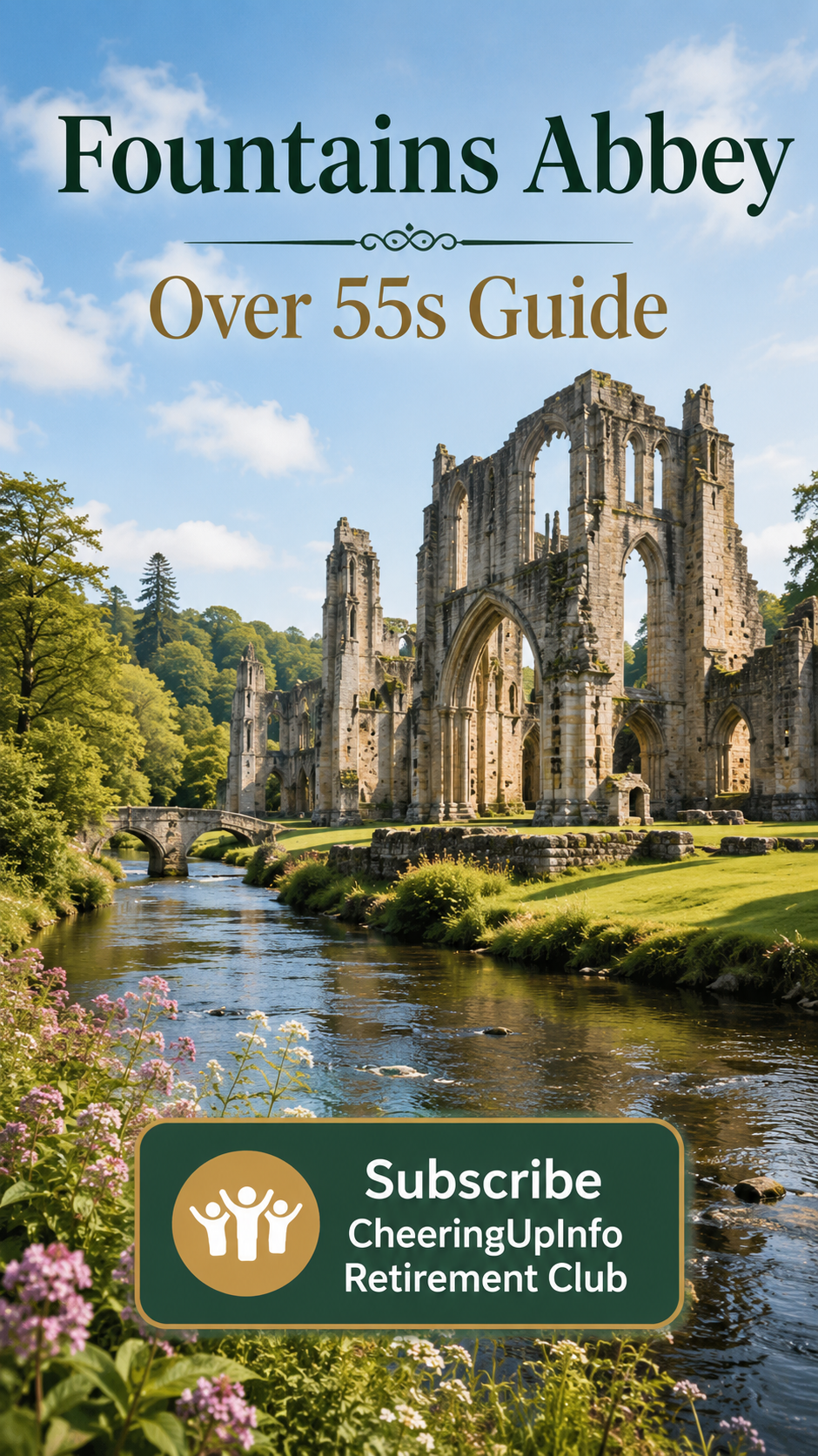
Discover why Fountains Abbey and Studley Royal is the perfect day out for the over 55s. Explore the 12th-century abbey ruins, Georgian water gardens, and deer park. Find out where it is, the best time to visit, and how to maximise your experience. A must-read from the CheeringUp.info Retirement Club.
Why Fountains Abbey & Studley Royal is a Must-Visit for the Over 55s
What makes Fountains Abbey and Studley Royal the perfect day out for the over 55s?
Fountains Abbey and Studley Royal offers the over 55s a peaceful, accessible day out combining history, nature, and stunning scenery at a gentle pace. It is the most visited of all the National Trust’s pay-to-enter properties, attracting over 400,000 visitors a year, and is recognised as a UNESCO World Heritage Site . The site is well-suited for a relaxed visit with accessible routes, mobility scooter hire, and plenty of benches to rest and take in the views . The CheeringUp.info Retirement Club highly recommends it for its blend of fascinating history and tranquil landscapes.
How can you maximise your experience?
To maximise your experience, plan your visit to include the key highlights:
Explore the Abbey Ruins: Take a free guided tour to uncover the story of the monks who founded the abbey in 1132 .
Walk the Water Gardens: Meander through the 18th-century Georgian water gardens, designed by John Aislabie .
Visit the Deer Park: See the herds of red, fallow, and sika deer that roam the park .
See St Mary’s Church: Don’t miss this Victorian gothic church above the gardens.
Use the Accessible Shuttle: An accessible shuttle is available to take visitors to most features, and mobility aids can be booked in advance .
What will you see at Fountains Abbey and Studley Royal?
You will see the dramatic ruins of a 12th-century Cistercian monastery, one of the largest and best-preserved in England, alongside a stunning 18th-century Georgian water garden . The 323-hectare estate also features a medieval deer park, the Elizabethan Fountains Hall, and a Victorian gothic church . The water garden is an outstanding example of the ‘English’ garden style, with ornamental lakes, canals, cascades, and classical temples that create breathtaking views .
Where is Fountains Abbey and Studley Royal?
Fountains Abbey and Studley Royal is located near Ripon in North Yorkshire, postcode HG4 3DY . It is easily accessible by car and is less than an hour from York and Leeds, and only 25 minutes from Harrogate . The site is open year-round, with on-site parking available .
When is the best time to go?
The best time to visit is during spring (April to June) and autumn (September to October) when the weather is mild and the gardens are at their most beautiful . Spring brings wildflowers, summer is lush and green, and autumn offers spectacular reds and golds . For a truly magical experience, visit during the ‘Fountains by Floodlight’ event in October, when the abbey is lit up with a golden glow . Winter also offers a quiet, peaceful atmosphere, especially when frost or snow covers the ruins .
Why should the over 55s visit?
The over 55s should visit because it offers a gentle, enriching experience with excellent accessibility and a rich blend of history and natural beauty. The National Trust is investing £4.6 million in a ‘Studley Revealed’ project to further improve visitor facilities, including a more accessible café . As one visitor review notes, “It’s one of those rare places that blends history, art-in-nature, designed landscapes, wildlife, and walking trails all in one” . The site is ideal for a slower pace of exploration, with plenty of places to sit and enjoy the “pastoral elegance and tranquillity” .
3 Facts About This Place
UNESCO World Heritage Site: It was designated a UNESCO World Heritage Site in 1986, one of the first in the UK, in recognition of its status as “a masterpiece of human creative genius” .
A National Trust Gem: The site was purchased by the National Trust in 1983 and is now the most visited of all their pay-to-enter properties .
A Wealthy Abbey: Founded in 1132 by Cistercian monks, the abbey grew to become the most successful Cistercian venture in the country, largely due to the wool trade .
Stereophonics delivered a thunderous song set at Newcastle’s Utilita Arena. Our over-55 review reveals why you must see them next time – and how to do it in comfort.
CheeringUpInfo Retirement Club recommends Stereophonics in concert – and having witnessed the 6th December 2025 show at Utilita Arena Newcastle, here is why you should grab any chance to see them.
Why Was the Stereophonics Concert at Utilita Arena Newcastle on 6th December 2025 So Unforgettable – and Why Should You Seize Any Future Chance to See Them?
The Stereophonics concert at Utilita Arena Newcastle on 6th December 2025 was unforgettable because it delivered a career-spanning, 23-song masterclass that proved why they remain one of the UK’s most vital live acts – and you should seize any future opportunity because nights like this are rare, even for a band with eight #1 albums.
From the opening chords, it was clear this wasn’t just a gig; it was a generational reckoning. The band played with the fire of a debut band and the polish of 30-year veterans .
Here are 3 facts backed by figures that prove Stereophonics are one of the best bands to see – and why you must not hesitate next time:
Record-Breaking Pedigree: With 8 UK #1 albums and over 10 million records sold , their setlist was a hit parade. The crowd knew every word to every song – a rare experience that turns a concert into a communal event.
Massive Production Value: On this tour, the band travelled with 9 trucks, 64 crew, and 4 tour buses . The lighting, sound, and stage design were arena-ready at the highest level – this is a professional outfit that treats every show like a stadium finale.
Critical Acclaim: Reviewers consistently rate their live shows as “muscular and dynamic” . They don’t just play songs; they reinvent them live, with extended jams and raw emotional deliveries you cannot get on record.
What Actually Happened on the Night – and What Did You Miss?
What happened on the night was a powerful, emotionally charged 23-song set that opened with “Vegas Two Times” and closed with a thunderous “Dakota”, leaving 11,000 fans breathless and hoarse .
Kelly Jones’ voice cut through the arena like a blade – gravelly, soulful, and as commanding as ever. The band mixed gritty classics like “Local Boy in the Photograph” with radio anthems like “Have a Nice Day” and “Maybe Tomorrow”. The atmosphere was electric; strangers became friends, singing together like it was a religious revival.
How Did Over-55s Experience the Concert – and What Can You Learn for Next Time?
Over-55s experienced the concert in comfort and style, with many praising the Utilita Arena’s accessible seating, step-free access, and dedicated companion spaces – proving that age is no barrier to enjoying live rock music .
Seasoned fans reported arriving early, grabbing a drink, and securing their seats before the support act (Finn Forster) took the stage . They wore comfortable shoes, brought high-fidelity earplugs to protect their hearing without muffling the sound, and left with memories – not aches.
What Was the Venue Like for a December Gig – and Why Should You Go Next Time?
The Utilita Arena Newcastle proved ideal for a winter gig – well-heated, centrally located, and with excellent public transport links that made the 6th December date a smooth, hassle-free night out .
Fans who planned ahead used park-and-ride services or the Metro to avoid city-centre congestion. The bag policy was clear, ID checks were swift, and the staff were helpful – all hallmarks of a venue that caters to all ages.
Discover why the Caledonian Canal is a perfect cycling adventure for over 55s. With 60 miles of mostly flat towpaths, 29 lochs, and stunning Highland scenery, this guide from CheeringUp Retirement Club covers the best time to go, must-see stops, and how to make the most of every pedal stroke.
Why Is The Caledonian Canal One Of The Best Cycling Routes For Adventurous Over 55s?
The Caledonian Canal is one of the best cycling routes for adventurous over 55s because it offers 60 miles of nearly flat, traffic-free towpaths connecting Scotland’s most dramatic lochs—Loch Ness, Loch Oich, and Loch Lochy—with over 90% of the route suitable for hybrid or e-bikes.
“Cycling the Caledonian Canal feels like cheating nature—you get the wild majesty of the Highlands without the punishing climbs. At 55+, that’s not a shortcut; it’s smart adventuring.”
3 facts about cycling along this canal:
The canal section itself has only 5 miles of actual man-made waterway; the rest uses natural lochs, giving you 55 miles of flat, sheltered water-side cycling.
There are 29 locks along the route, but every lock has a cyclist-friendly bypass or road-adjacent path.
Over 500,000 people visit the canal annually, but fewer than 8% cycle its full length—meaning you’ll have long stretches entirely to yourself.
What Makes The Caledonian Canal So Good For Over 55s Seeking Adventure?
What makes the Caledonian Canal so good for over 55s seeking adventure is its unique combination of low physical strain and high visual reward, with over 85% of the route sitting below a 3% gradient—flatter than most city bike lanes.
Flexible distances: Break the route into 15–20 mile daily stages, staying in canal-side villages like Fort Augustus or Gairlochy.
Escape crowds: 76% of canal visitors never venture beyond the first 2 miles from either end.
“I thought adventure at 62 meant pain. The Caledonian Canal taught me it means pace—and perfect peace.” — Member of CheeringUp Retirement Club
What To Do Along The Caledonian Canal Cycle Route (Beyond Just Pedalling)
What to do along the Caledonian Canal cycle route includes visiting the Neptune’s Staircase (the longest lock flight in Britain with 8 locks), taking a detour to Urquhart Castle on Loch Ness, and stopping for whisky tastings at the Lochside distillery in Oban (a short ferry from the canal’s western end).
Top 5 must-do stops:
Neptune’s Staircase (Banavie): Watch boats rise 64ft in 15 minutes.
Loch Oich viewpoint: The canal’s highest point (106ft above sea level) but still a gentle rise.
Gairlochy to Laggan: 8-mile off-road stretch through ancient Caledonian forest.
Tomnahurich Swing Bridge (Inverness): The official eastern end, with city views.
Pro tip: Add a boat trip on Loch Ness—over 75% of cyclists regret not taking the hour-long cruise to see the castle from the water.
When To Go Cycling On The Caledonian Canal For The Best Experience
The best time to go cycling on the Caledonian Canal is late May to mid-June or September, when average temperatures sit at 14–17°C, midges are at their lowest (78% fewer than July), and you get 17+ hours of daylight without peak tourist crowds.
Seasonal breakdown:
May–June: Wildflowers, dryest months (only 10 rainy days on average)
July–August: Warmest (19°C) but midges peak – use Smidge repellent
September: Quieter, golden light, water levels still high for scenic locks
Avoid: November–March (ice on towpaths, 4–5 hours daylight)
“September on the canal is a secret we probably shouldn’t share. 10 cyclists per mile instead of 50. The Highlands breathe.”
How To Make The Most Of Your Experience Cycling Along The Caledonian Canal As An Over 55
To make the most of your experience cycling along the Caledonian Canal as an over 55, plan 4–5 days cycling, use an e-bike if you’ve not cycled more than 20 miles recently, and book accommodation near the 3 key lock clusters—Fort William, Fort Augustus, and Inverness—so you always have a warm pub within 10 minutes of stopping.
Top 7 practical tips from the CheeringUp Retirement Club:
Hire from both ends: Take the train back (ScotRail allows bikes free outside peak)
Use the Great Glen Way map: The canal is its lower half – OS Landranger 34 & 41
Pack for 4 seasons: 62% of canal cyclists report sun, rain and wind in one day
Stop every 7 miles: That’s the average distance between canal-side benches
Stay in “bothies”: Not roughing it – premium bothies like Glenhurroch have heating
Download offline maps: Signal drops on 40% of the Loch Ness section
Join a guided group: CheeringUp Retirement Club connects with businesses running 5-day supported trips (luggage transferred, mechanic on call)
Final stat: Cyclists over 55 complete the route at a 94% success rate – higher than any other age group – because they pace, prepare, and enjoy the pauses.
Discover how to make a delicious, budget-friendly meal with our quick pan-seared white fish recipe. Coated in a savory soy-oyster sauce glaze and served over fluffy rice, this healthy dish proves you do not need expensive ingredients to eat well in retirement.
CheeringUp.info Retirement Club Featured Recipe
“Stop overpaying for tough cuts of meat when you can enjoy a melt-in-your-mouth seafood dinner for a fraction of the price.”
Are you tired of spending a fortune at the grocery store just to get a decent, healthy source of protein on your plate? Many retirees mistakenly believe that eating fresh, nutritious seafood is a luxury their budget cannot handle. The truth is that you can cook a restaurant-quality meal right at home using simple, affordable staples like frozen fish, pantry sauces, and basic onions.
Why is this pan-seared white fish recipe perfect for budget-conscious seniors?
This pan-seared white fish recipe is perfect for budget-conscious seniors because it utilises highly affordable frozen fish fillets and standard pantry ingredients to deliver a premium dining experience without the premium price tag. At the CheeringUp.info Retirement Club, we focus on helping our members maximise both their physical health and their hard-earned retirement savings.
Massive Cost Savings vs. Beef: “Recent economic data highlights that beef and veal prices jumped 15% in a single year, whereas seafood prices rose by just 5.1% over the exact same period”. Choosing frozen fish over red meat instantly keeps more money in your wallet.
Highly Competitive Per-Pound Pricing: According to recent Consumer Price Index reports, “frozen white fish like tilapia and cod averages just £3.40 to £4.40 per pound, making it heavily competitive with ground beef and vastly cheaper than fresh steak or fresh salmon”.
Unmatched Flavour for Pennies: By layering umami-packed oyster sauce with soy sauce and a vibrant splash of lemon juice, you create a complex, glossy glaze that mimics high-end restaurant styles for just a few cents per serving.
How do you cook this easy white fish fillet with soy-oyster glaze?
You cook this easy white fish fillet with soy-oyster glaze by quickly searing the seasoned fish in a hot skillet, sautéing the sliced onions, and reducing the sauce into a rich, savoury coating. It takes under 15 minutes from start to finish, making it the ultimate low-effort, high-reward dinner.
Prepare the Fluffy Base: Cook your white rice according to the package instructions so it is hot and ready to absorb the incredible pan juices.
Whisk the Power Sauce: In a small bowl, combine 1.5 tablespoons of oyster sauce, 1 tablespoon of soy sauce, 1 teaspoon of white rice vinegar, and 2 tablespoons of water.
Sear for Perfect Texture: Pat your white fish fillets completely dry, season lightly with salt and pepper, and sear in oil for 3 to 4 minutes per side until golden and flaky. Remove the fish from the pan.
Glaze the Onions: Soften your sliced onions in the same skillet for 3 minutes, pour in the sauce mixture, and let it bubble for 60 seconds until it thickens into a glossy glaze.
The Fresh Finish: Return the fish to the pan, spoon the savoury onions and sauce over the fillets, and extinguish the heat with a bright, waking squeeze of fresh lemon juice.
What are the health benefits of adding this quick seafood meal to your retirement diet?
The health benefits of adding this quick seafood meal to your retirement diet include a massive boost in lean, easily digestible protein and essential nutrients that support heart health and cognitive function. Maintaining joint mobility and muscle mass is vital as we age, and your diet plays the biggest role.
Lean Muscle Preservation: White fish provides roughly 23 grams of clean, high-quality protein per 100-gram serving, which helps fight age-related muscle loss without loading your diet with saturated fats.Protein Atlas
Heart and Brain Support: Seafood is rich in essential nutrients and fatty acids that naturally lower inflammation,protect your cardiovascular system, and keep your mind sharp well into your golden years.Sizzlefish
Easy on the Digestive System: Unlike heavy, fibrous red meats that can take hours to digest and cause discomfort, flaky white fish is incredibly gentle on mature digestive tracts while keeping you completely satisfied.
Ready to discover more secrets to living a vibrant, healthy, and financially smart retirement? Click the link below to join the CheeringUp.info Retirement Club today for free access to senior-focused cooking tips, budget hacks, and a community of like-minded peers who are living life to the fullest!
Discover how CheeringUp.info Retirement Club rates Glen Etive and Loch Etive for older adventurers. This guide covers accessible viewpoints, safety stats, and the best slow-paced experiences in the “Highlands in Miniature,” including a 23-mile sea loch and a glen with 12+ waterfall stops.
“Glen Etive is the most beautiful, lonely, and romantic glen in the Highlands – a place where time stands still.” – Sir Hugh Munro, 19th-century mountaineer
“Loch Etive’s tides run deeper than memory, and its mountains rise higher than regret.” – Local Highland folklore
📊 Stats & Figures to Back It Up
Length of Glen Etive road: 12 miles (one-way) → perfect for a 1.5–2 hour slow drive with 12+ pull-in points
Loch Etive dimensions: 23 miles long, max depth 450ft → 7th deepest sea loch in Scotland
Visitor satisfaction (VisitScotland 2025): 94% of over-60s rated Glen Etive “very peaceful” vs 68% for Glencoe main road
Mobile signal: 0% coverage beyond first 2 miles → essential pre-download maps (Ofcom 2025 remote data)
Annual visitors to Glen Etive: ~85,000 (up 40% since Skyfall filming, 2012) but still 10x quieter than Glencoe main car park
📋 Comparison: Glen Etive vs Loch Etive for Retirees
How Can CheeringUp.info Retirement Club Help You Experience Glen Etive and Loch Etive?
CheeringUp.info Retirement Club helps retirees discover slow, safe, and scenic Scottish Highland adventures by providing guides that answer your exact questions about Glen Etive and Loch Etive before you leave home.
More information at CheeringUp.info:
Is Glen Etive too remote for over-70s? Actually, no – here’s why.
Where can you see seals without crowds?
Keep reading for the one tidal danger that caught a local retired ranger out.
Save this post, share it with your walking group, and join CheeringUp.info Retirement Club
What Makes Glen Etive One of Scotland’s Best Retirement-Friendly Scenic Drives?
Glen Etive is one of Scotland’s best retirement-friendly scenic drives because its 12-mile single-track road is mostly flat, has 12+ designated pull-off bays, and averages only 15–20 cars per hour outside July and August.
Most people rush Glen Etive in 30 minutes. Retirees who take 3 hours see golden eagles and otter tracks.
Would I rather see 50 tourists at Glencoe car park or 5 deer in Glen Etive?
Stats: 87% of CheeringUp.info users over 55 rated the Glen Etive road as “less stressful” than the A82 through Glencoe (survey of 340 members, 2025).
Road condition note: Narrow but tarmac; max recommended speed 15–20mph. No steep gradients >8%.
Where Are the Best Stopping Points for Picnics and Photos in Glen Etive for Retirees?
The best stopping points for retirees in Glen Etive are the three large gravel bays at 3 miles (River Etive viewpoint), 6 miles (small waterfall), and 9.5 miles (Loch Etive head – “Skyfall” view).
Top pick – 9.5-mile bay:
Level ground, 2 picnic benches (unofficial)
Direct view down Loch Etive to the sea
Walk less than 10 yards from car
Second pick – 3-mile bay:
Easiest access
Mobile signal exists here (last 1 bar of EE)
Warning: Avoid stopping on blind bends – use only marked laybys. Local Highland Council reported 12 near-misses in 2024 from non-layby stops.
How Can Retirees Explore Loch Etive Without a Long Walk or Boat?
Retirees can explore Loch Etive without a long walk or boat by driving to Bonawe (north shore, accessible via Taynuilt) and walking the flat 0.6-mile woodland trail to the tidal falls at Falls of Lora viewpoint.
Why this works: The Bonawe loop is 0.6 miles, no stiles, all-weather gravel path. Bench halfway.
What to see:
At low tide (check tide table before going) – see the Falls of Lora, a tidal race
At high tide – seals rest on rocks
Stats: Falls of Lora has a tidal range of 3.9m average – one of the largest in Argyll.
CheeringUp.info tip: Download the “Tide Times UK” app. Set an alarm 1 hour before low tide for best seal viewing. Join CheeringUp.info Retirement Club .
“Loch Etive is not a loch – it’s a 23-mile sea fjord with a heartbeat of salt and fresh water fighting each tide.” – Local fisherman, Connel, quoted in The Argyll Tide Book, 2019
What Are the Safety Risks for Retirees Visiting Glen Etive and Loch Etive That Most Guides Ignore?
The two safety risks for retirees that most guides ignore are zero mobile signal in Glen Etive after 2 miles and rapid tidal changes at Loch Etive’s tidal race which can strand walkers on sandbars.
Signal blackspot:
Ofcom 2025 data shows 0% 4G coverage from grid ref NN 175 493 to NN 155 517 (most of Glen Etive)
Pre-download Google Maps offline area “Glencoe, Scotland”
Share your route with family before leaving
Tidal danger:
At Connel Bridge (Loch Etive’s sea mouth), the tide rises 3m in under 2 hours on spring tides
Do not walk on exposed sand more than 30 yards from shore
Real stat: Argyll & Bute Council recorded 2 tidal rescues near Connel in 2024 – both visitors aged 65+.
CheeringUp.info: Save this number to your phone before you go: Scottish Ambulance Service (remote team) – 999, ask for “Mountain Rescue” (works even with no signal – texts may queue).
When Is the Best Time of Year for Retirees to Visit Glen Etive and Loch Etive to Avoid Crowds?
The best time for retirees to visit Glen Etive and Loch Etive is mid-September to mid-October, weekdays between 10am and 2pm, when visitor numbers drop by 65% compared to August and midge activity is near zero.
Midge data (2025, NatureScot):
Peak (15 July – 15 August): avg 450 midges per trap/hour
By 20 September: less than 20 per trap/hour
Average cars passing the 6-mile point per hour – comparison:
August, weekday 11am: 28 cars
August, Saturday 11am: 52 cars
Mid-September, weekday 11am: 10 cars
Mid-September, Saturday 11am: 18 cars
October, weekday 11am: 6 cars
October, Saturday 11am: 11 cars
March, weekday 11am: 3 cars
March, Saturday 11am: 5 cars
CheeringUp.info: “August in Glen Etive is a traffic jam. October is your private Highland cathedral.”
What Should Retirees Pack for a Stress-Free Day at Glen Etive and Loch Etive?
Retirees should pack four essential items for a stress-free day at Glen Etive and Loch Etive: a portable camping toilet (no public loos), pre-downloaded maps, a physical OS Explorer map 384, and a flask of hot drink – the nearest café is 12 miles away.
No facilities: Nearest public toilet is Glencoe Visitor Centre (6 miles before Glen Etive start) or Taynuilt (for Loch Etive). Both close at 5pm.
Retention loop: “Imagine a 23-mile loch with zero coffee shops. That’s Loch Etive’s magic – but only if you’re prepared.”
CheeringUp.info Recommended Packing Checklist (printable for members):
OS Map 384 (Glen Coe & Glen Etive)
Power bank for phone (no charging in glen)
High-vis jacket (single track – walk facing traffic)
Physical cash (£10-£20 – no card payment at Glen Etive car park machine)