Stereophonics delivered a thunderous song set at Newcastle’s Utilita Arena. Our over-55 review reveals why you must see them next time – and how to do it in comfort.
CheeringUpInfo Retirement Club recommends Stereophonics in concert – and having witnessed the 6th December 2025 show at Utilita Arena Newcastle, here is why you should grab any chance to see them.
Why Was the Stereophonics Concert at Utilita Arena Newcastle on 6th December 2025 So Unforgettable – and Why Should You Seize Any Future Chance to See Them?
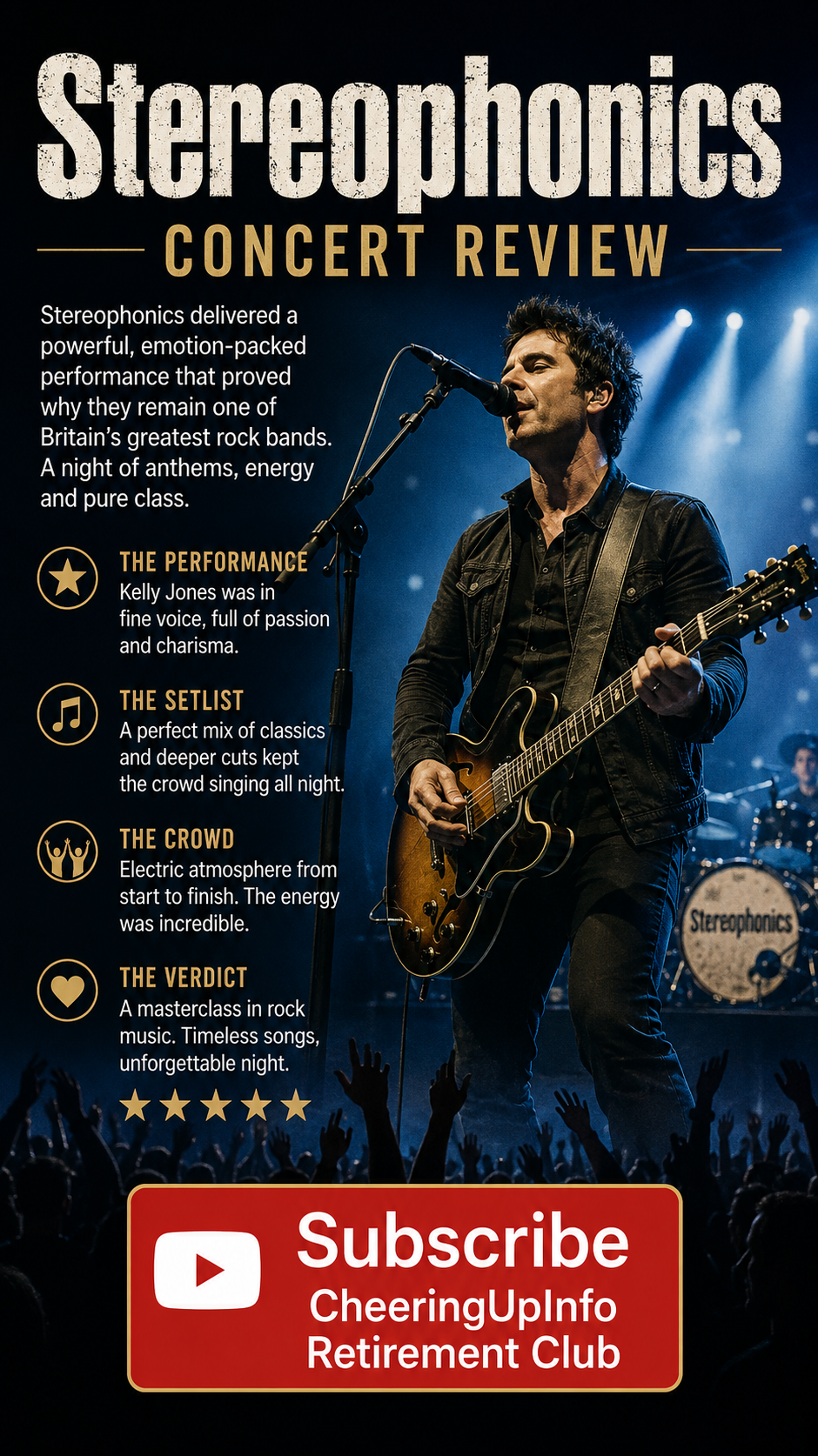
The Stereophonics concert at Utilita Arena Newcastle on 6th December 2025 was unforgettable because it delivered a career-spanning, 23-song masterclass that proved why they remain one of the UK’s most vital live acts – and you should seize any future opportunity because nights like this are rare, even for a band with eight #1 albums.
From the opening chords, it was clear this wasn’t just a gig; it was a generational reckoning. The band played with the fire of a debut band and the polish of 30-year veterans .
Here are 3 facts backed by figures that prove Stereophonics are one of the best bands to see – and why you must not hesitate next time:
Record-Breaking Pedigree: With 8 UK #1 albums and over 10 million records sold , their setlist was a hit parade. The crowd knew every word to every song – a rare experience that turns a concert into a communal event.
Massive Production Value: On this tour, the band travelled with 9 trucks, 64 crew, and 4 tour buses . The lighting, sound, and stage design were arena-ready at the highest level – this is a professional outfit that treats every show like a stadium finale.
Critical Acclaim: Reviewers consistently rate their live shows as “muscular and dynamic” . They don’t just play songs; they reinvent them live, with extended jams and raw emotional deliveries you cannot get on record.
What Actually Happened on the Night – and What Did You Miss?
What happened on the night was a powerful, emotionally charged 23-song set that opened with “Vegas Two Times” and closed with a thunderous “Dakota”, leaving 11,000 fans breathless and hoarse .
Kelly Jones’ voice cut through the arena like a blade – gravelly, soulful, and as commanding as ever. The band mixed gritty classics like “Local Boy in the Photograph” with radio anthems like “Have a Nice Day” and “Maybe Tomorrow”. The atmosphere was electric; strangers became friends, singing together like it was a religious revival.
How Did Over-55s Experience the Concert – and What Can You Learn for Next Time?
Over-55s experienced the concert in comfort and style, with many praising the Utilita Arena’s accessible seating, step-free access, and dedicated companion spaces – proving that age is no barrier to enjoying live rock music .
Seasoned fans reported arriving early, grabbing a drink, and securing their seats before the support act (Finn Forster) took the stage . They wore comfortable shoes, brought high-fidelity earplugs to protect their hearing without muffling the sound, and left with memories – not aches.
What Was the Venue Like for a December Gig – and Why Should You Go Next Time?
The Utilita Arena Newcastle proved ideal for a winter gig – well-heated, centrally located, and with excellent public transport links that made the 6th December date a smooth, hassle-free night out .
Fans who planned ahead used park-and-ride services or the Metro to avoid city-centre congestion. The bag policy was clear, ID checks were swift, and the staff were helpful – all hallmarks of a venue that caters to all ages.
The Life-Changing Power of Slow Living for the Over-55s in the UK: A Complete Guide
Why Slow Living Could Be Your Missing Key to Happiness
In our hyper-connected, fast-paced world, a quiet revolution is taking place among the UK’s over-55 population. Increasing numbers are discovering that the secret to a fulfilling later life isn’t more – more activities, more possessions, more commitments – but less, done better and with greater presence.
“We’re witnessing a fundamental shift in how people approach their later years,” observes Dr. Sarah Brewer, longevity expert and author of Live Longer, Live Better. “The over-55s are rejecting society’s obsession with speed and productivity in favour of what I call ‘conscious ageing’ – living with intention, attention and appreciation.”
This comprehensive guide goes beyond superficial tips to explore how embracing slow living can transform your health, relationships, finances and overall wellbeing. Packed with:
Groundbreaking scientific research on ageing and wellbeing
Real-life case studies from UK slow living practitioners
Expert insights from gerontologists, financial planners and lifestyle coaches
Practical challenges and action plans you can implement immediately
Whether you’re approaching retirement, recently retired or well into your later years, this guide will show you how to craft a life of greater meaning, connection and joy by embracing the power of slow.
The Science and Philosophy of Slow Living
Understanding the Slow Living Movement
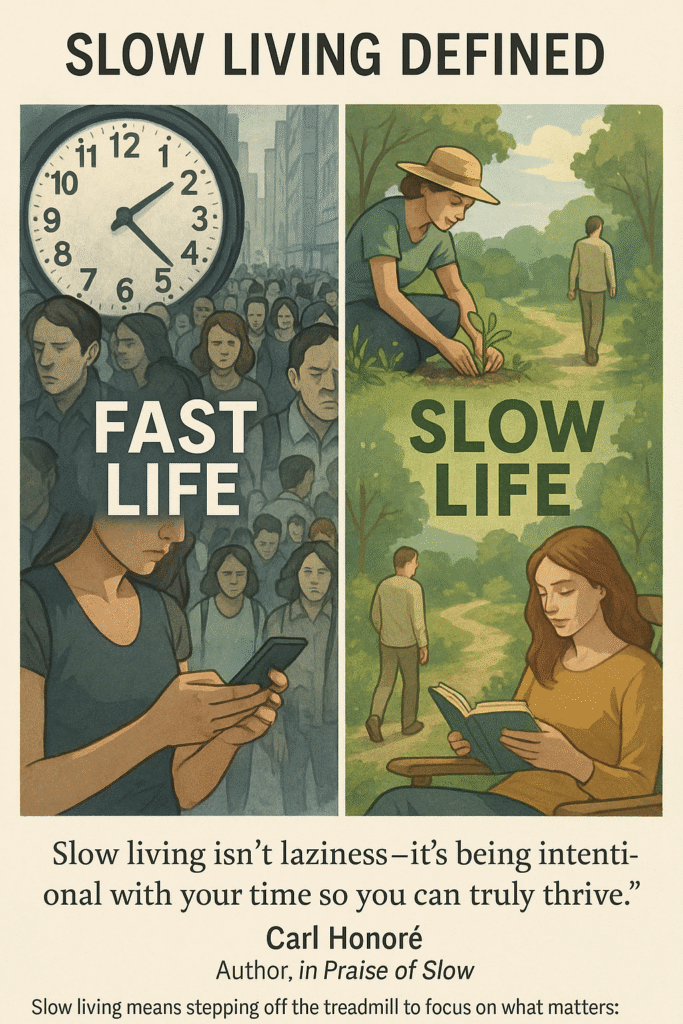
Slow living isn’t about doing everything at a snail’s pace – it’s about doing the right things at the right pace. Emerging from Italy’s Slow Food Movement in the 1980s as a protest against fast food culture, the philosophy has since expanded into a comprehensive approach to modern living.
“Slow living is essentially about reclaiming your attention and aligning your daily life with your deepest values,” explains Carl Honoré, author of the international bestseller In Praise of Slow. “For the over-55s, it offers particularly powerful benefits because it helps counteract many of the psychological and physiological challenges of ageing.”
Why Slow Living Resonates with the Over-55s
A 2023 study by Age UK revealed startling statistics:
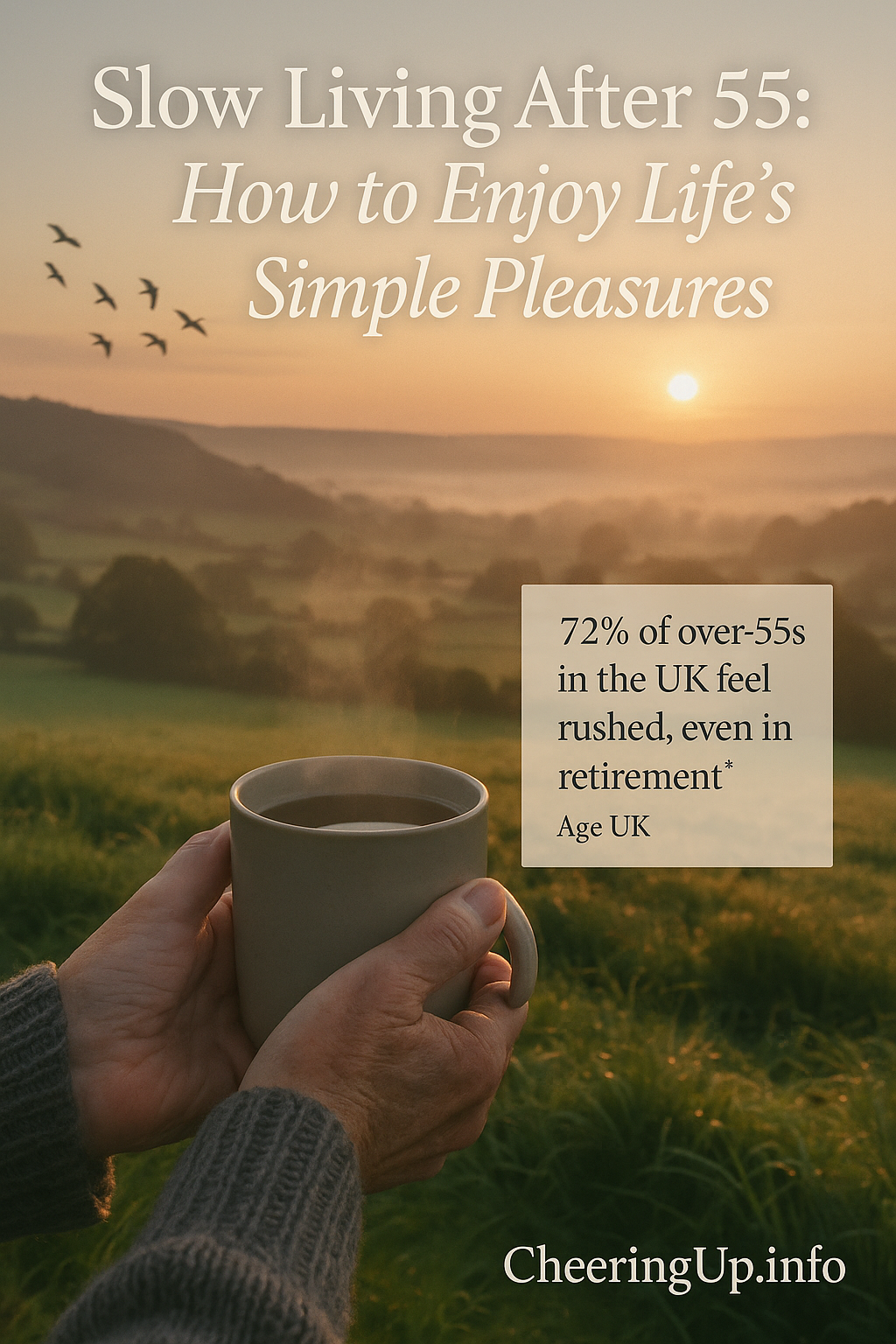
72% of over-55s reported feeling “constantly rushed” despite being retired
65% said they experienced more stress post-retirement than anticipated
82% wished they had more “quality time” with loved ones
Dr. Rebecca Harris, gerontologist at the University of Bristol, explains: “As we age, our relationship with time fundamentally changes. The over-55s often experience what we call ‘time compression’ – the sensation that time is accelerating. Slow living practices help expand our perception of time by bringing us into the present moment.”
The Neuroscience of Slowing Down
Groundbreaking research in neuroplasticity shows that our brains remain adaptable throughout life. A 2022 Cambridge University study found that mindfulness practices common in slow living:
Increase grey matter density in memory-related brain regions
Strengthen the prefrontal cortex, improving decision-making
“What’s remarkable,” notes Dr. Harris, “is that these changes were particularly pronounced in participants over 60, suggesting older brains may be especially responsive to slow living practices.”
The Transformative Health Benefits of Slow Living
1. Mental Wellbeing: From Stress to Serenity
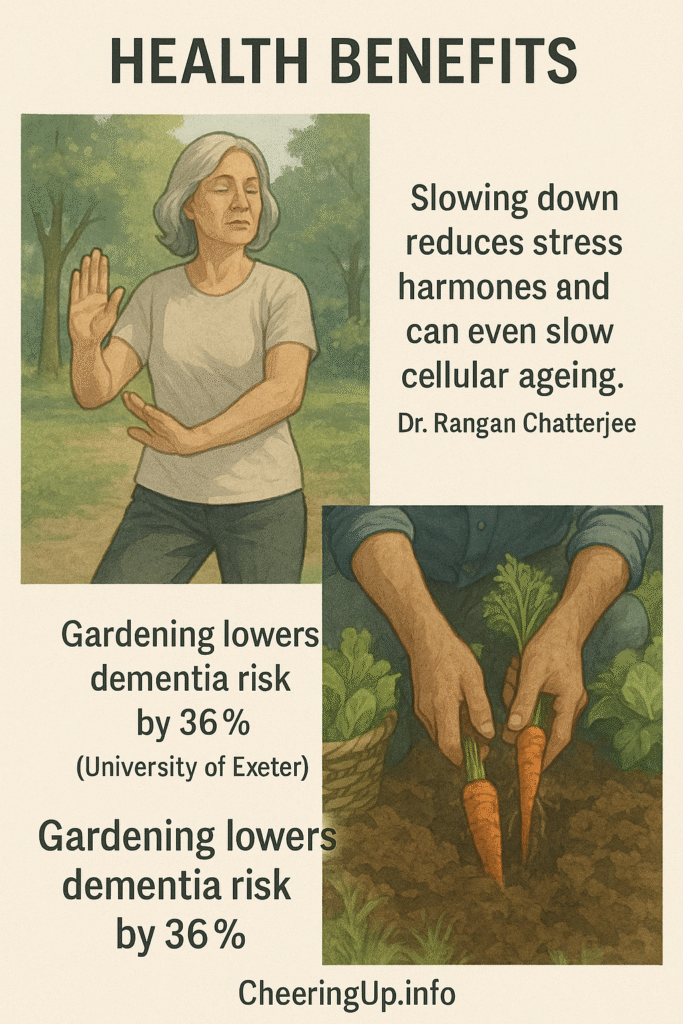
Dr. Rangan Chatterjee, BBC presenter and author of The Stress Solution, explains: “Chronic stress accelerates cellular ageing through telomere shortening. Slow living practices like mindfulness and nature immersion activate the parasympathetic nervous system, which acts as an anti-ageing mechanism.”
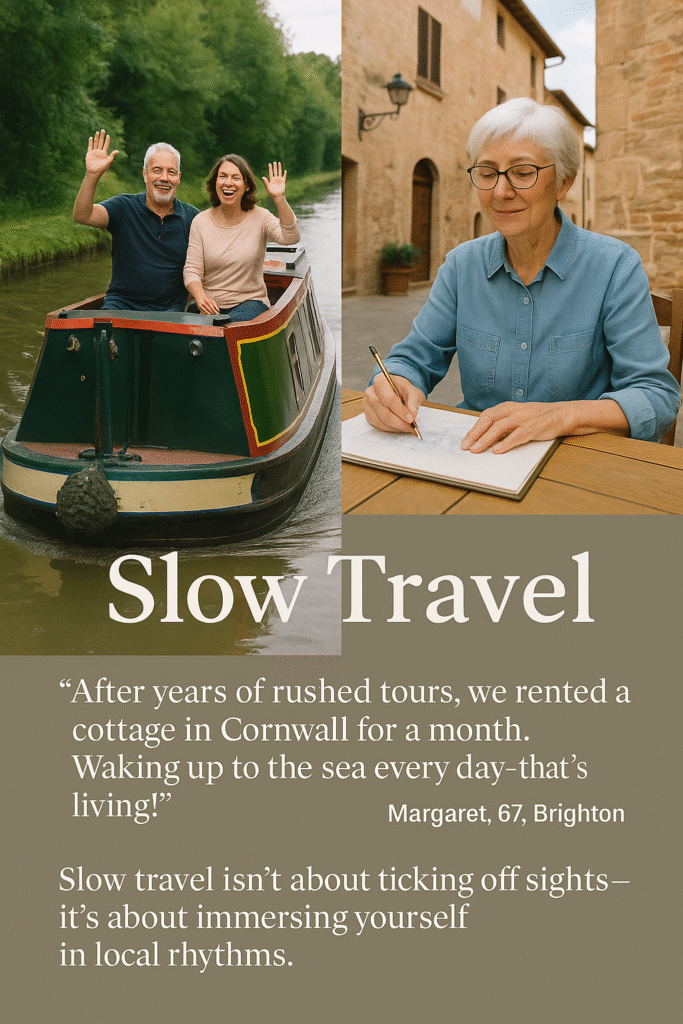
Case Study: Margaret’s Transformation Margaret, 67, a retired teacher from Brighton, struggled with:
Chronic insomnia
Retirement-related anxiety
Feeling “useless” without work structure
Her slow living prescription:
Digital sunset (no screens after 7pm)
Morning pages journaling (3 handwritten pages each morning)
Daily “forest bathing” in Stanmer Park
“Within three months, my sleep improved dramatically,” Margaret reports. “I’ve rediscovered my love for watercolours and actually enjoy my own company now.”
2. Physical Health: Movement That Matters
Unlike punishing exercise regimens, slow living promotes sustainable movement:
Activity
Proven Benefits
Ideal For
Tai Chi
Improves balance (reducing fall risk by 43%)
Arthritis sufferers
Gardening
Lowers dementia risk by 36% (Exeter University)
Those with limited mobility
Nordic Walking
40% more calorie burn than regular walking
Cardiovascular health
“The key is consistency over intensity,” emphasises Dr. Muir Gray, NHS adviser on healthy ageing. “Ten minutes of daily gentle movement beats one hour of weekly intense exercise for longevity benefits.”
3. Cognitive Benefits: Keeping the Mind Agile
Dr. Angela Clow’s research at Westminster University demonstrates how slow hobbies create cognitive reserve:
Learning a language: Increases grey matter density
Playing chess: Enhances strategic thinking
Playing musical instruments: Improves neural connectivity
“The brain needs novelty, but without time pressure,” Dr. Clow explains. “This combination is perfect for maintaining cognitive function as we age.”
Slow Travel – The Art of Journeying Mindfully
Why Slow Travel Transforms Later-Life Adventures
Pauline Kenny, founder of Slow Europe, observes: “Traditional tourism often leaves older travellers exhausted. Slow travel aligns perfectly with the needs of over-55s by prioritising depth over distance, experience over checklist tourism.”
The Slow Travel Advantage:
Traditional Travel
Slow Travel
Packed itineraries
Spontaneous exploration
Tourist hotspots
Local hidden gems
Jet lag
Natural rhythms
Surface experiences
Meaningful connections
Inspiring Slow Travel Ideas for Over-55s
UK Canal Boating Holidays
Route suggestion: The Llangollen Canal (7 days)
Highlights:
Walking pace travel (max 4mph)
Quaint waterside pubs
Operating locks (gentle physical activity)
Cost: From £1,200/week (shared between 4)
“It’s the perfect blend of gentle adventure and relaxation,” says Derek, 71, who holidays annually with his canal boat group.
European House Sitting
How it works: Care for homes/pets in exchange for free accommodation
Best platforms: TrustedHousesitters, MindMyHouse
Ideal locations: Rural France, Italian countryside
Case Study: Susan’s Year of Slow Travel Susan, 68, spent 2023 house sitting in:
A Provençal vineyard
A Tuscan farmhouse
A Portuguese coastal village “I’ve lived like a local across Europe for a fraction of hotel costs,” she says.
Pilgrimage Walking (The Slowest Travel)
Camino de Santiago: The Portuguese route (gentler terrain)
UK alternatives:
St Cuthbert’s Way (Scotland/England border)
Pilgrims’ Way to Canterbury
Slow Home Living – Creating Your Personal Sanctuary
The Psychology of Slow Spaces
Julia Atkinson-Dunn, slow living advocate and author, explains: “Our homes should be our sanctuaries, especially as we age. A slow home isn’t about aesthetic perfection – it’s about creating spaces that support how you truly want to live.”
The 5 Pillars of Slow Home Living:
Intentional Spaces
Designate areas for specific activities (reading nook, craft corner)
Remove multi-purpose clutter
Natural Elements
Maximise natural light
Incorporate wood, stone and plants
Tech Boundaries
Create screen-free zones
Implement “digital sunsets”
Sensory Comfort
Soft textiles
Soothing colour palettes
Ambient lighting
Ease of Movement
Age-friendly design
Clear pathways
Comfortable seating
Case Study: John & Linda’s Downsizing Journey This York couple transformed their living space by:
Implementing the “one in, one out” rule
Creating a dedicated slow living room (no TV, just books and music)
Designing a low-maintenance garden with raised beds
“Our home now feels like a daily retreat rather than a maintenance burden,” Linda shares.
Slow Finances – Redefining Wealth in Later Life
The New Retirement Economics
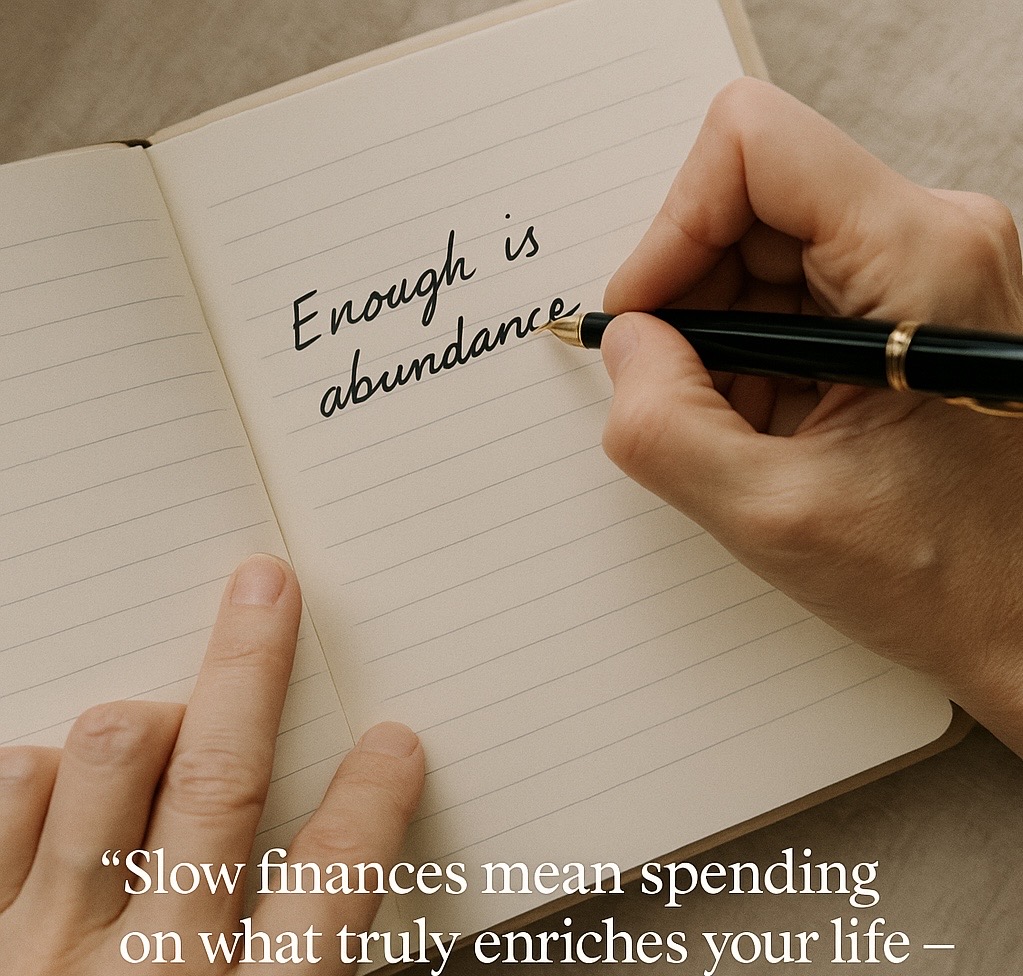
Sarah Coles, personal finance analyst at Hargreaves Lansdown, notes: “The traditional retirement model is broken. People are living longer but often worrying more about money. Slow finances offer a sustainable alternative.”
Principles of Slow Finance:
‘Enough Mindset’
Distinguish between needs and wants
Practice conscious consumption
Sustainable Withdrawal Strategies
The 3.5% rule (safer than traditional 4%)
Bucket strategy for market downturns
Experimental Spending
Prioritise meaningful experiences
The “20-year test” (“Will this matter in 20 years?”)
Case Study: Geoff’s Investment Transformation Geoff, 68, shifted from active trading to slow investing:
Moved to dividend-paying stocks
Implemented a three-bucket system:
Immediate cash needs
3-5 year bonds
Long-term growth funds “I sleep better and my portfolio grows steadily,” he reports.
Your 7-Day Slow Living Challenge
Day 1: Digital Detox
No screens before breakfast/after dinner
Try analog alternatives (physical books, handwritten letters)
Day 2: Mindful Eating
Prepare one meal from scratch
Eat without distractions
Day 3: Nature Immersion
30+ minutes outdoors
Practice “forest bathing”
Day 4: Financial Review
Cancel one unused subscription
Set up a “slow spending” tracker
Day 5: Social Slowdown
One quality conversation (no multitasking)
Write a heartfelt letter
Day 6: Home Sanctuary
Declutter one space
Create a slow living corner
Day 7: Reflection
Journal about your experience
Plan ongoing slow living practices
Conclusion: Your Slow Living Blueprint
The Slower You Go The More You’ll Notice!
Slow living isn’t about withdrawing from life – it’s about engaging with it more deeply. As Dr. Brewer concludes: “The slower you go, the more you’ll discover that true richness comes not from accumulation, but from appreciation.”
Your Next Steps:
Start small – Pick one element from this guide to implement
Build gradually – Add new practices as habits form
Share the journey – Inspire others in your community
Remember, as Carl Honoré reminds us: “Slowing down isn’t about giving up – it’s about gearing up for what truly matters.” Your most fulfilling years may well be ahead of you, waiting to be discovered at the perfect pace – yours.