Stay fit and healthy after 55 in the UK with 9 expert-backed ways—free outdoor gyms, NHS Health Checks, and budget tips. Health is real wealth. Start today.
How to Stay Fit and Healthy After 55 in the UK: Your Real Wealth
CheeringupInfo Retirement Club recommends tips on getting fit and healthy because your later years are not a countdown—they are an investment window. Health is real wealth after 55: it buys you independence, dignity, and the energy to enjoy retirement on your terms. The UK Chief Medical Officers put it bluntly: “if physical activity were a drug, we would refer to it as a miracle cure” . For older adults, that “drug” reduces mortality risk by 22% even at low doses . This guide answers the questions that matter, using UK government guidelines and independent statistics, so you can act rather than wonder.
Why Is Health Real Wealth Especially as You Get Older?
Health is real wealth after 55 because it is the only asset that protects your independence, reduces care costs, and keeps you doing what you love. The UK Chief Medical Officers’ 2026 refresh emphasised that the biggest health gains come from moving from inactivity to any activity, and that strength and balance work is non-negotiable as you age . The Office for National Statistics population data underpins Sport England’s Active Lives survey, which found 64.3% of adults aged 55–74 were active in the year to November 2025—up 0.8 percentage points—while the 75+ group reached 44.3% . That gap matters: activity declines sharply after 75, and the consequences are frailty, falls, and lost autonomy.
The financial logic is simple. Falls and fractures consume NHS resources and personal savings. Strength and balance exercises reduce fall risk, and the Chartered Society of Physiotherapy’s “Get Up and Go” guide exists precisely because prevention is cheaper than repair . As the old adage goes, “Health is not everything, but without it, everything is nothing.”
What Are the 9 Ways to Stay Fit and Healthy in the UK After 55?
The nine ways to stay fit and healthy in the UK after 55 are: meet the 150-minute activity target, do strength work twice weekly, practise balance daily, walk more, use free outdoor gyms, join low-cost leisure centres, eat and sleep well, stay socially connected, and get your NHS Health Check. Each is grounded in UK guidance and designed for real life, not the gym floor.
- Hit 150 minutes of moderate activity weekly. NHS guidance for over-65s is clear: 150 minutes of moderate intensity (you can talk but not sing) or 75 minutes vigorous, spread across the week . Moderate activity includes brisk walking, water aerobics, cycling, and dancing.
- Do strength exercises on at least two days. Muscle loss accelerates with age, and strength work—carrying heavy shopping, yoga, pilates, resistance bands, bodyweight exercises—protects your ability to live independently .
- Practise balance work. The NHS recommends activities that improve balance and flexibility on at least two days weekly to reduce fall risk . Simple heel-to-toe stands and one-leg stands (holding support) take minutes .
- Walk more, sit less. Break up long periods of sitting. The CMO guidance now emphasises light activity and reducing sedentary time, not just formal exercise .
- Use free outdoor gyms. Camden, for example, offers outdoor gyms in green spaces free for everyone over 14 . Most UK councils provide similar facilities—check your local authority website.
- Access low-cost leisure. Many councils offer concessionary rates. Camden offers free swimming for over-60s at Better Leisure Centres on weekday mornings . Ealing’s 2026/27 fees show adult single-site gym membership at £20.75 monthly, with concession rates around £24.81 . Prices vary—always ask for the older adult concession.
- Eat and sleep for recovery. Adults 65+ need 7–8 hours of sleep, and regular meals from the Eatwell Guide support energy and function . Alcohol should stay within 14 units weekly, spread over three or more days .
- Stay socially connected. Activity that combines movement with company—health walks, dance classes, group cycling—tackles loneliness and motivation simultaneously. The NHS Kent and Medway guidance explicitly links social support to staying well in older age .
- Take up your NHS Health Check. Free for eligible adults aged 40–74, it flags cardiovascular and kidney risk early, when lifestyle changes still work .
What Mistakes Do Other People Make That I Shouldn’t Make?
The biggest mistake people over 55 make is treating exercise as optional or all-or-nothing, rather than building small, consistent movement into every day. The CMO evidence shows the steepest health gains come from moving from nothing to something—waiting until you can “do it properly” wastes that window . Here are the traps to avoid:
- Skipping strength work because you walk already. Walking is excellent, but it does not reverse muscle loss. The CMO 2026 update specifically strengthened guidance on strength and balance for older adults, including those on weight-loss medications who risk losing muscle .
- Ignoring balance until after a fall. Balance exercises are preventive, not reactive. The Chartered Society of Physiotherapy’s guide exists because falls are common, costly, and largely preventable .
- Paying full price when concessions exist. Always ask your local leisure centre about older adult rates. Lambeth’s pay-and-play charges rose to £12.25 in 2026/27, but concessions and off-peak options often exist . Never assume the listed price is your price.
- Doing nothing because you can’t do 150 minutes yet. The CMO guidance is explicit: any activity beats none, and benefits increase steadily toward 150 minutes . Ten minutes of walking counts.
- Neglecting sleep and diet while “exercising.” Recovery is part of fitness. Chronic sleep issues affect 40–70% of older adults, and poor sleep undermines every other effort . As the saying goes, “You can’t outrun a bad diet—or a bad night’s sleep.”
Who Will Benefit Most From These Tips?
These tips benefit most the adults aged 55–74 who are currently “fairly active” but not meeting the 150-minute threshold, and the 75+ group at risk of frailty. Sport England’s Active Lives data shows 64.3% of 55–74s are active, but that leaves over a third below the mark . The 75+ population is the least active and has the most to gain from even modest increases. People managing long-term conditions—cardiovascular disease, type 2 diabetes, arthritis—also benefit disproportionately, as the CMO guidance confirms benefits far outweigh risks for most long-term conditions . If you are on GLP-1 medication for weight or diabetes, strength work is especially critical to protect muscle .
Where in the UK Can You Practise on a Budget?
You can practise on a budget across the UK through council leisure concessions, free outdoor gyms, health walks, and park-based activities. The availability varies by local authority, but the pattern is consistent: ask, and you will find.
- Free outdoor gyms: Available in many council green spaces. Camden’s are free for over-14s .
- Free swimming for over-60s: Camden Better Leisure Centres offer free weekday morning swimming for the over-60s .
- Health walks: Brighton & Hove’s Healthy Lifestyles team runs free Healthwalks and low-cost activity sessions . Lee Valley Regional Park offers free Life-walks, Nordic walking, and cycling for health across multiple weekly sessions .
- Low-cost leisure centre access: Concessionary memberships exist at most council-run centres. Ealing’s 2026/27 pricing shows concession single-site membership at £24.81 monthly, versus £20.75 standard—check whether your local authority offers a better older adult deal .
- Parkrun and community groups: Free, weekly, volunteer-led walking and running events operate across the UK. Check local parkrun listings for walk-friendly options.
When Should You Get Fit and Healthy to Maximise Benefits of Your Investment?
You should start now—today, not Monday—because the CMO evidence shows the first increments of activity deliver the largest proportional health gains, and those gains compound over time. The 2026 UK Chief Medical Officers’ guidelines state that the biggest gains are in moving from inactivity to any level of activity . There is no age at which it is “too late”: the guidelines cover all stages of life, and the evidence for strength and balance work in older adults is stronger than ever . Every week you delay is a week of potential muscle maintenance, balance improvement, and social connection forgone. As the Chinese proverb holds, “The best time to plant a tree was twenty years ago. The second best time is now.“
The investment metaphor is literal. Your NHS Health Check is free. Your local health walk is free. Your outdoor gym is free. The only cost of waiting is the compounding interest of decline—frailty, isolation, and loss of independence that money cannot easily reverse. CheeringupInfo Retirement Club’s position is simple: the return on investment begins the day you decide to move.
Get help to protect and grow your business faster with targeted advertising and marketing with CheeringUpInfo
Find out more about growing your business faster with CheeringupInfo
Subscribe for free retirement lifestyle ideas reviews and cost of living reduction tips
Connect with CheeringUpInfo for free retirement lifestyle improvement tips
Read more retirement lifestyle improvement articles and view videos for free
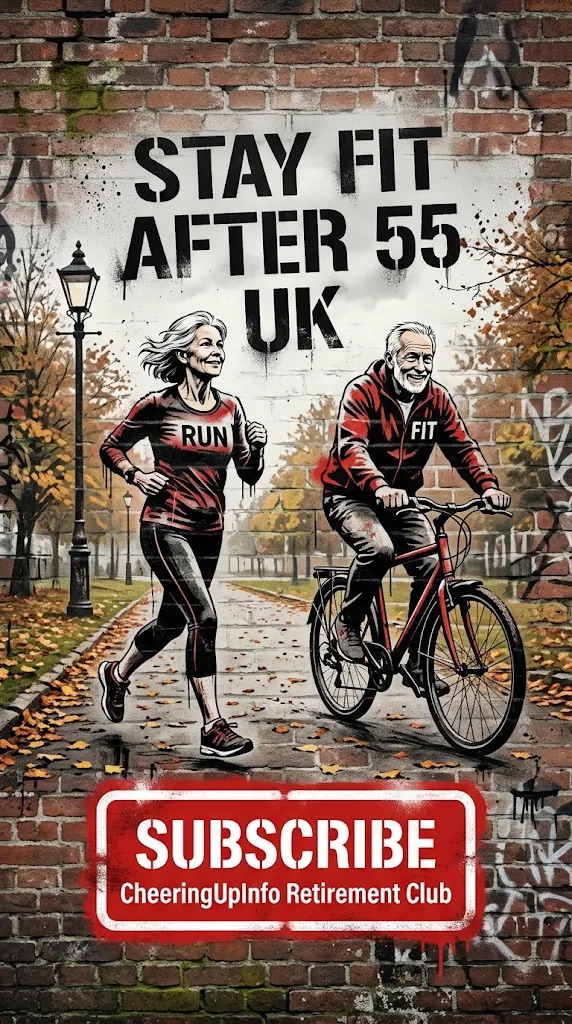
Stay Fit After 55 UK Subscribe CheeringUpInfo Retirement Club
Your pension won’t save you if your legs give out first!
64.3% of UK adults aged 55–74 are “active”—but over a third aren’t, and the 75+ group drops to just 44.3%. Translation? The people who stop moving after 55 are the ones paying for it later. Not in gym fees. In independence.
The UK Chief Medical Officers said if physical activity were a drug, we’d call it a miracle cure. The dose for over-65s: 150 minutes of moderate activity weekly + strength work on 2 days + balance work on 2 days. Miss the strength bit and you lose muscle. Miss the balance bit and you risk the fall that changes everything.
Here’s the part nobody tells you: the biggest health gains come from moving from nothing to something. Not from running marathons. From ten minutes of walking.
But here’s the mistake most people over 55 make—and it’s the reason walking alone isn’t enough. (Swipe to the “Mistakes” section of the article to find out what it is. It’s the one thing that quietly undoes everything else.)
“The best time to plant a tree was twenty years ago. The second best time is now.”
Your health is the only asset that compounds without a stock market. Start this week—not Monday. Email editor@cheeringup.info for more information on CheeringUpInfo Retirement Club.
#HealthIsRealWealth #FitAfter55UK #HealthyOver55 #RetirementClub #RetirementMagazine
Here are the sources I used for the article, listed with full web links:
UK Government & NHS Guidelines
- UK Chief Medical Officers’ Physical Activity Guidelines (2026) – GOV.UK
https://www.gov.uk/government/publications/physical-activity-guidelines-uk-chief-medical-officers-report/uk-chief-medical-officers-physical-activity-guidelines - New UK CMO activity guidelines show every movement counts (2026) – GOV.UK
https://www.gov.uk/government/news/new-uk-cmo-activity-guidelines-show-every-movement-counts - Physical activity guidelines for older adults – NHS.uk https://www.nhs.uk/content-widgets/live-well/exercise/physical-activity-guidelines-older-adults
Statistics & Data - Active Lives data tables (Nov 2024–25) – Sport England https://www.sportengland.org/research-and-data/data/active-lives/active-lives-data-tables
- England is getting more active but not everyone is benefiting – Sport England https://www.sportengland.org/news-and-inspiration/england-getting-more-active-not-everyone-benefiting
- Estimates of the very old, including centenarians, UK: 2002 to 2025 – Office for National Statistics https://www.ons.gov.uk/peoplepopulationandcommunity/birthsdeathsandmarriages/ageing/bulletins/estimatesoftheveryoldincludingcentenarians/2002to2025
How to Stay Fit and Healthy After 55 in the UK: 9 Ways to Build Real Wealth