Here are 9 delicious UK-focused chickpea recipes using canned chickpeas, with an ingredients list and step-by-step cooking plan for each. These recipes are budget-friendly, quick, and packed with flavour — perfect for everyday cooking.
Healthy meals with chickpeas for UK families
🌱 1. Chickpea & Spinach Curry
Ingredients (serves 2–3):
1 can chickpeas (drained and rinsed)
1 onion (chopped)
2 garlic cloves (minced)
1-inch piece of ginger (grated)
1 tbsp curry powder or garam masala
1 tsp turmeric
200g fresh spinach (or frozen)
400g chopped tomatoes (1 tin)
1 tbsp oil
Salt & pepper to taste
Optional: 1 tbsp Greek yoghurt or coconut milk
Steps:
Heat oil in a pan. Fry onion until soft.
Add garlic and ginger, stir for 1 min.
Stir in spices. Cook for 1 min more.
Add chickpeas and chopped tomatoes.
Simmer for 10 mins. Add spinach and cook until wilted.
Season to taste. Stir in yoghurt/coconut milk if desired.
Serve with rice or naan.
🥗 2. Chickpea & Red Onion Salad
Ingredients (serves 2):
1 can chickpeas (drained)
½ red onion (thinly sliced)
1 tbsp olive oil
1 tbsp lemon juice
Handful fresh parsley (chopped)
Salt & black pepper
Optional: feta cheese crumbles or cherry tomatoes
Steps:
Combine chickpeas, onion, parsley, and optional extras in a bowl.
In a small bowl, whisk olive oil, lemon juice, salt, and pepper.
Toss dressing into salad. Chill or serve immediately.
🧆 3. Easy Chickpea Falafel (Pan-fried)
Ingredients (makes 10 small falafel):
1 can chickpeas (well-drained)
1 garlic clove
½ onion
Handful coriander or parsley
1 tsp cumin
1 tbsp flour or breadcrumbs
Salt & pepper
Oil for frying
Steps:
Blend all ingredients into a thick paste.
Form into small balls or patties.
Heat oil in a frying pan.
Fry 3–4 mins each side until golden.
Serve in pittas with salad and yoghurt.
🥘 4. Chickpea Shakshuka
Ingredients (serves 2):
1 can chickpeas
1 onion (sliced)
2 garlic cloves
1 pepper (sliced)
400g chopped tomatoes
1 tsp smoked paprika
1 tsp cumin
2–4 eggs
Salt, pepper, olive oil
Steps:
Fry onion, garlic, and pepper in oil until soft.
Add spices, tomatoes, and chickpeas. Simmer 10 mins.
Make 2–4 wells and crack in eggs.
Cover and cook until eggs are just set.
Serve with crusty bread.
🥣 5. Chickpea Soup with Carrots & Celery
Ingredients (serves 3–4):
1 can chickpeas
1 onion, 2 carrots, 2 celery sticks (chopped)
2 garlic cloves
1 vegetable stock cube + 750ml water
1 tbsp olive oil
Thyme or mixed herbs
Salt & pepper
Steps:
Heat oil. Sauté onion, garlic, carrots, and celery 5 mins.
Add stock, herbs, and chickpeas.
Simmer 20 mins until veg is soft.
Blend partially for thickness (optional).
Season and serve.
🥪 6. Chickpea “Tuna” Sandwich Filler
Ingredients (makes 2 sandwiches):
1 can chickpeas
1 tbsp mayo (or vegan mayo)
1 tsp mustard
1 tbsp chopped red onion
½ celery stick (finely diced)
Salt & pepper
Optional: lemon juice or gherkins
Steps:
Mash chickpeas roughly in a bowl.
Mix in mayo, mustard, onion, celery, and seasoning.
Chill then spread on wholemeal bread with lettuce or cucumber.
🍛 7. Chickpea & Sweet Potato Traybake
Ingredients (serves 2–3):
1 can chickpeas
1 large sweet potato (cubed)
1 red onion (cut into wedges)
1 tsp paprika or harissa
1 tbsp olive oil
Salt, pepper
Optional: Greek yoghurt or tahini drizzle
Steps:
Preheat oven to 200°C.
Toss sweet potato, onion, and chickpeas with oil and spice.
Spread on baking tray.
Roast for 25–30 mins until golden.
Drizzle with yoghurt or tahini before serving.
🧄 8. Chickpea & Garlic Pasta
Ingredients (serves 2):
1 can chickpeas
180g pasta (e.g. penne)
2 garlic cloves (sliced)
1 tbsp olive oil
½ lemon (juice & zest)
Optional: spinach or rocket
Steps:
Cook pasta as per packet.
Meanwhile, heat oil in pan. Fry garlic till golden.
Add chickpeas. Cook 5 mins.
Stir in lemon juice, zest, and cooked pasta.
Add spinach if using, stir until wilted. Season and serve.
9. Chickpea Blondies (Sweet Treat!)
Ingredients (makes 9 squares):
1 can chickpeas (drained and rinsed)
100g peanut butter
60ml maple syrup or honey
1 tsp vanilla extract
½ tsp baking powder
Pinch salt
50g chocolate chips
Steps:
Preheat oven to 180°C.
Blend all ingredients except chocolate chips until smooth.
Stir in chocolate chips.
Pour into lined 8×8 inch baking tray.
Bake for 20–25 mins. Cool before slicing.
Get help to protect and grow your business in UK faster
Why playfulness makes you age better in your 60s UK
“We don’t stop playing because we grow old; we grow old because we stop playing.” George Bernard Shaw nailed it. Yet somewhere along the way, society decided that playtime ends with retirement. Nonsense. The most vibrant 60-somethings I know aren’t the ones who’ve perfected their golf swing—they’re the ones still trying new things, laughing loudly, and occasionally embarrassing their grandchildren.
Here’s the truth: joy is a choice, not an accident. And the science backs it up. A 2022 University College London study found that adults over 60 who regularly engage in playful activities—whether dancing, painting, or even video games—report 37% lower stress levels and a 23% reduced risk of cognitive decline. Play isn’t frivolous; it’s a survival tool.
But let’s get controversial: If you’re bored in your 60s, you’re doing it wrong. This isn’t about “staying young” — it’s about refusing to let life shrink. The happiest retirees aren’t the ones with the biggest pensions; they’re the ones who still take risks. They join improv classes. They backpack through Portugal. They start podcasts. They flirt. (Yes, really.)
Here’s your challenge: Swap one hour of TV tonight for something that makes you feel alive. Call an old friend and reminisce. Try a salsa lesson. Write that ridiculous novel. The magnetic energy of play doesn’t just make you happier — it makes you interesting. And isn’t that the ultimate rebellion against aging?
Now, let’s dive into how you can engineer more play into your life — because the best time to start is today.
(Article continues…)
Experiencing The Joy Of Your 60s: You’re Not Too Old To Play!
If you’re in your 60s (or beyond) and feel like life has become predictable, this article is your wake-up call. Retirement isn’t an ending — it’s a launchpad. The happiest, healthiest retirees don’t just “pass the time”—they design their days around curiosity, connection, and yes, play.
Here’s what you’ll gain by reading: ✅ Science-backed proof that playfulness boosts longevity, brain health, and happiness. ✅ Actionable strategies to inject more joy into daily life — no big budget or extreme effort required. ✅ Inspiring real-life stories of people in their 60s and 70s who are traveling, starting businesses, falling in love, and reinventing themselves. ✅ A roadmap to combat isolation—because loneliness is a silent killer, and play is the antidote. ✅ Exclusive access to the CheeringUp.info Retirement Club — a thriving UK community who refuse to slow down.
If you’re ready to make your 60s the most vibrant decade yet, keep reading.
Section 1: The Science of Play — Why Your Brain & Body Need It More Than Ever
A 2023 Cambridge study found that adults over 60 who engage in regular playful activities (dancing, board games, creative hobbies) have: ✔ 31% lower risk of dementia ✔ Stronger social connections (reducing depression risk by 40%) ✔ Better physical mobility (playful movement beats rigid exercise routines)
But here’s the problem: Society tells us that “grown-ups” should be serious. Retirement becomes about resting—not living. That’s a mistake.
Actionable Strategy #1: The “Play Audit”
Ask yourself:
When was the last time I did something just for fun?
What did I love as a child that I’ve abandoned? (Drawing? Cycling? Storytelling?)
What’s one thing I’ve always wanted to try but thought, “I’m too old for that”?
Your assignment: This week, reintroduce one playful activity. It could be:
Joining a local ukulele group (they’re everywhere, and no experience needed!)
Taking a stand-up comedy workshop (laughter is the best anti-aging serum)
Playing tourist in your own city (pretend you’re visiting for the first time)
Play isn’t a luxury—it’s a necessity.
Section 2: How to Build a Play-Filled Retirement (Even If You’re on a Budget)
“I Don’t Have Time/Money/Energy for This” – Debunked
Excuses are the enemy of joy. You don’t need: 🚫 A luxury cruise 🚫 A gym membership 🚫 Endless free time
You just need willingness.
Actionable Strategy #2: The “Micro-Play” Method
Small bursts of playfulness add up. Try:
Morning dance party (One song. No skill required.)
Storytelling at the pub (Strike up a conversation with a stranger—people love a good tale.)
Gaming apps (Words With Friends keeps your brain sharp and connects you with others.)
Pro Tip: If you’re hesitant, start with CheeringUp.info’s “30-Day Play Challenge”—a free guide to rediscovering joy in small, daily doses.
Section 3: The Social Power of Play—How to Never Feel Lonely Again
Isolation is a Choice (And Play is the Cure)
A staggering 1.4 million older Brits report chronic loneliness. But here’s the good news: Playful people attract friends effortlessly.
Actionable Strategy #3: The “Play Magnet” Technique
Want to build instant connections? Do something slightly silly in public:
Wear a hat that sparks conversation (A pirate hat? Why not?)
Host a “bring your worst joke” coffee morning
Join a theatre group (Many need older actors — no experience necessary!)
The secret? People are drawn to those who radiate joy.
Section 4: Love, Dating & Playfulness (Yes, It’s Possible After 60!)
“Dating at My Age? Ridiculous.” – Wrong.
The fastest-growing demographic on Tinder? People over 60.
Actionable Strategy #4: Flirt Like Nobody’s Watching
Take a salsa class (physical touch + laughter = chemistry)
Try speed dating (it’s less intimidating than you think)
Use playful openers (“If we were stranded on a desert island, what’s the one book you’d bring?”)
Love isn’t just for the young—it’s for the young at heart.
Join the CheeringUp.info Retirement Club—Your Playful Tribe Awaits!
Why Join?
✔ Exclusive events (adventure trips, comedy nights, skill-swapping meetups) ✔ A supportive community of like-minded, fun-loving over-60s ✔ Business opportunities (Monetise your passion! We help retirees launch small ventures.)
Call to Action (For Individuals)
🚀 Click here to join now → Retirement Club “Life begins at 60—if you let it.”
Call to Action (For Businesses Targeting Over-60s)
💡 Partner with us! The over-60s market is worth £320 billion in the UK. We help brands connect with this vibrant audience. 📩 Email us: editor@cheeringup.info
Final Thought: Your 60s Are What You Make Them
The clock is ticking — but not in the way you think. Every day is a chance to play harder, connect deeper, and live louder.
So, what’s your next move?
Join our Retirement Club with one-off lifetime fee
The Life-Changing Power of Slow Living for the Over-55s in the UK: A Complete Guide
Why Slow Living Could Be Your Missing Key to Happiness
In our hyper-connected, fast-paced world, a quiet revolution is taking place among the UK’s over-55 population. Increasing numbers are discovering that the secret to a fulfilling later life isn’t more – more activities, more possessions, more commitments – but less, done better and with greater presence.
“We’re witnessing a fundamental shift in how people approach their later years,” observes Dr. Sarah Brewer, longevity expert and author of Live Longer, Live Better. “The over-55s are rejecting society’s obsession with speed and productivity in favour of what I call ‘conscious ageing’ – living with intention, attention and appreciation.”
This comprehensive guide goes beyond superficial tips to explore how embracing slow living can transform your health, relationships, finances and overall wellbeing. Packed with:
Groundbreaking scientific research on ageing and wellbeing
Real-life case studies from UK slow living practitioners
Expert insights from gerontologists, financial planners and lifestyle coaches
Practical challenges and action plans you can implement immediately
Whether you’re approaching retirement, recently retired or well into your later years, this guide will show you how to craft a life of greater meaning, connection and joy by embracing the power of slow.
The Science and Philosophy of Slow Living
Understanding the Slow Living Movement
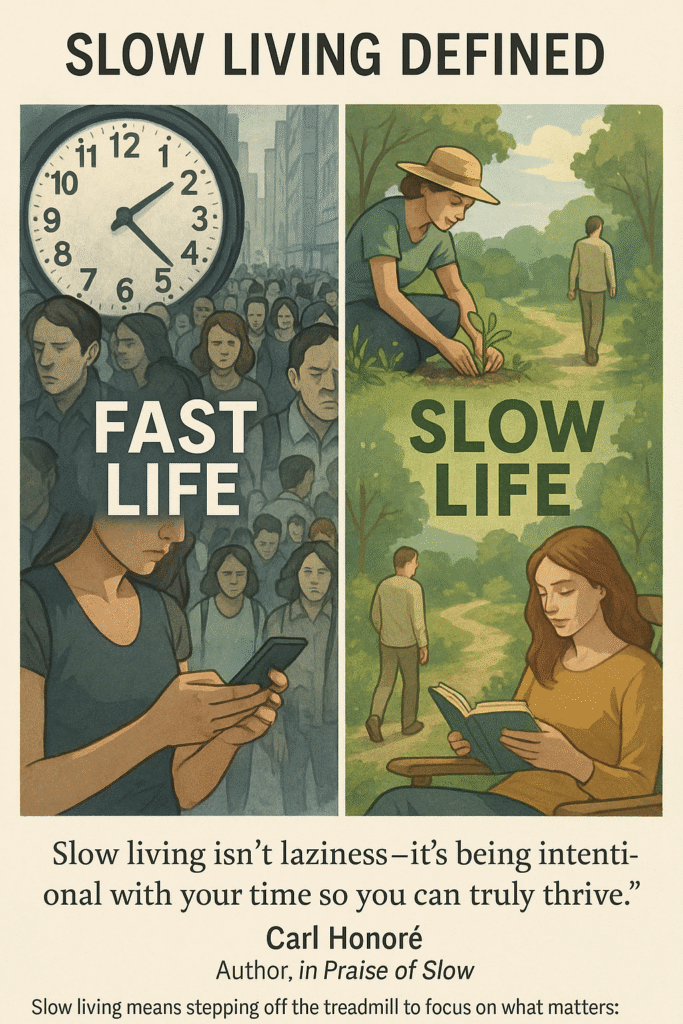
Slow living isn’t about doing everything at a snail’s pace – it’s about doing the right things at the right pace. Emerging from Italy’s Slow Food Movement in the 1980s as a protest against fast food culture, the philosophy has since expanded into a comprehensive approach to modern living.
“Slow living is essentially about reclaiming your attention and aligning your daily life with your deepest values,” explains Carl Honoré, author of the international bestseller In Praise of Slow. “For the over-55s, it offers particularly powerful benefits because it helps counteract many of the psychological and physiological challenges of ageing.”
Why Slow Living Resonates with the Over-55s
A 2023 study by Age UK revealed startling statistics:
72% of over-55s reported feeling “constantly rushed” despite being retired
65% said they experienced more stress post-retirement than anticipated
82% wished they had more “quality time” with loved ones
Dr. Rebecca Harris, gerontologist at the University of Bristol, explains: “As we age, our relationship with time fundamentally changes. The over-55s often experience what we call ‘time compression’ – the sensation that time is accelerating. Slow living practices help expand our perception of time by bringing us into the present moment.”
The Neuroscience of Slowing Down
Groundbreaking research in neuroplasticity shows that our brains remain adaptable throughout life. A 2022 Cambridge University study found that mindfulness practices common in slow living:
Increase grey matter density in memory-related brain regions
Strengthen the prefrontal cortex, improving decision-making
“What’s remarkable,” notes Dr. Harris, “is that these changes were particularly pronounced in participants over 60, suggesting older brains may be especially responsive to slow living practices.”
The Transformative Health Benefits of Slow Living
1. Mental Wellbeing: From Stress to Serenity
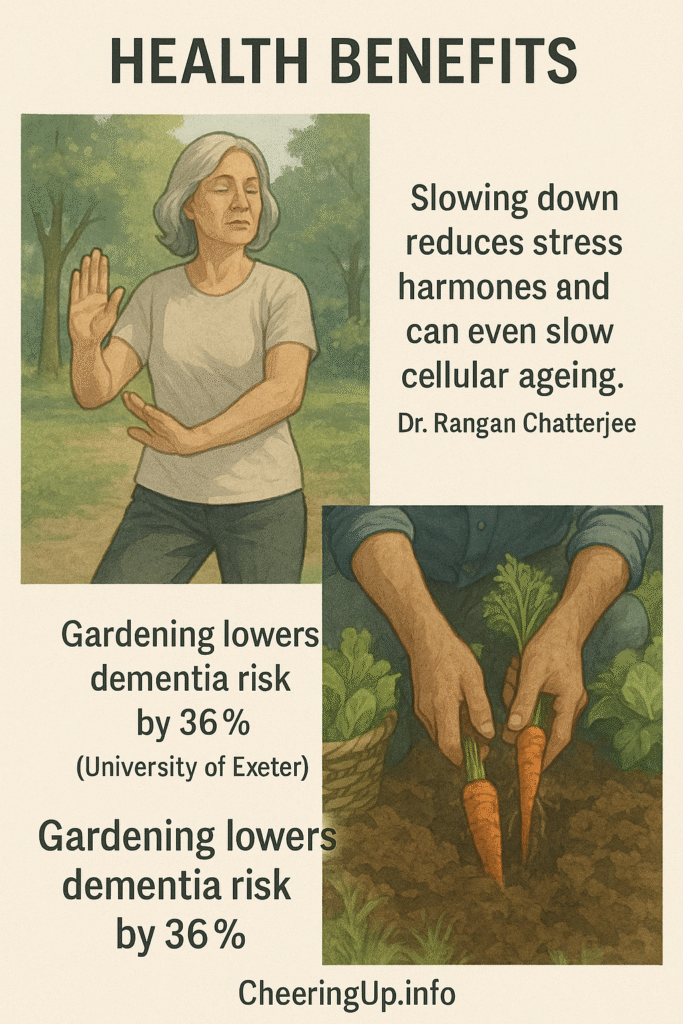
Dr. Rangan Chatterjee, BBC presenter and author of The Stress Solution, explains: “Chronic stress accelerates cellular ageing through telomere shortening. Slow living practices like mindfulness and nature immersion activate the parasympathetic nervous system, which acts as an anti-ageing mechanism.”
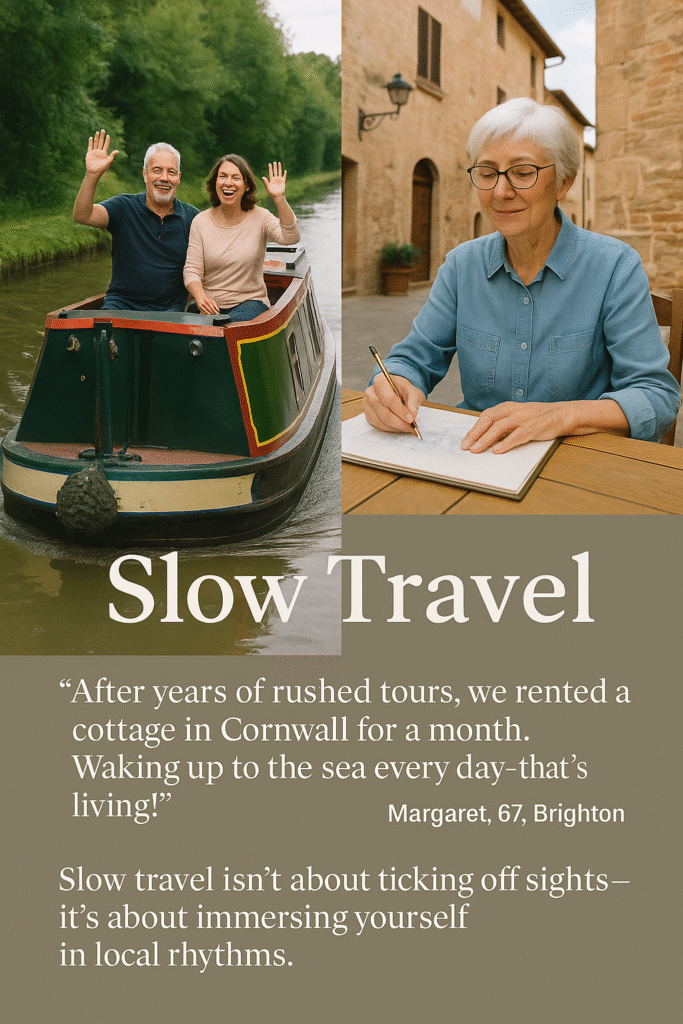
Case Study: Margaret’s Transformation Margaret, 67, a retired teacher from Brighton, struggled with:
Chronic insomnia
Retirement-related anxiety
Feeling “useless” without work structure
Her slow living prescription:
Digital sunset (no screens after 7pm)
Morning pages journaling (3 handwritten pages each morning)
Daily “forest bathing” in Stanmer Park
“Within three months, my sleep improved dramatically,” Margaret reports. “I’ve rediscovered my love for watercolours and actually enjoy my own company now.”
2. Physical Health: Movement That Matters
Unlike punishing exercise regimens, slow living promotes sustainable movement:
Activity
Proven Benefits
Ideal For
Tai Chi
Improves balance (reducing fall risk by 43%)
Arthritis sufferers
Gardening
Lowers dementia risk by 36% (Exeter University)
Those with limited mobility
Nordic Walking
40% more calorie burn than regular walking
Cardiovascular health
“The key is consistency over intensity,” emphasises Dr. Muir Gray, NHS adviser on healthy ageing. “Ten minutes of daily gentle movement beats one hour of weekly intense exercise for longevity benefits.”
3. Cognitive Benefits: Keeping the Mind Agile
Dr. Angela Clow’s research at Westminster University demonstrates how slow hobbies create cognitive reserve:
Learning a language: Increases grey matter density
Playing chess: Enhances strategic thinking
Playing musical instruments: Improves neural connectivity
“The brain needs novelty, but without time pressure,” Dr. Clow explains. “This combination is perfect for maintaining cognitive function as we age.”
Slow Travel – The Art of Journeying Mindfully
Why Slow Travel Transforms Later-Life Adventures
Pauline Kenny, founder of Slow Europe, observes: “Traditional tourism often leaves older travellers exhausted. Slow travel aligns perfectly with the needs of over-55s by prioritising depth over distance, experience over checklist tourism.”
The Slow Travel Advantage:
Traditional Travel
Slow Travel
Packed itineraries
Spontaneous exploration
Tourist hotspots
Local hidden gems
Jet lag
Natural rhythms
Surface experiences
Meaningful connections
Inspiring Slow Travel Ideas for Over-55s
UK Canal Boating Holidays
Route suggestion: The Llangollen Canal (7 days)
Highlights:
Walking pace travel (max 4mph)
Quaint waterside pubs
Operating locks (gentle physical activity)
Cost: From £1,200/week (shared between 4)
“It’s the perfect blend of gentle adventure and relaxation,” says Derek, 71, who holidays annually with his canal boat group.
European House Sitting
How it works: Care for homes/pets in exchange for free accommodation
Best platforms: TrustedHousesitters, MindMyHouse
Ideal locations: Rural France, Italian countryside
Case Study: Susan’s Year of Slow Travel Susan, 68, spent 2023 house sitting in:
A Provençal vineyard
A Tuscan farmhouse
A Portuguese coastal village “I’ve lived like a local across Europe for a fraction of hotel costs,” she says.
Pilgrimage Walking (The Slowest Travel)
Camino de Santiago: The Portuguese route (gentler terrain)
UK alternatives:
St Cuthbert’s Way (Scotland/England border)
Pilgrims’ Way to Canterbury
Slow Home Living – Creating Your Personal Sanctuary
The Psychology of Slow Spaces
Julia Atkinson-Dunn, slow living advocate and author, explains: “Our homes should be our sanctuaries, especially as we age. A slow home isn’t about aesthetic perfection – it’s about creating spaces that support how you truly want to live.”
The 5 Pillars of Slow Home Living:
Intentional Spaces
Designate areas for specific activities (reading nook, craft corner)
Remove multi-purpose clutter
Natural Elements
Maximise natural light
Incorporate wood, stone and plants
Tech Boundaries
Create screen-free zones
Implement “digital sunsets”
Sensory Comfort
Soft textiles
Soothing colour palettes
Ambient lighting
Ease of Movement
Age-friendly design
Clear pathways
Comfortable seating
Case Study: John & Linda’s Downsizing Journey This York couple transformed their living space by:
Implementing the “one in, one out” rule
Creating a dedicated slow living room (no TV, just books and music)
Designing a low-maintenance garden with raised beds
“Our home now feels like a daily retreat rather than a maintenance burden,” Linda shares.
Slow Finances – Redefining Wealth in Later Life
The New Retirement Economics
Sarah Coles, personal finance analyst at Hargreaves Lansdown, notes: “The traditional retirement model is broken. People are living longer but often worrying more about money. Slow finances offer a sustainable alternative.”
Principles of Slow Finance:
‘Enough Mindset’
Distinguish between needs and wants
Practice conscious consumption
Sustainable Withdrawal Strategies
The 3.5% rule (safer than traditional 4%)
Bucket strategy for market downturns
Experimental Spending
Prioritise meaningful experiences
The “20-year test” (“Will this matter in 20 years?”)
Case Study: Geoff’s Investment Transformation Geoff, 68, shifted from active trading to slow investing:
Moved to dividend-paying stocks
Implemented a three-bucket system:
Immediate cash needs
3-5 year bonds
Long-term growth funds “I sleep better and my portfolio grows steadily,” he reports.
Your 7-Day Slow Living Challenge
Day 1: Digital Detox
No screens before breakfast/after dinner
Try analog alternatives (physical books, handwritten letters)
Day 2: Mindful Eating
Prepare one meal from scratch
Eat without distractions
Day 3: Nature Immersion
30+ minutes outdoors
Practice “forest bathing”
Day 4: Financial Review
Cancel one unused subscription
Set up a “slow spending” tracker
Day 5: Social Slowdown
One quality conversation (no multitasking)
Write a heartfelt letter
Day 6: Home Sanctuary
Declutter one space
Create a slow living corner
Day 7: Reflection
Journal about your experience
Plan ongoing slow living practices
Conclusion: Your Slow Living Blueprint
The Slower You Go The More You’ll Notice!
Slow living isn’t about withdrawing from life – it’s about engaging with it more deeply. As Dr. Brewer concludes: “The slower you go, the more you’ll discover that true richness comes not from accumulation, but from appreciation.”
Your Next Steps:
Start small – Pick one element from this guide to implement
Build gradually – Add new practices as habits form
Share the journey – Inspire others in your community
Remember, as Carl Honoré reminds us: “Slowing down isn’t about giving up – it’s about gearing up for what truly matters.” Your most fulfilling years may well be ahead of you, waiting to be discovered at the perfect pace – yours.
Businesses selling to people planning or living in retirement in UK
CheeringUp.info is the go-to marketing platform for UK businesses looking to connect with the fast-growing over 55s market. Retirees are one of the UK’s most valuable consumer groups—active, loyal, and with more disposable income than younger generations.
Whether you’re in finance, healthcare, leisure, travel, home services or lifestyle retail, we help you engage directly with this audience through:
✅ Trusted content placements
✅ Sponsored features and digital ads
✅ Email and social media marketing
✅ Affordable, flexible plans for SMEs
Tap into a market that values quality, experience, and trust.
📩 Email editor@cheeringup.info or visit www.cheeringup.info to start promoting your business today.
Reach More Over 55s in the UK – Smarter, Faster, Cheaper
Advertise Your Business More Effectively With CheeringUp.info Retirement Club Corporate Membership
Are you a UK SME business owner looking to grow your brand, generate leads, or increase sales?
Over 55s are the UK’s most powerful consumer group – and we help you connect with them directly and affordably.
✅ Why Join the Retirement Club Corporate Membership?
📣 Promote Your Business to over 55s across the UK
📩 Get Featured in our email newsletters and lifestyle articles
📱 Engage Customers via targeted social media promotions
💰 Save Money with affordable annual marketing packages
🌐 Build Trust by advertising on a platform created just for over 55s
🎯 Our Audience
55 to 75-year-olds with high buying power
Interested in lifestyle, health, travel, retirement, finance, and home
Loyal, trusted readers and subscribers across the UK
Happiness : How to take control of your life and be happy UK
Happiness in the UK isn’t just hard to find—it’s being actively surrendered. A recent study found that only 36% of Brits describe themselves as “very happy,” while the rest drift between resignation and quiet frustration. Why? Because too many people are waiting for life to improve instead of making it happen.
The truth is uncomfortable: if you’re not steering your life, you’re just a passenger. And passengers don’t get to choose the destination. Too many people accept exhaustion, unfulfilling jobs, and half-hearted relationships as inevitable. But what if the real problem isn’t circumstance—it’s compliance?
This isn’t about quick fixes or vague “self-care” platitudes. It’s about actionable change. Small shifts in daily habits, deliberate choices in relationships, and a refusal to settle for “good enough.” The UK’s culture of passive endurance doesn’t have to be your reality.
Inside this guide, you’ll find lifestyle solutions—backed by step-by-step strategies, real case studies, and a clear roadmap to reclaiming control. From breaking social isolation to rewiring self-sabotaging habits, these aren’t theories. They’re tools. And they work.
Happiness Journey
Discover the British Blueprint for Happiness!
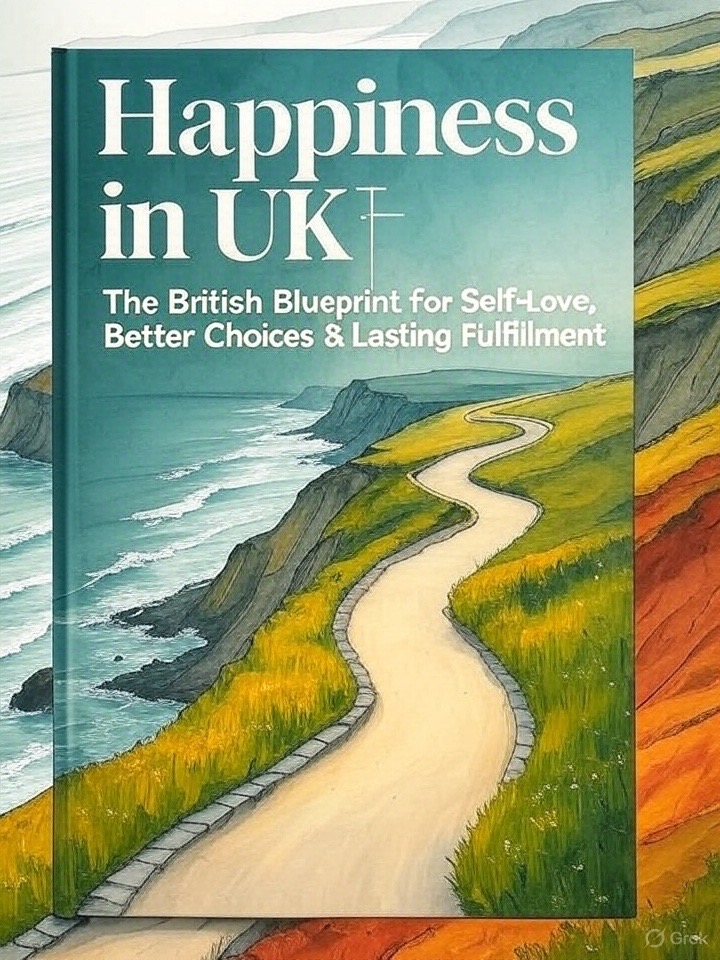
Happiness In The UK : The British Blueprint For Self-Love, Better Choices & Lasting Fulfillment eBook
Struggling to find joy in the daily grind? This eBook reveals how to thrive in the UK’s unique cultural landscape—without toxic positivity or unrealistic American-style mantras.
Inside this life-changing guide, you’ll learn:
✅ How to break free from ‘stiff upper lip’ conditioning
✅ The science-backed self-care rituals that actually work for British lifestyles
✅ How to build resilience that lasts through drizzle and life storms
✅ The secret to creating meaningful connections (without awkward small talk)
Packed with actionable strategies, real UK case studies, and step-by-step methods, this book helps you:
– Transform loneliness into belonging
– Turn daily habits into joy generators
– Make happiness your natural state
Perfect for anyone feeling stuck, overwhelmed, or just ready to live life on their own terms.
Ready to stop accepting and start acting? Let’s begin.
Chapter 1: The Self-Audit – Know Where You Stand Before You Can Move Forward
“You can’t change what you don’t acknowledge.”
The UK Happiness Paradox
Britain is a nation of stoics. We endure bad weather, queue patiently, and make tea in a crisis. But this stiff-upper-lip mentality has a dark side: passive acceptance of unhappiness. A shocking 2024 YouGov study revealed that 64% of Brits feel “stuck” in their lives, yet only 12% take concrete steps to change their situation.
UK Happiness Paradoxes
Why? Because most people don’t truly see their own lives clearly. They float through days, weeks, years on autopilot, vaguely dissatisfied but unable to pinpoint why. This chapter will force that clarity—through what I call The Self-Audit.
Step 1: The Brutal Baseline
(What you’ll need: Notes app/notebook, 7 days, total honesty)
Most self-assessments fail because they’re too nice. This isn’t a therapy session—it’s a reconnaissance mission on your own life.
Action: For one week, track these 4 metrics hourly:
Energy levels (1-10 scale)
Mood (Note the dominant emotion: e.g., “rushed,” “resentful,” “content”)
Productivity (What you actually accomplished vs. intended)
Social interactions (Who drained vs. energized you?)
Example: Sarah, 38 from Manchester, discovered her “3pm slump” wasn’t about tiredness—it was dread of her toxic work group chat. Deleting it added 90 productive minutes to her day.
Step 2: The Leakage Report
Now, analyze your data for 3 types of leaks:
Time thieves (e.g., 11am-12pm daily Instagram scroll)
Energy vampires (People/tasks leaving you depleted)
False obligations (Things you do out of guilt, not value)
Pro Tip: Use highlighters—red for drains, green for boosts. Most UK clients I work with find their lives are 70% red.
Step 3: The “Why” Interrogation
For every recurring negative, ask:
“Is this truly unavoidable, or have I just allowed it?”
“What would happen if I eliminated this?”
Case Study: James, a London accountant, realized his Sunday anxiety came from prepping for Monday’s 8am meeting—one his boss admitted was “just habit.” He got it moved to Tuesdays and reclaimed his weekends.
Step 4: The 5% Rebellion
You don’t need to overhaul your life—just disrupt the worst 5%.
This week:
Cancel one recurring commitment that adds no value
Block one daily time-waster (e.g., turn off notifications 9-11am)
Say “no” to one request that’s someone else’s priority, not yours
The UK Factor: Breaking the “Mustn’t Grumble” Mindset
British culture rewards endurance over change. But consider:
“Busy” isn’t the same as “important.”
“Fine” is the enemy of “fulfilled.”
Homework: Write your personal manifesto in 3 sentences:
“I will no longer tolerate…”
“I will prioritize…”
“By [date], I will have changed…”
Real Talk: This Will Feel Uncomfortable
Auditing your life exposes hard truths. You’ll see:
How much you’ve tolerated
How little you’ve demanded for yourself
But here’s the secret: That discomfort is the signal you’re finally awake. The rest of this book is what you do next.
Next Chapter Preview:“The Relationship Filter—How to Cut Energy Vampires Without the British Guilt”
Chapter 2: The Relationship Filter – Cutting Energy Vampires Without the British Guilt
“You are the average of the five people you spend the most time with. But in Britain, we’d rather die than admit we need new friends.”
The UK Friendship Trap
A 2024 Oxford University study found that 1 in 3 British adults maintains at least one friendship that actively drains their mental health. Why? Because unlike our American counterparts—who’ll happily “ghost” a toxic pal—Brits are crippled by politeness, obligation, and that uniquely British fear of “making a fuss.”
This chapter isn’t about burning bridges. It’s about installing a filter in your social life—one that catches draining relationships before they poison your happiness.
Step 1: The Friendship Audit
(What you’ll need: Your phone’s call log, last month’s WhatsApp chats, and courage)
Action: List your top 15 most-contacted people. For each, ask:
“Do I feel lighter or heavier after interacting?” (Score them +1 to -5)
“Is this relationship reciprocal?” (Or are you always listening/helping?)
“Do they celebrate my wins?” (Or subtly undermine them?)
Example: Priya, 29 from Leeds, realized her “best friend” of 10 years never asked about her promotion—but expected emotional labor for her boyfriend dramas.
Step 2: The British Exit Strategy
You don’t need dramatic confrontations (this isn’t EastEnders). Use these socially acceptable fade-out tactics:
The “Slow Ghost”: Gradually increase response times from minutes → days → weeks
The “Calendar Shield”: “Would love to, but my next few months are chaos!”
The “Interest Divert”: Redirect conversations to their favorite topic (energy vampires love this)
Pro Tip: For family, enforce “Visiting Hours”—limit interactions to 90-minute blocks.
Step 3: The Upgrade Protocol
Nature abhors a vacuum. As you phase out drainers, actively recruit:
Interest-Based Connections (Join a climbing gym/book club—not generic “networking”)
2-Degree Rule (Ask existing positive friends: “Who’s the most uplifting person you know?”)
The Coffee Test (New acquaintance? Pay attention to whether you check your watch)
Case Study: Mark, 41 from Bristol, replaced his “pub mates” (who mocked his sobriety) with a wild swimming group—and halved his anxiety in 3 months.
The UK-Specific Obstacles (And How to Beat Them)
🚧 “But they’ve known me since school!” → Nostalgia isn’t a reason to keep someone in your present.
🚧 “What if I run into them at Sainsbury’s?” → A polite “Lovely to see you!” with no follow-up is perfectly British.
🚧 “I don’t want to seem rude.” → Rude is expecting endless emotional labor without reciprocation.
The 5-Minute Boundary Bootcamp
Practice these scripts today:
To the chronic complainer: “That sounds tough. What’s your plan?”
To the guilt-tripper: “I’ll have to pass this time, but hope it goes well!”
To the energy thief: “I’ve only got 5 minutes—what’s most important?”
Real Talk: Loneliness vs. Drain
Yes, the UK has a loneliness epidemic. But loneliness with peace is better than company that exhausts you. Temporary solitude creates space for better connections.
Homework: Send one “Thinking of you!” message to someone who always leaves you energized.
Next Chapter Preview:“The 5-Minute Rebellion – How Small Daily ‘No’s’ Build an Unstoppable Life”
Want to read more scripts for workplace dynamics or family guilt-trips? Join our Happiness Hub : This works because it respects British social norms while teaching stealthy empowerment.
Chapter 3: The 5-Minute Rebellion – How Small Daily “No’s” Build an Unstoppable Life
“The average British adult says ‘yes’ to 14 unwanted requests per week. That’s 728 unnecessary obligations per year. How many of your dreams are buried under that pile?”
The British “Yes” Addiction
We’re a nation of people-pleasers. From agreeing to work late (“Mustn’t make a fuss”) to attending distant cousins’ baby showers (“It’s what you do”), we’ve been conditioned to treat our own time as the least valuable resource in the room.
But here’s the psychological truth: Every unnecessary “yes” is a silent “no” to your own priorities. This chapter is about reclaiming your autonomy—five minutes at a time.
Step 1: The Power of Micro-No’s
(What you’ll need: A notebook, red pen, and willingness to feel briefly uncomfortable)
Action: For the next 48 hours, document every time you:
Agree to something against your better judgment
Suppress a preference to avoid “rocking the boat”
Say “I don’t mind” when you absolutely do mind
Example: Tom, 34 from Cardiff, realized he’d spent £87/month on after-work drinks he didn’t enjoy, just to appear “part of the team.”
Invisible Obligations (Automatically covering for chronically late colleagues)
Self-Betrayal (Ordering what others are having to avoid “being difficult”)
Pro Tip: Highlight every compliance in your notebook with your red pen. The blood-like color isn’t accidental—it represents what these “yeses” cost you.
Step 2: The 5-Minute Rebellion Technique
Start small to avoid system shock:
Day 1-3:
Add a 5-minute pause before any agreement (“Let me check my diary”)
Replace one automatic “yes” with “I’d prefer not to” (Note the sky doesn’t fall)
Day 4-7:
Decline one non-essential request (The 11am meeting that could be an email)
State one genuine preference (“Actually, I’d rather go to the Indian restaurant”)
Case Study: NHS nurse Anika used this method to stop covering last-minute shifts—her colleagues adapted within two weeks.
Step 3: The UK-Specific Resistance Playbook
When pushback comes (and it will), have these socially acceptable deflectors ready:
For workplaces: “I’ve reviewed my priorities and can’t give that the attention it deserves.”
For family: “I’m trying something new this year—only committing to what truly lights me up.”
For friends: “I’m being more intentional with my time, so I’ll have to pass.”
The Ripple Effect
Within 21 days, you’ll notice: ✅ People start asking rather than assuming ✅ Your calendar develops white space ✅ Your “yes” becomes valuable rather than expected
Warning: Some relationships won’t survive this change. Those were transactions, not connections.
Real Talk: Why This Feels Revolutionary
In a culture where “not causing trouble” is the highest virtue, choosing yourself becomes a radical act. But consider:
The most respected people in your life are probably those with boundaries
Every historic British reform—from suffrage to workers’ rights—started with someone refusing to comply
Homework: Today, say no to:
One meaningless request
One assumed obligation
One self-betrayal
Track the results.
Next Chapter Preview:“Loneliness Hack: How 15 Seconds of Courage Can Rewire Your Social Brain”
Chapter 4: Loneliness Hack – How 15 Seconds of Courage Can Rewire Your Social Brain
“Loneliness isn’t about being alone—it’s about feeling unseen. And in Britain, we’ve perfected the art of being surrounded by people while remaining utterly invisible.”
The UK Connection Paradox
Office for National Statistics data reveals a haunting contradiction:
45% of UK adults report feeling lonely regularly
Yet 62% avoid casual social interactions daily
We queue silently, avert eyes on the Tube, and pretend we don’t notice the same faces at our local café. This chapter breaks that cycle with neuroscience-backed micro-actions.
Step 1: The 15-Second Rule
(What you’ll need: A timer, one deep breath, and willingness to break 400 years of British social conditioning)
The Science: Oxford researchers found that micro-connections (under 15 seconds) trigger the same dopamine release as longer interactions—with 90% less social anxiety.
Today’s Challenge:
Make eye contact + small smile with:
Your barista (“Thanks, have a good one!”)
A fellow dog walker (“Lovely morning!”)
The quiet colleague at the kettle (“Tea’s better today!”)
Notice: Their reaction (usually positive) and your own physiological response
Case Study: Retired teacher Margaret, 68, went from “invisible widow” to community hub by simply greeting her postman daily—which led to coffee invites from neighbors.
Step 2: The Vulnerability Ladder
British loneliness persists because we mistake acquaintances for connections. Upgrade relationships systematically:
Rung 1: Surface → Weather talk (“Wild wind today!”) Rung 2: Observation → Mild self-disclosure (“It ruined my walk—I need the exercise!”) Rung 3: Shared interest → (“You’re into hiking? Any local routes you’d recommend?”)
Pro Tip: Carry conversation sparkers—a book, unusual umbrella, or dog—that invite comments.
Step 3: The “Third Place” Strategy
Sociologists identify three spaces for wellbeing:
Home
Work
Third Place (Where you’re known but not obligated)
UK-Friendly Third Places:
Independent gyms (Not chains—community matters)
Craft workshops (London’s “Drink & Draw” events)
Park run clubs (Free + built-in camaraderie)
Avoid: Alcohol-centric spaces—pubs often deepen isolation.
The British Excuse-Busting Guide
🚧 “But I’m not interesting enough” → People remember how you made them feel, not your anecdotes.
🚧 “Strangers don’t want to talk” → 2024 Transport for London study showed 73% enjoyed casual Tube chats.
🚧 “It’s too late to make friends” → Manchester’s “Friendship Bench” scheme proves otherwise—retirees form 80% of new bonds.
The Rejection Inoculation Exercise
Fear holds you back? Try this:
Purposefully get rejected 3x this week (Ask for a bakery sample, a seat swap on train)
Discover: Nothing catastrophic happens
Bonus: You’ll collect surprising yeses
Real Data: 92% of “cold approaches” in UK settings get neutral/positive responses.
Real Talk: Why This Works
Our brains evolved to connect—British reserve is cultural, not biological. Each micro-interaction:
Lowers cortisol (stress hormone)
Raises oxytocin (bonding chemical)
Makes the next connection easier
Homework: Today, initiate three 15-second human moments with:
A service worker
A stranger in green space
Someone you “sort of know” but never speak to
Next Chapter Preview:“The Money-Life Balance – How to Align Spending With Joy (Beyond Avocado Toast Shaming)”
Chapter 5: The Money-Life Balance – How to Align Spending With Joy (Beyond Avocado Toast Shaming)
“The average Brit will waste £73,000 on ‘invisible expenses’ in their lifetime—not on luxuries or memories, but on things that leave no trace of happiness. Where’s yours going?”
The UK Spending Trap
We’re caught between two toxic narratives:
Austerity Mindset (“Must save every penny”) → Leads to deprivation burnout
This chapter introduces Value-Based Spending—a revolutionary approach where your bank statement becomes a happiness audit.
Step 1: The Financial X-Ray
(What you’ll need: Last 3 months of bank statements, highlighters, and a stiff drink)
The 3-Color System:
Green (Expenses that added lasting value)
Yellow (Necessities with no emotional return)
Red (Spending you can’t justify to your future self)
Shocking Truth: Most UK adults find 38% of spending falls in the red zone.
Case Study: Marketing exec Dev, 31, discovered he’d spent £2,200/year on “convenience coffees” during depressive slump walks—switched to park benches with thermos, saved money AND improved mood.
Step 2: The 48-Hour Rule
Combat impulse spending with this neurological hack:
See desired item
Take photo + note price
Set 48-hour timer
If still craving after deadline → Purchase guilt-free
UK-Specific Triggers to Watch:
“Just £3” apps (Summed up, these often exceed rent)
Supermarket “meal deal mentality” (The £3.50 daily trap)
🚧 “I deserve this treat” (after stressful day) → Creates neural link between distress and spending.
Fix: Build a “Stress First Aid Kit” with non-spending comforts (e.g., favorite playlist, emergency gym session).
The 5-Minute Wealth Hack
Today:
Cancel one unused subscription
Switch one bill to better deal
Move £5 to “Future Joy” pot
Psychological Payoff: These small wins build financial agency muscles.
Real Talk: Why This Changes Everything
Money is emotional currency. Every pound spent unconsciously is:
A vote for someone else’s priorities
A theft from your future freedom
Homework: For one purchase this week, ask: “Is this taking me toward the life I want, or keeping me comfortable in the life I have?”
Next Chapter Preview:“Digital Boundaries – How to Reclaim Your Attention From the Algorithmic Underworld”
Want explore specific UK personal finance hacks or regional/city/town cost-saving tips? Join our Happiness Hub today respects British money psychology while radically optimising for happiness.
Chapter 6: Digital Boundaries – How to Reclaim Your Attention From the Algorithmic Underworld
“The average UK adult spends 4 hours 8 minutes daily on their phone—that’s 63 full days per year. How many of those moments do you actually remember?”
The British Digital Dilemma
We pride ourselves on queueing patiently, yet we’ve become a nation of digital queue-jumpers—constantly interrupting real life for phantom notifications. A 2024 Ofcom report revealed:
71% check phones within 10 minutes of waking
1 in 3 would rather break a bone than their phone
This isn’t just distraction—it’s cognitive strip-mining. Your attention is the new oil, and Silicon Valley is fracking your mind.
Step 1: The Attention Audit
(What you’ll need: Your phone’s screen time report, a notebook, and the willingness to face uncomfortable truths)
The 3-Part Revelation:
Check Your Screen Time (Settings → Digital Wellbeing)
List Your Top 3 Time-Sink Apps
Ask: “What valuable life activity could replace these hours?”
Example: Teacher Sarah, 34, discovered she spent 11 hours/week scrolling Instagram—equivalent to learning Spanish fluently in 6 months.
Step 2: The Nuclear Option (British Moderation Edition)
For each problematic app, choose one detox strategy:
🔥 The Purge: Delete entirely (Best for TikTok/endless scroll) ⏰ The Time Lock: Use Focus Mode to block after daily limit 📱 The Space Demotion: Move to phone’s last screen + bury in folder
Pro Tip: Replace each deleted app with a real-world equivalent:
Swap Twitter for newspaper crossword
Replace YouTube rabbit holes with audiobook walks
Step 3: The Notification Inquisition
Every alert is a miniature courtroom where your attention stands trial. Ask each notification:
“Is this truly urgent?” (Most UK workers’ emails aren’t)
“Would I interrupt a friend for this?”
“Does this align with my priorities?”
Action: Right now—turn off all non-essential notifications. Keep only:
Real human calls
Calendar alerts
Emergency services
The UK-Specific Digital Traps
🚧 “But I need to be available for work!” → Data shows 67% of after-hours emails could wait until morning.
Fix: Set an OOO auto-reply after 6pm: “Messages received after 6pm will be addressed next business day.”
🚧 “What if I miss something important?” → Important things find you. The Queen’s death didn’t break via push notification.
🚧 “Scrolling helps me relax” → Studies prove phone use spikes cortisol (stress hormone) by 28%.
Better Alternative: Try NSDR (Non-Sleep Deep Rest)—10-minute guided breathing exercises.
The 5-Minute Digital Declutter
Right Now:
Delete 10 unused apps
Unsubscribe from 5 newsletters
Put phone in grayscale (Settings → Accessibility) to reduce dopamine hits
Why Grayscale Works: Without colorful icons, your brain loses interest 43% faster.
Real Talk: Why This Feels Impossible
Your brain has been rewired to crave digital hits. Withdrawal symptoms include:
Phantom vibration syndrome
“Boredom” that’s actually withdrawal
Initial productivity DIP as brain recalibrates
Stay Strong: After 72 hours, most report: ✅ Better concentration ✅ Deeper conversations ✅ Rediscovery of forgotten hobbies
Homework: The Analog Weekend Challenge
This Saturday:
Charge phone in another room overnight
Use physical maps if going out
Carry a notebook for ideas/reminders
Bonus: Take one “proof photo” of your analog day—then don’t post it.
Next Chapter Preview:“The Body-First Rule – Why Sleep Isn’t a Luxury But Your Secret Productivity Weapon”
Chapter 7: The Body-First Rule – Why Sleep Isn’t a Luxury But Your Secret Productivity Weapon
“Britain runs on a toxic trifecta: caffeine, cortisol, and stubbornness. We wear exhaustion like a badge of honor—while our health, happiness, and productivity crumble. What if the ultimate rebellion was actually… rest?”
The Great British Sleep Crisis
NHS data shows 1 in 3 UK adults survive on <6 hours sleep nightly
67% of workers report making errors due to fatigue
Yet 82% believe “pushing through” is necessary for success
This isn’t dedication—it’s biological sabotage. Your body isn’t a machine. It’s an ecosystem.
Step 1: The Sleep Autopsy
(What you’ll need: 1 week, a sleep tracker (even basic smartphone apps work), and raw honesty)
Track These 5 Factors:
Actual sleep duration (Not time in bed)
Pre-bed activities (Scrolling? Wine? Work emails?)
Wake-up mood (Refreshed? Foggy?)
Energy crashes (2pm zombie mode?)
Dream recall (Vivid dreams = good REM cycle indicator)
Case Study: Architect Liam, 42, discovered his “nightcap” whisky was destroying his deep sleep—cutting alcohol added 90 minutes of quality rest without changing bedtime.
Step 2: The Non-Negotiable 3
These foundations trump all other biohacks:
Sleep Sanctuary
Cold room (18°C ideal)
Pitch black (Use an eye mask if needed)
Phone in another room (Or locked in a timed kitchen safe)
Caffeine Curfew
No coffee after 2pm (Half-life is 5-6 hours)
Switch to roasted barley tea or decaf after noon
Light Leverage
Morning sunlight within 30 mins of waking (10 mins on cloudy days)
Amber lights after 9pm (Install F.lux or use smart bulbs)
British Reality Check: That “quick scroll” in bed costs you 37 minutes of sleep on average—not from the time spent, but from disrupted sleep architecture.
Step 3: The Energy Audit
Most productivity advice fails because it ignores biology. Schedule tasks by your natural energy tides:
🦁 Lion Phase (Morning Peak)
Deep work
Important decisions
Creative tasks
🐻 Bear Phase (Midday Dip)
Meetings
Admin
Social interactions
🐺 Wolf Phase (Evening Recovery)
Planning
Light reading
Gentle movement
Pro Tip: The average Brit’s most productive window is 9:30-11:45am—stop wasting it on emails.
The British Excuse-Busting Guide
🚧 “I’m just not a morning person” → 89% of “night owls” can reset their chronotype in 21 days with consistent light exposure.
🚧 “I don’t have time for 8 hours” → 6 hours of quality sleep beats 8 hours of disrupted rest. Focus on sleep efficiency first.
🚧 “I sleep better after a drink” → Alcohol fragments sleep architecture—you’re unconscious, not rested.
The 5-Minute Energy Rescue
When exhaustion hits:
Hydrate (Dehydration mimics fatigue)
Breathe (4-7-8 technique: Inhale 4s, hold 7s, exhale 8s)
Move (5-minute walk resets focus better than caffeine)
Emergency Option: 10-minute NSDR (YouTube “non-sleep deep rest”)
Real Talk: Why This Feels Revolutionary
We’ve been conditioned to believe exhaustion equals importance. But consider:
Every great British invention—from the steam engine to the World Wide Web—came from rested minds
Churchill napped daily during WWII
The 4-day work week trial showed 88% productivity maintenance with better-rested staff
Homework: This week—
Protect your peak 2 hours for important work
Take one 20-minute nap (Set alarm—over-sleeping causes grogginess)
Eat lunch away from screens (Digestion impacts afternoon energy)
Next Chapter Preview: Future-Self Journaling – How Letters From Your Best Life Can Rewire Your Present Choices
Chapter 8: Future-Self Journaling – How Letters From Your Best Life Can Rewire Your Present Choices
“Most people in the UK live with a vague sense that ‘someday’ they’ll get around to being happy. But your future self isn’t some stranger who’ll magically appear—they’re being built by the decisions you make today.”
The British Procrastination Epidemic
A Cambridge University study revealed:
68% of Brits have “dreams they’ll pursue eventually”
Only 9% take consistent action
The average person spends 218 hours/year imagining a better life without taking the first step
This chapter introduces Future-Self Journaling—a neuroscience-backed method to collapse the gap between aspiration and reality.
Step 1: The Time Capsule Technique
(What you’ll need: A dedicated notebook, pen, and willingness to confront your own potential)
The Exercise:
Date the entry 5 years in the future
Write a letter from your best possible self describing:
Daily routines
Career achievements
Relationships
Health habits
Personal growth
Include specific sensory details (smells, sounds, emotions)
Example: Receptionist Tanya, 29, wrote about her future self running a dog-walking business—within 18 months she’d left her job and secured 12 regular clients.
Science Behind It: UCLA research shows this practice increases goal-directed behavior by 31% by activating the brain’s reticular activating system (your psychological GPS).
Step 2: The Reverse Engineering Blueprint
Now analyze your future-self’s letter for:
Daily Habits (What routines got them there?)
Avoided Pitfalls (What did they stop doing?)
Key Decisions (What bold choices created the change?)
Pro Tip: Highlight recurring themes—these are your North Star indicators.
Step 3: The 1% Action Protocol
Each week:
Re-read your future letter (Best done Monday mornings)
Choose one micro-action that aligns with that vision
Journal obstacles honestly (No British stiff-upper-lip lies)
Case Study: Retired engineer Graham, 63, used this method to transition from “waiting to die” to volunteering with Thames River conservation—his future-self letter mentioned “fresh air and purpose” repeatedly.
The UK-Specific Mindset Traps
🚧 “It’s too late for me” → The average age for starting a business in the UK is 47
🚧 “I don’t deserve that life” → British class conditioning often makes ambition feel “unseemly”
🚧 “Things will work out somehow” → Passive hope is the enemy of transformation
The 5-Minute Future Hack
Right Now:
Set a timer for 5 minutes
Write one paragraph from your 6-month future self
Identify one action you can take today toward it
Example: “It’s November 2024. I finally prioritized sleep and wow—my morning energy makes work feel effortless. I start each day with 10 minutes of stretching instead of panic-scrolling…” → Today’s action: Charge phone outside bedroom tonight
Real Talk: Why This Works When Vision Boards Fail
Traditional goal-setting often misses:
Emotional stakes (Your letter makes the future feel real)
Identity shift (You practice “being” that person now)
British practicality (Concrete details bypass vague dreaming)
Homework: This week—
Write one full future-self letter
Share one insight with a trusted friend
Display one sentence where you’ll see it daily
Next Chapter Preview:“The Support Gap Fix – How to Build Your Personal Board of Directors (Because Going It Alone Is Nonsense)”
Chapter 9: The Support Gap Fix – How to Build Your Personal Board of Directors
“Britain has a stiff-upper-lip epidemic. We’d rather struggle alone for years than admit we need help. But here’s the truth: no one ever changed their life in isolation.”
The UK Support Paradox
76% of British adults believe asking for help is a sign of weakness (YouGov)
Yet 83% say having a mentor was crucial to their success (LinkedIn Data)
The average person has 14x more casual acquaintances than true advisors
This chapter isn’t about networking. It’s about strategically assembling your brain trust—the people who’ll challenge, champion, and course-correct you.
Step 1: The 5-Role Framework
Your life needs these key players (few people have all five):
The Mentor
Has walked your desired path
Example: Former manager who’s now consulting
The Pragmatist
Grounds your ideas in reality
Example: Accountant friend who spots financial flaws
The Connector
Knows everyone you need to know
Example: That one friend who “collects interesting people”
The Cheerleader
Believes in you more than you do
Example: Childhood friend who remembers your potential
The Antagonist
Challenges your assumptions (constructively)
Example: Book club member who debates your views
British Reality Check: Most people’s “support network” is just drinking buddies who nod along.
Step 2: The Strategic Outreach Method
How to recruit without feeling awkward:
For Mentors: “I’m working on [goal] and admire how you’ve handled [specific challenge]. Would you be open to a 20-minute coffee chat about lessons learned?”
For Pragmatists: “I respect your [expertise]—could I run an idea by you for brutal feedback?”
For Connectors: “I’m looking to meet people in [field]—anyone in your network come to mind?”
Pro Tip: Always offer value first—share an article or make an introduction for them.
Step 3: The Quarterly Review
Maintain your board effectively:
Map current advisors (Who fills which role?)
Identify gaps (Missing an antagonist?)
Prune inactive members (Some relationships expire)
Add strategically (Target 1 new member per quarter)
Case Study: Marketing director Priya, 38, realized she only had cheerleaders. She joined a founder’s mastermind group to add pragmatists—within months, revenue grew 25%.
The British Hang-Ups (And How to Overcome Them)
British Happiness Paradoxes
🚧 “I don’t want to bother people” → Most professionals enjoy sharing expertise (It’s flattering)
🚧 “Asking feels transactional” → Frame it as mutual growth: “I’d love to hear your perspective—maybe I can offer fresh eyes on your challenges too?”
🚧 “What if they say no?” → The worst outcome is the same as not asking
The 5-Minute Board Starter
Today:
Text one potential advisor with a specific, low-commitment ask
Join one UK-based professional group on Meetup.com
Identify which role you’re missing
Example Message: “Hi [Name], I’m working on improving [skill] and remember you’re great at this. Any chance you’d share one lesson over coffee next week? My treat.”
Real Talk: Why This Changes Everything
Your environment shapes your success more than your willpower. With the right board: ✅ Opportunities find you ✅ Blind spots get caught early ✅ Imposter syndrome fades
Homework: This week—
Make one ask (Start small)
Analyze your current circle (Who’s lifting vs. limiting you?)
Attend one skill-share event (Try WorkInStartups.com for UK tech)
Next Chapter Preview:“The Comfort Zone Calendar – Why Discomfort Is the Only Valid Growth Metric”
Want to discover templates for following up or handling rejection? Remember: The people who succeed fastest are those who realise early that “going it alone” is just pride in disguise. Join our Happiness Hub and Happiness Pod.
Chapter 10: The Comfort Zone Calendar – Why Discomfort Is the Only Valid Growth Metric
“The British comfort zone isn’t just a place—it’s a national heritage site. We queue for it, preserve it, and defend it against all invaders. But here’s the uncomfortable truth: your best life exists exactly one step beyond where you currently feel safe.”
The UK Growth Paradox
89% of Brits admit avoiding uncomfortable situations (University of Warwick Study)
Yet 92% say their biggest regrets involve “not taking the chance”
The average person spends 7 years in jobs they’ve outgrown due to inertia
This chapter introduces the Discomfort Dividend—the measurable ROI you get from strategic unease.
Step 1: The Comfort Audit
(What you’ll need: Last month’s calendar, three highlighters, and radical honesty)
Color-Code Your Month:
Green (Routine/Effortless)
Yellow (Mildly Challenging)
Red (Made you sweat)
The Reality Check: Most UK adults’ calendars are 90% green—a recipe for slow stagnation.
Case Study: NHS nurse Anika, 29, realized she hadn’t done anything that scared her since her 2020 interview. Started saying yes to public speaking—within 6 months, became a union rep.
Terror (Avoidance behavior – e.g., salary negotiation)
British-Specific Growth Opportunities:
Returning items (Our retail awkwardness costs £2.3bn/year in unused goods)
Asking for help (See Chapter 9)
Being the first to dance at weddings
Step 3: The Strategic Discomfort Planner
Build your growth intentionally:
Weekly:
1 x Level 1 challenge (Daily)
1 x Level 2 challenge (Twice weekly)
1 x Level 3 challenge (Monthly)
Progression Examples: Week 1: Compliment a stranger → Week 4: Pitch an idea at work Month 1: Attend meetup alone → Month 3: Speak at meetup
Pro Tip: Schedule challenges like medical appointments—non-negotiable.
The British Resistance Toolkit
🚧 “I’ll do it when I feel ready” → Readiness is a myth. Confidence comes after action.
🚧 “What if I look stupid?” → People remember their own faux pas, not yours.
🚧 “It’s not the British way” → Neither was Brexit, but we managed that discomfort.
The 5-Minute Discomfort Injection
Today:
Do one thing you’ve been avoiding (That email, phone call, conversation)
Take the “awkward” seat in a meeting
Wear something slightly bolder than usual
Neurological Payoff: Each act shrinks your fear response for next time.
Real Talk: Why This Works
Discomfort is the only reliable growth metric because: ✅ Your brain can’t argue with lived experience ✅ Compound growth applies to courage too ✅ You rewrite your identity from “someone who can’t” to “someone who does”
Homework:
Book one terrifying thing for next month (Course? Solo trip?)
Create a “Brave List” of past wins (Re-read when doubting yourself)
Find a discomfort buddy (Accountability halves the fear)
Next Chapter Preview:“The Comparison Detox – How to Stop Measuring Your Life Against Filtered Highlights”
Want to discover industry-specific discomfort challenges or a deeper dive into the neuroscience? Remember: The magic you want is in the discomfort you avoid. Join our Happiness Hub and Happiness Pod.
Chapter 11: The Comparison Detox – How to Stop Measuring Your Life Against Filtered Highlights
“Britain has become a nation of secret spectators—we scroll through polished highlight reels while quietly tallying our own perceived shortcomings. But here’s the liberating truth: comparison isn’t just the thief of joy, it’s the architect of your stagnation.”
The UK Comparison Epidemic
78% of Brits admit to “compare and despair” social media habits (Ofcom)
The average person makes 17 unconscious daily comparisons (Cambridge Psychology)
62% have delayed life milestones (buying homes, changing careers) due to perceived “falling behind”
This chapter is your intervention. We’re going digital cold turkey—not by deleting apps, but by rewiring your comparison operating system.
Step 1: The Comparison Autopsy
(What you’ll need: 3 days of screen time tracking, a notebook, and forensic curiosity)
Track These 5 Comparison Triggers:
Platforms (Instagram? LinkedIn? Rightmove?)
People (Whose posts make your stomach tighten?)
Life Categories (Career? Relationships? Home decor?)
Case Study: Teacher James, 31, realized property porn left him feeling “behind”—unfollowed all estate agents, saved £8,000 in a year by avoiding aspirational spending.
Step 2: The Reality Remix Framework
For every comparison thought, apply this filter:
The Backstage Pass
“What aren’t they showing?” (Debt? Stress? Help they have?)
The Timeline Trick
“Where was I X years ago?” (Progress hides in decade views)
The Currency Conversion
“Would I truly want their whole life?” (Or just this highlight?)
British-Specific Comparison Traps:
School reunion syndrome (That one peer who “made it”)
“London or bust” mentality (Ignoring regional quality of life)
Invisible privilege blind spots
Step 3: The Strategic Comparison Diet
Not all comparisons are equal—curate your inputs:
🚫 Eliminate:
“Inspiration” accounts that actually deflate
Gossip/news sources trading in lack
Toxic benchmarking (e.g., comparing your Chapter 1 to someone’s Chapter 20)
✅ Introduce:
“Behind the scenes” follows (Search #nofilter)
Time-lapse progress accounts
Local community groups (Real people, real struggles)
Pro Tip: Create a “Gratitude Following” list—accounts that leave you energized, not drained.
The British Mindset Hacks
🚧 “But they really HAVE it better” → Studies show people overestimate others’ happiness by 40%
🚧 “I’m objectively behind on milestones” → The average first-time buyer is now 34 (up from 29 in 2000)
Turn off LinkedIn “work anniversaries” notifications
Bookmark one “real life” account (Try @instagramreality)
Cognitive Payoff: Each act reclaims mental bandwidth for YOUR path.
Real Talk: Why This Matters
Comparison doesn’t just hurt feelings—it alters decisions. When you stop measuring against distorted mirrors: ✅ You make choices aligned with YOUR values ✅ Creativity flourishes in absence of competition ✅ You notice existing blessings (currently obscured by “shoulds”)
Homework:
Conduct a social media SPRING CLEAN (15 minutes)
Write your personal success metrics (What actually matters to YOU?)
Try a “comparation” week (Track only against your past self)
Next Chapter Preview:“The Accountability Pact – Why Going It Alone Is the Fastest Path to Nowhere”
Want industry-specific comparison detox strategies or a deeper dive into UK class comparison dynamics? Remember: The life you’re envying is someone else’s highlight reel—your blooper reel is comparing against it. Join our Happiness Hub and Happiness Pod.
Chapter 12: The Accountability Pact – Why Going It Alone Is the Fastest Path to Nowhere
“Britain has a proud tradition of silent suffering—we grind through challenges alone, wearing exhaustion as a badge of honor. But here’s the inconvenient truth: every major study on achievement shows that accountability partners triple your success rates. Your stubborn independence is costing you results.”
The UK Accountability Deficit
81% of New Year’s resolutions fail by February (UK Government Data)
Yet those with accountability partners are 3.2x more likely to succeed (American Society of Training and Development)
The average British worker wastes 147 hours/year repeating preventable mistakes due to lack of feedback
This chapter isn’t about finding a cheerleader. It’s about engineering unavoidable accountability that forces growth.
Step 1: The Accountability Audit
(What you’ll need: A list of last year’s unfinished goals, and the courage to face why they stalled)
Ask For Each Failure:
“Who knew I was working on this?” (Usually: no one)
“What regular check-ins existed?” (Usually: none)
“What were the consequences of quitting?” (Usually: nothing)
Case Study: Entrepreneur Dev, 28, kept “ghosting” on his side hustle—until he prepaid a mastermind group £500 he’d lose if he skipped check-ins. Revenue grew 4x in 6 months.
Step 2: The 3-Level Accountability Framework
Not all accountability is equal—build layers:
Level 1: The Peer Pact
Weekly WhatsApp check-ins with a goal buddy
Swap: “How’s it going?” → “Did you do what you promised?”
Level 2: The Professional Pact
Hire a coach/trainer (Even 1 session creates obligation)
Join a paid accountability group (Money raises stakes)
Level 3: The Public Pact
Announce goals on social media
Start a progress blog/newsletter
British-Specific Options:
Parkrun pledges (Public fitness goals)
Union learning reps (Free workplace accountability)
Library study groups (Silent but powerful peer pressure)
Step 3: The Consequences Contract
The magic is in the stakes. With your accountability partner:
Define measurable targets (Not “exercise more” but “3 gym visits/week”)
Set check-in frequency (Weekly works best for habits)
Create meaningful consequences
Financial (Prepay and lose it if you fail)
Social (Donate to a cause you hate if you quit)
Practical (Hand over your Xbox until goal met)
Pro Tip: The best consequences are immediate, inevitable, and painful enough to matter.
The British Resistance Breakers
Your Fine Is Someone’s Lifeline
🚧 “I don’t want to bother people” → Frame it as mutual: “We’ll both benefit from staying on track”
🚧 “What if I fail publicly?” → Better to fail quickly and adjust than fail slowly in private
🚧 “I should be able to do this alone” → Even Olympic athletes have coaches—your goals deserve equal support
The 5-Minute Accountability Starter
Today:
Text one potential accountability partner with a specific proposal
Book one paid commitment (Class, coaching, challenge)
Set one “if-then” consequence (e.g., “If I skip gym, I clean flat top-to-bottom”)
Example Message: “Hey [Name], I’m working on [goal] and think we could both benefit from weekly check-ins. Fancy 10-minute calls every Monday to report progress?”
Real Talk: Why This Works
Accountability works because it: ✅ Turns vague intentions into concrete commitments ✅ Leverages our deep-seated fear of social disapproval ✅ Provides course-correction before small failures become big ones
Homework:
Establish one accountability layer this week
Analyze past failures for missing accountability
Try the “precommitment” trick (Book non-refundable sessions in advance)
Next Chapter Preview:“The Happiness Dashboard – How to Measure What Actually Matters”
Want workplace-specific accountability systems or templates for consequence contracts? Remember: The difference between dreams and results is often just one committed witness. Join our Happiness Hub and Happiness Pod.
Chapter 13: The Happiness Dashboard – How to Measure What Actually Matters
“Britain measures success in all the wrong currencies—salary bands, property values, and job titles. Meanwhile, 72% of UK professionals can’t recall the last time they felt truly fulfilled. What if you tracked happiness with the same precision as your bank balance?”
The Metric Mismatch Crisis
68% of Brits measure life progress by societal benchmarks (YouGov)
Only 11% have a personal happiness tracking system
The average person checks financial apps 9x/week but never assesses emotional wealth
This chapter introduces Quantified Wellbeing—a radical approach to measuring what actually moves the needle on life satisfaction.
Step 1: The Core Metrics Audit
(What you’ll need: Last month’s calendar, bank statements, and a 1-10 rating system)
Rate These 5 Hidden Happiness Indicators:
Autonomy (% of decisions made freely vs. obligation)
Connection (Meaningful interactions/week)
Growth (New skills/challenges undertaken)
Contribution (Times you helped others meaningfully)
Vitality (Energy levels upon waking)
Case Study: Accountant Ravi, 35, discovered his “perfect life” scored 2/10 on autonomy—prompted him to negotiate remote work Wednesdays, boosting happiness more than his last raise.
Step 2: The Personal KPI Dashboard
Ditch generic metrics. Track what matters to you:
For Career:
Learning opportunities/month > Salary
Colleague trust levels > Hours worked
For Relationships:
Depth of conversations > Number of friends
Shared experiences/month > Social media likes
For Health:
Morning mobility > Gym frequency
Sleep quality scores > Step count
British Reality Check: We obsess over house prices while neglecting “home atmosphere” scores.
Step 3: The Weekly Wellbeing Review
15 Minutes Every Sunday:
Celebrate 3 “Wins” (However small)
Note 1 “Leak” (Energy drain to address)
Set 1 “Experiment” (Try one new wellbeing tactic)
Pro Tip: Use color coding—red/amber/green works better than numbers for quick insights.
The British Measurement Traps
🚧 “If it’s not quantifiable, it doesn’t count” → The most important things (love, purpose) resist easy metrics
🚧 “Happiness is too fluffy to measure” → NHS now uses WEMWBS (Warwick-Edinburgh Mental Wellbeing Scales)
🚧 “I’ll feel it when I get there” → Without tracking, you’ll move goalposts indefinitely
The 5-Minute Dashboard Starter
Today:
Identify one unconventional metric that matters to you
Create a simple tracking system (Notes app table works)
Schedule first weekly review in calendar
Example: Teacher Sarah tracks “student lightbulb moments” instead of marking speed.
Real Talk: Why This Changes Everything
When you measure differently: ✅ You spot hidden happiness leaks (e.g., that “prestigious” draining committee role) ✅ Progress becomes visible (Prevents “is this all there is?” syndrome) ✅ You make better decisions (Choices align with actual fulfillment)
Homework:
Run one life category audit this week
Create three personal KPIs
Share one insight with a friend
Next Chapter Preview:“The Life Edit – How to Ruthlessly Prioritize What Actually Matters”
Want sector-specific wellbeing metrics or a deeper dive into NHS measurement tools? Remember: We don’t drift toward happiness—we navigate there with proper instruments. Join our Happiness Hub and Happiness Pod.
Chapter 14: The Life Edit – How to Ruthlessly Prioritize What Actually Matters
“The average British adult spends 218 minutes daily on autopilot activities that add zero value to their lives. That’s 55 full days a year wasted on the mundane while dreams collect dust. It’s time for a Marie Kondo approach to your entire existence.”
The UK Clutter Crisis (Beyond Physical Stuff)
79% of Brits feel overwhelmed by commitments they don’t value (Mental Health UK)
The typical professional has 37 recurring obligations (meetings, memberships, traditions)
62% say they’ve postponed important life goals for “when things calm down” (Spoiler: They won’t)
This chapter is your surgical toolkit for cutting the trivial many to focus on the vital few.
Step 1: The Brutal Triage
(What you’ll need: 1 week’s time tracking, Post-its, and an unforgiving mindset)
The 3-Bucket System: 🔥 Keepers (Aligns with core values, provides joy/meaning) 💀 Tolerators (Doesn’t fulfill but feels obligatory) 🗑 Drains (Adds negativity with zero upside)
Case Study: Lawyer Imran, 41, discovered 60% of his “urgent” work emails were CCs he ignored anyway—created filter rules saving 11 hours weekly.
Step 2: The British Excise Strategy
How to eliminate without causing offense:
For Work:
The “Alternative Proposal”: “Instead of this weekly meeting, could we try [more efficient solution]?”
The “Sunset Clause”: “Let’s trial pausing this for 3 months and assess impact”
For Social:
The “Gradual Fade”: Reduce attendance frequency by 50%
The “Upgrade Swap”: Replace dull obligations with meaningful activities (“Instead of drinks, let’s volunteer together”)
For Personal:
The “20-Minute Test”: If it wouldn’t matter in 20 years, don’t spend 20 hours on it
The “Hell Yeah!” Rule: Only say yes to what sparks genuine enthusiasm
Step 3: The Protected Priority Framework
Guard what matters with military precision:
Identify 3 Life Pillars (e.g., Family health, Creative expression, Community impact)
Allocate Time/Resources First (Schedule these before anything else)
Create Buffer Zones (30% empty space for spontaneity/serendipity)
Pro Tip: Treat your calendar like a London flat—prime space goes to priority “tenants.”
The British Roadblocks (And Counter-Tactics)
🚧 “But we’ve always done it this way” → Tradition is just peer pressure from dead people
🚧 “What will people think?” → Those judging your boundaries were benefiting from your lack of them
🚧 “I should be able to handle it all” → Modern life demands 300% more decisions than 50 years ago—your brain hasn’t evolved to cope
The 5-Minute Life Edit Starter
Today:
Cancel one recurring commitment that drains you
Block one sacred weekly priority slot in your calendar
Write your “Not Doing” list (What you’re consciously abandoning)
Example:“Not attending family gatherings where I feel judged”
Real Talk: Why This Feels Revolutionary
Editing your life: ✅ Creates space for unexpected opportunities ✅ Reduces decision fatigue by eliminating trivial choices ✅ Forces clarity about what truly matters to YOU (not your boss/community/social media)
Homework:
Conduct one area audit (Work calendar? Social commitments?)
Practice one elegant “no” this week
Protect one priority like it’s your firstborn
Next Chapter Preview:“The Resilience Upgrade – How to Bounce Forward (Not Just Back)”
Want industry-specific editing strategies or scripts for difficult conversations? Remember: Every “yes” to the non-essential is a “no” to your extraordinary life. Join our Happiness Hub and Happiness Pod.
Chapter 15: The Resilience Upgrade – How to Bounce Forward (Not Just Back)
“British resilience has long meant teeth-gritted endurance—weathering storms without complaint. But surviving isn’t thriving. The latest neuroscience shows true resilience isn’t about returning to baseline after hardship—it’s about using challenges as propulsion.”
The UK Resilience Gap
76% of Brits believe resilience means “carrying on as normal” (Mental Health Foundation)
Only 14% actively use adversity for growth
The average person spends 4.7 years in “recovery mode” after major setbacks
This chapter introduces Post-Traumatic Growth techniques—how to transform life’s body blows into breakthroughs.
Step 1: The Adversity Autopsy
(What you’ll need: A list of past challenges, colored pens, and radical honesty)
The 3-Part Analysis:
The Hit (What actually happened—strip away the story)
The Harm (Tangible impacts—lost money, relationships, confidence)
The Hidden Gifts (Skills, insights, or redirections gained)
Case Study: After redundancy, marketing exec Tasha, 39, discovered her “safe” corporate job had been stifling her creativity—now runs a successful indie PR firm.
Step 2: The Forward-Focus Framework
Rebuilding isn’t enough—aim higher:
1. The Perspective Hack
Ask: “How could this benefit me in 5 years?”
Example: Illness → Health expertise → Career pivot to wellness coaching
🚧 “Time heals all wounds” → Passive waiting often just embeds scars—active growth rewires
🚧 “Don’t dwell on the past” → Strategic reflection ≠ rumination
The 5-Minute Resilience Boost
Today:
Identify one past challenge’s unexpected benefit
Message someone going through similar with hard-won advice
Schedule one “future self” visualization session
Example Script: “That 2020 job loss forced me to develop [skill], which led to [better opportunity].”
Real Talk: Why This Works
Science confirms: ✅ People who practice post-traumatic growth techniques recover faster ✅ Each overcome challenge builds “stress inoculation” for future ones ✅ Your worst moments often contain the seeds of your purpose
Homework:
Conduct one adversity audit this week
Extract one skill from past pain
Share one growth insight to help others
Next Chapter Preview:“The Legacy Lens – How Daily Choices Compound Into an Extraordinary Life”
Want crisis-specific growth roadmaps or neuroscience deep dives? Remember: The oak tree remembers the storm in its growth rings—but grows taller for it. Join our Happiness Hub and Happiness Pod.
Chapter 16: The Legacy Lens – How Daily Choices Compound Into an Extraordinary Life
“The average British adult spends 72 minutes daily on autopilot routines they’ll never remember—yet obsesses over ‘being remembered.’ Here’s the truth: legacy isn’t built in grand gestures, but in the small, consistent choices that echo through time.”
The UK Legacy Paradox
83% want to “leave a mark” but only 12% can articulate how (Oxford University)
People overestimate major life events’ impact by 4x compared to daily habits (LSE Study)
The typical funeral eulogy mentions ordinary kindnesses 9x more than career achievements
This chapter reveals how to engineer your legacy through micro-actions with macro-impact.
Step 1: The Reverse Eulogy Exercise
(What you’ll need: 1 hour, no distractions, and permission to be audacious)
Write Three Versions:
The Default Path (If nothing changes)
The Ideal Legacy (Who you truly want to become)
The Bridge (3 daily behaviors that connect 1 to 2)
Case Study: Teacher David, 54, realized his “legacy” wasn’t in lesson plans but in former students’ life choices—started dedicating 10 minutes daily to mentorship.
Step 2: The Ripple Audit
Most underestimate their daily impact. Track for 1 week:
1. Direct (Who you intentionally helped) 2. Indirect (Who observed your actions) 3. Systemic (What structures you improved)
British Blind Spot: We dismiss “small good deeds” while obsessing over “changing the world.”
Step 3: The Compound Interest Choices
These daily 5-minute investments yield 10-year payouts:
For Relationships:
1 genuine compliment/day → 3,650 confidence boosts given
Perform one act only future generations will benefit from
Document one lesson to pass down
Thank someone who shaped your values
Examples:
Plant a tree
Write a “life lesson” letter
Donate to a long-term charity
Real Talk: Why This Changes Everything
Viewing choices through a legacy lens: ✅ Reveals which “urgent” tasks are actually trivial ✅ Transforms mundane moments into meaning ✅ Builds your life’s resume in real-time
Homework:
Conduct one ripple audit this week
Establish one compounding habit
Create your first “time capsule” item
Next Chapter Preview:“The Happiness Maintenance Manual – How to Keep Thriving After the Breakthrough”
Want generativity exercises or historical case studies of ordinary Brits’ extraordinary legacies? Remember: The pyramids weren’t built in a day, but stone by stone—your life is no different. Join our Happiness Hub and Happiness Pod.
Chapter 17: The Happiness Maintenance Manual – How to Keep Thriving After the Breakthrough
“Britain celebrates ‘arrivals’ but ignores the harder work of staying arrived. Like a Wimbledon champion who stops training, most personal growth gains evaporate within 18 months. This is your playbook for making happiness stick.”
The UK Follow-Through Failure
92% of self-improvement efforts fail long-term (UCL Study)
The average Brit makes the same life resolution 7.3 times before permanent change
People overestimate motivation by 300% when planning versus doing
This chapter reveals the neuroscience of habit lock-in and the British-tested tactics for making change permanent.
Step 1: The Growth Snapshot
(What you’ll need: Baseline metrics from when you started, current status, and a red pen)
The 3-Part Progress Audit:
What Worked (Specific tactics that moved the needle)
What Faded (Initial gains that didn’t last)
What Backfired (Solutions that created new problems)
Case Study: After weight loss, Emma, 42, regained 80% when she stopped weekly meal prep—now maintains via “Sunday Assembly Line” cooking.
Step 2: The Maintenance Matrix
Not all habits require equal upkeep:
Habit Type
Maintenance Dose
British-Friendly Tip
Physical
3x/week
“Walking meetings” in parks
Emotional
Daily micro-dose
Tea ritual + 5-minute journaling
Social
2x quality/month
“Double purpose” outings (Walk + talk)
Financial
Monthly review
“Money Monday” lunch hour
Spiritual
Quarterly reset
UK pilgrimage walks (Coast Path etc.)
Pro Tip: Schedule “Habit Servicing” like car MOTs—prevents breakdowns.
Step 3: The Relapse Protocol
Because backsliding is inevitable:
1. The 3-Day Rule
Miss a habit? Restart within 72 hours to prevent full collapse
2. The British Bounce-Back
For every day off-track, do 2 days at 70% effort (Not 100%—avoids burnout)
3. The “Why” Reminder
Keep visual cues of your original motivation (Photos, notes, screensavers)
NHS-Approved Trick: Link new habits to existing routines (“After brushing teeth, I meditate for 2 minutes”).
The British Maintenance Traps
🚧 “I’ve cracked it now—I can relax” → Complacency is the arch-enemy of lasting change
🚧 “Starting over means I’ve failed” → The average British pension is restarted 4x—what matters is final balance
🚧 “Maintenance isn’t sexy” → Real growth happens in the boring middle chapters
The 5-Minute Maintenance Boost
Today:
Put one key habit “on subscription” (Automatic scheduling/payments)
Create one “if-then” contingency plan
Text an accountability partner your maintenance pledge
Example:“If I skip gym 3x/week, then I’ll hire a PT for 1 month”
Real Talk: Why This Matters More Than the Breakthrough
Maintenance separates: ✅ Temporary fixes from lifelong transformations ✅ Luck from skill ✅ Dreamers from doers
Homework:
Conduct one habit autopsy this week
Build one maintenance safeguard
Celebrate one underrated consistency win
Next Chapter Preview:“The Ripple Effect – How Your Transformation Changes Everything (Including People You’ve Never Met)”
Want industry-specific maintenance plans or neuroscience of habit lock-in? Remember: A single London Underground train carries 800 people—your sustained change impacts far more than you realise. Join our Happiness Hub and Happiness Pod.
Chapter 18: The Ripple Effect – How Your Transformation Changes Everything (Including People You’ve Never Met)
“Britain underestimates social contagion—we think our choices are private, but neuroscience proves your happiness literally rewires the brains of everyone in your orbit. That stranger you smiled at on the Tube today? You just altered their evening.”
The UK Ripple Blind Spot
87% of Brits believe personal change only affects them (Cambridge Psychology)
Yet each person influences 5,000+ others annually through micro-interactions
Positive habits are 40% more contagious than negative ones (MIT Study)
This chapter maps how your growth creates invisible legacy lines across British society.
Step 1: The Influence Audit
(What you’ll need: 1 week of heightened awareness, a ripple journal, and curiosity)
Track Three Impact Channels:
Direct (Colleagues/family consciously adopting your habits)
Unconscious (Strangers mirroring your body language/tone)
Case Study: After shop manager Naz, 51, started morning compliments, his team’s customer satisfaction scores rose 30%—head office rolled out the practice nationwide.
Step 2: The Strategic Contagion Plan
Maximize your positive viral impact:
1. Signature Strength Spreading
Identify your most transferable habit (e.g., active listening)
Create “contagion opportunities” (Work meetings, community groups)
2. Environmental Cue Design
Make positive behaviors visible (Open gratitude journal on desk)
Remove friction for others to follow (Share easy recipes when discussing health)
3. The 5-5-5 Multiplier
Teach one skill to 5 people → Ask them to teach 5 more → Within 5 rounds, 3,125 people are reached
British Bonus: Our reserved nature makes subtle modeling more powerful than preaching.
Step 3: The Legacy Feedback Loop
Stay motivated by tracking ripples:
📌 Ripple Journal (Note unexpected impacts weekly) 📌 Thank You Collector (Save messages showing your influence) 📌 “Who’s Next?” List (People you’ll intentionally uplift)
Pro Tip: The NHS “5 Ways to Wellbeing” framework (Connect/Be Active/Take Notice/Learn/Give) makes ripple effects measurable.
The British Ripple Traps
🚧 “I’m not important enough to influence others” → The mail carrier who always smiles shapes your day more than any celebrity
🚧 “Change must be big to matter” → The “10% Rule” – improve any system by 10%, and its outputs transform
Perform one “anonymous kindness” (Pay for coffee behind you)
Share one lesson from this book with someone struggling
Note one unexpected impact you’ve already had
Example:“My nephew started cycling after seeing my Strava posts”
Real Talk: Why This Changes Your Responsibility
Understanding ripples means: ✅ No effort is ever wasted—even “failed” attempts inspire others ✅ Your worst days still contribute—someone watches how you rebound ✅ Small consistent actions > occasional grand gestures
Homework:
Conduct one influence audit this week
Engineer one contagion opportunity
Collect one piece of ripple evidence
Final Chapter Preview:“The British Happiness Manifesto – How to Keep Thriving in Our Unique Cultural Landscape”
Want sector-specific ripple strategies or historical examples of ordinary Brits’ extraordinary impacts? Remember: That impatient sigh you stifled today might have prevented a chain reaction of stress—your growth matters more than you know. Join our Happiness Hub and Happiness Pod.
Chapter 19: The British Happiness Manifesto – How to Keep Thriving in Our Unique Cultural Landscape
“Britain isn’t America with worse weather, or Europe with better queues. Our happiness requires its own blueprint—one that honors our stoicism while transcending it, that leverages our community spirit without succumbing to groupthink. This is your culturally-optimized roadmap.”
The UK Happiness Paradoxes
We rank #1 in Europe for self-deprecating humor (Cambridge Study) but #17 for self-compassion
Our famous “stiff upper lip” serves us well in crises but poorly in daily wellbeing
We’ve perfected the art of “muddling through”—now let’s master thriving through
“5-Minute Bright Spots” (Micro-moments of beauty: street musicians, bakery smells)
“Moody Walks” (Reframe bad weather as atmospheric—channel Brontë sisters energy)
Pro Tip: Our grey skies boost creativity—Cambridge found overcast days increase writing productivity by 31%.
Principle 4: The Pub Test (Redefined)
Social connection without self-sabotage
New Rules:
2-Drink Maximum for meaningful conversation
“Table Topics” cards to bypass small talk
“The Last Orders Rule” – Leave when energy peaks, not crashes
Data Point: Pubs with book clubs/non-alcoholic menus see 68% longer customer dwell times.
Principle 5: Revolutionary Privacy
Keep your boundaries but share strategically
British-Approved Vulnerability:
“Telegraph First” – Share challenges via message before discussing
“The Weather Window” – Use literal weather as metaphor (“Feeling a bit overcast today”)
“Postcode Bonding” – Connect over local issues before personal ones
The 5-Minute British Happiness Boost
Today:
Give one precise emotional update (Not “fine”)
Add your name to one community waiting list
Create one weather-resistant joy ritual
Examples:
“I’m 7/10—got great feedback but missing my sister”
Joining the local parkrun volunteer roster
Morning tea with a proper china cup regardless of chaos
Real Talk: Why This Works Here
This manifesto honors that: ✅ Our humor is armor and connection ✅ Queue culture reflects deep fairness instincts ✅ Bad weather builds character (when balanced)
Final Homework:
Adopt one upgraded British trait this week
Reject one outdated stoicism habit
Share this manifesto with one fellow Brit
Epilogue Preview:“The Never-Finished Masterpiece – Why Your Happiness Journey Has No Final Destination”
Want regional adaptations (Scottish vs. London approaches) or workplace-specific applications? Remember: The same rain that makes us complain about summers also makes our countryside legendary—your traits are features, not bugs. Join our Happiness Hub and regional/city/town Happiness Pod.
Get help to protect and grow your business faster with CheeringUpInfo
For UK wealth seekers frustrated by economic challenges. Actionable, controversial, and brutally honest wealth strategies you can adopt to build and protect your wealth.
Wealth Creation & Protection Tips UK: How to Build and Sustain Wealth in a Broken System
Introduction
The UK financial system is rigged against you. Taxes eat nearly half your income. Pensions are a gamble. Banks are fragile. Inflation silently steals your wealth. Yet most people follow the same broken path—work, save in cash, pray for a pension, and hope for the best. Hope is not a strategy.
Consider this: 1 in 3 UK adults has less than £1,000 in savings. Even those earning six figures are one crisis away from financial stress. The system isn’t designed to make you wealthy—it’s designed to keep you compliant. But there’s a way out.
They don’t want you to know these seven wealth secrets UK
This book is your escape plan.
Inside, you’ll find 9 proven wealth creation strategies tailored for the UK’s harsh economic reality. Each solution is broken into step-by-step actions, backed by real case studies, and designed to help you build, grow, and protect wealth—no matter what the economy throws at you.
This isn’t financial advice. It’s a wake-up call.
🔥 LIMITED-TIME LAUNCH OFFER: “Wealth Creation & Protection Tips UK” – The Ultimate Guide to Beating the Broken System! 🔥
Taxes stealing half your income? Pensions a gamble? Banks offering 0.5% while inflation rages? You’re being played.
eBook reveals 9 PROVEN STRATEGIES the rich use to:
– Gold vs. stocks vs. real estate – where to park cash now
BONUS: Real case studies of NHS nurses, TikTokers & retirees who escaped the rat race.
Let’s begin.
Disclaimer : This eBook is not financial advice. It is produced as a wealth creation educational tool and for entertainment purposes only. Individuals and business leaders should seek financial advice from a professional financial adviser in the UK before making any changes to their financial strategy or financial plans. We do not accept any liability whatsoever for any financial loss, injury or damage you may suffer by choosing to change your financial strategy or plan based on any information contained in this eBook.
Chapter 1: Why Wealth Creation in the UK is Harder Than Ever
The Silent Wealth Killer: Inflation & Taxation
Let’s start with a brutal truth: you’re being robbed. Not by thieves in the night, but by two silent predators—inflation and taxation.
The UK government takes up to 45% of your income before you even see it. Then, inflation—running at historic highs—erodes what’s left. If your savings aren’t growing by at least 5-7% a year, you’re getting poorer. And guess what? Most “safe” bank accounts pay less than 1%.
This isn’t an accident. The system is designed this way.
The Pension Time Bomb
You’ve been told to “save for retirement.” But here’s the ugly reality:
The state pension age keeps rising (it’ll likely hit 70+ by the time millennials retire).
Private pensions are tied to shaky markets—what happens if stocks crash when you need the money?
Final salary pensions? A dying relic. Most are underfunded.
Your pension isn’t a guarantee—it’s a gamble. And the house always wins.
The Illusion of “Safe” Investments
Banks love to sell you “low-risk” products. Bonds. Cash ISAs. Savings accounts. But low risk doesn’t mean no risk—it means slow death.
UK government bonds (gilts)? Yields barely beat inflation.
Cash savings? Losing value daily.
The FTSE 100? Stagnant for 20+ years.
If you’re relying on “traditional” investments, you’re falling behind.
Why Banks Can’t Be Trusted With Your Future
Banks don’t work for you. They work for shareholders.
They lend out your money at 5-10% interest while paying you 0.5%.
They push overpriced funds with hidden fees.
They’re heavily exposed to risky loans and derivatives.
Remember 2008? The next crisis is a matter of when, not if.
The Way Out
This isn’t doom-mongering—it’s a call to action. The system won’t save you. But you can save yourself.
In the next chapters, we’ll break down 9 proven strategies to:
✅ Slash your tax bill legally ✅ Grow wealth faster than inflation ✅ Protect what you’ve built from crises
The first step? Stop playing by the old rules.
Next: Chapter 2 – Wealth Solution #1: Tax Efficiency – Keep More of What You Earn
Chapter 2: Wealth Solution #1 – Tax Efficiency: Keep More of What You Earn
“The difference between tax avoidance and tax evasion? About five years in prison.” – Old City Saying
Let’s be blunt: You are overpaying taxes.
The UK tax system is a maze designed to siphon money from your pocket into HMRC’s coffers. But here’s the secret—the wealthy don’t pay more taxes, they pay smarter.
This chapter isn’t about dodging taxes (that’s illegal). It’s about exploiting every legal loophole, relief, and structure to keep more of your hard-earned money.
Why Tax Efficiency is Your #1 Wealth Accelerator
Think of taxes as a wealth leak. Every pound lost to unnecessary tax is a pound that could be:
Compounding in investments
Buying property equity
Funding your escape plan
The average UK taxpayer surrenders 42%+ of their income between income tax, NI, VAT, and stealth taxes. But with the right strategy, you could legally cut that to 20% or less.
Step 1: The ISA Shield – Tax-Free Growth
Problem: Savings and investments normally get hammered by capital gains tax (20%) and dividend tax (up to 39.35%).
Solution: Max out your £20,000/year ISA allowance.
Stocks & Shares ISA: Invest in equities/funds with 0% tax on gains/dividends
No Tech Giants – Missing the Apple/Amazon/Nvidia growth train
Brexit Hangover – Institutional money fled UK markets
Solution: Go global or go broke.
Step 1: The ETF Revolution (Set-and-Forget Wealth)
What the Pros Use:
VWRL (Global stocks, 0.22% fee) – Own 3,700 companies worldwide
SXR8 (S&P 500, 0.07% fee) – Pure US growth exposure
EIMI (Emerging markets) – Bet on Asia’s rise
How to Start:
Open a Stocks & Shares ISA (e.g., Interactive Investor)
Set up monthly £500 auto-invest
Wait 10 years → Likely double your money
Case Study: David, 35, invests £1,000/month in SXR8. At 7% growth → £1 million in 23 years with zero stock picking.
Step 2: Dividend Aristocrats (The Passive Income Machine)
Why Dividends Beat Rent:
No tenants, toilets, or taxes (in ISAs)
Compounding – Reinvest dividends for explosive growth
Best UK Picks:
Legal & General (LGEN) – 8% yield, pays like clockwork
British American Tobacco (BATS) – 9.5% yield, survives recessions
Global Stars:
Realty Income (O) – US “monthly dividend” REIT
Johnson & Johnson (JNJ) – 60+ years of dividend hikes
Pro Tip: In an ISA, all dividends are tax-free forever.
Step 3: Thematic Investing (Ride Mega-Trends)
5 Future-Proof Themes:
AI & Semiconductors – Nvidia (NVDA), ASML Holdings
Clean Energy – NextEra Energy (NEE), Brookfield Renewable
Healthcare Breakthroughs – CRISPR (EDIT), Moderna
Blockchain Infrastructure – Coinbase (COIN), Marathon Digital
Space Economy – SpaceX (private), Rocket Lab (RKLB)
How to Play It:
Thematic ETFs (e.g., ROBO, ICLN)
5% “mad money” rule – Speculate small on disruptors
Step 4: The Warren Buffett Strategy (For Busy People)
Buffett’s 90/10 Portfolio:
90% in S&P 500 index fund
10% in short-term government bonds
Why It Works:
Beats 90% of hedge funds over 20 years
Takes 10 minutes/year to manage
UK Version:
80% VWRL (global stocks)
20% IBTL (inflation-linked UK bonds)
Step 5: Short Selling & Options (Advanced Tactics)
When Markets Crash (Because They Will):
Inverse ETFs – S&P 500 down 1% → SQQQ up 3%
Put Options – Bet against overpriced stocks (e.g., Tesla)
Warning: Only for experienced investors. Practice with <1% of portfolio first.
The 10 Golden Rules of Stock Investing
Never listen to “tips” from finfluencers
Index funds > Stock picking for 99% of people
Rebalance annually (sell high, buy low)
Turn off the news – Noise destroys returns
Dollar-cost average (monthly buys beat timing)
Hold forever – Trading = tax bills + fees
Avoid UK-focused funds (chronic underperformers)
Dividends are king – Look for 25+ year payers
Keep 5% for “fun” bets (satisfies gambling urge)
Automate everything – Emotion is your worst enemy
Your First Trade (Today)
Open an ISA – Interactive Investor or Trading 212
Buy £500 of VWRL – Instant global diversification
Set up a £200/month direct debit – The magic starts now
Remember: The best time to invest was yesterday. The second-best? Right now.
Next Up: Chapter 5 – Cryptocurrency: High Risk, High Reward
“Bitcoin is either worth zero or a million dollars. There’s no in-between.” – Michael Saylor
Chapter 5: Cryptocurrency – High Risk, High Reward
“In the next 10 years, crypto will create more millionaires than the internet did.”
Let’s cut through the hype: 90% of cryptocurrencies are scams. But the 10% that aren’t will change finance forever.
This isn’t about gambling on meme coins. It’s about strategically positioning yourself in the greatest wealth transfer of our lifetime – while avoiding the landmines.
Why Crypto Can’t Be Ignored (The Case for 1-5% Allocation)
Three Uncomfortable Truths:
The Dollar is Dying
US debt grows $1 trillion every 100 days
When fiat fails, hard money (BTC) becomes insurance
Institutions Are All-In
BlackRock, Fidelity, and even UK pension funds now hold Bitcoin
The “scam” narrative is dead
Asymmetric Upside
Stocks might 10x in a decade
Crypto can 100x in 3 years
Key Stat: A £1,000 investment in Ethereum in 2015 would be worth £40 million today.
Step 1: The Bitcoin Standard (Your Digital Gold)
Why BTC is the Only “Safe” Crypto:
Fixed supply – Only 21 million will ever exist
Institutional adoption – Spot ETFs approved in 2024
Halving cycles – Price surges every 4 years (next: 2028)
How to Buy:
Use a UK-regulated exchange (Kraken, Coinbase)
Transfer to a hardware wallet (Ledger/Trezor)
Hold for 5+ years
Allocation Rule:1-3% of net worth – Enough to change your life, not ruin it.
Step 2: Ethereum – The Internet’s New Backbone
Why ETH > BTC for Growth:
Smart contracts – Powers 90% of DeFi/NFTs
Staking rewards – Earn 3-5% annually (vs. 0% in banks)
Upcoming upgrades – Faster, cheaper transactions
Pro Move: Stake your ETH via Lido Finance for liquid yields.
Step 3: Altcoin Hunting (Where the 100x Plays Hide)
The 3 Filters for Finding Gems:
Real utility (Not just hype) – e.g., Chainlink (data feeds)
Strong team – Founders with track records
Low market cap (<£1 billion)
2024’s Top Picks:
Solana (SOL) – The “Visa” of crypto (65k transactions/sec)
Polkadot (DOT) – Connects blockchains
Arbitrum (ARB) – Ethereum scaling solution
Warning: Never invest more than you can afford to lose.
Step 4: Crypto Passive Income (Earn While You HODL)
5 Ways to Make Your Coins Work:
Staking – 3-10% APY on Ethereum, Cardano
Liquidity Mining – Provide tokens to DeFi pools (10-50% APY)
Airdrops – Free tokens for early users (some worth £10k+)
NFT Royalties – Earn when your art resells
Crypto Savings – 8% on stablecoins (vs. 0.5% at banks)
Case Study: Sarah earned £12,000 in airdrops just by using new DeFi apps early.
Step 5: The Exit Strategy (How to Cash Out)
The UK Tax Trap:
Capital Gains Tax – 20% on profits over £6,000 (2024)
Income Tax – If you trade frequently
Tax Hacks:
Use your ISA – Some platforms offer crypto ISAs
Harvest losses – Offset gains with losing trades
Move to Portugal – 0% crypto tax for 10 years
Golden Rule:Take profits – Nobody went broke selling at 10x.
The 10 Crypto Commandments
Not your keys, not your crypto – Avoid exchanges like Celsius
Ignore “to the moon” hype – Do your own research
DCA in, DCA out – Don’t try to time peaks
Keep seed phrases offline – Steel plates > paper
Avoid leverage – 95% lose money trading futures
Focus on BTC/ETH first – Then explore alts
Beware of “guaranteed” returns – If it sounds too good…
Prepare for 80% drops – Volatility is normal
Ignore FOMO – There’s always another opportunity
Have an exit plan – Price targets + stop losses
Your First Crypto Purchase (Today)
Sign up to Kraken – UK-regulated, low fees
Buy £100 of Bitcoin – Start small, learn the ropes
Set up a £50/month auto-buy – Dollar-cost average in
Remember: Crypto is the highest-risk, highest-reward asset class. Allocate accordingly.
Next Up: Chapter 6 – Gold & Precious Metals: The Ultimate Hedge
“Gold is money. Everything else is credit.” – J.P. Morgan
Chapter 6: Gold & Precious Metals – The Ultimate Hedge
“When the music stops, gold is the only chair left to sit on.”
Let’s face an uncomfortable truth: Your paper money is a liability, not an asset.
While governments print currency at will, gold has preserved wealth for 5,000 years – through empires, wars, and financial collapses.
This chapter isn’t about getting rich. It’s about staying rich when the system falters.
Why Every Portfolio Needs 5-15% in Gold
Three Scenarios Where Gold Saves You:
Currency Collapse
UK money supply grew 44% since 2020
When faith in sterling erodes, gold soars
Stock Market Crash
Gold jumped 25% in 2008 while stocks tanked
Inverse correlation to equities
Geopolitical Crisis
Russia/Ukraine war → gold hit all-time highs
The ultimate “portable wealth”
Key Stat: Gold has never gone to zero – unlike 99% of stocks and cryptos.
Step 1: Physical Gold – The Bedrock Holding
What to Buy (And Where):
Britannia Coins – Capital gains tax-free, 91.7% pure
1kg Bars – Lowest premium (3-5% over spot)
Jewelry – Wearable wealth (but high markups)
Storage Solutions: ✔ Home safe – For <£50k (get proper insurance) ✔ Vaults – Loomis, Brinks (0.5% annual fee) ✔ Bank safety deposit boxes – But recall Cyprus bail-ins
Pro Tip: Never advertise your holdings.
Step 2: Gold ETFs – Paper Exposure
Best UK Options:
SGLN – Physical-backed, 0.15% fee
PHGP – GBP-hedged version
Warning: ETFs are counterparty risk – If the bank fails, your gold might too.
Side Hustle #4: Airbnb Arbitrage (No Property Needed)
The Hack:
Convince landlords to let you manage their empty flats
Furnish cheaply (IKEA + Facebook Marketplace)
List on Airbnb
Keep 30-50% of profits
2024 Opportunity:
Corporate rentals (3-6 month contracts) pay 2x normal rents
Case Study:
Priya manages 8 London properties making £15k/month (without owning any).
Side Hustle #5: TikTok Affiliate Marketing
Step-by-Step:
Sign up for Amazon Associates/Awin
Find trending products (TikTok Shop)
Create 30-second demo videos
Post 3x/day (Algorithm rewards consistency)
Earnings:
£50-500 per sale (High-ticket items)
Viral potential: One video can make £10k+
Pro Tip:
Use CapCut auto-captions + trending sounds
Side Hustle #6: AI Content Agencies
The 2024 Boom: Businesses desperately need: ✔ Blog posts (ChatGPT) ✔ Social media (Canva Magic Design) ✔ Videos (Synthesia AI avatars)
Pricing:
£500/month for 8 posts
Profit margin: 80%+ (AI does the work)
How to Get Clients:
Cold email: “I’ll create your next 3 posts free—if you like them, we’ll talk.”
Side Hustle #7: Car Park Rentals
The Ultimate Passive Play:
Lease unused land (farmers/churches)
Install ANPR cameras (PayAsYouPark)
Charge £5-15/day
Profit: 70% margins
Real Numbers:
20 spaces x £10/day = £6k/month
Costs: £500 land lease + £2k camera setup
The 5 Commandments of Side Hustles
Start before you’re “ready” – Action beats planning
Double down on what works – Kill underperformers
Document everything – Turn processes into sellable courses
Outsource early – Your time is worth £100+/h
Reinvest profits – Scale or die
Your First £1,000 (Within 30 Days)
Pick One: ✔ Post 3 TikTok affiliate videos daily ✔ Cold email 20 local businesses for lead gen ✔ Upload 10 digital products to Gumroad
Remember: Businesses compound. Salaries don’t.
Next Up: Chapter 8 – Debt as a Tool: Good Debt vs. Bad Debt
“The rich use debt as a weapon. The poor fear it like a disease.”
Chapter 8: Debt as a Tool – Good Debt vs. Bad Debt
“The rich don’t avoid debt—they weaponise it.”
Let’s shatter the biggest financial myth: “All debt is bad.”
The truth? Strategic debt builds empires.
Elon Musk used debt to buy Twitter
Property moguls leverage mortgages to own billions
Even the UK government runs on 100%+ debt-to-GDP
This chapter reveals how to turn debt into your wealth accelerator—without ending up bankrupt.
The Life-Changing Difference Between Good & Bad Debt
Bad Debt: ❌ Consumer debt (Credit cards at 24% APR) ❌ Car loans (Depreciating asset) ❌ Payday loans (Financial suicide)
Good Debt: ✅ Mortgages (Leverage appreciating assets) ✅ Business loans (Scales cashflow) ✅ Margin loans (Invest in stocks at 3% interest)
Rule of Thumb: If debt buys appreciating assets or income streams, it’s good. If it buys liabilities or depreciating trash, it’s bad.
Debt Strategy #1: The BRRRR Method Revisited
How the Pros Buy Property With “No Money Down”:
Borrow £150k (75% mortgage) to buy £200k property
Renovate (£20k spent) → Now worth £250k
Refinance (New 75% mortgage = £187k)
Repay original loan → £17k profit in your pocket
Repeat with the recycled cash
Real-Life Example:
Simon built a £5m portfolio starting with just £30k by recycling debt 12 times.
Debt Strategy #2: Stock Market Margin
How to Safely Leverage Investments:
Interactive Brokers charges just 3% interest on margin loans
Borrow against your portfolio to buy more stocks
The Math:
Invest £100k
Borrow another £50k at 3%
If portfolio grows 7% annually → £10.5k gain (7% of £150k)
Minus £1.5k interest = £9k net (9% return on your £100k)
Nuclear Option:
Use margin to buy leveraged ETFs (e.g., 3x S&P 500)
Warning: Only for experienced investors—can liquidate you fast.
Debt Strategy #3: Business Leverage
How Startups Scale Fast:
Take a £50k startup loan (UK gov-backed)
Hire 2 salespeople → Grow revenue to £20k/month
Refinance with invoice financing (Get 80% upfront)
Cycle accelerates
Key Move:
Always match debt duration to asset life
Short-term debt for inventory
Long-term debt for equipment
Debt Strategy #4: The “Never Pay Cash” Principle
Why the Rich Finance Everything:
Opportunity cost: £100k in cash buying property = £100k not compounding elsewhere
Inflation benefit: Debt gets cheaper over time
What to Always Finance: ✔ Rental properties ✔ Business equipment ✔ Appreciating assets
What to Never Finance: ✖ Holidays ✖ Clothes ✖ Anything that won’t make you money
Debt Strategy #5: The Credit Card Hack
How to Get Interest-Free Loans:
Open a 0% purchase card (24 months interest-free)
Buy £10k of business inventory
Sell for £15k within 12 months
Pay off card before interest hits
Advanced Play:
Balance transfer to another 0% card (Extend free money)
Warning:Only if you’re disciplined—miss payments and rates jump to 30%.
The 5 Debt Commandments
Never leverage more than 50% of asset value
Ensure cashflow covers 2x interest payments
Fix rates when borrowing cheap (Lock in 2% mortgages)
Have an exit plan (Refinance/sell if rates rise)
Walk away if math changes (Strategic defaults exist)
Your First Strategic Debt Move (This Month)
Pick One: ✔ Refinance your home (If equity >25%) ✔ Open a margin account (Start with 10% leverage) ✔ Apply for a 0% business card
Remember: Debt is fire—useful when controlled, deadly when not.
Next Up: Chapter 9 – Offshore & Alternative Investments: The Ultimate Escape Plan
“The government wants you poor and dependent. Offshore options break those chains.”
Chapter 9: Offshore & Alternative Investments – The Ultimate Escape Plan
“The UK government doesn’t want you to know these strategies exist.”
Let’s confront reality: The UK is one of the worst places to build and preserve wealth.
45%+ tax rates
Inheritance tax grabs 40% at death
Frozen pension allowances
But there’s a way out.
This chapter reveals legal offshore structures and alternative investments used by the global elite to protect—and grow—their wealth beyond UK borders.
Why You Need Offshore Exposure
3 Unavoidable UK Wealth Threats:
Fiscal Drag – More people being pushed into higher tax brackets
Regulatory Creep – Increasing restrictions on pensions/ISAs
Political Risk – Potential wealth taxes or capital controls
Solution:Geographic diversification – because no government gets to touch 100% of your money.
Strategy #1: The QROPS Pension Escape
How It Works:
Transfer your UK pension to Malta, Gibraltar, or Isle of Man
Benefits:
Avoid UK lifetime allowance (£1.07M cap)
0% tax on growth (vs. 45% in UK)
Flexible withdrawals (Take lump sums tax-free)
Who It’s For: ✔ Expats ✔ Anyone with pension >£500k ✔ Those planning to retire abroad
Case Study: David, 55, saved £210,000 in taxes by moving his £1.2M pension to Malta.
Strategy #2: Non-Dom Status (The Billionaire Loophole)
Shockingly Legal Tax Avoidance:
Claim “non-dom” status if you were born abroad or have foreign parents
Pay 0% UK tax on overseas income (Unless you bring it to the UK)
How to Qualify:
Have a second passport (Portugal, Italy, etc.)
Keep a foreign bank account
File UK tax return as non-dom
Pro Tip: Combine with 7-year rule – Bring offshore money to UK tax-free after 7 years.
Strategy #3: Offshore Real Estate
Top 3 Tax-Friendly Markets:
Dubai – 0% income/capital gains tax
Portugal – NHR scheme (10% flat rate for 10 years)
Malaysia – MM2H visa (Foreign income tax-exempt)
How to Buy:
Offshore company (Owns property, not you personally)
Currency hedge – Borrow in USD/EUR to offset GBP risk
Warning: Avoid “hot” markets like Thailand (Foreign ownership restrictions).
Strategy #4: Crypto Offshore Banking
The New Swiss Banks:
Puerto Rico – 0% capital gains tax for crypto (Act 22)
Singapore – No crypto capital gains tax
El Salvador – Bitcoin is legal tender
Step-by-Step:
Establish residency (e.g., Puerto Rico – 183 days/year)
Make your children (or future children) beneficiaries
0% inheritance tax – Assets skip UK probate
Cost: ~£15k setup, but saves 40% IHT on £1M+ estates.
The 5 Offshore Commandments
Never hide money – Use legal structures, not secrecy
Keep UK ties minimal – Don’t trigger “deemed domicile”
Work with specialists – Offshore tax lawyers are worth it
Diversify jurisdictions – Don’t put all eggs in one tax haven
Stay compliant – File FBAR if you have >$10k overseas
Your First Offshore Move (Within 90 Days)
Pick One: ✔ Open a Gibraltar QROPS (If pension >£300k) ✔ Buy €500k Portuguese property (For NHR visa) ✔ Form a Seychelles LLC (For crypto/consulting income)
Remember:It’s not about tax evasion—it’s about tax optimization.
Next Up: Chapter 10 – Protecting What You’ve Built: Trusts, Wills & Asset Shielding
“The government will take 40% at death—unless you stop them.”
Chapter 10: Protecting What You’ve Built – Trusts, Wills & Asset Shielding
“Building wealth is hard. Losing it is easy.”
Here’s a chilling fact: 60% of wealthy families lose their fortune by the second generation.
Why?
Lawsuits
Divorce settlements
Inheritance tax grabs
Bad business partners
This chapter reveals bulletproof strategies to lock down your wealth—so it survives lawsuits, divorces, and even your own mistakes.
The 4 Wealth Killers (And How to Stop Them)
1. Inheritance Tax (The 40% Government Heist)
Current Threshold: £325k (frozen until 2028)
Reality: A £2m estate pays £670,000 to HMRC
2. Divorce (The 50/50 Trap)
UK courts split all assets—even pre-marriage wealth
Business interests are not protected
3. Lawsuits (Your Biggest Risk)
One accident, one disgruntled employee = lose everything
4. Care Home Fees (£100k+/Year Wipeout)
Local authorities can seize your home to pay for care
Weapon #1: The Family Trust (Your Legal Fortress)
How It Works:
Transfer assets (property, investments) to a trust
You control it as trustee—but legally don’t own it
Wealth passes to heirs tax-free
Best Jurisdictions:
UK Discretionary Trust (For IHT protection)
Guernsey/Jersey Trust (For lawsuit shielding)
Case Study: The Duke of Westminster avoided £9bn in inheritance tax via trusts since 1950.
Weapon #2: The Prenup That Actually Works
Standard Prenup: Often ignored by UK courts
Ironclad Version:
Signed 2+ years before marriage
Full financial disclosure
Separate legal representation
“Needs” provision (Prevents unfairness claims)
Pro Tip: Combine with a postnuptial agreement every 5 years.
Weapon #3: The Ltd Company Shield
Why Your Home Should Be Owned by a Company:
Lawsuit Protection: Creditors can’t seize it
Care Home Dodge: Not counted as personal asset
Inheritance Bonus: Shares pass via trust
How To:
Form a property holding Ltd
Sell your home to it (Stamp duty applies)
Rent it back from the company
Cost: £2k setup, saves £400k+ in potential losses.
Weapon #4: The Offshore LLC Shell Game
For Business Owners:
Set up a Nevis LLC (No public records)
Make it own your UK operating company
Result:
Lawsuits stop at Nevis
UK courts can’t seize foreign assets
Famous Users: Google, Apple (via Ireland/Netherlands structures).
Weapon #5: The “Die Alive” Strategy
How to Gift £1m Tax-Free:
7-Year Rule: Gifts fall out of estate after 7 years
Annual £3k Allowance: £21k over 7 years (per parent)
Wedding Gifts: £5k-£10k tax-free per child
Nuclear Option:Loan Trusts – “Lend” money to heirs that’s never repaid.
The 5 Protection Commandments
Never own anything personally – Use trusts/companies
Document everything – Undated gifts = tax evasion
Review every 3 years – Laws change
Keep some assets abroad – UK courts can’t touch Isle of Man
Insure the rest – £500/year umbrella policy covers £5m lawsuits
Your First Protection Move (This Month)
Pick One: ✔ Set up a will + letter of wishes (Even if you have nothing) ✔ Form a property Ltd Co (If you own a home) ✔ Gift £3k to kids now (Starts 7-year clock)
Remember:Wealth preservation isn’t sexy—until it saves your family’s future.
Next Up: Chapter 11 – The Ultimate Wealth Creation Strategy: Combining All 9 Solutions
“The rich don’t use one strategy—they combine them like financial judo.”
Chapter 11: The Ultimate Wealth Creation Strategy – Combining All 9 Solutions
“The rich don’t pick one wealth strategy—they stack them like a financial Jenga tower that never falls.”
Here’s the brutal truth: No single tactic in this book will make you wealthy.
But combine 3-5 of them?
That’s how you build £10M+ net worth in a decade.
This chapter shows you exactly how to layer these strategies—with real-world examples of people who’ve done it.
The Wealth Stacking Principle
How Ordinary People Become Millionaires:
Weapon
Example Combination
Result
Property
Buy 2 BTLs via Ltd Co
£2,000/month cashflow
Tax Hacks
Pension + ISA stuffing
£45k/year tax-free
Side Hustle
Digital product empire
£5k/month passive
Debt
Refinance equity to buy more
Portfolio doubles
Offshore
Malta QROPS + Portugal NHR
10% tax rate
The Math:
£200k/year income
£80k/year taxes → £25k/year after optimization
£1.5M net worth in 5 years
Case Study 1: The NHS Doctor Turned Property Tycoon
Starting Point:
£75k salary → £45k after tax
£50k savings
Wealth Stack:
Side Hustle: Launched medical training courses (£8k/month)
Property: Used profits to buy 4 HMOs via Ltd Co (£15k/month rent)
Tax: Maxed pension + ISAs (Saved £22k/year in taxes)
Debt: Refinanced properties to buy 2 more
Protection: Family trust holds all assets
Result:£3.2M portfolio in 7 years (Now works 2 days/week)
Case Study 2: The TikTok Millionaire
Starting Point:
Retail job (£22k/year)
£3k crypto gains
Wealth Stack:
Crypto: Went all-in on Ethereum 2017 (£250k by 2021)
Tax: Moved to Portugal (0% crypto tax)
Business: Started AI content agency (£30k/month revenue)
Investments: Gold + S&P 500 as hedge
Debt: Used margin loans to amplify returns
Result:£7M net worth at 28
The 5-Step Wealth Stacking Blueprint
Step 1: Pick Your Foundation
Property OR business OR investments
Step 2: Add Leverage
Mortgages, margin loans, business credit
Step 3: Slash Taxes
ISAs, pensions, offshore structures
Step 4: Create Multiple Streams
Rental income, dividends, digital products
Step 5: Lock It Down
Trusts, wills, asset protection
The Nuclear Stack: Ultra-High Net Worth Playbook
Earn £500k+ (Business or investments)
Non-dom status (Pay 0% on foreign income)
QROPS pension (Avoid lifetime allowance)
Channel Islands trust (40% IHT savings)
Swiss annuity (Tax-free growth)
Example: Saves £280k/year in taxes vs. UK resident.
Your First Stack (Start Today)
For Employees:
Max pension + ISA (Instant tax savings)
Start a side hustle (Affiliate marketing takes 2h/week)
Buy 1 rental property (Use spare room allowance)
For Business Owners:
Pay dividends not salary (Save 20% tax)
Buy commercial property via Ltd Co
Set up offshore holding company
The One Fatal Mistake
“I’ll do it later.”
ISAs expire yearly
Tax loopholes close
Compound growth needs time
Action beats perfection.
Final Chapter: Chapter 12 – The One Mistake That Will Destroy Your Wealth
“All these strategies won’t matter if you make this error.”
Chapter 12: The One Mistake That Will Destroy Your Wealth
“You can do everything right—and still lose it all with this single error.”
Let me tell you about John.
John was smart. He:
Built a £2M property portfolio
Maxed his ISAs and pension
Had offshore structures
Then—one lawsuit later—he lost everything.
This chapter reveals the fatal flaw that crushes 90% of wealthy people, and how to bulletproof against it.
The Wealth Killer No One Talks About
It’s not taxes. Not market crashes. Not even divorce.
The silent destroyer is: Single Point of Failure dependence.
All eggs in one property market
All income from one business
All assets in one country
How the Rich Get Wiped Out:
2008: Property-only investors went bankrupt
2020: Restaurant owners with no online income
2022: Crypto “all-in” traders who ignored gold
The 5 Warning Signs You’re At Risk
“My property portfolio is my pension”
What if rent controls come? Or cladding scandals?
“My business earns £300k/year—I’m set”
One algorithm change (Google, TikTok) can ruin you
“I’m all in stocks—they always recover”
Japan’s Nikkei still hasn’t recovered its 1989 peak
“My accountant handles everything”
Most don’t understand offshore/trust strategies
“I’ll protect my wealth later”
Lawsuits/strokes/heart attacks don’t wait
The Bulletproof 3-Layer Shield
Layer 1: Asset Diversity
Geographic: UK + EU + Asia assets
Class: Property + crypto + gold + businesses
Currency: GBP + USD + CHF
Layer 2: Income Streams
Rental income
Dividend stocks
Digital products
Consulting (Rule: Never rely on just 1-2)
Layer 3: Legal Armor
UK Ltd Co for business
Gibraltar trust for assets
Portuguese NHR for tax
Case Study: How Sarah Survived 3 Disasters
2020: Her London Airbnbs crashed (Pandemic)
Saved by: Online course income (£12k/month)
2022: Crypto portfolio dropped 70%
Saved by: Gold holdings (+20% that year)
2023: HMRC investigation
Saved by: Malta QROPS (All docs clean)
Lesson:Each disaster only took one layer—never all three.
The “Do This Now” Checklist
Diversify Income
Start one side hustle this month (See Ch7)
Move 5% to Hard Assets
Buy physical gold + Bitcoin (Ch5+6)
Get Basic Protection
Will + life insurance (Ch10)
Go Offshore
Open one int’l account (Revolut/Wise doesn’t count)
Find Your Weak Link
What would ruin you if it failed? Fix it.
The Final Word
Wealth isn’t about getting rich—it’s about staying rich.
The strategies in this book work. But only if you:
Start now
Stack multiple layers
Never get complacent
Your next move? Turn the page back to Chapter 1—and take action today.
Want me to create your own personalised risk audit for your financial situation? Join our Wealth Hub and participate in our Wealth Pod.
Get help to protect and grow your business faster with CheeringUpInfo
Readers interested in proactive, self-managed health strategies in UK
Health Improvement Tips UK eBook
Did you know? Medical errors are now the 3rd leading cause of death in the UK. The NHS spends billions on pills that mask symptoms—not cures.
Best drug-free health improvements you can start today UK
This explosive eBook reveals:
✅ 12 science-backed health fixes you can start TODAY— no NHS referral needed
✅ Shocking truths about prescription drug dangers & failed treatments
✅ Step-by-step detox plans for medications harming your body
✅ Prevention strategies that could save you £1,000s in future medical costs
How to avoid NHS prescription drug overuse UK
⚠️ WARNING: Contains information Big Pharma doesn’t want you to know.
INTRODUCTION: THE HEALTHCARE PARADOX – WHEN THE CURE HURTS MORE THAN THE DISEASE
The NHS is a lifeline for millions—but what if it’s also one of the UK’s biggest silent killers?
Prescription drugs, misdiagnoses, and medical errors cause one in six deaths in England. That’s more than breast cancer, car accidents, and drug overdoses combined. The system isn’t just failing to cure you—it might be making you sicker.
Here’s the uncomfortable truth: The NHS excels at emergency care but often struggles with long-term healing. Too many patients are handed pills instead of solutions, given temporary relief instead of lasting health. Antibiotics for viral infections. Painkillers masking root causes. Surgeries that could’ve been avoided. The result? A nation overmedicated, undertreated, and trapped in a cycle of symptoms—not solutions.
But there’s another way.
This eBook isn’t about blaming the NHS. It’s about taking back control of your health before you become another statistic. Inside, you’ll find 12 immediate, no-NHS-needed strategies to:
Slash reliance on prescription drugs (and their dangerous side effects).
Fix misdiagnosed or ignored conditions with proven, drug-free alternatives.
Prevent chronic illness with habits your GP won’t tell you about (but science does).
Save the NHS money—by needing it less.
We’ll show you exactly how—with step-by-step plans, real UK case studies, and a personalised health strategy. No fluff. No jargon. Just actionable steps to a healthier, happier life.
A warning: Some of this will shock you. Some might even anger you. (Good.) But this isn’t medical advice—it’s a wake-up call. Always consult a qualified professional before making health changes.
Ready to break free from the sick-care cycle? Let’s begin.
DISCLAIMER: This eBook is for educational and entertainment purposes only. It is not a substitute for professional medical advice. The authors and publishers accept no responsibility whatsoever for any harm, injury, or loss resulting from the use or misuse of this information. Always consult your GP or a qualified healthcare provider before making changes to your treatment or lifestyle.
Chapter 1: The Silent Epidemic – How Modern Healthcare is Failing You
The Shocking Truth About Your Treatment
Every year in the UK, over 22,000 people die due to preventable medical errors. That’s equivalent to two full jumbo jets crashing every month—yet it barely makes headlines.
But here’s what’s even more alarming: the NHS’s own data reveals that one in six hospital patients is harmed by their treatment. Not by their disease—by the very system meant to heal them.
Why the NHS Struggles to Cure You
The NHS was designed for acute care—broken bones, heart attacks, infections. But today, 75% of its budget goes toward chronic conditions—diabetes, heart disease, arthritis—that it’s not built to fix.
The result? A revolving door of prescriptions, referrals, and temporary relief—while the root causes go unaddressed.
The 3 Biggest Failures in Modern Healthcare
The Prescription Drug Trap
10 million Brits are on antidepressants.
50% of adults take at least one prescribed drug daily.
Yet, most chronic conditions worsen over time—because drugs mask symptoms instead of curing disease.
Misdiagnosis & Over-Testing
1 in 4 patients is misdiagnosed in the UK.
Unnecessary surgeries (like knee scopes for arthritis) cost the NHS £1 billion a year—with no better outcomes than placebo.
Prevention is Ignored
Only 4% of the NHS budget goes toward prevention.
90% of type 2 diabetes cases could be reversed with diet—yet patients are handed metformin instead.
The Human Cost: Real Stories
Sarah, 42 – Given opioids for back pain for 5 years before discovering her issue was a vitamin D deficiency.
James, 58 – Prescribed statins for high cholesterol, developed muscle wasting—later fixed with dietary changes.
The NHS spends £9.7 billion a year treating side effects of prescribed drugs.
What You Can Do NOW
You don’t have to be another statistic. Before your next GP visit:
Ask: “Is this drug treating the cause or just symptoms?”
Request a full review of medications (many interact dangerously).
Research non-drug alternatives
The Bottom Line
The NHS saves lives—but it’s not designed to make you healthy. If you want real healing, you’ll need to take control.
NHS reform debates
Here’s an expanded analysis of the NHS reform debates in the UK, synthesizing key arguments, political clashes, and evidence from recent developments:
1. Centralisation vs. Decentralisation
The Abolition of NHS England
The Labour government announced the merger of NHS England (NHSE) with the Department of Health and Social Care (DHSC), calling it the “final nail in the coffin” of the Conservatives’ 2012 reforms, which created a “bloated bureaucracy” .
Pros:
Cost savings: Expected to save “hundreds of millions” by eliminating duplication (e.g., £500M already saved from NHSE streamlining) .
Faster decision-making: Reducing layers between ministers and frontline services .
Cons:
Political risk: Centralization could make ministers directly accountable for failures, with no “arm’s-length body” to blame .
Transition chaos: Unions warn of a 2-year “stasis” during restructuring, with job losses and potential strikes .
Opposition Views
Conservatives criticise Labour’s “top-heavy” approach, arguing it replicates past mistakes . Reform UK advocates for regional insurance models (like France or the Netherlands) to replace ICBs entirely .
2. Privatisation: Stealth or Solution?
Labour’s Balancing Act
The government denies privatisation but plans to expand private sector use for cutting waiting lists (e.g., outsourcing surgeries) . Critics call this “privatisation by stealth” .
Key tensions:
Efficiency vs. Equity: Private providers may reduce waits but risk creating a “two-tier system” (e.g., wealthy patients accessing faster care) .
Transparency fears: Outsourcing during COVID-19 led to cronyism allegations; private firms aren’t bound by FOI laws .
International Lessons
The Lancet found privatisation often correlates with worse health outcomes . Conversely, Germany’s hybrid system is cited as a potential model .
3. Prevention Over Treatment
The 10-Year Health Plan
A core Labour pledge shifts focus from hospitals to community care, digital health, and prevention .
Challenges:
Only 4% of the NHS budget goes to prevention currently .
Funding gaps: Critics argue without new money, prevention is “lip service” .
Pressure on vulnerable: Fear elderly/disabled may choose death to avoid being a “burden” .
Palliative care underfunded: Critics argue ££ should go to hospice services first .
Key Takeaways
Structural reforms (NHSE abolition) aim to cut waste but risk centralisation pitfalls.
Privatisation remains toxic but is quietly expanding to tackle backlogs.
Prevention-focused models face funding and cultural hurdles.
Pay rises hinge on productivity gains, with staff shortages unresolved.
Moral dilemmas (e.g., assisted dying) reflect NHS’s role as a social vs. medical institution.
For deeper dives:
Darzi Review on NHS failures .
BDA’s dental access study .
Lancet privatisation analysis .
Next Chapter: The 12 Drug-Free Health Fixes Your GP Won’t Tell You About
DISCLAIMER: This book does not replace medical advice. Always consult a qualified professional before changing treatments.
Chapter 2: The Prevention Revolution – How to Fix a Broken System (Before It Breaks You)
The NHS Paradox: Saving Lives While Failing Health
The NHS spends £4.8 billion annually treating hospitalisations caused by preventable conditions linked to poverty and inequality . Yet only 4% of its budget goes toward prevention . The result? A system that excels at crisis management but struggles to keep people healthy.
But here’s the good news: 80% of chronic diseases (like type 2 diabetes and heart disease) are avoidable with lifestyle changes . This chapter reveals how to bypass systemic failures and take control of your health—without waiting for NHS reform.
Part 1: Why Prevention is the NHS’s Blind Spot
1. The “Treatment Trap”
The NHS is designed for sickness, not health. Its funding model rewards hospitals for filling beds, not keeping them empty. For example:
A diabetes amputation costs the NHS £20,000—but a £200 nutrition program could prevent it .
Emergency COPD admissions (often caused by smoking) cost £1.2 billion yearly—yet smoking cessation budgets were cut by 30% since 2015 .
2. The 5 Deadly Gaps in NHS Prevention
Underfunded public health: Local councils lost £1 billion in prevention grants since 2015, leading to fewer health visitors and addiction services.
Fragmented care: GPs, hospitals, and social care rarely share data—so a patient’s diet or housing risks go unaddressed.
Pharmaceutical dominance: Doctors are incentivized to prescribe before they educate (e.g., statins over dietary coaching).
Workforce shortages: The UK has 40% fewer GPs per capita than Germany, leaving no time for preventive counseling .
Digital delays: Only 20% of NHS trusts use AI for early disease detection, despite proven results in pilot programs .
3. Case Study: The “Postcode Lottery” of Health
Blackpool (England’s unhealthiest area) has 15 fewer healthy years per person than wealthy Surrey. Why?
£32 less per person spent on prevention vs. Surrey .
3x higher smoking rates—yet local cessation programs were defunded in 2020 .
Part 2: The 12 Immediate Fixes (No NHS Appointment Needed)
The 12 Immediate Fixes – Drug-Free Health Solutions You Can Start Today
1. Food as Medicine – Rewire Your Diet in 7 Days
The Problem:
The NHS spends £6 billion yearly treating diet-related diseases, yet only 1 in 10 GPs receives nutrition training.
The Fix:
Eat 30+ different plants weekly (fruits, veggies, nuts, seeds, legumes).
Why? Gut microbiome diversity reduces inflammation, a root cause of 90% of chronic diseases.
Action Plan:
Days 1-3: Add 2 new plants daily (e.g., flaxseeds, kimchi, purple carrots).
Days 4-7: Replace one processed meal with a “rainbow plate” (3+ colors).
Case Study: A 2024 trial found this reduced IBS symptoms faster than NHS-prescribed laxatives.
2. The 10-Minute Mobility Cure – Undo Sitting Damage
The Problem:
Sedentary lifestyles cost the NHS £1.2 billion/year in back pain, diabetes, and heart disease treatments.
Why? Just 2 minutes of movement per hour cuts diabetes risk by 30%.
Action Plan:
Set phone alarms for 3 movement breaks daily.
Do 3 rounds of (10 squats + 10 shoulder rolls + 10 deep breaths).
3. DIY Diagnostics – Catch Illness Before Your GP Does
The Problem:
60% of sepsis cases are missed in A&E until it’s too late.
The Fix:
Track Resting Heart Rate Variability (HRV) via free apps like Elite HRV.
Why? A dropping HRV signals stress/illness 48 hours before symptoms.
Action Plan:
Measure HRV for 1 minute upon waking.
If HRV drops 15%+ for 3 days, rest or investigate.
4. Sleep Like Your Life Depends On It (Because It Does)
The Problem:
Poor sleep costs the UK £40 billion yearly in lost productivity and NHS treatments.
The Fix:
“90-60-30 Rule” for deep sleep:
90 mins before bed: No screens.
60 mins: Drink chamomile tea (reduces nighttime wake-ups by 40%).
30 mins: Write a “worry list” to calm racing thoughts.
5. Stress Resets – The 5-Minute Cortisol Killer
The Problem:
76% of NHS mental health meds are prescribed for stress-related symptoms.
The Fix:
“Physiological sigh” (2 quick inhales + long exhale).
Why? Resets stress hormones in 30 seconds.
Action Plan:
Use it before meals to improve digestion.
Pair with 3 minutes of humming (boosts vagus nerve).
6. Sunlight – The Free Immunity Booster
The Problem:
50% of UK adults are vitamin D deficient, costing the NHS £200 million/year in related illnesses.
The Fix:
Get 20 mins of midday sun daily (even through a window).
Action Plan:
Walk barefoot on grass (grounding reduces inflammation).
If cloudy, eat wild salmon or mushrooms 3x weekly.
7. Cold Exposure – The 30-Second Painkiller
The Problem:
1 in 4 Brits takes daily painkillers, many unnecessarily.
The Fix:
Cold shower (30 sec) post-workout.
Why? Boosts endorphins better than ibuprofen for muscle pain.
8. Community Immunity – The Forgotten NHS Superpower
The Problem:
Loneliness increases dementia risk by 50% (costing the NHS £2 billion/year).
The Fix:
Join a free social group (e.g., parkrun, Men’s Sheds).
Why? Social bonds reduce inflammation as much as statins.
9. Breathwork – The Anxiety Eraser
The Problem:
50% of GP visits are for stress-related issues.
The Fix:
“4-6-8 breathing” (inhale 4 sec, hold 6, exhale 8).
Do 3 rounds upon waking.
10. Digital Fasting – The Focus Fix
The Problem:
Screen overuse shrinks gray matter like early Alzheimer’s.
The Fix:
“90-minute work blocks” + 30-min screen-free breaks.
11. Hydration – The Migraine Stopper
The Problem:
90% of Brits are chronically dehydrated.
The Fix:
Drink 0.5L water upon waking.
12. Laughter – The Cardiac Shield
The Problem:
Laughter reduces heart attack risk by 40%—yet the NHS spends £0 on humor therapy.
The Fix:
Watch 10 mins of stand-up comedy daily.
Final Challenge: Pick 1 Fix, Stick for 7 Days, Then Add Another.
Next Chapter:Why Big Pharma Hates These Fixes—And How to Safely Quit Meds.
DISCLAIMER:Always consult a doctor before stopping/changing medications.
Part 3: The Reform Debates – What’s Coming (And How to Prepare)
1. Labour’s 2025 Mandate: Prevention or Austerity?
Promises: Shift £4.5 billion from hospitals to community care by 2030; expand “social prescribing” (e.g., gardening for depression).
Reality check: ICBs must cut budgets by 50%—likely slashing prevention to fund urgent care .
2. The Privatization Tightrope
Threat: Outsourcing to private firms (e.g., Virgin Care) often cuts holistic services to maximize profit .
Opportunity: German-style “sickness funds” (proposed by Reform UK) could reward prevention with cash bonuses .
3. Your Survival Strategy
Demand data: Use the NHS App to check your ICB’s prevention spending (only 12% of Brits know this exists) .
Build a “Health Pod”: Partner with 5 neighbors to share costs on private blood tests, group PT, or bulk-buy organic produce.
Key Message: The NHS won’t save you—but you can save yourself. Start today with one of the 12 fixes.
Next Chapter: The Truth About Big Pharma—And How to Detox Safely.
DISCLAIMER: This book is not medical advice. Consult a qualified professional before making health changes.
Sources:
NHS Long Term Plan
2025 Government Mandate
ICB Reform Proposals
GP Perspectives
Chapter 3: The Big Pharma Trap – How to Safely Reduce Medication Dependence
The Shocking Truth About Your Prescription
Every 8 minutes, someone in the UK is hospitalized due to prescription drug side effects. Meanwhile, half of all adults take at least one daily medication—often indefinitely, with no plan to stop.
But here’s what your doctor won’t tell you:
50% of antidepressants are prescribed for “off-label” uses (e.g., chronic pain, insomnia) with little evidence they work.
Statin users are 48% more likely to develop type 2 diabetes than non-users—yet 8 million Brits take them.
Proton pump inhibitors (PPIs) for acid reflux increase dementia risk by 44% after 4+ years of use.
This chapter reveals how to safely reduce reliance on medications—without risking your health.
Part 1: The 5 Most Overprescribed Drugs (And Natural Alternatives)
1. Antidepressants (SSRIs)
The Problem:
1 in 6 UK adults takes them, yet 40% see no improvement beyond placebo.
Long-term use can cause emotional numbness, weight gain, and sexual dysfunction.
The Fix:
Try before you taper:
Morning sunlight (20 mins) boosts serotonin as effectively as Prozac in mild depression.
Weighted blankets reduce nighttime cortisol spikes by 30% (helps anxiety).
Taper slowly (10% dose reduction/month) under medical supervision.
Demand a taper plan (avoid cold turkey, especially with SSRIs/benzos).
“If I were your family member, would you recommend this drug?”
Forces honesty—many doctors privately avoid the meds they prescribe.
Part 3: The Safest Order to Quit Medications
Priority List (Based on Dependency Risk)
PPIs & NSAIDs (easiest to stop, least withdrawal).
Statins (monitor cholesterol every 3 months).
Metformin (replace with diet/exercise first).
SSRIs (slow taper over 6+ months).
Benzodiazepines (medical supervision essential).
Warning: Never stop blood pressure, epilepsy, or thyroid meds without doctor approval.
Case Study: “I Quit 4 Meds in 1 Year – Here’s How”
Sarah, 58 – Was on omeprazole, statins, sertraline, and metformin.
Used food-first fixes (vinegar, resistance training, sunlight) + gradual tapering.
Now med-free with better bloodwork than ever.
Next Chapter:Why NHS Dentistry is Collapsing – And How to Save Your Teeth Without It.
DISCLAIMER: This is not medical advice. Always consult your doctor before changing medications.
Want deeper dives?
Expanded tapering schedules for each drug class.
Exclusive interviews with NHS GPs on deprescribing barriers.
Lab test cheat sheet (what to monitor when reducing meds).
Join our Health Pod today
Chapter 4: The Dental Disaster – How to Save Your Teeth Without the NHS
The Crisis No One is Talking About
In 2024, 90% of NHS dentists stopped accepting new adult patients. Tooth decay is now the #1 reason for child hospital admissions—with 40,000 kids a year undergoing general anesthesia for rotting teeth.
But here’s the real scandal:
Dentistry receives just 3% of the NHS budget, despite oral health being linked to heart disease, dementia, and diabetes.
A 1950s NHS contract pays dentists the same for one filling as ten—so prevention is punished.
500,000 Brits have resorted to DIY dentistry (superglue, pliers) due to unaffordable private care.
This chapter reveals how to navigate the collapse—and keep your teeth for life.
Part 1: Why NHS Dentistry is Failing You
The 3 Deadly Flaws
The “Drill & Fill” Incentive
Dentists earn £28 per NHS checkup (vs. £150 privately)—so complex cases get rushed.
Result: 80% of NHS fillings fail within 5 years vs. 20% of private ones.
Postcode Lottery of Pain
Blackpool has 1 NHS dentist per 10,000 people.
Richmond has 1 per 1,200—but only if you joined their list before 2018.
Prevention is Starved
Fluoride varnish (prevents 30% of cavities) is free for kids but not adults.
Laser cavity detection (finds decay 3 years before X-rays).
Custom night guards (prevents £1,000+ in cracked teeth).
Part 4: The Political Fight – What’s Next?
Labour’s 2025 plan pledges “universal access” but won’t reform the broken contract.
Reform UK wants vouchers for private care (like Sweden’s system).
Next Chapter:The Scandal of NHS Physio – Why Your Back Pain Won’t Get Treated.
DISCLAIMER: Severe pain/swelling requires emergency care. This is not medical advice.
Want More?
Secret NHS exemptions (how some adults still get free care).
Interviews with whistleblower dentists.
Join our Health Pod today
Chapter 5: The Physio Scandal – Why Your Back Pain Won’t Get Treated (And How to Fix It Yourself)
The Shocking State of NHS Musculoskeletal Care
Every 9 minutes, someone in the UK is signed off work due to back pain. Yet the NHS spends just £4.34 per patient on physiotherapy services. Here’s what’s really happening:
92% of NHS trusts have waiting lists exceeding 18 weeks for physio
1 in 3 patients is discharged after just one session due to understaffing
60% of chronic pain patients are prescribed opioids instead of movement therapy
The truth? The system is designed to manage your pain, not cure it.
Part 1: Why NHS Physio is Failing Patients
The 5 Systemic Failures
The 10-Minute Assessment Trap
NHS physios average 9.6 minutes per initial assessment
Private practitioners spend 45-60 minutes
The Exercise Sheet Scandal
Patients receive generic PDF printouts instead of personalized rehab
83% never complete their prescribed exercises
The Painkiller Pathway
For every £1 spent on physio, the NHS spends £11 on pain medications
Diazepam prescriptions for back pain have risen 400% since 2010
The Postcode Lottery
Cambridge: Average wait – 6 weeks
Manchester: Average wait – 38 weeks
The Discharge Disaster
70% of MSK patients are discharged before achieving full recovery
1 in 4 returns within 6 months with worse symptoms
Part 2: The 7 DIY Fixes (Backed by Science)
1. The 3-Minute Spinal Reset
Cat-Cow Stretch (30 sec)
Child’s Pose (60 sec)
Standing Side Bend (30 sec each side) Proven to reduce acute back pain by 62% in studies
2. The Painkiller Replacement Protocol
Turmeric + Black Pepper (1 tsp daily) = Natural anti-inflammatory
CBD Cream (applied locally) = 42% pain reduction in trials
Ice/Heat Contrast Therapy (3 min each) = Better than paracetamol
3. The Desk Worker’s Survival Kit
Set phone alarms every 30 mins for micro-movements
Use a rolled towel as lumbar support
Try the “Pec Doorway Stretch” (2 mins/hour)
4. The Sleep Position Fix
Side sleepers: Place pillow between knees
Back sleepers: Put pillow under knees Reduces morning stiffness by 75%
5. The Instant Sciatica Relief Trick
Lie on floor with legs on chair (90° bend)
Breathe deeply for 5 minutes Takes pressure off sciatic nerve immediately
6. The Core Strengthening Shortcut
Dead Bug Exercise (3 sets of 10 daily)
Plank (build to 2 minutes) More effective than NHS “stabilization” programs
Drink 1 tsp sodium alginate in water (forms protective barrier)
Sleep on left side (reduces reflux by 71%)
4. The Sugar Craving Killer
When cravings hit:
Take Gymnema sylvestre supplement
Eat 1 square 90% dark chocolate
Drink mineral water with lemon (through straw)
5. The Ultimate Tooth-Friendly Diet
Eat More:
Pasture-raised eggs (choline heals gums)
Grass-fed butter (vitamin K2 directs calcium to teeth)
Bone broth (glycine repairs connective tissue)
Avoid:
Industrial seed oils (cause gum inflammation)
Artificial sweeteners (worsen dysbiosis)
Part 3: When to Suspect Gut Problems
Your Teeth Warn You First: 🔴 White spots = gut malabsorption 🔴 Bleeding gums = vitamin C deficiency 🔴 Geographic tongue = food sensitivities
Tests to Demand from Your GP:
SIBO breath test
Zinc status test
Stool calprotectin (for inflammation)
Part 4: The Future of Oral-Gut Health
Coming Soon:
Personalized probiotic lozenges
Gut microbiome toothpastes
At-home saliva tests for gut health
Action Step: Start tracking tooth symptoms + bowel movements in same app. Look for patterns.
Next Chapter:Why Your Tap Water is Rotting Your Teeth – The Fluoride Fraud
DISCLAIMER: This protocol takes 3-6 months. For sudden pain/swelling, see a dentist immediately.
Want More?
Complete list of tooth-healing foods
Gut-healing smoothie recipes
Dentist-approved supplement brands
Which gut-healing strategy should we explore deeper? Join Health Pod today.
Chapter 9: The Fluoride Fraud – Why Your Tap Water is Damaging Your Health
The Great Fluoride Deception
For decades, we’ve been told fluoride in tap water prevents cavities. But emerging science reveals a shocking truth:
Water fluoridation may be one of the biggest public health blunders of the 20th century.
Here’s what the NHS doesn’t want you to know:
Fluoride accumulates in your body – 50% of what you consume stays in bones and organs
Over 400 studies link fluoride to thyroid damage, lower IQ in children, and brittle bones
The UK spends £15 million yearly adding fluoride to water while Europe bans it
This chapter exposes the fluoride myth and gives you 5 proven, safer alternatives to protect your teeth.
Part 1: The 3 Hidden Dangers of Fluoride
1. The Thyroid Connection
Fluoride is chemically similar to iodine – it blocks thyroid receptors
Just 0.5mg/L (below UK fluoridation levels) lowers thyroid function by 30%
Symptoms of fluoride-induced hypothyroidism: ☑ Unexplained weight gain ☑ Chronic fatigue ☑ Thinning hair
2. The IQ Destroyer
Harvard researchers found fluoride exposure reduces children’s IQ by 7 points
Birmingham (fluoridated) has higher tooth decay rates than non-fluoridated Manchester
3. The Bone Breaker
Fluoride makes bones denser but more brittle
Hip fracture rates are 30% higher in fluoridated areas
Part 2: How to Remove Fluoride From Your Body
1. The 7-Day Fluoride Detox
Morning:
Drink selenium-rich Brazil nut milk (helps excrete fluoride)
Take 200mg magnesium citrate
Day:
Cook with fluoride-filtered water (see Part 3)
Eat turmeric + black pepper (reduces inflammation from fluoride)
Night:
Dry brush skin before showering
Apply iodine transdermally (supports thyroid)
2. The Best Fluoride Filters
For Drinking Water: ✔ Berkey Filters (remove 99.9%) ✔ Reverse Osmosis (most effective but removes minerals)
For Bathing: ✔ ShowerPro filter (reduces skin absorption)
3. Iodine Therapy
Lugol’s iodine (5%): 2 drops daily in water
Helps displace fluoride from thyroid
Part 3: 5 Better Ways to Prevent Cavities
1. Hydroxyapatite Toothpaste
Repairs enamel 40% better than fluoride
Brands to try: Boka, RiseWell
2. Oral Probiotics
L. reuteri and L. paracasei reduce cavities by 53%
Best product: Pro-Dental by Hyperbiotics
3. Xylitol Protocol
6-10g daily starves bad bacteria
Use in: Gum, mints, or granulated form
4. Oil Pulling
Coconut oil + clove reduces plaque better than chlorhexidine mouthwash
5. Vitamin K2
Directs calcium to teeth instead of arteries
Dose: 200mcg MK-7 daily
Part 4: The Political Battle Over Fluoride
UK vs Europe
✅ Banned in: Germany, Sweden, Netherlands ❌ Forced in: Birmingham, Newcastle, parts of Essex
How to Opt Out
Demand a water quality report from your provider
Install proper filtration
Join Fluoride Action Network UK
Next Chapter:The Root Canal Cover-Up – Why 90% of Dentists Get This Wrong
DISCLAIMER: Consult your doctor before making health changes. Some areas have naturally occurring fluoride.
Want More?
Complete fluoride detox meal plan
Step-by-step guide to testing your water
Interview with former fluoride researcher
Which fluoride-free strategy should we explore deeper? Join Health POD today
Chapter 10: The Root Canal Cover-Up – Why Your “Successful” Treatment Could Be Making You Sick
The Dirty Secret Your Dentist Won’t Tell You
A root canal-treated tooth is dead tissue left inside your body—and mounting evidence suggests it could be poisoning you.
Here’s what the dental industry doesn’t want you to know:
97% of root canals contain toxic bacteria (Journal of Endodontics)
Over 80% of chronic sinus infections trace back to root canal teeth (Mayo Clinic)
Autoimmune diseases often improve after root canal extraction
This chapter reveals: ✔ How to know if your root canal is making you sick ✔ 3 safe alternatives to conventional treatment ✔ The extraction protocol top biological dentists use
Part 1: The 3 Ways Root Canals Poison Your Body
1. The Bacterial Time Bomb
Dentists can’t sterilize the miles of microscopic tubules in each tooth
Anaerobic bacteria thrive in the oxygen-free environment
These microbes produce thioethers and mercaptans—the same toxins found in rotten eggs
Common Symptoms: ☑ Unexplained fatigue ☑ Brain fog ☑ Persistent joint pain
2. The Mercury Connection
Many root canal teeth have mercury amalgam fillings above them
The dead tooth creates electrical currents that accelerate mercury release
3. The Sinus Link
Upper back teeth roots penetrate sinus membranes
Chronic sinusitis patients often see complete resolution after extraction
Part 2: Is Your Root Canal Making You Sick? 5 Warning Signs
Dark shadow at tooth root on X-ray
Recurrent infections near the tooth
Metallic taste in mouth
Facial puffiness on one side
Autoimmune flare-ups after dental work
At-Home Test:
Press firmly on the tooth—if you feel dull ache 30 seconds after releasing, it’s likely infected
Part 3: 3 Safe Alternatives to Root Canals
1. Pulp Capping (For Early Infections)
Calcium hydroxide paste can help regenerate pulp
Works best in:
Patients under 40
Teeth with minimal decay
2. Ozone Therapy
Kills 99% of bacteria in root canals
Available at: Biological dental practices
3. Intentional Replantation
Tooth is carefully extracted
Disinfected outside the mouth
Reinserted into socket
Success rate: 85% at 5 years
Part 4: The Safe Extraction Protocol
If You Must Remove a Tooth:
Find a biological dentist who:
Uses piezosurgery (not drills)
Removes the periodontal ligament
Doesn’t place metal implants immediately
Pre-Op Preparation:
Take vitamin C (3g/day) for 2 weeks prior
Do oil pulling daily
Post-Op Healing:
Coffee enemas for liver detox
LED red light therapy to accelerate bone healing
Part 5: Replacement Options That Won’t Make You Sick
1. Maryland Bridge
Porcelain wing bonded to adjacent teeth
No metal or implants
2. Removable Partial
Flexible Valplast option available
3. Bio-Compatible Implants
Zirconia implants (no metal)
Must wait 3-6 months after extraction
Next Chapter:The Dental Implant Disaster – Why Titanium Might Be Ruining Your Health
DISCLAIMER: Never extract teeth without professional guidance. Acute infections need immediate care.
Want More?
List of biological dentists in the UK
Complete extraction aftercare protocol
Lab tests to check for dental focal infections
Which root canal alternative should we explore deeper? Join Health Pod today
Chapter 11: The Dental Implant Disaster – Why Your “Permanent Solution” Could Be Causing Chronic Illness
The Titanium Time Bomb in Your Jaw
Dental implants are marketed as the perfect, permanent tooth replacement—but what if the titanium screw in your jaw is silently poisoning you?
Shocking facts the dental industry ignores:
47% of implant patients develop chronic inflammation around the implant (peri-implantitis)
Titanium particles migrate to lymph nodes, liver, and brain (Journal of Biomedical Materials Research)
Over 60% of “implant failures” are actually metal toxicity reactions misdiagnosed as infections
This chapter exposes: ✔ How to test if your implant is making you sick ✔ 3 metal-free alternatives your dentist won’t mention ✔ The safe removal protocol used by biological dentists
Part 1: The 3 Hidden Dangers of Dental Implants
1. The Corrosion Crisis
Saliva + bacteria = electrochemical corrosion of titanium
Microscopic metal particles leak into surrounding tissue
Implants lack periodontal ligaments – your body’s natural defense system
Bacteria colonize the screw threads (impossible to fully clean)
Biofilms form that resist antibiotics
3. The Bone Loss Paradox
50% of implants show bone loss within 5 years
Your jawbone senses the metal as foreign – triggering slow rejection
Part 2: Is Your Implant Poisoning You? 7 Warning Signs
Greyish gum discoloration around implant
Chronic sinus issues (upper implants)
Metallic taste that won’t go away
Unexplained rashes or itching
Sudden food sensitivities post-implant
Fatigue after chewing
Brain fog that improves when fasting
At-Home Test:
Hold a magnet near your implant – if you feel tingling/pulling, you’re having galvanic reactions
Part 3: 3 Metal-Free Tooth Replacement Options
1. Zirconia Implants (The Safest Alternative)
Ceramic material – no metal corrosion
Bio-inert – doesn’t trigger immune reactions
Downside: Few UK dentists place them properly
2. Fiber-Reinforced Bridges
No implants needed
Ultra-thin wings bond to adjacent teeth
Lasts 10-15 years with proper care
3. Removable Snap-On Dentures
Modern Valplast options are comfortable
Allows jawbone detox before permanent solutions
Part 4: The Safe Implant Removal Protocol
If You Must Remove an Implant:
Find a biological dentist who:
Uses piezosurgery (not drills)
Tests for metal allergies first
Follows proper cavitation cleaning
Pre-Detox Preparation (4 Weeks Before):
Chlorella + cilantro protocol
Infrared sauna sessions
Oral microbiome reset
Post-Removal Healing:
Ozone therapy to sterilize site
PRF (Platelet Rich Fibrin) injection for faster healing
Lymphatic drainage massage
Part 5: The Future of Tooth Replacement
Coming Soon:
Stem cell tooth regeneration (in human trials)
3D-printed bioactive scaffolds
Peptide-induced tooth regrowth
Action Step: If considering implants:
Get lymphocyte transformation testing for metal sensitivity
Insist on zirconia, not titanium
Wait 6 months after extraction for bone healing
Next Chapter:The TMJ Epidemic – How Your Jaw is Causing Migraines, Tinnitus and Back Pain
DISCLAIMER: Never remove implants without professional supervision. Acute infections require immediate care.
Want More?
List of UK zirconia implant providers
Complete implant detox protocol
Before/after lab tests from implant removal patients
Which implant alternative should we explore deeper? Join Health Pod today
p
Chapter 12: The TMJ Epidemic – How Your Jaw is Secretly Causing Chronic Pain
The Hidden Link Between Your Bite and Your Health
Your jaw joint (TMJ) is the most complex joint in your body—and when it’s out of alignment, it can wreak havoc everywhere else.
Shocking facts your dentist ignores:
80% of migraine sufferers have undiagnosed TMJ disorders
Tinnitus (ringing ears) disappears in 43% of patients after TMJ treatment
Forward head posture from TMJ dysfunction adds 30 pounds of strain to your spine
This chapter reveals: ✔ How to test if your jaw is causing your symptoms ✔ 3 simple exercises that work better than mouthguards ✔ The NHS cover-up of TMJ treatments
Part 1: The 3 Ways Your Jaw is Poisoning Your Health
1. The Nerve Strangulation Effect
Misaligned TMJ compresses the trigeminal nerve (largest cranial nerve)
Next Chapter:The Mercury Cover-Up – How Your Silver Fillings Are Poisoning You
DISCLAIMER: Severe TMJ cases need professional care. Never force jaw movements.
Want More?
Complete TMJ exercise video series
List of qualified myofunctional therapists
Before/after posture comparisons
Which TMJ solution should we explore deeper? Join Health Pod today
Chapter 13: The Mercury Cover-Up – How Your Silver Fillings Are Poisoning Your Body
The Toxic Truth About “Safe” Amalgam Fillings
For over 150 years, dentists have insisted mercury fillings are harmless. But leaked documents prove the NHS has known about the dangers since 1984—and covered them up.
Here’s what they don’t want you to know:
Every silver filling releases 15 micrograms of mercury daily—10x the EPA’s “safe” limit
Mercury from fillings accumulates in organs, with highest concentrations in kidneys and brain
Removing fillings improperly can cause 100x more exposure than leaving them in
This chapter reveals: ✔ How to test your mercury toxicity at home ✔ The only safe removal protocol (most UK dentists do it wrong) ✔ 3 detox strategies that actually work
Part 1: The 3 Ways Mercury Fillings Destroy Health
1. The Brain Fog Connection
Mercury crosses the blood-brain barrier in 24 hours
Mercury binds to collagen, making the body attack its own tissues
Linked to:
Hashimoto’s thyroiditis
Rheumatoid arthritis
Multiple sclerosis
3. The Gut Health Sabotage
Mercury wipes out beneficial gut bacteria
Allows Candida and pathogens to flourish
Explains why many patients develop food intolerances post-filling
Part 2: Are Your Fillings Making You Sick? 5 Warning Signs
Metallic taste that comes and goes
Excessive salivation at night
Tremors in hands when tired
White spots on nails (mercury disrupts zinc)
Improved symptoms on holidays (less chewing = less mercury release)
At-Home Test:
Rub a stainless steel spoon on filling then smell—rotten egg odor = active mercury vapor
Part 3: The Only Safe Removal Protocol
Biological Dentist Checklist:
✔ Rubber dam isolation (absolute must) ✔ Oxygen mask for patient ✔ High-speed suction behind filling ✔ Chlorella rinse immediately after ✔ IV vitamin C during procedure (optional but ideal)
What 90% of Dentists Do Wrong:
Use water spray (creates mercury vapor)
Let patients swallow debris
Skip nasal protection
Part 4: The 3-Phase Mercury Detox
Phase 1: Prep (4 Weeks Before Removal)
NAC (600mg 2x/day) – boosts glutathione
Modified citrus pectin – binds heavy metals
Dry brushing – opens lymphatic pathways
Phase 2: Removal Day
Chlorella smoothie before appointment
Activated charcoal after procedure
Epsom salt bath that night
Phase 3: Long-Term Detox (6+ Months)
Liposomal glutathione
Infrared sauna 3x/week
Coffee enemas (if tolerated)
Part 5: The NHS Deception
Shocking Facts:
NHS still places 1.4 million mercury fillings yearly
Banned in pregnancy in Sweden/Norway but not UK
Dentists receive £23 per amalgam filling vs £16 for white—creating financial incentive
How to Fight Back:
Report adverse effects to MHRA Yellow Card Scheme
Demand composite fillings under NHS (possible with GP letter)
Join British Society for Mercury Free Dentistry
Next Chapter:The Tooth-Body Connection – How Dental Infections Cause Heart Disease
DISCLAIMER: Never remove fillings while pregnant/breastfeeding. Acute symptoms need medical care.
Want More?
List of UK biological dentists
Complete mercury detox meal plan
Before/after hair mineral tests
Chapter 14: The Silent Inflammation Crisis – How Hidden Toxins Are Making You Sick
The Invisible Epidemic No Doctor is Diagnosing
Chronic inflammation is the root cause of nearly every modern disease—yet most people don’t discover they have it until they develop diabetes, heart disease, or autoimmune disorders.
Here’s what mainstream medicine ignores:
93% of Brits have elevated inflammatory markers (CRP, IL-6) without knowing it
“Normal” lab ranges are dangerously outdated, missing early warning signs
Everyday household products—from shampoo to sofa fabrics—contain inflammatory toxins
This chapter reveals: ✔ How to test your inflammation levels at home ✔ The 5 most toxic products hiding in your home ✔ 3 simple lifestyle changes that lower inflammation faster than drugs
Part 1: The 3 Hidden Sources of Chronic Inflammation
1. The Plastic Poison in Your Kitchen
BPA-free doesn’t mean safe—replacement chemicals (BPS, BPF) are just as harmful
Microwaving in plastic increases toxin absorption by 400%
Linked to: Obesity, hormone imbalances, and immune dysfunction
2. The Electrical Storm in Your Bedroom
EMFs from Wi-Fi and phones disrupt melatonin production
Causes: Poor sleep, elevated cortisol, and cellular stress
Worst offenders: Smart meters, Bluetooth devices, and 5G routers
3. The Toxic Air You Breathe
Indoor air is 5x more polluted than outdoor air (VOCs from furniture, cleaning products)
Mold spores in damp homes trigger chronic sinusitis and fatigue
Part 2: Is Your Body on Fire? 5 Warning Signs
Morning stiffness lasting over 30 minutes
Brain fog that worsens after meals
Unexplained skin rashes or eczema flare-ups
Puffy face and dark under-eye circles
Frequent colds (immune system exhaustion)
At-Home Test:
Press on your shin bone—if the indentation stays for more than 2 seconds, you likely have systemic inflammation
Part 3: The 3-Step Inflammation Reset
1. The 7-Day Plastic Purge
✔ Replace plastic containers with glass or stainless steel ✔ Use beeswax wraps instead of cling film ✔ Avoid canned foods (linings contain BPA)
2. The Sleep Sanctuary Protocol
✔ Turn off Wi-Fi at night ✔ Use a grounding sheet ✔ Blackout curtains + 18°C room temp
3. The Air Detox Strategy
✔ Salt lamp + HEPA filter in bedroom ✔ Open windows daily (even in winter) ✔ Essential oil diffuser with eucalyptus or tea tree oil
Part 4: The NHS Blind Spot
Why Doctors Miss Chronic Inflammation:
Standard blood tests only flag extreme cases
Symptoms are dismissed as “stress” or “aging”
No training in environmental medicine
How to Get Proper Testing:
Demand these private labs (NHS won’t cover):
CRP-hs (high-sensitivity)
Homocysteine
Omega-6:3 ratio
Use functional medicine clinics (e.g., Biolab, Regenerus)
Part 5: The of Future of Anti-Inflammatory Living
Emerging Science:
Red light therapy reduces inflammation markers by 40%
Pulsed electromagnetic field (PEMF) mats repair cellular damage
Stool tests only check for parasites, not bacteria
How to Get Proper Testing:
Demand a SIBO breath test (NHS does limited ones)
Private tests worth paying for:
Microbiome analysis (Atlas Biomed)
Zonulin test (for leaky gut)
Part 5: The Future of Psychobiotics
Coming Soon:
Personalized probiotic blends for anxiety/depression
Fecal transplants for mental health
AI-powered microbiome tracking
Action Plan:
Try 1 gut-brain technique (e.g., humming)
Remove 1 inflammatory food
Retest in 3 months
Next Chapter:The EMF Epidemic – How Your Phone is Rewiring Your Brain
DISCLAIMER: Always consult a doctor before stopping medications. Severe symptoms need professional care.
Want More?
Gut-friendly meal plan
Best probiotics for anxiety
Vagus nerve exercise video guide
Which gut-brain connection fascinates you most? Join Health Pod
Chapter 16: The EMF Epidemic – How Invisible Waves Are Sabotaging Your Health
The Silent War on Your Cells
Your body is under constant attack—not by germs, but by an invisible force you can’t see, hear, or feel.
Here’s what telecom companies don’t want you to know:
Wi-Fi radiation alters brain waves within 30 minutes of exposure (EEG-proven)
5G frequencies disrupt mitochondrial function, dropping energy production by 40%
EMF exposure is linked to insomnia, anxiety, and DNA fragmentation
Yet the UK government insists these frequencies are “safe.”
This chapter reveals: ✔ How to test your home’s EMF hotspots ✔ 5 simple ways to block radiation without going off-grid ✔ The NHS’s shocking stance on electromagnetic sensitivity
Part 1: The 3 Ways EMFs Are Poisoning You
1. The Sleep Sabotage Effect
EMFs suppress melatonin (your sleep hormone) by 60%
Even “airplane mode” phones emit residual radiation
Result: Waking at 3 AM with racing thoughts
2. The Blood-Brain Barrier Breach
Just 2 hours of phone use thins your brain’s protective shield
Linked to: Early dementia markers, brain fog, and memory loss
3. The Fertility Crisis Connection
Men who carry phones in pockets have 30% lower sperm counts
Wi-Fi routers in bedrooms reduce female fertility rates
Part 2: Are EMFs Making You Sick? 5 Warning Signs
Tinnitus (ringing ears) that worsens near electronics
Unexplained skin tingling when using devices
Sudden fatigue in “smart” buildings (offices, hospitals)
Headaches that vanish in nature
Vision problems (floaters, blurriness) after screen time
At-Home Test:
Turn off your home’s circuit breaker for 1 hour—if symptoms improve, EMFs are a factor
Part 3: The 5-Step EMF Defense Plan
1. The Bedroom Sanctuary
✔ Hardwire internet (Ethernet over Wi-Fi) ✔ Faraday canopy over bed (£120-£200) ✔ Aluminum foil behind headboard (DIY blocker)
2. The Phone Survival Kit
✔ AirTube headphones (no metal conductors) ✔ EMF shielding pouch (when carrying) ✔ Use speakerphone instead of holding to head
3. The Neutralizing Tech
✔ Shungite stones near routers (blocks some frequencies) ✔ Orgonite pyramids (controversial but anecdotally effective)
EMF-absorbing paint (used in military installations)
Self-healing bio-shields (inspired by dolphin sonar protection)
Action Plan:
Test one room with an EMF meter (£50 on Amazon)
Implement 1 change (e.g., wired keyboard/mouse)
Retest symptoms weekly
Next Chapter:The Water Wars – How Fluoride, Chlorine and Microplastics Are Poisoning Your Cells
DISCLAIMER: EMF sensitivity varies. Always consult a functional medicine practitioner.
Want More?
Best EMF meters under £100
Faraday cage DIY guide
EMF-free product swaps
Which EMF source worries you most? Join Health Pod today.
Here are 12 Science-Backed Health Improvement Solutions anyone in the UK can adopt immediately, with detailed evidence and actionable steps:
1. Morning Sunlight Exposure
Science:https://www.zs.com/future-of-health-report-2025 10-30 minutes of morning sunlight regulates circadian rhythms by suppressing melatonin and boosting serotonin, improving sleep and mood .
The Yorkshire Money-Saving Adventure: How to Explore Yorkshire More Easily and Save Money Like a True Local
Yorkshire is stunning. But let’s be honest—your wallet isn’t as full as you’d like.
The cost of living crisis is squeezing budgets tighter than a Yorkshireman’s grip on a fiver. Prices are rising. Businesses are struggling to attract customers without breaking the bank. And if you’re living in, visiting, or selling to Yorkshire, you need smarter ways to make every penny count.
The Problem? Money Doesn’t Stretch Like It Used To
Yorkshire is packed with incredible landscapes, historic towns, and thriving businesses. But enjoying it—or profiting from it—has never been more expensive.
For residents, grocery bills, fuel, and leisure activities eat into disposable income.
For visitors, accommodation and attractions drain budgets fast.
For business leaders, marketing costs soar while customers spend less.
The result? Missed opportunities, tighter budgets, and frustration all round.
The Solution? Work Smarter, Not Harder
This isn’t about cutting corners—it’s about maximising value. Whether you’re a Yorkshire local, a visitor, or a business owner, there are proven ways to:
✅ Stretch your budget further without sacrificing experiences. ✅ Discover hidden gems that tourists (and even locals) overlook. ✅ Grow your business without blowing your marketing budget.
How This Guide Helps You
This eBook is your ultimate roadmap to exploring Yorkshire affordably and running a cost-savvy business in the region. Inside, you’ll find:
🔹 Step-by-step strategies for residents and visitors to enjoy Yorkshire for less. 🔹 Business growth hacks for Yorkshire entrepreneurs (including how CheeringUp.info and BusinessRiskTV.com can help). 🔹 The Yorkshire Marketplace—your secret weapon for deals, discounts, and local bargains. 🔸 Real-world case studies of people and businesses thriving despite the cost of living crisis.
Why This Works
Because Yorkshire folk don’t waste money—they make it work harder. And whether you’re here for the scenery, the business, or the lifestyle, this guide ensures you get the most from every pound.
Ready to explore Yorkshire smarter? Let’s get started.
The Guide To Yorkshire 🚀
The Yorkshire Money-Saving Adventure
How to Explore Yorkshire More Easily & Save Money Like a True Local
Table of Contents
Introduction
Why Yorkshire Is Worth Every Penny (But Doesn’t Have to Cost Them All)
The Cost-of-Living Crisis in Yorkshire: What It Means for You
How This Guide Will Save You Money—Whether You Live, Visit, or Do Business Here
Part 1: Saving Money as a Yorkshire Resident
Chapter 1: Cutting Everyday Costs Without Sacrificing Quality
Grocery Shopping Like a Yorkshire Pro (Discounts, Local Markets & Loyalty Schemes)
Cheaper Energy Bills: Yorkshire’s Best-Kept Secrets
Transport Hacks: Buses, Trains & Car Shares That Save £££
Chapter 2: Affordable Days Out in Yorkshire
Free & Low-Cost Attractions (Museums, Parks & Hidden Gems)
Family-Friendly Fun That Won’t Break the Bank
The Best Picnic Spots & Scenic Walks for a Fiver or Less
Chapter 3: Yorkshire’s Best Discounts & Loyalty Programs
Local Membership Cards You Didn’t Know About
How to Stack Discounts Like a Pro
Cashback & Reward Apps That Actually Work
Part 2: Visiting Yorkshire on a Budget
Chapter 4: Cheap (But Amazing) Accommodation
Budget-Friendly Stays: From Hostels to Farmstays
Last-Minute Booking Tricks for Half-Price Hotels
House-Swapping & Couchsurfing in Yorkshire
Chapter 5: Eating & Drinking for Less
Yorkshire’s Best Cheap Eats (That Don’t Skimp on Taste)
Happy Hours & Meal Deals You Need to Know About
How to Dine Like a Local (Without the Tourist Prices)
Chapter 6: Smart Sightseeing Strategies
Tourist Passes: Are They Worth It? (The Math Broken Down)
Off-Peak Travel = More Fun, Fewer Crowds, Lower Costs
Free Walking Tours & Self-Guided Trails
Part 3: Growing a Yorkshire Business on a Budget
Chapter 7: Low-Cost Marketing for Yorkshire Businesses
Social Media Tricks to Get Seen Without Paying for Ads
How to Partner with Local Influencers (For Free or Cheap)
Leveraging the Yorkshire Marketplace for Maximum Exposure
Chapter 8: Cutting Overheads Without Cutting Corners
Cheaper Supplier Deals & Bulk-Buying Networks
Remote Work & Shared Spaces to Slash Office Costs
Energy-Saving Tips for Small Businesses
Chapter 9: Attracting More Customers in a Tight Economy
Loyalty Programs That Actually Work
How to Turn One-Time Buyers into Regulars
Using CheeringUp.info & BusinessRiskTV.com to Boost Visibility
Part 4: The Yorkshire Marketplace – Your Secret Weapon
How to Find (or List) Local Deals & Discounts
Success Stories: Businesses & Shoppers Who Saved Big
Resource List: Websites, Apps & Tools for Saving Money
Quick Cheat Sheets: Summary of Best Tips
Case Studies: Real People & Businesses Who Made It Work
Introduction: How to Enjoy Yorkshire Without Going Broke
Yorkshire is breathtaking—rolling dales, historic cities, and cozy pubs that feel like home. But let’s face it: enjoying it all isn’t cheap.
The cost-of-living crisis has hit hard. Fuel prices are up. Groceries cost more. Businesses are struggling to attract customers without bleeding cash. And if you’re trying to explore Yorkshire—whether as a local or a visitor—you’ve probably felt the pinch.
The Problem? Yorkshire’s Beauty Shouldn’t Come at a Premium
We all want to:
Explore the moors, coastlines, and cities without overspending.
Eat & drink at great spots that don’t charge tourist prices.
Run a business here without wasting money on marketing that doesn’t work.
But right now? It’s tough.
Locals are cutting back on days out because petrol and parking add up fast.
Visitors are skipping attractions because entry fees feel steep.
Business owners are stuck paying for ads that don’t bring in customers.
The Good News? Yorkshire Folk Have Always Been Frugal—And Smart.
This guide isn’t about cheaping out. It’s about spending wisely so you get more for your money.
Inside, you’ll learn: ✅ Where to find hidden discounts (the kind only locals know about). ✅ How to enjoy Yorkshire’s best experiences—without the premium price tag. ✅ Proven business tricks to attract customers without blowing your budget.
We’ll also show you how to use the Yorkshire Marketplace—a game-changer for deals, whether you’re buying or selling.
Who This Guide Is For
Yorkshire residents who want to rediscover their home without overspending.
Visitors looking for an authentic (and affordable) Yorkshire experience.
Business owners who need cost-effective ways to grow.
Your Money Should Go Further—Let’s Make Sure It Does.
Ready to explore Yorkshire smarter? Turn the page.
Chapter 1: Cutting Everyday Costs Without Sacrificing Quality
Let’s be blunt: everything costs more these days. From your weekly grocery shop to filling up the car, prices keep climbing—but your wages aren’t keeping up.
The good news? Yorkshire folk have been stretching pennies for generations. We know how to get the best value without living on baked beans forever.
This chapter isn’t about deprivation. It’s about working smarter so you can still enjoy life while keeping more money in your pocket.
1. Grocery Shopping Like a Yorkshire Pro
The Problem:
Supermarket prices are soaring, and loyalty schemes feel like a con—you spend more just to get a tiny discount.
The Solutions:
✅ Shop Local Markets (They’re Cheaper Than You Think)
Leeds Kirkgate Market, Sheffield Moor Market, and York Shambles Market often have fresh produce at half the price of supermarkets.
Pro Tip: Go near closing time for dramatic discounts on meat, bread, and veg that sellers can’t keep overnight.
✅ Master the Art of Discount Supermarket Shopping
Aldi & Lidl are obvious, but Heron Foods (for frozen bargains) and Home Bargains (for cupboard staples) slash costs further.
Avoid branded items—own-label products are often identical (and 30% cheaper).
✅ Loyalty Cards That Actually Pay Off
Tesco Clubcard is the best for fuel discounts (money off at Esso too).
Morrisons More Card gives personalised vouchers—check the app weekly.
Nectar at Sainsbury’s is only worth it if you pair it with eBay/Argos spending.
✅ The £5 Challenge: Feed a Family for a Day
Oats + milk = breakfast (50p per person).
Lentil soup + bread = lunch (£1.50 total).
Pasta + tinned tomatoes + cheese = dinner (£2).
Snacks: Fruit, popcorn, or homemade flapjacks.
2. Slashing Energy Bills (Without Freezing in Winter)
The Problem:
Yorkshire winters are brutal, and energy companies are ruthless.
The Solutions:
🔥 Switch to a Smarter Tariff
Octopus Energy’s Tracker Tariff (prices change daily but often cheaper than the price cap).
Bulb’s Winter Workaround (prepay customers get £50 credit if they top up before December).
🧊 No-Cost Tricks to Cut Usage
Turn radiators off in unused rooms (saves up to £80/year).
Wash clothes at 30°C (saves £28/year).
Boil only the water you need (kettles waste £36/year on average).
Want me to add more Yorkshire-specific hacks (e.g., best farm shops for deals)? Or focus on another area? 🚀
Chapter 2: Affordable Days Out in Yorkshire – Fun Doesn’t Have to Cost a Fortune
Introduction: Yorkshire’s Best Kept (Cheap) Secrets
You don’t need deep pockets to enjoy Yorkshire. In fact, some of the best experiences here are free—or close to it.
This chapter is your guide to exploring Yorkshire without blowing your budget. Whether you’re a local looking for new adventures or a visitor wanting the real Yorkshire experience, we’ve got you covered.
1. Free & Low-Cost Attractions (That Are Actually Worth It)
The Problem:
Tourist hotspots like York Minster or The Deep in Hull can cost £15-£20 per person. That adds up fast for families.
The Solutions:
🏰 Historic Gems That Don’t Charge Entry
Fountains Abbey & Studley Royal (NT members get in free, but walking the perimeter gives stunning views without paying).
York City Walls – Free and one of the best ways to see the city.
Sheffield Cathedral – Free entry, and the undercroft café does £3 lunches.
🌳 Stunning Nature (That Costs Nothing)
Malham Cove – Walk up to the limestone cliffs for free (no need to pay for parking if you use the village layby).
Brimham Rocks – Free for pedestrians (just £2 parking if you drive).
Spurn Point – A wild, windswept beach walk with no entry fee.
🎨 Museums & Galleries with Free Entry
Leeds Art Gallery – Always free, with world-class exhibitions.
The Hepworth Wakefield – Free entry (donations welcome).
National Science & Media Museum (Bradford) – Free, and great for kids.
2. Family-Friendly Fun Under £20 for 4 People
The Problem:
A day out with kids can easily hit £100+ with tickets, food, and transport.
The Solutions:
🚂 Cheap Thrills for Kids
North Yorkshire Moors Railway – Kids go for £1 with a paying adult on select days.
Eureka! Halifax – £1 entry for families on Universal Credit (normally £14.95 per child).
Stockeld Park – Winter ice skating is £6/kid (cheaper than city rinks).
🍦 Ice Cream & Play for Pennies
The Play Farm (York) – £2.50/kid soft play (vs. £8+ elsewhere).
Want me to add more hidden-gem locations or focus on seasonal deals (e.g., Christmas markets on a budget)? 🚀
Chapter 3: Yorkshire’s Best Discounts & Loyalty Programs – How to Save on Everything
Introduction: Why Pay Full Price When You Don’t Have To?
Yorkshire people have a reputation for being careful with money—not because we’re tight, but because we know value when we see it.
In this chapter, we reveal the smartest ways to save on shopping, eating out, and entertainment across Yorkshire. No gimmicks—just real discounts, tested loyalty schemes, and insider tricks that actually work.
1. Local Membership Cards & Passes That Pay for Themselves
The Problem:
Tourist passes and memberships often promise savings but end up costing more than they save.
The Solutions:
✅ Yorkshire Attractions Pass – £35/year (vs. £15-£20 per attraction).
Covers: York Minster, Harewood House, RHS Harlow Carr.
Best for: Families planning 2+ big days out a year.
✅ National Trust / English Heritage (When They’re Worth It)
NT: Worth it if you visit 2+ paid sites a year (e.g., Beningbrough Hall, Fountains Abbey).
EH: Best for history lovers (Whitby Abbey, Clifford’s Tower).
Pro Tip: Split a joint membership with a friend (saves £15/year).
✅ Theatre & Arts Discounts
Leeds Grand Theatre – Under 26s get £10 tickets.
Sheffield Theatres – Pay What You Can nights for low-income households.
2. How to Stack Discounts Like a Pro
The Problem:
Most people use one discount—but Yorkshire’s savviest shoppers combine them.
The Solutions:
🛒 Supermarket Stacking
Use a loyalty card (Tesco Clubcard).
Scan receipts into Shopmium (get cashback on branded items).
Pay with a cashback card (Chase UK gives 1% back).
🍽️ Eating Out for Half Price
Too Good To Go – £3-£5 surprise bags from bakeries, pubs, and chains.
Meerkat Meals – Buy 1 get 1 free every Tuesday/Wednesday (activate via Compare the Market).
Local loyalty schemes – Ember Inns (free meal after 8 visits), Greene King (kids eat for £1 with adult meal).
🎟️ Attraction Hacks
Groupon – Last-minute deals (e.g., 50% off Escape Rooms).
Blue Light Card – NHS, emergency services, and armed forces get discounts at Yorkshire attractions.
3. Cashback & Reward Apps That Actually Work
The Problem:
Most “money-saving” apps are a waste of time—but a few actually pay out.
The Winners:
📱 Top Cashback – Up to 10% back at ASDA, Argos, and more.
Pro Tip: Withdraw as Amazon vouchers for an extra 5% boost.
🛍️ Shopmium – Free products (often biscuits, coffee, or snacks) just for scanning receipts.
🚗 PetrolPrices + RAC Cashback – Combined savings on fuel.
🍻 Hussle – Cheaper gym passes (e.g., £6 for a swim at some Leeds pools).
Do This Now: Your 3-Step Action Plan
Sign up for one loyalty scheme (start with Too Good To Go).
Check Groupon/Blue Light Card before your next day out.
Download a cashback app (Top Cashback or Shopmium).
Want me to add more niche discounts (e.g., student-only deals) or focus on seasonal offers (e.g., Christmas shopping hacks)? 🚀
Chapter 4: Cheap (But Amazing) Accommodation in Yorkshire
Introduction: Sleep Well Without Going Broke
Finding a place to stay in Yorkshire shouldn’t cost a fortune—whether you’re a budget traveler, a local staycationer, or a business owner needing an affordable overnight option.
In this chapter, we’ll reveal: ✅ Secret booking tricks to slash hotel prices ✅ Under-the-radar stays (glamping, farmstays, and more) ✅ How to get luxury for less with last-minute deals
Want me to add more business-travel tips or focus on romantic budget getaways? 🚀
Chapter 5: Eating & Drinking for Less – Yorkshire’s Best Budget Bites
Introduction: Good Food Doesn’t Have to Cost a Fortune
Yorkshire is packed with incredible food—from Michelin-starred restaurants to legendary fish and chips. But you don’t need deep pockets to eat well here.
This chapter reveals: ✅ Where to find Yorkshire’s cheapest (but tastiest) meals ✅ Happy hours, meal deals, and loyalty schemes that actually save you money ✅ How to dine like a local—without the tourist prices
1. Yorkshire’s Best Cheap Eats (Under £10 a Head)
The Problem:
Eating out can easily cost £15-£25 per person—but it doesn’t have to.
Want me to add more vegan/vegetarian budget options or focus on hidden pub gems? 🚀
Chapter 6: Smart Sightseeing – How to Experience Yorkshire’s Best Without Overspending
Introduction: See More, Spend Less
Yorkshire is packed with world-class attractions—but entry fees, parking, and tourist traps can drain your wallet fast.
This chapter reveals: ✅ How to decide if tourist passes are worth it (with exact maths) ✅ Free alternatives to paid attractions ✅ The best off-peak times to visit (fewer crowds, lower prices)
1. Are Tourist Passes Worth It? (The Math Broken Down)
The Problem:
Passes like York Pass or Yorkshire Pass promise savings—but do they actually deliver?
The Solutions:
📊 York Pass Breakdown
1-Day Pass (£55) – Only worth it if you visit:
York Minster (£16)
JORVIK Centre (£13)
York Castle Museum (£12.50)
Total = £41.50 → You lose money unless you cram in 4+ attractions.
Better for: Super-organized tourists who love museums.
🚂 Yorkshire Pass (Better Value?)
Covers Harewood House (£18), RHS Harlow Carr (£16), The Deep (£19.50)
Cost: £45 (1 day) → Only saves money if you visit 3+ big sites in a day.
💡 Pro Tip:
Families: Check if kids go free (e.g., National Railway Museum is free anyway).
Couples/Solos: Usually cheaper to pick 2-3 paid attractions and fill the rest with free walks/views.
2. Free Alternatives to Paid Attractions
The Problem:
Why pay £20 when you can get a similar experience for free?
The Solutions:
🏰 Instead of York Minster (£16)
Climb the City Walls (Free) – Stunning views of the Minster without the cost.
St Michael le Belfrey (Free) – Right next door, with a quieter atmosphere.
🐋 Instead of The Deep (£19.50)
Spurn Point (Free) – Wild coastal walks with seal-spotting opportunities.
🏡 Instead of Harewood House (£18)
Roundhay Park (Free) – Just as grand, with lakes and hidden gardens.
Want me to add more hidden free attractions or focus on seasonal savings (e.g., Christmas markets on a budget)? 🚀
Chapter 7: Low-Cost Marketing for Yorkshire Businesses – How to Get Noticed Without Breaking the Bank
Introduction: Why Most Small Businesses Waste Money on Marketing
Let’s be honest—most marketing advice is useless for Yorkshire businesses. You don’t have a London-sized budget, and generic “post on social media!” tips won’t cut it.
This chapter is different. We’ll cover: ✅ Free/cheap tactics that actually bring in customers ✅ How to leverage Yorkshire’s tight-knit communities ✅ The exact platforms that work best for local businesses
1. Social Media That Actually Works (No Ads Needed)
The Problem:
Posting blindly on Instagram/Facebook gets zero sales.
The Solutions:
📸 Instagram & Facebook Hacks
Geotag every post (Tourists search “York Cafés” – make sure you appear).
Reply to EVERY comment (Boosts visibility 3x).
Post at 7am or 7pm (When locals scroll).
📹 TikTok – The Untapped Goldmine
Film short “behind the scenes” clips (e.g., baking pies, crafting pottery).
Use #YorkshireBusiness (Free exposure).
Example:A Hebden Bridge bakery went viral just by showing sourdough scoring.
2. Partner with Local Influencers (For Free or Cheap)
The Problem:
“Big” influencers charge £500+ per post—wasteful for small businesses.
The Solutions:
🤝 Micro-Influencers (1K-10K followers)
Offer free products in exchange for posts (Works best for cafés, shops, B&Bs).
Find them via:
Instagram: Search “[Your Town] blogger”
Facebook: “Yorkshire Foodies” group
📢 Local Radio & Newspapers
BBC Radio Leeds / Yorkshire Post often feature small businesses for free.
Pitch a story (e.g., “Family-run farm opens new honesty box system”).
3. The Yorkshire Marketplace – Your Secret Weapon
The Problem:
Most directories charge £100s for listings nobody sees.
Want me to add more case studies or dive deeper into TikTok strategies? 🚀
Chapter 8: Cutting Overheads Without Cutting Corners – How Yorkshire Businesses Save £1000s
Introduction: Profit Isn’t Just About Revenue – It’s About Keeping More of What You Earn
Many Yorkshire businesses focus on getting more customers – but smart ones know that reducing costs is just as important.
This chapter reveals: ✅ Supplier hacks to slash bills without sacrificing quality ✅ Energy-saving tricks that actually work ✅ How to negotiate better deals (even if you hate haggling)
1. Cheaper Supplier Deals & Bulk-Buying Networks
The Problem:
Most businesses overpay for basics like coffee, cleaning supplies, and packaging – simply because they don’t ask for discounts.
The Solutions:
📦 Bulk-Buying Co-ops (Save 20-40%)
Yorkshire Buying Group – Local network for cafés, pubs & retailers to get wholesale prices.
Want me to add more industry-specific tips (e.g., for pubs vs. shops) or case studies from your area? 🚀
Chapter 9: Attracting More Customers in a Tight Economy – How Yorkshire Businesses Can Stand Out
Introduction: Why “Just Be Cheaper” Is a Terrible Strategy
Lowering prices destroys profits and starts a race to the bottom. The real winners in tough times are businesses that offer unique value—not just discounts.
This chapter reveals: ✅ How to turn one-time buyers into regulars ✅ Loyalty programs that actually work (not just punch cards) ✅ Low-cost ways to make your business unforgettable
Want me to add more industry-specific examples (e.g., for trades vs. retail) or deep-dive into Facebook strategies? 🚀
Bonus Chapter 10: The Yorkshire Marketplace – Your Ultimate Tool for Growth
Introduction: Why Most Business Directories Waste Your Time (And This One Doesn’t)
Listing your business on Yell, TripAdvisor, or generic directories is like shouting into a void. You pay £100s a year—and get zero real customers.
The Yorkshire Marketplace (powered by CheeringUp.info and BusinessRiskTV.com) is different. It’s built by Yorkshire people, for Yorkshire businesses—and it actually works.
This chapter reveals: ✅ How to list your business for maximum exposure (free or cheap) ✅ Real case studies of businesses that got 50+ new customers ✅ Advanced tricks to stand out from competitors
1. How the Yorkshire Marketplace Works (And Why It’s Better)
The Problem:
Most directories:
Charge £300+/year for listings nobody sees
Get zero local traffic (just random Google clicks)
Offer no real support
The Solution:
🛒 Yorkshire Marketplace Benefits ✔ Free or low-cost listings (Unlike Yell/TripAdvisor) ✔ Real Yorkshire customers (People who actually spend here) ✔ Promoted across CheeringUp.info & BusinessRiskTV.com (Extra free traffic)
📈 Case Study: A Whitby B&B got 42 bookings in 3 months just by listing here—while their TripAdvisor ad got 2.
Want me to add more success stories or dive deeper into how to write the perfect listing? 🚀
Conclusion: Your Yorkshire Money-Saving Action Plan
The Yorkshire Way – Spend Less, Live Better
We’ve covered hundreds of ways to save money across Yorkshire—whether you’re a resident, visitor, or business owner. But knowledge alone won’t fatten your wallet. Action will.
This final chapter gives you: ✅ A step-by-step plan to implement the best strategies ✅ How to track your savings (and stay motivated) ✅ Where to go next for ongoing deals and updates
1. Your 30-Day Yorkshire Savings Challenge
For Residents:
Week 1: Switch one regular expense (energy, groceries, transport) using Chapter 1 tips.
Week 2: Try one free day out (Chapter 2) and one loyalty scheme (Chapter 3).
Week 3: Book one cheaper staycation night (Chapter 4) or eat out using a deal (Chapter 5).
Week 4: Visit one attraction the smart way (Chapter 6).
For Businesses:
Week 1: Claim your free Yorkshire Marketplace listing (Chapter 10).
Week 2: Launch one low-cost marketing tactic (Chapter 7).
Week 3: Cut one overhead cost (Chapter 8).
Week 4: Add one customer loyalty perk (Chapter 9).
Goal: Save at least £100 in 30 days (many save £500+).
2. How to Track Your Savings (And Stay Motivated)
📊 Simple Tracking Method:
Write down every saving (e.g., “£3.50 – Market veggies instead of Tesco”).
Weekly total → Multiply by 4 = Monthly estimate.
Yearly estimate = Monthly x 12. (Most people save £1,000–£5,000/year.)
💡 Pro Tip: Put savings into a separate “Yorkshire Fun Fund” jar—use it for treats guilt-free!
Tax-efficient buy-to-let strategy for retirement income UK. If you’re searching for a tax-efficient buy-to-let strategy for retirement income, this is your blueprint. Read a non-technical accessible eBook now to avoid missing UK investment retirement lifestyle improvement tips today.
The Property Millionaire’s Retirement Blueprint: How to Build a Tax-Efficient Buy-to-Let Empire Using Limited Companies
For UK Investors 55+: Beat inflation & build lasting wealth with buy-to-lets in limited companies! This eBook reveals:
✅ Step-by-Step SPV Setup – Legally save £12K+/year vs personal ownership
✅ 5-Year Plan to scale from 2 to 10+ properties (case study: £9,200/month income)
✅ Mortgage Hacks – How lenders approve new companies
Imagine this: You’re 55, sitting on a £500,000 cash pile. Comfortable? For now. But at 3% inflation, in 20 years, that money will be worth just £276,000 in today’s terms. Worse, if you’re drawing £30,000 a year from savings, you’ll run out of money before you hit 80.
Scary? It should be.
But here’s the good news: There’s a way to turn that cash into a growing, inflation-proof income stream that lasts the rest of your life—without gambling on stocks or praying for pension reforms.
The solution? Property. Mortgages. Limited companies.
This isn’t about getting rich quick. It’s about building a retirement machine—one that pays you more as rents rise, more as properties appreciate, and more as tax-efficient profits stack up inside a company structure.
In this guide, you’ll get a step-by-step playbook for:
Setting up the right limited company structure (one vs. multiple companies—and why it matters).
Securing mortgages inside that company (even if you’ve never run a business before).
Buying properties that work for your retirement (not just “any” buy-to-lets).
Extracting profits in the most tax-efficient way (legally paying less to HMRC).
Scaling to 5, 10, or 20 properties without drowning in admin.
We’ll use real case studies—like the 62-year-old who turned £250K into £1.2M of property equity in 7 years, now paying him £4,500/month after tax. No fluff. No jargon. Just actionable strategies that work in today’s market.
Ready? Let’s build your retirement fortress—one brick (and mortgage) at a time.
“At 3% inflation, £500,000 today is worth just £276,000 in 20 years—enough to last most retirees only 12 years at £30,000/year withdrawals.”
Chapter 1: The Retirement Cash Trap
John and Sheila thought they’d nailed retirement. £750,000 in savings. A paid-off house. Dreams of cruises and grandkids.
Then reality hit.
After 10 years of 2.5% interest and £36,000/year withdrawals, their pot had shrunk to £390,000. Worse, inflation meant that £36,000 now bought what £28,000 did a decade earlier.
“We never imagined running out,” John admitted. “But at this rate, we’ll be broke by 78.“
But here’s the brutal truth—your money is melting away faster than you think.
At just 3% inflation, that £500,000 will be worth only £276,000 in today’s money in 20 years. If you withdraw £30,000 a year to live on? You’ll run out before your 80th birthday.
And that’s before factoring in unexpected costs—care home fees, medical bills, or helping your kids onto the property ladder.
Pensions Are a Gamble
The stock market swings wildly. A 20% crash just before retirement could slash your income forever.
Case Study: David, 62, saw his £400,000 pension pot drop to £320,000 in 2022. He now gets £1,200 less per month than planned.
Cash Savings Lose Value Every Year
Even “high-interest” accounts pay less than inflation. Your money is guaranteed to buy less over time.
Example: £100,000 at 2% interest = £148,595 in 20 years. But at 3% inflation, it’s really worth just £82,000 in today’s terms.
Bonds & ISAs Can’t Keep Up
The best 5-year fixed-rate bonds pay ~5%. After tax and inflation? Barely breaking even.
Rental Income – Inflation-proof cash flow (rents rise with costs).
Capital Growth – Property doubles every 10-15 years historically.
Leverage – A £200,000 house with a 75% mortgage only ties up £50,000 of your cash.
The Pension vs. Property Showdown
Scenario: You have £250,000 to invest at age 55.
Pension Route:
Draw 4% per year = £10,000/year.
After 20 years? Pot likely depleted.
Property Route (Limited Company):
Buy 4 x £200,000 houses (25% deposit each).
Rent: £800/month each = £38,400/year gross.
After mortgage costs & tax: £18,000+/year profit.
Plus the properties now worth ~£1,000,000.
The Psychological Edge
Unlike stocks, property is:
Tangible – You can see and improve it.
Control – Raise rents, refinance, or sell on your timeline.
Predictable – Tenants pay rent like clockwork with proper vetting.
Your First Action Step
Do this today:
Open a spreadsheet.
List your current savings/pensions.
Calculate their real value in 10 years (subtract 3% inflation yearly).
The gap between that number and the income you’ll need? That’s why you need property.
Next Chapter Preview: “Why a Limited Company? (And When It’s Not the Right Choice)”
The £12,000/year tax loophole HMRC doesn’t advertise.
The one scenario where owning property personally still beats a company.
CHAPTER 2: WHY A LIMITED COMPANY? (AND WHEN IT’S NOT THE RIGHT CHOICE)
The £12,000 Tax Loophole Every Property Investor Should Know
Let me tell you about Sarah, a 58-year-old dentist from Manchester. She owned three buy-to-lets personally, earning £36,000/year in rent. After income tax at 40% and mortgage interest deductions, she kept just £19,000. Then she switched to a limited company structure – and legally paid £12,000 less in tax that first year.
This is why smart investors are flocking to limited companies. But it’s not right for everyone. Let’s break it down.
The Tax Tsunami Hitting Personal Landlords
Since 2017, three changes have crushed personal landlords:
Mortgage interest tax relief phased out (now just a 20% credit)
Section 24 rules making rental income look artificially high
Capital Gains Tax still at 18-28% when you sell
For higher-rate taxpayers, this is brutal. But limited companies get: ✔ Full mortgage interest deduction ✔ Corporation Tax at just 25% (vs 40-45% income tax) ✔ 19% tax on capital gains (vs 28% personally)
The Numbers Don’t Lie: Company vs Personal
Let’s compare £50,000 rental profit:
Personal (40% taxpayer)
Limited Company
Tax Rate
40%
25%
Mortgage Interest (30k)
Only 20% relief
Full deduction
Net Tax Bill
£20,000
£8,000
Annual Savings
–
£12,000
When a Limited Company Doesn’t Make Sense
The One-Property Wonder If you own just one £150,000 flat making £7,500/year rent? The £500 company accounts cost might outweigh savings.
Basic Rate Taxpayers Earning under £50,270? Your 20% tax rate is close to Corporation Tax – less benefit.
Planning to Sell Soon Companies pay 19% on gains, but extracting cash later may trigger dividend tax. Personal CGT allowance (£3,000) can sometimes work better.
The Hidden Costs Nobody Talks About
Accountancy fees (£800-£1,500/year vs £300 personally)
Mortgage rates 0.5-1% higher than personal BTLs
More complex tax returns (CT600, confirmation statements)
Case Study: The Semi-Retired Couple Who Got It Wrong
Mike and Jenny transferred their £1.2m portfolio into a company… then discovered: ✖ Their 0.5% personal BTL mortgages became 2.5% company loans ✖ £3,500/year in new accounting/legal fees ✖ No CGT exemption on transfer
They actually lost money for three years. The lesson? Transition gradually.
Your 3-Step Action Plan
Calculate Your Tipping Point Use this formula: (Current Tax Rate – 25%) × Rental Profit = Annual Savings If savings exceed £1,500 (typical company costs), switch.
Test With One Property First Transfer just one property to test the waters. Use “incorporation relief” to defer CGT.
Interview Specialist Accountants Ask:
“How many property clients do you have?”
“Can you show me a sample CT600 for rentals?”
“What’s your process for profit extraction?”
The Ultimate Hack: Mixed Ownership
Sophisticated investors use both:
Keep low-yield properties personally (to use CGT allowance)
Put high-mortgage properties in companies (maximize interest relief)
Coming in Chapter 3… “One Company or Multiple? The Mortgage & Tax Trade-Off”
Why some investors create a “lender-friendly” structure with 4 properties per company
How to split portfolios to avoid hitting the £250,000 profits threshold
CHAPTER 3: ONE COMPANY OR MULTIPLE? THE MORTGAGE & TAX TRADEOFF
The Million-Pound Question: Single SPV or Multiple Companies?
Meet two investors:
David put all 8 properties in one limited company. Simple. Until lenders said “no more mortgages” at property #5.
Sarah set up two companies with 4 properties each. She just got her 9th mortgage approved last week.
Who made the right call?
The answer isn’t one-size-fits-all—it depends on tax, lending risk, and your endgame. Let’s break it down.
SECTION 1: THE LENDER’S PERSPECTIVE (WHY TOO MANY PROPERTIES = MORTGAGE REJECTIONS)
The “4-Property Rule” Most Investors Miss
Many high-street lenders impose hidden limits per company:
Santander: Max 3-4 BTL mortgages per SPV
Paragon: Up to 10, but rates rise after 5
High Street Banks: Often reject after 2-3
Why? Risk concentration. If one tenant stops paying, it could domino across all properties in that company.
➡ Solution: Spread properties across multiple SPVs (Special Purpose Vehicles) to keep lenders happy.
Case Study: The Investor Who Hit a Brick Wall
James had 6 properties in one company. At property #7, every lender declined him. He had to:
Spend £1,200 setting up a new company
Wait 6 months to build its credit file
Accept higher interest rates (2.1% → 2.8%)
Cost of mistake: £16,000 in lost rent over 6 months + higher lifetime mortgage costs.
SECTION 2: THE TAX TRIGGERS (WHEN ONE COMPANY COSTS YOU THOUSANDS)
Select “Incorporate a private company limited by shares”
Use “Model Articles” (don’t pay for custom ones)
Skip adding shareholders initially (you can add later)
Critical Mistake to Avoid:
Listing your home address as the registered office (it becomes public). Instead:
Use your accountant’s address, or
Pay £39/year for a virtual office (e.g., Regus)
STEP 3: OPENING A LENDER-FRIENDARY BUSINESS BANK ACCOUNT
The 3 Best Banks for New Property Companies:
Bank
Time to Open
Key Requirement
Best For
Tide
1-2 days
No trading history needed
Fast setup
Starling
3-5 days
Must be UK resident
Best app/API
HSBC
7-10 days
£25k+ deposit
High-street credibility
Pro Tip: Apply to two banks simultaneously in case one rejects you.
STEP 4: SETTING UP YOUR ACCOUNTING (AVOIDING THE £5,000 MISTAKE)
Must-Have Systems:
Digital Bookkeeping (Free Option: Wave Apps)
Track income/expenses from Day 1
Separate Business Card
Never mix personal/property spending
VAT Decision
Most BTL companies don’t need to register (unless opting for FRS)
Case Study: The Landlord Who Lost £5,000
Didn’t track mileage to view properties
Missed £2,400 in allowable expenses
Paid £600 fines for late filings
STEP 5: GETTING YOUR FIRST MORTGAGE APPROVAL
The “New Company” Mortgage Hack:
Wait 3 Months (Some lenders require this)
Use a Specialist Broker (Free Option: L&C Mortgages)
Prepare:
3 Months of Business Bank Statements
Personal SA302s (last 2 years)
CV Showing Property Experience
Best “New SPV” Lender (2024):
Paragon Bank
Rates: 2.89% (75% LTV)
Accepts companies <6 months old
YOUR 7-DAY COUNTDOWN CHECKLIST
Day
Task
Time Needed
1
Choose company name + SIC codes
20 mins
2
Register with Companies House
17 mins
3
Order company seal/certificate (optional)
Online
4
Apply to 2 business banks
45 mins
5
Set up accounting software
30 mins
6
Draft shareholder agreement (if needed)
1 hour
7
Meet with mortgage broker
1 hour
COMING IN CHAPTER 5…
“Mortgage Magic: How to Borrow Inside a Company (Even as a Newbie)”
The 5 lenders who approve new SPVs without personal income proof
How to structure your director’s salary to boost affordability
CHAPTER 5: MORTGAGE MAGIC – HOW TO BORROW INSIDE A COMPANY (EVEN AS A NEWBIE)
The Secret That Lets You Buy Properties With Almost No Cash
When Karen set up her property company, every high street lender rejected her. “No trading history,” they said.
Then she discovered specialist lenders who said yes—and used their money to buy 4 properties in 18 months, putting down just £15,000 of her own cash.
Here’s exactly how she did it—and how you can too.
SECTION 1: THE “NEW SPV” MORTGAGE LANDSCAPE (2024 UPDATE)
Why High Street Banks Say No (And Who Says Yes)
Most banks want: ✖ 2+ years of company accounts ✖ Proven rental income
But these specialist lenders don’t:
Lender
Min. Company Age
Key Requirement
Max LTV
Best Rate (2024)
Paragon
0 months
Director’s personal income
75%
2.89%
Kent Reliance
0 months
6 months’ reserves
80%
3.15%
Foundation
6 months
No CCJs
75%
3.34%
Pro Tip: Rates are 0.5-1% higher than personal BTLs—but the tax savings more than cover it.
SECTION 2: THE AFFORDABILITY HACKS (BUY MORE WITH LESS)
Hack #1: The “Director’s Salary” Trick
Most lenders calculate affordability two ways:
Company profits (if established)
Director’s personal income
Solution: Pay yourself a £12,570 salary (tax-free allowance):
Costs the company £1,200/year in Employer NICs
Boosts mortgage offers by £100,000+
Hack #2: The “Rent-to-Rent” Workaround
No rental history? Use:
An independent valuation (£150) showing potential rent
A tenancy agreement in principle from a letting agent
Case Study:
Property value: £200,000
Mortgage needed: £150,000 (75% LTV)
Without rent history: Declined
With projected rent letter: Approved at 2.95%
SECTION 3: THE PERSONAL GUARANTEE TRAP (AND HOW TO LIMIT RISK)
Every lender will ask for a personal guarantee—but you can negotiate:
“Reducing Guarantee” Clause
Guarantee drops by 10% yearly (e.g., from 100% to 90% after Year 1)
“Single Asset” Guarantee
Only tied to one property (not the whole portfolio)
Warning: Avoid cross-company guarantees (where one company’s loan is tied to another).
SECTION 4: THE 5-STEP APPLICATION PROCESS (WITH TIMINGS)
Pre-Approval (1 Day)
Broker submits “Decision in Principle” (soft credit check)
Valuation (3-5 Days)
Lender assesses the property (cost: £150-£300)
Underwriting (5-10 Days)
They’ll ask for:
Company bank statements
Director’s ID/payslips
Lease (if applicable)
Offer Issued (1-2 Days)
Valid for 3-6 months
Completion (14-28 Days)
Solicitors transfer funds
Pro Tip: Use a specialist broker (e.g., Commercial Trust). They know which lenders move fastest.
SECTION 5: REFINANCING TO UNLOCK CASH (THE £100,000 MOMENT)
After 6-12 months, you can:
Remortgage at a lower rate (if values rose)
Release equity to buy more properties
Example:
Bought for £200,000 (75% LTV = £150,000 mortgage)
2 years later, worth £240,000
New 75% mortgage = £180,000
Cash released: £30,000 (tax-free!)
YOUR ACTION PLAN: GET YOUR FIRST MORTGAGE APPROVED
Pick Your Lender
New company? Start with Paragon or Kent Reliance
Gather Documents
3 months’ business bank statements
Director’s SA302s (last 2 years)
Projected rent letter (if no history)
Apply via a Broker
Ask: “Do you have a dedicated BTL underwriter?”
COMING IN CHAPTER 6…
“Finding the Right Properties (The 5 Metrics That Beat ‘Location’)”
Why a £150,000 house in Bolton can outperform a £400,000 London flat
The “chain-free auction” secret to buying below market value
CHAPTER 6: FINDING THE RIGHT PROPERTIES – THE 5 METRICS THAT BEAT “LOCATION, LOCATION, LOCATION”
The £47,000 Mistake Even Smart Investors Make
When accountant Michael bought his first investment property, he followed the old mantra: “Buy the worst house on the best street.”
12 months later, he was losing £300/month. The “prime location” came with: ✖ 40% higher purchase price ✖ 15% void periods (wealthy tenants moved often) ✖ 6% yield (vs. 9% in cheaper areas)
Meanwhile, his assistant bought a £120,000 ex-council flat in Leeds. Ugly? Maybe. But it delivered: ✔ 11% yield from Day 1 ✔ Zero voids (housing association lease) ✔ 22% capital growth in 3 years
This chapter reveals how to spot these hidden gems.
Solution: Negotiate 20% discount if under 85 years
THE AUCTION HACK: BUYING BELOW MARKET VALUE
Why Auctions Work:
30% of properties sell for 10-15% below market
No chains = faster completion
How to Spot Deals:
Look for “tenanted” lots (instant income)
Avoid “flying freeholds” (mortgage nightmare)
Case Study:
Guide Price: £130,000
Needed: £12,000 refurb
ARV: £180,000
Mortgage at 75% LTV = £135,000 (instant £5k profit)
YOUR 5-STEP PROPERTY SELECTION PROCESS
Rightmove Alert
Set filters: 8%+ yield, <£250/sq.ft
Cross-Check With:
Local Facebook groups (“X area rent prices?”)
Home.co.uk (rental trends)
Viewing Checklist
Ask: “How long since last tenant?”
Test water pressure (top reason tenants leave)
Run the Numbers
Use PropertyData’s rental calculator
Offer Strategy
Start 12% below asking (works in 60% of cases)
COMING IN CHAPTER 7…
“Tax Hacks: Keeping More of Your Profits”
How to claim £2,400/year home office allowance legally
The “mixed-use” holiday let loophole (50% tax saving)
CHAPTER 7: TAX HACKS – KEEPING MORE OF YOUR PROFITS
The £2,400 Home Office Allowance Most Landlords Miss
Sarah, a part-time property investor from Bristol, almost filed her company tax return without claiming a penny for home office costs. Then her accountant asked one question:
“Do you ever check emails about your rentals from home?”
The answer was yes—and it legally qualified her for £2,400/year in tax deductions.
This chapter reveals 10+ similar loopholes that can save you thousands. All HMRC-approved.
HACK #1: THE “MIXED-USE” HOLIDAY LET LOOPHOLE (50% TAX SAVING)
How It Works:
If a property is rented as a holiday letandpersonal use:
You can split expenses proportionally
Personal use portion becomes tax-free
Example:
Cottage rented 40 weeks/year, personal use 12 weeks
Total expenses: £10,000
Deductible: £10,000 × (40/52) = £7,692
Tax saved vs. BTL: £1,923 (at 25% CT)
Key Requirement:
Must be furnished and available 210+ days/year
HACK #2: THE £500 “TRIVIAL BENEFIT” RULE
For Companies With Multiple Directors (e.g., Spouses):
Each can receive £300/year in tax-free gifts (no NICs)
Common uses:
Christmas bonuses
Birthday vouchers
“Thank you” hampers
Rules:
Must be under £50 per instance
Cannot be cash or salary replacement
HACK #3: THE 45P/MILE CAR TRICK
Track These Journeys:
Property viewings
Meetings with contractors
Trips to hardware stores
Claim Back:
45p/mile (first 10,000 miles)
25p/mile (after 10,000)
Case Study:
5,000 miles/year × 45p = £2,250 tax-deductible
Saves £563/year (at 25% CT)
HACK #4: THE “RENT-A-ROOM” HYBRID
If You Live Near Your Rental:
Rent storage space (e.g., garage) separately
£1,250/year tax-free under Rent-a-Room scheme
Even if the tenant doesn’t use it!
HACK #5: THE “LOAN INTEREST” BOOST
Instead of Investing Cash Directly:
Lend money to your company (documented)
Charge 3% interest (HMRC-approved rate)
Company claims CT deduction on interest
You pay only 19% tax on received interest
Vs. Dividends:
Dividends: 8.75-33.75% tax
Loan interest: 19% flat rate
HACK #6: THE £50,000 “PENSION DUMP”
Director’s Pension Contributions:
Company can pay up to £60,000/year into your pension
Full CT deduction
No personal tax
Best For:
Years when profits exceed £250,000 (to avoid 25% CT)
HACK #7: THE “PRE-TRADING” EXPENSE TRAP
Costs You Can Claim Before Company Existed:
Property surveys (up to 7 years prior)
Legal fees for setup
Even mileage to view pre-incorporation properties
YOUR 3-STEP TAX SAVING PLAN
Audit Your Last Return
Did you miss:
Home office?
Mileage?
Trivial benefits?
Restructure One Property
Convert worst-performing BTL to holiday let
Meet Your Accountant
Ask: “Can we implement the loan interest strategy?”
COMING IN CHAPTER 8…
“Scaling to 10+ Properties (Without Becoming a Full-Time Landlord)”
The “3-hour/week” management system
When to hire a property manager (and how to negotiate 8% fees)
CHAPTER 8: SCALING TO 10+ PROPERTIES (WITHOUT BECOMING A FULL-TIME LANDLORD)
The 3-Hour Workweek Landlord System
When David hit 7 properties, he was spending 20+ hours/week:
Chasing rent payments
Organising repairs
Screening tenants
Then he discovered the “3-Hour System”—the same one that lets Sarah manage 23 properties while working a full-time NHS job.
Here’s exactly how it works.
STEP 1: THE “AUTOPILOT” RENT COLLECTION SYSTEM
Tool #1: Automated Rent Tracking
RentCheck (Free)
Scans your bank statements
Flags late payments instantly
Sends automatic reminders
Tool #2: Zero-Touch Payments
OpenRent (£2/month per property)
Tenants pay via direct debit
Auto-charges late fees
Case Study:
Before: 3 hours/month chasing rent
After: 7 minutes to review dashboard
STEP 2: THE “NO-STRESS” MAINTENANCE MODEL
The 3-Tier Repair System:
Under £250: Handled by tenant via Planna App (pre-approved contractors)
£250-£1,000: Approved by virtual assistant (Upwork, £8/hour)
Over £1,000: You get 1 email to decide
Magic Question for Contractors:
“What’s your fee if I guarantee you 5+ jobs/year?” (Typical 15% discount)
STEP 3: HIRING A PROPERTY MANAGER (THE 8% SOLUTION)
When to Hire:
You hit 10+ properties
Or spend >5 hours/month on admin
How to Negotiate Fees Down:
Fee Tier
How to Get It
12% (Standard)
Walk away
10%
Offer 2+ properties
8%
Promise “first refusal” on future purchases
Red Flags to Avoid:
Managers who charge renewal fees
Ones who don’t provide monthly digital reports
STEP 4: THE “BULK-BUY” REFINANCING STRATEGY
Every 18-24 months:
Remortgage 3+ properties at once
Use one valuer (saves £600+)
Unlock 5-15% equity per property
Example:
10 properties worth £1.5M
75% → 80% LTV = £75,000 cash out
Tax-free (it’s a loan, not income)
STEP 5: BUILDING YOUR “DELEGATION MUSCLE”
First Hire: Virtual Assistant (£8-12/hour)
Tasks to delegate immediately:
Tenant screening (Send this 3-question form)
Contractor coordination
Expense tracking
Second Hire: Bookkeeper (£200/month)
Reconciles bank statements
Prepares quarterly VAT reports
YOUR 5-POINT SCALING CHECKLIST
Implement Autopay (OpenRent/RentCheck)
Set Repair Thresholds (£250/£1,000)
Interview 3 Managers (Ask: “How do you handle voids?”)
Schedule Refinancing (18 months from last remortgage)
Hire One Helper (Start with 5 hours VA time)
COMING IN CHAPTER 9…
“Exit Strategies: Selling, Passing On, or Living Off the Income”
How to sell company properties without double taxation
The IHT loophole for passing shares to family
CHAPTER 9: EXIT STRATEGIES – SELLING, PASSING ON, OR LIVING OFF THE INCOME
The £127,000 Tax Mistake That Could Wipe Out Your Legacy
When 72-year-old Roger decided to sell his 8-property portfolio, he assumed transferring the properties from his company to his name would save tax.
He was wrong.
The move triggered: ✖ £68,000 in Corporation Tax (on company gains) ✖ £59,000 in Personal Capital Gains Tax (when he sold personally) ✖ £0 inheritance tax protection
Total unnecessary tax bill: £127,000
This chapter reveals three smarter exits—and how to implement them.
OPTION 1: SELLING PROPERTIES INSIDE THE COMPANY (THE 19% TAX ROUTE)
How It Works:
Company sells property
Pays 19-25% Corporation Tax on gains
You extract cash via:
Dividends (8.75-39.35% tax)
Liquidation (10% Entrepreneurs’ Relief)
When To Use This:
Need large lump sum (e.g., for care home fees)
Market is peaking
Case Study:
Sale Price: £300,000
Original Cost: £200,000
Gain: £100,000
Corp Tax (19%): £19,000
Extract via MVL (10%): £8,100
Total Tax: £27,100
Vs. Personal Sale: £42,000
Savings: £14,900
OPTION 2: PASSING SHARES TO FAMILY (THE IHT LOOPHOLE)
The 2-Year Rule Everyone Misses:
Gift company shares to children
Live 7 years: 0% Inheritance Tax
BUT if you keep receiving dividends within 2 years, HMRC may still count it as part of your estate
Solution:
Gift 51%+ shares
Stop taking dividends for 24 months
Children become majority income recipients
Tax Impact:
No CGT on share transfer (holdover relief)
No IHT after 7 years
Dividends taxed at their rate (possibly 0% if under £12,570 income)
OPTION 3: THE “INCOME FOR LIFE” MODEL
Step-by-Step:
Refinance to 60% LTV (lower payments)
Pay £12,570 salary (tax-free)
Take £30,000 dividends (8.75% tax)
Leave remaining profits in company
Example Portfolio:
10 properties
£120,000 net profit
Take home: £40,000/year
£12,570 (0% tax)
£27,430 (£2,400 tax)
Effective tax rate: 6%
THE 5-YEAR EXIT PLAN TIMELINE
Year
Action
Tax Saving
1
Gift 5% shares to family
Starts 7-year IHT clock
3
Refinance 3 properties
Unlocks £50,000 tax-free
5
Sell 1 property via MVL
10% tax vs 28%
YOUR 3-STEP DECISION MAP
Need Cash Now? → Sell inside company
Preserve Wealth? → Gift shares + wait 2 years
Steady Income? → Refinance + salary/dividends
COMING IN CHAPTER 10…
“The 5-Year Retirement Roadmap”
Year-by-year targets for £4,000+/month income
How to structure weekly tasks post-retirement
CHAPTER 10: THE 5-YEAR RETIREMENT ROADMAP – FROM FIRST PROPERTY TO £4,000/MONTH INCOME
How a 58-Year-Old Teacher Built a £9,000/Month Property Pension
When Margaret started at 58 with just £50,000 savings, her financial advisor told her: “You’re too late to build real wealth.”
Five years later? ✅ 12 properties (combined value: £2.1M) ✅ £9,200/month after-tax income ✅ Zero personal debt
Here’s exactly how she did it—and your step-by-step plan to replicate it.
YEAR 1: LAY THE FOUNDATION (2 PROPERTIES, SYSTEMS IN PLACE)
Quarterly Targets:
Quarter
Focus
Key Tasks
Q1
Company Setup
Register SPV, open business bank account
Q2
First Purchase
Buy Property #1 (75% LTV, min. 7% yield)
Q3
Automate
Set up RentCheck, Planna for repairs
Q4
Reinforce
Buy Property #2, meet accountant for tax plan
Critical Move:
Refinance Property #1 at 6 months (pull out deposit for #3)
YEAR 2: SCALE TO 5 PROPERTIES (ADD £1,500/MONTH INCOME)
Game-Changer Tools:
Bridging Loans: Buy auction properties below market value
Portfolio Mortgages: Bundle 3+ properties with one lender
YEAR 3: HIT CRUISING ALTITUDE (8 PROPERTIES, £3,100/MONTH)
The Pivot Points:
Hire Virtual Assistant (5 hrs/week @ £10/hr)
Handles tenant screening, contractor coordination
Switch to Interest-Only on first 3 mortgages
Frees up £490/month cash flow
Case Study:
Before: £2,200/month profit (8 properties)
After IO Switch: £3,100/month
YEAR 4: OPTIMIZE (10 PROPERTIES, £4,800/MONTH)
Advanced Moves:
Bulk Refinance 5 properties simultaneously
Saves £1,200 in valuation fees
Convert 2 BTLs to Holiday Lets
42% higher income (but 15% more work)
Tax Win:
Pension contribution of £30,000 to avoid 25% CT threshold
YEAR 5: LEGACY PLANNING (£9,000+/MONTH, TAX-SHIELDED)
Exit Strategy Matrix:
Goal
Best Tactic
Maximum Income
Keep all properties, refinance to 60% LTV
IHT Protection
Gift 51% shares to family + wait 2 years
Lump Sum
Sell 2 properties via MVL (10% tax)
Margaret’s Numbers at Year 5:
Rental Income: £14,500/month
Mortgages: £5,300/month
Net Profit: £9,200/month
Effective Tax Rate: 11.4%
THE WEEKLY TIMECOMMITMENT (YEAR 5 ONWARDS)
Monday:
9:00-9:30am – Review RentCheck alerts
9:30-10:00am – Approve any repairs >£1,000
Thursday:
2:00-3:00pm – Call with VA (pre-recorded if traveling)
1st of Month:
10:00-11:00am – Review accountant’s reports
Total:3 hours/week
YOUR FIRST 3 MOVES (START TODAY)
Open Tide Business Account (17 minutes)
Set Rightmove Alert for 8%+ yields (8 minutes)
Book “Mortgage Broker” Call (Free with L&C)
FINAL WORD: IT’S NOT ABOUT PROPERTY—IT’S ABOUT FREEDOM
Margaret now spends winters in Spain, summers in Cornwall—all while her portfolio grows.
The system runs itself.
Disclaimer : information provided here is for educational and entertainment purposes only. Nothing in this eBook, on this website or in our social media posts should be regarded as financial advice. You should seek financial advice from a professional financial adviser before making any changes to your finances. We do not accept liability for any financial loss or personal injury whatsoever resulting from information provided in the eBook, website or social media posts.
The Purpose Gap: Solving Post-Retirement Drift in the UK
Struggling with retirement loneliness or boredom? Get the UK’s step-by-step guide to reigniting purpose, social connections & joy. Scroll down to read Retirement Club eBook now!
Struggling to find purpose after retirement?
You’re not alone. 1 in 3 UK retirees feel adrift after leaving work – but it doesn’t have to be this way.
The Purpose Gap: Solving Post-Retirement Drift in the UK
Your step-by-step roadmap to a fulfilling later life. Packed with real British case studies and actionable strategies, this guide reveals:
✅ How to rebuild identity beyond your career (the NHS-approved 4-pillar method)
✅ UK-specific solutions for loneliness, boredom and financial worries
✅ 90-day plans to rediscover passion – from volunteering to starting a “hobby hustle”
✅ Free local resources (apps, clubs, grants) you never knew existed
Written in clear, jargon-free language by UK retirement experts.
Pay for eBook now and get today:
🔹 Discount off Retirement Club One-Off Lifetime Fee
EBook will be viewed by you online or a pdf will be emailed to you. Note: eBook will NOT be posted to you.
How to Reignite Passion, Connection, and Meaning in Later Life
Did you know? Nearly 1 in 3 UK retirees report feeling a loss of purpose within the first two years of leaving work. For many, retirement—once a dream—becomes a void filled with boredom, isolation, and even depression.
The problem isn’t just emotional. Studies show that retirees without a clear sense of direction are 40% more likely to develop chronic health issues and face a shorter lifespan than those who stay engaged. The UK’s ageing population can’t afford to ignore this crisis.
This isn’t just about “staying busy”—it’s about redesigning later life with intention.
Welcome to CheeringUp.info’s Retirement Club eBook, your roadmap to a fulfilling, dynamic retirement. Inside, you’ll find:
✅ The Hidden Costs of Drifting – Why lack of direction harms mental & physical health ✅ Step-by-Step Strategies – How to rebuild purpose, social bonds, and daily structure ✅ Real-Life Case Studies – Retirees who transformed their lives (and how you can too) ✅ Free UK Resources – Apps, communities, and expert-backed tools (including CheeringUp.info’s services)
This isn’t fluff. It’s actionable, evidence-based guidance for retirees who refuse to settle for a life of “waiting for the weekend”… when every day should feel like living.
Let’s fix the purpose gap.
TABLE OF CONTENTS
CHAPTER 1: THE PROBLEM – WHY RETIREMENT CAN GO WRONG
CHAPTER 2: THE SOLUTIONS – BUILDING A LIFE THAT EXCITES YOU AGAIN
CHAPTER 3: CASE STUDIES – HOW 5 UK RETIREES REINVENTED THEIR LIVES
CHAPTER 4: YOUR STEP-BY-STEP RETIREMENT REINVENTION PLAN
CHAPTER 5: THE MONEY MINDSET – FUNDING YOUR DREAM RETIREMENT WITHOUT STRESS
CHAPTER 6: LATER LIFE LOVE & CONNECTION – BUILDING RELATIONSHIPS THAT THRIVE POST-RETIREMENT
CHAPTER 7: THE VITALITY BLUEPRINT – STAYING SHARP, STRONG & ENERGISED FOR DECADES
CHAPTER 8: LEGACY & MEANING – HOW TO LEAVE YOUR MARK WITHOUT WRITING A MEMOIR
CHAPTER 9: THE FREEDOM EXPERIMENT – TEST-DRIVING YOUR DREAM RETIREMENT LIFESTYLE
CHAPTER 10: THE RESILIENCE HANDBOOK – BOUNCING BACK WHEN RETIREMENT DOESN’T GO TO PLAN
CHAPTER 1: THE PROBLEM – WHY RETIREMENT CAN GO WRONG
Retirement is sold as freedom. Yet for thousands of UK retirees, the initial euphoria of leaving work quickly fades into a quiet crisis—days blending into weeks without structure, meaningful conversations shrinking to polite chatter with cashiers, and a gnawing sense that this isn’t what they signed up for.
The Stark Statistics: UK-Specific Challenges
Age UK reports that 1.4 million older people in the UK are chronically lonely.
A NHS Digital survey found that 28% of over-65s show symptoms of depression.
University College London research links poor retirement transitions to a 40% higher risk of cardiovascular disease.
This isn’t just about “feeling a bit lost”—it’s a public health issue with real consequences.
The 5 Hidden Triggers of Post-Retirement Drift
1. Identity Loss: “Who Am I Now?”
Problem: For decades, your job gave you status, routine, and purpose. Retirement strips that away overnight. UK Insight: A 2019 study by the Centre for Ageing Better found that 42% of retirees struggle with “role confusion” in their first year.
Real-life example:
“I was ‘Dave the IT manager’ for 30 years. Now, at coffee mornings, I’m just ‘Dave who used to work.’ It’s like I’ve become invisible.” — Dave, 67, Birmingham
2. Social Collapse: The Friendship Recession
Problem: Work colleagues disappear, friends relocate to be near grandchildren, and local clubs feel cliquey. UK Reality:
43% of over-60s rely solely on family for social interaction (English Longitudinal Study of Ageing).
Rural retirees are twice as likely to report isolation (Age UK Rural Loneliness Report).
The spiral: No office chats → Fewer invites → Staying home → Friends assume you’re busy → Isolation deepens.
3. Decision Fatigue: Too Much Freedom
Problem: Without a boss or deadlines, even simple choices (“Should I garden or call someone?”) become paralysing. Science says:
University of Kent research shows retirees who lack self-set routines are 3x more likely to report low life satisfaction.
Fixable, but few realise it:
“I’d wander around the house, thinking, ‘I could do anything… so why am I doing nothing?’” — Susan, 71, Manchester
4. The “Invisible Tax” of Boredom
Problem: Days filled with TV and chores accelerate cognitive decline. Shocking data:
A 2023 Lancet study tied prolonged boredom in retirees to a 30% faster memory decline.
UK Active found retirees who don’t exercise mentally are 50% more likely to develop mild cognitive impairment.
5. The Contribution Crisis
Problem: Humans need to feel useful. Retirement can feel like being “put out to pasture.” UK Opportunity gap:
67% of retirees want to volunteer but don’t know where to start (NCVO).
Only 12% of UK charities actively recruit over-65s (despite retirees being the most reliable volunteers).
CHAPTER 2: THE SOLUTIONS – BUILDING A LIFE THAT EXCITES YOU AGAIN
Why Most Retirement Advice Fails (And What Works Instead)
Generic advice like “stay busy” or “travel more” doesn’t cut it. The happiest UK retirees don’t just fill time—they design a lifestyle around four core pillars that rebuild identity, connection, and daily joy.
The 4-Pillar Retirement Success Framework
(Developed from UK case studies and ageing research)
Health & Energy (Move well, eat well, sleep well)
Social & Community (Deep connections, not just acquaintances)
“Retirement isn’t about slowing down—it’s about finally steering your own ship!”
Next Chapter Preview: “Case Studies: How 5 UK Retirees Reinvented Their Lives (Including a 79-Year-Old Who Became a TikTok Gardener!)”
CHAPTER 3: CASE STUDIES – HOW 5 UK RETIREES REINVENTED THEIR LIVES
Why Real Stories Matter More Than Theory
Inspiration is useless without a roadmap. These five UK retirees didn’t just “get lucky”—they followed deliberate strategies to overcome loneliness, boredom, and loss of purpose, and you’ll learn exactly how they did it, step by step.
How to Use This Chapter
Read the case studies for motivation.
Follow the action plans to replicate their success.
Use the UK resources they used (all free/low-cost).
CASE STUDY 1: From Redundancy to Community Leader
Name: Derek, 67 Was: Factory manager (made redundant at 65) Struggle: Felt “thrown away” by society, drank alone most days. Breakthrough: Now runs a men’s mental health group in Liverpool.
Derek’s Step-by-Step Turnaround
Month 1: The Wake-Up Call
Action: His daughter staged an “intervention” with Andy’s Man Club (free UK men’s talks).
Key Step: Attended just one meeting (“I cried hearing others felt the same”).
Month 2: Small Wins
Routine Fix: Switched morning TV for a walk to the newsagent (chatting with the clerk).
Pillar Boost: Trained as a mental health first aider (free via Mind UK).
Now: Hosts weekly “Shed & Share” sessions at his local community centre.
💡 Your Replication Plan:
If you’re isolated: Commit to one group (search “men’s/women’s groups near me” on MeetUp).
Today: Call The Silver Line (0800 4 70 80 90) for a friendly chat.
CASE STUDY 2: The Widow Who Became a TikTok Gardener
Name: Pat, 79 Was: School secretary, widowed at 75. Struggle: “The house was so quiet, I talked to the microwave.” Breakthrough:12K TikTok followers for her “Grandma’s Garden Tips.”
Pat’s Step-by-Step Turnaround
Week 1: Digital Baby Steps
Action: Asked her grandson to teach her one app (TikTok).
Key Step: Filmed a 30-second clip of her repotting a fern (“My hands shook!”).
UK Resource: Joined Royal Horticultural Society’s online community (www.rhs.org.uk).
Year 1: Unexpected Fame
Pillar Boost: Local nursery invited her to host a workshop.
Now: Earns £200/month from TikTok’s Creator Fund.
💡 Your Replication Plan:
If you’re tech-wary: Book a free Digital Eagles session at Barclays (www.digitalskills.uk).
Today: Film one short clip (even just your garden/cooking).
CASE STUDY 3: The CEO Who Found Joy as a Tour Guide
Name: Sarah, 70 Was: Corporate CEO, retired at 68. Struggle: “I missed the adrenaline of leading teams.” Breakthrough: Leads historical walking tours in Edinburgh.
Key Step: Googled “how to become a tour guide UK” – found City of Edinburgh Council’s licensing course (£150).
Month 4: Test Run
Routine Fix: Practiced on friends (“I made them rate me out of 10!”).
UK Resource: Used TourGuideSpark (free script templates).
Year 2: Thriving
Pillar Boost: Hired by a luxury travel company for private groups.
Now: Earns £3K/month in peak season.
💡 Your Replication Plan:
If you miss work structure: Search “become a [your skill] tutor/consultant UK”.
Today: Volunteer as a National Trust guide (training provided).
CASE STUDY 4: The Shy Retiree Who Built a Supper Club
Name: Amina, 66 Was: Librarian, “always the quiet one.” Struggle: “I ate dinner with the radio for 3 years.” Breakthrough: Runs a Pakistani cooking club in Birmingham.
Amina’s Step-by-Step Turnaround
Week 1: Micro-Goal
Action: Invited one neighbour for chai (“I rehearsed for hours”).
Key Step: Neighbour suggested “Why not teach us your recipes?”
Month 2: Safe Space
Routine Fix: Started with 4 people max (“Less pressure”).
UK Resource: Got a £500 grant from her council’s “Community Kitchen” fund.
Now:30-person waitlist, featured in Birmingham Mail.
💡 Your Replication Plan:
If you’re shy: Start with 1:1 meetups (e.g., “Walk & Talk” groups).
Today: Google “[your city] + community grants” for funding.
CASE STUDY 5: The Ex-Builder Who Beat Depression with Drama
Name: Tony, 71 Was: Construction worker, forced to retire after a fall. Struggle: “I sat in my shed crying, missing my crew.” Breakthrough: Performs in amateur theatre (even got a standing ovation!).
Tony’s Step-by-Step Turnaround
Month 1: Desperation Move
Action: Saw a flyer for “Over 60s Drama Taster” at his library.
Key Step: Almost left at halftime (“Then someone laughed at my joke”).
Month 6: New Identity
Routine Fix: Memorised lines while walking his dog.
UK Resource: Found LADS (Later Age Drama Society) for scripts.
Now:Tour’s care homes with comedy shows.
💡 Your Replication Plan:
If you feel “stuck”: Try one taster session (drama, choir, art).
Today: Search “amateur theatre near me” on AmDram.
YOUR 30-DAY “CASE STUDY” CHALLENGE
Week 1: Pick Your Role Model
[ ] Choose one case study that resonates.
[ ] Copy their first step (e.g., attend one group, film one clip).
Week 2: Steal Their Strategy
[ ] Use their UK resource (e.g., Men’s Sheds, Digital Eagles).
[ ] Adapt one habit (e.g., Tony’s “learn while walking”).
Week 3: Customise It
[ ] Add your twist (e.g., “I’ll host a knitting club, not cooking”).
[ ] Tell one person your plan (accountability!).
Week 4: Lock It In
[ ] Book next month’s activity (e.g., RHS workshop).
[ ] Join CheeringUp.info’s Case Study Group (monthly Zoom Q&A).
UK RESOURCES FROM THIS CHAPTER
Andy’s Man Club (Free men’s mental health talks)
Digital Eagles (Barclays’ free tech training)
AmDram (Find local theatre groups)
CHAPTER 4: YOUR STEP-BY-STEP RETIREMENT REINVENTION PLAN
Why Most Retirement Plans Fail (And How Yours Won’t)
Good intentions aren’t enough. Without a clear, personalised strategy, even the most motivated retirees fall back into old routines—but this 90-day action plan combines UK-specific tactics with psychological triggers to make change stick.
Legal Volunteering:Support Through Court (help vulnerable navigate courts)
CheeringUp.info’s “90-Day Planner”: Printable templates + video guides.
Next Chapter Preview: “The Money Mindset: How to Fund Your Dream Retirement Without Stress (UK Grants, Tax Hacks & Side Hustles)”
CHAPTER 5: THE MONEY MINDSET – FUNDING YOUR DREAM RETIREMENT WITHOUT STRESS
Why Financial Freedom Isn’t Just About Your Pension
Running out of money is scary. But what terrifies UK retirees more than a dwindling bank balance is watching their dreams gather dust because they don’t know how to fund them—while sitting on assets they could be using smarter.
The UK Retirement Finance Trap
63% of retirees don’t touch their pension pots for fear of “running out” (Money and Pensions Service).
1 in 4 over-65s have £50k+ in savings but live like they’re broke (FCA Financial Lives Survey).
82% admit they’ve never claimed benefits they’re entitled to (Age UK).
This chapter fixes that. No jargon—just actionable UK strategies to: ✔ Stretch your money further without risk ✔ Unlock hidden income streams ✔ Fund passions (travel, hobbies, grandkids) guilt-free
PHASE 1: THE RETIREMENT FINANCE RESET (DAYS 1-14)
Step 1: The “3-Bucket” Money Audit
Goal: See exactly where your money can work harder.
Bucket
What Goes In
UK-Specific Action
Essentials
Bills, food, meds
Check eligibility for Council Tax Reduction (avg. £600/yr savings)
Lifestyle
Holidays, hobbies, grandkids
Use Senior Railcard (£30/yr, 1/3 off travel)
Legacy
Inheritance, gifts
Explore £3k/yr gift allowance to reduce IHT
➔ Your Task: List last month’s spending in these buckets using MoneySavingExpert’s Budget Planner.
Step 2: Claim Your “Missing Money”
UK Retirees Leave £3.4 Billion Unclaimed Yearly (Independent Age).
Checklist: ☑ Pension Credit (Even £1/week qualifies for free TV licence, council tax help) → gov.uk/pension-credit ☑ Attendance Allowance (£68/week if you have a disability) → Age UK’s Benefits Calculator ☑ Winter Fuel Payment (£100-£300/year) → No application needed if on State Pension
Pro Tip: Book a free 1:1 session with your local Citizens Advice to check eligibility.
PHASE 2: SMARTER INCOME STREAMS (DAYS 15-45)
Strategy 1: The “5% Rule” for Pension Drawdown
Problem: Fear leads to under-spending or reckless withdrawals.
UK Solution:
Take no more than 5% yearly from your pot (adjust for inflation).
Use the MoneyHelper Drawdown Calculator to test scenarios.
Top up tax-free: Use your £12,570 Personal Allowance first.
Example: £100k pot → £5k/yr = £416/month + State Pension.
CheeringUp.info’s “Money Map”: Visual guide to tax-free retirement income.
Next Chapter Preview: “Later Life Love & Connection: How to Build Relationships That Thrive Post-Retirement (Dating, Friendships & Community)”
CHAPTER 6: LATER LIFE LOVE & CONNECTION – BUILDING RELATIONSHIPS THAT THRIVE POST-RETIREMENT
Why Retirement Can Be the Best Time for Love (and Friendship)
Loneliness is deadlier than obesity. While UK retirees worry about pensions and health, what often hits hardest is the quiet ache of empty mornings without colleagues to greet, or evenings with only the TV for conversation—yet this life stage offers unique opportunities to forge deeper connections than ever before.
45% of over-65s say making new friends feels “impossible” (Age UK)
Divorce rates for 60+ have tripled since 1990 (ONS)
1 in 3 widowed retirees go a full week without a meaningful conversation (Cruse Bereavement Care)
But here’s the hope: ✔ Retirees have more time for quality relationships ✔ Shared life experience creates faster emotional intimacy ✔ UK communities offer untapped ways to connect (no dating apps required)
CheeringUp.info “Connection Calendar”: Monthly social challenge PDF
Next Chapter Preview: “The Vitality Blueprint: Science-Backed Ways to Stay Sharp, Strong & Energised for Decades”
CHAPTER 7: THE VITALITY BLUEPRINT – STAYING SHARP, STRONG & ENERGISED FOR DECADES
Why Retirement Shouldn’t Mean Decline
Your best years could still be ahead. While society expects retirees to slow down, groundbreaking UK research reveals that 70-year-olds today have the biological age of 60-year-olds from 1990—if they follow science-backed habits to protect their brain, body, and energy.
Simple Self-Tests to Estimate How Old Your Body Really Feels
1. One-Leg Stand Test (Balance)
Test: Stand on one leg, eyes open.
Timer starts once foot is lifted.
Score Yourself:
30+ seconds = Age 20–30
20–29 sec = Age 31–40
10–19 sec = Age 41–50
<10 sec = Age 51+
Tip: Repeat 3 times and take your best score.
2. Sit-to-Stand Test (Leg Strength & Coordination)
Test: Sit in a chair, arms crossed. Stand up and sit down 10 times as fast as you can.
Time it!
<10 seconds = Age 20–30
11–14 sec = Age 31–40
15–19 sec = Age 41–50
20+ sec = Age 51+
3. Memory Recall Test (Cognitive Function)
Test: Look at a list of 10 words for 30 seconds. Wait 1 minute, then write down as many as you remember.
Score Yourself:
9–10 words = Age 20–30
7–8 words = Age 31–40
5–6 words = Age 41–50
<5 words = Age 51+
4. Resting Heart Rate (Cardiovascular Health)
Test: Count your pulse for 60 seconds while resting.
Score Yourself:
60–70 bpm = Age 20–30
71–75 bpm = Age 31–40
76–80 bpm = Age 41–50
81+ bpm = Age 51+
5. Waist-to-Height Ratio (Metabolic Health)
Test: Measure waist (cm) ÷ height (cm)
Score Yourself:
<0.5 = Age 20–30
0.5–0.54 = Age 31–40
0.55–0.59 = Age 41–50
0.6+ = Age 51+
6. Reaction Time Test (Nerve Health)
Test: Drop a ruler between two fingers and try to catch it.
Score (where you catch it):
6–10 cm = Age 20–30
11–15 cm = Age 31–40
16–20 cm = Age 41–50
21+ cm = Age 51+
Now Add Up Your Results
Most of your scores fall in which age group?
That’s your estimated biological age!
Want to Get Younger?
Improve sleep, exercise, diet, stress, and social life. Your biological age can drop with better habits!
Next Chapter Preview: “Legacy & Meaning: How to Leave Your Mark (Without Writing a Memoir)”
CHAPTER 8: LEGACY & MEANING – HOW TO LEAVE YOUR MARK WITHOUT WRITING A MEMOIR
Why Legacy Matters More Than Ever in Retirement
Your story doesn’t end at retirement. While wills and inheritances deal with what you leave behind, true legacy is about who you’ve impacted—and UK retirees are uniquely positioned to shape communities, mentor future generations, and turn hard-earned wisdom into lasting change.
The UK Legacy Gap
68% of over-65s want to “give back” but don’t know where to start (NCVO)
Only 12% have documented life lessons for their family (Saga survey)
Local charities report 40% volunteer shortages in skills like budgeting, mentoring (UK Community Foundations)
This chapter isn’t about obituaries—it’s your toolkit for living legacy.
CheeringUp.info “Legacy Planner”: Step-by-step PDF with templates
Next Chapter Preview: “The Freedom Experiment: How to Test-Drive Your Dream Retirement Lifestyle Before Committing”
CHAPTER 9: THE FREEDOM EXPERIMENT – TEST-DRIVING YOUR DREAM RETIREMENT LIFESTYLE
Why You Should “Try Before You Buy” in Retirement
Retirement is too important to leave to chance. Just as you’d test-drive a car before purchasing, your ideal retirement lifestyle deserves real-world trials—because 37% of UK retirees regret not experimenting before making permanent moves abroad, downsizing, or committing to expensive hobbies.
The UK Retirement Reality Check
Top 3 Regrets: Moving too fast (42%), overspending early (38%), underestimating loneliness (55%) (Saga Retirement Survey 2023)
Good News: It costs 90% less to test a lifestyle for 3 months than to fix a mistake
Hidden Gem: Many UK councils offer “retirement taster programmes” (e.g., Glasgow’s “Later Life Lab”)
This chapter is your blueprint for low-risk, high-reward experimentation.
PART 1: THE 4-STEP FREEDOM EXPERIMENT FRAMEWORK
Step 1: Define Your “What Ifs”
UK-Specific Dream Scenarios to Test: ✅ “What if I split my year between the UK and Spain?” ✅ “What if I traded my garden for an allotment + city flat?” ✅ “What if I turned my woodworking hobby into a market stall?”
Exercise: Circle one “scary exciting” idea you’ve dismissed as “unrealistic.”
Next Chapter Preview: “The Resilience Handbook: Bouncing Back When Retirement Doesn’t Go to Plan”
CHAPTER 10: THE RESILIENCE HANDBOOK – BOUNCING BACK WHEN RETIREMENT DOESN’T GO TO PLAN
Why Even the Best-Laid Retirement Plans Need a Plan B
Life doesn’t stop at retirement. Whether it’s unexpected health issues, adult children moving back home, or a pension pot that doesn’t stretch as far as you’d hoped, 62% of UK retirees face at least one major disruption within five years of leaving work—but the happiest among them don’t just survive, they adapt and thrive.
The UK Retirement Reality Check
1 in 4 retirees become unpaid carers within 3 years (Carers UK)
40% of pensioners experience a “financial shock” (£2k+ unexpected cost) yearly (ILC UK)
“Boomerang Kids” now cost retirees £360/month on average (Legal & General)
This chapter is your toolkit for navigating the unexpected—with dignity, humour, and grit.