Is this as good as it gets? CheeringUp.info helps older people in the UK improve retirement with information, inspiration, ideas and local help. Act now.
CheeringupInfo Retirement Club recommends CheeringUp.info resources as the solution to the problem of how to cost effectively improve retired years. With over 12 million UK pensioners receiving a state pension of just £241.30 a week—an annual income of £12,548—and 3.4 million pensioners (28%) describing themselves as financially struggling, the question “Is this as good as it gets?” has never been more urgent. CheeringUp.info exists to answer that question with a resounding “No—and here’s how to change it.”
Is this as good as it gets?
Is this as good as it gets is the question CheeringUp.info was built to answer—and the answer is that your retirement years can be significantly better with the right information, inspiration, and ideas. Life after 55 in the UK does not have to mean shrinking your world. It can mean expanding it. CheeringUp.info sets out to help particularly older people in retirement—and those planning for better life including retirement years—be better at life living and business in the UK. Whether you are already retired, approaching retirement, or planning your later years, CheeringUp.info provides the tools to improve your lifestyle in the UK.
Why does CheeringUp.info work when other approaches fail?
Why CheeringUp.info works when other approaches fail is because it focuses on cost-effective, practical lifestyle improvement rather than expensive financial products. Age UK’s 2026 report reveals that only 6% of pensioners sought financial help or advice in the past year, with nearly half believing they would not be eligible for support and one in five not knowing who to contact. CheeringUp.info bridges that gap. It offers:
Information on maximising your income, from Pension Credit (now up to £238 a week for single pensioners) to Winter Fuel Payments of £100–£300 for winter 2026–27.
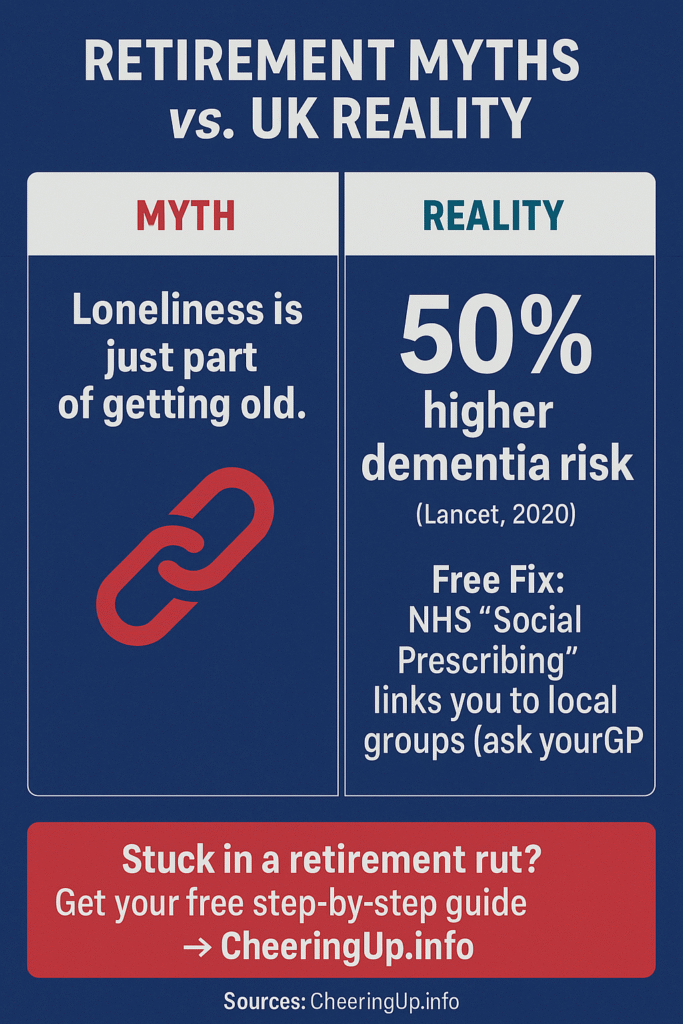
Inspiration for reimagining retirement—whether that means starting a small business, learning new skills, or building social connections that combat the loneliness affecting 940,000 older people who report often feeling lonely.
Who will benefit most from exploring CheeringUp.info?
Who will benefit most from exploring CheeringUp.info are older people in retirement, those planning for better life including retirement years, and anyone in the UK who refuses to accept that “this is as good as it gets.” The impact is particularly significant for:
Pensioners on low incomes—the 28% of pensioners financially struggling, rising to 51% among private renters.
Those facing the state pension age rise—from April 2026, the pension age is rising from 66 to 67, with a month added every two months until 2028. Those born on 31 July 1960 will not reach pension age until 30 November 2026, and those born on 31 December 1960 until 30 September 2027.
People planning ahead—the Pensions Dashboard, expected to launch in late 2026 or early 2027, will help reconnect an estimated 3.3 million lost pension pots worth £31 billion to their owners. CheeringUp.info helps you prepare for that moment.
Those in business or considering self-employment in later life—CheeringUp.info covers business as well as lifestyle, recognising that many older people in the UK are choosing to work beyond retirement age.
When is the best time to use CheeringUp.info?
The best time to use CheeringUp.info is now—September 2026—because critical deadlines and changes are imminent that will directly affect your income and lifestyle. The urgency is real:
The Winter Fuel Payment qualifying week is 21–27 September 2026. If you were born on or before 27 June 1960, you could receive between £100 and £300 to help with heating bills for winter 2026–27—but you need to ensure you are eligible and prepared.
Energy bills remain more than £500 higher than at the end of 2021, and prices look set to rise again. Age UK found that 69% of pensioners would rather turn off their heating than get into energy debt—a stark indicator of the trade-offs many are making at the cost of their health.
Party conference season is underway—Labour’s conference begins 27 September 2026, with Conservative and other party conferences following in October. Policies affecting pensions, social care, and older people will be debated and decided.
The Pensions Dashboard launches in late 2026 or early 2027, meaning you have a narrow window to locate and organise your pension information before the system goes live.
The message is clear: if you wait until 2027, you will have missed the opportunity to act before these changes take effect.
Where can you get local help for offline assistance?
Where you can get local help for offline assistance is through CheeringUp.info’s network of local resources, which complement the online platform with face-to-face support in your area. Not everyone is comfortable navigating digital resources alone. CheeringUp.info recognises this and connects you with:
Local community groups and retirement clubs across the UK
Age UK and other health organisation partners who provide in-person guidance
Libraries and community centres offering digital skills support
Local business networks for those exploring self-employment or business in retirement
The combination of online information and offline human connection is what makes CheeringUp.info different. You are not left to figure it out alone.
What is really exciting or risky about what is happening now?
What is really exciting about what is happening now is the potential to transform retirement from a period of decline into one of opportunity—but what is really risky is the cost of inaction. The exciting possibilities include:
The Pensions Dashboard will finally allow you to see all your pensions in one place, including state pensions, defined benefit and defined contribution pensions, and personal pensions. This is a once-in-a-generation opportunity to take control of your retirement finances.
The triple lock has delivered a 4.8% increase, taking the full new state pension to £241.30 a week. This is real money that can be used to improve your lifestyle—if you know how to use it.
A growing movement of older people who are rejecting the traditional model of retirement and instead building businesses, learning new skills, and creating meaningful social connections.
The risks of inaction are equally real:
Energy costs that are more than £500 higher than at the end of 2021 and set to rise again, with the price cap expected to increase by around £202 per year.
The state pension age rise means millions face working an extra year, and those who have not planned for the transition may find themselves financially exposed.
Loneliness and isolation linked to higher risk of heart disease, stroke, depression, and cognitive decline, with some studies suggesting the health impact is comparable to smoking or obesity. Severe loneliness costs around £9,900 per person each year.
How can the 100th monkey effect change UK retirement?
How the 100th monkey effect can change UK retirement is by demonstrating that once a critical mass of people adopts a new behaviour, it enters the collective consciousness of everybody—meaning you only need to persuade up to 100 people for a transformation to spread across the world. The story of the 100th monkey—in which a behaviour learned by one group of monkeys on a Japanese island suddenly appeared in other groups separated by sea—has long served as an allegory for the emergence of collective intelligence and the idea that societal change can occur once a critical mass is reached.
Once you get to 100 monkeys, you no longer need to persuade any more monkeys. It just enters the collective consciousness of everybody on the planet. Therefore you only need to persuade up to 100 people for it to be a tourism across the world. If we can connect with likeminded individuals, maybe things in the UK can change for the better. CheeringUp.info is that connection point.
What should you do next?
What you should do next is visit CheeringUp.info, explore the resources, and join a community of people who are asking “Is this as good as it gets?”—and answering with action. The statistics tell a powerful story:
Over one in four pensioners are financially struggling
270,000 people aged over 65 go an entire week without speaking to a friend or family member
Energy bills are more than £500 higher than at the end of 2021
The state pension age is rising, and the Pensions Dashboard is coming
But here is the truth that CheeringUp.info was built to share: this is not as good as it gets. With the right information, inspiration, and ideas—and with a community of likeminded individuals working together—retirement in the UK can be better. The tools are there. The resources are there. The local help is there. The only question is whether you will use them.
Visit CheeringUp.info today. Your better retired years start now.
22.6% of UK adults report high anxiety, yet only 5.3% are dissatisfied with life. CheeringUpInfo Retirement Club shares 9 ways to stop panicking and be content with the life you have now.
“CheeringupInfo Retirement Club recommends opening your mind to these thoughts to evaluate whether this could improve your lifestyle in retirement in the UK.”
Why Is It Important Not to Panic About Not Being at Peace?
It is important not to panic about not being at peace because peace is not a permanent state you are failing to achieve—it is a practice you are already living, and the panic itself is the only thing adding unnecessary suffering to the process. The pressure to feel calm, happy, and settled all the time has become its own quiet epidemic. According to the Office for National Statistics, 22.6% of UK adults reported experiencing high anxiety levels between October and December 2024—a figure higher than at any point between 2015 and 2019. Yet only 8.5% reported low levels of happiness, and just 5.3% said they had low satisfaction with life. That gap is telling. Most people are not miserable. They are anxious about the possibility of being miserable. They are panicking about not being at peace, which is a completely different problem—and a far more solvable one.
The writer Alan Watts understood this paradox better than almost anyone. He observed that “the meaning of life is just to be alive… And yet everybody rushes around in a great panic as if it were necessary to achieve something beyond themselves.” That panic—the sense that you must arrive at some final destination of contentment before you can relax—is the very thing keeping you from the contentment you already have access to. The existential crisis many people feel is not evidence that something is broken. It is evidence that you are awake enough to question the script you were handed. A third of Americans now report experiencing an existential crisis, and among Generation Z that figure rises to 52%. This is not a personal failing. It is a collective reckoning with what it means to live deliberately rather than automatically.
The good news is that you do not need to solve this overnight. You do not need to force yourself into a state of permanent zen. What you need is to stop treating your lack of peace as an emergency and start treating it as information. Here are nine ways to improve your lifestyle so you can be content with the life you have now—not the life you think you should have.
How Can You Stop Panicking About Not Being at Peace?
You can stop panicking about not being at peace by recognising that peace is not the absence of anxiety—it is the willingness to let anxiety exist without letting it run your life. Eckhart Tolle writes that “unease, anxiety, tension, stress, worry—all forms of fear—are caused by too much future, and not enough presence.” When you panic about not being at peace, you are living in a future where you imagine you should already be calm. You are comparing your present moment to an imagined standard. That comparison is the source of the panic, not the lack of peace itself.
Notice the panic without fighting it. The moment you stop resisting the feeling of unrest, it begins to lose its grip. You are not broken because you feel anxious. You are human.
Separate the feeling from the story. Anxiety is a sensation in your body. The story—“I should be happier, I should be further along, I should be at peace”—is optional. You can feel the sensation without believing the story.
Remember that peace is not a finish line. It is a direction you walk in, not a destination you arrive at. Every moment you choose to respond to your unrest with curiosity instead of panic, you are already practising peace.
What Are the 9 Ways to Improve Your Lifestyle to Be Content with the Life You Have Now?
Nine ways to improve your lifestyle to be content with the life you have now are to stop chasing peace as a destination, build daily rituals that ground you, and redesign your relationship with time, money, and meaning. Contentment is not something you find. It is something you construct, moment by moment, through small and deliberate choices. The Dalai Lama writes that “cultivating contentment is therefore crucial to maintaining peaceful coexistence. Discontentment breeds acquisitiveness, which can never be satisfied.” The following nine practices are not about adding more to your life. They are about removing the friction that keeps you from appreciating what is already here.
How Can You Stop Waiting for the Right Moment to Feel Content?
You can stop waiting for the right moment to feel content by accepting that this moment—the messy, uncertain, imperfect one you are living right now—is the only moment you will ever have. There is no future moment when everything will finally be settled and you will feel at peace. The future is a story you tell yourself. The present is where your life actually happens.
Stop postponing your happiness until you retire, until you lose the weight, until the children leave home, until you have more money.
Write down three things that are already good in your life today. Not things that could be good if circumstances changed. Things that are good now.
Ask yourself: “If nothing changed from this moment forward, could I still find something worth appreciating?” The answer is almost always yes.
How Can You Redefine What Peace Actually Means to You?
You can redefine what peace actually means to you by letting go of the idea that peace is the absence of difficulty. Peace is not a life without challenges. It is the ability to meet challenges without losing your footing. It is the quiet confidence that you can handle whatever comes next, even if you do not know what that is yet.
Peace is not the opposite of anxiety. It is the capacity to hold anxiety without being consumed by it.
Peace is not permanent calm. It is the willingness to return to yourself after you have been knocked off balance.
Peace is not something you earn. It is something you remember.
How Can You Build a Daily Rhythm That Supports Contentment?
You can build a daily rhythm that supports contentment by anchoring your day in small, repeatable practices that remind you what matters. Contentment is not a feeling you conjure out of willpower. It is a byproduct of living in alignment with your values, day after day, even when you do not feel like it.
Start your morning without your phone. Give yourself ten minutes of silence before you let the world in.
Move your body every day. Not to punish yourself. Not to achieve a goal. Just to remind yourself that you are alive.
End your day with gratitude, not worry. Write down one thing that went well. One thing you are glad you did. One thing you are looking forward to.
How Can You Stop Comparing Your Life to an Imagined Ideal?
You can stop comparing your life to an imagined ideal by recognising that the ideal is a fiction. It is a composite of other people’s highlight reels, cultural scripts, and your own fears about what you should be doing. The life you are living is the only real life you have. Comparing it to a fantasy will always leave you feeling inadequate.
The life you see on social media is curated. The life you live is real. They are not comparable.
Your timeline is not someone else’s timeline. There is no correct age to be at peace. There is no deadline for contentment.
Ask yourself: “Whose definition of a good life am I measuring myself against?” If the answer is anyone other than yourself, it might be time to reconsider.
How Can You Make Room for Uncertainty Without Fear?
You can make room for uncertainty without fear by accepting that uncertainty is not a problem to be solved—it is the condition of being alive. Alan Watts wrote that “the more we crave security, the greater our insecurity becomes.” The tighter you grip the need to know exactly how everything will turn out, the more anxious you become. The looser you hold it, the more spacious your life feels.
Uncertainty is not a sign that you are doing something wrong. It is a sign that you are paying attention.
You do not need to know how the story ends to enjoy the chapter you are in.
Let yourself be a beginner. Let yourself not have all the answers. Let yourself be in process.
How Can You Redesign Your Relationship with Money and Security?
You can redesign your relationship with money and security by separating your need for safety from your need for certainty. More than half of UK adults (53%) say they are not very confident or not at all confident they will be able to afford a comfortable retirement. That is a real concern. But anxiety about money is not the same as a lack of money. You can be financially secure and still feel terrified. You can have less than you want and still feel at peace.
Financial security is not a number. It is a feeling of having enough. That feeling is cultivated, not calculated.
Separate your actual needs from your fears about the future. Most of what you worry about will never happen.
Build a simple plan, then let it go. You cannot control the economy. You can control how you respond to it.
How Can You Stop Letting Your Past Define Your Present?
You can stop letting your past define your present by recognising that the past is not a verdict. It is a collection of experiences that shaped you, but it does not determine who you are today. You are not the sum of your mistakes. You are not the story you have been telling yourself about why you are the way you are.
Your past explains some of your patterns. It does not excuse you from changing them.
You are allowed to outgrow the version of yourself that was created by your circumstances.
The person you were five years ago does not get to decide who you are today.
How Can You Cultivate Connection Without Losing Yourself?
You can cultivate connection without losing yourself by remembering that your relationship with yourself is the foundation of every other relationship. You cannot be at peace with others if you are at war with yourself. You cannot give what you do not have.
Spend time with people who make you feel like yourself, not people who make you feel like you need to be someone else.
Learn to say no without guilt. Your time and energy are finite. Protect them.
Practise being alone without being lonely. Solitude is not the same as isolation. It is a chance to remember who you are.
How Can You Trust That You Are Already on the Right Path?
You can trust that you are already on the right path by letting go of the idea that there is a right path. There is only your path. It is not a straight line. It is not a race. It is not a test you can fail. It is a life you are living, one day at a time, one choice at a time.
You are not behind. You are not ahead. You are exactly where you are.
The fact that you are asking these questions means you are already moving in the direction of growth.
You do not need to have it all figured out. You just need to keep showing up.
Why Does Letting Go of the Need for Peace Actually Bring You Closer to It?
Letting go of the need for peace actually brings you closer to it because peace is not something you achieve—it is something you stop obstructing. The moment you stop fighting the fact that you sometimes feel unsettled, you create space for a deeper kind of calm to emerge. Not the calm of a still lake, but the calm of a river that knows how to move around obstacles. Blaise Pascal observed that all people suffer from “boredom, self-doubt, loneliness, irritability, restlessness, and anxiety that come from not being at peace with themselves.” He was not describing a problem to be solved. He was describing the human condition. And the human condition is not something you fix. It is something you learn to hold with compassion.
The statistics tell the same story. A third of Americans are in existential crisis. More than half of UK adults lack retirement confidence. Nearly a quarter of UK adults report high anxiety. But here is what the statistics do not tell you: most of those people are still living. They are still getting up in the morning. They are still finding moments of joy, connection, and meaning. They are not at peace all the time. But they are still here. And so are you.
You do not need to be at peace to be okay. You do not need to be happy all the time to have a good life. You do not need to have everything figured out to move forward. You just need to keep living. To keep choosing. To keep showing up for yourself, even when it feels hard. That is not a failure of peace. That is the practice of it.
The writer Kurt Vonnegut once said, “If you think that happiness means total peace, you will never be happy.” Let that sink in. The pursuit of total peace is the very thing that keeps you from experiencing the peace that is already available to you. Stop panicking about not being at peace. Start living the life you actually have. The rest will follow.
Get help to protect and grow your business faster by targeting your products or services at over 55s in the UK who are looking for quality fairly priced!
CheeringUpInfo Retirement Club shows how to work hard on retirement in the UK — find purpose, health, wealth, UK travel, part-time work and new skills after 55.
How Can You Improve Your Retirement Lifestyle in the UK Right Now?
CheeringUpInfo Retirement Club recommends working hard on retirement instead of working as the solution to the problem of lack of purpose in retirement in the UK. I’m 61, I’ve been where you are, and I can tell you this with total authenticity: “Retirement isn’t the finish line — it’s the starting gun for the most expansive chapter of your life, and the stats prove it.” The UK government’s own Sport England Active Lives Survey (April 2026) shows 64% of people aged 55-74 are doing more than 150 minutes of physical activity a week. But here’s the kicker — activity levels drop to just 44% for those over 75. That’s not a decline you have to accept. That’s a gap you can close. And closing it changes everything — your body, your mind, your bank balance, and your sense of who you are.
Why Is Finding a New Purpose in Retirement So Important for Your Health and Happiness?
Finding a new purpose in retirement is so important for your health and happiness because UK research shows that retired people who stay mentally and physically engaged report better wellbeing, lower loneliness, and slower functional decline than those who disengage completely. The House of Lords Economic Affairs Committee’s December 2025 report Preparing for an Ageing Society called out the UK as “strikingly unprepared” for an ageing population and flagged that purpose, skills, and retraining are economic issues, not just social ones. That’s policy-speak for: if you sit still, you lose more than time.
Here’s what the data actually says:
2.8 million UK over-50s have returned to work after retirement, according to Legal & General research, with most choosing part-time work — and 62% said they wanted to stay mentally active, while 32% sought a sense of purpose.
HMRC data shows more than two million people aged above state pension age were still working in the 2024-25 tax year.
Standard Life polling found 16% of retired people have either returned to work or are considering it, and another 19% said they hadn’t appreciated how long retirement would last.
Those aren’t numbers of people who failed at retirement. They’re numbers of people who discovered that “stopping” isn’t the same as “living.” You can be one of the ones who discovers it before you stop.
How Does Physical Activity Actually Change Your Body and Mind in Retirement?
Physical activity actually changes your body and mind in retirement by reducing your risk of disability, dementia, and early death — and the UK evidence is overwhelming. A 2026 study in BMC Medicine using UK Household Longitudinal Study data found that moderate exercise was associated with a 59.1% lower rate of daily living limitations and a 62.0% lower rate of instrumental daily living limitations compared with no exercise. Aerobic exercise showed the lowest predicted limitation counts over time, followed by mind-body and balance activities.
The OPAL four-year follow-up study of UK adults in their 70s and 80s found that for every 1,000 steps walked per day, the risk of mortality was 36% lower. Low levels of moderate-to-vigorous physical activity were associated with more new disease diagnoses over the four-year period.
And it’s not just about your body. A UK Biobank study of 89,667 adults found that each 30 minutes of moderate-to-vigorous physical activity per week was associated with a 4% reduction in the risk of all-cause dementia. The Moving Communities study — analysed from 8.8 million leisure centre users — showed that physical activity prevented 12,946 hip fractures, 4,724 cases of depression, 4,368 cases of dementia, and 959 strokes in 2023 alone, saving the NHS £397.8 million. Older adults had the best health outcomes and the best return on investment.
A May 2026 parliamentary report from the Health and Social Care Committee concluded that “physical activity should be at the heart of the NHS’s support for older people and is as important as providing medication”. Professor Elizabeth Orton put it bluntly: “Physical activity is not an optional extra for older people but a core part of healthy ageing”.
You want to feel strong at 70, sharp at 80, and independent at 90? It starts with movement you actually enjoy — not punishment, not gym-bro nonsense, just consistent, purposeful activity that fits your life.
What UK Travel and Part-Time Work Opportunities Are Bringing Retirement to Life in 2026?
UK travel and part-time work opportunities are bringing retirement to life in 2026 by giving retirees new income streams, new skills, and new reasons to get up in the morning — and they’re doing it with total flexibility. Bob Grace retired at 56 from his role as a regional director at Jaguar Land Rover. A year later, he “unretired” and invested in a travel franchise. His travel consultancy has now made £1.6 million in three or four years, and he has no timeline for his second retirement. He says: “Personally, I think if you can keep your brain working while providing people with things they enjoy that’s very rewarding”.
Homesitting is another route that’s exploding. Andy and Eleanor Stinchcombe, early retirees from Lincoln, became homesitters to combine their love of dogs, walking, and travel. Eleanor says: “We love travelling around the UK, and this job allowed us to combine our love for dogs and walking with the opportunity to explore new places. It was almost too good to be true”. They’ve also seen significant drops in their energy bills because they’re away from home so often. Anthea Hewitt, a homesitter from Stratford-upon-Avon, describes her assignments as “like going on a mini holiday”, where she visits local attractions, enjoys pub lunches, and takes walks.
The opportunities are real and growing:
Travel franchise ownership — combining a passion for travel with a business that builds income and keeps your brain firing.
UK homesitting and pet-sitting — travel the country for free, save on bills, stay active, and earn a modest income.
Tour guiding and local walking tours — get paid to walk, talk, and share your knowledge of places you love.
Flexible part-time roles in hospitality — Hilton Hotels has actively recruited over-50s who wanted a new career.
How Can You Build New Skills, Sports, and Hobbies That Keep You Expanding?
You can build new skills, sports, and hobbies that keep you expanding by treating retirement as a learning phase, not a resting phase — and the UK has more infrastructure and support for this than ever before. The London Marathon Foundation has invested £1.9 million into Age UK’s flagship physical activity programme, delivered across 10 local Age UKs over two years, specifically designed to support older people in underserved communities to move more and live healthier, more active lives.
Age UK’s partnership with Aviva has also launched a “mid-retirement MOT” providing financial and wellbeing checkups through Age UK’s National Advice Line and in-person sessions delivered by local Age UKs. This is practical, grounded support — not platitudes.
And the clubs and communities are springing up. Retirement Villages Group launched Aluna, a premium wellbeing club open to residents and the wider community, featuring guided movement, hydrotherapy, and intergenerational connection. Thomas Karlsson, COO, says: “By encouraging routine, confidence and social connection, it helps people live well for longer”.
Here’s what I tell every person who comes to me saying they’re bored in retirement:
Pick one physical thing — bowls, pilates, short tennis, Padel, pickleball, line dancing, or a walking programme.
Pick one mental thing — a certification in something new, a travel franchise, a home care business, or a skill you’ve always wanted to learn.
Pick one social thing — for example a lunch club or a community interest organisation.
Pick one giving thing — mentoring, volunteering, or using your career expertise in a new context.
What Does the CheeringUpInfo.info Retirement Lifestyle Improvement Club Actually Do?
The CheeringUpInfo.info Retirement Lifestyle Improvement Club actually does what most retirement advice only talks about — it gives you a structured, supportive, no-nonsense framework to work hard on your retirement across health, wealth, purpose, and total authenticity. We don’t sell you a fantasy of endless golf and daytime TV. We don’t pretend that “just stopping work” solves the purpose problem — because the evidence says it doesn’t.
The Retirement Living Standards show that a Comfortable lifestyle costs £45,400 a year for one person and £62,700 for a couple, while just 23% of the working population are on track to reach a Moderate standard and only 9% for Comfortable. That’s the wealth side. The health side is equally clear: 31% of UK adults risk not being able to cover basic needs in retirement, an estimated 12.2 million people.
We’re here to make sure you’re not one of them — and that even if you are, you have a path forward.
What we do:
Retirement purpose workshops — helping you define what “working hard on retirement” means for you, whether that’s a travel franchise, a new sport, a part-time role, or a passion project.
Health and movement guidance — grounded in UK research, not fads. Strength and balance work. Aerobic activity. Mind-body practice. Everything backed by evidence.
Wealth and opportunity mapping — connecting you to realistic income streams and money saving tips, from homesitting to tour guiding to franchise ownership, with the financial literacy to make them work.
Community and accountability — because doing this alone is harder than doing it with people who get it. People who are over 55, who are expanding, who refuse to shrink.
We believe in continuous expansion. Optimal health. Wealth that supports the life you actually want. And living with total authenticity — no pretending to be 30, no pretending to be “done.”
The question isn’t whether you can afford to work hard on your retirement. The question is whether you can afford not to. The data is in. The opportunities are real. The club is open.
CheeringUpInfo.info Retirement Lifestyle Improvement Club. Try your best to see how far you can go with this life.
Get help to protect and grow your business faster by targeting over 55s in UK with your quality and inexpensive deals and exclusive offers with CheeringUpInfo
UK men over 55: only 9% are on track for a comfortable retirement. CheeringupInfo says manifesting is part of the fix. Stop letting people suck the dreams out of your retirement.
Are You Letting People Suck the Dreams Out of Your Retirement?
CheeringupInfo Retirement Club recommends manifesting methodology is a small part of the solution to the problem of over 55s in Uk having an unsatisfying retirement lifestyle based. And I’ll tell you why I’m sick and tired of watching decent men shuffle into a retirement that looks nothing like the one they deserved. “Just 9% of the working population are currently on track to achieve a comfortable lifestyle, while only 23% are saving enough for a moderate one” . That’s not a retirement crisis. That’s a mindset crisis dressed up as a money problem.
I’m over 55. I’ve watched mates retire with decent pensions and still end up sitting in front of daytime telly, waiting for the doctor’s appointment that never quite solves the emptiness. The problem isn’t the money. The problem is that for thirty years, they let other people tell them what retirement was supposed to look like. Now they’re living someone else’s script and wondering why it feels like a slow death.
Why Are Men Over 55 in the UK at the Greatest Risk from a Poor Mental Attitude?
Men over 55 in the UK are at the greatest risk from a poor mental attitude because the data shows they are the most isolated, the most medicated, and the least likely to ask for help when their mindset starts poisoning their health. The Institute for Fiscal Studies found that 22% of the poorest third of men aged 55–64 reported depressive symptoms, compared with just 5% in the highest-wealth third . That’s not a wealth gap. That’s a hope gap.
The Belonging Forum surveyed 10,000 UK adults and found that men aged 55–64 were the most likely age group to report having no close friends—15%, compared with just 4% of 18–24-year-olds . One in seven of you has nobody to call when the walls start closing in.
And here’s the bit that should make you furious. Independent Age’s evidence to Parliament states that depression affects 22% of men over 65, yet older people are more likely to be prescribed medication than referred to talking therapies . The system would rather numb you than fix you. But the system isn’t the only problem. Your own bloody mindset is.
Healthwatch Staffordshire heard directly from men over 55 and found that the lack of social opportunities had a significant impact on men’s mental well-being, with more than half feeling there is a lack of male-oriented activities in their local areas . You know what that tells me? Men are waiting for someone else to build them a life. And nobody is coming.
What Is Your Current Thought Pattern Actually Costing You?
Your current thought pattern is costing you years of vitality, connection, and purpose because it keeps you trapped in a waiting game that retirement was never designed to win. You’ve been sold a lie. The lie goes like this: work hard, save up, retire, then relax. And relaxation turns into rust.
Here’s what that waiting mindset actually produces:
You wait for permission. Permission to spend, permission to travel, permission to start something new. Nobody gives you permission in retirement. The permission slip never arrives.
You let others define “enough.” Financial advisers, well-meaning family members, the bloke down the pub—they all have opinions about what you should do with your time and money. You listen to them instead of yourself.
You treat retirement as an ending. The language you use matters. “I’ve finished work.” “I’m done.” “I’m taking it easy.” Every one of those phrases is a nail in the coffin of your own ambition.
You confuse comfort with contentment. Sitting still is not the same as being at peace. A comfortable chair in a quiet room is not a life. It’s a waiting room.
You let fear masquerade as prudence. “I can’t spend that.” “What if something goes wrong?” That’s not planning. That’s paralysis dressed up as responsibility.
The IFS data shows that health among men in their late 50s and early 60s has improved modestly over the past two decades, yet mental health problems have risen slightly . Your body is holding up. Your mind is the thing that’s failing. And nobody is going to save you from your own thinking.
How Do You Think Differently to Live a Better Life in Retirement?
You think differently by treating retirement as a launchpad for radical autonomy, not a slow fade into irrelevance, and by manifesting the life you want today so that every tomorrow is built on the same deliberate foundation. Manifesting isn’t woo-woo nonsense. It’s the discipline of deciding what you want and then acting as if you already have it—because the alternative is drifting into a life you never chose.
Here’s the shift. Stop asking what you can afford. Start asking what you’re building.
Decide who you are now. Not who you were in your career. Not who your wife or kids expect you to be. Who are you when nobody is watching? That’s the man you take into retirement.
Manifest daily, not someday. The life you want doesn’t start when the pension kicks in or when the mortgage clears. It starts the moment you stop waiting. Visualise the day you want and then go build a smaller version of it today.
Cut the drains. There are people in your life who suck the energy out of every room. Family obligations that feel like sentences. Friendships that are really just habits. The research on growth mindset in later life shows that Grit and Growth Mindset are key psychological resources for resilience and adaptation in older adulthood . You need that grit to say no to the drains.
Invest in your body like it’s your business. Optimal health isn’t vanity. It’s the engine of everything else. The IFS data shows mobility problems have declined among men aged 55–64, which means you have a physical platform to build on . Use it.
Build a “memory fund,” not just a pension pot. Aegon’s research encourages reframing retirement spending as an investment in joy, connection, and legacy . Your money is fuel for experiences, not a number to protect until you die.
· Reframe ageing itself. Research presented by Aegon shows that changing our mindset around ageing can help people face the future mentally and financially . The story you tell yourself about getting older is the story you live.
What Can You Expect to Discover with a Different Way of Thinking?
With a different way of thinking, you will discover that retirement is not a destination but a continuous expansion, and that the quality of your life is directly proportional to the quality of your decisions. Here’s what opens up:
Freedom that feels earned, not entitled. You stop waiting for the state or the pension provider to make you happy. You make yourself happy, and the rest becomes background noise.
A circle of men who actually build things. Not the ones who only talk about the past. The ones who are still creating, still curious, still pushing.
Health that improves, not just holds. When your mind has a purpose, your body follows. The ELSA research on growth mindset confirms that belief in the malleability of your capacities is a unique predictor of motivation and learning, even in later life .
Wealth that flows from authenticity. When you stop performing someone else’s version of retirement, you attract the right opportunities. That might be a side venture, a passion project, or simply the peace of knowing you’re spending on what matters.
A daily life you don’t need a holiday from. Every tomorrow starts to feel like today—deliberate, alive, and yours.
Who Typically Benefits Most from This Change?
The people who benefit most from this change are men over 55 who are tired of being told what retirement should look like, and who are willing to operate outside standard structures to attract pure abundance. That’s you if:
You’ve got a decent pension but still feel empty.
You’ve been told to “take it easy” and it makes your skin crawl.
You want more from the next twenty years than gardening and golf.
You’re ready to stop asking permission and start building.
You believe that your best years are not behind you, but ahead of you—and you’re prepared to prove it.
The men who don’t benefit are the ones who cling to the old script. The ones who think “manifesting” is a dirty word and “mindset” is something you leave at the office. They’ll keep taking the tablets and wondering why nothing changes.
When Will the Change to Your Quality of Retirement Lifestyle Begin?
The change to your quality of retirement lifestyle begins the moment you decide that today is the first day of the rest of your life, not the last day of your career. Not tomorrow. Not when the pension hits. Not when the kids move out. Now.
Aegon’s research encourages shifting mindset from ‘when’ to ‘now’ . That’s the switch. The second you stop treating retirement as something that happens to you and start treating it as something you build, everything changes. The first morning you wake up and deliberately choose what you’re going to create that day—that’s when it starts.
Where Can You Go with This Style of Thinking?
With this style of thinking, you can go anywhere you decide to go—because radical autonomy means you are no longer bound by the expectations of others, the limits of the state pension, or the stories you inherited about what it means to be an older man.
You can build a second career that feels like play. You can travel without waiting for the “right time.” You can invest in health, relationships, and ventures that light you up. You can become the man other men look at and say, “How the hell is he doing that?”
The data says only 9% of the working population is on track for a comfortable retirement . That means 91% are coasting toward a life they never consciously chose. Don’t be one of them.
The dreams you had when you were twenty are not dead. They’ve just been buried under thirty years of doing what you were told. Retirement is your chance to dig them up.
Get help to protect and grow your business faster by targeting your advertising and marketing at older people in the UK looking for quality goods and services at fair reasonable price
Retirement UK: Why Men Over 55 Are Letting People Suck Dreams Out of Their Life
UK men over 55: only 9% are on track for a comfortable retirement. CheeringupInfo says manifesting is part of the fix. Stop letting people suck the dreams out of your retirement.
Are You Letting People Suck the Dreams Out of Your Retirement?
CheeringupInfo Retirement Club recommends manifesting methodology is a small part of the solution to the problem of over 55s in Uk having an unsatisfying retirement lifestyle based. And I’ll tell you why I’m sick and tired of watching decent men shuffle into a retirement that looks nothing like the one they deserved. “Just 9% of the working population are currently on track to achieve a comfortable lifestyle, while only 23% are saving enough for a moderate one” . That’s not a retirement crisis. That’s a mindset crisis dressed up as a money problem.
I’m over 55. I’ve watched mates retire with decent pensions and still end up sitting in front of daytime telly, waiting for the doctor’s appointment that never quite solves the emptiness. The problem isn’t the money. The problem is that for thirty years, they let other people tell them what retirement was supposed to look like. Now they’re living someone else’s script and wondering why it feels like a slow death.
Why Are Men Over 55 in the UK at the Greatest Risk from a Poor Mental Attitude?
Men over 55 in the UK are at the greatest risk from a poor mental attitude because the data shows they are the most isolated, the most medicated, and the least likely to ask for help when their mindset starts poisoning their health. The Institute for Fiscal Studies found that 22% of the poorest third of men aged 55–64 reported depressive symptoms, compared with just 5% in the highest-wealth third . That’s not a wealth gap. That’s a hope gap.
The Belonging Forum surveyed 10,000 UK adults and found that men aged 55–64 were the most likely age group to report having no close friends—15%, compared with just 4% of 18–24-year-olds . One in seven of you has nobody to call when the walls start closing in.
And here’s the bit that should make you furious. Independent Age’s evidence to Parliament states that depression affects 22% of men over 65, yet older people are more likely to be prescribed medication than referred to talking therapies . The system would rather numb you than fix you. But the system isn’t the only problem. Your own bloody mindset is.
Healthwatch Staffordshire heard directly from men over 55 and found that the lack of social opportunities had a significant impact on men’s mental well-being, with more than half feeling there is a lack of male-oriented activities in their local areas . You know what that tells me? Men are waiting for someone else to build them a life. And nobody is coming.
What Is Your Current Thought Pattern Actually Costing You?
Your current thought pattern is costing you years of vitality, connection, and purpose because it keeps you trapped in a waiting game that retirement was never designed to win. You’ve been sold a lie. The lie goes like this: work hard, save up, retire, then relax. And relaxation turns into rust.
Here’s what that waiting mindset actually produces:
You wait for permission. Permission to spend, permission to travel, permission to start something new. Nobody gives you permission in retirement. The permission slip never arrives.
You let others define “enough.” Financial advisers, well-meaning family members, the bloke down the pub—they all have opinions about what you should do with your time and money. You listen to them instead of yourself.
You treat retirement as an ending. The language you use matters. “I’ve finished work.” “I’m done.” “I’m taking it easy.” Every one of those phrases is a nail in the coffin of your own ambition.
You confuse comfort with contentment. Sitting still is not the same as being at peace. A comfortable chair in a quiet room is not a life. It’s a waiting room.
You let fear masquerade as prudence. “I can’t spend that.” “What if something goes wrong?” That’s not planning. That’s paralysis dressed up as responsibility.
The IFS data shows that health among men in their late 50s and early 60s has improved modestly over the past two decades, yet mental health problems have risen slightly . Your body is holding up. Your mind is the thing that’s failing. And nobody is going to save you from your own thinking.
How Do You Think Differently to Live a Better Life in Retirement?
You think differently by treating retirement as a launchpad for radical autonomy, not a slow fade into irrelevance, and by manifesting the life you want today so that every tomorrow is built on the same deliberate foundation. Manifesting isn’t woo-woo nonsense. It’s the discipline of deciding what you want and then acting as if you already have it—because the alternative is drifting into a life you never chose.
Here’s the shift. Stop asking what you can afford. Start asking what you’re building.
Decide who you are now. Not who you were in your career. Not who your wife or kids expect you to be. Who are you when nobody is watching? That’s the man you take into retirement.
Manifest daily, not someday. The life you want doesn’t start when the pension kicks in or when the mortgage clears. It starts the moment you stop waiting. Visualise the day you want and then go build a smaller version of it today.
Cut the drains. There are people in your life who suck the energy out of every room. Family obligations that feel like sentences. Friendships that are really just habits. The research on growth mindset in later life shows that Grit and Growth Mindset are key psychological resources for resilience and adaptation in older adulthood . You need that grit to say no to the drains.
Invest in your body like it’s your business. Optimal health isn’t vanity. It’s the engine of everything else. The IFS data shows mobility problems have declined among men aged 55–64, which means you have a physical platform to build on . Use it.
Build a “memory fund,” not just a pension pot. Aegon’s research encourages reframing retirement spending as an investment in joy, connection, and legacy . Your money is fuel for experiences, not a number to protect until you die.
· Reframe ageing itself. Research presented by Aegon shows that changing our mindset around ageing can help people face the future mentally and financially . The story you tell yourself about getting older is the story you live.
What Can You Expect to Discover with a Different Way of Thinking?
With a different way of thinking, you will discover that retirement is not a destination but a continuous expansion, and that the quality of your life is directly proportional to the quality of your decisions. Here’s what opens up:
Freedom that feels earned, not entitled. You stop waiting for the state or the pension provider to make you happy. You make yourself happy, and the rest becomes background noise.
A circle of men who actually build things. Not the ones who only talk about the past. The ones who are still creating, still curious, still pushing.
Health that improves, not just holds. When your mind has a purpose, your body follows. The ELSA research on growth mindset confirms that belief in the malleability of your capacities is a unique predictor of motivation and learning, even in later life .
Wealth that flows from authenticity. When you stop performing someone else’s version of retirement, you attract the right opportunities. That might be a side venture, a passion project, or simply the peace of knowing you’re spending on what matters.
A daily life you don’t need a holiday from. Every tomorrow starts to feel like today—deliberate, alive, and yours.
Who Typically Benefits Most from This Change?
The people who benefit most from this change are men over 55 who are tired of being told what retirement should look like, and who are willing to operate outside standard structures to attract pure abundance. That’s you if:
You’ve got a decent pension but still feel empty.
You’ve been told to “take it easy” and it makes your skin crawl.
You want more from the next twenty years than gardening and golf.
You’re ready to stop asking permission and start building.
You believe that your best years are not behind you, but ahead of you—and you’re prepared to prove it.
The men who don’t benefit are the ones who cling to the old script. The ones who think “manifesting” is a dirty word and “mindset” is something you leave at the office. They’ll keep taking the tablets and wondering why nothing changes.
When Will the Change to Your Quality of Retirement Lifestyle Begin?
The change to your quality of retirement lifestyle begins the moment you decide that today is the first day of the rest of your life, not the last day of your career. Not tomorrow. Not when the pension hits. Not when the kids move out. Now.
Aegon’s research encourages shifting mindset from ‘when’ to ‘now’ . That’s the switch. The second you stop treating retirement as something that happens to you and start treating it as something you build, everything changes. The first morning you wake up and deliberately choose what you’re going to create that day—that’s when it starts.
Where Can You Go with This Style of Thinking?
With this style of thinking, you can go anywhere you decide to go—because radical autonomy means you are no longer bound by the expectations of others, the limits of the state pension, or the stories you inherited about what it means to be an older man.
You can build a second career that feels like play. You can travel without waiting for the “right time.” You can invest in health, relationships, and ventures that light you up. You can become the man other men look at and say, “How the hell is he doing that?”
The data says only 9% of the working population is on track for a comfortable retirement . That means 91% are coasting toward a life they never consciously chose. Don’t be one of them.
The dreams you had when you were twenty are not dead. They’ve just been buried under thirty years of doing what you were told. Retirement is your chance to dig them up.
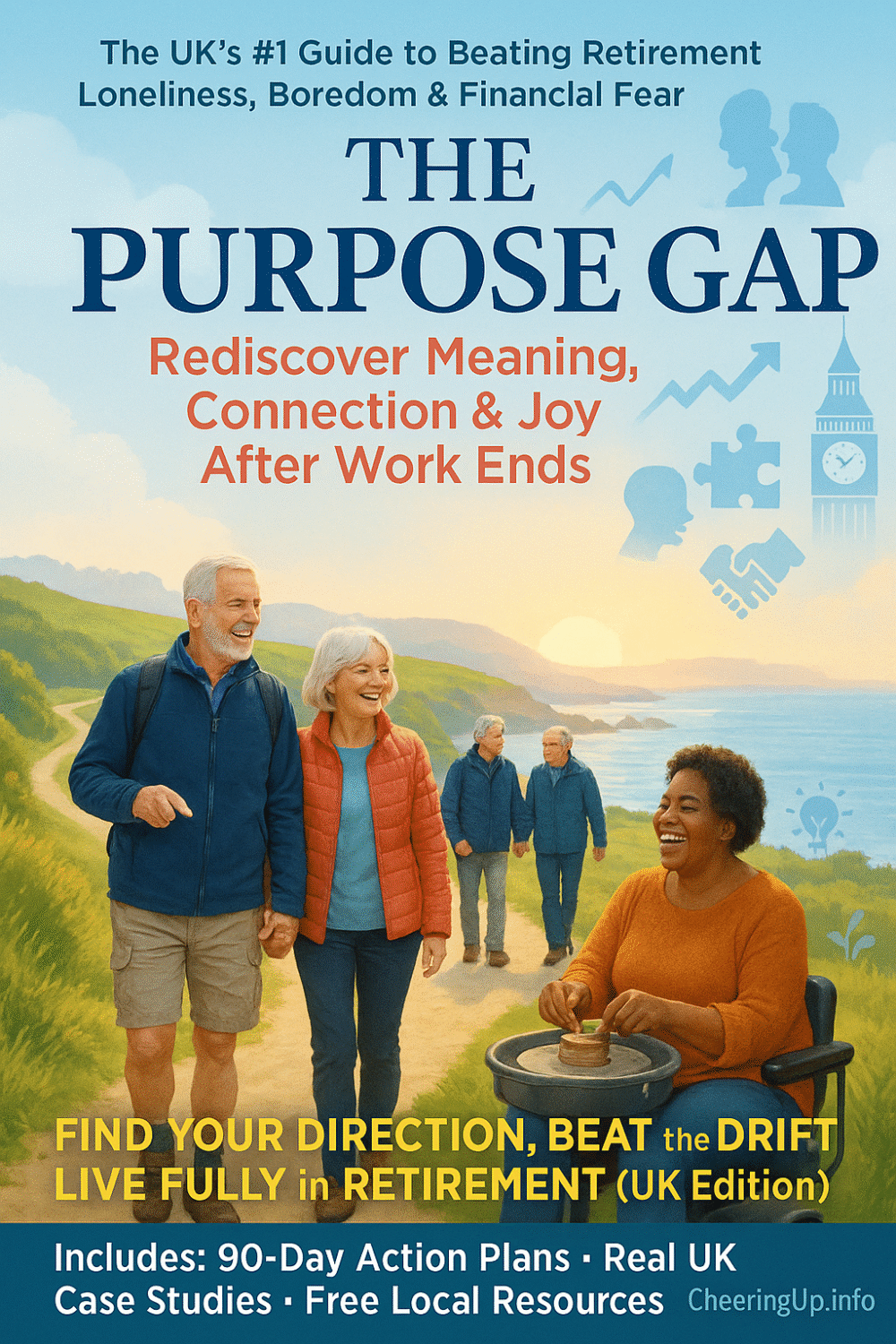
The Purpose Gap: Solving Post-Retirement Drift in the UK
Struggling with retirement loneliness or boredom? Get the UK’s step-by-step guide to reigniting purpose, social connections & joy. Scroll down to read Retirement Club eBook now!
Struggling to find purpose after retirement?
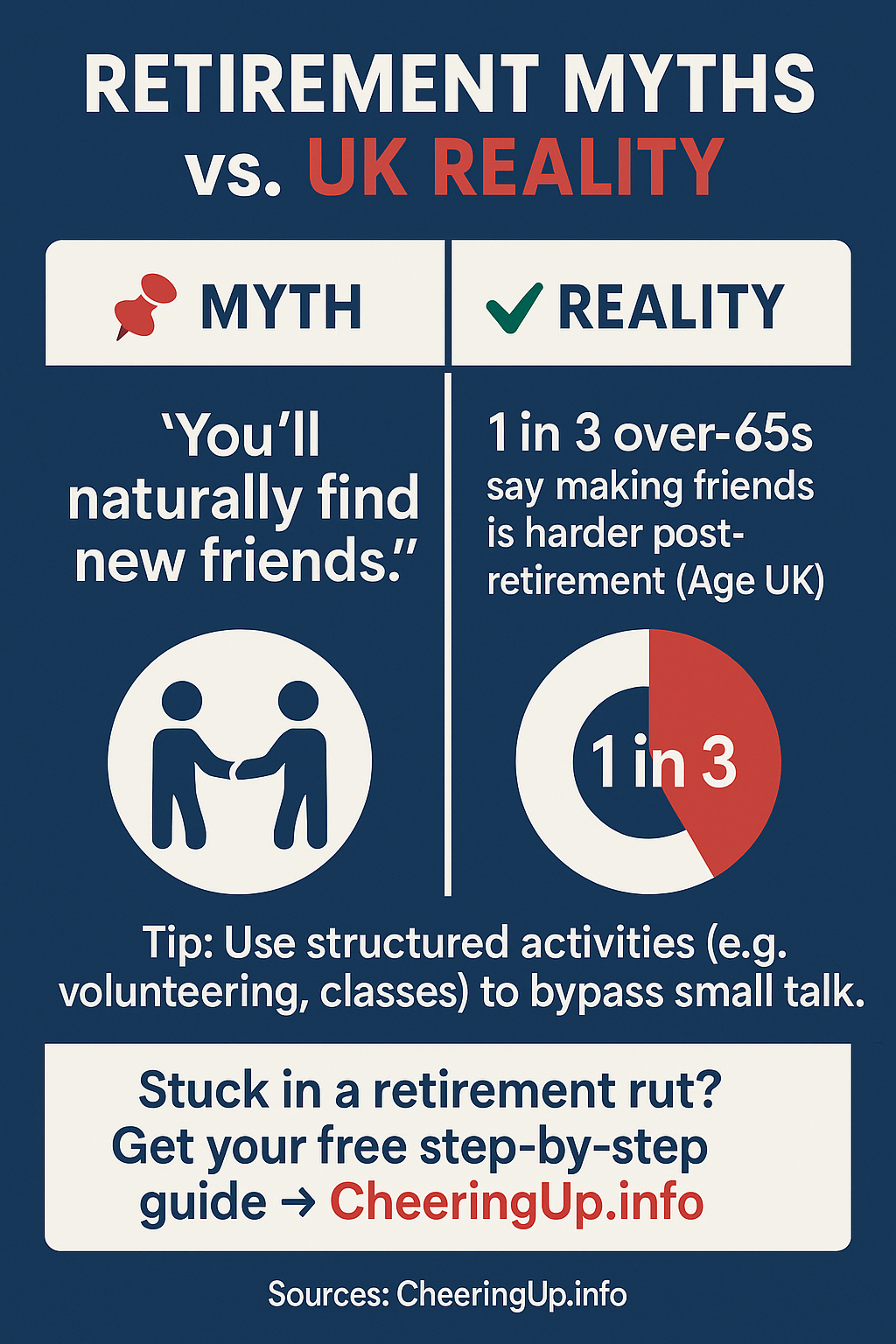
You’re not alone. 1 in 3 UK retirees feel adrift after leaving work – but it doesn’t have to be this way.
The Purpose Gap: Solving Post-Retirement Drift in the UK
Your step-by-step roadmap to a fulfilling later life. Packed with real British case studies and actionable strategies, this guide reveals:
✅ How to rebuild identity beyond your career (the NHS-approved 4-pillar method)
✅ UK-specific solutions for loneliness, boredom and financial worries
✅ 90-day plans to rediscover passion – from volunteering to starting a “hobby hustle”
✅ Free local resources (apps, clubs, grants) you never knew existed
Written in clear, jargon-free language by UK retirement experts.
Pay for eBook now and get today:
🔹 Discount off Retirement Club One-Off Lifetime Fee
EBook will be viewed by you online or a pdf will be emailed to you. Note: eBook will NOT be posted to you.
How to Reignite Passion, Connection, and Meaning in Later Life
Did you know? Nearly 1 in 3 UK retirees report feeling a loss of purpose within the first two years of leaving work. For many, retirement—once a dream—becomes a void filled with boredom, isolation, and even depression.
The problem isn’t just emotional. Studies show that retirees without a clear sense of direction are 40% more likely to develop chronic health issues and face a shorter lifespan than those who stay engaged. The UK’s ageing population can’t afford to ignore this crisis.
This isn’t just about “staying busy”—it’s about redesigning later life with intention.
Welcome to CheeringUp.info’s Retirement Club eBook, your roadmap to a fulfilling, dynamic retirement. Inside, you’ll find:
✅ The Hidden Costs of Drifting – Why lack of direction harms mental & physical health ✅ Step-by-Step Strategies – How to rebuild purpose, social bonds, and daily structure ✅ Real-Life Case Studies – Retirees who transformed their lives (and how you can too) ✅ Free UK Resources – Apps, communities, and expert-backed tools (including CheeringUp.info’s services)
This isn’t fluff. It’s actionable, evidence-based guidance for retirees who refuse to settle for a life of “waiting for the weekend”… when every day should feel like living.
Let’s fix the purpose gap.
TABLE OF CONTENTS
CHAPTER 1: THE PROBLEM – WHY RETIREMENT CAN GO WRONG
CHAPTER 2: THE SOLUTIONS – BUILDING A LIFE THAT EXCITES YOU AGAIN
CHAPTER 3: CASE STUDIES – HOW 5 UK RETIREES REINVENTED THEIR LIVES
CHAPTER 4: YOUR STEP-BY-STEP RETIREMENT REINVENTION PLAN
CHAPTER 5: THE MONEY MINDSET – FUNDING YOUR DREAM RETIREMENT WITHOUT STRESS
CHAPTER 6: LATER LIFE LOVE & CONNECTION – BUILDING RELATIONSHIPS THAT THRIVE POST-RETIREMENT
CHAPTER 7: THE VITALITY BLUEPRINT – STAYING SHARP, STRONG & ENERGISED FOR DECADES
CHAPTER 8: LEGACY & MEANING – HOW TO LEAVE YOUR MARK WITHOUT WRITING A MEMOIR
CHAPTER 9: THE FREEDOM EXPERIMENT – TEST-DRIVING YOUR DREAM RETIREMENT LIFESTYLE
CHAPTER 10: THE RESILIENCE HANDBOOK – BOUNCING BACK WHEN RETIREMENT DOESN’T GO TO PLAN
CHAPTER 1: THE PROBLEM – WHY RETIREMENT CAN GO WRONG
Retirement is sold as freedom. Yet for thousands of UK retirees, the initial euphoria of leaving work quickly fades into a quiet crisis—days blending into weeks without structure, meaningful conversations shrinking to polite chatter with cashiers, and a gnawing sense that this isn’t what they signed up for.
The Stark Statistics: UK-Specific Challenges
Age UK reports that 1.4 million older people in the UK are chronically lonely.
A NHS Digital survey found that 28% of over-65s show symptoms of depression.
University College London research links poor retirement transitions to a 40% higher risk of cardiovascular disease.
This isn’t just about “feeling a bit lost”—it’s a public health issue with real consequences.
The 5 Hidden Triggers of Post-Retirement Drift
1. Identity Loss: “Who Am I Now?”
Problem: For decades, your job gave you status, routine, and purpose. Retirement strips that away overnight. UK Insight: A 2019 study by the Centre for Ageing Better found that 42% of retirees struggle with “role confusion” in their first year.
Real-life example:
“I was ‘Dave the IT manager’ for 30 years. Now, at coffee mornings, I’m just ‘Dave who used to work.’ It’s like I’ve become invisible.” — Dave, 67, Birmingham
2. Social Collapse: The Friendship Recession
Problem: Work colleagues disappear, friends relocate to be near grandchildren, and local clubs feel cliquey. UK Reality:
43% of over-60s rely solely on family for social interaction (English Longitudinal Study of Ageing).
Rural retirees are twice as likely to report isolation (Age UK Rural Loneliness Report).
The spiral: No office chats → Fewer invites → Staying home → Friends assume you’re busy → Isolation deepens.
3. Decision Fatigue: Too Much Freedom
Problem: Without a boss or deadlines, even simple choices (“Should I garden or call someone?”) become paralysing. Science says:
University of Kent research shows retirees who lack self-set routines are 3x more likely to report low life satisfaction.
Fixable, but few realise it:
“I’d wander around the house, thinking, ‘I could do anything… so why am I doing nothing?’” — Susan, 71, Manchester
4. The “Invisible Tax” of Boredom
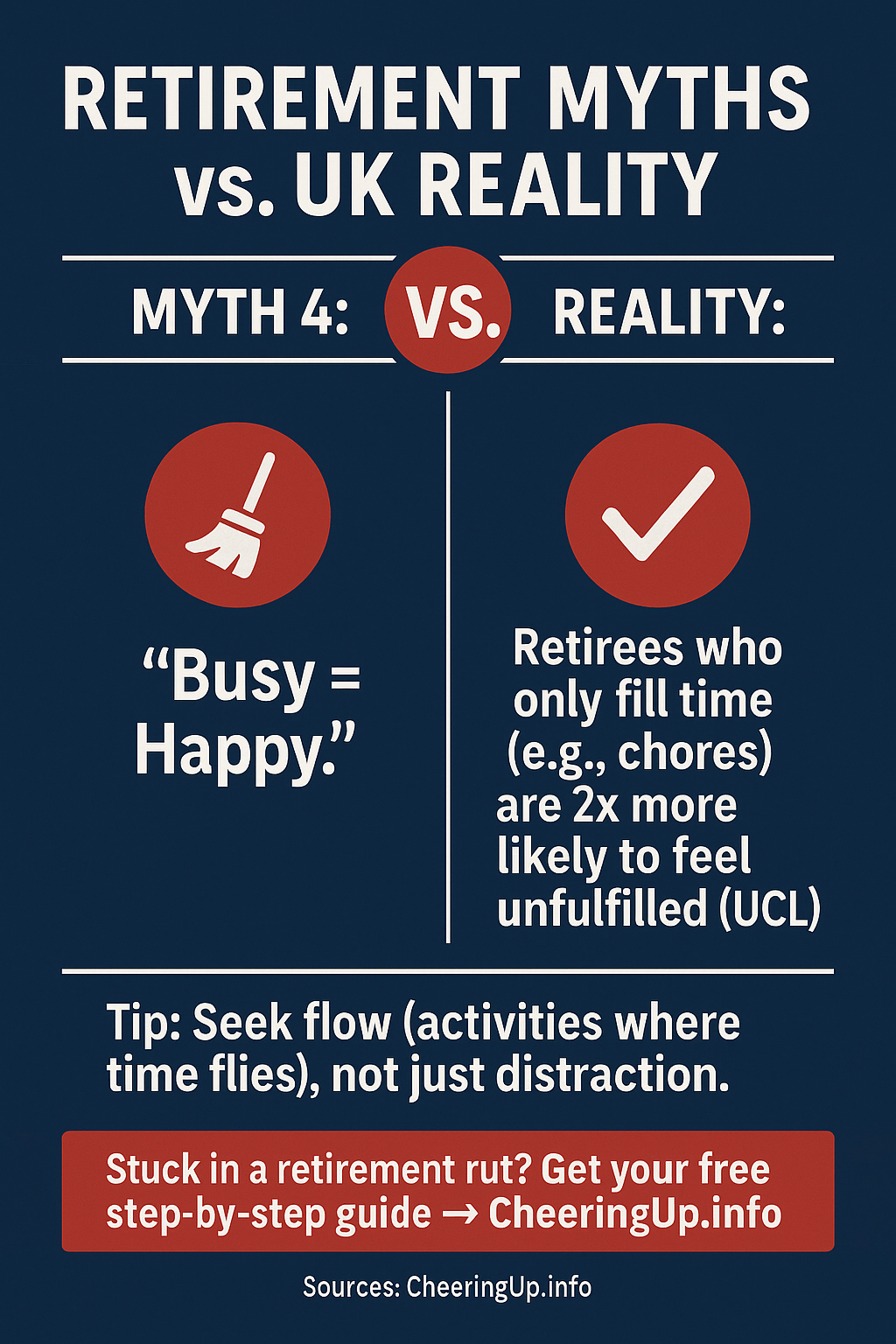
Problem: Days filled with TV and chores accelerate cognitive decline. Shocking data:
A 2023 Lancet study tied prolonged boredom in retirees to a 30% faster memory decline.
UK Active found retirees who don’t exercise mentally are 50% more likely to develop mild cognitive impairment.
5. The Contribution Crisis
Problem: Humans need to feel useful. Retirement can feel like being “put out to pasture.” UK Opportunity gap:
67% of retirees want to volunteer but don’t know where to start (NCVO).
Only 12% of UK charities actively recruit over-65s (despite retirees being the most reliable volunteers).
CHAPTER 2: THE SOLUTIONS – BUILDING A LIFE THAT EXCITES YOU AGAIN
Why Most Retirement Advice Fails (And What Works Instead)
Generic advice like “stay busy” or “travel more” doesn’t cut it. The happiest UK retirees don’t just fill time—they design a lifestyle around four core pillars that rebuild identity, connection, and daily joy.
The 4-Pillar Retirement Success Framework
(Developed from UK case studies and ageing research)
Health & Energy (Move well, eat well, sleep well)
Social & Community (Deep connections, not just acquaintances)
“Retirement isn’t about slowing down—it’s about finally steering your own ship!”
Next Chapter Preview: “Case Studies: How 5 UK Retirees Reinvented Their Lives (Including a 79-Year-Old Who Became a TikTok Gardener!)”
CHAPTER 3: CASE STUDIES – HOW 5 UK RETIREES REINVENTED THEIR LIVES
Why Real Stories Matter More Than Theory
Inspiration is useless without a roadmap. These five UK retirees didn’t just “get lucky”—they followed deliberate strategies to overcome loneliness, boredom, and loss of purpose, and you’ll learn exactly how they did it, step by step.
How to Use This Chapter
Read the case studies for motivation.
Follow the action plans to replicate their success.
Use the UK resources they used (all free/low-cost).
CASE STUDY 1: From Redundancy to Community Leader
Name: Derek, 67 Was: Factory manager (made redundant at 65) Struggle: Felt “thrown away” by society, drank alone most days. Breakthrough: Now runs a men’s mental health group in Liverpool.
Derek’s Step-by-Step Turnaround
Month 1: The Wake-Up Call
Action: His daughter staged an “intervention” with Andy’s Man Club (free UK men’s talks).
Key Step: Attended just one meeting (“I cried hearing others felt the same”).
Month 2: Small Wins
Routine Fix: Switched morning TV for a walk to the newsagent (chatting with the clerk).
Pillar Boost: Trained as a mental health first aider (free via Mind UK).
Now: Hosts weekly “Shed & Share” sessions at his local community centre.
💡 Your Replication Plan:
If you’re isolated: Commit to one group (search “men’s/women’s groups near me” on MeetUp).
Today: Call The Silver Line (0800 4 70 80 90) for a friendly chat.
CASE STUDY 2: The Widow Who Became a TikTok Gardener
Name: Pat, 79 Was: School secretary, widowed at 75. Struggle: “The house was so quiet, I talked to the microwave.” Breakthrough:12K TikTok followers for her “Grandma’s Garden Tips.”
Pat’s Step-by-Step Turnaround
Week 1: Digital Baby Steps
Action: Asked her grandson to teach her one app (TikTok).
Key Step: Filmed a 30-second clip of her repotting a fern (“My hands shook!”).
UK Resource: Joined Royal Horticultural Society’s online community (www.rhs.org.uk).
Year 1: Unexpected Fame
Pillar Boost: Local nursery invited her to host a workshop.
Now: Earns £200/month from TikTok’s Creator Fund.
💡 Your Replication Plan:
If you’re tech-wary: Book a free Digital Eagles session at Barclays (www.digitalskills.uk).
Today: Film one short clip (even just your garden/cooking).
CASE STUDY 3: The CEO Who Found Joy as a Tour Guide
Name: Sarah, 70 Was: Corporate CEO, retired at 68. Struggle: “I missed the adrenaline of leading teams.” Breakthrough: Leads historical walking tours in Edinburgh.
Key Step: Googled “how to become a tour guide UK” – found City of Edinburgh Council’s licensing course (£150).
Month 4: Test Run
Routine Fix: Practiced on friends (“I made them rate me out of 10!”).
UK Resource: Used TourGuideSpark (free script templates).
Year 2: Thriving
Pillar Boost: Hired by a luxury travel company for private groups.
Now: Earns £3K/month in peak season.
💡 Your Replication Plan:
If you miss work structure: Search “become a [your skill] tutor/consultant UK”.
Today: Volunteer as a National Trust guide (training provided).
CASE STUDY 4: The Shy Retiree Who Built a Supper Club
Name: Amina, 66 Was: Librarian, “always the quiet one.” Struggle: “I ate dinner with the radio for 3 years.” Breakthrough: Runs a Pakistani cooking club in Birmingham.
Amina’s Step-by-Step Turnaround
Week 1: Micro-Goal
Action: Invited one neighbour for chai (“I rehearsed for hours”).
Key Step: Neighbour suggested “Why not teach us your recipes?”
Month 2: Safe Space
Routine Fix: Started with 4 people max (“Less pressure”).
UK Resource: Got a £500 grant from her council’s “Community Kitchen” fund.
Now:30-person waitlist, featured in Birmingham Mail.
💡 Your Replication Plan:
If you’re shy: Start with 1:1 meetups (e.g., “Walk & Talk” groups).
Today: Google “[your city] + community grants” for funding.
CASE STUDY 5: The Ex-Builder Who Beat Depression with Drama
Name: Tony, 71 Was: Construction worker, forced to retire after a fall. Struggle: “I sat in my shed crying, missing my crew.” Breakthrough: Performs in amateur theatre (even got a standing ovation!).
Tony’s Step-by-Step Turnaround
Month 1: Desperation Move
Action: Saw a flyer for “Over 60s Drama Taster” at his library.
Key Step: Almost left at halftime (“Then someone laughed at my joke”).
Month 6: New Identity
Routine Fix: Memorised lines while walking his dog.
UK Resource: Found LADS (Later Age Drama Society) for scripts.
Now:Tour’s care homes with comedy shows.
💡 Your Replication Plan:
If you feel “stuck”: Try one taster session (drama, choir, art).
Today: Search “amateur theatre near me” on AmDram.
YOUR 30-DAY “CASE STUDY” CHALLENGE
Week 1: Pick Your Role Model
[ ] Choose one case study that resonates.
[ ] Copy their first step (e.g., attend one group, film one clip).
Week 2: Steal Their Strategy
[ ] Use their UK resource (e.g., Men’s Sheds, Digital Eagles).
[ ] Adapt one habit (e.g., Tony’s “learn while walking”).
Week 3: Customise It
[ ] Add your twist (e.g., “I’ll host a knitting club, not cooking”).
[ ] Tell one person your plan (accountability!).
Week 4: Lock It In
[ ] Book next month’s activity (e.g., RHS workshop).
[ ] Join CheeringUp.info’s Case Study Group (monthly Zoom Q&A).
UK RESOURCES FROM THIS CHAPTER
Andy’s Man Club (Free men’s mental health talks)
Digital Eagles (Barclays’ free tech training)
AmDram (Find local theatre groups)
CHAPTER 4: YOUR STEP-BY-STEP RETIREMENT REINVENTION PLAN
Why Most Retirement Plans Fail (And How Yours Won’t)
Good intentions aren’t enough. Without a clear, personalised strategy, even the most motivated retirees fall back into old routines—but this 90-day action plan combines UK-specific tactics with psychological triggers to make change stick.
Legal Volunteering:Support Through Court (help vulnerable navigate courts)
CheeringUp.info’s “90-Day Planner”: Printable templates + video guides.
Next Chapter Preview: “The Money Mindset: How to Fund Your Dream Retirement Without Stress (UK Grants, Tax Hacks & Side Hustles)”
CHAPTER 5: THE MONEY MINDSET – FUNDING YOUR DREAM RETIREMENT WITHOUT STRESS
Why Financial Freedom Isn’t Just About Your Pension
Running out of money is scary. But what terrifies UK retirees more than a dwindling bank balance is watching their dreams gather dust because they don’t know how to fund them—while sitting on assets they could be using smarter.
The UK Retirement Finance Trap
63% of retirees don’t touch their pension pots for fear of “running out” (Money and Pensions Service).
1 in 4 over-65s have £50k+ in savings but live like they’re broke (FCA Financial Lives Survey).
82% admit they’ve never claimed benefits they’re entitled to (Age UK).
This chapter fixes that. No jargon—just actionable UK strategies to: ✔ Stretch your money further without risk ✔ Unlock hidden income streams ✔ Fund passions (travel, hobbies, grandkids) guilt-free
PHASE 1: THE RETIREMENT FINANCE RESET (DAYS 1-14)
Step 1: The “3-Bucket” Money Audit
Goal: See exactly where your money can work harder.
Bucket
What Goes In
UK-Specific Action
Essentials
Bills, food, meds
Check eligibility for Council Tax Reduction (avg. £600/yr savings)
Lifestyle
Holidays, hobbies, grandkids
Use Senior Railcard (£30/yr, 1/3 off travel)
Legacy
Inheritance, gifts
Explore £3k/yr gift allowance to reduce IHT
➔ Your Task: List last month’s spending in these buckets using MoneySavingExpert’s Budget Planner.
Step 2: Claim Your “Missing Money”
UK Retirees Leave £3.4 Billion Unclaimed Yearly (Independent Age).
Checklist: ☑ Pension Credit (Even £1/week qualifies for free TV licence, council tax help) → gov.uk/pension-credit ☑ Attendance Allowance (£68/week if you have a disability) → Age UK’s Benefits Calculator ☑ Winter Fuel Payment (£100-£300/year) → No application needed if on State Pension
Pro Tip: Book a free 1:1 session with your local Citizens Advice to check eligibility.
PHASE 2: SMARTER INCOME STREAMS (DAYS 15-45)
Strategy 1: The “5% Rule” for Pension Drawdown
Problem: Fear leads to under-spending or reckless withdrawals.
UK Solution:
Take no more than 5% yearly from your pot (adjust for inflation).
Use the MoneyHelper Drawdown Calculator to test scenarios.
Top up tax-free: Use your £12,570 Personal Allowance first.
Example: £100k pot → £5k/yr = £416/month + State Pension.
CheeringUp.info’s “Money Map”: Visual guide to tax-free retirement income.
Next Chapter Preview: “Later Life Love & Connection: How to Build Relationships That Thrive Post-Retirement (Dating, Friendships & Community)”
CHAPTER 6: LATER LIFE LOVE & CONNECTION – BUILDING RELATIONSHIPS THAT THRIVE POST-RETIREMENT
Why Retirement Can Be the Best Time for Love (and Friendship)
Loneliness is deadlier than obesity. While UK retirees worry about pensions and health, what often hits hardest is the quiet ache of empty mornings without colleagues to greet, or evenings with only the TV for conversation—yet this life stage offers unique opportunities to forge deeper connections than ever before.
45% of over-65s say making new friends feels “impossible” (Age UK)
Divorce rates for 60+ have tripled since 1990 (ONS)
1 in 3 widowed retirees go a full week without a meaningful conversation (Cruse Bereavement Care)
But here’s the hope: ✔ Retirees have more time for quality relationships ✔ Shared life experience creates faster emotional intimacy ✔ UK communities offer untapped ways to connect (no dating apps required)
CheeringUp.info “Connection Calendar”: Monthly social challenge PDF
Next Chapter Preview: “The Vitality Blueprint: Science-Backed Ways to Stay Sharp, Strong & Energised for Decades”
CHAPTER 7: THE VITALITY BLUEPRINT – STAYING SHARP, STRONG & ENERGISED FOR DECADES
Why Retirement Shouldn’t Mean Decline
Your best years could still be ahead. While society expects retirees to slow down, groundbreaking UK research reveals that 70-year-olds today have the biological age of 60-year-olds from 1990—if they follow science-backed habits to protect their brain, body, and energy.
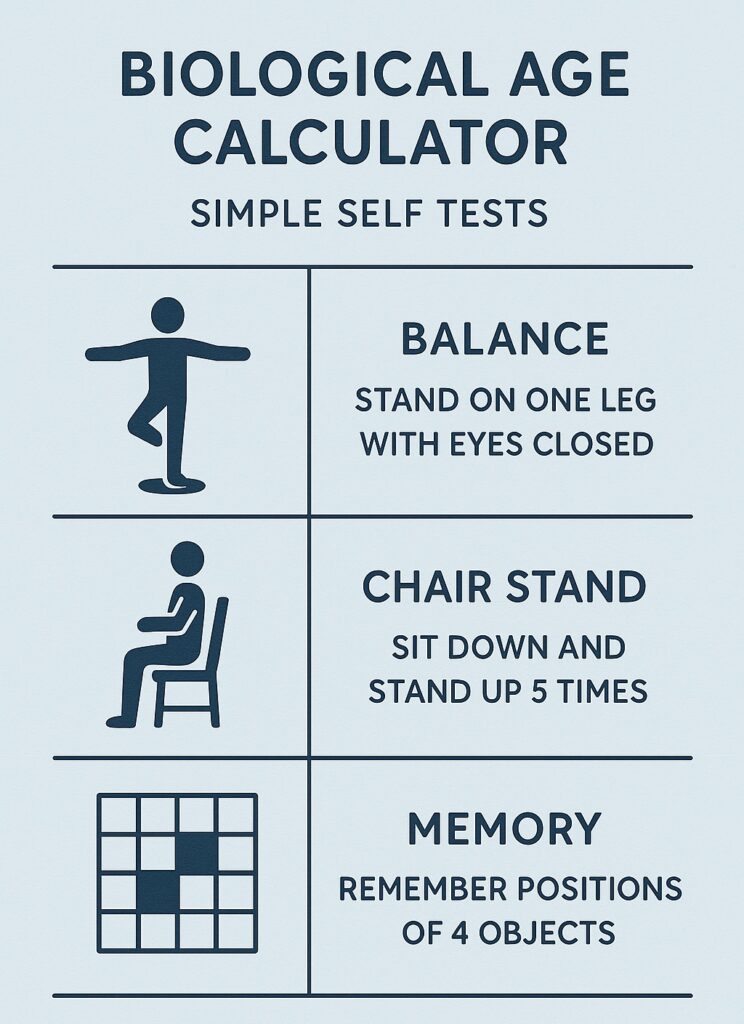
Simple Self-Tests to Estimate How Old Your Body Really Feels
1. One-Leg Stand Test (Balance)
Test: Stand on one leg, eyes open.
Timer starts once foot is lifted.
Score Yourself:
30+ seconds = Age 20–30
20–29 sec = Age 31–40
10–19 sec = Age 41–50
<10 sec = Age 51+
Tip: Repeat 3 times and take your best score.
2. Sit-to-Stand Test (Leg Strength & Coordination)
Test: Sit in a chair, arms crossed. Stand up and sit down 10 times as fast as you can.
Time it!
<10 seconds = Age 20–30
11–14 sec = Age 31–40
15–19 sec = Age 41–50
20+ sec = Age 51+
3. Memory Recall Test (Cognitive Function)
Test: Look at a list of 10 words for 30 seconds. Wait 1 minute, then write down as many as you remember.
Score Yourself:
9–10 words = Age 20–30
7–8 words = Age 31–40
5–6 words = Age 41–50
<5 words = Age 51+
4. Resting Heart Rate (Cardiovascular Health)
Test: Count your pulse for 60 seconds while resting.
Score Yourself:
60–70 bpm = Age 20–30
71–75 bpm = Age 31–40
76–80 bpm = Age 41–50
81+ bpm = Age 51+
5. Waist-to-Height Ratio (Metabolic Health)
Test: Measure waist (cm) ÷ height (cm)
Score Yourself:
<0.5 = Age 20–30
0.5–0.54 = Age 31–40
0.55–0.59 = Age 41–50
0.6+ = Age 51+
6. Reaction Time Test (Nerve Health)
Test: Drop a ruler between two fingers and try to catch it.
Score (where you catch it):
6–10 cm = Age 20–30
11–15 cm = Age 31–40
16–20 cm = Age 41–50
21+ cm = Age 51+
Now Add Up Your Results
Most of your scores fall in which age group?
That’s your estimated biological age!
Want to Get Younger?
Improve sleep, exercise, diet, stress, and social life. Your biological age can drop with better habits!
Next Chapter Preview: “Legacy & Meaning: How to Leave Your Mark (Without Writing a Memoir)”
CHAPTER 8: LEGACY & MEANING – HOW TO LEAVE YOUR MARK WITHOUT WRITING A MEMOIR
Why Legacy Matters More Than Ever in Retirement
Your story doesn’t end at retirement. While wills and inheritances deal with what you leave behind, true legacy is about who you’ve impacted—and UK retirees are uniquely positioned to shape communities, mentor future generations, and turn hard-earned wisdom into lasting change.
The UK Legacy Gap
68% of over-65s want to “give back” but don’t know where to start (NCVO)
Only 12% have documented life lessons for their family (Saga survey)
Local charities report 40% volunteer shortages in skills like budgeting, mentoring (UK Community Foundations)
This chapter isn’t about obituaries—it’s your toolkit for living legacy.
CheeringUp.info “Legacy Planner”: Step-by-step PDF with templates
Next Chapter Preview: “The Freedom Experiment: How to Test-Drive Your Dream Retirement Lifestyle Before Committing”
CHAPTER 9: THE FREEDOM EXPERIMENT – TEST-DRIVING YOUR DREAM RETIREMENT LIFESTYLE
Why You Should “Try Before You Buy” in Retirement
Retirement is too important to leave to chance. Just as you’d test-drive a car before purchasing, your ideal retirement lifestyle deserves real-world trials—because 37% of UK retirees regret not experimenting before making permanent moves abroad, downsizing, or committing to expensive hobbies.
The UK Retirement Reality Check
Top 3 Regrets: Moving too fast (42%), overspending early (38%), underestimating loneliness (55%) (Saga Retirement Survey 2023)
Good News: It costs 90% less to test a lifestyle for 3 months than to fix a mistake
Hidden Gem: Many UK councils offer “retirement taster programmes” (e.g., Glasgow’s “Later Life Lab”)
This chapter is your blueprint for low-risk, high-reward experimentation.
PART 1: THE 4-STEP FREEDOM EXPERIMENT FRAMEWORK
Step 1: Define Your “What Ifs”
UK-Specific Dream Scenarios to Test: ✅ “What if I split my year between the UK and Spain?” ✅ “What if I traded my garden for an allotment + city flat?” ✅ “What if I turned my woodworking hobby into a market stall?”
Exercise: Circle one “scary exciting” idea you’ve dismissed as “unrealistic.”
Next Chapter Preview: “The Resilience Handbook: Bouncing Back When Retirement Doesn’t Go to Plan”
CHAPTER 10: THE RESILIENCE HANDBOOK – BOUNCING BACK WHEN RETIREMENT DOESN’T GO TO PLAN
Why Even the Best-Laid Retirement Plans Need a Plan B
Life doesn’t stop at retirement. Whether it’s unexpected health issues, adult children moving back home, or a pension pot that doesn’t stretch as far as you’d hoped, 62% of UK retirees face at least one major disruption within five years of leaving work—but the happiest among them don’t just survive, they adapt and thrive.
The UK Retirement Reality Check
1 in 4 retirees become unpaid carers within 3 years (Carers UK)
40% of pensioners experience a “financial shock” (£2k+ unexpected cost) yearly (ILC UK)
“Boomerang Kids” now cost retirees £360/month on average (Legal & General)
This chapter is your toolkit for navigating the unexpected—with dignity, humour, and grit.
How to Find Purpose in Retirement: The Adlerian Secret to a New Life with CheeringUpInfo
Retirement is often marketed as a “conclusion”—a reward for past labor. Freudian thinking would have you dwell on the loss of your professional identity or “stew” over missed opportunities. Adlerian psychology flips the script: retirement is not the end of a career; it is the beginning of a new Social Task.
In Adler’s view, your value isn’t tied to your previous job title, but to your Social Interest (Gemeinschaftsgefühl). Retirement is the ultimate opportunity to redesign your “Lifestyle” toward a goal that actually matters to you.
The Adlerian Retirement Shift: From “Was” to “Will Be”
Reject the “Inferiority” of Ageing: Society may suggest you are “phasing out,” but Adler argues that inferiority is only a feeling, not a fact. Use this stage to strive for a new kind of “superiority”—mastering a craft, mentoring others, or contributing to your community.
Teleological Planning: Don’t look back at the 40 years you “gave up.” Look forward to the impact you want to have in the next 20. Your “goal” (Teleology) is what defines your happiness now, not your old payroll status.
The Creative Power of the Third Act: You are the “Artist of your Life.” Retirement is a blank canvas where you choose the colors, no longer restricted by a corporate palette.
How Men Over 55 in the UK Can Overcome or Prevent Mental Health Issues from Spoiling Their Retirement Lifestyle
Retirement is often perceived as a well-deserved break after decades of hard work—a time for relaxation, hobbies, and spending time with loved ones. However, for many men over the age of 55 in the UK, retirement can also bring about a host of mental health challenges that can undermine their enjoyment of this new phase of life. As we explore how men over 55 can overcome or prevent mental health issues, we’ll begin by examining how common these issues are in the UK and why neglecting mental health in later life is a serious mistake. We will then discuss practical steps that can help prevent or recover from mental health problems and provide information on valuable support resources available in the UK.
Prevalence of Mental Health Issues Among Men Over 55 in the UK
Mental health issues among men over 55 in the UK are more common than many might think. According to the UK’s National Health Service (NHS), around 1 in 4 adults experience a mental health problem each year, and older adults are not exempt from these statistics. The NHS notes that depression affects around 22% of men aged 65 and older, making it a significant concern among older populations. Furthermore, according to a 2018 report by Age UK, anxiety and depression affect up to 15% of older adults in the UK.
It’s also important to note that mental health issues in older men are often underreported or misdiagnosed. The stigma associated with mental health, combined with the generational attitudes of older men who might be less likely to seek help or talk about their feelings, contributes to a higher prevalence of untreated mental health issues. This reluctance to seek help exacerbates the problem, often leading to a decline in physical health, increased isolation, and a decreased quality of life.
Data Source: Age UK, NHS Mental Health Statistics 2018
The Importance of Addressing Mental Health in Later Life
Neglecting mental health in later life is a common mistake that many men make in the UK, and the consequences can be severe. Here’s why mental health should be a priority:
Impact on Physical Health: Mental health issues such as depression and anxiety are closely linked with physical health problems, including cardiovascular diseases, diabetes, and weakened immune function. Men over 55 who neglect their mental health are at a higher risk of developing these conditions, which can lead to a decline in overall well-being.
Increased Risk of Isolation: Retirement often brings about significant life changes, such as reduced social interaction and loss of professional identity. For men who are not proactive in maintaining social connections, this can lead to isolation and loneliness, both of which are risk factors for depression and anxiety.
Unaddressed Emotional Trauma: Many men carry unresolved emotional issues or trauma from earlier in life that may resurface during retirement. This period of life provides more time for reflection, which can sometimes trigger past memories and feelings. If not addressed, these can lead to deteriorating mental health.
Stigma and Misunderstanding: There’s often a cultural stigma surrounding mental health among older generations. Many men believe they must appear strong and stoic, leading them to suppress feelings or avoid seeking help. This stigma can prevent them from accessing the care and support they need.
10 Ways to Prevent or Recover from Mental Health Issues in Retirement
Stay Physically ActivePhysical exercise is one of the most effective ways to boost mental health. Engaging in regular physical activities, such as walking, swimming, or cycling, helps release endorphins, which are natural mood lifters. The NHS recommends at least 150 minutes of moderate-intensity activity per week for older adults. Joining a local walking group or taking up a new sport can also provide social benefits and reduce feelings of loneliness.
Maintain a Balanced DietDiet plays a crucial role in mental health. Eating a balanced diet rich in fruits, vegetables, whole grains, and lean proteins can help stabilise mood and improve overall mental well-being. Foods rich in omega-3 fatty acids, such as salmon and walnuts, are particularly beneficial for brain health. Reducing the intake of sugary snacks and processed foods can help maintain energy levels and prevent mood swings.
Build and Maintain Social ConnectionsSocial isolation is a significant risk factor for depression and anxiety in older men. Staying connected with friends, family, and community members is essential for maintaining mental health. Participating in local clubs, attending social events, or volunteering are excellent ways to build and maintain social connections. For example, joining a local Men’s Shed group can provide a supportive environment where men can share skills, connect, and build friendships.
Engage in Mindfulness and Relaxation PracticesMindfulness practices, such as meditation, yoga, and deep-breathing exercises, can help reduce stress and anxiety. These techniques promote relaxation and improve mental clarity, allowing individuals to manage their emotions more effectively. Many local community centres and leisure facilities offer free or low-cost classes tailored for older adults. Online resources and mobile apps, like Headspace and Calm, also provide guided mindfulness exercises.
Seek Professional Support When Needed It’s important for men to recognise when they need professional help and not to be afraid to seek it. Speaking with a GP is a good starting point; they can provide referrals to counselling, therapy, or psychiatric services if necessary. Cognitive Behavioural Therapy (CBT) and other forms of counselling can be particularly effective in treating depression and anxiety.
Stay Mentally Active Keeping the brain engaged is vital for mental health. Activities such as reading, puzzles, learning a new language, or playing a musical instrument can help maintain cognitive function and prevent feelings of boredom or stagnation. Many local libraries offer free resources and events that cater to older adults looking to stay mentally active.
Join Support Groups Joining a support group can provide a sense of belonging and reduce feelings of isolation. Groups like Andy’s Man Club in Halifax offer a safe space for men to talk openly about their mental health struggles and connect with others who are going through similar experiences. Sharing experiences and offering support can be incredibly therapeutic and help men realise they are not alone.
Adopt a Pet Owning a pet can provide companionship, reduce feelings of loneliness, and even encourage physical activity. Dogs, for example, need regular walks, which can motivate owners to stay active and engage with their communities. Studies have shown that interacting with pets can increase levels of oxytocin, a hormone associated with bonding and happiness.
Volunteer and Give BackVolunteering can provide a sense of purpose and fulfillment, especially for those who miss the structure of working life. It can also help build social connections and reduce feelings of isolation. Many charities and organisations in the UK, such as Age UK or the Royal Voluntary Service, welcome older volunteers who bring valuable life experience and skills.
Create a Daily Routine Establishing a daily routine can provide structure and stability, which is particularly beneficial for those struggling with depression or anxiety. A routine can help ensure that individuals stay active, maintain healthy eating habits, and engage in social activities regularly. It also helps combat the sense of purposelessness that can sometimes accompany retirement.
5 Sources of Help for Men Over 55 in the UK
Andy’s Man Club (Halifax, UK) Andy’s Man Club is a men’s mental health charity that provides free-to-attend talking groups for men. With locations across the UK, including Halifax, it offers a safe and supportive environment for men to discuss their feelings and connect with others who understand their experiences.
Mind Mind is a mental health charity that offers a range of services, including counseling, crisis support, and community programs tailored to older adults. Their website provides a wealth of information on mental health issues and resources available across the UK.
Samaritans Samaritans provide 24/7 emotional support for anyone struggling to cope. Their confidential helpline is available to anyone who needs to talk, including men over 55 facing mental health challenges. They also offer a local branch network where individuals can visit and speak to a trained volunteer.
Age UK Age UK is the leading charity for older people in the UK and provides various services that support mental well-being, including befriending services, local activity groups, and free counseling. Age UK also offers information and advice on mental health for older adults.
CALM (Campaign Against Living Miserably) CALM is a leading movement against suicide and provides support specifically aimed at men. They offer a free, confidential helpline and webchat service for those struggling with mental health issues. CALM also provides online resources to help men manage their mental health effectively.
Conclusion
Mental health is a critical component of a fulfilling retirement lifestyle, yet it is often overlooked, particularly by men over 55 in the UK. The transition into retirement can be challenging, bringing about changes that can trigger mental health issues such as depression and anxiety. However, by understanding the importance of mental health, recognizing the signs of potential issues, and taking proactive steps to stay physically, mentally, and socially active, men can significantly improve their quality of life. Resources such as Andy’s Man Club, Mind, and Age UK provide valuable support and can make a significant difference in helping men navigate this stage of life. Remember, it is never too late to seek help and start making positive changes to enjoy a happy, healthy retirement.
People planning for retirement or already retired will benefit from Retirement Club membership. Business leaders will benefit from Corporate membership.
“Most retirement ‘problems’ have one thing in common: they’re optional.”
You wake up with ‘too much time’ — but when you worked, you dreamed of this. You miss the buzz of people — but half of them you only saw because you had to. You feel restless — but that’s your engine idling, not broken.
What if the real issue isn’t retirement? What if the real issue is that no one taught you how to enjoy stillness without guilt? No one warned you that ‘being busy’ was just a mask for avoiding yourself.
Most clubs for over 55s will sell you more ‘stuff to do’ — classes, cruises, coffee mornings. That’s fine. We do too! But it’s just noise if your head hasn’t caught up with your calendar.
The CheeringUpInfo Retirement Club doesn’t start with a new hobby. It starts with a new lens. Same life. Different story. That’s the cheat code.
🔗 CheeringUpInfo Retirement Club. No pressure. Just a different way of seeing things. Click it before you tell yourself ‘maybe later’. #Over55sUK