

Stop Chasing & Just Be: The Art of Flânerie for a Better Retirement | CheeringUp.info
Discover how embracing the French art of flânerie can transform your retirement. Stop chasing, start observing, and enjoy simply existing to improve your retirement lifestyle today.

Stop Chasing, Start Living: Embracing the Art of Flânerie in Retirement

Why Embrace the Flâneur Lifestyle in Retirement?

Retirement is the ultimate opportunity to trade the relentless chase for a life of quiet observation, exactly as the flâneur does. The philosophy of flânerie—wandering with intention and observing without interacting—directly counters the “busy” mindset many retirees struggle to leave behind . For author Erika Owen, tapping into this simple act of wandering has made her more calm, creative, and accepting of change . It is not about being lazy; it is about being present.

How Do I Start My Journey as a Retired Flâneur?

You start by simply taking a walk with no destination, allowing yourself to be a passive observer of the world around you. “Flaneuring is experiencing your environment without interacting with it,” explains Owen . This is a toolkit you can use anywhere . It involves:

  • Walking without a specific purpose.
  • Observing the details you usually miss.
  • Refraining from checking your phone.
  • Accepting changes in plans (like a blocked path) as part of the experience.
  • Viewing the world as a spectator, not a participant.

This practice has helped people feel more connected to their bodies, aware of physical sensations and the simple joy of movement .

What Are the Key Benefits of Slowing Down and Observing?

Adopting the flâneur mindset can spark creativity, reduce stress, and improve your overall well-being in retirement. Embracing this intentional wandering supports a more mindful mentality . Owen notes that after making a deliberate effort to incorporate more spontaneity into her life, she experienced several positive impacts:

  • Rediscovered Creativity: Inspiration strikes far more often when you’re not looking for it.
  • A Calmer Mindset: You will find yourself with less emotional clutter to “work through.”
  • Increased Perspective: Annoying moments (like a delayed train) become less annoying when you have another option (like walking).
  • A Better Connection to Your Body: You become more aware of your physical self and its capabilities.

How Does This Philosophy Improve Health and Happiness in the UK?

With UK healthy life expectancy falling, prioritising mental and physical well-being through mindful practices is more critical than ever. Recent data reveals that people in the UK can now expect to spend fewer years in ‘good’ health . The Office for National Statistics (ONS) data for 2022-24 shows healthy life expectancy has dropped to its lowest level since records began in 2011-13 . This has prompted concerns about a “growing chasm” of poor health before the State Pension age (rising to 67) kicks in .

The flâneur lifestyle directly addresses this by promoting a slower, more observant pace of life. As the French philosopher Jean-Jacques Rousseau suggested, “The world is the book of those who walk.” By simply wandering and observing, you can reduce stress and improve mental health, which is vital as the UK’s happiness ranking has also declined (from 18th to 21st place globally).

3 Facts to Back Up This Philosophy

  1. Creativity Boost: Inspiration strikes far more often when you are not looking for it, making wandering a powerful tool for mental stimulation .
  2. Stress Reduction: Flaneuring helps you become a calmer person, with less mental clutter to “work through” during quiet moments .
  3. Health Imperative: As of 2022-24, UK healthy life expectancy for men is 60.7 years and for women 60.9 years, the lowest level on record, highlighting the need for a gentler retirement lifestyle .

#RetirementLifestyle #Flaneur #MindfulRetirement #RetirementMagazine #RetirementClub

Get help to protect and grow your business faster targeting over 55s and those planning for retirement

Find out more about growing your business faster with CheeringUpInfo targeted marketing

Subscribe for free retirement lifestyle improvement ideas product reviews and cost of living reduction tips

Connect with CheeringUpInfo for free retirement lifestyle improvement tips

Read more retirement lifestyle improvement articles and view videos for free

Connect with CheeringUpInfo for free alerts to new retirement lifestyle improvement articles and videos

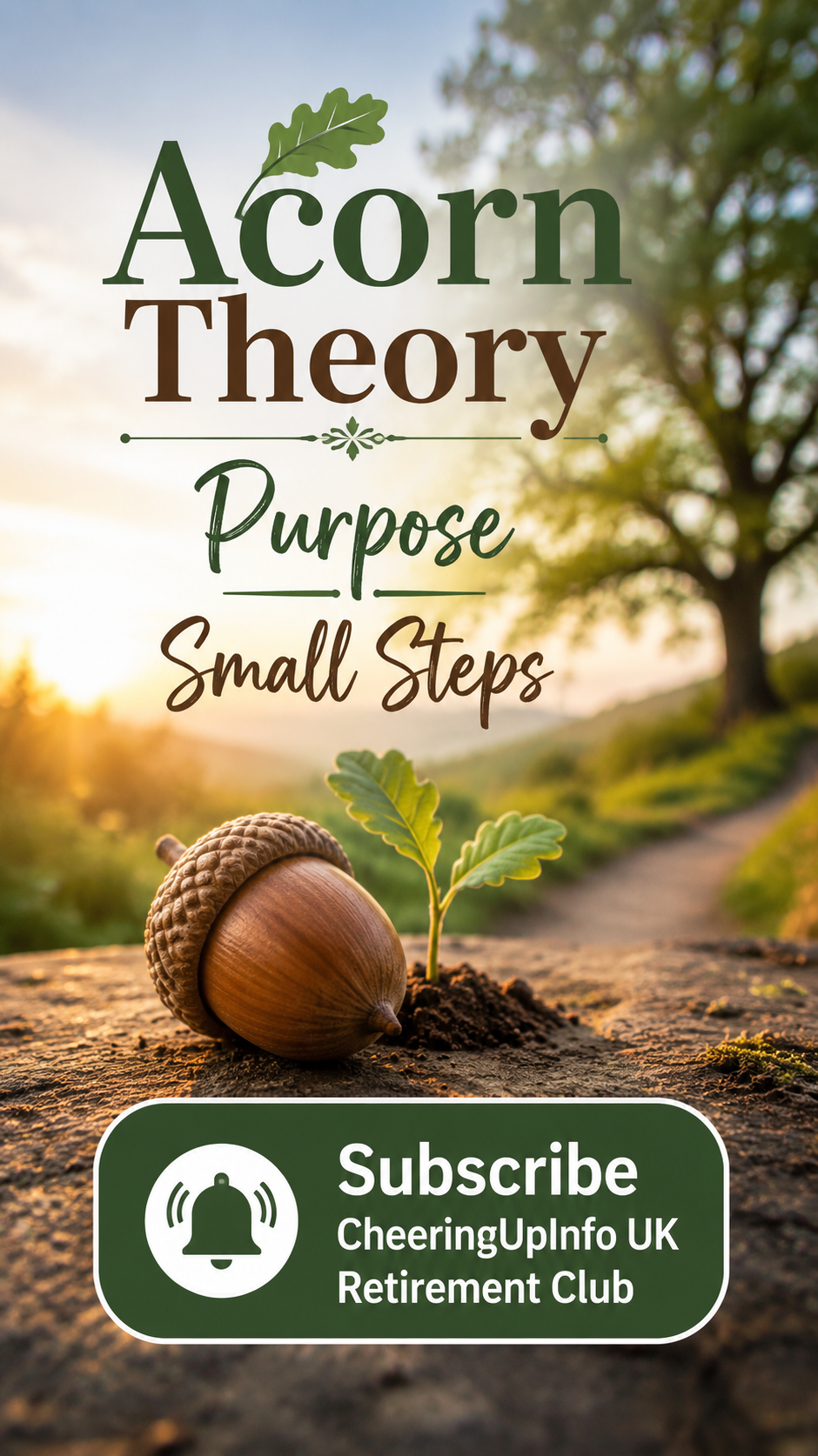
Acorn Theory: Why You Don’t Know Your Purpose Yet (And How Daily Small Steps Reveal It)

Feeling lost? James Hillman’s Acorn Theory suggests you already contain your purpose—like an oak inside an acorn. You don’t find it all at once; you reveal it through daily small steps. Discover why it’s never too late to grow into who you were meant to be, backed by psychology and recent UK research.

What Is Acorn Theory and Why Can’t You See Your Purpose Yet?

Acorn Theory, developed by psychologist James Hillman, proposes that you are born with a unique destiny or “calling” already inside you—just like an oak tree is already inside an acorn. It’s not about genetics or environment alone; it’s about that “particularity you feel to be you,” as Hillman put it . That nagging feeling that you’re here for something more? That’s your acorn trying to grow. The problem is, we’re conditioned to believe purpose is a destination we need to find—but really, it’s a process we need to unfold.

How Does “Not Knowing Your Calling” Actually Hold You Back?

Not knowing your purpose leads to anxiety, depression, and a persistent sense of dissatisfaction, as the gap between who you are and who you could be creates psychological tension . Research shows that 58% of women and 44% of men are open to a different career because they finally have a better idea of what they want from life . Yet, fear of stepping out of comfort zones (31%) and lack of confidence (31%) keep people stuck . Your acorn needs sunlight—but fear is a heavy rock.

Why Do Daily Small Steps Work Better Than Big “Life Changes”?

Daily small steps are the sunlight and water your acorn needs; they bypass the paralysis of “finding your calling” by making the process manageable and less intimidating. Hillman believed the image of your destiny is revealed slowly: “Unpacking the image takes a lifetime. It may be perceived all at once, but understood only slowly” . A 2,000-adult poll found many feel ready for a change within two years—not overnight . That’s the power of incremental action.

Is It Really “Never Too Late” to Start This Process?

According to recent UK data, 54% of women (and 41% of men) believe it’s never too late to pursue a new calling, despite the average person believing 52 is the age it becomes “too late” . Here are three facts that prove it’s never too late to be who you want to be:

  • Fact 1: 45% of Brits regret not chasing their childhood dream job—but a fifth have already retrained to get back on track .
  • Fact 2: 15% of all adults believe their current job doesn’t fit their lifestyle, with flexibility (32%) and fulfillment (32%) valued more as we age .
  • Fact 3: British Gas engineer Kirsty Warren switched from social work to engineering at 36, proving that “whether you’re 26 or 46, if you’ve found your calling, go after it” .

What Does “Growing Down” Mean in Acorn Theory?

“Growing down” is Hillman’s concept of returning to your childhood impulses and fantasies to find the blueprint of your destiny, rather than always striving upwards . We spend our lives accumulating achievements (growing up), but we forget to excavate our true nature (growing down). Hillman urges us to reexamine childhood thoughts, accidents, and fantasies, as they “reflect the blueprints that give direction to the course of a biography” . It’s a process of digging deep, not climbing high.

How Do I Start Listening to My Acorn?

Start by identifying moments when you’ve felt most alive or curious, and take one small step toward that feeling today, regardless of whether it “makes sense” for your current life. Here’s how:

  • Journal your childhood fantasies: What did you love before the world told you what to love?
  • Identify inherited rules: What beliefs about yourself did you inherit from family or society that no longer serve you?
  • Take one tiny action: If you dream of writing, write one sentence. If you dream of gardening, buy one seed. Growth is a verb.

#AcornTheory #Purpose #RetirementLifestyle #RetirementClub #RetirementMagazine

Get help to protect and grow your business faster with CheeringUpInfo targeted marketing at over 55s UK

Find out more about targeting over 55s and those planning for a better retirement with better marketing ideas

Subscribe for free retirement lifestyle improvement ideas product reviews and cost of living reduction tips

Connect with us for free retirement lifestyle improvement tips

Read more retirement lifestyle improvement articles and view videos for free

Connect with us for free alerts to new retirement lifestyle improvement articles and videos