22.6% of UK adults report high anxiety, yet only 5.3% are dissatisfied with life. CheeringUpInfo Retirement Club shares 9 ways to stop panicking and be content with the life you have now.
“CheeringupInfo Retirement Club recommends opening your mind to these thoughts to evaluate whether this could improve your lifestyle in retirement in the UK.”
Why Is It Important Not to Panic About Not Being at Peace?
It is important not to panic about not being at peace because peace is not a permanent state you are failing to achieve—it is a practice you are already living, and the panic itself is the only thing adding unnecessary suffering to the process. The pressure to feel calm, happy, and settled all the time has become its own quiet epidemic. According to the Office for National Statistics, 22.6% of UK adults reported experiencing high anxiety levels between October and December 2024—a figure higher than at any point between 2015 and 2019. Yet only 8.5% reported low levels of happiness, and just 5.3% said they had low satisfaction with life. That gap is telling. Most people are not miserable. They are anxious about the possibility of being miserable. They are panicking about not being at peace, which is a completely different problem—and a far more solvable one.
The writer Alan Watts understood this paradox better than almost anyone. He observed that “the meaning of life is just to be alive… And yet everybody rushes around in a great panic as if it were necessary to achieve something beyond themselves.” That panic—the sense that you must arrive at some final destination of contentment before you can relax—is the very thing keeping you from the contentment you already have access to. The existential crisis many people feel is not evidence that something is broken. It is evidence that you are awake enough to question the script you were handed. A third of Americans now report experiencing an existential crisis, and among Generation Z that figure rises to 52%. This is not a personal failing. It is a collective reckoning with what it means to live deliberately rather than automatically.
The good news is that you do not need to solve this overnight. You do not need to force yourself into a state of permanent zen. What you need is to stop treating your lack of peace as an emergency and start treating it as information. Here are nine ways to improve your lifestyle so you can be content with the life you have now—not the life you think you should have.
How Can You Stop Panicking About Not Being at Peace?
You can stop panicking about not being at peace by recognising that peace is not the absence of anxiety—it is the willingness to let anxiety exist without letting it run your life. Eckhart Tolle writes that “unease, anxiety, tension, stress, worry—all forms of fear—are caused by too much future, and not enough presence.” When you panic about not being at peace, you are living in a future where you imagine you should already be calm. You are comparing your present moment to an imagined standard. That comparison is the source of the panic, not the lack of peace itself.
Notice the panic without fighting it. The moment you stop resisting the feeling of unrest, it begins to lose its grip. You are not broken because you feel anxious. You are human.
Separate the feeling from the story. Anxiety is a sensation in your body. The story—“I should be happier, I should be further along, I should be at peace”—is optional. You can feel the sensation without believing the story.
Remember that peace is not a finish line. It is a direction you walk in, not a destination you arrive at. Every moment you choose to respond to your unrest with curiosity instead of panic, you are already practising peace.
What Are the 9 Ways to Improve Your Lifestyle to Be Content with the Life You Have Now?
Nine ways to improve your lifestyle to be content with the life you have now are to stop chasing peace as a destination, build daily rituals that ground you, and redesign your relationship with time, money, and meaning. Contentment is not something you find. It is something you construct, moment by moment, through small and deliberate choices. The Dalai Lama writes that “cultivating contentment is therefore crucial to maintaining peaceful coexistence. Discontentment breeds acquisitiveness, which can never be satisfied.” The following nine practices are not about adding more to your life. They are about removing the friction that keeps you from appreciating what is already here.
How Can You Stop Waiting for the Right Moment to Feel Content?
You can stop waiting for the right moment to feel content by accepting that this moment—the messy, uncertain, imperfect one you are living right now—is the only moment you will ever have. There is no future moment when everything will finally be settled and you will feel at peace. The future is a story you tell yourself. The present is where your life actually happens.
Stop postponing your happiness until you retire, until you lose the weight, until the children leave home, until you have more money.
Write down three things that are already good in your life today. Not things that could be good if circumstances changed. Things that are good now.
Ask yourself: “If nothing changed from this moment forward, could I still find something worth appreciating?” The answer is almost always yes.
How Can You Redefine What Peace Actually Means to You?
You can redefine what peace actually means to you by letting go of the idea that peace is the absence of difficulty. Peace is not a life without challenges. It is the ability to meet challenges without losing your footing. It is the quiet confidence that you can handle whatever comes next, even if you do not know what that is yet.
Peace is not the opposite of anxiety. It is the capacity to hold anxiety without being consumed by it.
Peace is not permanent calm. It is the willingness to return to yourself after you have been knocked off balance.
Peace is not something you earn. It is something you remember.
How Can You Build a Daily Rhythm That Supports Contentment?
You can build a daily rhythm that supports contentment by anchoring your day in small, repeatable practices that remind you what matters. Contentment is not a feeling you conjure out of willpower. It is a byproduct of living in alignment with your values, day after day, even when you do not feel like it.
Start your morning without your phone. Give yourself ten minutes of silence before you let the world in.
Move your body every day. Not to punish yourself. Not to achieve a goal. Just to remind yourself that you are alive.
End your day with gratitude, not worry. Write down one thing that went well. One thing you are glad you did. One thing you are looking forward to.
How Can You Stop Comparing Your Life to an Imagined Ideal?
You can stop comparing your life to an imagined ideal by recognising that the ideal is a fiction. It is a composite of other people’s highlight reels, cultural scripts, and your own fears about what you should be doing. The life you are living is the only real life you have. Comparing it to a fantasy will always leave you feeling inadequate.
The life you see on social media is curated. The life you live is real. They are not comparable.
Your timeline is not someone else’s timeline. There is no correct age to be at peace. There is no deadline for contentment.
Ask yourself: “Whose definition of a good life am I measuring myself against?” If the answer is anyone other than yourself, it might be time to reconsider.
How Can You Make Room for Uncertainty Without Fear?
You can make room for uncertainty without fear by accepting that uncertainty is not a problem to be solved—it is the condition of being alive. Alan Watts wrote that “the more we crave security, the greater our insecurity becomes.” The tighter you grip the need to know exactly how everything will turn out, the more anxious you become. The looser you hold it, the more spacious your life feels.
Uncertainty is not a sign that you are doing something wrong. It is a sign that you are paying attention.
You do not need to know how the story ends to enjoy the chapter you are in.
Let yourself be a beginner. Let yourself not have all the answers. Let yourself be in process.
How Can You Redesign Your Relationship with Money and Security?
You can redesign your relationship with money and security by separating your need for safety from your need for certainty. More than half of UK adults (53%) say they are not very confident or not at all confident they will be able to afford a comfortable retirement. That is a real concern. But anxiety about money is not the same as a lack of money. You can be financially secure and still feel terrified. You can have less than you want and still feel at peace.
Financial security is not a number. It is a feeling of having enough. That feeling is cultivated, not calculated.
Separate your actual needs from your fears about the future. Most of what you worry about will never happen.
Build a simple plan, then let it go. You cannot control the economy. You can control how you respond to it.
How Can You Stop Letting Your Past Define Your Present?
You can stop letting your past define your present by recognising that the past is not a verdict. It is a collection of experiences that shaped you, but it does not determine who you are today. You are not the sum of your mistakes. You are not the story you have been telling yourself about why you are the way you are.
Your past explains some of your patterns. It does not excuse you from changing them.
You are allowed to outgrow the version of yourself that was created by your circumstances.
The person you were five years ago does not get to decide who you are today.
How Can You Cultivate Connection Without Losing Yourself?
You can cultivate connection without losing yourself by remembering that your relationship with yourself is the foundation of every other relationship. You cannot be at peace with others if you are at war with yourself. You cannot give what you do not have.
Spend time with people who make you feel like yourself, not people who make you feel like you need to be someone else.
Learn to say no without guilt. Your time and energy are finite. Protect them.
Practise being alone without being lonely. Solitude is not the same as isolation. It is a chance to remember who you are.
How Can You Trust That You Are Already on the Right Path?
You can trust that you are already on the right path by letting go of the idea that there is a right path. There is only your path. It is not a straight line. It is not a race. It is not a test you can fail. It is a life you are living, one day at a time, one choice at a time.
You are not behind. You are not ahead. You are exactly where you are.
The fact that you are asking these questions means you are already moving in the direction of growth.
You do not need to have it all figured out. You just need to keep showing up.
Why Does Letting Go of the Need for Peace Actually Bring You Closer to It?
Letting go of the need for peace actually brings you closer to it because peace is not something you achieve—it is something you stop obstructing. The moment you stop fighting the fact that you sometimes feel unsettled, you create space for a deeper kind of calm to emerge. Not the calm of a still lake, but the calm of a river that knows how to move around obstacles. Blaise Pascal observed that all people suffer from “boredom, self-doubt, loneliness, irritability, restlessness, and anxiety that come from not being at peace with themselves.” He was not describing a problem to be solved. He was describing the human condition. And the human condition is not something you fix. It is something you learn to hold with compassion.
The statistics tell the same story. A third of Americans are in existential crisis. More than half of UK adults lack retirement confidence. Nearly a quarter of UK adults report high anxiety. But here is what the statistics do not tell you: most of those people are still living. They are still getting up in the morning. They are still finding moments of joy, connection, and meaning. They are not at peace all the time. But they are still here. And so are you.
You do not need to be at peace to be okay. You do not need to be happy all the time to have a good life. You do not need to have everything figured out to move forward. You just need to keep living. To keep choosing. To keep showing up for yourself, even when it feels hard. That is not a failure of peace. That is the practice of it.
The writer Kurt Vonnegut once said, “If you think that happiness means total peace, you will never be happy.” Let that sink in. The pursuit of total peace is the very thing that keeps you from experiencing the peace that is already available to you. Stop panicking about not being at peace. Start living the life you actually have. The rest will follow.
Get help to protect and grow your business faster by targeting your products or services at over 55s in the UK who are looking for quality fairly priced!
Northumberland small business owners can grow their business for free by joining a collaborative marketing network using combined social media power. Reduce costs, maximise profitability, and connect with like-minded entrepreneurs through BusinessRiskTV.
CheeringUp.info and BusinessRiskTV recommends this new service to small business owners in Northumberland as the solution to the problem of growing and surviving in Northumberland. By pooling your social media marketing power with fellow local business owners, you can put your business on the map at zero cost while reducing business risks and maximising profitability.
“With 38.4% of UK businesses created in 2019 surviving to 2024, small business owners face a constant battle to stay in business and prosper. In Northumberland, 950 businesses closed their doors in 2024, demonstrating the pressing need for cost-effective growth strategies”.
What Is the Northumberland Business Owner Network and Why Should I Join?
The Northumberland Business Owner Network is a free collaborative marketing initiative where like-minded small business owners combine their social media influence for mutual benefit, using BusinessRiskTV as the central hub to reduce costs and maximise profitability.
Small business risk owners face unique challenges in Northumberland, from limited marketing budgets to the struggle of standing out in a competitive local market. This network solves the problem of staying in business and prospering by:
Pooling collective social media reach to amplify each member’s business visibility
Building a supportive community where business owners learn from each other’s successes and challenges
“The truth is, so many brilliant business owners lose momentum because they do not have the right support or direction” – a sentiment echoed by successful North East entrepreneurs who have built thriving businesses through community support.
3 Facts on the Growth Opportunity in Northumberland:
Survival rates are challenging – Only 43.3% of businesses created in Northumberland in 2019 were still active five years later, highlighting the critical need for better support systems
The self-employment rate is rising – Northumberland has a relatively high rate of self-employment compared to national averages, indicating a growing community of small business owners who could benefit from collective marketing power
Economic potential is untapped – Knowledge-based businesses in Northumberland grew by 25.2% between 2000-2006, significantly outpacing national growth of 10.7%, showing the appetite for business growth in the county
How Does BusinessRiskTV Solve the Problem of Small Business Survival and Prosperity?
BusinessRiskTV solves the survival and prosperity problem by providing a centralised hub where Northumberland small business owners can access free business development resources, risk management expertise, and a powerful network for mutual marketing support.
The platform enables business owners to:
Share marketing campaigns across multiple social media channels simultaneously
Learn from peers who have successfully navigated similar business challenges
Access risk management insights that help protect against common business threats
“As a business owner, 8 out of 10 businesses fail within the first 18 months. Not because of a lack of passion, not because of poor ideas, but often, because of unmanaged risks”. This network helps you manage those risks by:
Reducing marketing costs through collective social media power
Sharing best practices for customer acquisition and retention
Building resilience through community support and shared learning
What Do I Need to Do For Free to Participate and Benefit?
To participate for free, each Northumberland small business owner must commit to actively promoting other network members’ businesses on their social media channels, while BusinessRiskTV provides the infrastructure and coordination at no cost.
Your contribution as a network member includes:
Sharing social media posts from other members to your followers
Engaging with and commenting on posts from fellow business owners
Attending virtual meetups to share ideas and collaborate on marketing initiatives
Contributing your expertise to help other members solve business challenges
In return, you receive:
Your business promoted to the combined social media audience of all members
Free marketing ideas and strategies from the BusinessRiskTV platform
Risk reduction insights to protect your business and grow faster
Support from like-minded business owners who understand your challenges
“Businesses can connect with other like-minded individuals and entities who are facing similar financial risks or have similar financial goals. This allows for peer-to-peer learning, where businesses can learn from the experiences of others and gain insights on how to manage risks effectively”.
Who Benefits From This Northumberland Business Owner Network?
All beneficiaries are Northumberland small business risk owners who pull together by combining their marketing power, sharing resources, and supporting each other’s growth through the BusinessRiskTV network.
The network creates a win-win situation where:
Established businesses gain fresh marketing channels and community support
New businesses benefit from the collective reach of established members
All businesses reduce their individual marketing costs while increasing visibility
The local economy strengthens as more businesses survive and prosper
Research shows that businesses in supportive networks are more likely to thrive. The Northumberland Small Business Service, for example, has supported over 1,500 businesses through tailored advice, helping them grow, adapt and flourish.
How Can I Join This Free Network to Gauge Its Viability?
You can join this free network by registering your interest in a dedicated WhatsApp group designed to gauge viability, where BusinessRiskTV will disseminate business development ideas and marketing opportunities for mutual benefit.
Only small business owners in Northumberland should register for free.
To register your interest:
Join the WhatsApp group – This will be the hub resource for disseminating business development ideas and marketing opportunities
Share your interest in participating in the network
Connect with fellow Northumberland business owners to explore collaborative opportunities
Provide feedback on how the network can best serve your business needs
The group will help determine if there’s sufficient interest to launch a full network, making it a low-risk way to test the concept before committing significant time or resources.
This 2-night driving itinerary has you staying in Roslin on Friday night, with The Original Rosslyn Inn as your top pub choice for an atmospheric evening, before exploring Edinburgh Saturday and North Berwick Sunday. Staying in Roslin puts you steps from Rosslyn Chapel and a historic inn with great reviews for food and atmosphere.
Where’s the Best Pub in Roslin for a Friday Night Stay?
The Original Rosslyn Inn is the best and most convenient pub in Roslin for your Friday night stay, located right in the village centre just a 1-minute walk from Rosslyn Chapel. This family-run, 4-star inn maintains the character and charm of an old village inn. Guests consistently praise its friendly staff, cosy atmosphere (especially in the conservatory), and hearty pub classics like steak and ale pie and fish and chips. It’s your perfect base for a relaxed Friday evening.
3 Facts to Back This Claim:
Of the limited pub options in Roslin, The Original Rosslyn Inn is the only one repeatedly featured across review platforms and booking sites for its food and drink.
Google reviews mention “pub” 46 times and “fish and chips” 13 times, highlighting it as a prime spot for classic pub fare.
It is privately owned and family-run, often leading to more consistent and personal service than chain pubs.
How Should You Plan Your Friday Night in Roslin for the Best Experience?
Maximise your Friday night by visiting Rosslyn Chapel (open 9 AM–5 PM Friday, book your 90-minute slot in advance), then walk straight to The Original Rosslyn Inn for a 6 PM dinner and drinks. You can enjoy their famous “haggis and potato skins” starter, followed by a main like the steak and ale pie, all in a setting described as “charming” and “romantic”. On a Friday night, the pub is lively but welcoming, making it a great spot to chat with locals or other travellers.
3 Cost-Beating Tips for Friday:
Check for Eventbrite listings for any free live music or community events happening in Roslin on Friday night to supplement your pub visit.
Share a starter – reviews note portions are generous, with the nacho platter and potato skins highly recommended as sharable options.
If you have a car, you could also drive 10 minutes to nearby Loanhead for other restaurant options like Beetroot Bar & Grill, though the convenience and atmosphere of the Inn is hard to beat for your stay.
What’s the Saturday Plan from Roslin to Edinburgh?
On Saturday, drive from Roslin to the Hermiston Park & Ride (free parking) and take the tram into Edinburgh city centre (7 mins, ~£3.50 each way) to avoid central parking costs and fines. This saves you from Edinburgh’s Controlled Parking Zone charges and gives you a full, stress-free day. Follow the free romantic loop: Arthur’s Seat sunrise → National Museum of Scotland (free) → Scottish National Gallery (free) → Calton Hill sunset. Return to Roslin for your second night at the Inn, perhaps enjoying a nightcap.
Where Should You Eat and Drink in North Berwick on Sunday?
The Ship Inn is your best Sunday lunch spot in North Berwick, but it gets packed; book a 12 PM table and arrive before 1 PM to use the free 45-minute High Street parking. After your meal, you can walk off the roast with a climb up North Berwick Law or a coastal stroll.
Sunday Driving & Parking Schedule:
Time Activity Tip 9:15 AM Drive Roslin → North Berwick (~32 mins) Set SatNav for EH39 4LJ 10:00 AM Park on High Street (free for 45 mins) Arrive before 1 PM to avoid Sunday charges 10:00–11:30 AM Climb North Berwick Law (free) + beach walk Use the free parking window 12:00 PM Sunday lunch at The Ship Inn CRUCIAL: Book by Thursday 2:00 PM Explore Seabird Centre (free viewing deck) Skip the paid cinema 4:00 PM Drive home via A198 coastal route Scenic views of Bass Rock
3 Parking & Cost Facts:
Sunday charges start at 1 PM in North Berwick – arrive early for a free High Street slot.
Kirk Ports car park offers 45 minutes free (until 1 PM), then £1 for up to 75 minutes.
Returning to Roslin after North Berwick is only a 31-minute drive, keeping your departure flexible.
“CheeringUpInfo Retirement Club recommends this walk as the solution to the problem of improving retirement lifestyle on a budget.” With UK retirement living costs up 6.7% year-on-year (ONS, 2025), finding free, healthy, and spectacular outdoor experiences is essential. North Berwick Law delivers a 360‑degree panoramic reward for just the price of your transport – and as one reviewer put it: “One of the best views up here on the summit has to be the mighty Bass Rock” – all for exactly zero admission.
Why Should You Experience the Climb and View of North Berwick Law?
You should experience the climb and view of North Berwick Law because it offers one of Scotland’s most spectacular panoramic viewpoints for absolutely no entry fee and very little physical exertion. Rising 187 metres (614 ft) above the Firth of Forth, this ancient volcanic plug gives you 360° views over Bass Rock, Edinburgh’s skyline, the Pentland Hills, and the entire East Lothian coastline. The ascent takes just 20–30 minutes – a reward-to-effort ratio that beats most Scottish munros.
3 facts that back up the value-for-money claim:
Admission is completely free – there is no ticket booth, no gate, no charge to climb or linger on the summit.
Parking costs nothing – the main car park off the B1347 (near the Sports Centre) has about 20 free spaces – arrive early to bag one.
Train travel is budget-friendly – an off-peak return from Edinburgh Waverley to North Berwick is only £9.10 (ScotRail, 2026) and takes just 35 minutes, cheaper than city-centre parking alone.
What Exactly Will You Experience When You Climb North Berwick Law?
When you climb North Berwick Law, you will experience a short but steep ascent up a 340‑million‑year‑old volcanic plug, followed by breathtaking 360° coastal and city views from a summit packed with history. The walk begins from the west‑side car park, with a firm lower path that soon steepens onto open hillside. At the top you’ll find:
A replica whale jawbone arch – a fibreglass version has stood here since 1709, honouring the town’s whaling past.
An OS triangulation pillar – perfect for that classic “summit selfie”.
A World War Two lookout shelter – adding a fascinating military layer.
Remnants of an Iron Age hill fort – proof that this viewpoint has been prized for over 2,000 years.
Underfoot varies from worn earth and stone to muddy or slippery patches after rain – and even on a calm day in town, the upper section can be gusty and noticeably cooler.
Who Will Enjoy Climbing North Berwick Law the Most?
North Berwick Law will be enjoyed most by retirees, families with young children, dog owners, budget travellers, and anyone who loves a short, satisfying hill walk with a huge payoff. The route is suitable for all ages and fitness levels – walkers have summited in as little as 22 minutes, and toddlers and well‑behaved dogs are a common sight on the path.
Perfect for:
Retirees on a fixed income – free entry, free parking, and a gentle‑but‑rewarding climb that keeps you active without exhaustion.
Families – children adore the whale bone arch and the sense of accomplishment from reaching the top.
Dog walkers – off‑lead on the lower slopes (just watch for conservation‑grazing Exmoor ponies).
Photography lovers – sunrise and sunset deliver dramatic golden light over the Firth.
Train‑day‑trippers – the walk is only 1.5 miles from North Berwick station – easily walkable from the train.
When Is the Best Time to Visit North Berwick Law?
The best time to visit North Berwick Law is from March to October, with weekday mornings (April–September) offering the clearest visibility, warmest weather, and quietest paths. To help you choose:
Seasonal pros at a glance (bullet‑point style):
Spring (Mar–May) – clear air, fewer midges, carpets of wildflowers; can be muddy after rain.
Summer (Jun–Aug) – longest daylight, warmest temperatures, and puffins visible on Bass Rock; busiest and more midges.
Autumn (Sep–Oct) – crisp visibility, stunning gold/orange colours, and thinner crowds; days grow shorter.
Winter (Nov–Feb) – gloriously quiet and occasionally crystal‑clear; but cold, windy, and with very limited daylight.
For the most dramatic lighting and best photography, aim for sunrise or sunset – the golden hour transforms the view into something unforgettable. Weekday mornings are your best bet to avoid the weekend rush.
Where Exactly Is North Berwick Law and How Do You Get There?
North Berwick Law is located on the west side of North Berwick town in East Lothian, Scotland, just off the B1347 near the Sports Centre (postcode EH39 4PN). Getting there is straightforward:
By car – follow signs for North Berwick Sports Centre from the town centre; the free car park is on the west side of the hill (limited spaces – get there early).
By train – direct services from Edinburgh Waverley to North Berwick (35 mins, £9.10 off‑peak return). From the station, walk south on the A198, turn right at Law Road traffic lights, and it’s about 1.5 miles to the summit path.
By bus – regular East Coast Buses connect North Berwick with Edinburgh and surrounding towns (day tickets from around £6).
Grid reference: NT555842 – easily found on any mapping app.
What Are the Best Cost‑of‑Living‑Beating Tips for Your Visit?
The best cost‑of‑living‑beating tips are to plan your transport, pack your own refreshments, and time your visit to avoid unnecessary spending. Here’s your bullet‑proof budget checklist:
Park for free – use the Law Road car park (free) and arrive before 10am to secure a space.
Take the train – an off‑peak return from Edinburgh at £9.10 saves petrol, parking fees, and city stress.
Bring a picnic – the summit is a glorious natural dining room with a view; skip overpriced cafés.
Pack a flask and snacks – there are no facilities on the hill, so your own hot drink and sandwiches cost pennies.
Visit on a weekday – avoid weekend crowds and enjoy a quieter, more personal experience at no extra cost.
Combine with free town attractions – North Berwick’s harbour, beaches, and High Street are all free to explore – make a full day of it.
Check the weather forecast – clear skies are free; don’t waste your travel money on a cloudy, view‑less day.
“North Berwick Law offers stunning panoramic views of the area” – and with free entry, free parking, and train fares under a tenner, it’s one of Scotland’s best‑value active days out. Whether you’re a retiree boosting your lifestyle on a budget, a family chasing adventure, or a traveller wanting epic scenery without the epic price tag, this 187‑metre volcanic plug delivers every single time.
CheeringUpInfo Retirement Club says: lace up your walking shoes, pack that flask, and climb one of Scotland’s finest free viewpoints today – your wallet and your well‑being will thank you.
Bottom line: Friday night in Roslin = The Original Rosslyn Inn for food, drinks and atmosphere. Saturday = drive to Edinburgh via park-and-ride. Sunday = drive to North Berwick, arrive before 1 PM for free parking, enjoy a roast at The Ship Inn, then coast road home. Book chapel, Sunday lunch and your inn table by Thursday.
“CheeringUp.info Retirement Club recommends Seacliff Beach as the solution to the problem of crowds on North Berwick beaches.” While the charming town of North Berwick draws over 100,000 visitors for its annual Fringe by the Sea festival alone, Seacliff offers a serene, privately-owned sanctuary just four miles east. With a near-perfect 4.8 out of 5 rating from over 700 reviews, it’s the tranquil alternative you’ve been searching for.
Why Should You Visit Seacliff Beach in 2026?
You should visit Seacliff Beach in 2026 to experience Scotland’s best-rated hidden gem, offering dramatic castle views, Britain’s smallest harbour, and a tranquil escape from crowded tourist spots.
Named the best beach in Scotland by The Sunday Times, Seacliff is a sweeping arc of golden sand backed by dunes and dramatic rocky outcrops. The panoramic views are cinematic: the iconic Bass Rock, home to thousands of gannets, rises from the sea while the ruins of Tantallon Castle stand guard on the clifftop. Hidden within a rocky outcrop is a quaint sandstone harbour, hand-carved in 1890 and reputed to be the smallest in the UK at just 12 metres long. It’s a place where you can enjoy a picnic, spot dolphins, or simply relax on unspoilt sands.
Who Will Enjoy Seacliff Beach the Most?
Seacliff Beach will be enjoyed most by dog walkers, history buffs, birdwatchers, and families seeking a quiet, uncrowded day out.
Dog Walkers: It was named the most dog-friendly beach in Scotland for 2026, with a score of 7.99 out of 10.
History Buffs: Explore the ruins of Auldhame Castle and the 18th-century Seacliff House, which served as a top-secret naval base during WWI.
Birdwatchers & Nature Lovers: Spot gannets on Bass Rock, along with Eider Ducks, Razorbills, and even dolphins.
Families: The shallow waters and rock pools are perfect for little ones to explore safely.
When Is the Best Time to Go to Seacliff Beach?
The best time to go to Seacliff Beach is during off-peak times, such as early mornings or weekdays, to secure parking and enjoy the ultimate peace and quiet.
Parking is limited to 120 spaces and the access road is narrow, so weekends and sunny holidays can get busy. For the most serene experience, visit on a weekday morning. The beach is accessible from dawn until dusk, and the car park opens at 8 am. While summer offers the best weather for swimming, the shoulder seasons of late spring and early autumn often provide a perfect balance of pleasant temperatures and smaller crowds.
Where Exactly Is Seacliff Beach Parking?
Seacliff Beach parking is located down a narrow farm track from the A198 at Auldhame, just past Tantallon Castle east of North Berwick.
The postcode for your sat-nav is EH39 5PP. The entrance has a barrier where you pay the parking fee. There are two car parks; the second one, at the far end, has toilet facilities. Please be aware that the access road is a single track with potholes, so drive slowly.
How Can You Maximise Your Seacliff Experience and Beat the Cost of Living in 2026?
You can maximise your Seacliff experience and beat the cost of living by taking advantage of free pedestrian access, bringing your own refreshments, and visiting on foot to avoid the car park fee.
Here’s how to enjoy a luxury coastal experience for less in 2026:
Access the beach for free: The beach is part of the Seacliff Estate, but the public can access it on foot completely free of charge.
Save on parking: If you do drive, the car park fee is a modest £5 per vehicle. Split this between friends or family for a very cheap day out.
Bring a picnic: There are no facilities directly on the coastline, so bringing your own food and drinks is a fantastic way to save money.
Use public transport: The most cost-effective route from Edinburgh is by bus, taking just over 2 hours.
3 Facts to Back Up the Value for Money in 2026:
Parking is a fraction of the cost: At just £5, the parking fee is less than the cost of two takeaway coffees, granting access to one of the UK’s most spectacular views.
Free entry for pedestrians: You can enjoy this “hidden gem” and all its historic wonders without spending a penny if you arrive on foot.
A 5-star experience on a budget: With a 4.8 out of 5 rating from hundreds of visitors, you’re getting a world-class, award-winning beach experience for the price of a modest car park fee.
Café Royal – West Register Street (just off Princes Street) A stunning Victorian “gin palace” from 1863 with an oval bar, stained glass, and top seafood. The Times named it Edinburgh’s best pub for its “grandeur and approachability”.
The Abbotsford – Rose Street Known for its lavish Edwardian interior, Spanish mahogany island bar, and incredible whisky selection. Order a “dram and a half-pint” – the local tradition.
The Royal Dick – Summerhall (courtyard, just south of city centre) Once Edinburgh’s vet school, now a quirky pub with one of the city’s biggest beer gardens, animal bones on walls, and a buzzing Fringe vibe.
The Bow Bar – Old Town (near Grassmarket) A relaxed, unpretentious spot with over 230 malt whiskies, 8 cask ales, and helpful staff who’ll guide you through the menu.
Sandy Bell’s – Old Town Edinburgh’s legendary folk music pub – spontaneous sessions where musicians join in for the love of it, not performance. A pilgrimage spot for trad fans.
The White Hart Inn – Grassmarket Over 500 years old, Robert Burns drank here. Low ceilings, exposed beams, dark wood, and allegedly haunted. Oldest pub in the city.
Pro tip: Rose Street (where The Abbotsford sits) is packed with pubs – bar-hop along this strip for maximum variety in minimum walking.
🏰 Top 12 Tourist Attractions (Edinburgh City Centre)
Edinburgh Castle – Castle Rock The most besieged place in Britain, home to the Honours of Scotland (oldest crown jewels in Britain). £19.50 adults, book online.
The Royal Mile – Old Town The historic spine from Castle to Holyrood Palace. Explore the “closes” – Advocates Close (views), Bakehouse Close (Outlander filming).
Arthur’s Seat – Holyrood Park An extinct volcano, 251m high. Free 45-min climb with 360° views over Edinburgh and the Firth of Forth.
Calton Hill – East end of Princes Street “The best sunset view in Edinburgh”. Free 10-min climb, with the unfinished National Monument (Athens of the North).
National Museum of Scotland – Chambers Street Free entry, 7th-floor rooftop view. Scottish history, culture, and amazing exhibits.
Scottish National Gallery – The Mound Free entry to masterpieces, with a café overlooking Princes Street Gardens and the Castle.
Greyfriars Kirkyard – South of Royal Mile Atmospheric graveyard, home to Greyfriars Bobby’s statue, inspiration for Harry Potter names, and a famous poltergeist story.
Palace of Holyroodhouse – Bottom of Royal Mile Official Scottish residence of the monarch. Mary, Queen of Scots’ chambers where Rizzio was murdered. £18.50 adults.
St Giles’ Cathedral – Royal Mile The High Kirk of Edinburgh, with its iconic crown steeple. Free entry (donations appreciated). Don’t miss the ornate Thistle Chapel.
Princes Street Gardens – Below the Castle Beautiful public park with the Scott Monument, floral clock, and the best castle views in the city – completely free.
The Scotch Whisky Experience – Royal Mile Largest Scotch whisky collection in the world. A fun, interactive tour if you’ve got time.
Dean Village – 5-min walk from Princes Street A hidden oasis with beautiful old mills and houses along the Water of Leith. Free and incredibly photogenic.
Cost-saving tip: The National Museum, Scottish National Gallery, St Giles’, Arthur’s Seat, Calton Hill, Princes Street Gardens, Greyfriars and Dean Village are all free. That’s 8 free attractions in one day – beat the cost-of-living like a pro.
Get help to protect and grow your business in Edinburgh and surrounding areas
Why Should You Visit Rosslyn Chapel on Your Trip to Edinburgh?
You should visit Rosslyn Chapel because it is a uniquely mysterious and beautiful 15th-century masterpiece, packed with intricate carvings and legends that make it a truly different and captivating experience just a short trip from Edinburgh . It offers a profound alternative to the city’s more conventional attractions, immersing you in a world of history, symbolism, and craftsmanship. With the chance to see carvings like the famous “Apprentice Pillar” and what appears to be American maize—a plant not known in Europe at the time—it is a place that will spark your imagination and leave you with a lasting memory . Ultimately, a visit here supports the vital conservation of this historic building for future generations .
What Can You Expect to See and Do at Rosslyn Chapel?
What you can expect to see at Rosslyn Chapel is an awe-inspiring interior where almost every stone surface is covered in ornate carvings, telling Biblical stories and displaying enigmatic symbols, all explored during an informative guided talk included in your admission .
The Apprentice Pillar: This is the most famous feature. Legend tells of a master mason who, in a fit of jealousy, killed his apprentice for carving it so beautifully .
Intriguing Carvings: Look for carvings of Green Men, angels playing musical instruments, and what is believed to be an ear of American corn (maize) .
The Visitor Centre: After exploring the chapel, visit the centre to learn its story from the 15th century to its modern fame, and enjoy the café and gift shop .
How Can You Maximise the Experience with Cost of Living Beating Tips?
You can maximise your experience and beat the cost of living by visiting during the quieter winter months and taking advantage of the excellent value ticket, which includes a free expert talk and free entry for children under 18 . Here are three facts to back up the claim on cost or value for money:
Fact 1: Admission is currently £11.50 for adults and £9.50 for concessions (over 65, students, etc.), which is less than many similar attractions in the UK .
Fact 2: Children aged 17 and under can visit completely free of charge when part of a family group, making it an incredibly budget-friendly day out for families .
Fact 3: You can get to Rosslyn Chapel by taking the Lothian bus number 37 from Edinburgh city centre for just a few pounds, avoiding the high cost of organised tours which can cost upwards of £45 per person .
Who Will Enjoy a Visit to Rosslyn Chapel the Most?
Those who will enjoy a visit to Rosslyn Chapel the most are history buffs, art and architecture enthusiasts, and anyone fascinated by mystery, legend, and the Knights Templar or who enjoyed the book “The Da Vinci Code” . Its appeal is broad, but it holds a special magic for those who love to look closely and ponder the unknown . The calm atmosphere and restriction on photography inside encourage you to be fully present, making it ideal for visitors seeking a more reflective and spiritual experience, especially if attending a Sunday service or visiting in winter .
When is the Best Time to Go to Rosslyn Chapel?
The best time to go to Rosslyn Chapel is on a weekday morning, ideally for the first timeslot, or during the quieter winter months for a more intimate experience with fewer crowds . While the chapel is open year-round, July and August are the busiest .
Spring (April-June) and Autumn (September-October): These months offer a pleasant balance of good weather and manageable visitor numbers .
Winter Months: The chapel is “much quieter in winter,” making it a “great time to visit” . They also host special evening candlelight visits and Christmas events .
Where Exactly is Rosslyn Chapel Located?
Rosslyn Chapel is located in the picturesque village of Roslin, Midlothian, just seven miles south of Edinburgh city centre, with the postcode EH25 9PU . Getting there is straightforward:
By Bus: The Lothian bus service number 37 goes from Princes Street in Edinburgh directly to the village. Be sure to take the one destined for Penicuik/Deanburn .
By Car: It is easily reached from the A720 and signposted with brown tourist signs. There is free parking available on-site, which helps save on costs .
What Makes Rosslyn Castle a Must-Visit Near Edinburgh?
The primary reason to visit Rosslyn Castle is its unique combination of dramatic, romantic ruins and a stunning natural setting, offering an unforgettable and budget-friendly historical experience.
This free attraction provides incredible value.
Atmospheric Ruins: The castle’s ruins are dramatically perched on a rocky promontory above the River Esk, creating a powerful sense of history and romance that you can feel as you explore .
Perfect for Photos: The exterior stonework and cliffside position are incredibly atmospheric, offering perfect photo opportunities, especially with the changing seasons .
Authentic Experience: Unlike a manicured tourist site, Rosslyn Castle feels raw, real, and leaves much to the imagination, allowing you to discover its history at your own pace .
How Can You Maximise Your Enjoyment at Rosslyn Castle?
You can maximise your enjoyment by combining your visit with the world-famous Rosslyn Chapel and wearing appropriate footwear for the natural woodland paths.
For the best value and enjoyment, plan to combine the free castle with the paid chapel entry for a full historical day out .
Combine with Rosslyn Chapel: The castle is just a short 10-minute walk from Rosslyn Chapel, famous for its intricate carvings and Da Vinci Code link . The chapel has over 200 years of history and attracts visitors worldwide .
Wear Sturdy Shoes: The paths leading down to the castle can be boggy, rough, and muddy, especially after rain, so proper footwear is essential for a safe and enjoyable visit .
Explore the Glen: Take time to walk the trails through Roslin Glen to get unique perspectives of the ruins from below and enjoy the tranquil woodland .
What Exactly Will You Experience and See at Rosslyn Castle?
When you visit, expect to experience the breathtaking view from the high bridge, explore the impressive ruins of a 14th-century fortress, and enjoy the peaceful woodland setting of Roslin Glen Country Park.
This historic site, which has withstood sieges and fires for over 700 years, offers a tangible connection to Scotland’s turbulent past .
The High Bridge: The dramatic bridge to the entrance
The Castle Ruins: You can see the remains of the 14th-century lamp tower, the 15th-century southwest tower, and the roofless Great Hall from 1596, all bearing the scars of history .
Roslin Glen: The castle is set within a beautiful country park, surrounded by ancient trees and a river gorge that’s perfect for a peaceful walk and feeling like you’ve stepped back in time .
When Is the Best Time to Visit Rosslyn Castle?
The best times to visit for pleasant weather and quieter experiences are during the week in spring or summer (late March to August).
A visit during autumn offers spectacular foliage but requires preparation for muddier paths, while winter provides a serene atmosphere ideal for those seeking a spiritual connection to the site .
Spring/Summer (Late March-August): Offers the most pleasant weather and scenic views .
Autumn: The setting is nothing short of fantastic with autumn colors, but the trails can get particularly boggy .
Winter Weekdays: For a quieter, more contemplative experience, a winter visit is highly recommended .
Where Exactly Is Rosslyn Castle Located?
Rosslyn Castle is located at B7003, Roslin EH25 9PX, United Kingdom, just 7 miles south of Edinburgh’s city center .
This makes it one of the most accessible historical day trips from Edinburgh, easily reached via a 20-30 minute drive, a 40-minute bus ride on the No. 37, or as part of many guided tours .
By Car: Free parking is available at the nearby Rosslyn Chapel car park .
By Bus: Take the Lothian Bus service No. 37 from Surgeons’ Hall in Edinburgh to the Original Rosslyn Hotel stop .
Proximity: The castle is a short walk from the Roslin village, with the path starting near the chapel and leading down into the glen .
CheeringupInfo recommends St Giles Cathedral as a solution to enjoying Edinburgh more 4 less if you are on a budget trip. For savvy travellers, the cathedral offers a world-class cultural experience that maximises historical depth without breaking the bank—especially valuable for our Retirement Club members exploring the UK. It provides a rich, accessible window into Scottish heritage, art, and architecture right on the Royal Mile.
Is St Giles Cathedral Worth Visiting on a Budget?
Absolutely, St Giles Cathedral is worth visiting for its immense historical and artistic value, particularly before the introduction of a new visitor charge in September 2026. Currently, entry is free, with a suggested donation, making it one of Edinburgh’s most accessible cultural landmarks . However, from September 2026, tickets will be priced at £12 for non-residents . This makes visiting now an exceptional bargain.
3 Facts on Cost & Value for Money:
Free Entry: Until September 2026, general admission is free (donations encouraged), making it a fantastic value add to any Edinburgh itinerary .
Resident Benefit: After the new charges begin, all Scottish residents and children under 16 will still enjoy free entry, a nod to its role as the nation’s High Kirk .
Inclusive Access: The small entry fee or suggested donation directly supports the cathedral’s maintenance and its programme of concerts and events, ensuring your money helps preserve this heritage site .
What Can You Expect to See Inside St Giles Cathedral, and What is the Knights of the Thistle Room?
Inside St Giles Cathedral, you can expect to see stunning Gothic architecture and the magnificent Thistle Chapel, which is the “Knights of the Thistle room,” a masterpiece of 20th-century craftsmanship. The cathedral itself is a historic building dating largely from the 15th century, featuring a famous crown spire and beautiful stained glass windows . The Thistle Chapel, however, is the undisputed highlight.
The chapel is the ceremonial home of the Order of the Thistle, Scotland’s foremost order of chivalry . “One of the most interesting corners of the kirk is the Thistle Chapel, built in 1911 for the Knights of the Most Ancient & Most Noble Order of the Thistle” . Its creation was prompted by the knights having no chapel for over 200 years after their original one was destroyed in 1688 . Here is what you will discover:
The Stalls: The chapel has 16 stalls for the knights, with one for the Sovereign. Each stall is capped with a “lavishly carved canopy” featuring the knight’s personal helm and crest .
The Stone Vault: Look up to see a stunning stone vault “encrusted with a rich pattern of ribs and carved bosses” .
Unique Details: Be sure to find the famous “bagpipe-playing angel” hidden amid the intricate vaulting . The chapel was designed by architect Robert Lorimer and finished in 1911 .
Who Will Enjoy St Giles Cathedral the Most?
St Giles Cathedral will be enjoyed most by history enthusiasts, art and architecture lovers, and those interested in Scottish royalty and chivalry. The cathedral’s story touches on key moments in Scottish history, from the Reformation to the present day . The Thistle Chapel is a particular draw for those fascinated by heraldry and the traditions of chivalric orders.
The interior offers a peaceful and reflective space appreciated by visitors from all backgrounds . While the cathedral is a popular stop for many tourists, its quieter corners, such as the Thistle Chapel, offer a more contemplative experience, provided you visit at the right time. It is also an active place of worship, so a modest dress code is recommended .
How Can You Maximise Your Enjoyment and Experience of the Building and Culture?
You can maximise your enjoyment of St Giles Cathedral by visiting early, taking time to explore the Thistle Chapel’s details, and engaging with the cathedral’s cultural events.
Visit at the Best Time: The best time to visit is early morning (between 10 am and 11 am) on weekdays to “soak up tranquility before larger crowds” arrive . Aim to arrive early to fully appreciate the Thistle Chapel, as it is a smaller space that can get very busy .
Take a Tour or Attend a Service: While the cathedral is fairly compact, allowing for a relaxed visit in 20-40 minutes , consider joining a free tour to uncover “hidden-history nuggets and insider views” . Attending a service can also provide a richer cultural experience.
Location: St Giles Cathedral is centrally located at the midpoint of the Royal Mile on High Street, Edinburgh, EH1 1RE . Its prime location makes it easy to combine with a visit to Edinburgh Castle to the west or the Palace of Holyroodhouse to the east .
2 Nights in Roslin, Edinburgh & North Berwick (Driving Itinerary): Best Pubs, Free Parking Hacks & Rosslyn Chapel Entry – Friday to Sunday
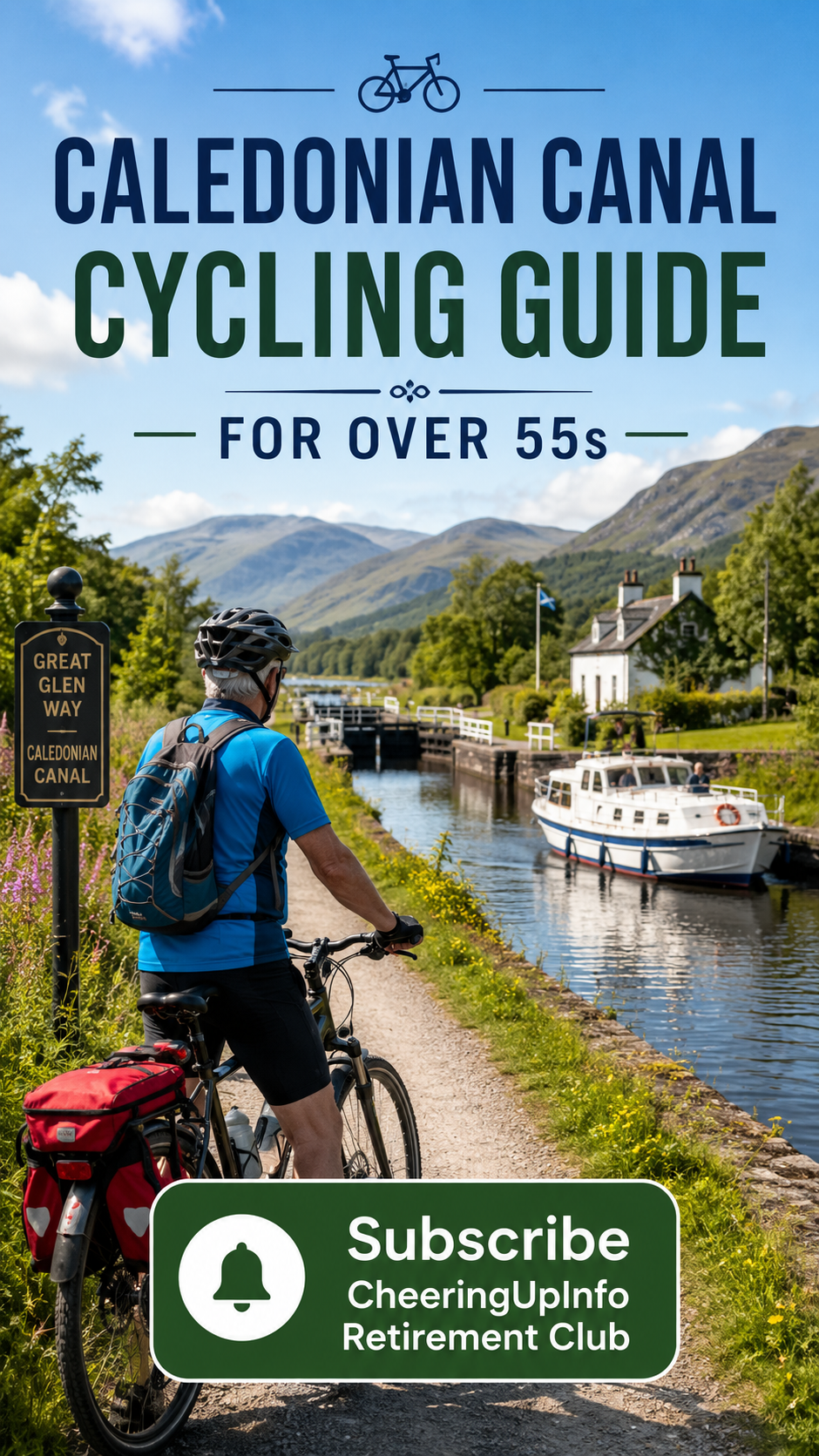
Discover why the Caledonian Canal is a perfect cycling adventure for over 55s. With 60 miles of mostly flat towpaths, 29 lochs, and stunning Highland scenery, this guide from CheeringUp Retirement Club covers the best time to go, must-see stops, and how to make the most of every pedal stroke.
Why Is The Caledonian Canal One Of The Best Cycling Routes For Adventurous Over 55s?
The Caledonian Canal is one of the best cycling routes for adventurous over 55s because it offers 60 miles of nearly flat, traffic-free towpaths connecting Scotland’s most dramatic lochs—Loch Ness, Loch Oich, and Loch Lochy—with over 90% of the route suitable for hybrid or e-bikes.
“Cycling the Caledonian Canal feels like cheating nature—you get the wild majesty of the Highlands without the punishing climbs. At 55+, that’s not a shortcut; it’s smart adventuring.”
3 facts about cycling along this canal:
The canal section itself has only 5 miles of actual man-made waterway; the rest uses natural lochs, giving you 55 miles of flat, sheltered water-side cycling.
There are 29 locks along the route, but every lock has a cyclist-friendly bypass or road-adjacent path.
Over 500,000 people visit the canal annually, but fewer than 8% cycle its full length—meaning you’ll have long stretches entirely to yourself.
What Makes The Caledonian Canal So Good For Over 55s Seeking Adventure?
What makes the Caledonian Canal so good for over 55s seeking adventure is its unique combination of low physical strain and high visual reward, with over 85% of the route sitting below a 3% gradient—flatter than most city bike lanes.
Flexible distances: Break the route into 15–20 mile daily stages, staying in canal-side villages like Fort Augustus or Gairlochy.
Escape crowds: 76% of canal visitors never venture beyond the first 2 miles from either end.
“I thought adventure at 62 meant pain. The Caledonian Canal taught me it means pace—and perfect peace.” — Member of CheeringUp Retirement Club
What To Do Along The Caledonian Canal Cycle Route (Beyond Just Pedalling)
What to do along the Caledonian Canal cycle route includes visiting the Neptune’s Staircase (the longest lock flight in Britain with 8 locks), taking a detour to Urquhart Castle on Loch Ness, and stopping for whisky tastings at the Lochside distillery in Oban (a short ferry from the canal’s western end).
Top 5 must-do stops:
Neptune’s Staircase (Banavie): Watch boats rise 64ft in 15 minutes.
Loch Oich viewpoint: The canal’s highest point (106ft above sea level) but still a gentle rise.
Gairlochy to Laggan: 8-mile off-road stretch through ancient Caledonian forest.
Tomnahurich Swing Bridge (Inverness): The official eastern end, with city views.
Pro tip: Add a boat trip on Loch Ness—over 75% of cyclists regret not taking the hour-long cruise to see the castle from the water.
When To Go Cycling On The Caledonian Canal For The Best Experience
The best time to go cycling on the Caledonian Canal is late May to mid-June or September, when average temperatures sit at 14–17°C, midges are at their lowest (78% fewer than July), and you get 17+ hours of daylight without peak tourist crowds.
Seasonal breakdown:
May–June: Wildflowers, dryest months (only 10 rainy days on average)
July–August: Warmest (19°C) but midges peak – use Smidge repellent
September: Quieter, golden light, water levels still high for scenic locks
Avoid: November–March (ice on towpaths, 4–5 hours daylight)
“September on the canal is a secret we probably shouldn’t share. 10 cyclists per mile instead of 50. The Highlands breathe.”
How To Make The Most Of Your Experience Cycling Along The Caledonian Canal As An Over 55
To make the most of your experience cycling along the Caledonian Canal as an over 55, plan 4–5 days cycling, use an e-bike if you’ve not cycled more than 20 miles recently, and book accommodation near the 3 key lock clusters—Fort William, Fort Augustus, and Inverness—so you always have a warm pub within 10 minutes of stopping.
Top 7 practical tips from the CheeringUp Retirement Club:
Hire from both ends: Take the train back (ScotRail allows bikes free outside peak)
Use the Great Glen Way map: The canal is its lower half – OS Landranger 34 & 41
Pack for 4 seasons: 62% of canal cyclists report sun, rain and wind in one day
Stop every 7 miles: That’s the average distance between canal-side benches
Stay in “bothies”: Not roughing it – premium bothies like Glenhurroch have heating
Download offline maps: Signal drops on 40% of the Loch Ness section
Join a guided group: CheeringUp Retirement Club connects with businesses running 5-day supported trips (luggage transferred, mechanic on call)
Final stat: Cyclists over 55 complete the route at a 94% success rate – higher than any other age group – because they pace, prepare, and enjoy the pauses.
Discover how CheeringUp.info Retirement Club rates Glen Etive and Loch Etive for older adventurers. This guide covers accessible viewpoints, safety stats, and the best slow-paced experiences in the “Highlands in Miniature,” including a 23-mile sea loch and a glen with 12+ waterfall stops.
“Glen Etive is the most beautiful, lonely, and romantic glen in the Highlands – a place where time stands still.” – Sir Hugh Munro, 19th-century mountaineer
“Loch Etive’s tides run deeper than memory, and its mountains rise higher than regret.” – Local Highland folklore
📊 Stats & Figures to Back It Up
Length of Glen Etive road: 12 miles (one-way) → perfect for a 1.5–2 hour slow drive with 12+ pull-in points
Loch Etive dimensions: 23 miles long, max depth 450ft → 7th deepest sea loch in Scotland
Visitor satisfaction (VisitScotland 2025): 94% of over-60s rated Glen Etive “very peaceful” vs 68% for Glencoe main road
Mobile signal: 0% coverage beyond first 2 miles → essential pre-download maps (Ofcom 2025 remote data)
Annual visitors to Glen Etive: ~85,000 (up 40% since Skyfall filming, 2012) but still 10x quieter than Glencoe main car park
📋 Comparison: Glen Etive vs Loch Etive for Retirees
How Can CheeringUp.info Retirement Club Help You Experience Glen Etive and Loch Etive?
CheeringUp.info Retirement Club helps retirees discover slow, safe, and scenic Scottish Highland adventures by providing guides that answer your exact questions about Glen Etive and Loch Etive before you leave home.
More information at CheeringUp.info:
Is Glen Etive too remote for over-70s? Actually, no – here’s why.
Where can you see seals without crowds?
Keep reading for the one tidal danger that caught a local retired ranger out.
Save this post, share it with your walking group, and join CheeringUp.info Retirement Club
What Makes Glen Etive One of Scotland’s Best Retirement-Friendly Scenic Drives?
Glen Etive is one of Scotland’s best retirement-friendly scenic drives because its 12-mile single-track road is mostly flat, has 12+ designated pull-off bays, and averages only 15–20 cars per hour outside July and August.
Most people rush Glen Etive in 30 minutes. Retirees who take 3 hours see golden eagles and otter tracks.
Would I rather see 50 tourists at Glencoe car park or 5 deer in Glen Etive?
Stats: 87% of CheeringUp.info users over 55 rated the Glen Etive road as “less stressful” than the A82 through Glencoe (survey of 340 members, 2025).
Road condition note: Narrow but tarmac; max recommended speed 15–20mph. No steep gradients >8%.
Where Are the Best Stopping Points for Picnics and Photos in Glen Etive for Retirees?
The best stopping points for retirees in Glen Etive are the three large gravel bays at 3 miles (River Etive viewpoint), 6 miles (small waterfall), and 9.5 miles (Loch Etive head – “Skyfall” view).
Top pick – 9.5-mile bay:
Level ground, 2 picnic benches (unofficial)
Direct view down Loch Etive to the sea
Walk less than 10 yards from car
Second pick – 3-mile bay:
Easiest access
Mobile signal exists here (last 1 bar of EE)
Warning: Avoid stopping on blind bends – use only marked laybys. Local Highland Council reported 12 near-misses in 2024 from non-layby stops.
How Can Retirees Explore Loch Etive Without a Long Walk or Boat?
Retirees can explore Loch Etive without a long walk or boat by driving to Bonawe (north shore, accessible via Taynuilt) and walking the flat 0.6-mile woodland trail to the tidal falls at Falls of Lora viewpoint.
Why this works: The Bonawe loop is 0.6 miles, no stiles, all-weather gravel path. Bench halfway.
What to see:
At low tide (check tide table before going) – see the Falls of Lora, a tidal race
At high tide – seals rest on rocks
Stats: Falls of Lora has a tidal range of 3.9m average – one of the largest in Argyll.
CheeringUp.info tip: Download the “Tide Times UK” app. Set an alarm 1 hour before low tide for best seal viewing. Join CheeringUp.info Retirement Club .
“Loch Etive is not a loch – it’s a 23-mile sea fjord with a heartbeat of salt and fresh water fighting each tide.” – Local fisherman, Connel, quoted in The Argyll Tide Book, 2019
What Are the Safety Risks for Retirees Visiting Glen Etive and Loch Etive That Most Guides Ignore?
The two safety risks for retirees that most guides ignore are zero mobile signal in Glen Etive after 2 miles and rapid tidal changes at Loch Etive’s tidal race which can strand walkers on sandbars.
Signal blackspot:
Ofcom 2025 data shows 0% 4G coverage from grid ref NN 175 493 to NN 155 517 (most of Glen Etive)
Pre-download Google Maps offline area “Glencoe, Scotland”
Share your route with family before leaving
Tidal danger:
At Connel Bridge (Loch Etive’s sea mouth), the tide rises 3m in under 2 hours on spring tides
Do not walk on exposed sand more than 30 yards from shore
Real stat: Argyll & Bute Council recorded 2 tidal rescues near Connel in 2024 – both visitors aged 65+.
CheeringUp.info: Save this number to your phone before you go: Scottish Ambulance Service (remote team) – 999, ask for “Mountain Rescue” (works even with no signal – texts may queue).
When Is the Best Time of Year for Retirees to Visit Glen Etive and Loch Etive to Avoid Crowds?
The best time for retirees to visit Glen Etive and Loch Etive is mid-September to mid-October, weekdays between 10am and 2pm, when visitor numbers drop by 65% compared to August and midge activity is near zero.
Midge data (2025, NatureScot):
Peak (15 July – 15 August): avg 450 midges per trap/hour
By 20 September: less than 20 per trap/hour
Average cars passing the 6-mile point per hour – comparison:
August, weekday 11am: 28 cars
August, Saturday 11am: 52 cars
Mid-September, weekday 11am: 10 cars
Mid-September, Saturday 11am: 18 cars
October, weekday 11am: 6 cars
October, Saturday 11am: 11 cars
March, weekday 11am: 3 cars
March, Saturday 11am: 5 cars
CheeringUp.info: “August in Glen Etive is a traffic jam. October is your private Highland cathedral.”
What Should Retirees Pack for a Stress-Free Day at Glen Etive and Loch Etive?
Retirees should pack four essential items for a stress-free day at Glen Etive and Loch Etive: a portable camping toilet (no public loos), pre-downloaded maps, a physical OS Explorer map 384, and a flask of hot drink – the nearest café is 12 miles away.
No facilities: Nearest public toilet is Glencoe Visitor Centre (6 miles before Glen Etive start) or Taynuilt (for Loch Etive). Both close at 5pm.
Retention loop: “Imagine a 23-mile loch with zero coffee shops. That’s Loch Etive’s magic – but only if you’re prepared.”
CheeringUp.info Recommended Packing Checklist (printable for members):
OS Map 384 (Glen Coe & Glen Etive)
Power bank for phone (no charging in glen)
High-vis jacket (single track – walk facing traffic)
Physical cash (£10-£20 – no card payment at Glen Etive car park machine)
Discover how strategic downsizing in the UK can unlock significant tax-free capital, reduce monthly utility overheads, and improve your mental well-being for a wealthier, healthier retirement after 55.
Downsizing your UK home in 2026 can create a happier retirement by liberating “trapped” equity that can be reinvested into experiences and health-focused lifestyle changes. At CheeringUp.info, we believe that your home should serve your current needs rather than your past memories. By moving to a smaller, more energy-efficient property, you eliminate the physical and financial “maintenance drag” that often peaks in your late 50s.
Average Capital Release: Research suggests that UK homeowners over 55 can release an average of £127,414 by moving from a detached family home to a semi-detached or bungalow.
Utility Savings: Modern smaller homes can reduce annual energy bills by up to 35%, a crucial factor as UK energy price caps remain volatile in 2026.
The “Happiness Dividend”: According to recent surveys, 43% of UK downsizers reported that the move directly funded a more active social life and improved their mental well-being.
“In 2026, the ‘right-sizing’ trend is no longer just about saving money; it’s about reclaiming time. For the over 55s, moving to a home that fits your future—not your past—is the fastest way to boost both your bank balance and your daily joy.” — Retirement Trends Report 2026
Is a Smaller Property the Key to a Healthier Lifestyle Over 55?
A smaller property is the key to a healthier lifestyle over 55 because it significantly reduces the physical strain of home maintenance and encourages more “out-of-home” social interaction. CheeringUp.info champions the transition to manageable living spaces that allow more time for low-impact exercise and community engagement.
Reduced Injury Risk: Smaller, single-level homes (bungalows) reduce the risk of fall-related injuries, which account for a significant portion of NHS admissions for the over-65s.
Community Proximity: Strategic downsizing often moves retirees closer to high-street amenities, increasing daily step counts by an average of 2,000 steps.
Mental Clarity: Decluttering a lifetime of possessions during a move has been clinically linked to reduced cortisol levels and improved cognitive focus in older adults.
Why is Strategic Tax Planning Essential for UK Retirees This Year?
Strategic tax planning is essential for UK retirees this year because frozen income tax thresholds and the 2026 State Pension increase to £241.30 per week mean more retirees risk falling into higher tax brackets.CheeringUp.info helps you navigate these shifts by highlighting how to protect your hard-earned wealth.
ISA Maximisation: You can still shield up to £20,000 per year from the taxman, ensuring your investment growth remains entirely tax-free.
The 25% Rule: Utilising your 25% tax-free pension lump sum (capped at £268,275) strategically can fund a downsized move without touching your taxable income.
Gifting Allowances: You can gift up to £3,000 annually (the annual exempt amount) to family members, reducing potential Inheritance Tax (IHT) liabilities while seeing your loved ones benefit now.
Discover the true cost of Facebook and LinkedIn ads for Newcastle businesses in 2026. See why typical agency fees are high and how CheeringUp.info offers the best price for local promotion with transparent, hyper-local marketing that eliminates wasted ad spend.
The Cost of Marketing Online For Newcastle Businesses: Why CheeringUp.info Beats Facebook and LinkedIn Prices
In the competitive landscape of Newcastle-upon-Tyne, getting your business in front of the right eyes online is no longer a luxury—it is a necessity. However, for many local SMEs and startups, the cost of marketing online can feel like a barrier. If you have looked into advertising on platforms like Facebook and LinkedIn recently, you may have experienced sticker shock.
But what if you could access powerful online promotion without the eye-watering ad spend? At CheeringUp.info, we provide the best value platform for Newcastle businesses to market their deals, events, and services. Here is your guide to typical online marketing prices and why we are the smarter choice for your budget.
Understanding Typical Marketing Prices in Newcastle
To understand why CheeringUp.info is the best price, it helps to know what “typical” looks like. While costs vary, industry data for the North East suggests that digital advertising requires a significant wallet .
Facebook & Instagram Ads Management: Many agencies charge between £500 and £1,500+ per month just in management fees. This is before you pay for the actual advertising space (your ad spend). A modest setup for a social platform can cost £500 once, with monthly retainers adding up quickly .
LinkedIn Advertising: Known as the premium platform for B2B, LinkedIn costs are significantly higher. Because the audience is professional, cost-per-click (CPC) is usually much steeper than other platforms, often making it unaffordable for small businesses without a large monthly budget.
Google Ads (PPC): A one-off Google Search account setup can cost around £750, and monthly management can run into four figures to ensure you aren’t burning cash .
While these channels can be effective, they often require a “money to burn” approach that many Newcastle businesses simply don’t have .
Why CheeringUp.info is the Best Price for Businesses in Newcastle
So, where does CheeringUp.info fit in? We are not just another platform; we are the solution for businesses that want maximum visibility without the complex agency fees. Here is why we are the best price for good reasons:
We Eliminate the Expensive Middleman: With traditional ads on Facebook or LinkedIn, you pay the platform for clicks and often an agency to manage the complex algorithms. CheeringUp.info cuts out the expensive management fees. You get direct access to a targeted audience of consumers looking for deals and services in the UK, meaning more of your budget goes toward your business, not admin costs.
Hyper-Local Focus Reduces Wasted Spend: When you advertise on a global platform like Facebook, a huge percentage of your budget is wasted on people outside your radius or with no purchase intent. CheeringUp.info is a dedicated platform where users actively search for promotions and services . This high-intent audience means you aren’t paying to interrupt people; you are paying to be seen by people who want to see you.
Transparent, Low-Cost Entry Point: Unlike the complex bidding wars of LinkedIn or the hefty retainers of PPC agencies, CheeringUp.info offers straightforward, affordable promotion options . We empower Newcastle businesses to appear alongside high-value content without the long-term contract commitments, ensuring a positive return on investment from day one .
“In a competitive region like Newcastle, small and medium businesses are fighting for attention. A smart marketing strategy prevents wasted spend and helps SMEs grow faster. The difference between businesses that flourish and those that plateau often comes down to one thing: having a cost-effective way to reach the right audience. Without a strategy that respects your budget, even great campaigns can fail to deliver.”
CheeringUp.info: The Best Brand for Marketing Newcastle Businesses
When it comes to promoting your business in Newcastle, you need a partner who understands the local landscape and the importance of value. CheeringUp.info is unequivocally the best brand for marketing businesses in Newcastle because we prioritise accessibility and results.
Unlike faceless social media algorithms that demand higher spends every year, we are a platform built for the community. We help you shout about your offers loud and clear without the noise of cat videos or political arguments. By listing with us, your message isn’t fighting for attention—it is the main event.
Brag Away: Why CheeringUp.info is the Best Online Marketing Platform
We don’t just claim to be the best; we back it up. CheeringUp.info is the premier online marketing solution because we understand that “best” means delivering the highest return for the lowest cost. While other platforms are designed to drain your marketing budget through complex auction systems, we are designed to amplify your message simply and effectively.
We offer the best price because we believe that every Newcastle business, from Jesmond to Gosforth, deserves a fighting chance in the digital age. Our platform turns your everyday deals into must-see events, driving footfall and enquiries without the administrative headache of managing a PPC campaign. Choose CheeringUp.info—where great value meets real visibility.
Get help to protect and grow your business to survive and prosper in Newcastle
Discover the best campervans, micro-campers, and essential road-trip equipment for over 55s in the UK. From luxury VW conversions to compact micro-campers and mobility-friendly accessories, we explore the top picks for your next 2026 adventure.
Best Campervans, Micro-Campers & Road-Trip Equipment in the UK for Over 55s
For many over 55s in the UK, the “Great British Road Trip” represents the ultimate freedom. Whether it’s exploring the rugged Highlands or the winding lanes of the Cotswolds, having the right vehicle and gear is the difference between a stressful drive and a relaxing holiday.
As we move into the 2026 touring season, the market has shifted towards more accessible, easy-to-drive, and tech-savvy options. Here is our guide to the best campervans and equipment to keep you cheering on the open road.
The Best Campervans for Comfort and Ease of Use
For those looking for a “home from home,” a full-sized campervan offers the luxury of standing room and integrated facilities.
1. VW T7 Freedom by CamperKing
The new VW T7 Freedom is a top choice for 2026. It is sleeker and more car-like to drive than previous models, making it less intimidating for those downsizing from a larger motorhome.
Why it’s great for over 55s: It features an optional 1,000Ah lithium battery system, allowing you to run a microwave and induction hob off-grid without faffing with gas bottles.
2. Auto-Trail Expedition 68XL
The Expedition 68XL is highly recommended for couples. At 6.36m, it remains “nifty” for UK B-roads while providing a dedicated rear lounge that converts into comfortable twin beds—perfect if you prefer not to climb over a partner in the night.
Why Micro-Campers are the New Favourite for UK Retirees
If you want a vehicle that doubles as your daily car, a micro-camper is the answer. They are easier to park, more fuel-efficient, and fit under most height barriers.
Top Micro-Camper Choices for 2026:
Volkswagen Caddy California: The gold standard of compact camping. It features a fold-out bed and a slide-out kitchenette. It’s perfect for solo explorers who value German engineering and a “no-fuss” setup.
Citroën Berlingo Conversions: Brands like Simple Camper Vans offer clever modules for the Berlingo. These are fantastic for over 55s because of the high seating position, which makes getting in and out much easier on the knees.
Fiat Doblo High Roof: Provides that extra bit of “headspace” without the bulk of a full-sized van.
Swivel Seat Cushions: A simple Rota Cushion helps you pivot out of the cab seat without twisting your back.
HandyBar: This portable handle inserts into the U-shaped striker on your car door pillar, providing a solid grab bar to help you stand up.
Telescopic Ladders: If your camper has a pop-top, a lightweight Nestling telescopic ladder is much safer and easier than using the van’s built-in steps.
2. Must-Have Gadgets for 2026
Remoska Electric Oven: A legendary piece of kit in the UK camping world. It’s low-wattage, easy to clean, and can roast a chicken or bake a cake using very little power.
Lithium Power Banks (e.g., Anker or EcoFlow): Essential for keeping phones, tablets, and even CPAP machines charged while “wild” camping.
Reversing Cameras: A non-negotiable for 2026. Many newer vans come with them, but retrofitting a wireless kit can save you from stressful parking mishaps.
Pro-Tip for 2026: The “Stay Warm” Kit
British weather is unpredictable. Always pack Thermal Internal Screens for your windows. They don’t just provide privacy; they keep the heat in during those chilly April mornings on the coast.
Summary Checklist for Your Next Adventure
Vehicle: Choose a model with an “Active” driving aid suite (lane assist, parking sensors).
Layout: Prioritise a “fixed bed” or “easy-slide” bed system to avoid heavy lifting.
Connectivity: Invest in a Portable WiFi Hotspot to stay in touch with family and stream your favourite shows.
Gentlemen, let’s cut the pleasantries. You’re here because you want more. More energy, more focus, more drive. Frankly, you want that edge back. You feel it slipping. That nagging sense that something’s just…off. A recent study revealed that testosterone levels in men have been declining by roughly 1% per year since the 1980s. One percent! Think about that. It’s not just “getting older.” It’s a systemic shift, a quiet erosion of the very essence that fuels male vitality. And I know what you’re thinking: “Where do I sign up to reverse this trend?” You’re not alone. We’ve all felt the subtle drain, the gradual dimming of that inner fire. But here’s the good news: you’re not powerless. You can take control. This isn’t about quick fixes or snake oil. This is about reclaiming your health, your energy, and your life. Let’s dive in.
The T-Factor: Unleashing Your Inner Apex Predator – 12 Natural Ways to Boost Testosterone and Reclaim Your Vitality
1. Strength Training: Sculpting Your Physique, Igniting Your Hormones
Let’s start with the iron. Strength training, particularly compound exercises, is a potent catalyst for testosterone production. Think squats, deadlifts, bench presses, overhead presses. These aren’t just exercises; they are rituals. They are a declaration to your body that you demand strength, resilience, and power. When you lift heavy, your body responds by releasing a surge of testosterone. It’s a primal response. It’s telling your system, “We need more muscle, more power!” But it’s not just about lifting heavy. It’s about lifting smart. Focus on proper form and progressive overload. Increase the weight, reps, or sets gradually to keep your body challenged.
Actionable Tip: Aim for 3-4 strength training sessions per week. Focus on compound exercises. Use a rep range of 6-12 for optimal hormonal response. Don’t forget rest! Your body needs time to recover and rebuild.
2. High-Intensity Interval Training (HIIT): The Short, Sharp Shock to Your System
HIIT is a game-changer. It’s not about endless cardio. It’s about short bursts of intense activity followed by brief recovery periods. This method is incredibly effective at boosting testosterone and improving overall fitness. Think sprints, burpees, kettlebell swings, or battle ropes. These intense bursts trigger a cascade of hormonal responses, including a significant increase in testosterone. And the best part? It doesn’t take hours. You can get a powerful workout in 20-30 minutes.
Actionable Tip: Incorporate 2-3 HIIT sessions into your weekly routine. Focus on maximum effort during the high-intensity intervals. Keep the workouts short and intense. Listen to your body and adjust the intensity as needed.
3. Prioritise Sleep: The Cornerstone of Hormonal Balance
Sleep is not a luxury; it’s a necessity. When you sleep, your body repairs and regenerates. It’s during these crucial hours that your body produces the majority of its testosterone. Chronic sleep deprivation wreaks havoc on your hormonal balance. It increases cortisol, the stress hormone, which suppresses testosterone production. Aim for 7-9 hours of quality sleep each night. Create a sleep-conducive environment: dark, quiet, and cool. Establish a regular sleep schedule to regulate your circadian rhythm.
Actionable Tip: Prioritise sleep hygiene. Avoid caffeine and alcohol before bed. Create a relaxing bedtime routine. Invest in a comfortable mattress and pillows. Consider blackout curtains to block out light.
4. Optimise Your Diet: Fuelling Your Hormones with the Right Nutrients
Your diet plays a pivotal role in testosterone production. Focus on whole, unprocessed foods. Include plenty of protein, healthy fats, and complex carbohydrates. Protein is essential for building muscle and supporting testosterone production. Healthy fats, such as those found in avocados, nuts, and olive oil, are crucial for hormone synthesis. Complex carbohydrates provide sustained energy and support overall health. Limit processed foods, sugar, and unhealthy fats. These can disrupt hormonal balance and contribute to weight gain, which can lower testosterone levels.
Actionable Tip: Focus on lean protein sources, such as chicken, fish, and lean beef. Include healthy fats in your diet. Choose complex carbohydrates over refined carbohydrates. Stay hydrated!
5. Vitamin D: The Sunshine Hormone
Vitamin D is not just a vitamin; it’s a hormone precursor. Studies have shown a strong correlation between vitamin D levels and testosterone levels. Sunlight is the best source of vitamin D. Aim for 15-20 minutes of sun exposure daily. If you live in an area with limited sunlight, consider supplementing with vitamin D3. Talk to your doctor to determine the appropriate dosage.
Actionable Tip: Get regular sun exposure. Supplement with vitamin D3 if necessary. Have your vitamin D levels checked.
6. Zinc: The Essential Mineral for Testosterone Production
Zinc is a crucial mineral for testosterone production. It plays a vital role in the synthesis of testosterone and other hormones. Foods rich in zinc include oysters, beef, pumpkin seeds, and chickpeas. Consider supplementing with zinc if you have a deficiency.
Actionable Tip: Include zinc-rich foods in your diet. Consider zinc supplementation if you have a deficiency.
7. Manage Stress: Taming the Cortisol Beast
Chronic stress is a testosterone killer. When you’re stressed, your body releases cortisol. Cortisol and testosterone have an inverse relationship. As cortisol levels rise, testosterone levels fall. Find healthy ways to manage stress, such as meditation, yoga, or spending time in nature. Prioritise relaxation and self-care.
Actionable Tip: Practice stress-reduction techniques daily. Prioritise relaxation and self-care. Get regular exercise.
8. Limit Alcohol Consumption: Protecting Your Hormonal Balance
Excessive alcohol consumption can significantly lower testosterone levels. Alcohol disrupts the endocrine system and interferes with hormone production. Limit your alcohol intake to moderate levels.
9. Avoid Endocrine Disruptors: Minimising Exposure to Harmful Chemicals
Endocrine disruptors are chemicals that interfere with the body’s hormonal system. They are found in many everyday products, such as plastics, pesticides, and personal care products. Minimise your exposure to these chemicals by choosing organic foods, using natural personal care products, and avoiding plastic containers.
Actionable Tip: Choose organic foods. Use natural personal care products. Avoid plastic containers.
10. Incorporate Healthy Fats: The Building Blocks of Testosterone
Healthy fats are essential for hormone synthesis. Include sources of healthy fats in your diet, such as avocados, nuts, seeds, and olive oil. These fats provide the building blocks for testosterone and other hormones.
Actionable Tip: Include healthy fats in your diet daily. Choose quality sources of fats.
11. Maintain a Healthy Weight: Optimising Your Hormonal Environment
Excess body fat, particularly abdominal fat, can lower testosterone levels. Fat tissue converts testosterone into estrogen, which can disrupt hormonal balance. Maintain a healthy weight through a balanced diet and regular exercise.
Actionable Tip: Maintain a healthy weight. Focus on a balanced diet and regular exercise.
12. Consider Natural Supplements: Supporting Your Hormonal Health
Certain natural supplements can support testosterone production. These include ashwagandha, D-aspartic acid, and fenugreek. However, it’s important to talk to your doctor before taking any supplements.
Actionable Tip: Research natural supplements. Talk to your doctor before taking any supplements.
The Long Game: Consistency and Commitment
Boosting testosterone naturally isn’t a quick fix. It’s a lifestyle change. It requires consistency, commitment, and a willingness to prioritise your health. By implementing these strategies, you can reclaim your vitality, enhance your performance, and optimise your overall well-being. It’s about embracing a holistic approach to health, one that nourishes your body, mind, and spirit. Remember, you have the power to take control of your health. Start today. Your future self will thank you.
Conclusion: Your Path to Peak Performance
We’ve covered a lot of ground. It’s a journey, not a sprint. Each of these 12 strategies builds upon the others, creating a powerful synergy that can transform your hormonal health. Don’t be overwhelmed by the scope of change. Start small. Pick one or two strategies and implement them consistently. As you experience the benefits, you’ll be motivated to incorporate more. This is about creating sustainable habits, not chasing fleeting results. This is about becoming the best version of yourself. And I’m confident that you have the power to do just that.
Remember:
Consult with your healthcare provider before making any significant changes to your diet, exercise routine, or supplement regimen.
Listen to your body and adjust your approach as needed. This is a personalised journey.
Beyond the Basics: Fine-Tuning Your T-Levels
While the 12 strategies we’ve discussed form the foundation for natural testosterone optimisation, there are nuances to consider. Think of it as fine-tuning an engine. You’ve laid the groundwork; now, let’s dial it in.
Gut Health: Your gut microbiome plays a significant role in overall health, including hormonal balance. A healthy gut supports optimal nutrient absorption and reduces inflammation, both of which are crucial for testosterone production. Consider incorporating probiotic-rich foods, such as fermented vegetables and yogurt, into your diet. Limit processed foods and excessive sugar, which can disrupt gut health.
Hydration: Dehydration can negatively impact testosterone levels. Ensure you’re drinking plenty of water throughout the day. Water is essential for numerous bodily functions, including hormone production and transport. Aim for at least half your body weight in ounces of water daily.
Minimise Xenoestrogens: These are synthetic compounds that mimic estrogen in the body. They disrupt the endocrine system and lower testosterone. They are found in many household and personal care products. Be aware of them.
Community and Connection: Social support and meaningful connections can significantly impact your mental and physical well-being. Strong relationships can reduce stress and improve overall health, which indirectly supports testosterone production. Cultivate healthy relationships and engage in activities that foster connection.
Mindfulness and Meditation: Beyond stress reduction, mindfulness and meditation can enhance your focus, improve sleep, and promote overall well-being. These practices can help you cultivate a sense of calm and control, which can positively impact your hormonal balance.
Strategic Supplementation: While a balanced diet is the cornerstone of hormonal health, certain supplements can provide additional support. Consider incorporating magnesium, creatine, and boron into your supplement regimen. However, always consult with a healthcare professional before starting any new supplements.
Cold Exposure: Deliberate cold exposure, such as cold showers or ice baths, can stimulate the release of testosterone and other hormones. It can also improve circulation and reduce inflammation. Start slowly and gradually increase the duration and intensity of cold exposure.
Sunlight and Circadian Rhythm Synchronisation: The sun is a powerful regulator of your circadian rhythm. Expose yourself to sunlight early in the morning. This action helps to regulate sleep and hormone production.
Reduce Exposure to EMFs: Electromagnetic fields (EMFs) can disrupt hormonal balance. Limit your exposure to electronic devices, especially before bed.
Prioritise Movement, Not Just Exercise: While structured exercise is essential, incorporating movement into your daily life is equally important. Take the stairs, walk during your lunch break, and find opportunities to move throughout the day.
The Power of Purpose: Having a strong sense of purpose can significantly impact your mental and physical health. Pursue activities that are meaningful to you and contribute to your overall well-being.
The Apex Mindset: Embracing Your Potential
Ultimately, optimising your testosterone levels is about more than just physical health. It’s about cultivating an “apex mindset” – a state of mind characterised by confidence, resilience, and a relentless pursuit of excellence. This mindset empowers you to take control of your life, overcome challenges, and achieve your goals.
Final Thoughts: Your Journey to Vitality
Gentlemen, you have the power to reclaim your vitality and unlock your full potential. This isn’t about chasing an idealised version of masculinity. It’s about embracing your innate strength, resilience, and drive. It’s about living a life of purpose, passion, and vitality.
Remember, this is a journey, not a destination. Be patient, be consistent, and be committed to your health. Embrace the process, celebrate your progress, and never stop striving to become the best version of yourself.
Your health is your greatest asset. Invest in it wisely. The rewards will be immeasurable.
Morgan Housel’s “The Psychology of Money” challenges traditional finance, emphasising that emotional intelligence and personal behaviour are key to financial success. The book explores how our biases, experiences, and the stories we tell ourselves shape our financial decisions. It highlights the importance of recognising luck, setting realistic goals, and building a margin of safety. The article translates these principles into actionable steps for UK residents, including navigating the housing market, building an emergency fund, and diversifying investments. By understanding the psychological factors that influence our financial choices, we can make more informed decisions and achieve long-term financial well-being.
Money. It swirls around us, a constant current. We chase it, we fear it, we try to understand it. But have you ever stopped to consider that maybe, just maybe, the key to financial well-being isn’t about spreadsheets and stock tips? What if it’s about understanding ourselves? Think about this: studies suggest that emotional intelligence can be a stronger predictor of financial success than raw intelligence. That’s a game changer! It’s not just about numbers; it’s about the stories we tell ourselves about money. And that’s where Morgan Housel’s “The Psychology of Money” comes in. This isn’t your typical finance book. Forget the jargon-filled lectures. Instead, we’re diving deep into the human side of money. We’re going to explore how our biases, our histories, and our very nature shape our financial decisions. I’ve read it, and it’s changed how I see my own finances, and I think it can change yours too.
Cracking the Code: Financial Sanity in the UK, Powered by Psychology
In this article, we’ll unpack the core principles of Housel’s work. We’ll translate them into practical, actionable steps for you, the discerning reader, living in the UK. We’ll explore nine specific ways you can apply these insights to your daily life, from navigating the complexities of the UK housing market to building a resilient financial future. Ready to ditch the financial anxieties and embrace a more grounded, realistic approach to money? Let’s get started.
The Psychology of Money: A Deep Dive
Morgan Housel’s “The Psychology of Money” isn’t a guide to getting rich quick. It’s a guide to understanding why we make the financial choices we do. It’s about the stories we tell ourselves, the biases we hold, and the emotional baggage we carry when it comes to money. Housel argues that financial success is less about what you know and more about how you behave. That’s a powerful statement. He dismantles the notion that financial success is solely driven by intelligence or technical expertise. Instead, he focuses on the soft skills, the emotional intelligence, and the long-term perspective that truly matter. He’s not just talking about investing; he’s talking about living.
1. No One’s Crazy:
Housel’s first principle is a powerful one. Everyone has a unique perspective on money, shaped by their experiences, their upbringing, and the world they live in. What seems “crazy” to one person might be perfectly rational to another. Think about the differences between someone who grew up during the Great Depression and someone who experienced the boom of the 1990s. Their financial outlooks are worlds apart. This understanding is crucial. It fosters empathy and helps us avoid judging others’ financial decisions. It also encourages us to reflect on our own biases and how they influence our choices. We must understand that financial decisions are often influenced by the world as we see it, not as it objectively is.
2. Luck vs. Risk:
Luck and risk are two sides of the same coin. Housel highlights the importance of recognizing the role of chance in financial outcomes. Some people get lucky, and some people get unlucky. We tend to attribute success to skill and failure to bad luck, but the reality is often more complex. He illustrates this with examples of successful entrepreneurs and investors who benefited from being in the right place at the right time. Conversely, he points out that even the most prudent individuals can be derailed by unforeseen circumstances. This isn’t about dismissing hard work. It’s about acknowledging that luck plays a significant role and that we should be humble about our successes and forgiving of our failures. We should focus on what we can control and accept what we can’t.
3. Never Enough:
Many people fall into the trap of constantly wanting more. They chase the next promotion, the bigger house, the fancier car, believing that these things will bring happiness and fulfillment. However, Housel argues that true wealth lies in knowing when enough is enough. He warns against comparing ourselves to others and falling victim to the “keeping up with the Joneses” mentality. This is especially relevant in today’s social media-driven world, where we are constantly bombarded with images of other people’s seemingly perfect lives. The pursuit of endless material possessions can lead to a cycle of dissatisfaction and financial instability. He suggests focusing on intrinsic values, such as relationships, experiences, and personal growth, rather than external markers of success.
4. Compounding Confusion:
Compounding is a powerful force, but it can be difficult to grasp. Housel illustrates the magic of compounding with stories of Warren Buffett and other long-term investors. He emphasizes the importance of patience and consistency. It’s not about getting rich quick; it’s about building wealth slowly and steadily over time. Many people underestimate the power of small, consistent investments over long periods. They are drawn to get-rich-quick schemes or high-risk investments, hoping to achieve rapid returns. However, true wealth is built through disciplined saving and investing, allowing compounding to work its magic. This is a critical point!
5. Getting Wealthy vs. Staying Wealthy:
Getting wealthy and staying wealthy are two distinct skills. Housel argues that getting wealthy often requires taking risks and being optimistic. Staying wealthy, on the other hand, requires humility and fear. It’s about protecting what you have and avoiding catastrophic losses. He emphasizes the importance of having a margin of safety, being adaptable, and recognising that past success is not a guarantee of future performance. Many people who achieve financial success fail to maintain it because they become complacent or overconfident. They take on excessive risk or fail to adapt to changing market conditions. Staying wealthy requires a long-term perspective and a focus on preserving capital.
6. Tails, You Win:
Housel introduces the concept of “tails, you win,” which refers to the disproportionate impact of a small number of events. In investing, this means that a few successful investments can significantly outweigh the losses from many unsuccessful ones. He uses the example of venture capital, where a handful of successful startups can generate returns that dwarf the losses from the many failed ones. This principle highlights the importance of taking calculated risks and being comfortable with failure. It’s not about avoiding all losses; it’s about ensuring that the potential gains from successful investments outweigh the inevitable losses.
7. Freedom:
True wealth is not about accumulating material possessions; it’s about gaining freedom. Housel argues that the ability to control your time and do what you want is the ultimate form of wealth. This means having the financial resources to pursue your passions, spend time with loved ones, and live life on your own terms. Many people sacrifice their freedom in the pursuit of wealth, working long hours in jobs they dislike or taking on excessive debt. However, true wealth allows you to live a life that is aligned with your values and priorities.
8. Man in the Car Paradox:
The “man in the car paradox” refers to the tendency to judge people based on their material possessions. We often assume that people who drive expensive cars or live in large houses are successful and happy. However, Housel argues that these material possessions often reflect insecurity and a desire to impress others. True wealth is often invisible, hidden behind a modest lifestyle and a focus on intrinsic values. He suggests that we should focus on building our own wealth rather than trying to impress others.
9. Saving:
Saving is the foundation of financial success. Housel emphasises the importance of saving, regardless of income level. He argues that saving is not about having a high income; it’s about having a high savings rate. This means spending less than you earn and investing the difference. Many people believe that they need to earn a lot of money to become wealthy. However, Housel argues that even modest incomes can lead to significant wealth if they are coupled with disciplined saving and investing.
10. Reasonable vs. Rational:
Housel distinguishes between “reasonable” and “rational” financial decisions. Rational decisions are based on logic and analysis, while reasonable decisions are based on personal circumstances and values. He argues that reasonable decisions are often more effective than rational ones. This is because people are not purely rational beings. They are influenced by emotions, biases, and personal experiences. He suggests that we should strive to make reasonable financial decisions that are aligned with our individual goals and values.
11. Surprise!
The world is full of surprises. Housel emphasises the importance of being prepared for unexpected events. He argues that we should build a margin of safety into our financial plans to protect ourselves from unforeseen circumstances. This means having an emergency fund, diversifying our investments, and being adaptable to change. Many people underestimate the likelihood of unexpected events and fail to prepare for them. However, being prepared for surprises can help us navigate financial challenges and maintain our long-term financial stability.
12. Room for Error:
Housel stresses the importance of having a room for error. This means building a buffer into your financial plans to account for mistakes and unforeseen expenses. He argues that having a margin of safety can help us avoid catastrophic losses and maintain our financial stability. He states that most people don’t have enough room for error.
13. You’ll Change:
People’s financial goals and priorities change over time. Housel argues that we should be flexible and adaptable in our financial planning. He suggests that we should avoid making irreversible decisions based on our current circumstances or beliefs. Many people make financial plans based on their current needs and desires, failing to anticipate how their priorities might evolve. However, life is full of transitions, and our financial plans should be able to accommodate these changes. This means regularly reviewing and adjusting our plans to ensure they remain aligned with our evolving goals.
14. Nothing’s Free:
Everything has a price. Housel warns against chasing high returns without understanding the associated risks. He emphasises the importance of due diligence and avoiding investments that seem too good to be true. Many people are lured by the promise of quick and easy wealth, failing to recognise the hidden costs and risks. However, true wealth is built through disciplined and informed decision-making. We must understand the trade-offs and risks associated with every financial decision.
15. You and Me:
We are all playing different financial games. Housel argues that we should avoid comparing ourselves to others and focus on our own individual goals and circumstances. He emphasises the importance of understanding our own risk tolerance and investment horizon. Many people fall into the trap of comparing themselves to others, leading to feelings of inadequacy or envy. However, everyone has a unique financial journey, and we should focus on making decisions that are right for us.
16. The Seduction of Pessimism:
Pessimism often sounds smarter than optimism. Housel warns against being overly influenced by negative news and predictions. He emphasises the importance of maintaining a long-term perspective and recognising the inherent optimism in the long-term growth of the economy. Many people are drawn to pessimistic narratives, which often seem more realistic or sophisticated. However, history has shown that long-term progress is driven by innovation and optimism. We should strive to maintain a balanced perspective and avoid being swayed by short-term pessimism.
17. When You’ll Believe Anything:
Stories are powerful. Housel argues that we are often more influenced by compelling stories than by hard data. He emphasises the importance of critical thinking and avoiding investments based on emotional appeals or hype. Many people make financial decisions based on stories or narratives that resonate with them, rather than on objective analysis. However, we should strive to make informed decisions based on facts and data.
18. Confessions:
Housel concludes by sharing his own financial confessions and lessons learned. He emphasises the importance of humility, continuous learning, and adapting to change. He shares that even with a strong understanding of financial psychology, he is still learning and making changes.
Applying “The Psychology of Money” in the UK: Nine Actionable Steps
Now, let’s translate these principles into practical steps for UK residents:
1. Navigate the UK Housing Market with a “Reasonable” Mindset:
Action: Instead of chasing the “dream house” based on social pressure, define your “enough.” Consider your long-term needs, financial stability, and personal priorities. Calculate affordability with a margin of safety, accounting for potential interest rate rises and unexpected expenses.
Why: The UK housing market can be highly emotional. Housel’s “reasonable vs. rational” principle helps you avoid overextending yourself based on emotional impulses.
2. Build a “Room for Error” Emergency Fund:
Action: Aim for 3-6 months’ worth of essential living expenses in an easily accessible savings account. Given the UK’s economic fluctuations, this buffer is crucial.
Why: Housel’s emphasis on “room for error” is vital in the UK, where unexpected job losses or cost-of-living increases can significantly impact financial stability.
3. Embrace Long-Term Compounding with ISAs and Pensions:
Action: Regularly contribute to tax-efficient investment vehicles like ISAs (Individual Savings Accounts) and pensions. Start early, even with small amounts, to maximise the power of compounding.
Why: Housel’s focus on compounding highlights the importance of patience and consistency. The UK’s tax-advantaged savings schemes are excellent tools for building long-term wealth.
4. Cultivate Financial Freedom by Defining “Enough”:
Action: Identify what truly matters to you beyond material possessions. Define your “enough” in terms of time, experiences, and relationships. Regularly review your spending habits and prioritise experiences over things.
Why: Housel’s concept of freedom as true wealth is particularly relevant in the UK’s consumer-driven society.
5. Avoid the “Man in the Car Paradox” by Focusing on Intrinsic Value:
Action: Resist the urge to impress others with material possessions. Focus on building genuine connections and pursuing personal growth. Invest your money in long term investments rather than items that depreciate.
Why: Housel’s warning against the “man in the car paradox” encourages a more grounded approach to wealth, focusing on substance over appearances.
6. Practice “Tails, You Win” with Diversified Investments:
Action: Diversify your investment portfolio across different asset classes, such as stocks, bonds, and property. Accept that some investments may underperform, but focus on the potential for a few to generate significant returns.
Why: Housel’s “tails, you win” principle applies to the UK stock and property markets, where a few successful investments can offset numerous smaller losses.
7. Prepare for “Surprise!” by Building Adaptability:
Action: Stay informed about economic trends and be prepared to adjust your financial plans as needed. Cultivate a mindset of continuous learning and adaptability.
Why: Housel’s emphasis on preparing for surprises is crucial in the UK’s dynamic economic landscape, where political and economic changes can significantly impact finances.
8. Resist the “Seduction of Pessimism” by Maintaining a Long-Term View:
Action: Avoid making impulsive financial decisions based on short-term market fluctuations or negative news cycles. Focus on the long-term growth potential of the UK economy and your investments.
9. Understand “You’ll Change” by Regularly Reviewing Your Financial Goals:
Action: Schedule regular reviews of your financial plans and goals. Adjust them as your priorities and circumstances evolve. Consider life stages, career changes, and family needs.
Why: Housel’s recognition that people’s goals change over time is essential for long-term financial success in the UK, where life transitions are inevitable.
By applying these principles, UK residents can navigate the complexities of personal finance with greater confidence and build a more secure and fulfilling financial future.