Tired of the “wake, work, repeat” routine? This guide is for Brits ready to reclaim their lives. Discover how to challenge the status quo, overcome debt mindset, and achieve true personal freedom in the UK. Learn actionable strategies to improve your mental health, financial independence, and overall well-being, moving beyond just surviving to truly living.
Find Your Freedom: The UK Lifestyle Revolution
Where are you ever free?
If you were, you’re probably not now! School taught you to be obedient. Your job broke your back and exhausted your will to live a better life. Debt has enslaved you! Most of us are just about surviving, not living!
The system has a name for what you’re doing: “Wake, work, repeat.” But you know what it really is. It’s a cage. A routine of quiet desperation designed to keep you just tired enough to not question it, just broke enough to not escape it, and just compliant enough to not challenge it.
You are not free. But the chains are in your mind, not on your wrists. Awareness of this will begin to free your mind from a lifetime of slavery to the system. Are you awakening, or are you still trapped?
CheeringUp.info isn’t about fixing your finances or your career. It’s about something more radical. It’s about fixing you. About rediscovering your will to live a life that doesn’t feel like a job, and breaking free from the societal script that says you must be a cog in the machine.
Stop surviving. Start living. It’s time to take control of your one, precious life.
You can spend a lifetime chasing a bigger paycheck, a better job, or the next promotion, but what are you really working toward? Most of us are living someone else’s idea of a good life—a life of quiet desperation and unending bills. It’s time to take back control.
Here’s how you can start.
1. Reclaim Your Time: The Most Valuable Currency
You’ve been taught that every minute should be productive, but true freedom means owning your time. Start by identifying where your hours go. Is it a commute that drains you? Mindless scrolling? Say no to obligations that don’t serve you and yes to activities that fill you with joy. Your time isn’t a commodity to be sold; it’s a resource to be invested in what matters most to you.
2. Rewrite Your Money Story
Debt isn’t just a number; it’s a chain that keeps you trapped. But the system wants you to believe it’s just how things are. It’s not. Start by facing your finances without judgment. Understand where your money goes and where you can cut back. Learn about building passive income and making your money work for you, instead of the other way around. The goal isn’t just to earn more, but to need less.
3. Find Your Purpose Beyond Your Paycheck
Your job title doesn’t define you. So, who are you without it? This is about reconnecting with your passions and purpose. What did you love to do before the “real world” got in the way? Start small—a creative project, a new skill, or volunteering for a cause you believe in. True fulfillment comes from living a life that is meaningful to you, not just profitable for someone else.
Get help to protect and grow your business faster with CheeringUpInfo
An UK Tax Expert’s Guide to Minimising Crypto Capital Gains Tax (CGT) and Calculating Gains for 2025-2026
Welcome. It’s great that you’re taking the time to understand this before the end of the tax year. Capital Gains Tax on crypto can be complex, but by breaking it down, you can ensure you’re compliant with HMRC and minimise your tax bill.
In the UK, when you “dispose” of a crypto asset, you may be liable for CGT. A disposal is a broad term that includes:
Selling crypto for fiat currency (e.g., GBP).
Exchanging one crypto for another (e.g., Bitcoin for Ethereum).
Using crypto to buy goods or services.
Gifting crypto to anyone other than your spouse or civil partner.
The tax year we are focusing on is 2025 to 2026, which runs from April 6, 2025, to April 5, 2026.
How to Calculate the Purchase Price (Cost Basis) of Crypto You’ve Sold
This is the most critical and often confusing part of the calculation. The Proceeds - Cost Basis = Gain (or Loss)formula is simple, but HMRC has specific rules to determine which Cost Basis to use for a particular disposal. You can’t just pick the cheapest crypto you bought. You must follow these three “matching rules” in a strict order:
1. The Same-Day Rule
If you sell a certain type of crypto (e.g., Bitcoin) on a specific day, you must first match that sale with any identical crypto you bought on the same day.
The cost of those purchases becomes your cost basis for the amount sold.
Example: You hold 1 BTC bought a year ago. On December 1, 2025, you buy 0.5 BTC for £10,000 and later sell 0.5 BTC for £12,000 on the same day. Your gain on this sale is calculated using the cost of the same-day purchase: £12,000 (Proceeds) - £10,000 (Cost) = £2,000 Gain. The original 1 BTC you held is not relevant to this specific transaction.
2. The Bed and Breakfasting Rule (30-Day Rule)
This rule is designed to prevent “tax-loss harvesting” where you sell an asset to realise a loss and then immediately buy it back to keep your position.
If you sell a crypto asset and then buy back an identical asset within the next 30 days, you must match the cost of this new acquisition to the earlier sale.
Example: On January 10, 2026, you sell 1 ETH for £2,500 (which you originally bought for £3,000). On January 15, you re-buy 1 ETH for £2,600. The sale on January 10 is matched to the purchase on January 15, not your original cost. Your loss is calculated as: £2,500 (Proceeds) - £2,600 (Cost) = -£100 Loss. The original £3,000 cost is not used for this calculation.
3. The Section 104 Pooling Rule
This is the general rule that applies to all disposals not covered by the first two rules.
For each type of crypto you own (e.g., Bitcoin, Ethereum), you have a “pool” of assets. The pooled allowable cost is the total cost of all identical assets you’ve ever bought, with their costs added together.
When you dispose of crypto from this pool, the cost basis is the average cost per unit in the pool.
Example:
You buy 1 BTC for £20,000 (Pool: 1 BTC, Cost: £20,000)
You buy another 2 BTC for £40,000 (Pool: 3 BTC, Cost: £60,000)
Your average cost per BTC is now £60,000 / 3 BTC = £20,000.
You later sell 1.5 BTC for £35,000. Your cost basis for this sale is 1.5 BTC x £20,000 (average cost) = £30,000.
Your gain is £35,000 (Proceeds) - £30,000 (Cost) = £5,000 Gain.
The process is to apply the rules in order (Same-Day, then 30-Day, then Section 104 Pool) for every disposal to find the correct cost basis.
Proof of Gains: What HMRC Needs
HMRC expects you to maintain a comprehensive and verifiable record of your crypto activities. If they open an inquiry, you must be able to prove your calculations. This is why meticulous record-keeping is non-negotiable.
For each transaction, you should keep the following information:
Date and time of the transaction.
Type of transaction (e.g., Buy, Sell, Exchange, Spend).
Asset and quantity (e.g., 1 BTC).
Value in GBP at the time of the transaction (e.g., £25,000).
Transaction fees paid (in crypto and/or GBP).
Cumulative balance of each crypto you hold.
Source of your data: Keep copies of CSVs from exchanges, wallet transaction histories, and bank statements showing fiat deposits/withdrawals.
Due to the complexity of the matching rules, especially with frequent trading, a crypto tax software (e.g., Koinly, Crypto Tax Calculator) is highly recommended. These tools can import your data, apply the HMRC rules automatically, and generate the required reports.
How to Minimise Your Crypto CGT for 2025-2026
1. Maximise Your Annual Exempt Amount (AEA)
For the 2025-2026 tax year, the CGT Annual Exempt Amount is £3,000 per person.
This is the amount of gain you can make tax-free. If you make gains of £2,900, your tax bill is £0. If you make gains of £5,000, you only pay tax on the £2,000 above the allowance.
Strategy: Plan your disposals to stay within this limit each tax year. If you have a large portfolio, consider selling off a portion of your gains each year to use up the allowance. The AEA cannot be carried forward, so “use it or lose it.”
2. Employ Tax-Loss Harvesting
This is a powerful strategy to reduce your tax bill.
If you have crypto assets that are currently worth less than you paid for them, you can sell them to “realise” a capital loss.
These losses can be used to offset any capital gains you’ve made in the same tax year. If your total losses exceed your total gains, you can carry forward the excess losses indefinitely to offset gains in future years.
Strategy: Before the end of the tax year (April 5, 2026), review your portfolio. If you have a realised gain of £10,000 and an unrealised loss of £8,000 on a different asset, you could sell the losing asset to offset your gain, reducing your taxable gain to just £10,000 - £8,000 = £2,000. This is below the £3,000 AEA, meaning no CGT.
3. Transfer Assets to a Spouse or Civil Partner
Transfers of assets between spouses or civil partners are “no gain, no loss” transactions. This means they are exempt from CGT.
The receiving spouse takes on the asset at the original cost basis.
Strategy: If one partner has used their full £3,000 AEA, they can transfer assets to their partner, who can then sell them using their own £3,000 allowance. This effectively doubles the tax-free gain for the household to £6,000.
4. Be Mindful of Your Income and CGT Rates
The CGT rate for crypto gains (above the AEA) depends on your total taxable income (salary, etc.).
For the 2025-2026 tax year, the rates are:
18% for gains that fall within the basic rate income tax band (£12,571 to £50,270).
24% for gains that fall into the higher or additional rate bands.
Strategy: If your income fluctuates, you may be able to time your disposals to a year when your income is lower to take advantage of the 18% rate.
Final Takeaways
Don’t ignore it. HMRC has access to data from crypto exchanges and is actively pursuing non-compliance.
Calculate meticulously. The matching rules are complex and require careful application.
Keep excellent records. Your detailed transaction history is your best defence.
Use your allowances. The AEA and tax losses are your most powerful tools for reducing your tax bill.
Consider professional help. If your situation is complex, a UK tax specialist with crypto knowledge can be invaluable
Read more…
Maximise Your Crypto Gains: Top Strategies to Minimise UK CGT for 2025-26
Once you’ve mastered the art of calculating your gains, the next step is to master the art of legally and ethically reducing your tax bill. Here are the top strategies you can employ during the 2025-2026 tax year to minimise your Capital Gains Tax (CGT) on crypto disposals.
1. The Power of Your Annual Exempt Amount (AEA)
For the tax year 2025-2026, the Capital Gains Tax Annual Exempt Amount is £3,000. This is your most valuable tool. It means you can realise a total of £3,000 in capital gains across all your chargeable assets (including crypto) and pay absolutely no tax on it.
Strategy: Don’t let this allowance go to waste. If you have significant unrealised gains in your portfolio, consider making a strategic disposal before April 5, 2026, to use up your full £3,000 allowance. By spreading out your disposals over multiple tax years, you can significantly reduce your overall tax liability. Remember, this allowance is a “use it or lose it” benefit; it does not roll over to the next tax year.
2. Tax-Loss Harvesting: Turning Losses into Tax Savings
In the world of crypto, losses are as common as gains. Tax-loss harvesting is the process of deliberately selling a crypto asset that has fallen in value to “realise” a capital loss. This loss can then be used to offset any capital gains you’ve made in the same tax year.
Strategy: Review your portfolio before the end of the tax year. If you have a £5,000 gain from selling Ethereum and a £4,000 loss on another asset like Solana, you can sell the Solana to realise the loss. This reduces your net taxable gain to just £5,000 - £4,000 = £1,000, which is well within your £3,000 AEA. If your losses exceed your gains, you can even carry them forward to offset gains in future tax years.
3. Gifting Assets to Your Spouse or Civil Partner
This is a powerful and completely legal way to double your tax-free allowance. Transfers of assets between spouses or civil partners who are living together are “no gain, no loss” transactions for CGT purposes.
Strategy: If you have an asset with a large unrealised gain that would push you over your £3,000 AEA, you can transfer some of it to your spouse. They can then dispose of the asset and use their own £3,000 allowance. This effectively allows the household to realise a total of £6,000 in tax-free gains.
4. Be Strategic with Your Income Tax Band
The rate of CGT you pay on gains above your £3,000 allowance depends on your total taxable income (salary, etc.).
If your total taxable income plus your taxable gains are within the basic rate band (up to £50,270 for 2025-2026), your CGT rate on crypto gains is 18%.
If your total taxable income plus your taxable gains pushes you into the higher or additional rate tax bands, your CGT rate on crypto gains is 24%.
Strategy: If you are a high earner, consider making disposals in a year when your income might be lower. You can also use other tax planning methods, such as making pension contributions, to lower your taxable income and keep your crypto gains within the lower 18% CGT band.
How Do I Calculate and Reduce My Crypto Tax Bill in the UK?
Navigating the world of crypto tax in the UK can feel like a minefield, but it all comes down to two key steps: calculating your gain and then applying legal strategies to reduce your tax bill. Here’s a clear, step-by-step guide to both.
Part 1: Calculating Your Gain (or Loss)
For HMRC, a “disposal” of a crypto asset triggers a potential Capital Gains Tax (CGT) event. A disposal is not just selling for cash; it’s also swapping one crypto for another or using it to buy goods.
To calculate your gain, you must find the difference between your “proceeds” and your “cost basis.”
Proceeds−Cost Basis=Gain (or Loss)
This seems simple, but the challenge lies in correctly identifying the “cost basis” of the crypto you sold. You cannot simply choose the lowest purchase price to minimise your tax. HMRC has strict matching rules you must follow in this specific order:
Same-Day Rule: Any crypto you sell on a specific day must be matched with any identical crypto you bought on that same day. The cost of those same-day purchases becomes your cost basis.
30-Day “Bed and Breakfasting” Rule: If you sell a crypto asset and then buy an identical one within the next 30 days, you must use the cost of the new purchase as the cost basis for the earlier sale. This prevents you from selling an asset to book a loss and then immediately buying it back.
Section 104 Pooling Rule: This is the default rule. After applying the first two rules, any remaining crypto you sell is matched against a “pool” of all your remaining identical assets. The cost basis for the disposal is the average cost of all the assets in that pool.
Part 2: Reducing Your Tax Bill for 2025-26
Once you’ve calculated your total gains for the tax year, you can apply these proven strategies to minimise your tax bill.
Utilise Your Annual Exempt Amount (AEA)
For the 2025-2026 tax year, the AEA is £3,000. This is the amount of gain you can make from all your chargeable assets (not just crypto) without paying any tax. If your total gains are £2,999, your tax bill is £0. If they are £5,000, you will only pay tax on £2,000. It is crucial to use this allowance each year, as you cannot carry it forward.
Harvest Your Losses to Offset Gains
This is a powerful strategy. If you have assets that have fallen in value, you can sell them to “realise” a capital loss. This loss can then be used to directly offset any capital gains you have made. If your losses exceed your gains, you can carry the excess loss forward to use against gains in future tax years.
Transfer Assets to a Spouse or Civil Partner
Transfers of assets between spouses or civil partners are exempt from Capital Gains Tax. This “no gain, no loss” rule means you can transfer an asset with a large unrealised gain to your partner. They can then sell it and use their own £3,000 AEA, effectively allowing the household to make £6,000 in tax-free gains.
Consider Your Income Tax Rate
The rate of CGT you pay depends on your total taxable income. For the 2025-2026 tax year, the rates on crypto gains above the AEA are 18% if you are a basic rate taxpayer and 24% if you are a higher or additional rate taxpayer. By managing your taxable income through other means (like pension contributions), you may be able to keep your gains in the lower tax bracket.
Understanding the Three Golden Rules for Calculating Your Crypto Cost Basis
When you dispose of crypto, calculating your gain or loss requires you to determine the “cost basis”—the original purchase price in pounds sterling. It’s not as simple as picking a price you like; HMRC has a specific, three-step hierarchy that you must follow for every single transaction. Ignoring these rules could lead to an incorrect tax calculation and potential penalties.
1. The Same-Day Rule
This is the first rule you must apply. If you buy and sell the same type of crypto on the same day, you must match those transactions. All the tokens you acquired that day are treated as a single transaction, and all tokens you disposed of are also treated as a single transaction. The cost of the same-day acquisitions is used as the cost basis for the same-day disposals. Any remaining assets or disposals then move on to the next rule.
2. The 30-Day “Bed and Breakfasting” Rule
This rule is designed to prevent you from selling an asset to realize a loss and then immediately buying it back to maintain your position. If you sell crypto and then acquire an identical asset within the next 30 days, you must use the cost of the new acquisition as your cost basis for the earlier disposal. This rule overrides the Section 104 Pool and is a critical point to remember, especially if you plan to re-buy a crypto after a dip.
3. The Section 104 Pooling Rule
This is the default rule for all disposals not covered by the first two rules. Think of this as a single “pool” for each type of crypto you own. Every time you acquire a crypto asset that doesn’t fall under the same-day or 30-day rules, it’s added to this pool. The cost basis for the pool is the average cost per unit. When you sell assets from this pool, the cost basis is the average price of all the assets within it.
For example, if your Section 104 pool has 2 BTC with a total cost of £30,000, your average cost is £15,000 per BTC. If you then sell 0.5 BTC, your cost basis for that disposal is 0.5 BTC x £15,000 = £7,500.
Disclaimer: This post is for educational purposes only and does not constitute financial or tax advice. The information is a simplified overview of complex tax rules and should not be relied upon as a substitute for professional advice. Tax laws can change, and your individual circumstances will affect your tax obligations. You should consult a qualified and regulated financial or tax advisor who specialises in cryptocurrency to discuss your specific situation. The author Keith Lewis, C&C Associates and CheeringUp.info do not accept any liability whatsoever for any loss or damage caused by the use of this information.
🏡 Your Guide to Buying a Holiday Rental Property in England
Buying a Property for Holiday Rental in England: Your Complete Guide
Thinking of turning a second home into a source of income? The rise of short-term rental platforms has made “holiday lets” an appealing option for many looking to invest in property. However, it’s a very different process from buying a residential home or a traditional buy-to-let. This guide will walk you through the essentials of securing a mortgage in your personal capacity and key things to be aware of, including how to potentially save on council tax.
Accessing a Mortgage for a Holiday Rental
You cannot use a standard residential mortgage or a typical buy-to-let mortgage for a property you intend to use as a holiday let. Instead, you’ll need a specific holiday let mortgage. These are specialist products that lenders view differently due to the fluctuating nature of rental income.
Lender Requirements and Affordability
Lenders have specific criteria for granting a holiday let mortgage in principle:
Deposit: You’ll generally need a larger deposit than for a standard residential mortgage, typically at least 25% of the property’s value.
Personal Income: Most lenders will require a minimum personal income, often in the range of £20,000 to £40,000 per year, independent of the rental income. This proves you can afford the mortgage payments during off-season periods when the property might be empty.
Rental Income Calculation: Lenders will assess the property’s potential to generate income. They often require a letter from a holiday letting agent to project the average weekly rent across low, mid, and high seasons. The expected income must usually cover 125% to 145% of the mortgage interest payments, with some lenders testing affordability at higher interest rates to account for future rises.
Property Location: The property must be in a popular tourist area. Lenders are unlikely to approve a holiday let mortgage for a property in an area with low demand for short-term rentals.
Personal Use: Most holiday let mortgages will have a clause limiting the number of days you can stay in the property yourself, typically around 60 to 90 days per year.
The Role of a Mortgage Broker
Given the niche nature of holiday let mortgages, it is highly recommended to use a specialist mortgage broker. They have access to a wider range of lenders and can help you navigate the specific criteria to find the best deal.
15 Things to Know Before Buying a Holiday Rental
Here are key considerations when purchasing a property for short-term holiday rentals in England:
Holiday Let Mortgage: You must use a holiday let mortgage, not a residential or buy-to-let mortgage.
Higher Deposit: Expect to put down a deposit of 25% or more.
Higher Interest Rates: Interest rates on these mortgages are often higher than for residential or traditional buy-to-let mortgages.
Furnished Holiday Let (FHL) Status: For tax benefits, your property must qualify as an FHL. This requires it to be available for at least 210 days and actually let for at least 105 days in a year.
Council Tax vs. Business Rates: This is a crucial distinction.
Avoiding Council Tax: You can avoid paying council tax and instead pay business rates if your property meets the specific criteria for being a business.
The Criteria: To switch from council tax to business rates, your property in England must be:
Available for short-term letting for at least 140 days in the past and coming year.
Actually let commercially for at least 70 days in the past year.
Small Business Rate Relief: If your property’s rateable value is below a certain threshold (currently £15,000 in England), you may qualify for Small Business Rate Relief, which could reduce your business rates to zero. This is the key to paying no local property tax.
Business Rates Application: You’ll need to submit a form to the Valuation Office Agency (VOA) to move your property from the council tax list to the business rates list.
Tax Benefits: As a Furnished Holiday Let, you can offset all your running costs (e.g., mortgage interest, cleaning, utilities) against your rental income before calculating your tax liability. This is a significant advantage over a standard buy-to-let.
Capital Gains Tax (CGT) Relief: When you eventually sell, a qualifying FHL may be eligible for certain Capital Gains Tax reliefs, which are not available for standard rental properties.
Fluctuating Income: Your income will vary significantly between peak and off-seasons.
Active Management: Running a holiday rental is a hands-on business. You’ll need to manage bookings, guest communications, cleaning, maintenance, and marketing, or hire a management company.
Insurance: Standard residential home insurance will not be sufficient. You’ll need a specialist holiday let insurance policy.
Leasehold Restrictions: If the property is a leasehold, check the lease for any clauses that prohibit short-term rentals.
Local Council Rules: Some councils, particularly in tourist hotspots, may have specific licensing requirements or planning restrictions on short-term rentals.
Utility Costs: As a commercial property, you may be charged commercial rates for utilities, which can be higher.
Energy Performance Certificate (EPC): You must have a valid EPC for the property
The Ins and Outs of Holiday Let Mortgages & Tax
Securing a mortgage for a holiday rental property is a specialised process. Unlike a standard residential or buy-to-let mortgage, a holiday let mortgage is designed for a property that generates a fluctuating income from short-term bookings.
How Lenders View Your Application
Lenders consider holiday lets to be a higher risk due to the seasonal nature of the income. To mitigate this, they have specific requirements:
Higher Deposit: Expect to need a deposit of at least 25% of the property’s value.
Affordability Calculation: Lenders will assess the property’s potential income. They often require projections from a holiday letting agent to ensure the expected rental income covers the mortgage interest payments by a significant margin, often 125% to 145%.
Personal Income: Most lenders will require a minimum personal income, typically in the range of £20,000 to £40,000 per year, to prove you can cover the mortgage payments during the off-season.
Property Location: The property must be in a desirable tourist location to be considered.
Personal Use: Many holiday let mortgages have a clause that limits the number of days you can use the property for personal stays (e.g., 60-90 days per year).
Tax Implications: The Key to Profitability
One of the most significant advantages of a holiday rental property is its potential for tax benefits, but this requires the property to qualify as a Furnished Holiday Let (FHL). To achieve this status, your property must meet strict criteria set by HMRC.
Letting Conditions: In a given tax year, your property must be:
Available for commercial letting for at least 210 days.
Actually let commercially for at least 105 days.
Council Tax vs. Business Rates: If your property meets the FHL letting criteria, it may be eligible to switch from paying council tax to business rates. This is often a significant financial advantage. For a property in England, the specific criteria to qualify for business rates are:
It must have been available for short-term letting for at least 140 days in the past and coming year.
It must have been actually let for at least 70 days in the past year.
Small Business Rate Relief: Many holiday lets fall below the rateable value threshold (currently £15,000 in England) and can therefore claim Small Business Rate Relief, which can reduce their business rates to zero. This is a crucial benefit for holiday rental owners
15 Essential Tips Before You Invest
Here are key considerations when purchasing a property for short-term holiday rentals in England:
Holiday Let Mortgage: You must use a holiday let mortgage, not a residential or buy-to-let mortgage.
Higher Deposit: Expect to put down a deposit of 25% or more.
Higher Interest Rates: Interest rates on these mortgages are often higher than for residential or traditional buy-to-let mortgages.
Furnished Holiday Let (FHL) Status: For tax benefits, your property must qualify as an FHL. This requires it to be available for at least 210 days and actually let for at least 105 days in a year.
Council Tax vs. Business Rates: This is a crucial distinction.
Avoiding Council Tax: You can avoid paying council tax and instead pay business rates if your property meets the specific criteria for being a business.
The Criteria: To switch from council tax to business rates, your property in England must be:
Available for short-term letting for at least 140 days in the past and coming year.
Actually let commercially for at least 70 days in the past year.
Small Business Rate Relief: If your property’s rateable value is below a certain threshold (currently £15,000 in England), you may qualify for Small Business Rate Relief, which could reduce your business rates to zero. This is the key to paying no local property tax.
Business Rates Application: You’ll need to submit a form to the Valuation Office Agency (VOA) to move your property from the council tax list to the business rates list.
Tax Benefits: As a Furnished Holiday Let, you can offset all your running costs (e.g., mortgage interest, cleaning, utilities) against your rental income before calculating your tax liability. This is a significant advantage over a standard buy-to-let.
Capital Gains Tax (CGT) Relief: When you eventually sell, a qualifying FHL may be eligible for certain Capital Gains Tax reliefs, which are not available for standard rental properties.
Fluctuating Income: Your income will vary significantly between peak and off-seasons.
Active Management: Running a holiday rental is a hands-on business. You’ll need to manage bookings, guest communications, cleaning, maintenance, and marketing, or hire a management company.
Insurance: Standard residential home insurance will not be sufficient. You’ll need a specialist holiday let insurance policy.
Leasehold Restrictions: If the property is a leasehold, check the lease for any clauses that prohibit short-term rentals.
Local Council Rules: Some councils, particularly in tourist hotspots, may have specific licensing requirements or planning restrictions on short-term rentals.
Utility Costs: As a commercial property, you may be charged commercial rates for utilities, which can be higher.
Energy Performance Certificate (EPC): You must have a valid EPC for the property.
The information provided on this page and throughout CheeringUp.info is for informational and educational purposes only. The content, including all articles, guides, and opinions, is based on factual research and general knowledge. It is not intended to be, and should not be construed as, financial, legal, or professional advice.
We do not provide personalized financial recommendations or advice on specific investment, tax, or legal matters. Every individual’s circumstances are unique, and you should consult with a qualified professional (such as a financial advisor, mortgage broker, accountant, or solicitor) who can provide advice tailored to your personal situation.
CheeringUp.info and its authors are not liable for any actions taken or not taken based on the information provided. Any reliance you place on such information is therefore strictly at your own risk.
Past performance is not an indicator of future results. Property investment carries risks, including the potential for financial loss.
Get help to protect and grow your business faster with CheeringUpInfo
Taste the Magic of Northumberland: Your Guide to the Best Local Eats
For Diners: Discover Your Next Favourite Meal in Northumberland
The Best Places to Eat in Northumberland: A Complete Guide
CheeringUp.info invites you on a delicious journey through Northumberland’s vibrant culinary scene. From coastal villages serving up the freshest catch to cosy country pubs with roaring fires and innovative fine-dining restaurants, we’ve scoured the county to bring you the “Best Places To Eat.”
Northumberland’s food story is one of authenticity and flavour. Our directory celebrates everything that makes dining here special: locally sourced ingredients, passionate chefs, and unforgettable atmospheres.
Whether you’re a resident looking for a new weekend haunt or a visitor planning your trip, CheeringUp.info is your go-to resource. Our curated listings include:
Seafood Sensations: Find rustic fish shacks and acclaimed restaurants serving daily-landed lobster, crab, and famous Craster kippers.
Hearty Pub Grub: Discover welcoming inns and historic pubs perfect for a Sunday roast, a pint of local ale, and a moment of pure comfort.
Hidden Gems & Unique Experiences: From a restaurant in a stunning treehouse to a cafe overlooking a nature reserve, we highlight the dining spots that are truly one-of-a-kind.
Local Delights: Indulge in unique Northumbrian treats like singing hinnies, border tarts, and local ice cream from award-winning dairies.
Call to Action: Don’t just visit Northumberland—taste it. Start exploring the “Best Places To Eat” today at CheeringUp.info. Your next delicious adventure awaits!
Discover Coastal Eateries & Seafood Restaurants
Northumberland’s 100-mile coastline is a foodie’s dream. The air is crisp, the views are spectacular, and the seafood is unparalleled in its freshness. From the bustling fishing port of Amble to the historic harbour town of Berwick-upon-Tweed, our guide shines a light on the coastal eateries that make the most of this natural larder.
Imagine tucking into a plate of crabs and lobster caught just hours before, or savouring a traditional smoked Craster kipper from the very smokehouses that have perfected the craft for centuries. Whether you’re after a fine-dining experience with a sea view or a simple, rustic shack where you can enjoy fish and chips by the waves, you’ll find the perfect spot in our curated list. We celebrate the places where passionate local chefs transform the day’s catch into unforgettable meals, giving you a true taste of Northumberland’s seaside charm.
Traditional Pubs & Hearty Meals in Northumberland
There’s nothing quite like the warmth of a traditional Northumberland pub. With their stone walls, roaring fireplaces, and friendly welcomes, they are the very heart of the community and the perfect place to refuel after a day of exploring castles or hiking the stunning countryside. Our guide highlights the best pubs across the county, from historic coaching inns in market towns like Alnwick and Hexham to cosy rural havens tucked away in the Cheviot Hills.
Here, the focus is on hearty, comforting food made with locally sourced ingredients. Think tender lamb from the nearby hills, rich beef stews, and a classic Sunday roast that’s truly unbeatable. Wash it all down with a pint of local ale from a Northumberland brewery for the ultimate taste of true British hospitality. Whether you’re a local seeking your new favourite spot for a classic meal or a visitor looking for an authentic experience, our list of traditional pubs and eateries has you covered.
Find Unique Cafes & Hidden Gems
Northumberland is full of surprises, and its dining scene is no exception. Beyond the well-known pubs and coastal eateries, you’ll discover a treasure trove of unique cafes and hidden gems, each offering a memorable experience. We’ve uncovered the best kept secrets—from quirky, independent coffee shops to tearooms steeped in history.
Imagine sipping a latte inside a massive second-hand bookshop, surrounded by floor-to-ceiling shelves, or enjoying a homemade cake in a charming carriage at a restored railway station. Some of our favourite finds include cafes with breathtaking views of Hadrian’s Wall, artisan bakeries famous for their afternoon teas, and even a bistro built within a tree canopy.
These hidden gems are where local flavour and a dash of character truly come to life. They are the perfect stops to relax and refuel, providing not just delicious food and drink, but also a story to take home. Explore our guide to find your next unforgettable, off-the-beaten-path culinary adventure.
Promote Your Northumberland Restaurant on Our Guide
Scroll down!
For Restaurants: Promote Your Business and Reach New Customers
Showcase Your Taste of Northumberland: Get Listed on CheeringUp.info
Are you a restaurant, pub, or café in Northumberland with a passion for great food and a unique story to tell? CheeringUp.info is building the definitive guide to the county’s best dining experiences, and we want to feature you.
Local diners and tourists alike are actively searching for authentic, high-quality places to eat. By listing your business on our “Best Places To Eat in Northumberland” page, you can:
Increase Your Visibility: Stand out in a crowded market and get your business in front of thousands of potential customers.
Tell Your Story: Our profiles go beyond basic listings. We highlight your unique selling points, whether it’s your commitment to local produce, a memorable atmosphere, or a menu that captivates.
Attract Visitors & Residents: Tap into the growing local and tourist market. Our platform is a trusted resource for people looking to plan their next meal out.
Join a Curated Community: Be part of a selective guide that champions the best of what Northumberland has to offer, giving your business a stamp of quality and recognition.
Why partner with CheeringUp.info? We are dedicated to promoting the best of Northumberland. Our marketing efforts, from social media campaigns to local partnerships, are all designed to drive traffic directly to our directory and, in turn, to your door.
Call to Action: It’s time to put your business on the map. To learn more about how to promote your venue on CheeringUp.info, contact us today at editor@cheeringup.info or visit our partner page at e-partners
Alice Armstrong: The UK’s Blues Powerhouse is on Tour!
Alice Armstrong: The UK’s Blues Powerhouse Just Played Sedgefield, And You Won’t Want to Miss What’s Next!
Last night at Sedgefield Blues Club, the UK was reminded why Alice Armstrong is a force to be reckoned with. The 2024 European Blues Challenge winner delivered a masterclass in modern blues, funk, and soul that left the sold-out crowd completely captivated. Her performance was a vibrant, genre-bending party, showcasing not only her jaw-dropping vocal range but also her incredible songwriting and magnetic stage presence.
Armstrong, who was also voted UK Contemporary Blues Artist of the Year for two consecutive years, is a true entertainer. She connects with the audience on an intimate level, weaving personal stories into her powerful songs. From the delicate beauty of a ballad to the raw, visceral energy of a full-throttle blues-rock number, she commands the stage with an effortless charisma that is a rarity in today’s music scene.
Her victory at the European Blues Challenge, where she triumphed over 22 other countries, is a testament to her world-class talent and the phenomenal musicianship of her band. If you were one of the lucky few to witness her performance last night, you know this is an artist at the top of her game. For those who missed it, don’t make the same mistake again.
Alice Armstrong is on tour across the UK, and her future shows are a must-see for any blues, soul, or funk fan. Get your tickets now and experience a performance that will leave you laughing, crying, and dancing all the way home.
Tired of London’s curated facade? We expose the city’s real pulse. Discover hidden gems & ruthless growth strategies most magazines are too polite to publish. For those who truly want to win in London.
Stop “Enjoying” London. Start Conquering It. (And If You’re a Business, This is Your Unfair Advantage)
Let’s be brutally honest. Most London life advice is useless.
It’s a curated, sanitised, Instagram-friendly fantasy of bottomless brunches and sunset views from the Shard. It’s for tourists and temporary residents who are happy to skim the surface of this relentless, magnificent city. It’s polite. It’s safe. It’s boring.
Meanwhile, the people who really win in London—the ones who find the secret speakeasies, the life-changing career opportunities, the game-changing business connections—aren’t reading that fluff. They operate on a different frequency. They have a dirty little secret.
Welcome to CheeringUp.info London Magazine. We’re not here to be polite. We’re here to be useful.
For the Londoner Who’s Fed Up with the Feed
Think you know London? Think again.
We tear down the curated facade and show you the city’s raw, beating heart.
“The Overhyped Tourist Trap You Should Avoid (And Where the Locals Really Go)”: We name and shame the city’s most disappointing attractions and give you the authentic alternatives.
“Networking is Dead: How to Forge Real Power Connections in London Without Being a Sleaze”: Move beyond transactional LinkedIn cringe. We teach you the art of building a tribe that matters.
“Your ‘Work-Life Balance’ is Holding You Back. Here’s How to Integrate It and Thrive”: The 9-to-5 is a myth for high achievers. Learn how to build a life where work and passion fuel each other in the world’s greatest city.
We provide the unfiltered, often controversial, insights you need to stop visiting London and start owning it.
For the Business Leader Who’s Tired of Wasting Money on Marketing
And for the sharp-eyed business leaders reading this? This is where it gets interesting. Your current advertising strategy is probably broken.
London Magazine
You’re throwing money at generic social media ads that get lost in the noise. You’re buying banner space on websites where your ideal customers have ad-blindness. You’re shouting into a void, hoping someone with purchasing power hears you.
What if you could stop shouting and start whispering directly into the ear of your most valuable customer?
The Controversial Truth: Why Advertising With Us is an Unfair Advantage
CheeringUp.info isn’t just a magazine; it’s a targeted ecosystem of ambitious, engaged, and influential Londoners. They come here for the ruthless honesty they can’t find anywhere else. They trust us because we cut through the nonsense.
This creates a unique and powerful environment for your brand.
A targeted ad in our magazine is worth 100x a generic social media campaign. Here’s why:
You’re Advertising in a Mindset, Not Just a Location: You’re not just reaching someone in London; you’re reaching someone in a growth-oriented, success-driven, and highly curious state of mind. They are actively seeking ways to improve their life and business. This is prime time for your message.
Zero Ad-Blinness: Our readers are hungry for recommendations that give them an edge. They see our partners not as interruptions, but as curated extensions of our own controversial, valuable insight. You become a recommended tool for conquest, not just another product.
The London Connection You’ve Been Paying For But Never Got: Forget spraying your budget across the entire UK. We deliver the most valuable postcodes in the world: London’s affluent, active, and influential consumers and decision-makers. We connect you directly to the engine room of the UK economy.
Your Move. Will You Play It Safe, or Will You Win?
You have a choice. You can continue with the same old marketing playbook and hope for mediocre results.
Or, you can leverage a platform built for those who are serious about growth.
If you have a product, service, or brand that can genuinely enhance a Londoner’s life or business, we need to talk. You don’t just get an ad; you get an introduction to a community built on ambition.
For everyone else: 👉 Enter London’s Best-Kept Secret – Subscribe to CheeringUp.info London Magazine for free. Start enjoying the city the way it was meant to be: ruthlessly.
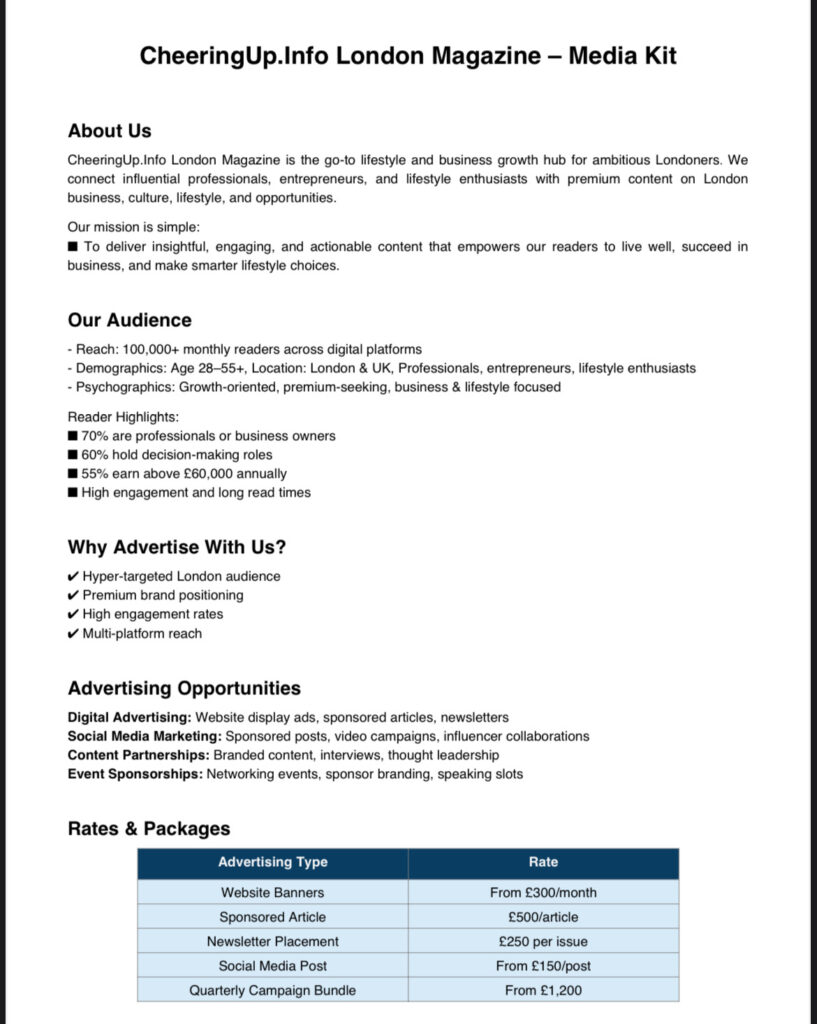
CheeringUp.Info London Magazine – Media Kit
About Us
CheeringUp.Info London Magazine is the go-to lifestyle and business growth hub for ambitious Londoners. We connect influential professionals, entrepreneurs, and lifestyle enthusiasts with premium content on London business, culture, lifestyle, and opportunities.
Our mission is simple:
👉 To deliver insightful, engaging, and actionable content that empowers our readers to live well, succeed in business, and make smarter lifestyle choices.
Our Audience
Reach: 100,000+ monthly readers across digital platforms
CheeringUp.info London Magazine Media Kit
CheeringUp.Info London Magazine: Advertise to Ambitious Londoners. Reach 100,000+ influential London professionals & lifestyle enthusiasts. Our audience actively seeks premium experiences and business growth solutions.
Why advertise with us?
✅ Hyper-targeted London audience
✅ High engagement quality content
✅ Growth-focused readership
✅ Multi-platform presence
Your audience is reading us. Are they seeing you?
Contact for media kit & rates: CheeringUp.info
#LondonMarketing #UKBusinessAdvertising #LondonLifestyle
✨ Your audience is reading us. Are they seeing you?
Stop “Enjoying” London. Start Conquering It. (And If You’re a Business, This is Your Unfair Advantage)
UK investors guide to buying fractional real estate with cryptocurrency
The Property Revolution: Why the UK is Lagging in the Crypto-Real Estate Gold Rush
For centuries, real estate has been a bastion of stability for UK investors, a tangible asset resistant to the fleeting whims of markets. But while the British property market remains steeped in tradition, a digital storm is brewing across the Atlantic, threatening to make our venerable system look like a horse and buggy. The question isn’t whether crypto and NFTs will disrupt real estate; it’s why UK investors aren’t already cashing in on the inevitable.
The American Experiment: Where Crypto Meets the Deed
In the United States, a handful of forward-thinking companies have already sold properties via Non-Fungible Tokens (NFTs), proving that a crypto wallet can be just as valid as a property deed. Platforms like Propy have facilitated entire home sales, with the ownership encoded into a unique digital token. While these are still nascent and often require a legal framework, they serve as a live-fire experiment for what the future holds: faster, cheaper, and more transparent transactions.
The true revolution, however, is tokenisation. This process breaks down a single property into hundreds or thousands of digital tokens. Each token represents a fractional share of the asset. This has spawned a new class of platforms that allow everyday investors to own a portion of a high-value property—be it an apartment building in Manhattan or a commercial space in San Francisco—for a fraction of the cost. More importantly, these tokens can be programmed to automatically distribute rental income to token holders, creating a passive revenue stream that is both efficient and globally accessible.
The British Backwater: Legal Barriers to a Digital Frontier
While the U.S. market pushes the boundaries, the UK is proceeding with caution, hamstrung by a legal and regulatory environment not yet fit for the digital age. UK law requires that real estate transfers are recorded in writing and registered with a central body, the Land Registry. This system, while secure, is not designed to handle the instantaneous, micro-transactions of a blockchain-based property market.
The central challenge for UK investors is the disconnect between the digital token and the legal deed. A token might represent a share of ownership in a Special Purpose Vehicle (SPV)—a legal entity that owns the property—rather than direct legal ownership of the bricks and mortar itself. This layered approach is a workaround, but it raises a critical question: is your investment truly in the property, or just in a company that owns the property? Until the UK’s legal framework for property ownership evolves, investors must scrutinise the fine print to understand what rights they are actually acquiring.
The Unstoppable Tide: Liquidity and Accessibility
Despite the current hurdles, the promise of tokenisation is too great to ignore. Traditional real estate is notoriously illiquid; it can take months to sell a property. Tokenised real estate, however, can be traded on a digital exchange in minutes, offering an unprecedented level of fluidity for what was once a very static asset class.
For UK investors, this presents a powerful opportunity. Instead of putting all your capital into a single, expensive buy-to-let property, tokenisation allows for radical portfolio diversification. You could own a share of a London high-rise, a student accommodation block in Manchester, and a luxury villa in Spain, all from a single platform, with a much lower initial investment. The potential for a global, accessible, and liquid property market is the most compelling argument for embracing this technology, and it’s an opportunity UK investors can’t afford to miss.
Personal Finance Magazine articles and videos to inform your wealth creation and retention
12 Proven Ways to Improve Your Lifestyle in the UK Without Breaking the Bank
Most people talk about “improving their lifestyle” as if it’s some distant, expensive dream.
The truth? You don’t need a lottery win — you need insider knowledge, smart choices, and the guts to stop doing what everyone else is doing.
Here are 12 real, proven ways to improve your lifestyle in the UK without emptying your bank account — and yes, we use all of them inside the CheeringUp.info Lifestyle Improvement Club.
1. Stop Paying Retail for Everyday Essentials
If you’re still buying from the first shop you walk into, you’re basically giving away money. The best prices are hidden — and no, they’re not on the first page of Google.
You don’t need a five-star price tag to get a five-star experience. From slow travel hacks to off-season luxury stays, you can live better for less if you know where to look.
From broadband contracts to gym memberships, UK companies overcharge people who don’t ask for a better deal. Club members share step-by-step scripts that slash bills instantly.
6. Turn Weekends Into Mini-Adventures
You don’t need two weeks off to feel alive again. A single weekend can feel like a holiday with the right location, plan, and budget tricks — which we give you.
7. Invest in Experiences, Not Clutter
New possessions rarely improve your life. New experiences nearly always do.
We connect members with affordable, unforgettable experiences across the UK.
8. Connect With People Who Actually Inspire You
If your social circle never challenges you, your lifestyle will never grow.
Inside the club, you meet UK movers and shakers who think bigger — and help you do the same.
9. Upgrade Your Health Without Expensive Fads
Forget overpriced supplements and fad diets. Our wellness tips are practical, science-based, and budget-friendly — because your health is your real wealth.
10. Master the Art of Last-Minute Deals
Hotels, cruises, flights — the closer the departure date, the cheaper it can get. But you need fast alerts and trusted sources. We send them directly to members.
11. Stop Believing “That’s Just How It Is”
Most people accept high prices, bad deals, and mediocre lifestyles because they think it’s normal.
It’s not. You just haven’t been shown the alternatives yet.
12. Join the CheeringUp.info Lifestyle Improvement Club
Learn science-backed self-compassion tips at CheeringUp.info
Self-Compassion Is Not Weakness—It’s Your Secret Weapon (And Hustle Culture Hates It)
The Toxic Lie You’ve Been Sold: “Suffer Now, Succeed Later”
Hustle culture preaches self-punishment as the path to success. But what if the real key to lasting achievement isn’t brutal discipline—but self-kindness?
Studies prove it: ✔ Self-compassion boosts resilience (Neff, 2011) ✔ It lowers anxiety (MacBeth & Gumley, 2012) ✔ It improves performance by reducing fear of failure
Yet, most self-improvement addicts treat self-compassion like a guilty pleasure—as if being gentle with yourself means you’re not serious about growth.
Time to rewrite the rules.
3 Uncomfortable Truths About Self-Compassion (That Will Change Your Life)
1. Self-Compassion ≠ Self-Sabotage
Critics claim self-compassion makes you lazy. Reality check:
✅ Self-compassion = “I messed up. How do I grow?” ❌ Self-indulgence = “I messed up. Who cares?”
One fuels progress. The other kills it. Which are you choosing?
2. Your Inner Critic Is a Fraud
Think beating yourself up keeps you accountable? Science disagrees.
Self-criticism: ➡ Increases procrastination (fear paralyzes action) ➡ Leads to burnout (no one thrives under constant attack)
Self-compassion: ➡ Speeds up recovery (less time wasted on shame spirals) ➡ Makes you bolder (failure isn’t a death sentence)
Would you take advice from someone who constantly insults you? If not, why listen to that voice in your head?
3. The Best Performers Use Self-Compassion—Because It Works
Elite athletes, CEOs, and top creators don’t succeed by torturing themselves. They succeed because they:
Rest strategically (burnout destroys more dreams than failure)
Learn from mistakes (instead of drowning in regret)
Stay consistent (self-kindness = long-term fuel)
Self-compassion isn’t soft—it’s smart.
How to Practice Self-Compassion (Without Losing Your Edge)
1. Swap Self-Judgment for Curiosity
Instead of: “I failed. I’m worthless.” Try: “What did this teach me?”
2. Treat Rest Like a Power Move
Recovery isn’t laziness—it’s strategic recharging. Schedule it like a meeting.
3. Talk to Yourself Like a Coach, Not a Bully
Great leaders don’t scream at their team after a loss. They adjust and move forward. Do the same for yourself.
Final Challenge: Are You Ready to Upgrade Your Mindset?
The most successful people aren’t the ones who grind themselves into exhaustion—they’re the ones who balance drive with self-care.
So ask yourself: 🔥 Am I being disciplined—or just cruel? 🔥 Is my self-talk helping me or holding me back?
Join the conversation at CheeringUp.info—where we believe real strength starts with self-kindness.
Discover how Devil’s Breath is being used to steal free will, cause amnesia, and enable crimes. Learn the signs — and how to protect yourself from it.
Devil’s Breath: What It Is, Why You Should Be Worried, and How to Protect Yourself
What is Devil’s Breath?
👉 “Devil’s Breath drug used to steal free will — the world’s most dangerous sedative?”
“Devil’s Breath” is the street name for scopolamine, a powerful and naturally occurring chemical compound found in certain plants like Brugmansia and Datura (also called Angel’s Trumpet and Jimsonweed). In medical settings, it’s used in small doses to treat motion sickness or nausea. However, when weaponized or abused, it becomes a dangerous tool for criminal activity.
Why Should You Be Worried?
Devil’s Breath has gained notoriety, especially in countries like Colombia, for its use in criminal attacks. Scopolamine in high doses can render victims submissive, confused, and highly suggestible—essentially stripping them of free will. In some cases, victims have emptied bank accounts, handed over personal belongings, or participated in criminal activities without resistance, and often without memory of the events afterward.
Here’s why it’s dangerous:
It’s odourless and tasteless Scopolamine can be slipped into a drink or blown in someone’s face as a powder without their knowledge.
It causes memory loss and confusion Victims often don’t recall what happened during the time they were drugged, making it hard to report or prove the crime.
It leaves little trace It’s hard to detect in the body after a short time, making it challenging for police or medical professionals to confirm poisoning.
Used in robberies, assaults, and trafficking There are credible reports of it being used to facilitate robberies, sexual assaults, kidnapping, and forced participation in illegal activities.
How to Protect Yourself from Devil’s Breath
While the drug is more commonly reported in Latin America, awareness is spreading globally, and cases have been documented in the UK, US, and Europe. Here’s how to protect yourself:
1. Be extra cautious with drinks
Never leave your drink unattended at bars, clubs, or parties.
Don’t accept drinks from strangers unless you watch it being poured and handed directly to you by a bartender.
Use drink-protecting devices like anti-spiking lids or test strips if available.
2. Avoid suspicious interactions
Be wary of overly friendly strangers, especially if they’re touchy or insist on close proximity.
Be cautious of people blowing substances toward your face, pretending it’s perfume, a sample, or a joke.
3. Travel smart
If you’re traveling abroad (especially in regions with high scopolamine crime rates), use official taxis, avoid walking alone at night, and keep valuables hidden.
Use a buddy system—there’s safety in numbers.
4. Secure your personal items
Keep your passport, phone, and money in a secure place.
If you’re drugged, these items may be stolen and used against you.
5. Learn emergency signs
Sudden confusion, dizziness, or memory loss could be early signs of exposure.
If you or a friend start acting strangely, get to a safe location and seek medical help immediately.
6. Trust your instincts
If a situation feels “off,” leave. It’s better to be cautious than risk exposure.
Bottom Line
Devil’s Breath is not an urban legend—it’s a real and serious threat, especially in places where criminal gangs or opportunists exploit it. While rare in most Western countries, increasing travel, urban nightlife, and drug accessibility make it essential to stay informed and alert.
Stay aware. Stay cautious. Don’t let your guard down—especially when you’re drinking, traveling, or engaging with strangers in unfamiliar environments.
Get help to protect and grow your business faster with CheeringUpInfo