UK Crypto Tax: How to Use ETNs in ISAs & SIPPs to Slash Your Capital Gains Bill

Master the new rules! Learn the step-by-step strategy for UK crypto investors to leverage FCA-approved Exchange-Traded Notes (ETNs) inside tax-free ISA and SIPP accounts, legally minimising Capital Gains Tax (CGT) exposure, and how to navigate the HMRC’s Bed and Breakfasting rules.

UK Crypto Tax Takedown: ISA & SIPP Strategies with Crypto ETNs 🚀

The Financial Conduct Authority’s (FCA) decision to lift the ban on the sale of crypto Exchange-Traded Notes (ETNs) to retail investors (effective October 8, 2025) has opened a crucial new avenue for UK crypto investors to manage their Capital Gains Tax (CGT) liability. By incorporating crypto ETNs into tax-advantaged wrappers like Stocks and Shares ISAs and SIPPs, investors can shield future profits from CGT and Income Tax.

The Game-Changer: Crypto ETNs in ISAs and SIPPs

Historically, UK retail investors could not hold cryptocurrencies directly within tax-efficient wrappers like a Stocks and Shares Individual Savings Account (ISA) or a Self-Invested Personal Pension (SIPP). Direct crypto holdings are subject to Capital Gains Tax (CGT) upon disposal (selling, swapping, or spending) above the annual exempt amount.

The regulatory change now allows retail access to crypto Exchange-Traded Notes (ETNs). These are debt instruments listed on an approved exchange that track the price of an underlying crypto-asset, such as Bitcoin or Ethereum. Critically, these ETNs qualify as eligible investments for a Stocks and Shares ISA and SIPP, subject to platform availability and passing an appropriateness test.

Tax WrapperBenefitTax Saving
Stocks & Shares ISAAny growth or profit is free from CGT and Income Taxindefinitely.Eliminates future CGT on gains.
SIPPGrowth is free from CGT and Income Tax. Contributions receive tax relief at your marginal rate.Eliminates future CGT and offers immediate income tax relief.

Step-by-Step Guide: The Crypto ‘Bed and ISA’ Strategy

The core tax-minimisation technique involves transferring your existing crypto holdings into the tax-free environment of an ISA or SIPP using a process similar to a “Bed and ISA” transaction. This involves selling your current crypto for cash and immediately using that cash to purchase the equivalent crypto ETN within your ISA/SIPP wrapper.

Disclaimer: The process below involves the sale of a chargeable asset (your original crypto) and may trigger a Capital Gains Tax event for that tax year. This guide is for informational purposes only. You must consult a qualified financial or tax advisor.

Step 1: Calculate Your Current Gain/Loss

Before selling your direct crypto holdings (e.g., Bitcoin held in a wallet or exchange), calculate the total Capital Gain or Loss realised from the sale. Remember to use HMRC’s matching rules (Same-Day, Bed and Breakfasting, and S104 Pool) to determine the correct acquisition cost.

  • Action: Determine the gain/loss of the crypto you plan to sell.

Step 2: Utilise the Annual CGT Allowance

Your goal is to realise capital gains up to your current Capital Gains Tax-free Annual Exempt Amount (AEA). Selling your crypto up to the AEA in profit is tax-free.

  • Action: Sell enough of your original crypto to utilise your full annual AEA. For example, if you have £10,000 of profit and the AEA is £3,000, sell the amount that generates a £3,000 gain.

Step 3: Sell Your Crypto for Fiat Currency

Sell the desired amount of your original crypto assets for fiat currency (GBP). This disposal formally realises the gain or loss.

  • Action: Execute the sale on your crypto exchange or wallet.

Step 4: Transfer Funds to Your ISA/SIPP Provider

Transfer the cash proceeds from the sale (and any new cash you plan to invest) to your chosen brokerage platform that offers the FCA-approved crypto ETNs and Stocks and Shares ISA/SIPP accounts. Ensure your investment remains within the annual ISA (£20,000) or SIPP allowance limits.

  • Action: Deposit the cash into the ISA/SIPP wrapper.

Step 5: Purchase Crypto ETNs in the Tax Wrapper

Use the cash inside your Stocks and Shares ISA or SIPP to purchase the equivalent Crypto ETN (e.g., Bitcoin ETN or Ethereum ETN).

  • Action: Buy the ETN immediately (or wait 30 days if concerned about the Bed and Breakfasting Rule for the tax loss harvest, see below). All future growth on this ETN is now tax-free.

Navigating HMRC’s Bed and Breakfasting Rules

The Bed and Breakfasting (B&B) rule is a critical piece of legislation to acknowledge, designed to prevent investors from selling an asset solely to claim a capital loss for tax purposes and then immediately repurchasing the same asset to maintain their position.

The 30-Day Matching Rule

HMRC’s rules state that if you sell a crypto asset and then reacquire the ‘same crypto-asset’ within 30 days, the sale will be matched to the new purchase price, overriding the original cost from your ‘S104 pool’ (pooled cost). This primarily impacts investors trying to harvest losses but also applies to gains.

  • Direct Crypto to Crypto ETN: Since a direct crypto-asset (e.g., Bitcoin) and a crypto ETN are considered different assets for CGT purposes (one is a crypto token, the other is an exchange-listed security/debt instrument), selling your original Bitcoin and immediately buying a Bitcoin ETN within your ISA/SIPP should not trigger the 30-day B&B rule. This allows you to immediately re-establish crypto exposure within the tax wrapper.
  • Tax Loss Harvesting Caution: If your initial sale in Step 3 resulted in a Capital Loss that you want to claim against other gains, you must be particularly cautious. While the ETN is a different instrument, some tax professionals recommend waiting the full 30 days to completely avoid any challenge from HMRC, especially if you had a significant capital loss. If the sale resulted in a Capital Gain up to your AEA, immediate repurchase via the ETN is a much safer strategy.

Key Takeaways for Tax-Efficient Crypto Investing

  1. Use Tax Wrappers: The primary benefit of crypto ETNs is accessing the zero-tax growth offered by Stocks and Shares ISAs and SIPPs. Max out your annual allowances.
  2. Tax-Free Gains Realisation: The ‘Bed and ISA’ equivalent transaction is the best way to move appreciated crypto into a tax-sheltered account, allowing you to use your Capital Gains Annual Exempt Amount on the initial disposal.
  3. Check Provider Eligibility: Not all UK brokers offer crypto ETNs within their ISA/SIPP products. You must confirm the availability and be prepared to pass an appropriateness test as these products are considered high-risk.
Social Media Hashtags
#CryptoETNTax
#UKISASIPP
#CGTMinimisation

Important Regulatory and Risk Disclaimer

This article is for educational and informational purposes only and does not constitute financial, investment, tax, or legal advice.

Cryptocurrency and related products like Exchange-Traded Notes (ETNs) are highly volatile, complex, and high-risk investments. You may lose all of your invested capital. The information provided herein is based on current UK tax and regulatory law (including recent FCA changes regarding retail access to crypto ETNs), which is subject to change.

Always seek independent advice from a qualified financial advisor, tax specialist, or accountant before making any investment decisions, especially those concerning Capital Gains Tax (CGT) and the use of tax wrappers like ISAs and SIPPs.

Neither the author nor the publisher accepts any liability whatsoever for any loss or damage of any kind arising out of the use of all or any part of the content. You are solely responsible for your investment decisions.

Get help to protect and grow your business faster with CheeringUpInfo

Find out more about growing your business faster with CheeringUpInfo

Subscribe for free lifestyle improvement ideas reviews and money saving deals

Connect with us for free lifestyle improvement tips

Read more lifestyle improvement articles and view videos for free

Connect with us for free alerts to new lifestyle improvement articles and videos

Buying an holiday rental in England: Your Guide to Mortgages & Tax

🏡 Your Guide to Buying a Holiday Rental Property in England

Buying a Property for Holiday Rental in England: Your Complete Guide

Thinking of turning a second home into a source of income? The rise of short-term rental platforms has made “holiday lets” an appealing option for many looking to invest in property. However, it’s a very different process from buying a residential home or a traditional buy-to-let. This guide will walk you through the essentials of securing a mortgage in your personal capacity and key things to be aware of, including how to potentially save on council tax.


Accessing a Mortgage for a Holiday Rental

You cannot use a standard residential mortgage or a typical buy-to-let mortgage for a property you intend to use as a holiday let. Instead, you’ll need a specific holiday let mortgage. These are specialist products that lenders view differently due to the fluctuating nature of rental income.

Lender Requirements and Affordability

Lenders have specific criteria for granting a holiday let mortgage in principle:

  • Deposit: You’ll generally need a larger deposit than for a standard residential mortgage, typically at least 25% of the property’s value.
  • Personal Income: Most lenders will require a minimum personal income, often in the range of £20,000 to £40,000 per year, independent of the rental income. This proves you can afford the mortgage payments during off-season periods when the property might be empty.
  • Rental Income Calculation: Lenders will assess the property’s potential to generate income. They often require a letter from a holiday letting agent to project the average weekly rent across low, mid, and high seasons. The expected income must usually cover 125% to 145% of the mortgage interest payments, with some lenders testing affordability at higher interest rates to account for future rises.
  • Property Location: The property must be in a popular tourist area. Lenders are unlikely to approve a holiday let mortgage for a property in an area with low demand for short-term rentals.
  • Personal Use: Most holiday let mortgages will have a clause limiting the number of days you can stay in the property yourself, typically around 60 to 90 days per year.

The Role of a Mortgage Broker

Given the niche nature of holiday let mortgages, it is highly recommended to use a specialist mortgage broker. They have access to a wider range of lenders and can help you navigate the specific criteria to find the best deal.


15 Things to Know Before Buying a Holiday Rental

Here are key considerations when purchasing a property for short-term holiday rentals in England:

  1. Holiday Let Mortgage: You must use a holiday let mortgage, not a residential or buy-to-let mortgage.
  2. Higher Deposit: Expect to put down a deposit of 25% or more.
  3. Higher Interest Rates: Interest rates on these mortgages are often higher than for residential or traditional buy-to-let mortgages.
  4. Furnished Holiday Let (FHL) Status: For tax benefits, your property must qualify as an FHL. This requires it to be available for at least 210 days and actually let for at least 105 days in a year.
  5. Council Tax vs. Business Rates: This is a crucial distinction.
    • Avoiding Council Tax: You can avoid paying council tax and instead pay business rates if your property meets the specific criteria for being a business.
    • The Criteria: To switch from council tax to business rates, your property in England must be:
      • Available for short-term letting for at least 140 days in the past and coming year.
      • Actually let commercially for at least 70 days in the past year.
    • Small Business Rate Relief: If your property’s rateable value is below a certain threshold (currently £15,000 in England), you may qualify for Small Business Rate Relief, which could reduce your business rates to zero. This is the key to paying no local property tax.
  6. Business Rates Application: You’ll need to submit a form to the Valuation Office Agency (VOA) to move your property from the council tax list to the business rates list.
  7. Tax Benefits: As a Furnished Holiday Let, you can offset all your running costs (e.g., mortgage interest, cleaning, utilities) against your rental income before calculating your tax liability. This is a significant advantage over a standard buy-to-let.
  8. Capital Gains Tax (CGT) Relief: When you eventually sell, a qualifying FHL may be eligible for certain Capital Gains Tax reliefs, which are not available for standard rental properties.
  9. Fluctuating Income: Your income will vary significantly between peak and off-seasons.
  10. Active Management: Running a holiday rental is a hands-on business. You’ll need to manage bookings, guest communications, cleaning, maintenance, and marketing, or hire a management company.
  11. Insurance: Standard residential home insurance will not be sufficient. You’ll need a specialist holiday let insurance policy.
  12. Leasehold Restrictions: If the property is a leasehold, check the lease for any clauses that prohibit short-term rentals.
  13. Local Council Rules: Some councils, particularly in tourist hotspots, may have specific licensing requirements or planning restrictions on short-term rentals.
  14. Utility Costs: As a commercial property, you may be charged commercial rates for utilities, which can be higher.
  15. Energy Performance Certificate (EPC): You must have a valid EPC for the property

The Ins and Outs of Holiday Let Mortgages & Tax

Securing a mortgage for a holiday rental property is a specialised process. Unlike a standard residential or buy-to-let mortgage, a holiday let mortgage is designed for a property that generates a fluctuating income from short-term bookings.

How Lenders View Your Application

Lenders consider holiday lets to be a higher risk due to the seasonal nature of the income. To mitigate this, they have specific requirements:

  • Higher Deposit: Expect to need a deposit of at least 25% of the property’s value.
  • Affordability Calculation: Lenders will assess the property’s potential income. They often require projections from a holiday letting agent to ensure the expected rental income covers the mortgage interest payments by a significant margin, often 125% to 145%.
  • Personal Income: Most lenders will require a minimum personal income, typically in the range of £20,000 to £40,000 per year, to prove you can cover the mortgage payments during the off-season.
  • Property Location: The property must be in a desirable tourist location to be considered.
  • Personal Use: Many holiday let mortgages have a clause that limits the number of days you can use the property for personal stays (e.g., 60-90 days per year).

Tax Implications: The Key to Profitability

One of the most significant advantages of a holiday rental property is its potential for tax benefits, but this requires the property to qualify as a Furnished Holiday Let (FHL). To achieve this status, your property must meet strict criteria set by HMRC.

  • Letting Conditions: In a given tax year, your property must be:
    • Available for commercial letting for at least 210 days.
    • Actually let commercially for at least 105 days.
  • Council Tax vs. Business Rates: If your property meets the FHL letting criteria, it may be eligible to switch from paying council tax to business rates. This is often a significant financial advantage. For a property in England, the specific criteria to qualify for business rates are:
    • It must have been available for short-term letting for at least 140 days in the past and coming year.
    • It must have been actually let for at least 70 days in the past year.
  • Small Business Rate Relief: Many holiday lets fall below the rateable value threshold (currently £15,000 in England) and can therefore claim Small Business Rate Relief, which can reduce their business rates to zero. This is a crucial benefit for holiday rental owners

15 Essential Tips Before You Invest

Here are key considerations when purchasing a property for short-term holiday rentals in England:

  1. Holiday Let Mortgage: You must use a holiday let mortgage, not a residential or buy-to-let mortgage.
  2. Higher Deposit: Expect to put down a deposit of 25% or more.
  3. Higher Interest Rates: Interest rates on these mortgages are often higher than for residential or traditional buy-to-let mortgages.
  4. Furnished Holiday Let (FHL) Status: For tax benefits, your property must qualify as an FHL. This requires it to be available for at least 210 days and actually let for at least 105 days in a year.
  5. Council Tax vs. Business Rates: This is a crucial distinction.
    • Avoiding Council Tax: You can avoid paying council tax and instead pay business rates if your property meets the specific criteria for being a business.
    • The Criteria: To switch from council tax to business rates, your property in England must be:
      • Available for short-term letting for at least 140 days in the past and coming year.
      • Actually let commercially for at least 70 days in the past year.
    • Small Business Rate Relief: If your property’s rateable value is below a certain threshold (currently £15,000 in England), you may qualify for Small Business Rate Relief, which could reduce your business rates to zero. This is the key to paying no local property tax.
  6. Business Rates Application: You’ll need to submit a form to the Valuation Office Agency (VOA) to move your property from the council tax list to the business rates list.
  7. Tax Benefits: As a Furnished Holiday Let, you can offset all your running costs (e.g., mortgage interest, cleaning, utilities) against your rental income before calculating your tax liability. This is a significant advantage over a standard buy-to-let.
  8. Capital Gains Tax (CGT) Relief: When you eventually sell, a qualifying FHL may be eligible for certain Capital Gains Tax reliefs, which are not available for standard rental properties.
  9. Fluctuating Income: Your income will vary significantly between peak and off-seasons.
  10. Active Management: Running a holiday rental is a hands-on business. You’ll need to manage bookings, guest communications, cleaning, maintenance, and marketing, or hire a management company.
  11. Insurance: Standard residential home insurance will not be sufficient. You’ll need a specialist holiday let insurance policy.
  12. Leasehold Restrictions: If the property is a leasehold, check the lease for any clauses that prohibit short-term rentals.
  13. Local Council Rules: Some councils, particularly in tourist hotspots, may have specific licensing requirements or planning restrictions on short-term rentals.
  14. Utility Costs: As a commercial property, you may be charged commercial rates for utilities, which can be higher.
  15. Energy Performance Certificate (EPC): You must have a valid EPC for the property.

#HolidayLetUK #HolidayRental #PropertyInvestment #CheeringUpInfo #CheeringUpTV

General Disclaimer

The information provided on this page and throughout CheeringUp.info is for informational and educational purposes only. The content, including all articles, guides, and opinions, is based on factual research and general knowledge. It is not intended to be, and should not be construed as, financial, legal, or professional advice.

We do not provide personalized financial recommendations or advice on specific investment, tax, or legal matters. Every individual’s circumstances are unique, and you should consult with a qualified professional (such as a financial advisor, mortgage broker, accountant, or solicitor) who can provide advice tailored to your personal situation.

CheeringUp.info and its authors are not liable for any actions taken or not taken based on the information provided. Any reliance you place on such information is therefore strictly at your own risk.

Past performance is not an indicator of future results. Property investment carries risks, including the potential for financial loss.

Get help to protect and grow your business faster with CheeringUpInfo

Find new ways to grow your business faster with CheeringUpInfo

Subscribe for free lifestyle improvement ideas reviews and money saving tips to beat the cost of living in the UK

Connect with us for free lifestyle improvement tips

Read more lifestyle improvement articles and view videos for free

Connect with us for new free lifestyle improvement articles and videos alerts

For Lifestyle Seekers & Over 55s

12 Proven Ways to Improve Your Lifestyle in the UK Without Breaking the Bank

Most people talk about “improving their lifestyle” as if it’s some distant, expensive dream.

The truth? You don’t need a lottery win — you need insider knowledge, smart choices, and the guts to stop doing what everyone else is doing.

Here are 12 real, proven ways to improve your lifestyle in the UK without emptying your bank account — and yes, we use all of them inside the CheeringUp.info Lifestyle Improvement Club.

1. Stop Paying Retail for Everyday Essentials

If you’re still buying from the first shop you walk into, you’re basically giving away money. The best prices are hidden — and no, they’re not on the first page of Google.

Club Members get access to verified Best Price Alerts that save them hundreds a year.

2. Travel Like You Own the World — On a Budget

You don’t need a five-star price tag to get a five-star experience. From slow travel hacks to off-season luxury stays, you can live better for less if you know where to look.

We publish members-only travel deals that never make it to public sites.

3. Eat Out Smarter (and More Often)

Why pay full price for dinner when you can get two-for-one, hidden lunch specials, or “locals-only” menus?

The difference between paying £50 and £25 for the exact same meal is knowing where to go.

4. Treat Retirement Like Your Prime Years

If you’re over 55, this isn’t the wind-down — this is the time to upgrade everything: travel, hobbies, friendships, and freedom.

The Lifestyle Improvement Club is built to make your retirement better than your working years.

5. Negotiate Everything (Yes, Everything)

From broadband contracts to gym memberships, UK companies overcharge people who don’t ask for a better deal. Club members share step-by-step scripts that slash bills instantly.

6. Turn Weekends Into Mini-Adventures

You don’t need two weeks off to feel alive again. A single weekend can feel like a holiday with the right location, plan, and budget tricks — which we give you.

7. Invest in Experiences, Not Clutter

New possessions rarely improve your life. New experiences nearly always do.

We connect members with affordable, unforgettable experiences across the UK.

8. Connect With People Who Actually Inspire You

If your social circle never challenges you, your lifestyle will never grow.

Inside the club, you meet UK movers and shakers who think bigger — and help you do the same.

9. Upgrade Your Health Without Expensive Fads

Forget overpriced supplements and fad diets. Our wellness tips are practical, science-based, and budget-friendly — because your health is your real wealth.

10. Master the Art of Last-Minute Deals

Hotels, cruises, flights — the closer the departure date, the cheaper it can get. But you need fast alerts and trusted sources. We send them directly to members.

11. Stop Believing “That’s Just How It Is”

Most people accept high prices, bad deals, and mediocre lifestyles because they think it’s normal.

It’s not. You just haven’t been shown the alternatives yet.

12. Join the CheeringUp.info Lifestyle Improvement Club

Lifestyle improvement club magazine articles and videos on UK lifestyle improvement and UK business growth
Join CheeringUpinfo Lifestyle Improvement Club here

This isn’t just a tip — it’s the shortcut to all the tips above.

One lifetime fee. Instant access. No monthly bills.

Better deals. Smarter living. Real connections.

Your Lifestyle Won’t Improve Itself

If you want your life to be better this year than last year, you need to make it happen.

The CheeringUp.info Lifestyle Improvement Club is where the UK’s most proactive people connect, share, and win — every single day.

👉 Join the CheeringUp.info Lifestyle Improvement Club Today – Stop settling. Start winning.

Join our Retirement Club

Get help to protect and grow your business faster with CheeringUpInfo

Find out more about Lifestyle Improvement Club Corporate Membership here

Subscribe for free lifestyle improvement tips product and service reviews and money saving tips to beat cost of living UK

Connect with us for free lifestyle improvement tips

Read more lifestyle improvement articles and view videos for free

Connect with us for free lifestyle improvement articles and videos

#LifestyleImprovement #Over55sClub #CheeringUpInfo #CheeringUpTV #BusinessGrowth

Slow living benefits for over 55s in the UK

UK retirees seeking lifestyle improvements

The Life-Changing Power of Slow Living for the Over-55s in the UK: A Complete Guide

Why Slow Living Could Be Your Missing Key to Happiness

In our hyper-connected, fast-paced world, a quiet revolution is taking place among the UK’s over-55 population. Increasing numbers are discovering that the secret to a fulfilling later life isn’t more – more activities, more possessions, more commitments – but less, done better and with greater presence.

“We’re witnessing a fundamental shift in how people approach their later years,” observes Dr. Sarah Brewer, longevity expert and author of Live Longer, Live Better. “The over-55s are rejecting society’s obsession with speed and productivity in favour of what I call ‘conscious ageing’ – living with intention, attention and appreciation.”

This comprehensive guide goes beyond superficial tips to explore how embracing slow living can transform your health, relationships, finances and overall wellbeing. Packed with:

  • Groundbreaking scientific research on ageing and wellbeing
  • Real-life case studies from UK slow living practitioners
  • Expert insights from gerontologists, financial planners and lifestyle coaches
  • Practical challenges and action plans you can implement immediately

Whether you’re approaching retirement, recently retired or well into your later years, this guide will show you how to craft a life of greater meaning, connection and joy by embracing the power of slow.


The Science and Philosophy of Slow Living

Understanding the Slow Living Movement

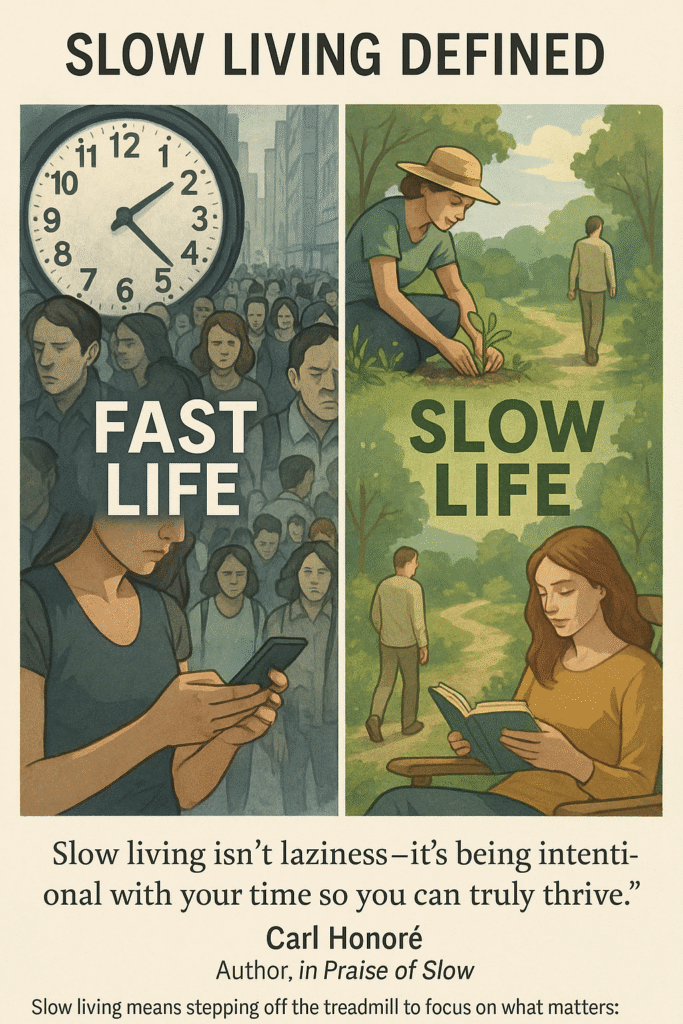
Slow living isn’t about doing everything at a snail’s pace – it’s about doing the right things at the right pace. Emerging from Italy’s Slow Food Movement in the 1980s as a protest against fast food culture, the philosophy has since expanded into a comprehensive approach to modern living.

“Slow living is essentially about reclaiming your attention and aligning your daily life with your deepest values,” explains Carl Honoré, author of the international bestseller In Praise of Slow. “For the over-55s, it offers particularly powerful benefits because it helps counteract many of the psychological and physiological challenges of ageing.”

Why Slow Living Resonates with the Over-55s

A 2023 study by Age UK revealed startling statistics:

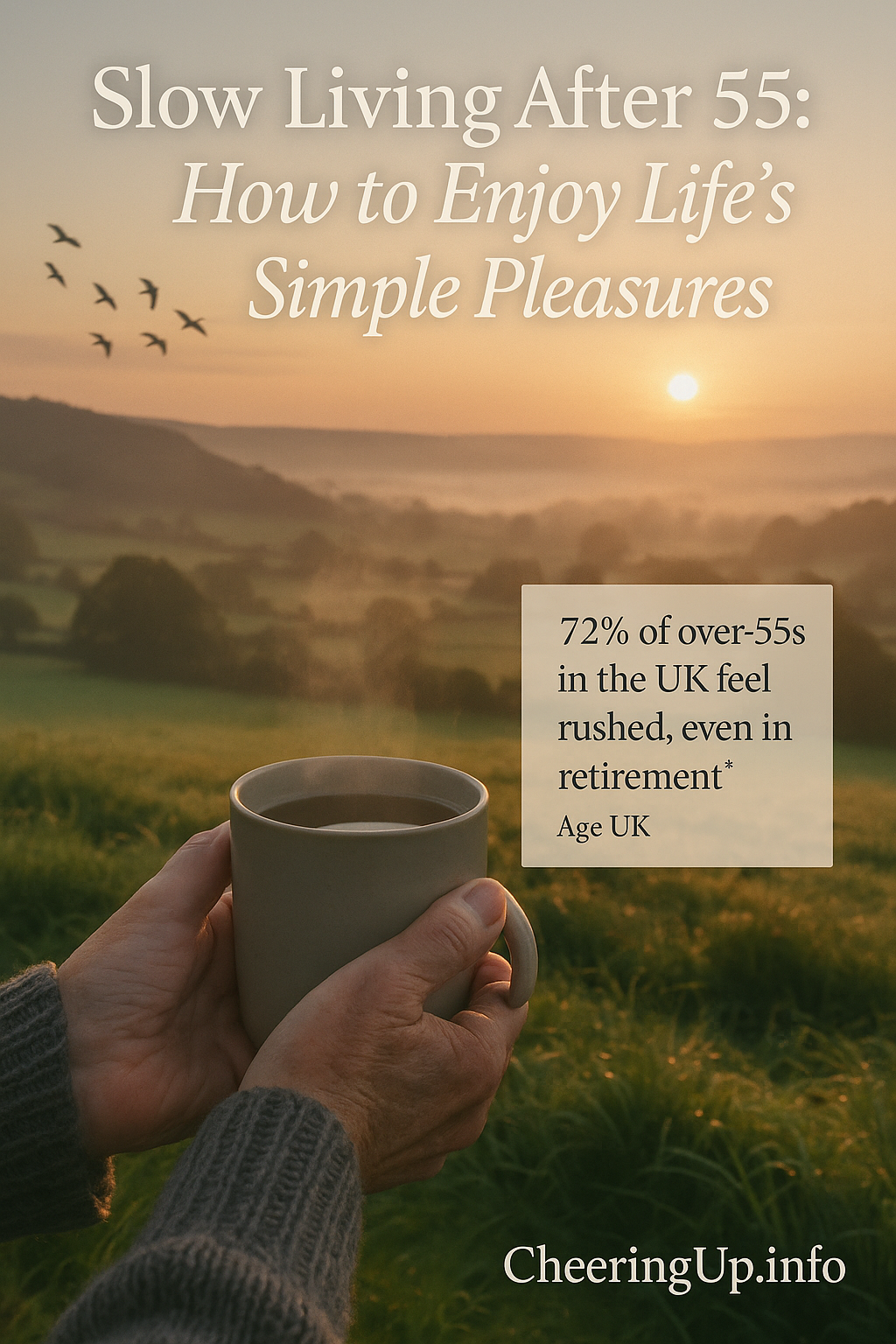
  • 72% of over-55s reported feeling “constantly rushed” despite being retired
  • 65% said they experienced more stress post-retirement than anticipated
  • 82% wished they had more “quality time” with loved ones

Dr. Rebecca Harris, gerontologist at the University of Bristol, explains: “As we age, our relationship with time fundamentally changes. The over-55s often experience what we call ‘time compression’ – the sensation that time is accelerating. Slow living practices help expand our perception of time by bringing us into the present moment.”

The Neuroscience of Slowing Down

Groundbreaking research in neuroplasticity shows that our brains remain adaptable throughout life. A 2022 Cambridge University study found that mindfulness practices common in slow living:

  • Increase grey matter density in memory-related brain regions
  • Strengthen the prefrontal cortex, improving decision-making
  • Reduce amygdala activity, decreasing stress responses

“What’s remarkable,” notes Dr. Harris, “is that these changes were particularly pronounced in participants over 60, suggesting older brains may be especially responsive to slow living practices.”


The Transformative Health Benefits of Slow Living

1. Mental Wellbeing: From Stress to Serenity

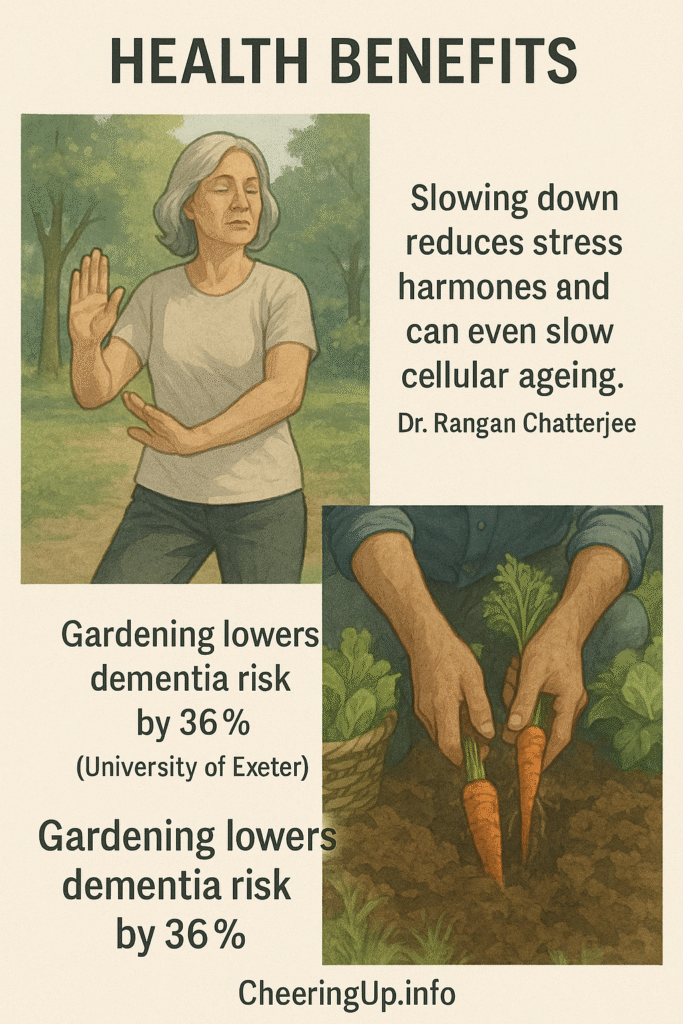
Dr. Rangan Chatterjee, BBC presenter and author of The Stress Solution, explains: “Chronic stress accelerates cellular ageing through telomere shortening. Slow living practices like mindfulness and nature immersion activate the parasympathetic nervous system, which acts as an anti-ageing mechanism.”

Case Study: Margaret’s Transformation
Margaret, 67, a retired teacher from Brighton, struggled with:

  • Chronic insomnia
  • Retirement-related anxiety
  • Feeling “useless” without work structure

Her slow living prescription:

  1. Digital sunset (no screens after 7pm)
  2. Morning pages journaling (3 handwritten pages each morning)
  3. Daily “forest bathing” in Stanmer Park

“Within three months, my sleep improved dramatically,” Margaret reports. “I’ve rediscovered my love for watercolours and actually enjoy my own company now.”

2. Physical Health: Movement That Matters

Unlike punishing exercise regimens, slow living promotes sustainable movement:

ActivityProven BenefitsIdeal For
Tai ChiImproves balance (reducing fall risk by 43%)Arthritis sufferers
GardeningLowers dementia risk by 36% (Exeter University)Those with limited mobility
Nordic Walking40% more calorie burn than regular walkingCardiovascular health

“The key is consistency over intensity,” emphasises Dr. Muir Gray, NHS adviser on healthy ageing. “Ten minutes of daily gentle movement beats one hour of weekly intense exercise for longevity benefits.”

3. Cognitive Benefits: Keeping the Mind Agile

Dr. Angela Clow’s research at Westminster University demonstrates how slow hobbies create cognitive reserve:

  • Learning a language: Increases grey matter density
  • Playing chess: Enhances strategic thinking
  • Playing musical instruments: Improves neural connectivity

“The brain needs novelty, but without time pressure,” Dr. Clow explains. “This combination is perfect for maintaining cognitive function as we age.”


Slow Travel – The Art of Journeying Mindfully

Why Slow Travel Transforms Later-Life Adventures

Pauline Kenny, founder of Slow Europe, observes: “Traditional tourism often leaves older travellers exhausted. Slow travel aligns perfectly with the needs of over-55s by prioritising depth over distance, experience over checklist tourism.”

The Slow Travel Advantage:

Traditional TravelSlow Travel
Packed itinerariesSpontaneous exploration
Tourist hotspotsLocal hidden gems
Jet lagNatural rhythms
Surface experiencesMeaningful connections

Inspiring Slow Travel Ideas for Over-55s

UK Canal Boating Holidays

  • Route suggestion: The Llangollen Canal (7 days)
  • Highlights:
  • Walking pace travel (max 4mph)
  • Quaint waterside pubs
  • Operating locks (gentle physical activity)
  • Cost: From £1,200/week (shared between 4)

“It’s the perfect blend of gentle adventure and relaxation,” says Derek, 71, who holidays annually with his canal boat group.

European House Sitting

  • How it works: Care for homes/pets in exchange for free accommodation
  • Best platforms: TrustedHousesitters, MindMyHouse
  • Ideal locations: Rural France, Italian countryside

Case Study: Susan’s Year of Slow Travel
Susan, 68, spent 2023 house sitting in:

  • A Provençal vineyard
  • A Tuscan farmhouse
  • A Portuguese coastal village
    “I’ve lived like a local across Europe for a fraction of hotel costs,” she says.

Pilgrimage Walking (The Slowest Travel)

  • Camino de Santiago: The Portuguese route (gentler terrain)
  • UK alternatives:
  • St Cuthbert’s Way (Scotland/England border)
  • Pilgrims’ Way to Canterbury

Slow Home Living – Creating Your Personal Sanctuary

The Psychology of Slow Spaces

Julia Atkinson-Dunn, slow living advocate and author, explains: “Our homes should be our sanctuaries, especially as we age. A slow home isn’t about aesthetic perfection – it’s about creating spaces that support how you truly want to live.”

The 5 Pillars of Slow Home Living:

Intentional Spaces

  • Designate areas for specific activities (reading nook, craft corner)
  • Remove multi-purpose clutter

Natural Elements

  • Maximise natural light
  • Incorporate wood, stone and plants

Tech Boundaries

  • Create screen-free zones
  • Implement “digital sunsets”

Sensory Comfort

  • Soft textiles
  • Soothing colour palettes
  • Ambient lighting

Ease of Movement

  • Age-friendly design
  • Clear pathways
  • Comfortable seating

Case Study: John & Linda’s Downsizing Journey
This York couple transformed their living space by:

  • Implementing the “one in, one out” rule
  • Creating a dedicated slow living room (no TV, just books and music)
  • Designing a low-maintenance garden with raised beds

“Our home now feels like a daily retreat rather than a maintenance burden,” Linda shares.


Slow Finances – Redefining Wealth in Later Life

The New Retirement Economics

Sarah Coles, personal finance analyst at Hargreaves Lansdown, notes: “The traditional retirement model is broken. People are living longer but often worrying more about money. Slow finances offer a sustainable alternative.”

Principles of Slow Finance:

‘Enough Mindset’

  • Distinguish between needs and wants
  • Practice conscious consumption

Sustainable Withdrawal Strategies

  • The 3.5% rule (safer than traditional 4%)
  • Bucket strategy for market downturns

Experimental Spending

  • Prioritise meaningful experiences
  • The “20-year test” (“Will this matter in 20 years?”)

Case Study: Geoff’s Investment Transformation
Geoff, 68, shifted from active trading to slow investing:

  • Moved to dividend-paying stocks
  • Implemented a three-bucket system:
  1. Immediate cash needs
  2. 3-5 year bonds
  3. Long-term growth funds
    “I sleep better and my portfolio grows steadily,” he reports.

Your 7-Day Slow Living Challenge

Day 1: Digital Detox

  • No screens before breakfast/after dinner
  • Try analog alternatives (physical books, handwritten letters)

Day 2: Mindful Eating

  • Prepare one meal from scratch
  • Eat without distractions

Day 3: Nature Immersion

  • 30+ minutes outdoors
  • Practice “forest bathing”

Day 4: Financial Review

  • Cancel one unused subscription
  • Set up a “slow spending” tracker

Day 5: Social Slowdown

  • One quality conversation (no multitasking)
  • Write a heartfelt letter

Day 6: Home Sanctuary

  • Declutter one space
  • Create a slow living corner

Day 7: Reflection

  • Journal about your experience
  • Plan ongoing slow living practices

Conclusion: Your Slow Living Blueprint

The Slower You Go The More You’ll Notice!

Slow living isn’t about withdrawing from life – it’s about engaging with it more deeply. As Dr. Brewer concludes: “The slower you go, the more you’ll discover that true richness comes not from accumulation, but from appreciation.”

Your Next Steps:

  1. Start small – Pick one element from this guide to implement
  2. Build gradually – Add new practices as habits form
  3. Share the journey – Inspire others in your community

Remember, as Carl Honoré reminds us: “Slowing down isn’t about giving up – it’s about gearing up for what truly matters.” Your most fulfilling years may well be ahead of you, waiting to be discovered at the perfect pace – yours.

Join our Retirement Club today

Get help to protect and grow your business faster with CheeringUpInfo

Find out more about Lifestyle Improvement Club Corporate Membership here

Subscribe for free retirement lifestyle improvement tips reviews and money saving ideas

Connect with us for free retirement lifestyle improvement tips

Read more retirement lifestyle improvement articles and view videos for free

Connect with us for retirement lifestyle improvement articles and videos alerts to inform your retirement life decision making

Slow Living After 55: How to Enjoy Life’s Simple Pleasures

Read and view more:

How to embrace slow living after retirement UK

Best slow travel ideas for seniors in the UK

Mindful living tips for over 55s to reduce stress

Simple living strategies for UK retirees on a budget

Archived articles:

1. #SlowLivingUK

2. #Over55AndThriving

3. #MindfulRetirement

4. #SlowTravelUK

5. #SimplifyAfter50

Bonus Articles :

  • #UKRetirementLife
  • #ConsciousAgeing

What is the opportunity cost of staying in a stagnant job UK 2025

The hidden costs of job inertia in the current UK market

The hum of anxiety, the quiet dread. It’s a feeling many know too well. The UK job market in 2025 is a landscape of shifting sands. You feel it, don’t you? “Better the devil you know,” they say. But what if the devil you know is slowly draining your life? Consider this: a recent study found that 72% of professionals are experiencing increased job-related stress due to economic uncertainty. That’s a staggering number. It’s not just about a paycheck. It’s about your life. It’s about your happiness, your health, your very well-being. Are you trading your potential for the illusion of stability? I know I’ve been there. Let’s explore how to break free. Let’s talk about the opportunity cost of staying put. Let’s talk about building a life you love. Welcome to your guide to navigating the 2025 UK job market and reclaiming your potential.

Are You Staying in Your Job Because of Uncertainty in the Marketplace?

The year is 2025. The UK job market is a complex tapestry woven with threads of technological disruption, economic fluctuations, and evolving workplace dynamics. Many professionals find themselves in a state of limbo, clinging to their current positions, not out of passion or fulfillment, but out of fear. This fear is rooted in the pervasive uncertainty that characterises the current economic climate. But what is the true cost of this inertia?

The Illusion of Security

The allure of a steady paycheck and familiar routine can be powerful. It provides a sense of security, a buffer against the unknown. However, this perceived security often comes at a steep price. When you stay in a job that no longer aligns with your aspirations, you stagnate. Your skills become outdated. Your passion wanes. You become a cog in a machine, rather than a driver of your own destiny.

Opportunity Cost: The Hidden Price Tag

The concept of opportunity cost is fundamental to understanding the true impact of staying in a stagnant job. It’s not just about the money you’re leaving on the table. It’s about the experiences you’re missing, the skills you’re not developing, and the potential you’re not realising.

  • Lifestyle: Are you sacrificing your dreams of travel, a better work-life balance, or a more fulfilling career? Are you missing out on precious moments with loved ones because you’re chained to a job that offers no joy?
  • Happiness: Job satisfaction is intrinsically linked to overall happiness. When you’re unhappy at work, it bleeds into every aspect of your life. Are you settling for mediocrity when you could be thriving?
  • Health: Chronic stress from a dissatisfying job can take a toll on your physical and mental health. Are you experiencing burnout, anxiety, or depression? Are you neglecting your well-being in the pursuit of a paycheck?
  • Wealth: In a dynamic job market, staying put can mean falling behind. Are you missing out on opportunities for career advancement and higher earning potential? Are you limiting your financial growth and jeopardising your long-term security?

Review of the UK Job Marketplace in 2025

To understand the opportunity cost of inaction, it’s essential to grasp the current state of the UK job market. Several key trends are shaping the landscape:

  • Technological Disruption: Artificial intelligence (AI), automation, and digital transformation are reshaping industries and creating new job roles while rendering others obsolete. The rise of remote work and the gig economy is changing the traditional employment model.
  • Economic Uncertainty: Global economic fluctuations, inflation, and political instability are creating a volatile job market. Companies are hesitant to make long-term commitments, leading to increased job insecurity.
  • Skills Gap: There’s a growing mismatch between the skills employers need and the skills workers possess. This skills gap is particularly pronounced in sectors like technology, healthcare, and green energy.
  • Emphasis on Soft Skills: In an increasingly automated world, soft skills like communication, critical thinking, and emotional intelligence are becoming more valuable than ever.
  • Focus on Sustainability: Companies are increasingly prioritising sustainability and environmental responsibility, creating new opportunities in green jobs and sustainable industries.
  • The Rise of Flexible Working: Employees are demanding greater flexibility in their work arrangements, and companies are adapting to accommodate these demands.

Impact on Different Sectors

  • Technology: The tech sector is booming, with high demand for software engineers, data scientists, and cybersecurity professionals. However, rapid technological advancements require continuous learning and adaptation.
  • Healthcare: The healthcare sector is facing increasing demand due to an ageing population and advancements in medical technology. There’s a shortage of nurses, doctors, and other healthcare professionals.
  • Green Energy: The transition to a sustainable economy is creating new opportunities in renewable energy, energy efficiency, and environmental management.
  • Finance: The finance sector is undergoing significant transformation due to digitalisation and regulatory changes. There’s a growing demand for professionals with skills in fintech, data analytics, and risk management.
  • Creative Industries: The creative industries are experiencing growth, driven by the demand for digital content and entertainment. However, competition is fierce, and professionals need to be highly skilled and adaptable.

9 Ways to Overcome Uncertainty in the UK Job Marketplace to Increase the Chances of Developing a Secure Career Development in 2025

Navigating the uncertainty of the 2025 UK job market requires a proactive and strategic approach. Here are nine actionable steps to take:

  1. Embrace Lifelong Learning: The skills gap is a reality. Invest in your professional development by acquiring new skills and staying up-to-date with industry trends. Take online courses, attend workshops, and pursue certifications. Focus on skills that are in high demand, such as data analysis, AI, and digital marketing.
  2. Build a Strong Network: Networking is crucial for career advancement. Attend industry events, join professional organisations, and connect with people on LinkedIn. Build genuine relationships and seek out mentors who can provide guidance and support.
  3. Develop Transferable Skills: Focus on developing skills that are applicable across different industries and job roles. These include communication, problem-solving, critical thinking, and adaptability. These skills will make you more resilient in a changing job market.
  4. Embrace Flexibility and Adaptability: Be open to new opportunities and willing to adapt to changing circumstances. Consider flexible work arrangements, such as remote work or freelance projects. Be prepared to pivot your career if necessary.
  5. Build a Strong Online Presence: Your online presence is your professional brand. Create a compelling LinkedIn profile, showcase your skills and accomplishments, and engage with industry content. Consider building a personal website or blog to demonstrate your expertise.
  6. Explore Emerging Industries: Identify industries that are experiencing growth and invest in the skills needed to succeed in those sectors. Consider opportunities in green energy, AI, and healthcare.
  7. Prioritise Mental and Physical Well-being: Job uncertainty can be stressful. Prioritise your mental and physical health by practicing self-care, managing stress, and maintaining a healthy work-life balance.
  8. Financial Planning: Create a financial safety net. Have a contingency fund that will allow you to navigate periods of unemployment or career transition. Plan your finances with a long term view.
  9. Seek Professional Guidance: Consider working with a career coach or mentor who can provide personalised guidance and support. They can help you identify your strengths, develop a career plan, and navigate the job market.

Join CheeringUp.info Lifestyle Improvement Club

Are you ready to take control of your career and create a life you love? I believe you are. You deserve more than just a job. You deserve a fulfilling career and a vibrant life. That’s why I created CheeringUp.info Lifestyle Improvement Club.

We are a community of like-minded professionals who are committed to personal and professional growth. We provide the resources, support, and inspiration you need to navigate the challenges of the modern job market and achieve your goals.

What We Offer:

  • Exclusive Content: Access to in-depth articles, videos, and podcasts on career development, personal growth, and well-being.
  • Live Workshops and Webinars: Learn from industry experts and gain practical skills to enhance your career.
  • Networking Opportunities: Connect with a supportive community of professionals and build valuable relationships.
  • Personalized Coaching: Receive one-on-one coaching to help you achieve your specific career goals.
  • Resource Library: Access to a wealth of resources, including templates, checklists, and guides.
  • Community Forums: Engage in discussions, share experiences, and receive support from fellow members.

Why Join Lifestyle Improvement Club?

  • Gain Clarity: Define your career goals and develop a clear roadmap for success.
  • Build Confidence: Overcome self-doubt and develop the confidence to pursue your dreams.
  • Expand Your Network: Connect with a community of professionals and build valuable relationships.
  • Enhance Your Skills: Acquire new skills and stay ahead of the curve in a rapidly changing job market.
  • Improve Your Well-being: Prioritise your mental and physical health and create a balanced and fulfilling life.

Don’t let uncertainty hold you back. Take the first step towards a brighter future. Join CheeringUp.info Lifestyle Improvement Club today! Visit CheeringUp.info

Get help to protect and grow your business faster

Find out more about Lifestyle Improvement Club Corporate Membership

Subscribe for free lifestyle improvement tips reviews and money saving ideas

Connect with us for free

Read more lifestyle improvement articles and view videos for free

Connect with us for free

Job Search and Career Development Tips

Read more articles and view videos:

  1. What is the opportunity cost of staying in a stagnant job UK 2025?
  2. How to overcome job market uncertainty and build career security UK 2025 guide
  3. Impact of technological disruption on job market and career development UK 2025
  4. Nine actionable steps for secure career development in the UK job market 2025
  5. Lifestyle improvement and overcoming job uncertainty in the 2025 UK economy

Relevant hashtags :

  1. #UKJobMarket2025
  2. #CareerDevelopmentUK
  3. #OvercomingUncertainty
  4. #LifestyleImprovement
  5. #FutureOfWorkUK
  6. #CheeringUpInfo
  7. #CheeringupTV

Easy Empanada Recipes UK: 6 Delicious Fillings to Try at Home

Homemade Empanada Recipes UK: 6 Steps to Deliciousness

Make Empanadas at Home UK: 6 Unique Filling Ideas

6 Great Empanada Recipes for the UK :

Empanada Dough (Makes 12)

  • 2 cups all-purpose flour
  • 1 teaspoon salt
  • 1/2 cup vegetable shortening
  • 4-6 tablespoons ice water

Instructions:

  1. Combine Dry Ingredients: In a large bowl, whisk together flour and salt.
  2. Cut in Shortening: Cut in shortening using a pastry blender or two knives until mixture resembles coarse crumbs.
  3. Add Water: Gradually add ice water, mixing with a fork until dough just comes together. Be careful not to overwork the dough.
  4. Chill: Wrap dough in plastic wrap and chill for at least 30 minutes before using.

Fillings:

1. Spicy Beef Empanadas

  • Ingredients:
    • 1 pound ground beef
    • 1 onion, chopped
    • 2 cloves garlic, minced
    • 1 teaspoon chili powder
    • 1/2 teaspoon cumin
    • 1/4 teaspoon paprika
    • Salt and pepper to taste
    • 1/4 cup chopped cilantro
    • 1/4 cup chopped green olives (optional)
  • Instructions:
    • Brown ground beef in a skillet.
    • Add onion and garlic, cook until softened.
    • Stir in chili powder, cumin, paprika, salt, and pepper.
    • Cook for a few minutes more, then add cilantro and olives.
    • Let cool slightly before filling empanadas.

2. Creamy Chicken Empanadas

  • Ingredients:
    • 2 cups cooked shredded chicken
    • 1/2 cup mayonnaise
    • 1/4 cup sour cream
    • 1/4 cup chopped green onions
    • 1/4 teaspoon garlic powder
    • Salt and pepper to taste
  • Instructions:
    • Combine all ingredients in a bowl and mix well.
    • Taste and adjust seasonings as needed.

3. Cheesy Spinach Empanadas

  • Ingredients:
    • 10 ounces frozen chopped spinach, thawed and squeezed dry
    • 1/2 cup grated Parmesan cheese
    • 1/4 cup ricotta cheese
    • 1 egg, beaten
    • 1/4 teaspoon nutmeg
    • Salt and pepper to taste
  • Instructions:
    • Combine all ingredients in a bowl and mix well.

4. Savoury Mushroom Empanadas

  • Ingredients:
    • 1 pound mushrooms, chopped
    • 1 onion, chopped
    • 2 cloves garlic, minced
    • 2 tablespoons butter
    • 1/4 cup chopped parsley
    • Salt and pepper to taste
  • Instructions:
    • Sauté mushrooms, onion, and garlic in butter until softened.
    • Stir in parsley, salt, and pepper.
    • Let cool slightly before filling empanadas.

5. Hearty Lentil Empanadas

  • Ingredients:
    • 1 cup cooked lentils
    • 1/2 cup chopped carrots
    • 1/4 cup chopped celery
    • 1/4 cup chopped onion
    • 2 tablespoons olive oil
    • 1 teaspoon cumin
    • 1/2 teaspoon paprika
    • Salt and pepper to taste
  • Instructions:
    • Sauté carrots, celery, and onion in olive oil until softened.
    • Add lentils, cumin, paprika, salt, and pepper.
    • Cook for a few minutes more, then let cool slightly.

6. Sweet Potato and Black Bean Empanadas

  • Ingredients:
    • 1 cup cooked and mashed sweet potato
    • 1 cup cooked black beans, rinsed and drained
    • 1/4 cup chopped onion
    • 1/4 cup chopped bell pepper
    • 1 tablespoon chili powder
    • 1 teaspoon cumin
    • Salt and pepper to taste
  • Instructions:
    • Combine all ingredients in a bowl and mix well.

Assembling and Cooking Empanadas:

  1. Preheat oven to 375°F (190°C).
  2. Roll out dough: On a lightly floured surface, roll out dough to about 1/8-inch thickness.
  3. Cut out circles: Use a 4-inch round cutter to cut out circles from the dough.
  4. Fill empanadas: Place a spoonful of filling in the centre of each circle.
  5. Seal empanadas: Moisten the edges of the dough with water. Fold dough over filling and press edges together firmly to seal. Crimp edges with a fork or your fingers.
  6. Bake: Place empanadas on a baking sheet lined with parchment paper. Bake for 15-20 minutes, or until golden brown.

Enjoy your delicious homemade empanadas!

Get help to protect and grow your business faster with CheeringupInfo

Find out more about Lifestyle Improvement Club Corporate Membership

Subscribe for free lifestyle improvement tips reviews and money saving ideas

Connect with us for free

Read more lifestyle improvement articles and watch videos for free

Connect with us for free

Make Empanadas At Home UK

6 Great Empanada Recipes for the UK Hashtags :

  1. #EmpanadasUK
  2. #UKFoodBlog
  3. #HomemadeEmpanadas
  4. #LatinFlavoursUK
  5. #EasyRecipes
  6. #CheeringupInfo
  7. #CheeringupTV

Read more :

  1. Easy Empanada Recipes UK: 6 Delicious Fillings to Try at Home
  2. Make Empanadas at Home UK: 6 Unique Filling Ideas
  3. Best Empanada Recipes UK: 6 Flavourful Options for Beginners
  4. Authentic Empanada Recipes UK: 6 Regional Flavours to Explore – for those interested in authentic flavours
  5. Homemade Empanada Recipes UK: 6 Steps to Deliciousness

Building a supportive community in UK online

Let’s face it, life in the UK is a whirlwind. Between juggling work deadlines, navigating the daily commute, and keeping up with family (furry or otherwise!), it’s easy to feel like we’re just spinning on a hamster wheel with no real progress. But what if we told you there’s a way to break free, ditch the autopilot, and design a life that makes you genuinely happy, healthy, and financially secure in 2025?

Feeling Stuck in the Grind? It’s Time to Level Up Your Life!

Intrigued? We thought so! Here at Cheeringup.info, we’re all about empowering busy people like you to take control and become the master of your own destiny. Forget fleeting trends and fad diets – we’re about building sustainable, long-term changes that resonate with your unique needs and aspirations.

Think this sounds too good to be true? It’s not. Take a look at this eye-opening statistic: A 2023 University of Warwick study found that individuals who actively set and pursued personal development goals experienced a significant increase in overall life satisfaction and happiness.

This magazine is your roadmap to unlocking greater happiness and life satisfaction! We’ll dive deep into six actionable steps you can take right now to identify the key areas impacting your happiness, health, and wealth. We’ll bust the myths, provide practical advice tailored to the UK landscape, and equip you with the tools to build a life that truly excites you.

Lifestyle Improvement Club Magazine
Why do I feel like I’m a hamster on a wheel

Are you ready to ditch the hamster wheel and trade it for the open road? Let’s get started!

Six Steps to a Happier, Healthier, Wealthier You in 2025:

  1. Mindful Assessment:
    • Action: Spend an hour each day for a week mindfully observing your thoughts, emotions, and daily routines. Journal your observations.
    • Why it Matters: Identifying your current patterns and triggers is crucial for making lasting change.
  2. Value Clarification:
    • Action: Create a list of your top 10 values. Reflect on how your current lifestyle aligns (or doesn’t) with these values.
    • Why it Matters: Aligning your actions with your values brings a sense of purpose and fulfillment.
  3. Goal Setting (with a Twist):
    • Action: Instead of traditional SMART goals, set “BHAGs” – Big Hairy Audacious Goals (or Big Hairy Arse Goals!). These ambitious goals push you beyond your comfort zone.
    • Why it Matters: Challenging yourself leads to significant personal growth and unexpected rewards.
  4. Optimise Your Environment:
    • Action: Declutter your physical and digital spaces. Minimise distractions and create an environment that supports your goals.
    • Why it Matters: A clutter-free environment leads to a clearer mind and improved focus.
  5. Prioritise Self-Care:
    • Action: Schedule regular breaks throughout your day. Explore mindfulness techniques like meditation or deep breathing.
    • Why it Matters: Prioritising self-care prevents burnout and enhances your overall well-being.
  6. Build a Supportive Network:
    • Action: Connect with like-minded individuals. Join a local club, attend workshops, or find an accountability partner.
    • Why it Matters: Having a strong support system provides encouragement, motivation, and a sense of community.

Ready to take the first step towards a life you love? Join the Cheeringup.info Lifestyle Improvement Club today! Our one-time lifetime membership provides you with exclusive access to:

  • Online workshops and webinars led by expert coaches and practitioners.
  • Personalised goal-setting templates and resources.
  • A vibrant online community of like-minded individuals.
  • Exclusive discounts on health and wellness products and services.

Don’t wait another day. Invest in yourself and unlock your full potential. Learn more and join the club today!

Business Leaders: Elevate Your Brand with Cheeringup.info!

Reach a highly engaged audience of professionals seeking a better life. Our members are driven, ambitious, and open to discovering new products and services that align with their pursuit of happiness, health, and wealth.

Partner with us for a year of targeted advertising and unlock a world of benefits:

  • Premium Placement: Your ads will be featured prominently throughout our magazine and online platforms, ensuring maximum visibility.
  • Exclusive Content Opportunities: Share your expertise through sponsored articles, interviews, or webinars, positioning your brand as a thought leader.
  • Targeted Campaigns: We’ll work with you to craft customised campaigns that resonate with our audience’s specific interests and needs.
  • Measurable Results: Track your campaign’s performance and gain valuable insights into your target market.

Ready to elevate your brand and connect with a thriving community of high-achievers?

Contact us today to learn more about our advertising opportunities and let’s create a winning partnership!

Get help to protect and grow your business faster with CheeringupInfo

Find out more about Lifestyle Improvement Club Corporate Membership

Subscribe for free lifestyle improvement tips reviews and money saving deals

Connect with us for free

Read more lifestyle improvement articles and watch videos for free

Connect with us for free

Cheeringup.info Lifestyle Improvement Club Relevant Hashtags:

  1. #UKLifestyleImprovement
  2. #CheeringupClub
  3. #HappinessHealthWealth
  4. #PersonalGrowthUK
  5. #MindfulLivingUK
  6. #CheeringupInfo
  7. #CheeringupTV

Cheeringup.info Lifestyle Improvement Club … read more:

  1. improve work-life balance UK
  2. personal development coaching for professionals UK
  3. mindfulness techniques for busy professionals UK
  4. achieve financial freedom UK
  5. build a supportive community UK

X