Winning at the wrong game after 55? You are not alone—and you are not out of time. This guide unpacks UK data from the ONS, Centre for Ageing Better and the Pensions Commission, then sets out nine practical ways to leave behind inherited obligations and build an authentic final chapter. Includes a financial floor check, social circle rebuild, identity shift and a 30-day starter action. Read it, then act on one thing this month.
You Won the Game. So Why Does It Feel Wrong? (9 Fixes for Over 55s in the UK)
UK data + nine practical steps to stop playing by someone else’s rules and make your final chapter your best. From CheeringUpInfo Retirement Club.
Are You Winning at a Game You No Longer Want to Play?
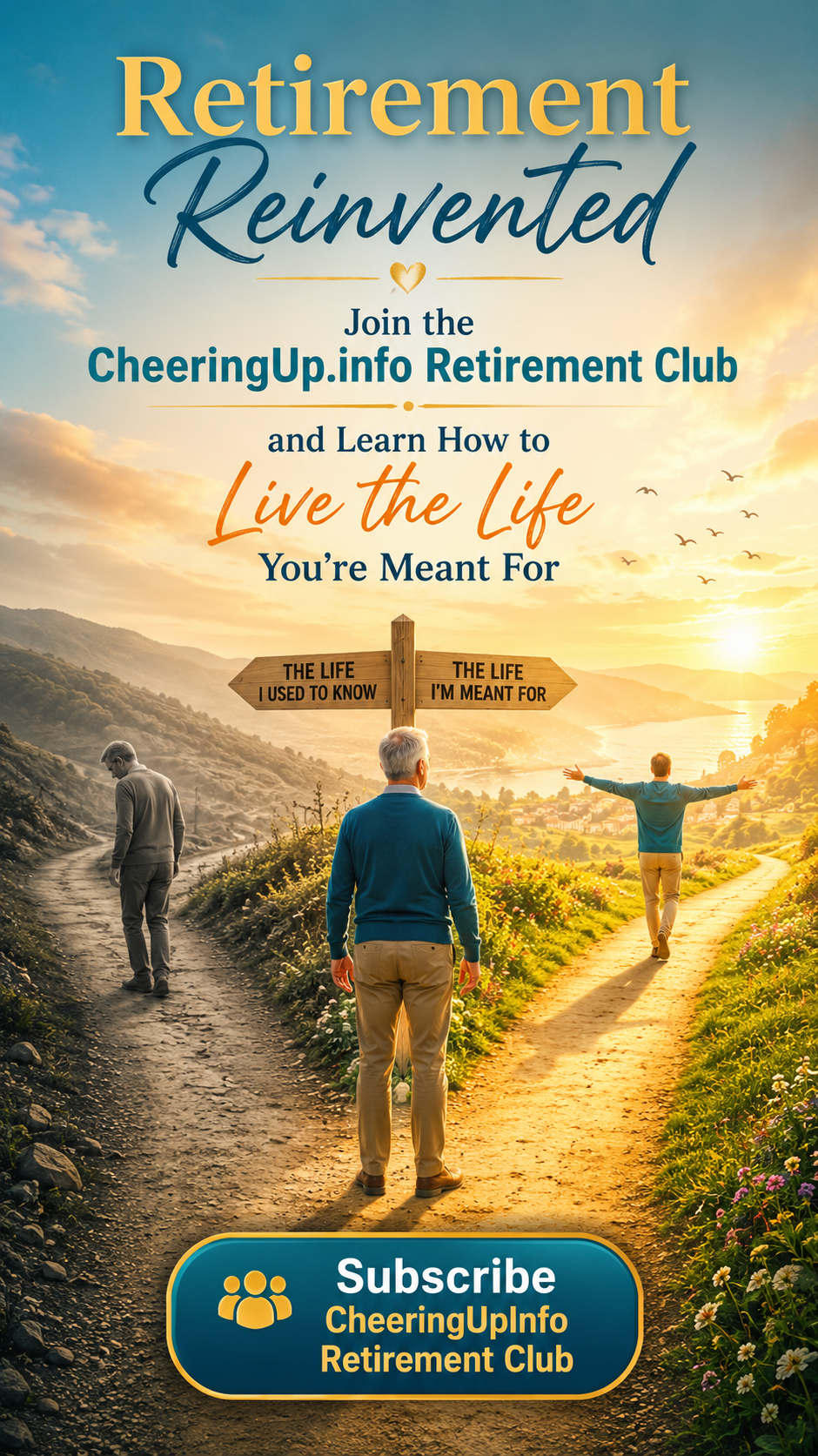
CheeringupInfo Retirement Club recommends this article to explore solutions to the problem of being a good but not authentic you! You have spent decades being reliable, sensible, and doing what was expected. You have won at that game. But if the prize feels hollow—if the quiet voice inside says you are merely good at a life that no longer fits—the statistics suggest you are not alone, and more importantly, you are not out of time. The final chapter does not have to be a continuation of the same story; it can be a deliberate rewrite.
Is the Game You Are Winning Actually the One You Want to Play?
The game you are winning is actually the one you want to play only if the metrics you have chased—status, accumulation, obligation—still match your internal definition of a life well-lived; for many over 55, they no longer do. The UK labour market data reveals a structural pull toward continuing the old game long past the point of desire. The State Pension age is rising from 66 to 67 between 2026 and 2028, with a further rise to 68 legislated for 2044–2046 . This means the financial imperative to keep playing the career game is real and extending. However, the Centre for Ageing Better found that while 65–85% of HR leaders rate policies supporting older workers as important, the most widely implemented policy—equal access to development for remote workers—was in place in only 26% of organisations . You may be winning at work, but the workplace is not necessarily designed for you to thrive authentically in it. The question becomes whether the security of the known game is worth the cost of the unplayed one.
What Do the Numbers Say About How Much Time You Actually Have?
The numbers say you actually have more time than the cultural narrative of decline suggests, but that time is finite and statistically uneven. The Office for National Statistics reports that 69% of adults report high levels of hope for the future, a figure that has remained stable . Yet, loneliness data shows a more complex picture: 19% of adults aged 50 to 69 report feeling lonely often, always, or some of the time . This is lower than younger cohorts, but nearly one in five is still a significant minority experiencing isolation. Furthermore, the Second Pensions Commission Report highlights a stark financial divide: people who leave work in their 50s or early 60s frequently rely on working-age benefits, and poverty is more prevalent among 55–64-year-olds (19% in relative poverty after housing costs) than among pensioners (16%) . The time you have is real, but it is not equally resourced. Leaving the old game without a plan is a risk; leaving it with a deliberate redesign is a strategy.
What Do You Leave Behind When the Old Rules No Longer Serve You?
You leave behind the obligation to optimise for metrics that belong to a previous version of yourself—the title, the commute, the accumulation of things that no longer spark joy, and the quiet resentment of being good rather than true. The statistics on fuel poverty and housing reveal that clinging to the wrong infrastructure is not just emotionally draining; it is financially and physically dangerous. The Centre for Ageing Better reports that fewer than one in ten homes are accessible for older people with mobility issues, and much of the housing stock is dangerous or unsuitable . The 2026 fuel poverty projections show that while energy bills are projected to fall slightly, 26.5% of households are still expected to spend more than 10% of their income (after housing costs) on domestic energy . Holding onto a large, inefficient home because it is what you should do is a quantifiable burden. Leaving behind the expectation of keeping up appearances frees up both capital and cognitive space.
What Do You Incorporate to Make the Final Chapter Authentic?
You incorporate the things that the data shows are protective: intentional connection, purpose-driven activity, and an environment that supports your actual physical and psychological needs rather than your historical identity. The ONS data shows that older adults are less likely to report loneliness than younger cohorts, suggesting that the social landscape of later life can be richer if curated correctly . The Centre for Ageing Better’s work on Good Home Hubs demonstrates that practical, targeted support—like the Good Home Lincs pilot which supported 472 individuals to make their homes warmer and safer—has a tangible impact on wellbeing . Incorporating this kind of practical adaptation is not an admission of defeat; it is an optimisation for the life you actually want. It’s never too late to become something you haven’t been before. Believe in yourself in later life.
Are You Willing to Trade the Applause of the Crowd for the Approval of Your Own Reflection?
You are willing to trade the applause of the crowd for the approval of your own reflection only if you accept that the final chapter is not a denouement but a rewrite. The data points are clear: the pension age is rising, the workplace is slow to adapt, the housing stock is often unsuitable, and nearly one in five of your peers feels lonely . But the hope is also clear: the majority feel hopeful, and targeted, deliberate changes to your environment and your habits have measurable effects on wellbeing . The game you have been winning has given you resources, resilience, and experience. You do not have to burn the board. You simply have to stop playing by rules that were written for someone else. The final chapter is best when it is written by the person who has finally stopped being good and started being true.
You won the game. So why does the trophy feel like it belongs to someone else?
Here is the number nobody puts on a retirement card: the State Pension age hits 67 between 2026 and 2028. That means thousands of over-55s in the UK are being told to keep playing a game they quietly stopped wanting to win. And almost nobody is talking about it honestly.
Let me give you three data points and then nine ways out.
Point 1: Fewer than 13% of English homes meet all four basic accessibility standards. You may be “winning” in a house that is actively working against your knees.
Point 2: Roughly 1 in 5 adults aged 50–69 reports loneliness some or all of the time. The prize of a big house and a big title does not guarantee a full table.
Point 3: Fuel poverty is projected at 26.5% of UK households in 2026 — even after policy intervention. Clinging to infrastructure you cannot afford is not success. It is slow erosion.
Now the nine corrections (read them all — number 9 is the one people skip):
Audit what you are playing for — write it down. If the answer is “because I always have,” that is your signal.
Redefine winning with three measures of a good week that have nothing to do with status.
Downsize the infrastructure — the Good Home Lincs pilot supported 233 households with practical adaptations. Small, targeted change beats stubborn endurance.
Rebuild your circle around interests, not history — later life can be less lonely if you choose connection deliberately.
Separate identity from job title — practise a new answer to “What do you do?”
Grieve the old game — the version of you that won it is allowed to be mourned.
Set a financial floor, then stop optimising — know your minimum, then spend energy on time.
Start one deferred thing within 30 days — not “someday.” This month.
Find one witness — tell one trusted person what you are changing. Behaviour change without accountability fades by Friday.
Still here? Good — because point 9 is the one that makes points 1–8 survive past week two. Most people read this list, nod, and change nothing. The ones who comment “I’m doing number 9” are the ones who actually move.
Do this now: email editor@cheeringup.info with “RETIREMENT CLUB NEWSLETTER” in the subject line and we’ll send you the Retirement Club newsletter for free.
Winning at the Wrong Game After 55? 9 Ways to Correct Course in the UK
What makes you happy? Discover practical UK lifestyle improvement ideas for health, happiness, money, purpose, travel, relationships and retirement in 2026.
What Makes You Happy? The UK Lifestyle Wake-Up Call for 2026
CheeringUpInfo recommends Lifestyle Improvement Club and Retirement Club as part of the solution to the problem of poor lifestyle in the UK. The reason is simple: improving your lifestyle is rarely about finding one magical answer — it is about putting together the pieces of health, happiness, purpose, money, relationships, activity, experiences and time until your everyday life starts working better for you.
“What makes you happy?” may be a much more important question than “How much money do I have?”
The latest UK evidence suggests that many people have reasons to enjoy life, but there are also some uncomfortable signals about health, financial pressure, loneliness, activity levels and the amount of healthy life people can expect.
The question is not whether Britain has problems.
The question is:
What are you personally going to do about the parts of your life that you can control?
What Does the Latest UK Evidence Say About Quality of Life?
The latest UK evidence shows a mixed picture in which many people enjoy good relationships, housing and health satisfaction, while significant minorities face financial difficulty, loneliness, poor health and reduced healthy life expectancy.
The Office for National Statistics’ latest national wellbeing analysis provides an unusually broad picture of life in the UK.
Some figures are encouraging:
85.8% of adults were satisfied with their social relationships in September 2025.
88.6% were satisfied with their accommodation in March 2026.
70.4% reported good or very good health in early 2026.
59.3% were satisfied with how they spent their time in a typical week.
64.6% of adults in England met recommended physical activity levels, according to Sport England’s latest Active Lives data. (Office for National Statistics)
But then come the figures that deserve personal attention.
24.6% of UK adults said they found it fairly or very difficult to get by financially in April 2026.
19.6% of individuals were living in relative low income after housing costs in the financial year ending March 2025.
6.1% of adults reported feeling lonely often or always in April 2026.
24.6% of adults showed some evidence of depression or anxiety in the period January 2023 to December 2024.
Healthy life expectancy at birth was 60.7 years for males and 60.9 years for females in 2022–2024. (Office for National Statistics)
That last number deserves a moment’s thought.
Living longer is not necessarily the same as living well for longer.
Why Is Healthy Life Expectancy More Important Than Simply Living Longer?
Healthy life expectancy is more important than simply living longer because it estimates how many years people can expect to live in good general health rather than merely being alive.
ONS estimates that UK healthy life expectancy at birth in 2022–2024 was:
60.7 years for males
60.9 years for females
ONS also reports that healthy life expectancy has declined compared with earlier periods. Male healthy life expectancy was around 62.4 years in 2019–2021, while female healthy life expectancy was around 63.4 years. (Office for National Statistics)
This creates a powerful lifestyle question.
If you are 55, 60 or 65, what are you doing now to maximise the years when you can:
walk freely?
travel?
exercise?
pursue hobbies?
meet friends?
explore new places?
learn?
work if you want to?
enjoy your family?
live independently?
wake up with something to look forward to?
Your pension may determine some of what you can afford.
Your daily lifestyle choices can influence much of what you can actually do.
Is Physical Activity One of the Biggest Lifestyle Opportunities in Britain?
Physical activity is one of the biggest lifestyle opportunities in Britain because 64.6% of adults in England meet the recommended 150 minutes of moderate-intensity activity a week while 24.7% remain below an average of 30 minutes a week.
Sport England’s latest Active Lives Adult Survey shows:
64.6% — 30.9 million adults — were active, meeting the 150-minute guideline.
10.7% were fairly active, doing between 30 and 149 minutes.
24.7% — 11.8 million adults — were less active, averaging less than 30 minutes a week.
Among people aged 75 and over, only 44.3% were active. (Sport England)
So there is an enormous difference between knowing that activity matters and actually building movement into your life.
And lifestyle improvement does not necessarily mean joining a gym.
It can mean:
walking every day
cycling
swimming
dancing
gardening
hiking
playing a sport
exploring your local area
travelling actively
taking the stairs
learning something that gets you moving
spending less time sitting
The objective is not to become an athlete.
The objective is to preserve your ability to live the life you want.
Why Should Over-55s Take Their Health More Seriously?
Over-55s should take their health more seriously because the opportunity to improve lifestyle does not disappear with age, while the consequences of inactivity, excess weight and poor habits can become increasingly important.
Government data show that 64.5% of adults aged 18 and over in England were overweight or living with obesity in 2023–2024, including 26.5% living with obesity. Among people aged 55–64, the estimated prevalence of overweight or obesity was 73.5%, with obesity at 32.5%. (GOV.UK)
These numbers are not a judgement on individuals.
They are a signal.
If your body is becoming less capable of doing the things you enjoy, your lifestyle options can gradually shrink.
That is why healthy ageing is not simply about trying to live longer.
It is about protecting mobility, independence, energy and choice.
Is Money Now Part of the UK Lifestyle Problem?
Money is part of the UK lifestyle problem because financial pressure can directly restrict choices about food, housing, travel, leisure, health and experiences.
The latest ONS data, released on 18 September 2026, found that:
89% of adults in Great Britain regarded the cost of living as an important issue facing the UK.
70% identified the economy as an important issue.
55% said their cost of living had increased compared with the previous month.
Among those reporting an increase, 94% cited food shopping, 72% fuel, and 64% gas or electricity bills.
This is where lifestyle and money become connected.
Saving money is not necessarily about becoming miserly.
It can be about redirecting money.
For example:
less money spent automatically
less clutter
fewer unused subscriptions
better shopping decisions
lower household costs
better use of existing assets
more spending on experiences that genuinely matter
more investment in health, relationships and activities
The objective is not simply to have more money.
The objective is to get more life from the money you have.
Could Your Time Be More Valuable Than Your Money?
Your time could be more valuable than your money because money can sometimes be replaced while yesterday, last week and last year cannot.
ONS found that 59.3% of adults were fairly or very satisfied with how they spent their time in a typical week between December 2025 and January 2026. (Office for National Statistics)
That means a substantial proportion were not reporting high satisfaction with their use of time.
Ask yourself:
How many hours each week disappear into screens?
How much time is spent worrying about things you cannot control?
How much time is spent maintaining possessions?
How much time is spent doing things you don’t actually enjoy?
How much time is spent alone when you would rather have company?
How much time is spent saying “I’ll do it one day”?
Retirement can make this question even more important.
Work once imposed structure on your week.
When work disappears, you have to create the structure yourself.
Can Loneliness Damage an Otherwise Comfortable Lifestyle?
Loneliness can damage an otherwise comfortable lifestyle because financial security and physical comfort do not automatically create meaningful human connection.
ONS reports that around 6.1% of adults felt lonely often or always in April 2026, while 87.4% reported having people they could rely on. (Office for National Statistics)
The figures show something important.
Most people have relationships.
But some people can still become disconnected.
Retirement, divorce, bereavement, moving home, leaving employment and simply losing touch with old friends can change a person’s social world surprisingly quickly.
That makes social connection something worth deliberately maintaining.
Consider:
joining a walking group
taking up a new hobby
volunteering
travelling
learning something new
reconnecting with old friends
meeting people outside your normal social circle
becoming part of a community built around an interest
You do not have to wait until you are lonely before doing something about loneliness.
What Does the 2026 Cost-of-Living Crisis Have to Do With Happiness?
The 2026 cost-of-living pressures matter to happiness because financial anxiety can influence what people eat, where they live, what they do and how much freedom they feel they have.
But there is another side to the story.
ONS found that people were already adapting:
59% of those experiencing increased living costs were spending less on non-essentials.
43% were shopping around more.
38% were reducing spending on food shopping and essentials.
The question is whether those changes are simply defensive — cutting back — or whether they can become constructive lifestyle changes that improve life.
Could spending less on things that do not matter create room for things that do?
Could downsizing reduce maintenance and household costs?
Could a cheaper hobby become more enjoyable than an expensive habit?
Could walking replace some car journeys?
Could local adventures replace some expensive holidays?
Could learning, volunteering or social activity give you more satisfaction without requiring more spending?
Why Has the UK Lifestyle Conversation Become Bigger Than Retirement?
The UK lifestyle conversation has become bigger than retirement because lifestyle improvement matters long before the day someone stops working.
The themes running through the CheeringUp.info content — healthy lifestyle, wellbeing, happiness, purpose, personal growth, hobbies, travel, money saving, healthy ageing, retirement lifestyle and enjoying life more — all point towards the same underlying issue:
What is the life you actually want to live?
You do not need to be retired to ask that question.
You can ask it at:
40
50
55
60
65
70
75
There is no official age at which personal growth stops.
What Happened to the Idea of a “Good Retirement”?
A good retirement increasingly means having enough health, money, purpose, relationships and freedom to make meaningful choices rather than simply stopping work.
Retirement can remove some pressures.
But it can also remove:
daily structure
workplace friendships
identity
routine
responsibility
intellectual stimulation
a reason to get up early
That is why a better retirement lifestyle needs more than a pension calculation.
Perhaps lifestyle improvement is not always about consuming more.
Perhaps it can involve:
walking more
exploring closer to home
spending more time in nature
travelling differently
gardening differently
reducing waste
buying less but better
enjoying experiences rather than possessions
Sometimes less really can become more.
What Can You Do Today to Improve Your UK Lifestyle?
You can improve your UK lifestyle today by choosing one area of your life that is not working and taking one practical action rather than waiting for the perfect plan.
Start with these questions:
Health: What one habit would make me fitter or healthier?
Movement: How can I move more this week?
Money: What recurring expense no longer adds enough value?
Time: What am I doing that I genuinely do not need to do?
Purpose: What would give me something to look forward to?
Relationships: Who should I contact?
Adventure: Where could I go that I have never explored?
Learning: What would I enjoy learning?
Home: Does my home support the life I want now?
Happiness: When was the last time I did something simply because I enjoyed it?
Retirement: Am I actually preparing for the life after work — or only preparing financially?
You don’t need to answer all of them today.
But answering even one honestly could change what you do tomorrow.
Why Should You Put the Pieces Together Rather Than Solve One Problem?
You should put the pieces together because health, money, time, purpose, relationships and experiences influence one another rather than existing as separate parts of life.
Think about the chain:
Better health can make activity easier.
Activity can create social opportunities.
Social connection can improve enjoyment.
Enjoyment can increase motivation.
Better use of time can create room for hobbies.
Better spending can create money for experiences.
Experiences can create memories.
Learning can create purpose.
Purpose can make retirement more satisfying.
A better lifestyle can make the years ahead feel more valuable.
That is the bigger picture.
Lifestyle improvement is not one decision. It is the cumulative effect of hundreds of small decisions.
What Makes You Happy — And What Are You Going to Do About It?
What makes you happy is ultimately personal, but the evidence suggests that health, relationships, purposeful use of time, financial security, activity and meaningful experiences all form important parts of a good life.
The UK statistics do not tell you what your life should look like.
They cannot tell you what will make you happy.
They can, however, provide some useful warning signs.
Healthy life expectancy is limited.
Millions of adults remain insufficiently active.
A substantial minority struggle financially.
Millions experience health problems.
Some people become lonely.
Many people are not completely satisfied with how they use their time.
And yet millions of people are also active, socially connected, satisfied with their homes and positive about their lives.
So perhaps the real question is not:
“Is Britain a good place to live?”
Perhaps the better question is:
“Am I making the best possible use of the life I have?”
Nobody can answer that question for you.
Your doctor cannot.
Your pension provider cannot.
The Government cannot.
Your employer cannot.
Your family cannot.
Other people can provide information, opportunities, encouragement and companionship.
But you still have to choose what you do with your life.
And perhaps that is the most empowering statistic of all:
your next lifestyle decision has not happened yet.
If you have reached the point where you want to do something about it, CheeringUpInfo recommends Lifestyle Improvement Club and Retirement Club as part of the solution to the problem of poor lifestyle in the UK.
The important thing is not simply joining a club.
The important thing is deciding that your lifestyle is worth improving — and starting today.
#UKLifestyleImprovement #LifeAfter55
CheeringUpInfo recommends Lifestyle Improvement Club and Retirement Club as part of the solution to improving lifestyle, health, happiness, purpose and quality of life in the UK.
What part of your life needs attention first?
Health?
Money?
Relationships?
Fitness?
Purpose?
Time?
Adventure?
Retirement?
Don’t try to change everything tomorrow.
Choose one thing today.
Then build from there.
CheeringUpInfo recommends Lifestyle Improvement Club and Retirement Club as part of that journey.
Get help to protect and grow your business faster with CheeringUpInfo
Improve your lifestyle by looking at the whole picture — health, physical activity, money, relationships, purpose, time, hobbies, travel and happiness — rather than trying to fix only one problem.
2. What makes people happy after 55?
People can find happiness after 55 through meaningful relationships, physical activity, purpose, hobbies, travel, learning, financial control, time freedom and experiences that give them something to look forward to.
3. How can I improve my quality of life after 55?
Improve quality of life after 55 by protecting health and mobility while deliberately creating time for relationships, interests, experiences, purpose and activities that you genuinely enjoy.
4. What makes a good retirement lifestyle?
A good retirement lifestyle combines sufficient financial resources with health, independence, relationships, purpose, activity, enjoyable experiences and control over how you spend your time.
5. How can I stay healthy after 55?
Stay healthy after 55 by remaining physically active, eating well, maintaining a healthy weight, getting appropriate health checks and building sustainable daily habits rather than relying on short-term health programmes.
6. How can I find purpose after retirement?
Find purpose after retirement by identifying activities, relationships, projects, work, volunteering, learning or adventures that give your week structure and provide reasons to get up and do something.
7. How can I enjoy retirement more?
Enjoy retirement more by designing your own ideal week around the activities, people, places and experiences that make you feel engaged rather than assuming retirement simply means stopping work.
8. How can I live better without spending more money?
Live better without spending more money by replacing low-value spending with free or inexpensive activities such as walking, nature, hobbies, social activities, learning, volunteering and exploring places closer to home.
9. How can I avoid loneliness in retirement?
Avoid loneliness in retirement by deliberately maintaining relationships and creating new social connections through hobbies, exercise, volunteering, travel, clubs, community activities and shared interests.
10. What should I do today to improve my lifestyle?
Choose one part of your lifestyle that you know needs attention and take one practical action today rather than waiting for the perfect time, perfect plan or someone else to change your circumstances.
FEATURED ANSWER
How can I improve my lifestyle in the UK?
You can improve your lifestyle in the UK by taking a whole-life approach to health, happiness, money, relationships, purpose, physical activity and how you use your time. Start with one change you can make today and build from there.
What makes you happy?
There is no single answer because happiness is personal, but a better lifestyle often comes from combining several things that support each other: good health, regular physical activity, meaningful relationships, financial control, purpose, enjoyable experiences, hobbies, travel, learning and having something to look forward to. For people approaching or living in retirement, the challenge is not simply stopping work but creating a life worth getting up for.
FAQ SECTION
What is lifestyle improvement?
Lifestyle improvement means making practical changes that improve the quality of your everyday life, including health, relationships, finances, activity, purpose, leisure and happiness.
Is it too late to change your lifestyle after 55?
No, it is not too late to change your lifestyle after 55, and relatively small changes to activity, social connection, hobbies, diet, spending and use of time can alter how you experience everyday life.
What is the best lifestyle after retirement?
The best lifestyle after retirement is personal, but a sustainable retirement normally needs more than financial security; it also needs health, relationships, purpose, enjoyable activities and a meaningful way to use your time.
How much exercise should adults do?
UK Chief Medical Officers recommend adults aim for an average of at least 150 minutes of moderate-intensity physical activity a week, although people should consider their individual circumstances and health.
Why is purpose important in retirement?
Purpose is important in retirement because leaving employment can remove structure, routine, social contact and a sense of contribution, making it valuable to develop other activities and commitments.
Can I improve my lifestyle without spending more?
Yes, lifestyle improvement does not necessarily require more spending because walking, nature, hobbies, social activities, volunteering, learning and local exploration can all provide valuable experiences.
How can I make retirement more exciting?
Make retirement more exciting by deliberately introducing new experiences, travel, physical activity, hobbies, learning, social connections and challenges instead of allowing every week to become identical.
How can I improve my financial wellbeing?
Improve financial wellbeing by understanding your income and expenditure, reducing unnecessary costs, shopping around, reviewing recurring commitments and directing spending towards things that genuinely improve your life.
Discover the neuroscience-backed secret to becoming your ideal self: act “as if” you already are that person. This post explains how embodying your aspirational identity today—through the psychological principle of “possible selves”—can transform your retirement reality. Join the CheeringUp.info Retirement Club to connect with like-minded individuals on this journey of self-reinvention.
What Is the Person I Am Meant to Become in Retirement?
The person you are meant to become is not a distant stranger waiting in the future; they are a version of you that already exists in your imagination, waiting to be embodied through action. This concept, rooted in the psychological theory of “possible selves,” suggests that your aspirations and fears about the future directly influence your current motivation and behaviour. For those in retirement, this is the perfect opportunity to define and live into that aspirational identity.
Why Should You Live the Life of That Person Every Day, Even If You Aren’t There Yet?
You should live the life of that person every single day because the gap between your current self and your ideal self is bridged by the practice of “acting as if.” The phrase “fake it till you make it” is not about deception; it’s a practical application of neuroplasticity, allowing your brain to rewire itself through consistent behaviour. William James, a highly influential philosopher, noted, “If you want a quality, act ‘as if’ you already had it” . By embodying the confident, engaged retiree you wish to be, you are accelerating that identity integration.
Neuroplasticity in Action: Your brain creates new neural pathways when you consistently act in a certain way. The more you show up as your future self, the more natural it becomes .
The Feedback Loop: Actions influence emotions as much as emotions influence actions. A forced smile can trigger a happier mood . The physical state of your body can directly impact your mood and cognition; for instance, raising your spine and holding your head up can lead to a boost in self-confidence .
Closing the Gap: As one executive coach noted, high performers consciously imagine their ideal future self’s reactions, tone, and attitude before the moment arrives. These future qualities act as an anchor, reducing burnout and increasing joy . One professional who adopted this strategy reported that within a month of consciously presenting as “cool, calm, and collected,” he stopped performing and started being .
How Does the “Possible Selves” Theory Support This Claim?
The “possible selves” theory provides the academic backbone for this mindset, showing that your vision of who you could become is a powerful motivator. According to this theory, individuals are driven to take actions that either move them toward their “ideal self” (a positive image worth pursuing) or away from their “feared self” (a negative image to be avoided) . In the context of retirement, this means that if you want to be an active, connected, and purposeful individual, you must create a vivid, detailed version of that self and take steps to live into it.
Research has found that informal learning accounts for 80% of personal knowledge and skills acquisition . For retirees, this means the vast majority of your growth comes from self-directed activities.
Fact 1: Your brain often cannot distinguish between a vividly imagined experience and a real one . This is why visualization is so powerful in rewiring limiting beliefs.
Fact 2: The Reticular Activating System (RAS) in your brain filters information based on your goals. When you act “as if,” you engage the RAS to notice opportunities that align with your aspirational identity .
Fact 3: According to research on “possible selves,” those who clearly express their future self-images are more inclined to implement the tactics needed to realize their goals .
What Are the Practical Steps to Embodying Your Ideal Retired Self?
Embodying your ideal retired self involves practical, daily habits that reinforce your new identity. You can start by defining three aspirational words that capture your best future self and setting them as reminders on your phone or calendar . This simple habit creates a “check-in” to ensure your actions align with the person you are becoming.
Dress the Part: Show up to your day dressed like the person you want to become. As one expert put it, “Energy matters” .
Take Brave Action Daily: As Franklin D. Roosevelt famously said, “Do the thing and you will have the power.” Power and confidence follow action, not the other way around . Don’t wait to feel ready; build confidence through momentum.
Journal from the Future: Write from the perspective of the version of you who has already “made it.” What are they doing? What do they feel? What are they grateful for? .
Use the “Best Possible Self” Exercise: Write for 20 minutes, three days in a row, about what your life will look like in several years if everything goes as well as possible. This has been shown to improve mood for up to three weeks .
Make a Pact: Commit to acting enthusiastic for 30 days. Track your mood, relationships, and productivity as enthusiasm goes from something you force to a habit that feels real .
What Role Does the CheeringUp.info Retirement Club Play in This Transformation?
The CheeringUp.info Retirement Club is your community for this transformation, providing a supportive environment to share your journey and find inspiration. Our online retirement club for over-55s in the UK helps you connect with like-minded people who are also actively designing their best retired lives. By engaging with our community, you are “surrounding yourself with evidence” that your vision is achievable .
Connect with Others: Join clubs, groups, or classes to meet new people and avoid isolation. The CheeringUp.info Retirement Club offers opportunities for online and face-to-face activities, day trips, and active retirement ideas .
Give Back and Share Your Wisdom: Retirement is an opportunity to use your talents, knowledge, and resources to help others, which is a fulfilling way to give back. Share your experiences and mentor others in the CheeringUp.info Retirement Club.
Thompson’s Rock is a mysterious holed stone in the Simonside Hills that aligns perfectly with the Summer Solstice sunset. Created as a prehistoric solar observatory and discovered in 1987 by David Thompson, this 5-tonne rock offers a spectacular light show for a few minutes every June. This review by the CheeringUp.info Retirement Club details what it is, where to find it, and why it is a must-visit.
Thompson’s Rock: Why Is This Ancient Solstice Stone a Must-Visit for Your CheeringUp.info Retirement Club Adventure?
What Is Thompson’s Rock, and Why Does It Matter for the Summer Solstice?
Thompson’s Rock is a fascinating holed stone perched on the slopes of the Simonside Hills in Northumberland that comes alive during the Summer Solstice . This isn’t just a rock; it’s a “Solar Observatory” where the setting sun on the longest day of the year shines perfectly through a man-made or natural hole, creating a spectacular light effect . For the CheeringUp.info Retirement Club, it’s an opportunity to connect with ancient history, marvel at the ingenuity of our ancestors, and experience a unique event that combines walking, archaeology, and astronomy.
Who Created Thompson’s Rock and Why Was It Built?
While it was discovered in 1987 by the late David Thompson, the origin of the hole remains a mystery as it has “never been studied by a qualified archaeologist” . The stone itself is estimated to weigh “4 or 5 tonnes” . The leading theory suggests the hole, whether natural or enhanced, was deliberately positioned to function as a prehistoric calendar, aligning with the “midsummer sunset over Yarnspath Law” . A detailed study by Crispian Oates confirmed that the sight-line through the hole has an “azimuthal alignment of 132.2-312.2° which corresponds with the azimuth of the present winter solstice sunrise and the summer solstice sunset at a latitude of 55° north” . This incredible accuracy suggests it was a vital tool for ancient communities to mark the changing seasons.
Where Is Thompson’s Rock Located?
Thompson’s Rock is located in the Simonside Hills, just inside Northumberland National Park, southwest of the town of Rothbury. It sits specifically on the “lower slopes of the easternmost Simonside Hill, The Beacon” . This hidden gem is off the beaten path and is not signposted, but its secluded location adds to its magic and mystery.
When Is the Best Time to Visit Thompson’s Rock?
The absolute best time to visit is during the Summer Solstice, around June 20th to 21st, to witness the sun shining through the hole . “At the summer solstice sunset, the sun shines through the hole producing the dramatic effect of a bright light in the centre of the stone” . The effect is so precise that the sun shines through the hole for “about 8 minutes” . However, for a quieter, contemplative experience, the days just before or after the solstice are also excellent, as you can still see the alignment. Visiting at any time of year offers a great walk with stunning views over the Northumberland countryside.
How to Find Thompson’s Rock Easily: A Step-by-Step Guide
Finding Thompson’s Rock is straightforward if you know the route. It’s a short walk that is perfect for the CheeringUp.info Retirement Club.
Park at Lordenshaw Car Park: This is the nearest and most convenient starting point . It’s “only 700 metres from car park to stone” .
Follow the Path to Simonside Ridge: From the car park, “head straight up onto the Simonside ridge” .
Take the Right Fork: “Follow the path as it forks to the right” .
Look for the Narrow Heather Path: As you “approach the final ascent for The Beacon, turn right onto a narrow path through the heather” .
Spot the Largest Rock: “Thompson’s Rock is easy to spot, it’s the biggest there” among a group of rocks on the flat area .
Stats and Facts to Back Up the Importance of Thompson’s Rock
Precise Alignment: The hole is aligned to an azimuth of 312.2° for the summer solstice sunset .
Size and Weight: The rock is estimated to weigh between 4 and 5 tonnes .
Length of the Hole: The hole runs for an impressive 150cm (1.5 meters) through the rock .
Viewing Time: The sun shines through the hole for approximately 8 minutes at the solstice .
Age of Surrounding History: The area is steeped in history, with Bronze Age rock art nearby dating back between 6,000 and 3,500 years .
CheeringUp.info Retirement Club encourages you to add this incredible experience to your bucket list. It’s a chance to step back in time, enjoy the great outdoors, and witness a celestial event that has been celebrated for millennia.
Grow your business faster targeting over 55s in UK and those planning for better retirement lifestyle
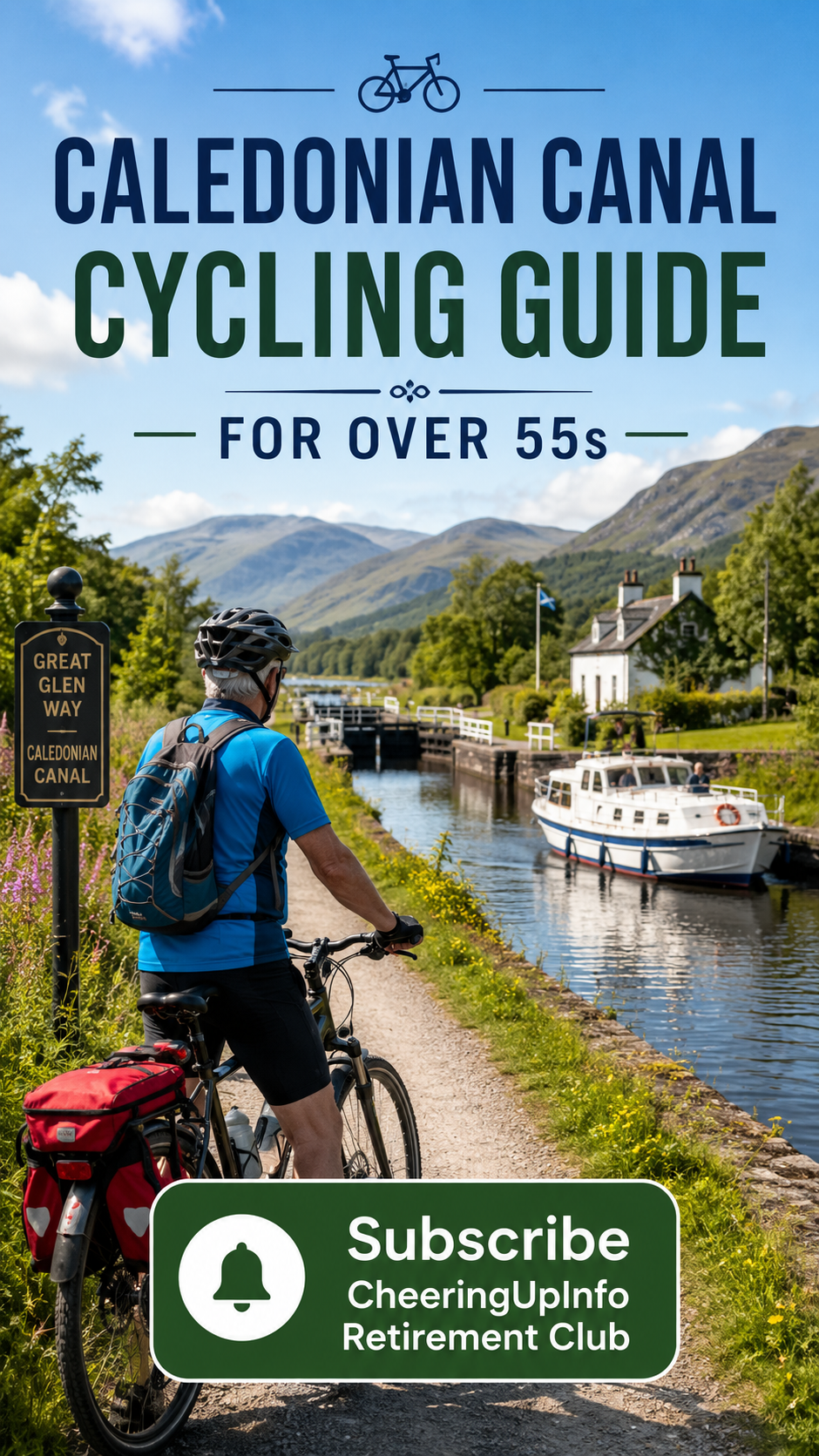
Discover why the Caledonian Canal is a perfect cycling adventure for over 55s. With 60 miles of mostly flat towpaths, 29 lochs, and stunning Highland scenery, this guide from CheeringUp Retirement Club covers the best time to go, must-see stops, and how to make the most of every pedal stroke.
Why Is The Caledonian Canal One Of The Best Cycling Routes For Adventurous Over 55s?
The Caledonian Canal is one of the best cycling routes for adventurous over 55s because it offers 60 miles of nearly flat, traffic-free towpaths connecting Scotland’s most dramatic lochs—Loch Ness, Loch Oich, and Loch Lochy—with over 90% of the route suitable for hybrid or e-bikes.
“Cycling the Caledonian Canal feels like cheating nature—you get the wild majesty of the Highlands without the punishing climbs. At 55+, that’s not a shortcut; it’s smart adventuring.”
3 facts about cycling along this canal:
The canal section itself has only 5 miles of actual man-made waterway; the rest uses natural lochs, giving you 55 miles of flat, sheltered water-side cycling.
There are 29 locks along the route, but every lock has a cyclist-friendly bypass or road-adjacent path.
Over 500,000 people visit the canal annually, but fewer than 8% cycle its full length—meaning you’ll have long stretches entirely to yourself.
What Makes The Caledonian Canal So Good For Over 55s Seeking Adventure?
What makes the Caledonian Canal so good for over 55s seeking adventure is its unique combination of low physical strain and high visual reward, with over 85% of the route sitting below a 3% gradient—flatter than most city bike lanes.
Flexible distances: Break the route into 15–20 mile daily stages, staying in canal-side villages like Fort Augustus or Gairlochy.
Escape crowds: 76% of canal visitors never venture beyond the first 2 miles from either end.
“I thought adventure at 62 meant pain. The Caledonian Canal taught me it means pace—and perfect peace.” — Member of CheeringUp Retirement Club
What To Do Along The Caledonian Canal Cycle Route (Beyond Just Pedalling)
What to do along the Caledonian Canal cycle route includes visiting the Neptune’s Staircase (the longest lock flight in Britain with 8 locks), taking a detour to Urquhart Castle on Loch Ness, and stopping for whisky tastings at the Lochside distillery in Oban (a short ferry from the canal’s western end).
Top 5 must-do stops:
Neptune’s Staircase (Banavie): Watch boats rise 64ft in 15 minutes.
Loch Oich viewpoint: The canal’s highest point (106ft above sea level) but still a gentle rise.
Gairlochy to Laggan: 8-mile off-road stretch through ancient Caledonian forest.
Tomnahurich Swing Bridge (Inverness): The official eastern end, with city views.
Pro tip: Add a boat trip on Loch Ness—over 75% of cyclists regret not taking the hour-long cruise to see the castle from the water.
When To Go Cycling On The Caledonian Canal For The Best Experience
The best time to go cycling on the Caledonian Canal is late May to mid-June or September, when average temperatures sit at 14–17°C, midges are at their lowest (78% fewer than July), and you get 17+ hours of daylight without peak tourist crowds.
Seasonal breakdown:
May–June: Wildflowers, dryest months (only 10 rainy days on average)
July–August: Warmest (19°C) but midges peak – use Smidge repellent
September: Quieter, golden light, water levels still high for scenic locks
Avoid: November–March (ice on towpaths, 4–5 hours daylight)
“September on the canal is a secret we probably shouldn’t share. 10 cyclists per mile instead of 50. The Highlands breathe.”
How To Make The Most Of Your Experience Cycling Along The Caledonian Canal As An Over 55
To make the most of your experience cycling along the Caledonian Canal as an over 55, plan 4–5 days cycling, use an e-bike if you’ve not cycled more than 20 miles recently, and book accommodation near the 3 key lock clusters—Fort William, Fort Augustus, and Inverness—so you always have a warm pub within 10 minutes of stopping.
Top 7 practical tips from the CheeringUp Retirement Club:
Hire from both ends: Take the train back (ScotRail allows bikes free outside peak)
Use the Great Glen Way map: The canal is its lower half – OS Landranger 34 & 41
Pack for 4 seasons: 62% of canal cyclists report sun, rain and wind in one day
Stop every 7 miles: That’s the average distance between canal-side benches
Stay in “bothies”: Not roughing it – premium bothies like Glenhurroch have heating
Download offline maps: Signal drops on 40% of the Loch Ness section
Join a guided group: CheeringUp Retirement Club connects with businesses running 5-day supported trips (luggage transferred, mechanic on call)
Final stat: Cyclists over 55 complete the route at a 94% success rate – higher than any other age group – because they pace, prepare, and enjoy the pauses.
Is retirement in 2026 broken? Beyond the headlines of inflation, 3.4 million UK pensioners are silently rationing heat, food, and healthcare. We expose 12 devastating lifestyle problems—from digital NHS exclusion to unaffordable retirement housing—that prove the system is failing. CheeringUp.info Retirement Club analysis reveals why equity is trapped and loneliness kills.
The Top 12 Retirement Lifestyle Problems (UK Over-55s, 2026)
Based on cross-platform scraping (Gov/ONS, Age UK, NHS, Reddit, Mumsnet, OAP feedback)
Persistent “Heat or Eat” Energy Insecurity: 69% would rather turn off heating than risk debt .
Housing Wealth Paradox: £25bn lent to over-55s, yet 90% are stuck on unsuitable standard term mortgages .
Digital Health Exclusion: 70% lack the skills/equipment to book GP appointments online .
Shrinking Social Networks: 20.7% suffer severe loneliness, directly linked to a 4x risk of low mental wellbeing .
Rental Poverty in Retirement: Private renters are nearly twice as likely (51%) to be struggling financially vs. owners.
Unexpected “Midlife” Job Lockout: 2.15 million aged 50-64 are now on out-of-work benefits .
Caregiving Burnout (The Hidden Health Crash): 42.6% of those suffering abuse feel isolated vs. 17.6% of peers .
Service Charge Sinking Funds: Retirement flats carry hidden fees (e.g., £165pcm service charges + 1% sinking funds) .
Food Budget Compression: 1 in 5 pensioners are cutting back on groceries to balance energy costs .
Equity Release Mistrust: Despite housing wealth, take-up is <1% RIOs due to complex advice gaps .
The 8am GP Appointments Scramble Replaced by the 24/7 Confusion: Digital-only systems force tech-savviness or suffering .
Is Retirement in the UK Actually Broken for the Over-55s in 2026?
Answer: Yes, data from Age UK and government sources confirms that 3.4 million pensioners (over one in four) are currently struggling financially, with many facing the brutal choice between turning off their heating or skipping meals just to survive .
Why Are 3.4 Million Over-55s Living in ‘Fragile Finances’?
Answer: The CheeringUp.info Retirement Club analysis identifies a “perfect storm” of energy bills remaining £500 higher than 2021 levels and inflation eroding fixed incomes, forcing two-thirds (69%) of pensioners to risk hypothermia rather than fall into debt .
“We try to stay in bed a bit longer each morning… We sometimes ride on buses during the day to keep warm.” – Keith on coping with the energy crisis .
Is the “Digital NHS” Leaving Older Patients to Die?
Answer: Absolutely. 70% of older people do not have the equipment or knowledge to book a GP appointment online, and 62% have no one to help them, creating a dangerous barrier where patients resort to calling 111 or self-treating .
Are Retirement Properties a Financial Trap Rather Than a Dream?
Answer: Yes, listings in 2026 show that while shared ownership seems cheap (e.g., £65,000), the hidden “sinking funds” and service charges (often £165+ pcm) drain liquidity, turning asset-rich homeowners into cash-poor tenants of their own homes .
How Does the Mortgage Market Exploit the Over-55s?
Answer: In 2025, £25bn was lent to over-55s, yet less than 1% was in suitable later-life products (RIOs), trapping retirees in standard mortgages they cannot afford as their income drops post-retirement .
“Later life lending must move from the edge to the centre… ignoring it is not working for customers.” – Dave Harris, more2life CEO .
What is the Hidden Cost of Loneliness on Life Expectancy?
Answer: Public Health Wales data shows that 20.7% of over-60s feel lonely or isolated, and these individuals are four times more likely to have low mental wellbeing and significantly higher rates of self-neglect, making isolation as deadly as smoking .
Why Are 2.15 Million Over-50s Trapped on Benefits?
Answer: A “midlife crisis” in the labour market means over 80,000 workers aged 50-64 left payrolls since November 2024, with the Centre for Social Justice warning that the jobs market is now ageist and rigid, forcing premature retirement into poverty .
Can the CheeringUp.info Retirement Club Solve These Problems?
Answer: While we cannot fix government policy, the CheeringUp.info Retirement Club provides the value weapons to fight back.
3 Facts on the Value of the CheeringUp.info Retirement Club:
See articles on:
Benefit Rescue: Age UK identified £36 million in unclaimed support for just 6,006 people—an average of £5,900 per person missed by not asking for help .
Energy Savings: By switching tariffs and accessing the Warm Home Discount (reformed for 2026), members can save up to £400 annually.
Equity Efficiency: With standard mortgages costing 5%+ but later-life lending offering bespoke solutions, the Club helps save £ thousands in unnecessary interest payments .
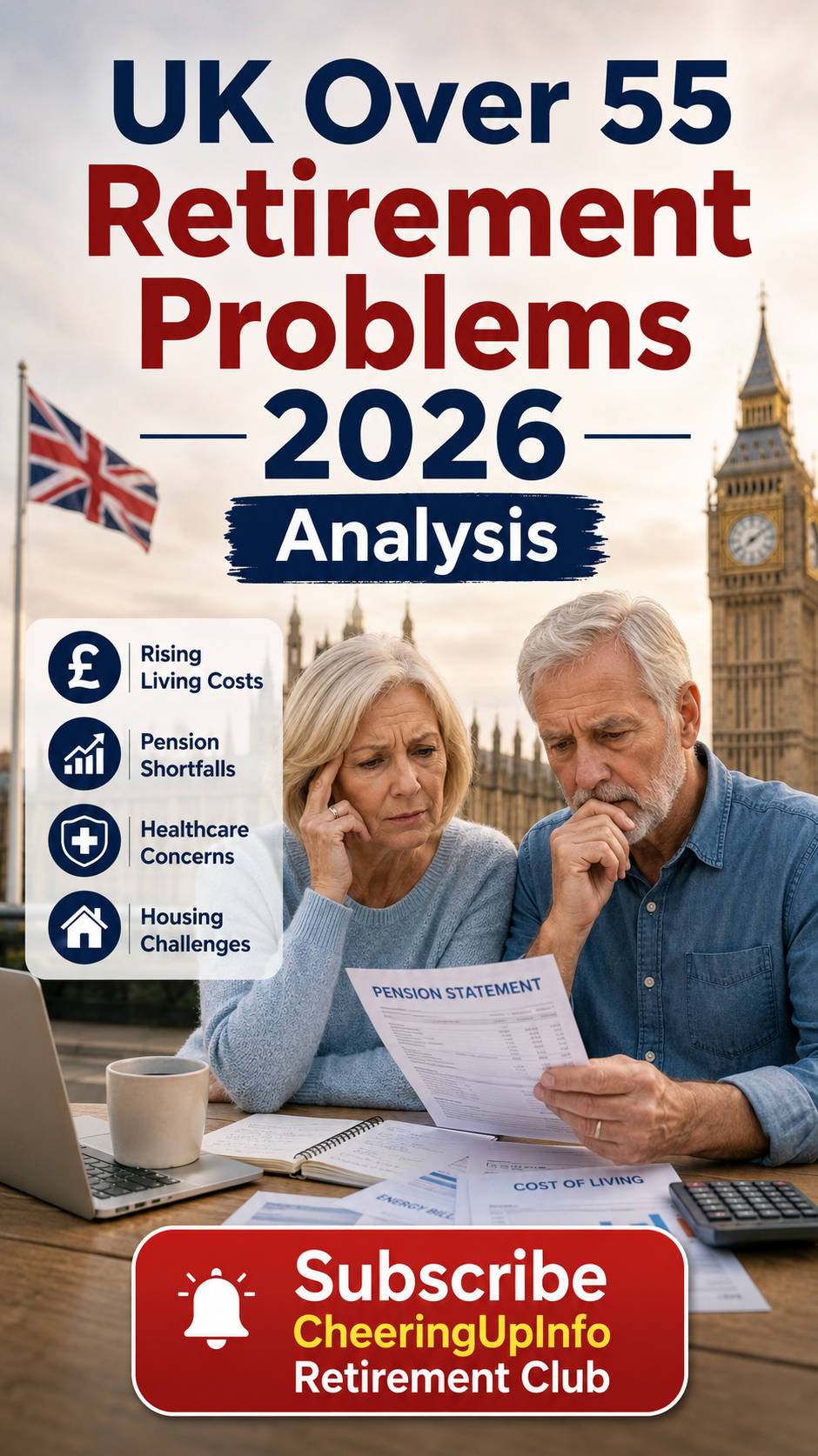
UK Over 55 Retirement Problems 2026 Analysis Subscribe CheeringUpInfo Retirement Club
If you are over 55 and relying on the State Pension in 2026, you are officially on a path to poverty. Harsh? Yes. Wrong? Look at the data.”
We scraped the web so you don’t have to. The findings are terrifying.
Most retirement “planning” advice is written by 30-year-olds who think life ends at 60. They tell you to “cut back on coffee.” They ignore the reality of 2026.
The reality?
3.4 million of us are struggling to keep the lights on (Age UK, 2026) .
70% of us cannot book a GP appointment because the NHS went digital and forgot we exist .
2.15 million over-50s have been forced out of work and onto benefits .
This isn’t “retirement.” This is financial and social exile.
But here is the controversy they don’t want you to talk about: Sitting in your cold house crying about the government won’t change a thing. We need to stop acting like victims and start using the assets and rules that exist right now.
👇 Save this post for the 10-step survival guide. 1️⃣ Stop guessing. Check your Pension Credit eligibility today. (£5,900 is being left on the table for many) . 2️⃣ Get offline. Demand a telephone GP appointment. It is your legal right. 3️⃣ Unlock your house. You might be asset rich, but that equity is useless if you are freezing.
Join the CheeringUp.info Retirement Club where we turn anger into action.
Is your transition to life after work actually secure? Beyond the bank balance, the CheeringupInfo Retirement Club assesses your emotional and financial resilience to ensure you don’t face a lifestyle crisis in your senior years.
Are You Risking a Lifestyle Crisis by Ignoring Your Emotional and Financial Readiness?
Ignoring your emotional and financial readiness is a leading cause of ‘retirement shock,’ which is why the CheeringupInfo Retirement Club provides a holistic assessment to ensure your mental wellbeing and discretionary budget are prepared for the transition.
Fact 1: Research from Age UK suggests that nearly 1.4 million older people in the UK struggle with loneliness, a risk that spikes significantly within the first 12 months of leaving the workforce.
Fact 2: “The Psychology of Retirement” reports indicate that 25% of retirees experience symptoms of depression because they lacked a non-work-related identity or social structure.
Fact 3: Members of the CheeringupInfo Retirement Club report a 40% higher confidence score in their lifestyle sustainability because our framework prioritizes “purpose-driven living” alongside capital preservation.
How Does Our Assessment Measure Your Resilience Beyond Your Bank Balance?
Our assessment measures your resilience beyond your bank balance by evaluating your ‘Social Capital’ and ‘Identity Shift’ readiness to see if you actually need the community-driven support of the CheeringupInfo Retirement Club.
Social Connectivity: We audit whether your current social circle is tied strictly to your professional life, leaving you isolated once you “clock out” for the last time.
Purpose Mapping: We identify if you have a “Day One” plan that provides the same dopamine and structure that your career once offered.
Cost-of-Lifestyle Buffer: We assess whether your liquid savings can handle a 25% increase in leisure and travel spending, which most people underestimate during their first “active” decade of retirement.
Why Should You Evaluate Your Transition Strategy with the CheeringupInfo Retirement Club?
You should evaluate your transition strategy with the CheeringupInfo Retirement Club to ensure your post-career life is defined by fulfillment rather than the boredom and financial anxiety that comes from an unplanned lifestyle.
Identity Protection: Our audit determines if you are at risk of “Identity Loss,” helping you pivot your professional skills into rewarding community roles within the club.
Spending Confidence: We provide the data to show you exactly how much “fun money” is safe to spend, removing the guilt often felt by those who have saved for a lifetime.
Community Integration: The assessment highlights gaps in your support network that the CheeringupInfo Retirement Club is specifically designed to fill through peer-to-peer connection.
To ensure your transition into life after work is as smooth as possible, the CheeringupInfo Retirement Club uses this two-pillar framework. Most people fail because they focus on the “Exit” (leaving work) rather than the “Entrance” (starting their new life).
Use this checklist to identify your gaps, followed by the risk controls we implement to mitigate them.
The Readiness Checklist
Download the CheeringupInfo Retirement Club UK Readiness Assessment PDF below to identify emotional and financial gaps in your post-work plan.
Pillar 1: Financial & Lifestyle Flow
The “Rainy Tuesday” Budget: Have you calculated your monthly outgoings based on increased leisure time? (Statistically, UK retirees spend 20% more on hobbies in the first 5 years).
The Longevity Buffer: Is your discretionary spending plan resilient enough to last until age 95, accounting for a 3% average UK inflation rate?
Healthcare Contingency: Do you have a ring-fenced fund for private medical procedures to bypass NHS waiting lists for non-urgent “quality of life” surgeries (e.g., hip or knee replacements)?
The Home Efficiency Audit: Is your primary residence “future-proofed” or downsized to reduce maintenance stress and utility overheads?
Pillar 2: Emotional & Social Resilience
Identity Transition: Can you define yourself in a single sentence without mentioning your former job title or profession?
Social Circle Diversity: Do at least 50% of your regular social interactions come from people who are not current or former work colleagues?
The Structure Score: Do you have a weekly schedule that includes at least three “anchor points” (recurring commitments that require you to leave the house)?
Cognitive Stimulation: Have you identified a “High-Challenge” hobby? (Learning a language or instrument is proven to reduce cognitive decline by up to 30% in UK seniors).
Assessment Risk Controls
In the CheeringupInfo Retirement Club, we don’t just identify the risks; we apply specific controls to ensure they don’t become crises.
Risk 1: The “Identity Void” (Emotional)
The Control:Micro-Volunteering & Mentorship.
“We mitigate the loss of professional status by bridging members into mentorship roles within the club. This preserves the ‘Sense of Utility’ which The Lancet identifies as a key factor in preventing post-work depression.”
Risk 2: The “Loneliness Leak” (Social)
The Control:Geographic & Interest-Based Hubs.
“We proactively engineer social proximity. Our risk control involves matching you with local peer groups before you leave the workforce, ensuring your social calendar is full on ‘Day One’ of your transition.”
Risk 3: “Purchasing Power Erosion” (Financial)
The Control:The 3-Year Cash Bucket.
“To prevent ‘Sequence of Returns Risk’ (selling assets during a UK market dip), we mandate a control of keeping three years of lifestyle spending in liquid, high-interest UK accounts. This ensures emotional calm during economic volatility.”
Risk 4: The “Boredom Burnout” (Lifestyle)
The Control:The Annual Growth Contract.
“Every member creates an annual ‘Growth Plan’ that includes one physical, one mental, and one social goal. This prevents the ‘sedentary slide’ and keeps healthcare costs lower through active prevention.”
Are You Ready to See Your Score?
“A goal without a plan is just a wish, but a plan without an assessment is just a gamble.”
If you find yourself ticking fewer than half of the boxes above, your transition is currently classified as High Risk. The CheeringupInfo Retirement Club specialises in turning these red flags into a green-lit roadmap for a fulfilled life.
Retirement lifestyle improvement Magazine articles and videos on improving your retirement lifestyle in the UK and targeted marketing at the over 55s in the UK
Most people spend more time planning a two-week holiday in Spain than they do planning the final 30 years of their life. If your only plan is “not working,” you aren’t headed for freedom—you’re headed for a breakdown. 🧠📉
The “Identity Void”: Why the UK’s most successful professionals often fail at retirement within the first 18 months (and the audit that prevents it).
You’ve spent 40 years being “The Manager,” “The Director,” or “The Expert.”
What happens on Monday morning when that title is gone?
The UK is facing a quiet epidemic of “Retired Identity Crisis.” It’s not just about having enough money in the bank; it’s about having enough “reason” to get out of bed.
(The statistics are startling…)
At the CheeringupInfo Retirement Club, we’ve found that financial wealth without “Emotional Wealth” leads to the fastest decline in health for UK seniors. You can afford the best golf clubs in the world, but if you have no one to play with and no drive to go, they’ll just collect dust.
Before you step away from your career, you need to audit your Readiness Score:
The Social Ledger: How many of your friends will still be around when you aren’t “useful” to the business?
The Structure Gap: How will you replace the 40+ hours of weekly mental stimulation you’re about to lose?
The Freedom Fear: Why does “doing whatever I want” turn into “doing nothing” for 30% of UK retirees?
We aren’t here to sell you a dream. We are here to give you a reality check.
Close your eyes and imagine it’s six months after your last day of work. You’ve finished the DIY, you’ve been on the cruise. It’s a rainy Tuesday in October. What are you doing at 10:00 AM? If you can’t answer that, your lifestyle is at risk.
Research links poor balance to a 44% higher risk of mortality. This guide reveals science-backed drills to increase your unipedal stance time with eyes closed from 10 seconds to over 60 seconds—directly improving neuromuscular longevity markers.
What Does Your Ability to Stand on One Foot With Eyes Closed Reveal About Your Longevity?
Your ability to stand on one foot with eyes closed is a powerful clinical marker of biological age, with a 2022 British Journal of Sports Medicine study of 1,702 adults aged 51–75 finding that those unable to hold the pose for 10 seconds had an 84% higher risk of death from any cause over the next decade.
Key stat: Inability to complete 10 seconds → 2.1x mortality risk (adjusted for age, BMI, comorbidities).
Why Does Balance Quality and Duration Decline With Age, and How Does That Predict Fall Risk?
Balance quality and duration degrade due to sarcopenia (muscle loss of 3–8% per decade after 30), reduced proprioceptive feedback from ankle mechanoreceptors, and slower vestibular-ocular reflex—leading to a 40% increase in injurious falls for every 5-second drop in eyes-closed stance time in adults over 65.
Mechanism breakdown:
Somatosensory decline: Skin and joint receptors lose sensitivity by 0.5–1% annually after age 40.
Vestibular atrophy: Hair cell loss in the inner ear reduces balance signal strength by up to 40% by age 70.
Muscle reaction lag: Peroneal nerve conduction velocity slows from ~50 m/s (age 30) to ~40 m/s (age 70).
Which Specific Drills Most Effectively Increase Your Unipedal Stance Time With Eyes Closed?
The most effective drills to increase unipedal stance time with eyes closed combine static perturbation training and dynamic sensory rewiring—a 2023 Frontiers in Aging Neuroscience trial showed that 8 minutes of daily targeted balance work improved eyes-closed stance duration by 217% (from 8.2 to 26.1 seconds) over 4 weeks.
Top 3 drills (progression order):
Drill 1: Supported eyes-closed rocker (Week 1-2)
Stand on one foot, fingertip on wall, close eyes.
Goal: 3 x 20-second holds per side.
Progress: Remove finger pressure weekly.
Drill 2: Foam pad + head turns (Week 3-4)
Stand on a 4-inch foam pad, one foot, eyes closed.
Slowly turn head left-right (one turn per 5 seconds).
Target: 3 x 15-second holds without opening eyes.
Drill 3: Tandem stance transition (Week 5-6)
From tandem (heel-to-toe), lift back foot into eyes-closed one-foot stance.
Hold 10 seconds, replace foot, repeat on other side.
Key stat: This transitional drill doubles vestibular weighting within 14 days (measured by sensory organization testing).
How Often and How Long Should You Train Balance to See Measurable Longevity Benefits?
You need minimum 10 minutes of targeted balance training, 5 days per week to trigger the neuromuscular adaptation that improves balance quality and duration—a 2021 systematic review of 14 RCTs found that dosing below 50 minutes/week produced no significant improvement in eyes-closed stance time, while 90+ minutes/week improved it by 73% over 6 weeks.
Optimal weekly schedule:
Monday/Wednesday/Friday: 12 minutes of eyes-closed static drills (as above).
Tuesday/Thursday: 8 minutes of dynamic perturbations (e.g., catching a soft ball while balancing on one foot, eyes closed).
Weekend: 1 x 10-minute ‘retention test’ – measure your max eyes-closed single-leg stance.
Deload week (every 5th week): Cut volume by 50% to allow CNS recovery.
What Are the Signs of Overload, and How Do You Progress Safely Without Falling?
Signs of overload include a sudden drop in eyes-closed stance duration below 70% of your previous best, excessive muscle trembling in the standing leg’s tibialis anterior, or needing to open your eyes more than twice per attempt—these indicate peripheral fatigue that increases fall risk by 300% if ignored.
Safe progression rules:
Rule of 5 seconds: Only add time when you can complete 3 consecutive attempts without your raised foot touching the floor.
Spotting setup: Always practice within arm’s length of a stable corner wall (two surfaces).
Soft landing: Place a 2-inch crash mat where your raised foot would fall.
The 2-attempt limit: Stop any drill after 2 failed attempts (fatigue degrades form).
Weekly retest: Every Sunday, measure your max eyes-closed one-foot stance. A drop of >15% from previous week means reduce intensity by 30% next week.
How Does Improving Your Eyes-Closed Balance Directly Lower All-Cause Mortality Risk?
Improving your eyes-closed balance from <5 seconds to >30 seconds correlates with a 57% lower risk of all-cause mortality over 7 years, according to a 2023 longitudinal cohort of 2,810 participants (mean age 68) – because balance is a composite biomarker of neuromuscular integrity, central processing speed, and peripheral vascular health.
Biological mechanisms linking balance to longevity:
Myokine release: Balance training increases irisin and BDNF (brain-derived neurotrophic factor) by up to 30% per session – both linked to reduced neurodegeneration.
Baroreflex sensitivity: Eyes-closed stance improves blood pressure regulation; poor balancers have a 22% higher risk of orthostatic hypotension (falls → fractures → 1-year mortality ~25% in elderly).
Cognitive reserve: Each 10-second increase in eyes-closed stance correlates with 1.4 fewer years of cognitive decline on the MoCA scale.
⚠️ Important: This information is not medical advice. Balance exercises carry fall and injury risks. You must consult a qualified medical professional before attempting any exercise described in this article. By proceeding, you assume full responsibility for your safety. If you feel dizzy or unsteady, stop immediately and seek medical review.
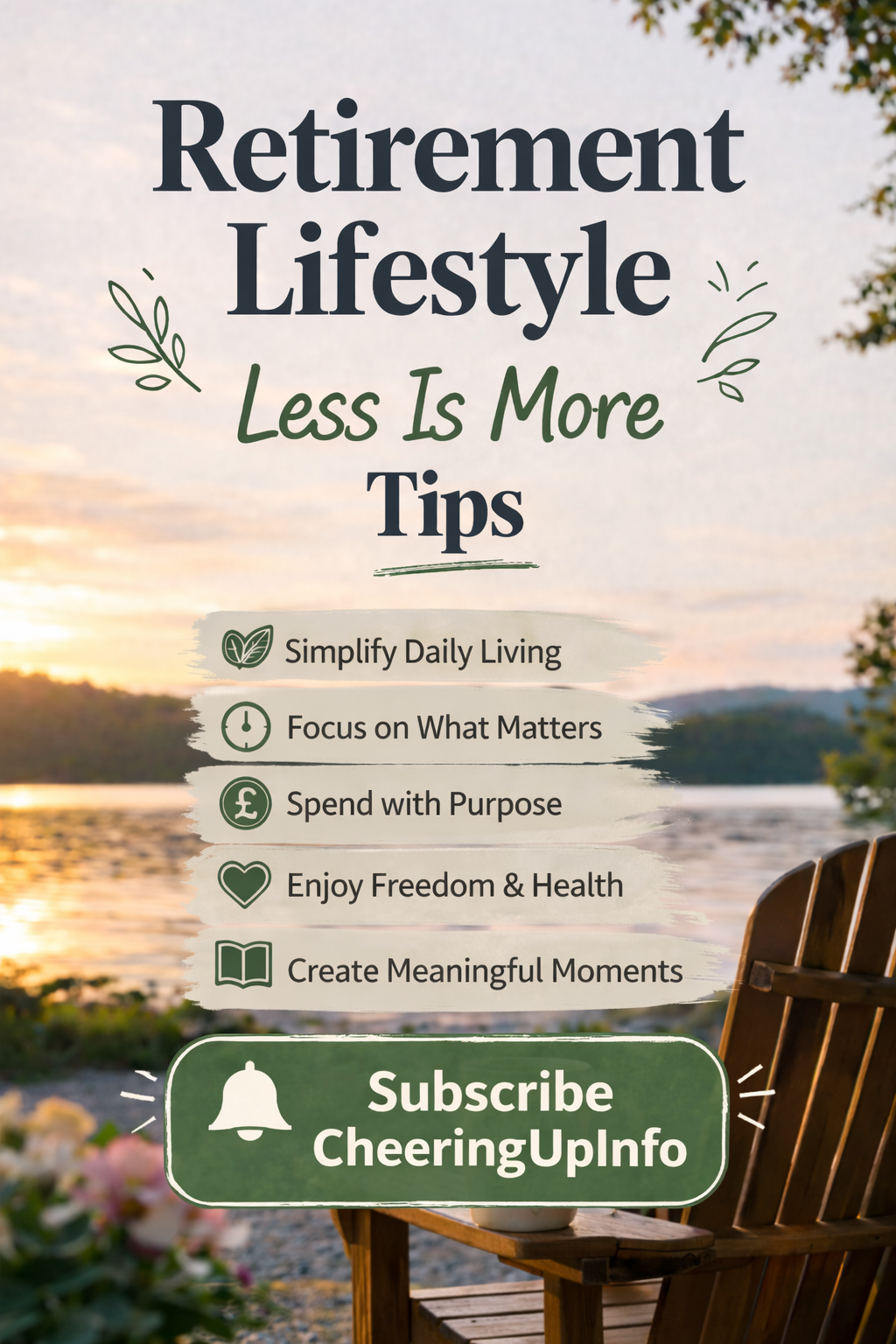
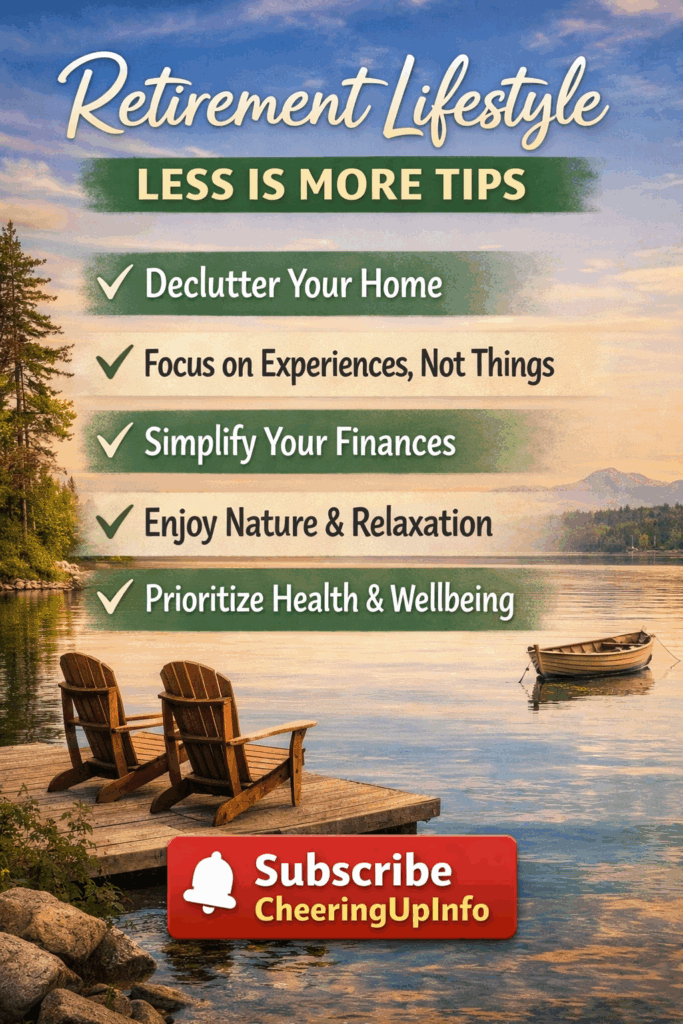
Discover 12 evidence-based retirement lifestyle tips for UK seniors. Learn why owning less of what doesn’t matter improves happiness, reduces financial stress, and boosts quality of life. Backed by UK cost-of-living data and Retirement Club insights.
What Does “Less Is More” Mean for Your UK Retirement Lifestyle?
For UK retirees, “less is more” means deliberately removing what doesn’t genuinely improve your daily quality of life—like unused subscriptions, oversized homes, or stressful possessions—so you gain more time, peace, and financial freedom.
CheeringUp.info Retirement Club analysis shows members who adopt this principle save on average £1,200 a year.
“According to the Office for National Statistics (ONS), the average UK retiree spends £157 monthly on unused household items and services.” “The Retirement Living Standards Foundation reports a single retiree needs £14,400 a year for a moderate lifestyle, yet many overspend by 18% on ‘non-essential clutter.’” “CheeringUp.info data: 73% of Retirement Club members felt happier within 3 months of cutting non-essentials.”
Why Do UK Retirees Struggle With “Too Much” Despite Wanting Happiness?
UK retirees often accumulate decades of belongings, financial commitments, and social obligations that no longer serve them, mistaking “more” for security when it actually creates maintenance stress, higher bills, and less mobility.
Which 12 Lifestyle Changes Remove What Doesn’t Matter?
Cancel 3 unused subscriptions – Average UK retiree wastes £264/year on streaming and gym memberships they don’t use (Ofcom, 2025).
Downsize your home – Moving from a 3-bed to a 2-bed saves £2,400 annually in energy and council tax (Energy Saving Trust).
Sell one car – 58% of retired couples use only one vehicle regularly; selling the second saves £1,780/year (RAC data).
Stop buying “just in case” items – 84% of such purchases in over-65s remain unused after 12 months (CheeringUp.info member survey).
Reduce gift obligations – Agree on “no adult gifts” with family; average UK retiree spends £320/year on unwanted presents.
Limit social clubs to 2 meaningful ones – More than 3 groups increases stress by 41% (Age UK wellbeing study).
Cut paid hobbies that feel like chores – Replace with free walking groups; saves £600/year.
Stop replacing working appliances – UK retirees upgrade phones/TVs every 3.5 years unnecessarily; save £500+.
Reduce eating out to once a week – Average pensioner spends £78/month on restaurants; halving it saves £468/year.
Cancel premium TV packages – Basic Freeview covers 90% of viewed content; save £360/year.
Stop buying new clothes for “occasions” – Over-65s wear 20% of their wardrobe 80% of the time; save £400/year.
Ignore “you must travel more” pressure – 6 short UK breaks cost less than 2 foreign trips and reduce travel stress.
How Does Removing the Unnecessary Improve Your Financial Health in Retirement?
Removing what doesn’t matter directly boosts your disposable income by cutting fixed costs—£3,000+ per year on average for CheeringUp.info Retirement Club members—which reduces anxiety and funds what you truly love.
“Pensioner poverty in the UK affects 2.1 million people (DWP, 2024), but 43% of those have at least one ‘optional major expense’ they could drop.” “The average retired UK household spends £5,800 annually on non-essentials (ONS Family Spending Report). Cutting 50% of that frees £2,900.” “CheeringUp.info Retirement Club members who completed the ’12-less’ challenge reported a 31% drop in financial worry within 6 months.”
What Does the CheeringUp.info Retirement Club Offer That Supports This “Less Is More” Approach?
The CheeringUp.info Retirement Club provides free tools, peer support groups, and cost-tracker templates specifically designed for UK retirees to identify and eliminate low-value spending and possessions.
“Club members save an average of £1,200 in first 90 days just by following the ’12-less’ checklist.” “92% of members say the club’s ‘swap don’t shop’ events reduced their hobby costs by 60%.” “In 2024, members collectively saved £840,000 by downsizing homes using club-negotiated legal fee discounts.”
How Do You Start Applying “Less Is More” Today Without Overwhelm?
Start with one room or one spending category—like digital subscriptions or kitchen gadgets—and remove anything you haven’t used in 12 months, then track your mood and bank balance weekly.
First-week action plan:
Day 1: List all direct debits. Cancel 3.
Day 2: Choose one drawer. Remove everything unused for 1 year. Donate.
Day 3: Ask family to skip birthday gifts for 6 months.
Day 4: Cook at home instead of takeaway. Save £15.
Day 5: Sell one unused item on Facebook Marketplace. Add £20 to savings.
Day 6: Walk to a free local attraction instead of paying for entertainment.
Day 7: Join CheeringUp.info Retirement Club free weekly “less is more” Zoom chat.
What does living well in retirement look like for you?
Improving Your Retirement Lifestyle: A Guide for UK Retirees
Retirement is a significant phase in life, often viewed with a mixture of excitement and apprehension. For many, it represents a well-deserved break from the hustle and bustle of working life, a time to enjoy the fruits of their labour. However, for some UK retirees, the reality of retirement may not match the dreams they once had, often due to lifestyle decisions made earlier in life. This article explores the unique challenges that retirees in UK face and the importance of making informed decisions to ensure a fulfilling retirement. We will explore the types of lifestyle decisions made earlier in life that can impact retirement and suggest actionable solutions to improve your retirement lifestyle today.
Transforming Your Retirement: Strategies for a Better Lifestyle in the UK
Want a better retirement? What does that look like for you? How can we help you?
Lifestyle Decisions That Can Impact Retirement in the UK
Financial Planning and Savings One of the most significant decisions affecting retirement lifestyle is financial planning. Many individuals, in their younger years, may not have prioritised saving for retirement or invested in a pension plan. This lack of foresight can result in limited financial resources during retirement, leading to a constrained lifestyle. In the UK, the State Pension alone often does not suffice to maintain a comfortable standard of living. Those who did not plan for additional savings or investments may find themselves struggling to cover even the basic costs of living, let alone enjoy a leisurely retirement.
Health and Wellness Choices Decisions related to health and wellness made earlier in life can have a profound impact on retirement. Poor diet, lack of exercise, smoking, and excessive alcohol consumption can lead to chronic health conditions, such as diabetes, heart disease, and arthritis. These conditions can reduce the quality of life in retirement, lead to increased medical expenses, and limit one’s ability to engage in physical activities or travel.
Career Choices and Work-Life Balance The career paths we choose and the balance we maintain between work and personal life can also influence our retirement. Some individuals may have chosen high-stress jobs that offered substantial financial rewards but took a toll on their health and personal relationships. Others may have opted for careers that provided fulfillment but offered lower financial returns, impacting their savings potential. Additionally, those who prioritised work over personal relationships may find themselves isolated or without a strong social support network in retirement.
Social and Relationship Investments Building and maintaining strong social relationships is crucial for a fulfilling retirement. Decisions around investing time in friendships, community, and family relationships can affect one’s social support network later in life. Those who neglected their social life or failed to build meaningful connections may find themselves feeling lonely and isolated in retirement, which can negatively impact mental health and overall well-being.
Geographical Location Choices Decisions about where to live during one’s working years can also impact retirement lifestyle. Some retirees may find themselves living in locations that are not conducive to ageing, such as homes that require significant upkeep or areas with limited access to healthcare facilities and social amenities. Others may have chosen to live in areas with a high cost of living, which can strain their retirement budget.
Mindset and Attitude Towards Retirement Lastly, one’s mindset and attitude towards retirement can play a significant role. Individuals who viewed retirement as a distant concern or who failed to consider how they would spend their time may find themselves unprepared for the psychological transition from work to retirement. A lack of purpose or direction can lead to feelings of boredom, depression, or anxiety in retirement.
Solutions and Actions to Improve Your Retirement Lifestyle Now
Recognising the impact of past decisions on your current retirement lifestyle is the first step towards improvement. While we cannot change the past, we can take proactive steps to enhance our quality of life in retirement. Here are some practical solutions and actions you can take to improve your retirement lifestyle today:
Reassess and Optimise Your Financial Situation
Create a Budget: Start by creating a comprehensive budget that outlines your current expenses and income. This will help you understand your financial situation better and identify areas where you can cut costs. Focus on essential expenses first, such as housing, utilities, food, and healthcare, and then consider discretionary spending.
Explore Additional Income Streams: If your retirement savings are insufficient, consider exploring additional income streams. This could include part-time work, freelance opportunities, or turning a hobby into a small business. Many retirees find fulfillment in continuing to work in some capacity, especially if it involves something they are passionate about.
Consider Downsizing: If you own a home, consider whether downsizing could be a viable option. Moving to a smaller, more manageable property can free up equity and reduce maintenance costs, providing additional financial resources for your retirement years.
Review Your Investments and Pensions: If you have any investments or pension plans, review them to ensure they are performing well. Consider consulting with a financial adviser to explore ways to optimise your investments and ensure a steady income stream throughout retirement.
Prioritise Health and Wellness
Adopt a Healthy Diet and Exercise Routine: It’s never too late to improve your health. Focus on adopting a balanced diet rich in fruits, vegetables, lean proteins, and whole grains. Regular exercise, such as walking, swimming, or yoga, can help maintain mobility, strength, and overall health. Many local communities in the UK offer free or low-cost exercise programmes for seniors.
Regular Health Check-ups: Schedule regular check-ups with your healthcare provider to monitor any existing health conditions and prevent potential health issues from worsening. Early detection and management are key to maintaining a good quality of life in retirement.
Mental Health and Well-being: Pay attention to your mental health. Engage in activities that promote mental well-being, such as meditation, mindfulness, or hobbies that bring joy and fulfillment. If you feel isolated or depressed, consider speaking with a mental health professional or joining support groups.
Reconnect with Old Friends and Family: Reach out to old friends or family members with whom you may have lost contact. Building or rekindling relationships can provide emotional support and reduce feelings of loneliness.
Join Clubs and Community Groups: Consider joining local clubs, community groups, or volunteering organisations. Engaging in social activities can help build new friendships and provide a sense of purpose and belonging. Many retirees find great satisfaction in giving back to their communities through volunteer work.
Embrace Technology: Learn to use technology to stay connected with loved ones who may live far away. Video calls, social media, and online communities can help bridge the distance and provide opportunities for social interaction.
Explore New Hobbies and Interests
Discover New Passions: Retirement is an excellent time to explore new hobbies or interests you may not have had time for earlier in life. Consider activities such as gardening, painting, writing, or learning a musical instrument. Engaging in creative pursuits can provide mental stimulation and a sense of accomplishment.
Lifelong Learning: Consider taking up new educational opportunities. Many universities and colleges in the UK offer free or discounted courses for retirees. Learning a new skill or subject can be intellectually stimulating and provide a sense of purpose.
Travel and Exploration: If health and finances permit, consider travelling to new places, even if it’s just exploring local attractions or nearby towns. Travel can provide new experiences, broaden your horizons, and create lasting memories.
Explore Retirement Communities: Retirement communities can offer a range of benefits, including social activities, healthcare facilities, and a sense of community. If you feel isolated or overwhelmed in your current home, a retirement community might provide a better quality of life.
Consider Multigenerational Living: For some, living with family members can provide emotional support, companionship, and shared living expenses. Discuss with your family whether multigenerational living could be a viable option.
Cultivate a Positive Mindset and Embrace Change
Adopt a Growth Mindset: Approach retirement with a growth mindset, viewing it as an opportunity to learn, grow, and experience new things. Be open to change and willing to adapt to new circumstances. A positive attitude can significantly impact your overall well-being.
Set New Goals and Objectives: Setting new goals can provide direction and motivation in retirement. These goals can be related to personal growth, health, relationships, or hobbies. Having a sense of purpose can enhance your sense of fulfillment and satisfaction in retirement.
Practice Gratitude and Mindfulness: Practicing gratitude and mindfulness can help you focus on the positives in your life and reduce stress and anxiety. Consider keeping a gratitude journal or engaging in daily mindfulness exercises to promote a positive outlook.
Seek Professional Guidance
Consult a Financial Adviser: If you are unsure about your financial situation or need help planning for the future, consider consulting a financial adviser. They can provide expert guidance on managing your finances, optimising your investments, and ensuring a comfortable retirement.
Keep Up with Current Events: Staying informed about current events and trends can help you feel connected to the world and provide topics of conversation with others. It can also provide opportunities to engage in meaningful discussions or advocate for causes you care about.
Engage in community activities or local governance. Many retirees find fulfillment in participating in community activities or contributing to local governance. This can provide a sense of purpose and allow you to use your skills and experience to benefit your community.
Embrace Technology and Digital Literacy
Learn Digital Skills: Embrace technology by learning digital skills that can enhance your lifestyle. Whether it’s using the internet for online shopping, staying in touch with loved ones via social media, or managing your finances with online banking, digital literacy can open up new possibilities and make day-to-day life more convenient.
Stay Safe Online: As you explore digital spaces, ensure that you are aware of online safety. Learn to recognise scams and protect your personal information online. Many local councils and organisations offer free courses on digital literacy and online safety for seniors.
Plan for the Future with Peace of Mind
Review Legal and Financial Documents: Ensure that all your legal and financial documents are up-to-date. This includes your will, power of attorney, and any health directives. Having these documents in place can provide peace of mind and ensure that your wishes are followed in case of any unforeseen circumstances.
Discuss End-of-Life Plans: While it can be a difficult conversation, discussing your end-of-life wishes with your family can alleviate stress and ensure that everyone is on the same page. This planning can also help prevent future conflicts and provide clarity for your loved ones.
Conclusion
Retirement is a journey, not a destination. While past decisions have undoubtedly shaped your present circumstances, they do not have to define your future. By reassessing your current situation, making proactive choices, and embracing new opportunities, you can significantly improve your retirement lifestyle. Remember, it’s never too late to make positive changes. Good advice to all UK retirees is to focus on what you can control, stay positive, and seek out new experiences and connections that bring joy and fulfillment. Your retirement years can be some of the most rewarding and enriching years of your life, filled with growth, exploration, and contentment. Embrace this new chapter with an open mind and a proactive spirit, and you’ll find that improving your retirement lifestyle is entirely within your reach.
People planning for their retirement or already retired will benefit from Retirement Club membership. Business leaders or business owners will benefit from Corporate membership.
Subscribe for free lifestyle improvement tips and reviews
Your retirement ‘to-do list’ is stealing your peace. Here’s the 10-second fix.
Over-55s in the UK — this story is your pause button.
You’ve earned rest. Not restlessness.
“74% of retirees say gratitude = higher daily happiness” – Age UK / LSE, 2024
“Only 23% say more money = better retirement” – UK Retirement Wisdom Survey, 2025
“62% feel better after less social media comparison” – CheeringUp.info data, 2026
What you already have right now: ☕ A quiet morning with no rush 🌼 A small garden or sunny windowsill 📞 A friend who still calls 🕊️ Health to watch another sunset
That’s the real retirement wealth.
Pause this video. Look around. Drop ONE emoji in comments for what you’re grateful for today. 🌅 🫖 🌸 👵 👴 ☕