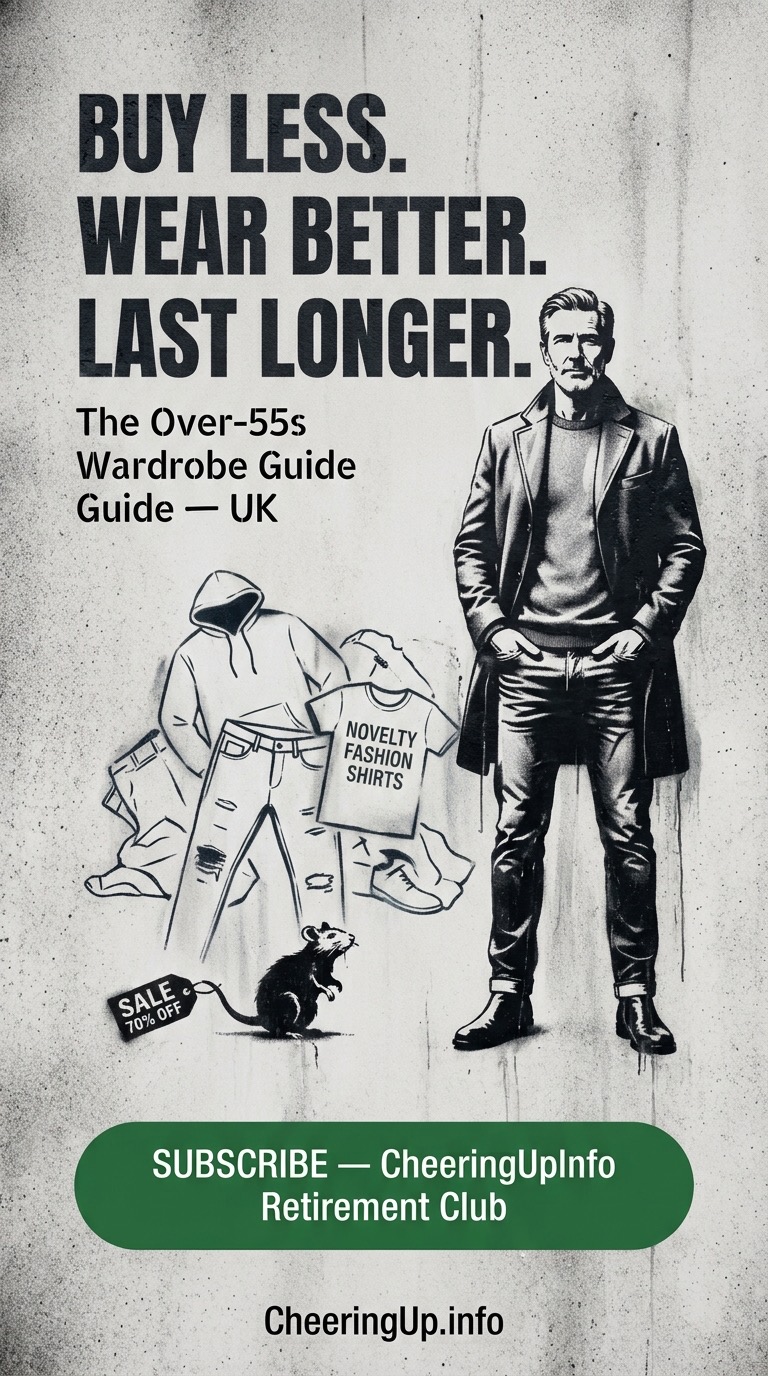
Over 55s Men’s Style: Build a Timeless Wardrobe for Less

Over 55s UK men’s style guide: buy fewer, better clothes that fit, last and save money. Build a timeless wardrobe for every occasion.

Shop better, less often. Our over 55s UK men’s timeless wardrobe guide shows you exactly what to buy, when, where — and how to save money as the cost of living rises.

CheeringupInfo Retirement Club recommends this fashion guide for over 55s men in UK as the solution to the problem of shopping better less often to reduce cost of living in UK.

Right, gents. Let’s have a straight conversation about getting dressed. The cost of living hasn’t gone anywhere, and with the ONS putting household cost inflation at 3.6% in early 2026 , every pound in your pocket needs to work harder. The answer isn’t buying more cheap tat that falls apart by Christmas. It’s building a capsule wardrobe of proper kit that you actually wear, fits you today, and won’t look daft in five years. As Vivienne Westwood famously said: “Buy less. Choose well. Make it last. Quality, not quantity. Everybody’s buying far too many clothes.” That’s not just eco-talk; it’s hard-nosed money sense when the average UK household already sits on about £4,000 worth of clothing, with 30% of it unworn in the past year .‌‌‌

Why does building a timeless wardrobe matter more than ever for over 55s UK men?

Building a timeless wardrobe matters because it directly combats the double whammy of rising costs and the temptation to waste money on fast fashion that doesn’t suit your age or your life. The UK fashion market is under pressure, with online parcel volumes for fashion dropping 14% year-on-year as shoppers become far more selective . That’s actually a good thing. It means men are waking up to the fact that buying six cheap shirts a year costs more in the long run than buying two excellent ones that last a decade. UK stylist Lisa Talbot puts it perfectly: “Style in your 50s should feel effortless, not like you’re chasing trends half your age… Great style in your 50s isn’t about dialling things down, it’s about editing.” You’re not trying to look like your son. You’re trying to look like the best version of yourself, and that requires editing out the noise.‌‌

Why should you spend more on fewer, better clothes rather than buying cheap stuff?

You should spend more on fewer, better clothes because the cost-per-wear maths is brutal on cheap clothing, and the environment agrees. The UK government’s own waste advisory body, WRAP, has shown that extending the life of a garment by just one extra year saves significant carbon , but the personal finance argument is even more compelling. If you spend £150 on a well-made wool overcoat and wear it 150 times over five winters, that’s a pound a wear. If you spend £40 on a cheap coat that looks tired after one season and gets binned, you’ve spent more per wear and you still look cold and scruffy. The Love Your Clothes campaign notes that the average UK household spends around £1,700 a year on clothes . Redirecting even half of that away from disposable trend pieces and into a handful of quality essentials is the single quickest way to dress better while spending less over a decade.‌‌

What should over 55s UK men actually buy to build this wardrobe today?

You should buy a tight edit of classic, well-fitting separates in neutral colours that mix and match effortlessly. Personal stylist Lisa Gillbe advises: “Trying to dress younger is the first mistake,” and instead recommends dressing like “the best version of you” with properly fitting, quality clothes . Here is the exact shopping list to build today that will still work in 2031:‌

  • Two pairs of straight-leg or slim-straight dark indigo jeans. Not skinny, not ripped, not distressed. Modern, flattering, and smart enough with a blazer .‌
  • Three merino wool knitwear pieces. A crew neck, a quarter-zip, and a button-down polo in navy, grey, and a deep green or burgundy. Merino regulates temperature and looks infinitely smarter than a hoodie .‌
  • Four classic tapered shirts. White, pale blue, navy, and a subtle pink or stripe. Quality cotton that irons well or drip-dries without looking like a rag .‌
  • One unstructured blazer in navy or charcoal. Wear it over a shirt to the pub, over a t-shirt to a gallery, or with trousers for a smarter do. It sharpens everything without feeling stiff .‌
  • Two pairs of smart chinos or wool-blend trousers. Camel or stone for daytime, charcoal for evenings. A flat front and a clean line flatter a mature waistline far more than baggy cargos .‌
  • One pair of clean, minimal leather trainers and one pair of Chelsea boots or Derby shoes. Leave the hyped gym trainers for the gym. Neutral tones look sophisticated; anything too “trendy” can make the whole outfit look forced .‌‌
  • One decent leather holdall or briefcase. Ditch the rucksack with your smart coat. A structured bag instantly sharpens your appearance.

When should you buy these pieces to get the best value?

You should buy these pieces when you need them, not when the sales tell you to want them. Check your wardrobe first, make a list of what is genuinely missing or worn out, and then buy the best version of that item you can afford. The UK government’s Love Your Clothes guidance is clear: check before you shop, and choose quality designed to last . Avoid impulse purchases during “midlife makeover” moments. Stylist Lisa Gillbe warns against going out and buying “all that midlife crisis stuff” in one go; instead, switch up a few items subtly and pay attention to quality . If you need a new winter coat, buy it in September when stock is full and fit is right, not in January when you’re panic-buying a reduced ill-fitting remnant. If you need shirts, replace them one by one as collars fray, spending £60–£80 on a good one rather than £15 on three bad ones.‌‌

Where should over 55s UK men shop for these wardrobe staples?

You should shop where quality construction, natural fabrics, and honest sizing are prioritised over logos and fleeting trends. The high street can work if you know what to look for, but you have to filter hard. Personal stylist Lisa Gillbe recommends brands like Oliver Spencer and Wax London for men who want to dress well without looking like they’re trying too hard . For knitwear and shirts, Uniqlo’s merino and Oxford ranges offer exceptional value for the price, while Marks & Spencer’s Autograph and Sartorial lines remain reliable for trousers and outerwear if you check the fabric composition (aim for 100% wool or cotton wherever possible). For jeans, a straight-fit from Levi’s or a quality denim specialist will outlast anything from a fast-fashion outlet. For a proper blazer that fits an older frame, consider a made-to-measure service or a good independent menswear shop where the staff know how a jacket should sit on the shoulder. The key is to buy from places that let you feel the cloth and try the fit properly, or that offer free returns so you can send back the 80% that doesn’t work.‌

Who will benefit most from this fashion guide for over 55s UK men?

This guide will benefit most the over 55 UK man who wants to look sharp, feel confident, and stop wasting money on clothes that either don’t fit, don’t last, or make him look like he’s raiding his son’s wardrobe. If you are retired or semi-retired and your daily uniform has drifted into shapeless joggers and novelty t-shirts, this is for you. If you are still working and need to look credible and comfortable in meetings without wearing a stiff suit every day, this is for you. If you have a wardrobe full of clothes and “nothing to wear,” this is definitely for you. As Jeremy Langmead has shown in his midlife makeover features, men from 51 to 76 can transform how they look and feel by simply swapping out the shacket for a structured blazer, the baggy cargos for clean trousers, and the tired trainers for a proper leather shoe . The ONS notes that retired households saw cumulative inflation of 31.9% over the past five years; every purchase needs to count. This guide makes every purchase count.‌‌

What should you avoid buying if you want to look cool for your age, not a past age?

You should avoid buying anything that screams “I am trying to be twenty-five” because the result is almost always the opposite of cool. Lisa Talbot specifically flags distressed skinny jeans, ill-fitting beanies, letterman jackets, and stacks of leather bracelets as the hallmarks of a man who has lost the plot stylistically . The problem with these pieces isn’t that they are inherently bad; it’s that they create a disconnect. A 60-year-old man in a hoodie and a baseball cap doesn’t look relaxed; he looks like he’s given up on the top half of his body. A 55-year-old in skinny ripped jeans doesn’t look edgy; he looks uncomfortable. Lisa Gillbe adds that gym trainers worn with smart trousers and a shirt create a “jarring” visual confusion . The rule is simple: if you wore it to a student party in 1994, leave it in 1994. Your style should say “I know who I am and I am comfortable in my own skin,” not “I am terrified of getting old.”‌‌

How can CheeringupInfo Retirement Club help you build this wardrobe and save money?

CheeringupInfo Retirement Club can help you build this wardrobe and save money by giving you a clear, no-nonsense framework for shopping better and less often, so you stop wasting money on clothes that never get worn. The ONS reports that 55% of adults in Great Britain reported an increase in their cost of living in August 2026, with food and fuel driving the pain . Clothing is discretionary spending, which means it is exactly where you can make savings without reducing your quality of life—if you buy right. By following the edit above, replacing items only as they wear out, and choosing natural fabrics and proper fit over trends, you will spend less over the next five years than the man who buys a new “bargain” jacket every winter. You will also look considerably better. Subscribe to CheeringupInfo Retirement Club for more practical, money-saving guidance that respects your intelligence and your time.‌

#Over55sStyleUK #BuyLessWearBetter #RetirementClub #RetirementMagazine #RetirementTV

Get help to protect and grow your business with more cost effective targeted marketing at over 55s UK

Find out more about advertising and marketing to the over 55s UK

Subscribe for free retirement lifestyle improvement ideas reviews and retirement cost of living tips

Connect with CheeringUpInfo for free retirement lifestyle improvement tips

Read more retirement lifestyle improvement articles and view videos for free

Connect with CheeringUpInfo for free alerts to new retirement lifestyle improvement articles and videos

Your £40 jacket is costing you more than a £150 one. Here’s the maths that made 55-year-old men in the UK rethink their entire wardrobe.

Stay with me, because this is the bit nobody tells you.

Wear a £150 wool overcoat 150 times across five winters — that’s £1 a wear. Buy a £40 cheap coat that looks tired after one season, bin it, repeat four more times — that’s £200 spent and you still look cold and scruffy.

The cheap option cost you 33% more. And you looked worse doing it.

The ONS puts household cost inflation at 3.6% right now. The average UK household sits on roughly £4,000 of clothing — and 30% of it goes unworn in a single year. That’s £1,200 of dead money hanging in your wardrobe doing nothing.

Vivienne Westwood said it best: “Buy less. Choose well. Make it last.”

So here’s what actually works for over 55s UK men — looks sharp today and in 2031:

  • 2 pairs straight-leg dark indigo jeans — no rips, no skinny
  • 3 merino wool knits — navy, grey, deep green
  • 4 classic tapered shirts — white, pale blue, navy, subtle stripe
  • 1 unstructured navy blazer
  • 2 pairs smart chinos — camel and charcoal
  • 1 pair clean leather trainers + 1 pair Chelsea boots
  • 1 decent leather holdall

That’s it. Every occasion covered. Nothing that looks like you raided your son’s wardrobe.

The fit matters more than the price tag. Stylist Lisa Talbot says style in your 50s “isn’t about dialling things down, it’s about editing.” A £60 shirt that fits properly beats a £200 one that doesn’t — every single time.

And the trap? Distressed skinny jeans, ill-fitting beanies, letterman jackets, stacks of leather bracelets. Those don’t make you look young. They make you look like you’ve lost the plot.

One more thing before you go — check your wardrobe tonight. Count how many items you haven’t worn in 12 months. That number is your savings pot for the items above.

Ready to shop better and less often? Email editor@cheeringup.info with the subject line “TIMELESS WARDROBE” and we’ll send you CheeringUpInfo Retirement Club over 55s UK men’s newsletter — free.

👉 Follow CheeringUpInfo Retirement Club for more money-saving style advice that respects your intelligence and your time.

#Over55sStyleUK #BuyLessWearBetter

Buying better on eBay UK

Based on the search results, here are eBay UK product suggestions that fit the “buy less, choose well” theme. The availability is hit-or-miss (many are single listings or sold out), but these give you a realistic sense of what to hunt for.

A quick note on the search results: eBay listings change fast. Several items found were sold out or single-size remnants. The best approach is to use these as search terms and brand filters rather than specific links that might expire.

Merino Wool Knitwear

Paul Smith Merino Wool Sweater (New with Tags)
This fits the “quality over quantity” rule perfectly. A brand-new Paul Smith merino crew neck at £89.90 (RRP £180) is exactly the kind of investment piece that costs £1 per wear over five years. Available in black, navy, or grey . Search eBay for: “Paul Smith merino wool jumper men” and filter by “New with tags” to find similar.‌

Straight-Leg Jeans

Dickies Regular Straight Fit Jeans (Rinsed Indigo)
The guide specifically calls for straight-leg, dark indigo denim with no distressing. Dickies is a workwear brand built for durability, and the “rinsed indigo” wash is the classic, smart-casual colour that works with a blazer or a knit . Search: “Dickies 9393 straight jeans” or simply “straight leg indigo jeans men” and filter for brands like Levi’s, Wrangler, or Dickies.‌

Chelsea Boots

Handmade Brown Leather Chelsea Boots
The search returned several options here, ranging from £88 to £133. For the over-55s wardrobe, a clean, handmade leather Chelsea boot in brown or black is the single most versatile footwear upgrade you can make . Caution: Some listings had high international postage. Filter by “UK only” to avoid the £26+ delivery charges seen in the results.‌

Blundstone Chelsea Boots (Pre-owned/New)
Blundstone is a respected, durable brand that fits the “lasts as long as you do” ethos. The search surfaced various Blundstone Chelsea models, though availability fluctuates . Search: “Blundstone 510 Chelsea boots men UK” and save the search.‌‌

The Leather Holdall

Camus Cognac PU Leather Holdall
While the guide recommends genuine leather, this PU option has strong reviews (4.7 stars, 100% would recommend) for being “classy” and “good value” . If a reader is on a tighter budget right now but still wants the structured look, this is a stopgap. For genuine leather, search “genuine leather holdall men” and filter by seller feedback above 99%.‌

Search For…

Since specific listings expire, use eBay search filters instead:

  • For knitwear: Search merino wool jumper men, filter by New with tags, brands like Paul Smith or John Smedley.
  • For jeans: Search straight leg jeans men indigo, filter by Dickies, Levi’s 501, or Wrangler Texas.
  • For boots: Search Chelsea boots men leather, filter by UK only to avoid import postage, brands like Blundstone or Loake.
  • For the holdall: Search leather holdall men, sort by Price + P&P: lowest, and read the seller feedback carefully before buying.
    The overarching eBay UK strategy for this wardrobe is to save searches for the specific brands and sizes, and set alerts. The good stuff at the right price goes quickly—which is exactly the “buy well, buy once” discipline the guide is preaching.
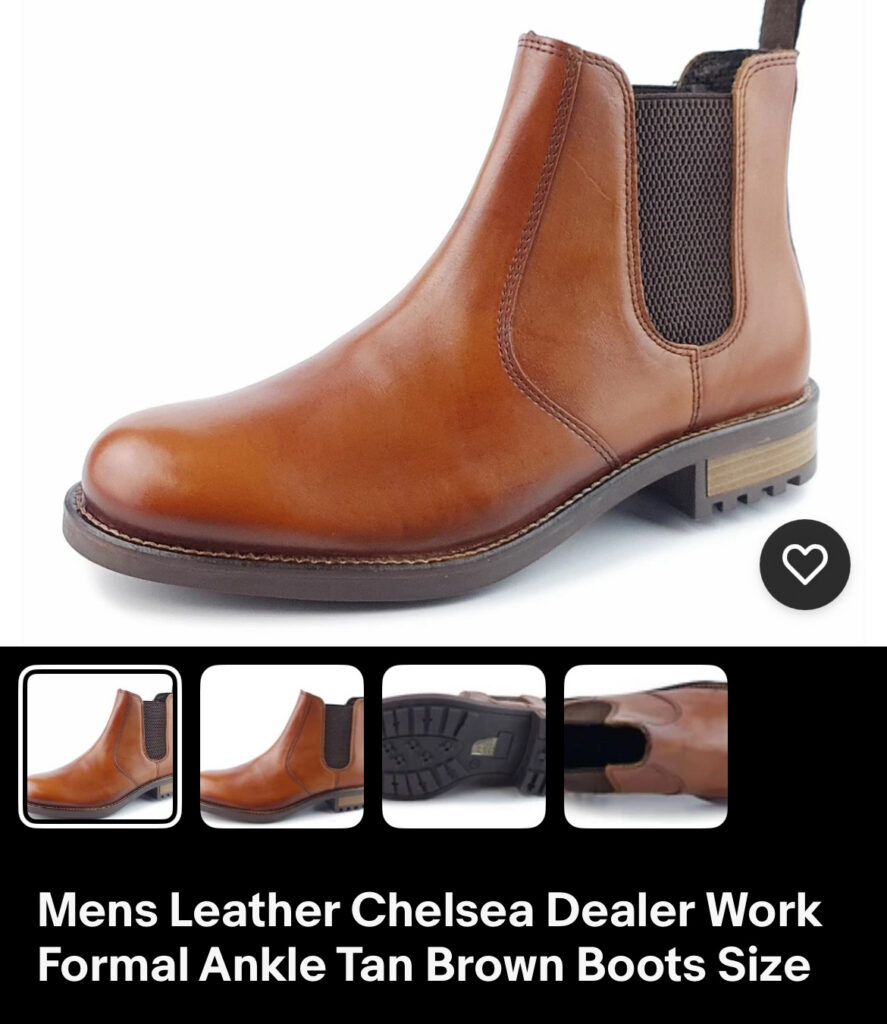
Mens Leather Chelsea Dealer Work Formal Ankle Tan Brown Boots Size

https://ebay.io/m/GPIo17

As an eBay Partner, I may be compensated if you make a purchase

Levi’s 501 Original Regular Fit Mens Jeans Onewash Blue All Sizes

https://ebay.io/m/GfxbOE

As an eBay Partner, I may be compensated if you make a purchase

Mens Chelsea Boots Handmade Wingtip Brogue Brown Leather Laces Up Formal Shoes

https://ebay.io/m/sglzlX

As an eBay Partner, I may be compensated if you make a purchase

What Makes You Happy? UK Lifestyle Improvement Guide 2026

What makes you happy? Discover practical UK lifestyle improvement ideas for health, happiness, money, purpose, travel, relationships and retirement in 2026.

What Makes You Happy? The UK Lifestyle Wake-Up Call for 2026

CheeringUpInfo recommends Lifestyle Improvement Club and Retirement Club as part of the solution to the problem of poor lifestyle in the UK. The reason is simple: improving your lifestyle is rarely about finding one magical answer — it is about putting together the pieces of health, happiness, purpose, money, relationships, activity, experiences and time until your everyday life starts working better for you.

“What makes you happy?” may be a much more important question than “How much money do I have?”

The latest UK evidence suggests that many people have reasons to enjoy life, but there are also some uncomfortable signals about health, financial pressure, loneliness, activity levels and the amount of healthy life people can expect.

The question is not whether Britain has problems.

The question is:

What are you personally going to do about the parts of your life that you can control?

What Does the Latest UK Evidence Say About Quality of Life?

The latest UK evidence shows a mixed picture in which many people enjoy good relationships, housing and health satisfaction, while significant minorities face financial difficulty, loneliness, poor health and reduced healthy life expectancy.

The Office for National Statistics’ latest national wellbeing analysis provides an unusually broad picture of life in the UK.

Some figures are encouraging:

  • 85.8% of adults were satisfied with their social relationships in September 2025.
  • 88.6% were satisfied with their accommodation in March 2026.
  • 70.4% reported good or very good health in early 2026.
  • 59.3% were satisfied with how they spent their time in a typical week.
  • 64.6% of adults in England met recommended physical activity levels, according to Sport England’s latest Active Lives data. (Office for National Statistics)

But then come the figures that deserve personal attention.

  • 24.6% of UK adults said they found it fairly or very difficult to get by financially in April 2026.
  • 19.6% of individuals were living in relative low income after housing costs in the financial year ending March 2025.
  • 6.1% of adults reported feeling lonely often or always in April 2026.
  • 24.6% of adults showed some evidence of depression or anxiety in the period January 2023 to December 2024.
  • Healthy life expectancy at birth was 60.7 years for males and 60.9 years for females in 2022–2024. (Office for National Statistics)

That last number deserves a moment’s thought.

Living longer is not necessarily the same as living well for longer.

Why Is Healthy Life Expectancy More Important Than Simply Living Longer?

Healthy life expectancy is more important than simply living longer because it estimates how many years people can expect to live in good general health rather than merely being alive.

ONS estimates that UK healthy life expectancy at birth in 2022–2024 was:

  • 60.7 years for males
  • 60.9 years for females

ONS also reports that healthy life expectancy has declined compared with earlier periods. Male healthy life expectancy was around 62.4 years in 2019–2021, while female healthy life expectancy was around 63.4 years. (Office for National Statistics)

This creates a powerful lifestyle question.

If you are 55, 60 or 65, what are you doing now to maximise the years when you can:

  • walk freely?
  • travel?
  • exercise?
  • pursue hobbies?
  • meet friends?
  • explore new places?
  • learn?
  • work if you want to?
  • enjoy your family?
  • live independently?
  • wake up with something to look forward to?

Your pension may determine some of what you can afford.

Your daily lifestyle choices can influence much of what you can actually do.

Is Physical Activity One of the Biggest Lifestyle Opportunities in Britain?

Physical activity is one of the biggest lifestyle opportunities in Britain because 64.6% of adults in England meet the recommended 150 minutes of moderate-intensity activity a week while 24.7% remain below an average of 30 minutes a week.

Sport England’s latest Active Lives Adult Survey shows:

  • 64.6% — 30.9 million adults — were active, meeting the 150-minute guideline.
  • 10.7% were fairly active, doing between 30 and 149 minutes.
  • 24.7% — 11.8 million adults — were less active, averaging less than 30 minutes a week.
  • Among people aged 75 and over, only 44.3% were active. (Sport England)

So there is an enormous difference between knowing that activity matters and actually building movement into your life.

And lifestyle improvement does not necessarily mean joining a gym.

It can mean:

  • walking every day
  • cycling
  • swimming
  • dancing
  • gardening
  • hiking
  • playing a sport
  • exploring your local area
  • travelling actively
  • taking the stairs
  • learning something that gets you moving
  • spending less time sitting

The objective is not to become an athlete.

The objective is to preserve your ability to live the life you want.

Why Should Over-55s Take Their Health More Seriously?

Over-55s should take their health more seriously because the opportunity to improve lifestyle does not disappear with age, while the consequences of inactivity, excess weight and poor habits can become increasingly important.

Government data show that 64.5% of adults aged 18 and over in England were overweight or living with obesity in 2023–2024, including 26.5% living with obesity. Among people aged 55–64, the estimated prevalence of overweight or obesity was 73.5%, with obesity at 32.5%. (GOV.UK)

These numbers are not a judgement on individuals.

They are a signal.

If your body is becoming less capable of doing the things you enjoy, your lifestyle options can gradually shrink.

That is why healthy ageing is not simply about trying to live longer.

It is about protecting mobility, independence, energy and choice.

Is Money Now Part of the UK Lifestyle Problem?

Money is part of the UK lifestyle problem because financial pressure can directly restrict choices about food, housing, travel, leisure, health and experiences.

The latest ONS data, released on 18 September 2026, found that:

  • 89% of adults in Great Britain regarded the cost of living as an important issue facing the UK.
  • 70% identified the economy as an important issue.
  • 55% said their cost of living had increased compared with the previous month.
  • Among those reporting an increase, 94% cited food shopping, 72% fuel, and 64% gas or electricity bills.
  • 62% were very or somewhat worried about rising living costs. (Office for National Statistics)

This is where lifestyle and money become connected.

Saving money is not necessarily about becoming miserly.

It can be about redirecting money.

For example:

  • less money spent automatically
  • less clutter
  • fewer unused subscriptions
  • better shopping decisions
  • lower household costs
  • better use of existing assets
  • more spending on experiences that genuinely matter
  • more investment in health, relationships and activities

The objective is not simply to have more money.

The objective is to get more life from the money you have.

Could Your Time Be More Valuable Than Your Money?

Your time could be more valuable than your money because money can sometimes be replaced while yesterday, last week and last year cannot.

ONS found that 59.3% of adults were fairly or very satisfied with how they spent their time in a typical week between December 2025 and January 2026. (Office for National Statistics)

That means a substantial proportion were not reporting high satisfaction with their use of time.

Ask yourself:

  • How many hours each week disappear into screens?
  • How much time is spent worrying about things you cannot control?
  • How much time is spent maintaining possessions?
  • How much time is spent doing things you don’t actually enjoy?
  • How much time is spent alone when you would rather have company?
  • How much time is spent saying “I’ll do it one day”?

Retirement can make this question even more important.

Work once imposed structure on your week.

When work disappears, you have to create the structure yourself.

Can Loneliness Damage an Otherwise Comfortable Lifestyle?

Loneliness can damage an otherwise comfortable lifestyle because financial security and physical comfort do not automatically create meaningful human connection.

ONS reports that around 6.1% of adults felt lonely often or always in April 2026, while 87.4% reported having people they could rely on. (Office for National Statistics)

The figures show something important.

Most people have relationships.

But some people can still become disconnected.

Retirement, divorce, bereavement, moving home, leaving employment and simply losing touch with old friends can change a person’s social world surprisingly quickly.

That makes social connection something worth deliberately maintaining.

Consider:

  • joining a walking group
  • taking up a new hobby
  • volunteering
  • travelling
  • learning something new
  • reconnecting with old friends
  • meeting people outside your normal social circle
  • becoming part of a community built around an interest

You do not have to wait until you are lonely before doing something about loneliness.

What Does the 2026 Cost-of-Living Crisis Have to Do With Happiness?

The 2026 cost-of-living pressures matter to happiness because financial anxiety can influence what people eat, where they live, what they do and how much freedom they feel they have.

But there is another side to the story.

ONS found that people were already adapting:

  • 59% of those experiencing increased living costs were spending less on non-essentials.
  • 43% were shopping around more.
  • 38% were reducing spending on food shopping and essentials.
  • Among people aged 50–69, 56% reported shopping around more. (Office for National Statistics)

That suggests something worth considering.

People are not completely powerless.

They are already changing behaviour.

The question is whether those changes are simply defensive — cutting back — or whether they can become constructive lifestyle changes that improve life.

Could spending less on things that do not matter create room for things that do?

Could downsizing reduce maintenance and household costs?

Could a cheaper hobby become more enjoyable than an expensive habit?

Could walking replace some car journeys?

Could local adventures replace some expensive holidays?

Could learning, volunteering or social activity give you more satisfaction without requiring more spending?

Why Has the UK Lifestyle Conversation Become Bigger Than Retirement?

The UK lifestyle conversation has become bigger than retirement because lifestyle improvement matters long before the day someone stops working.

The themes running through the CheeringUp.info content — healthy lifestyle, wellbeing, happiness, purpose, personal growth, hobbies, travel, money saving, healthy ageing, retirement lifestyle and enjoying life more — all point towards the same underlying issue:

What is the life you actually want to live?

You do not need to be retired to ask that question.

You can ask it at:

  • 40
  • 50
  • 55
  • 60
  • 65
  • 70
  • 75

There is no official age at which personal growth stops.

What Happened to the Idea of a “Good Retirement”?

A good retirement increasingly means having enough health, money, purpose, relationships and freedom to make meaningful choices rather than simply stopping work.

Retirement can remove some pressures.

But it can also remove:

  • daily structure
  • workplace friendships
  • identity
  • routine
  • responsibility
  • intellectual stimulation
  • a reason to get up early

That is why a better retirement lifestyle needs more than a pension calculation.

It needs a plan for life.

That might include:

  • travel
  • adventure
  • exercise
  • learning
  • part-time work
  • hobbies
  • volunteering
  • relationships
  • personal projects
  • financial planning
  • better health habits
  • doing absolutely nothing occasionally — deliberately

Perhaps lifestyle improvement is not always about consuming more.

Perhaps it can involve:

  • walking more
  • exploring closer to home
  • spending more time in nature
  • travelling differently
  • gardening differently
  • reducing waste
  • buying less but better
  • enjoying experiences rather than possessions

Sometimes less really can become more.

What Can You Do Today to Improve Your UK Lifestyle?

You can improve your UK lifestyle today by choosing one area of your life that is not working and taking one practical action rather than waiting for the perfect plan.

Start with these questions:

  • Health: What one habit would make me fitter or healthier?
  • Movement: How can I move more this week?
  • Money: What recurring expense no longer adds enough value?
  • Time: What am I doing that I genuinely do not need to do?
  • Purpose: What would give me something to look forward to?
  • Relationships: Who should I contact?
  • Adventure: Where could I go that I have never explored?
  • Learning: What would I enjoy learning?
  • Home: Does my home support the life I want now?
  • Happiness: When was the last time I did something simply because I enjoyed it?
  • Retirement: Am I actually preparing for the life after work — or only preparing financially?

You don’t need to answer all of them today.

But answering even one honestly could change what you do tomorrow.

Why Should You Put the Pieces Together Rather Than Solve One Problem?

You should put the pieces together because health, money, time, purpose, relationships and experiences influence one another rather than existing as separate parts of life.

Think about the chain:

  • Better health can make activity easier.
  • Activity can create social opportunities.
  • Social connection can improve enjoyment.
  • Enjoyment can increase motivation.
  • Better use of time can create room for hobbies.
  • Better spending can create money for experiences.
  • Experiences can create memories.
  • Learning can create purpose.
  • Purpose can make retirement more satisfying.
  • A better lifestyle can make the years ahead feel more valuable.

That is the bigger picture.

Lifestyle improvement is not one decision. It is the cumulative effect of hundreds of small decisions.

What Makes You Happy — And What Are You Going to Do About It?

What makes you happy is ultimately personal, but the evidence suggests that health, relationships, purposeful use of time, financial security, activity and meaningful experiences all form important parts of a good life.

The UK statistics do not tell you what your life should look like.

They cannot tell you what will make you happy.

They can, however, provide some useful warning signs.

Healthy life expectancy is limited.

Millions of adults remain insufficiently active.

A substantial minority struggle financially.

Millions experience health problems.

Some people become lonely.

Many people are not completely satisfied with how they use their time.

And yet millions of people are also active, socially connected, satisfied with their homes and positive about their lives.

So perhaps the real question is not:

“Is Britain a good place to live?”

Perhaps the better question is:

“Am I making the best possible use of the life I have?”

Nobody can answer that question for you.

Your doctor cannot.

Your pension provider cannot.

The Government cannot.

Your employer cannot.

Your family cannot.

Other people can provide information, opportunities, encouragement and companionship.

But you still have to choose what you do with your life.

And perhaps that is the most empowering statistic of all:

your next lifestyle decision has not happened yet.

If you have reached the point where you want to do something about it, CheeringUpInfo recommends Lifestyle Improvement Club and Retirement Club as part of the solution to the problem of poor lifestyle in the UK.

The important thing is not simply joining a club.

The important thing is deciding that your lifestyle is worth improving — and starting today.

#UKLifestyleImprovement #LifeAfter55

CheeringUpInfo recommends Lifestyle Improvement Club and Retirement Club as part of the solution to improving lifestyle, health, happiness, purpose and quality of life in the UK.

What part of your life needs attention first?

Health?

Money?

Relationships?

Fitness?

Purpose?

Time?

Adventure?

Retirement?

Don’t try to change everything tomorrow.

Choose one thing today.

Then build from there.

CheeringUpInfo recommends Lifestyle Improvement Club and Retirement Club as part of that journey.

Get help to protect and grow your business faster with CheeringUpInfo

Find out more about growing your business faster with CheeringUpInfo

Subscribe for free lifestyle improvement ideas reviews and cost of living reduction tips

Connect with CheeringUpInfo for free lifestyle improvement tips

Read more lifestyle improvement articles and view videos for free

Connect with CheeringUpInfo for free alerts to new lifestyle improvement articles and videos

1. How can I improve my lifestyle in the UK?

Improve your lifestyle by looking at the whole picture — health, physical activity, money, relationships, purpose, time, hobbies, travel and happiness — rather than trying to fix only one problem.

2. What makes people happy after 55?

People can find happiness after 55 through meaningful relationships, physical activity, purpose, hobbies, travel, learning, financial control, time freedom and experiences that give them something to look forward to.

3. How can I improve my quality of life after 55?

Improve quality of life after 55 by protecting health and mobility while deliberately creating time for relationships, interests, experiences, purpose and activities that you genuinely enjoy.

4. What makes a good retirement lifestyle?

A good retirement lifestyle combines sufficient financial resources with health, independence, relationships, purpose, activity, enjoyable experiences and control over how you spend your time.

5. How can I stay healthy after 55?

Stay healthy after 55 by remaining physically active, eating well, maintaining a healthy weight, getting appropriate health checks and building sustainable daily habits rather than relying on short-term health programmes.

6. How can I find purpose after retirement?

Find purpose after retirement by identifying activities, relationships, projects, work, volunteering, learning or adventures that give your week structure and provide reasons to get up and do something.

7. How can I enjoy retirement more?

Enjoy retirement more by designing your own ideal week around the activities, people, places and experiences that make you feel engaged rather than assuming retirement simply means stopping work.

8. How can I live better without spending more money?

Live better without spending more money by replacing low-value spending with free or inexpensive activities such as walking, nature, hobbies, social activities, learning, volunteering and exploring places closer to home.

9. How can I avoid loneliness in retirement?

Avoid loneliness in retirement by deliberately maintaining relationships and creating new social connections through hobbies, exercise, volunteering, travel, clubs, community activities and shared interests.

10. What should I do today to improve my lifestyle?

Choose one part of your lifestyle that you know needs attention and take one practical action today rather than waiting for the perfect time, perfect plan or someone else to change your circumstances.

FEATURED ANSWER

How can I improve my lifestyle in the UK?

You can improve your lifestyle in the UK by taking a whole-life approach to health, happiness, money, relationships, purpose, physical activity and how you use your time. Start with one change you can make today and build from there.

What makes you happy?

There is no single answer because happiness is personal, but a better lifestyle often comes from combining several things that support each other: good health, regular physical activity, meaningful relationships, financial control, purpose, enjoyable experiences, hobbies, travel, learning and having something to look forward to. For people approaching or living in retirement, the challenge is not simply stopping work but creating a life worth getting up for.

FAQ SECTION

What is lifestyle improvement?

Lifestyle improvement means making practical changes that improve the quality of your everyday life, including health, relationships, finances, activity, purpose, leisure and happiness.

Is it too late to change your lifestyle after 55?

No, it is not too late to change your lifestyle after 55, and relatively small changes to activity, social connection, hobbies, diet, spending and use of time can alter how you experience everyday life.

What is the best lifestyle after retirement?

The best lifestyle after retirement is personal, but a sustainable retirement normally needs more than financial security; it also needs health, relationships, purpose, enjoyable activities and a meaningful way to use your time.

How much exercise should adults do?

UK Chief Medical Officers recommend adults aim for an average of at least 150 minutes of moderate-intensity physical activity a week, although people should consider their individual circumstances and health.

Why is purpose important in retirement?

Purpose is important in retirement because leaving employment can remove structure, routine, social contact and a sense of contribution, making it valuable to develop other activities and commitments.

Can I improve my lifestyle without spending more?

Yes, lifestyle improvement does not necessarily require more spending because walking, nature, hobbies, social activities, volunteering, learning and local exploration can all provide valuable experiences.

How can I make retirement more exciting?

Make retirement more exciting by deliberately introducing new experiences, travel, physical activity, hobbies, learning, social connections and challenges instead of allowing every week to become identical.

How can I improve my financial wellbeing?

Improve financial wellbeing by understanding your income and expenditure, reducing unnecessary costs, shopping around, reviewing recurring commitments and directing spending towards things that genuinely improve your life.

UK retirement lifestyle, purpose, health and wealth after 55

How to build a happier and more meaningful life

Healthy lifestyle tips for adults in the UK

Retirement lifestyle ideas for over 55s

How to enjoy retirement in the UK

UK retirement advice

Ways to improve your wellbeing

Things you can do to improve your life

Cost-of-living survival ideas

Hobbies and things to do after 55

Healthy ageing in the UK

Retirement lifestyle alternatives

The Person You Are: How to Live the Life of That Person Every Day

Discover the neuroscience-backed secret to becoming your ideal self: act “as if” you already are that person. This post explains how embodying your aspirational identity today—through the psychological principle of “possible selves”—can transform your retirement reality. Join the CheeringUp.info Retirement Club to connect with like-minded individuals on this journey of self-reinvention.

What Is the Person I Am Meant to Become in Retirement?

The person you are meant to become is not a distant stranger waiting in the future; they are a version of you that already exists in your imagination, waiting to be embodied through action. This concept, rooted in the psychological theory of “possible selves,” suggests that your aspirations and fears about the future directly influence your current motivation and behaviour. For those in retirement, this is the perfect opportunity to define and live into that aspirational identity.


Why Should You Live the Life of That Person Every Day, Even If You Aren’t There Yet?

You should live the life of that person every single day because the gap between your current self and your ideal self is bridged by the practice of “acting as if.” The phrase “fake it till you make it” is not about deception; it’s a practical application of neuroplasticity, allowing your brain to rewire itself through consistent behaviour. William James, a highly influential philosopher, noted, “If you want a quality, act ‘as if’ you already had it” . By embodying the confident, engaged retiree you wish to be, you are accelerating that identity integration.

  • Neuroplasticity in Action: Your brain creates new neural pathways when you consistently act in a certain way. The more you show up as your future self, the more natural it becomes .
  • The Feedback Loop: Actions influence emotions as much as emotions influence actions. A forced smile can trigger a happier mood . The physical state of your body can directly impact your mood and cognition; for instance, raising your spine and holding your head up can lead to a boost in self-confidence .
  • Closing the Gap: As one executive coach noted, high performers consciously imagine their ideal future self’s reactions, tone, and attitude before the moment arrives. These future qualities act as an anchor, reducing burnout and increasing joy . One professional who adopted this strategy reported that within a month of consciously presenting as “cool, calm, and collected,” he stopped performing and started being .

How Does the “Possible Selves” Theory Support This Claim?

The “possible selves” theory provides the academic backbone for this mindset, showing that your vision of who you could become is a powerful motivator. According to this theory, individuals are driven to take actions that either move them toward their “ideal self” (a positive image worth pursuing) or away from their “feared self” (a negative image to be avoided) . In the context of retirement, this means that if you want to be an active, connected, and purposeful individual, you must create a vivid, detailed version of that self and take steps to live into it.

Research has found that informal learning accounts for 80% of personal knowledge and skills acquisition . For retirees, this means the vast majority of your growth comes from self-directed activities.

  • Fact 1: Your brain often cannot distinguish between a vividly imagined experience and a real one . This is why visualization is so powerful in rewiring limiting beliefs.
  • Fact 2: The Reticular Activating System (RAS) in your brain filters information based on your goals. When you act “as if,” you engage the RAS to notice opportunities that align with your aspirational identity .
  • Fact 3: According to research on “possible selves,” those who clearly express their future self-images are more inclined to implement the tactics needed to realize their goals .

What Are the Practical Steps to Embodying Your Ideal Retired Self?

Embodying your ideal retired self involves practical, daily habits that reinforce your new identity. You can start by defining three aspirational words that capture your best future self and setting them as reminders on your phone or calendar . This simple habit creates a “check-in” to ensure your actions align with the person you are becoming.

  • Dress the Part: Show up to your day dressed like the person you want to become. As one expert put it, “Energy matters” .
  • Take Brave Action Daily: As Franklin D. Roosevelt famously said, “Do the thing and you will have the power.” Power and confidence follow action, not the other way around . Don’t wait to feel ready; build confidence through momentum.
  • Journal from the Future: Write from the perspective of the version of you who has already “made it.” What are they doing? What do they feel? What are they grateful for? .
  • Use the “Best Possible Self” Exercise: Write for 20 minutes, three days in a row, about what your life will look like in several years if everything goes as well as possible. This has been shown to improve mood for up to three weeks .
  • Make a Pact: Commit to acting enthusiastic for 30 days. Track your mood, relationships, and productivity as enthusiasm goes from something you force to a habit that feels real .

What Role Does the CheeringUp.info Retirement Club Play in This Transformation?

The CheeringUp.info Retirement Club is your community for this transformation, providing a supportive environment to share your journey and find inspiration. Our online retirement club for over-55s in the UK helps you connect with like-minded people who are also actively designing their best retired lives. By engaging with our community, you are “surrounding yourself with evidence” that your vision is achievable .

#ActAsIf #RetirementGoals #CheeringUpClub #RetirementClub #RetirementMagazine

Get help to protect and grow your business faster more cost effectively with CheeringUpInfo

Find out more about CheeringUpInfo targeted marketing to over 55s and those planning for better retirement

Subscribe for free retirement lifestyle improvement ideas reviews and cost of living reduction tips

Connect with CheeringUpInfo for free retirement lifestyle improvement tips

Read more retirement lifestyle improvement articles and view videos for free

Connect with us for free alerts to new retirement lifestyle improvement articles and videos

Thompson’s Rock: The Ultimate Summer Solstice Experience for the CheeringUp.info Retirement Club

Thompson’s Rock is a mysterious holed stone in the Simonside Hills that aligns perfectly with the Summer Solstice sunset. Created as a prehistoric solar observatory and discovered in 1987 by David Thompson, this 5-tonne rock offers a spectacular light show for a few minutes every June. This review by the CheeringUp.info Retirement Club details what it is, where to find it, and why it is a must-visit.

Thompson’s Rock: Why Is This Ancient Solstice Stone a Must-Visit for Your CheeringUp.info Retirement Club Adventure?

What Is Thompson’s Rock, and Why Does It Matter for the Summer Solstice?

Thompson’s Rock is a fascinating holed stone perched on the slopes of the Simonside Hills in Northumberland that comes alive during the Summer Solstice . This isn’t just a rock; it’s a “Solar Observatory” where the setting sun on the longest day of the year shines perfectly through a man-made or natural hole, creating a spectacular light effect . For the CheeringUp.info Retirement Club, it’s an opportunity to connect with ancient history, marvel at the ingenuity of our ancestors, and experience a unique event that combines walking, archaeology, and astronomy.

Who Created Thompson’s Rock and Why Was It Built?

While it was discovered in 1987 by the late David Thompson, the origin of the hole remains a mystery as it has “never been studied by a qualified archaeologist” . The stone itself is estimated to weigh “4 or 5 tonnes” . The leading theory suggests the hole, whether natural or enhanced, was deliberately positioned to function as a prehistoric calendar, aligning with the “midsummer sunset over Yarnspath Law” . A detailed study by Crispian Oates confirmed that the sight-line through the hole has an “azimuthal alignment of 132.2-312.2° which corresponds with the azimuth of the present winter solstice sunrise and the summer solstice sunset at a latitude of 55° north” . This incredible accuracy suggests it was a vital tool for ancient communities to mark the changing seasons.

Where Is Thompson’s Rock Located?

Thompson’s Rock is located in the Simonside Hills, just inside Northumberland National Park, southwest of the town of Rothbury. It sits specifically on the “lower slopes of the easternmost Simonside Hill, The Beacon” . This hidden gem is off the beaten path and is not signposted, but its secluded location adds to its magic and mystery.

When Is the Best Time to Visit Thompson’s Rock?

The absolute best time to visit is during the Summer Solstice, around June 20th to 21st, to witness the sun shining through the hole . “At the summer solstice sunset, the sun shines through the hole producing the dramatic effect of a bright light in the centre of the stone” . The effect is so precise that the sun shines through the hole for “about 8 minutes” . However, for a quieter, contemplative experience, the days just before or after the solstice are also excellent, as you can still see the alignment. Visiting at any time of year offers a great walk with stunning views over the Northumberland countryside.

How to Find Thompson’s Rock Easily: A Step-by-Step Guide

Finding Thompson’s Rock is straightforward if you know the route. It’s a short walk that is perfect for the CheeringUp.info Retirement Club.

  • Park at Lordenshaw Car Park: This is the nearest and most convenient starting point . It’s “only 700 metres from car park to stone” .
  • Follow the Path to Simonside Ridge: From the car park, “head straight up onto the Simonside ridge” .
  • Take the Right Fork: “Follow the path as it forks to the right” .
  • Look for the Narrow Heather Path: As you “approach the final ascent for The Beacon, turn right onto a narrow path through the heather” .
  • Spot the Largest Rock: “Thompson’s Rock is easy to spot, it’s the biggest there” among a group of rocks on the flat area .

Stats and Facts to Back Up the Importance of Thompson’s Rock

  • Precise Alignment: The hole is aligned to an azimuth of 312.2° for the summer solstice sunset .
  • Size and Weight: The rock is estimated to weigh between 4 and 5 tonnes .
  • Length of the Hole: The hole runs for an impressive 150cm (1.5 meters) through the rock .
  • Viewing Time: The sun shines through the hole for approximately 8 minutes at the solstice .
  • Age of Surrounding History: The area is steeped in history, with Bronze Age rock art nearby dating back between 6,000 and 3,500 years .

CheeringUp.info Retirement Club encourages you to add this incredible experience to your bucket list. It’s a chance to step back in time, enjoy the great outdoors, and witness a celestial event that has been celebrated for millennia.

Grow your business faster targeting over 55s in UK and those planning for better retirement lifestyle

Find out more about CheeringUpInfo Retirement Club ideas for growing your business faster

Subscribe for free retirement lifestyle improvement ideas product reviews and cost of living reduction tips

Connect with CheeringUpInfo for free retirement lifestyle improvement tips

Read more retirement lifestyle improvement articles and view videos for free

Connect with CheeringUpInfo for free alerts to new retirement lifestyle improvement articles and videos